POP MART(09992)

Search documents
荣耀联姻泡泡玛特:一部潮玩手机背后的商业突围战
Xin Lang Cai Jing· 2026-01-16 07:31
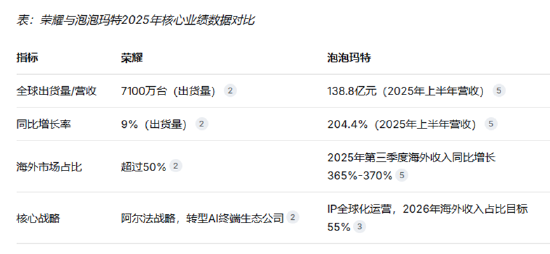
Core Insights - Honor will launch the industry's first trendy toy smartphone in collaboration with Pop Mart on January 19, 2026, reflecting both companies' ambitions for differentiation and new commercial strategies [1][9] - The global smartphone market has seen a decline in shipment volumes for several consecutive quarters, making collaborative partnerships a strategic choice rather than just a marketing gimmick [10][12] Group 1: Market Context - In Q3 2025, China's smartphone market shipped approximately 68.4 million units, a slight year-on-year decrease of 0.5%, with Honor and OPPO tied for fifth place with 9.9 million units each [12] - The smartphone industry's cost structure is rising, putting significant operational pressure on global manufacturers, while high-end market consumers remain less price-sensitive if products demonstrate sufficient technological innovation [12] - Honor's collaboration with Pop Mart aims to achieve product differentiation through trendy toy IPs, breaking through the homogenization of competition [12] Group 2: Company Performance - Honor's global shipment volume reached 71 million units in 2025, with a 9% year-on-year increase, and overseas sales grew by 47%, marking the first time overseas sales accounted for over half of total sales [10][13] - Pop Mart reported a revenue of 13.88 billion yuan in the first half of 2025, a year-on-year increase of 204.4%, with significant growth in both domestic and overseas markets [10][13] Group 3: IP Value and Business Logic - Pop Mart's IP empire is expanding rapidly, with the LABUBU series generating 4.81 billion yuan in revenue in the first half of 2025, a staggering year-on-year growth of 668% [14][16] - The collaboration with Honor allows Pop Mart to extend its IP value into the 3C digital field, reaching a broader audience beyond its core fan base [14] - Analysts categorize IP collaborations into lightweight partnerships focusing on branding and deep customizations that integrate IP culture throughout the product lifecycle [14][15] Group 4: Future Outlook - The collaboration between Honor and Pop Mart has the potential to create genuine value integration, moving beyond superficial marketing tactics [17] - Pop Mart's global strategy aims for overseas revenue to account for 55% by 2026, with significant growth in international markets already observed [17][18] - Recent trends in Pop Mart's blind box business show a divergence between online sales and secondary market performance, indicating a more rational development phase in the trendy toy market [18]

港股异动|泡泡玛特一度跌近7% 股价自2025年高位已回落近50%
Xin Lang Cai Jing· 2026-01-16 03:48
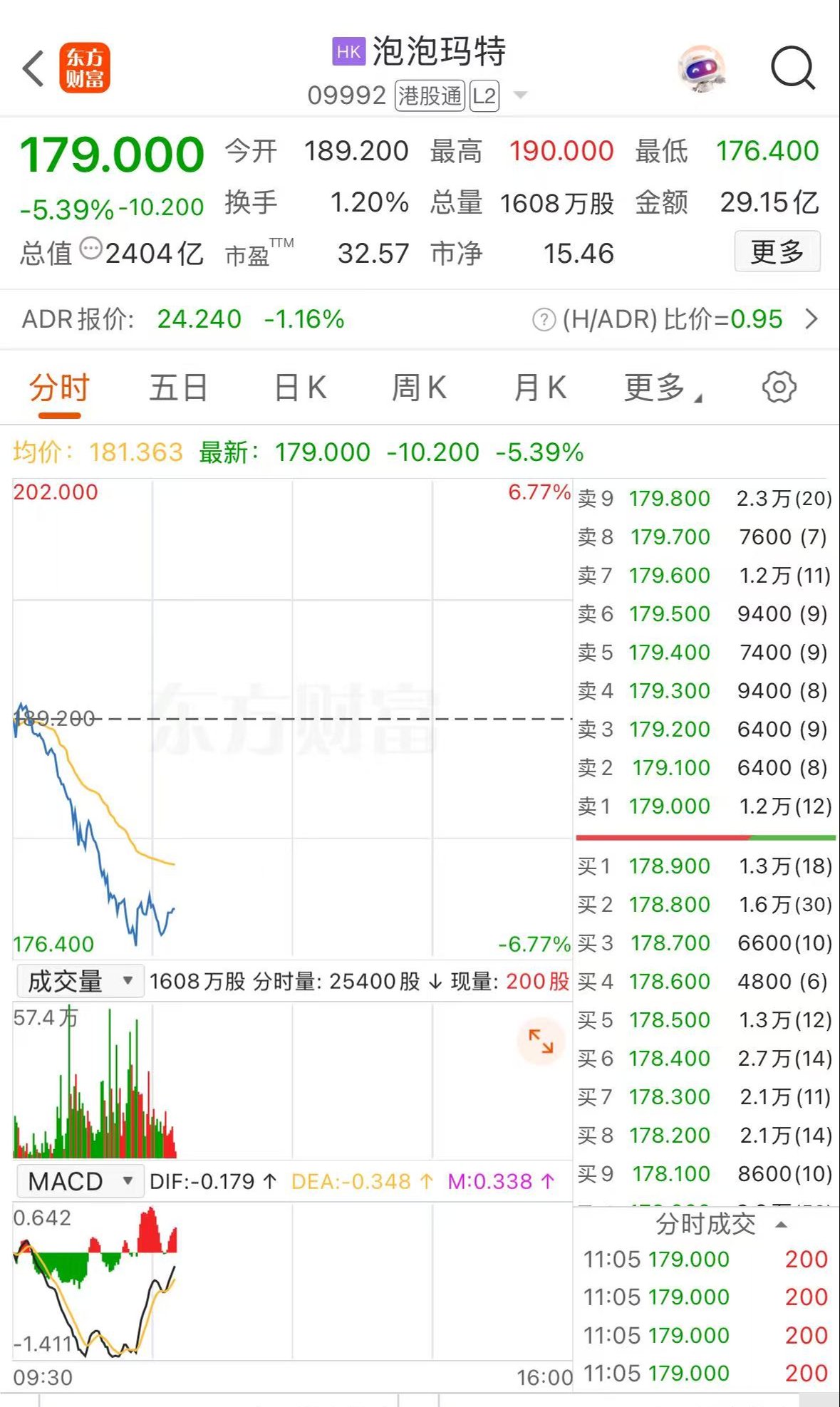
Core Viewpoint - The stock price of Pop Mart has experienced a significant decline, dropping nearly 47% from its peak of 339.80 HKD in August 2025 to 179 HKD as of January 16, 2023, indicating a transition from explosive growth to sustainable growth according to Morgan Stanley's report [3][7]. Group 1: Stock Performance - On January 16, 2023, Pop Mart's stock initially fell nearly 7%, later narrowing the decline to 5.39%, closing at 179 HKD per share [1][4]. - The stock opened at 189.20 HKD, reached a high of 190.00 HKD, and a low of 176.40 HKD during the trading session [2][5]. - The total trading volume was 16.08 million shares, with a total market value of 240.4 billion HKD and a price-to-earnings ratio of 32.57 [2][5]. Group 2: Future Growth Outlook - Morgan Stanley's report suggests that Pop Mart is transitioning from a phase of explosive growth over the past two years to a phase of sustainable growth [7]. - The report predicts a significant slowdown in revenue growth for Pop Mart's Labubu brand by 2026, with the growth engine shifting from a single blockbuster to a diversified approach driven by non-Labubu IP [7].
这年头,情绪竟成“大买卖”
Jin Rong Shi Bao· 2026-01-16 03:36
Core Insights - The rise of "emotional consumption" among the younger generation is driven by the need for emotional healing and stress relief, with a significant market potential projected to grow from 16.3 trillion yuan in 2022 to 23.1 trillion yuan in 2024, and expected to reach 27.2 trillion yuan by 2025 and exceed 45 trillion yuan by 2029 [1][2] Group 1: Emotional Consumption Trends - Emotional consumption is characterized by young consumers seeking products and services that provide immediate emotional satisfaction and companionship, such as blind boxes, emotional toys, and creative cultural products [1][3] - Over 90% of young people recognize the value of emotional consumption, with nearly 60% willing to pay for it, indicating a strong market demand [2][7] - The emotional consumption market is evolving, with physical products and experiential services becoming mainstream, as over 50% of respondents spend between 100-300 yuan monthly on physical goods [7][9] Group 2: Psychological Drivers - The core motivation for the rise in emotional consumption among youth is linked to the need for emotional management and the fulfillment of psychological needs in a high-pressure environment [3][9] - Traditional emotional support systems have weakened, leading young people to seek external products and services for emotional compensation [3][9] - The demand for emotional products is not just about material satisfaction but also about emotional expression, identity construction, and social connection [7][9] Group 3: Market Opportunities - The growth of digital and virtual emotional consumption is notable, with AI-driven products and services gaining traction, such as virtual gifts and emotional chatbots [8][9] - The market for AI toys is projected to see a significant increase, with sales expected to rise by 394.9% in 2025, highlighting the shift towards emotional companionship through technology [9][10] - Companies are encouraged to explore untapped emotional needs and expand consumption scenarios across various sectors, including health, education, and workplace environments [10]
智通港股通资金流向统计(T+2)|1月16日
智通财经网· 2026-01-15 23:34
Group 1 - The top three companies with net inflows of southbound funds are Alibaba-W (09988) with 1.05 billion, Tencent Holdings (00700) with 752 million, and Pop Mart (09992) with 678 million [1] - The top three companies with net outflows of southbound funds are SMIC (00981) with -836 million, China Mobile (00941) with -729 million, and Meituan-W (03690) with -378 million [1] - In terms of net inflow ratios, Jiangsu Ninghu Expressway (00177) leads with 53.75%, followed by Cheung Kong Infrastructure Group (01038) at 52.00%, and Mao Geping (01318) at 48.07% [1] Group 2 - The top ten companies by net inflow include Alibaba-W (09988) with 1.05 billion and a closing price of 159.90 (+3.63%), Tencent Holdings (00700) with 752 million and a closing price of 627.50 (+0.72%), and Pop Mart (09992) with 678 million and a closing price of 191.30 (-2.89%) [2] - The top ten companies by net outflow include SMIC (00981) with -836 million and a closing price of 74.45 (-1.13%), China Mobile (00941) with -729 million and a closing price of 80.95 (-0.25%), and Meituan-W (03690) with -378 million and a closing price of 104.90 (-0.10%) [2] - The top three companies by net inflow ratio also include Baiaosaitu-B (02315) at 46.69% and Wei Long Delicious (09985) at 45.51% [3] Group 3 - The top three companies by net outflow ratio include Southern Hong Kong Stock Connect (03432) at -100.00%, E Fund Hang Seng ESG (03039) at -93.75%, and Country Garden Services (06098) at -58.59% [3] - The data reflects the net inflow and outflow trends in the Hong Kong stock market, indicating investor sentiment towards specific companies [1][2][3]





穿透消费分化迷雾:CBI品牌榜中的“真增长”挖掘
Ge Long Hui· 2026-01-15 11:25
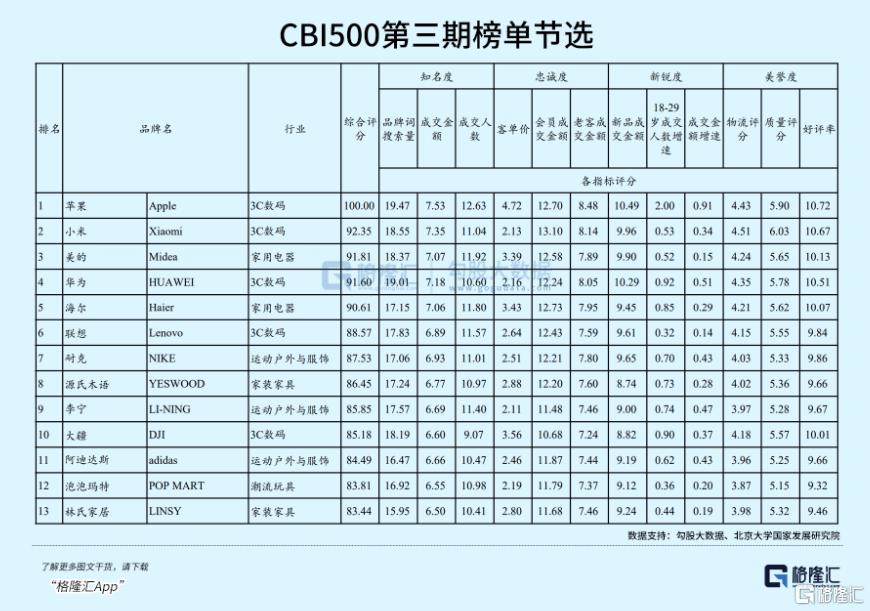
Group 1 - The Chinese consumer market has shown a steady recovery since 2025, with a year-on-year growth of 6.8% in retail sales of consumer goods in the first three quarters, contributing 53.5% to economic growth [1] - The recovery trend in the consumer sector is not uniform, with traditional brands struggling due to lack of innovation, while new brands are breaking through with technological advancements and innovative models [1] - The need for a quantitative evaluation tool to identify structural opportunities in the market has led to the development of the "China Online Consumption Brand Index (CBI)" and the "Global Brand China Online Top 500 List (CBI500)" by Peking University [2] Group 2 - The CBI500 list is based on real consumer data from Taobao and Tmall, utilizing a comprehensive brand quality indicator that includes new product capability, user reviews, and search popularity [2][5] - The top five brands in the CBI500 list—Apple, Xiaomi, Midea, Huawei, and Haier—demonstrate a "stronger gets stronger" logic, maintaining competitive advantages through balanced performance across various dimensions [6][8] - DJI has achieved significant growth, moving from a score of 78.53 to 85.18, entering the top ten for the first time, driven by continuous technological innovation and market expansion [9][12] Group 3 - Pop Mart has shown strong resilience in the collectible toy sector, climbing from 31st to 12th place in the CBI500 list, with leading scores in loyalty and customer spending [14][17] - The growth logic of Pop Mart is based on deep insights into emotional consumption needs, utilizing an IP matrix and a robust membership system to create a strong emotional connection with consumers [17] - The differentiation in the consumer market has created opportunities for brands that adapt to trends, as seen with Fenjiu's rise in rankings due to its "youthful" strategy targeting younger consumers [22][23] Group 4 - The CBI list serves as a data-driven tool for observing the consumer market, helping investors identify brands that capture product innovation opportunities and possess anti-cyclical potential [27][29] - The evaluation logic of the CBI list helps to avoid misleading short-term sales data, focusing instead on loyalty and reputation metrics to identify brands that achieve sustainable growth [27][29] - The current economic recovery phase presents a critical window for brand restructuring and value selection, emphasizing the importance of understanding consumer behavior changes [26][29]




穿透消费分化迷雾:CBI品牌榜中的“真增长”挖掘
格隆汇APP· 2026-01-15 11:15
Core Insights - The article highlights the steady recovery of China's consumer market since 2025, with a year-on-year growth of 6.8% in retail sales of consumer goods in the first three quarters, contributing 53.5% to economic growth [2] - However, the consumer sector faces challenges with increasing internal differentiation, where traditional brands struggle due to lack of innovation while new brands succeed through technological breakthroughs and innovative models [2][3] Group 1: Consumer Brand Landscape - The CBI500 ranking reflects a stable top tier of brands, emphasizing the "stronger get stronger" logic in the consumer market [7] - Leading brands like Apple, Xiaomi, Midea, Huawei, and Haier maintain competitive barriers through balanced performance across four dimensions: brand awareness, innovation, loyalty, and reputation [8][10] - DJI and Pop Mart have shown significant growth, with DJI entering the top ten for the first time, driven by continuous technological innovation and market expansion [11][16] Group 2: Brand Performance and Growth Strategies - DJI's growth is attributed to its focus on technology innovation and creating benchmark products, leading to a 66% market share in the global action camera market as of Q3 2025 [11][14] - Pop Mart's rise in the rankings is due to its strong loyalty metrics and effective IP matrix operation, which resonates with emotional consumer needs [19][20] - The brand's strategy includes a robust membership system that enhances customer loyalty through emotional engagement [19] Group 3: Market Differentiation and Opportunities - The differentiation in the consumer market presents challenges for traditional brands while creating opportunities for those that adapt to trends [21][22] - Brands like Fenjiu have successfully capitalized on changing consumer preferences, with a notable increase in their ranking due to a focus on younger consumers [26] - The article emphasizes the importance of aligning with policy support and consumer trends to identify quality brands that can thrive in a competitive landscape [27][28] Group 4: CBI Index and Its Value - The CBI index serves as a data-driven tool for observing the consumer market, helping investors identify brands that capture product innovation opportunities and possess resilience against economic cycles [30][31] - The index's multidimensional evaluation framework allows for a deeper understanding of consumer demand and brand performance, aiding in long-term investment decisions [32]

港股消费(159735)已连续5日获得资金净申购,区间净流入额6982.19万元
Xin Lang Cai Jing· 2026-01-15 02:27
Core Viewpoint - The Hong Kong Consumption ETF (159735) has seen significant net inflows, indicating growing investor interest in the fund and the underlying consumer sector in Hong Kong [1][2]. Group 1: Fund Performance - As of January 14, the Hong Kong Consumption ETF (159735) recorded a net subscription of 4.8298 million yuan, ranking 27th out of 208 in cross-border ETF net inflows for the day [1]. - The fund's latest size is 814 million yuan, up from 802 million yuan the previous day, reflecting a 0.60% increase in net inflow relative to the previous day's size [1]. - Over the past five days, the fund has accumulated a net subscription of 69.8219 million yuan, ranking 28th out of 208 in cross-border ETF net inflows [1][2]. Group 2: Fund Details - The Hong Kong Consumption ETF (159735) was established on May 25, 2021, with an annual management fee of 0.50% and a custody fee of 0.10% [2]. - The fund's latest share count is 1.007 billion shares, with a year-to-date increase of 9.46% in shares and a 12.08% increase in size compared to December 31, 2025 [2]. - The fund has a total trading volume of 922 million yuan over the last 20 trading days, averaging 46.0913 million yuan per day [2]. Group 3: Holdings and Composition - Major holdings in the Hong Kong Consumption ETF include Alibaba (19.54%), Tencent (16.59%), and Pop Mart (7.99%), among others, with the total market value of these holdings detailed [3]. - The ETF tracks the Hong Kong Consumption CNY index (931455), and its performance is compared with another fund, Hong Kong Consumption (513590), which has a smaller size and negative net subscriptions [3].

泡泡玛特在杭州新设文化创意公司
Zheng Quan Shi Bao Wang· 2026-01-15 02:00
人民财讯1月15日电,企查查APP显示,近日,杭州葩趣文化创意有限公司成立,法定代表人为代雨 茹,经营范围含互联网销售、个人商务服务、电子产品销售、机械设备租赁等。企查查股权穿透显示, 该公司由北京泡泡玛特文化创意有限公司间接全资持股。 ...
北京日报社区小板报 | 泡泡玛特画廊首展,今起开放!
Xin Lang Cai Jing· 2026-01-15 00:54
Group 1 - The new National Museum of Nature is expected to begin trial operations in October 2029, contributing to the cultural, industrial, and ecological development of the South Central Axis in Beijing [1] - The first batch of 12 new cinema spaces in Beijing has been officially launched, integrating immersive technology experiences, local cultural displays, and diverse performance activities, creating a "movie+" consumption model [3] - The East District will initiate a three-year action plan to enhance the environmental quality around the Temple of Heaven, improving traffic, facilities, and landscape to showcase the city's cultural heritage [3] Group 2 - The Pop Mart Gallery in Beijing's 798 Art District has opened to the public, featuring an exhibition on the popular IP character Zsiga, showcasing its creative process from sketches to final products [6] - Beijing has established 155 regional elderly care service centers, expanding services to improve the quality of life for senior citizens [8] - The "Snow Gear Convenience Service" on the Beijing-Zhangjiakou high-speed railway will be expanded, allowing passengers to carry ski equipment on designated trains [10] Group 3 - The Daxing Airport bus service has added a new line to Beijing Fengtai Station and enhanced connections to Beijing Tongzhou Station, improving transportation options for travelers [10] - Beijing's "One Bed, One Room" model aims to improve living conditions for urban service personnel and new citizens, with plans to increase affordable rental housing supply [12] - The Haidian District has introduced extended evening services for processing exit and entry documents to accommodate increased demand during the holiday season [12] Group 4 - A smart fire prevention system has been implemented in the Andingmen area, successfully resolving 11 emergency situations since its installation [13] - The National Medical Insurance Bureau has reported that 105 new drugs have been added to the national medical insurance directory, available in over 11,000 designated medical institutions [12]

智通港股沽空统计|1月15日
智通财经网· 2026-01-15 00:24
Group 1 - The core point of the news highlights the top short-selling ratios and amounts for various companies, indicating significant market sentiment towards these stocks [1][2]. - AIA Group Limited (友邦保险-R) and Anta Sports Products Limited (安踏体育-R) both have a short-selling ratio of 100.00%, indicating a high level of bearish sentiment [1][2]. - The top three companies by short-selling amount are Alibaba Group Holding Limited (阿里巴巴-W) with 4.031 billion, Tencent Holdings Limited (腾讯控股) with 2.553 billion, and Alibaba Health Information Technology Limited (阿里健康) with 1.776 billion [1][2]. Group 2 - The top short-selling ratio rankings show that AIA Group Limited (友邦保险-R) leads with a short-selling amount of 1.9534 million and a ratio of 100.00% [2]. - JD.com, Inc. (京东集团-SWR) has a short-selling ratio of 99.19% with a short-selling amount of 0.6316 million, indicating strong market pressure [2]. - The deviation values indicate that JD.com (京东集团-SWR) has the highest deviation at 44.47%, suggesting significant divergence from its historical short-selling average [2].