Hisense V.T.(600060)

Search documents
德州兴河湾社区掀起焕新热潮 山东以旧换新活动家门口惠民
Sou Hu Cai Jing· 2025-11-03 15:16
Group 1 - The event "Purchase in China 2025 Shandong Consumer Goods Exchange" was held in the Xinghewan community of Dezhou, focusing on "convenient renewal and quality consumption" [1][5] - The event sparked a "renewal consumption boom" in the community, attracting significant participation and interest from residents [1][5] - The initiative aims to promote green consumption and quality consumption concepts among the community [5][6] Group 2 - The "Quality Renewal Alliance" was established, led by Moonstar Home, integrating resources from major home appliance brands such as Haier, Midea, and Hisense [3][6] - The alliance offers a one-stop solution for residents to exchange old products for new ones, covering a wide range of categories including refrigerators, air conditioners, and washing machines [3][6] - The event provided tangible consumer benefits, with residents expressing satisfaction over the convenience and subsidies available for exchanging old appliances [5]





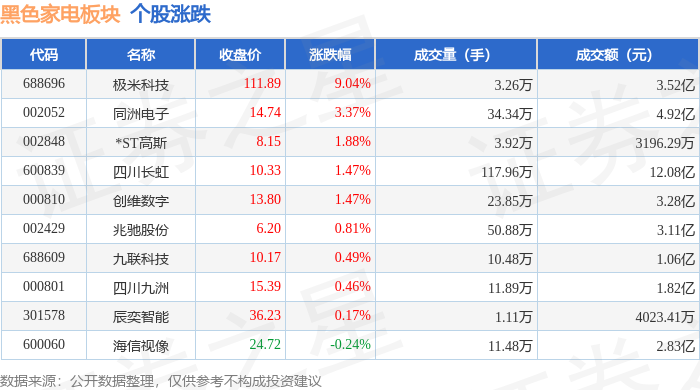
黑色家电板块11月3日涨1.34%,极米科技领涨,主力资金净流入5275.35万元
Zheng Xing Xing Ye Ri Bao· 2025-11-03 08:47
Core Insights - The black home appliance sector experienced a 1.34% increase on November 3, with XGIMI Technology leading the gains [1] - The Shanghai Composite Index closed at 3976.52, up 0.55%, while the Shenzhen Component Index closed at 13404.06, up 0.19% [1] Stock Performance - XGIMI Technology (688696) closed at 111.89, up 9.04% with a trading volume of 32,600 lots and a transaction value of 352 million [1] - Tongzhou Electronics (002052) rose by 3.37% to 14.74, with a trading volume of 343,400 lots [1] - ST Gauss (002848) increased by 1.88% to 8.15, with a trading volume of less than 39,200 lots [1] - Sichuan Changhong (600839) and Skyworth Digital (000810) both saw a 1.47% increase, closing at 10.33 and 13.80 respectively [1] - Other notable stocks include Feichi Co. (002429) up 0.81% and Jiulian Technology (688609) up 0.49% [1] Capital Flow - The black home appliance sector saw a net inflow of 52.75 million from main funds, while retail funds experienced a net outflow of 37.64 million [1] - Main fund inflows for Sichuan Changhong were negative at -35.79 million, while XGIMI Technology had a positive inflow of 31.84 million [2] - Retail investors showed a significant outflow from XGIMI Technology, totaling -2.56 million [2]


兴证策略&多行业:2025年11月市场配置建议和金股组合
INDUSTRIAL SECURITIES· 2025-11-03 08:36
Group 1 - The report emphasizes a strategic focus on the "15th Five-Year Plan," indicating that the most significant overseas disturbances may be gradually passing, with domestic factors such as the Fourth Plenary Session and third-quarter report verification likely to boost market risk appetite [3][9][11] - The report highlights the importance of technology growth sectors, particularly AI, military industry, and innovative pharmaceuticals, as key areas for investment opportunities [2][12][13] - The AI sector is identified as a focal point, with a focus on the global computing power supply chain and domestic innovation, particularly in GPU and semiconductor equipment [12][13] Group 2 - The military industry is expected to enter a new cycle of prosperity, supported by the "15th Five-Year Plan," which emphasizes national strategic deployment and the release of new orders [12][13] - The innovative pharmaceutical sector has seen sufficient emotional digestion, with expectations for revaluation driven by business development and global monetary easing [12][13] - The report includes a selection of "golden stocks" for November, including Tianshan Aluminum, Weiming Environmental Protection, and Sany Heavy Industry, among others, with a focus on their growth and value potential [4][8][19][22][33] Group 3 - Tianshan Aluminum reported a revenue of 22.32 billion yuan for the first three quarters of 2025, with a year-on-year growth of 7.3%, and a net profit of 3.34 billion yuan, reflecting an increase of 8.3% [15][16] - Weiming Environmental Protection achieved a revenue of 5.88 billion yuan in the first three quarters of 2025, with a net profit of 2.14 billion yuan, marking a year-on-year increase of 1.14% [22][23] - Sany Heavy Industry's revenue for 2024 was reported at 77.77 billion yuan, with a year-on-year increase of 6.22%, and a net profit of 5.98 billion yuan, reflecting a growth of 31.98% [33][35] Group 4 - The report outlines a growth strategy for Tianshan Aluminum, focusing on its integrated aluminum industry chain and cost advantages from self-supplied power generation [15][19] - Weiming Environmental Protection's new material business has begun to generate revenue and profit, indicating a potential second growth curve for the company [22][25] - Sany Heavy Industry's global strategy has shown significant results, with international revenue accounting for 63.98% of total revenue, reflecting a strong performance in overseas markets [33][35] Group 5 - The report provides a detailed earnings forecast for the selected stocks, indicating expected growth rates and profitability for the upcoming years [8][19][22] - The growth and value portfolios have been adjusted for November, highlighting companies with strong fundamentals and market positions [4][8][19][22] - The report emphasizes the importance of monitoring market conditions and company performance to identify potential investment opportunities [3][9][11]



Q3全球电视出货首度跌破5,000万台
WitsView睿智显示· 2025-11-03 08:04
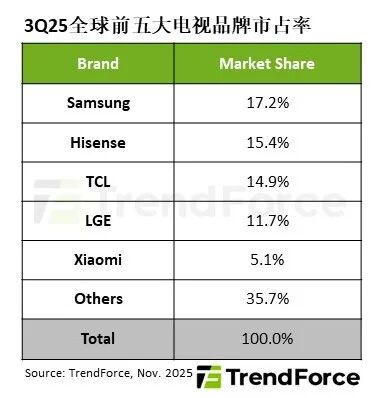
Core Insights - The global TV shipment volume is projected to drop below 50 million units for the first time in history in Q3 2025, reaching approximately 49.75 million units, a 6% quarter-on-quarter increase but a 4.9% year-on-year decrease [2] - The decline is attributed to extended consumer purchase cycles, changes in international circumstances leading to demand shifts, and the diminishing effects of subsidy policies in the Chinese market [2] - Despite challenges, a promotional peak in the U.S. and significant sales events in China are expected to boost Q4 shipments to approximately 53.21 million units, a 7.3% quarter-on-quarter increase [2] Shipment Performance - In Q3, the top five brands by shipment volume were Samsung, Hisense, TCL, LGE, and Xiaomi, collectively holding a market share of 64.3% [3] - Hisense's Q3 shipments reached 7.66 million units, a 9.7% quarter-on-quarter increase, allowing it to reclaim the global second position with a market share of 15.4%, the highest for the same period historically [3] Size Trends - The penetration rate of large-sized TVs (60 inches and above) has reached 28.2% for the first time, driven by increasing demand and subsidy policies in China [4] - Samsung and Hisense dominate the 65-inch and 75-inch markets with market shares of 26% and 22%, respectively, while TCL leads the 98-inch segment [4] - The overall shipment volume for 65-inch TVs remains higher than that for 70-inch and above by approximately 12 percentage points, indicating sustained demand for mid-to-high-end large sizes [4] Market Strategy Shift - The focus of brands is shifting from merely increasing size to upgrading product specifications, emphasizing differentiation through advanced features like RGB Mini LED, high refresh rates, and AI integration [5]

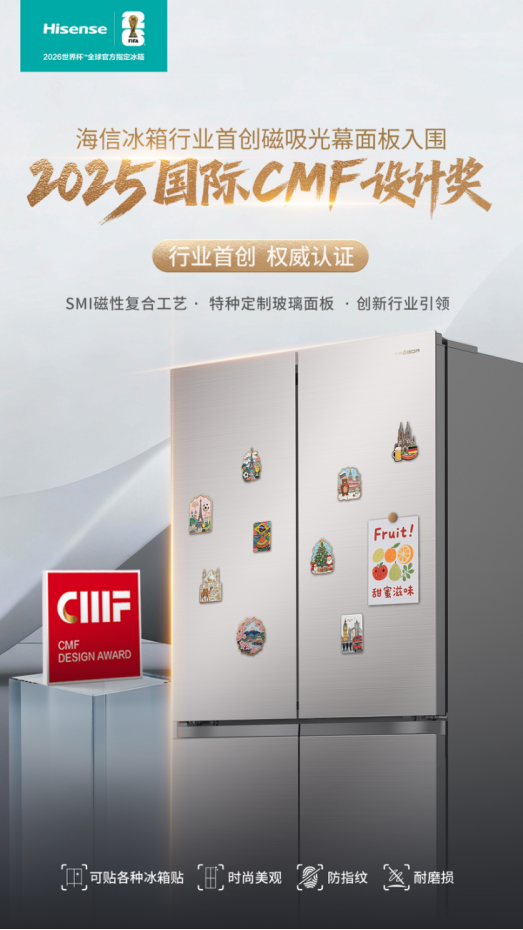
让冰箱贴回归!海信磁吸光幕门板守护千家万户的“生活仪式感”
Zhong Guo Zhi Liang Xin Wen Wang· 2025-11-03 07:55
Core Insights - The introduction of Hisense's magnetic light curtain door panel marks a significant innovation in the home appliance industry, addressing the long-standing user pain point of aesthetic yet non-adhesive glass door panels [1][3] - This breakthrough technology redefines the design standards for high-end refrigerators by integrating aesthetics, functionality, and emotional connection [1][3] Product Innovation - Hisense's magnetic light curtain door panel was developed after six years of research, utilizing a unique magnetic composite technology that allows for strong magnetic adhesion without compromising the panel's aesthetics, flatness, or insulation performance [3][4] - The door panel supports various magnetic attachments, enabling users to display family photos, travel souvenirs, and reminders, thus transforming the refrigerator into a center for family memories and rituals [3][4] Aesthetic and Functional Attributes - The magnetic light curtain door panel features SMI magnetic composite technology, offering a visually appealing and tactilely warm experience with multiple texture options [3][4] - It possesses practical attributes such as antibacterial properties, high hardness, fingerprint resistance, and ease of cleaning, achieving a perfect balance between visual aesthetics and tactile smoothness [3][4] Market Recognition and Performance - Hisense's commitment to user-centered design and continuous technological innovation is exemplified by the magnetic light curtain door panel and its advancements in core preservation technologies [4] - The company's third-quarter report indicates strong performance in refrigerator sales, reflecting enhanced product strength, brand power, and global operational capabilities [4]
集邦咨询:第三季度全球电视出货量首度跌破5000万台
Zhi Tong Cai Jing· 2025-11-03 06:19
Core Insights - Global TV shipments are projected to fall below 50 million units for the first time in history in Q3 2025, with an estimated 49.75 million units, reflecting a 4.9% year-over-year decline and a 6% quarter-over-quarter increase [1] - The decline is attributed to extended consumer purchase cycles, changes in international circumstances affecting demand, and the diminishing effects of subsidy policies in the Chinese market [1] - Despite the overall decline, a seasonal sales surge is expected in Q4 due to promotional activities in Europe and North America, as well as China's Double 11 and Double 12 shopping events, leading to an estimated 7.3% quarter-over-quarter increase in global shipments to 53.21 million units [1] Market Share and Brand Performance - The top five brands in Q3 2025 by shipment volume are Samsung, Hisense, TCL, LGE, and Xiaomi, collectively holding a market share of 64.3% [4] - Hisense regained its position as the second-largest global TV brand in Q3 2025, with shipments reaching 7.66 million units, a 9.7% quarter-over-quarter increase, and a market share of 15.4%, marking a record high for the brand [4] Size Segment Trends - The penetration rate of large-sized TVs (60 inches and above) has reached 28.2% for the first time, driven by demand in the Chinese market [5] - Samsung and Hisense lead the 65-inch and 75-inch segments with market shares of 26% and 22%, respectively, while Hisense and TCL dominate the 85/86-inch segment, each capturing nearly a quarter of the market [5] - TCL has emerged as the leader in the 98-inch market, while Hisense holds nearly half of the 100-inch market share [5] Future Market Dynamics - The growth momentum for large-sized TVs is expected to slow down as the effects of subsidy policies in China wane, with 65-inch shipments stagnating and 75-inch growth rates dropping to 13%, half of last year's figures [6] - The focus of brands is shifting from merely increasing size to upgrading product specifications, emphasizing differentiation through advanced features like RGB Mini LED, high refresh rates, and AI integration [6]


研报 | 2025年第三季度全球电视出货量首度跌破5,000万台,季增6%
TrendForce集邦· 2025-11-03 06:09
Core Insights - The global TV shipment volume in Q3 2025 was approximately 49.75 million units, marking a 6% increase quarter-over-quarter but a 4.9% decrease year-over-year, the first time it has fallen below 50 million units in the same period historically [2] - The decline is attributed to extended consumer purchase cycles, changes in international circumstances affecting demand, and the diminishing effects of subsidy policies in the Chinese market [2] - Anticipated promotions in the fourth quarter in Europe and the U.S., along with China's Double 11 and Double 12 shopping events, are expected to boost shipments to approximately 53.21 million units, a 7.3% increase from Q3 [2] - The total global TV shipment for 2025 is projected to be 195.59 million units, reflecting a year-over-year decrease of 1.2% [2] Brand Performance - The top five brands in Q3 2025 by shipment volume were Samsung, Hisense, TCL, LGE, and Xiaomi, collectively holding a market share of 64.3% [6] - Hisense regained the position of the second-largest global TV manufacturer with a shipment of 7.66 million units in Q3, a 9.7% increase quarter-over-quarter, raising its market share to 15.4%, a record high for the same period [6] Size Segment Trends - The penetration rate of large-sized TVs (60 inches and above) reached 28.2% for the first time, driven by increasing demand and subsidy policies in China [7] - Samsung and Hisense led the 65-inch and 75-inch markets with market shares of 26% and 22%, respectively [7] - TCL dominated the 98-inch market, while Hisense maintained a near 50% market share in the 100-inch segment [7] - Despite a decline in overall shipment volumes for smaller-sized TVs, Samsung retains a stable advantage in the 60-inch and above segment with a market share of 22% [7] Market Outlook - As the effects of subsidy policies in the Chinese market wane, growth in large-sized TV shipments is expected to slow significantly, with 65-inch shipments nearly stagnating and 75-inch growth rates dropping to 13%, half of the previous year's figures [8] - The focus of brands is shifting from merely increasing size to upgrading product specifications, emphasizing differentiation through advanced features such as RGB Mini LED, high refresh rates, and AI integration [8]
天风证券晨会集萃-20251103
Tianfeng Securities· 2025-11-03 01:34
Group 1 - The report highlights that the stock-bond allocation value has retreated from historical extremes, with the equity risk premium (ERP) stabilizing below one standard deviation [1] - The overall A-share index PE valuation stands at 22.0, with most broad-based indices around the 60th percentile historically, indicating relatively low valuations [1][29] - Market trading indicators show a decline in trading heat, with turnover rates and transaction volumes decreasing compared to the previous month, suggesting a cooling market sentiment [1][29] Group 2 - The "15th Five-Year Plan" suggestions have been officially released, marking a new phase in China's modernization process, emphasizing the importance of building a modern industrial system and financial strength [2] - The report indicates that local governments are likely to draft their own five-year plans by the end of the year, following the central government's guidelines [2] - The AI infrastructure investment is expected to significantly increase, with companies like Microsoft planning to expand their global AI infrastructure spending to meet growing demand [2] Group 3 - The report identifies green methanol as a key alternative fuel, with a projected demand of approximately 6.79 million tons from new methanol-fueled vessels expected to launch in the coming years [5] - China's green methanol production capacity is anticipated to achieve scale ahead of other regions, with a significant portion of global projects being developed in China [5] - The report recommends focusing on green methanol producers and related equipment manufacturers, highlighting companies like Goldwind Technology and Donghua Technology [5] Group 4 - The report notes that the AI server and cloud computing business is experiencing rapid growth, with a significant increase in revenue and profitability for companies involved in AI infrastructure [4] - The demand for AI computing power continues to rise, with GPU server shipments increasing by over five times year-on-year [4] - The report emphasizes the importance of technological advancements and market demand in driving the performance of companies in the AI sector [4] Group 5 - The report discusses the transition from UPS to HVDC technology, with major companies like Meta and NVIDIA making significant advancements in this area [7] - The domestic market is expected to see sustained demand for HVDC technology driven by initiatives like "East Data West Computing" [7] - Investment recommendations include focusing on domestic leaders in HVDC technology and companies that can benefit from the transition from UPS to HVDC [7]





海信视像(600060)季报点评:业绩略超预期 新显示新业务快速增长
Xin Lang Cai Jing· 2025-11-02 10:25
Core Viewpoint - The company reported a solid financial performance for Q3 2025, with significant growth in net profit and a strong increase in new business segments, particularly in commercial displays and smart projection products [1][2][3] Financial Performance - For Q1-Q3 2025, the company achieved operating revenue of 42.83 billion yuan, a year-on-year increase of 5.4%, and a net profit attributable to shareholders of 1.63 billion yuan, up 24.3% [1] - In Q3 2025, the company recorded operating revenue of 15.6 billion yuan, a 2.7% increase year-on-year, and a net profit of 570 million yuan, reflecting a 20.2% growth [1] Business Segments - The main business revenue for Q3 2025 reached 15.07 billion yuan, with a year-on-year growth of 6.7% [2] - The smart display segment showed rapid growth, with commercial display revenue increasing over 149% year-on-year, and smart projection sales growing over 107% [2] Profitability Improvement - The company achieved a gross margin of 14.4% in Q3 2025, an increase of 0.5 percentage points year-on-year, while the comprehensive expense ratio was 10.9%, a slight decrease of 0.1 percentage points [3] - The net profit margin for Q3 2025 was 3.7%, up 0.5 percentage points year-on-year, supported by increased government subsidies [3] Market Position and Innovation - The company is a leading player in the global display industry, with a focus on high-end television markets, particularly in Mini LED technology, where global shipments increased by 76% year-on-year [3] - The company is advancing its technology with proprietary AI image quality chips and RGB Mini LED backlight technology, setting new standards in display quality [3] Investment Outlook - The company is expected to maintain a stable long-term growth trajectory, with projected net profits of 2.51 billion yuan, 2.85 billion yuan, and 3.19 billion yuan for 2025, 2026, and 2027, respectively [4] - The company is positioned to benefit from ongoing industry optimization and its diversified brand matrix, enhancing operational efficiency and product structure [4]
周专题:三大白电11月外销排产表现优于内销
HUAXI Securities· 2025-11-02 09:53
Investment Rating - Industry rating: Recommended [8] Core Insights - The report highlights that the export production of major home appliances (air conditioners, refrigerators, and washing machines) in November 2025 outperformed domestic sales, with total production of 28.47 million units, a year-on-year decrease of 17.7% [17] - Air conditioner exports showed resilience with a production of 7.46 million units, down 13.8% year-on-year, while domestic production fell by 21.2% to 5.3 million units [17] - Refrigerator production for domestic sales was 3.76 million units, down 10.9% year-on-year, while exports were 4.02 million units, down 1.5% [2][18] - Washing machine exports increased by 5.0% year-on-year to 3.75 million units, while domestic production decreased by 2.6% to 4.18 million units [3][18] - The overall air conditioner export volume for the cold year 2025 reached 88.02 million units, an increase of 12.3% year-on-year, with export value at $16.97 billion, up 13.7% [19] Summary by Sections 1. Weekly Topic: November Production Performance - Air conditioners, refrigerators, and washing machines showed stronger export performance compared to domestic sales, with significant production declines in domestic markets due to high inventory and cost pressures [17] - The report attributes the decline in domestic production to factors such as inventory management, high raw material costs, and the impact of previous government subsidy policies [17] 2. Company Announcements - Hisense Home Appliances reported a revenue of 71.533 billion yuan for Q1-Q3 2025, a year-on-year increase of 1.35%, with a net profit of 2.812 billion yuan, up 0.67% [21] - Midea Group's revenue for Q1-Q3 2025 was 364.7 billion yuan, a 14% increase year-on-year, with a net profit of 37.9 billion yuan, up 20% [24] - Haier Smart Home reported a revenue of 234.1 billion yuan for Q1-Q3 2025, a 10% increase year-on-year, with a net profit of 17.4 billion yuan, up 15% [25] 3. Data Tracking - Raw material prices showed slight increases, with copper and aluminum prices rising by 0.9% and 1.1% respectively as of October 31, 2025 [28] - Shipping rates increased, with the CCFI composite index rising by 2.89% [30] - Real estate data indicated a decline in sales area and construction activity, with year-on-year decreases of 5.5% and 15.3% respectively for the first nine months of 2025 [33]