SAIC MOTOR(600104)

Search documents
60天内付款将加大车企现金流压力
Di Yi Cai Jing· 2025-06-11 14:54
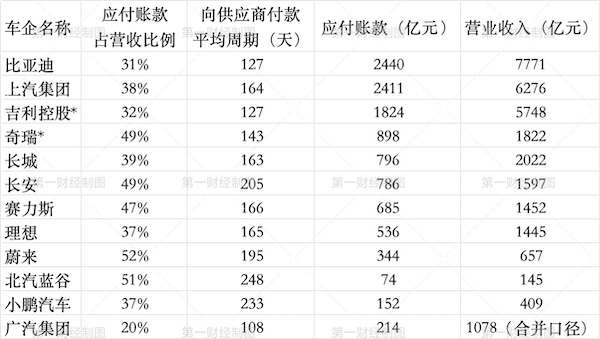
Group 1 - The average accounts payable turnover days for 12 major automotive companies is 170 days, with the longest being BAIC Blue Valley at 248 days and Xpeng Motors at nearly 233 days [1] - 12 automotive companies have a cumulative accounts payable exceeding 1.1 trillion yuan, with BYD, SAIC Motor, and Geely Holding leading at 244 billion yuan, 241 billion yuan, and 182 billion yuan respectively [1] - The average accounts payable as a percentage of revenue for these companies exceeds 40%, with 11 out of 12 companies surpassing 30%, and some like Chery, Changan, and NIO reaching around 50% [1] Group 2 - 17 automotive companies have collectively committed to a 60-day payment term, which may alleviate supplier cash flow pressure but increase cash flow pressure on the companies themselves [2] - The automotive industry has a high average debt-to-asset ratio, with NIO and Seres projected to reach 87.45% and 87.38% respectively in 2024, while the industry average is 66.32% [2] - Other companies' debt-to-asset ratios for 2024 include BAIC Blue Valley at 75.33%, BYD at 74.64%, Geely Holding at 69.74%, and SAIC Motor at 63.77% [2]





从170天降到60天,车企在“60天账期承诺”下迎资金“大考”?
Di Yi Cai Jing· 2025-06-11 14:03
Core Insights - The automotive industry is facing significant cash flow pressures as major companies have committed to a 60-day payment term for suppliers, while their current average accounts payable turnover days exceed 170 days, with some companies reaching up to 248 days [1][3][5] Group 1: Accounts Payable Situation - The average accounts payable turnover days for 12 major automotive companies is 170 days, with the longest being BAIC Blue Valley at 248 days and Xpeng Motors at 233 days [1][2] - The total accounts payable for the 12 companies exceeds 1.1 trillion yuan, with BYD, SAIC Group, and Geely Holding having the largest amounts at 244 billion, 241 billion, and 182 billion yuan respectively [1][2] - The average accounts payable as a percentage of revenue for these companies is over 40%, with several companies like Chery, Chang'an, and NIO exceeding 50% [1][2] Group 2: Impact on Suppliers - Automotive manufacturers are extending payment terms to improve their cash flow, effectively transferring financial pressure to suppliers who are often unable to refuse due to the manufacturers' market power [3][5] - Steel suppliers are particularly affected, facing demands for price reductions that exceed their capacity, leading to a lack of profitability in supplying automotive steel [4][5] Group 3: Financial Health and Debt Levels - The automotive sector is characterized by high debt levels, with NIO and Seres having asset-liability ratios of 87.45% and 87.38% respectively, significantly above the industry average of 66.32% [6] - Many companies are investing heavily in new energy vehicles without corresponding revenue, contributing to elevated debt ratios [6]


电池企业重大利好!车企承诺“60天付款”
起点锂电· 2025-06-11 10:30
Core Viewpoint - The implementation of the revised "Regulations on Payment of Funds for Small and Medium-sized Enterprises" by the State Council aims to shorten the payment period for suppliers to within 60 days, which has been positively received by multiple automotive companies, potentially improving supply chain efficiency and collaboration [2][6][7]. Group 1: Automotive Industry Response - Over ten automotive companies, including GAC Group, FAW Group, and BYD, have committed to reducing supplier payment terms to within 60 days, marking the beginning of a significant shift in the automotive industry's payment practices [3][4]. - The average payment cycle for domestic automotive companies has deteriorated from approximately 45 days a decade ago to much longer periods due to intensified competition and market pressures [6]. - The collective response from major automotive manufacturers is seen as a resistance to "involution" in the industry, with leaders publicly criticizing the negative impacts of price wars and extended payment terms [6][7]. Group 2: Impact on Suppliers - Shortening payment terms is expected to benefit suppliers by allowing quicker access to funds, thereby reducing operational risks and enabling faster production scale-up and product iteration [8]. - However, this shift may pose challenges for automotive companies with poor cash flow management, potentially leading to the elimination of weaker players in the market [8]. Group 3: Battery Industry Implications - The commitment to a 60-day payment term is particularly significant for the battery supply chain, where battery costs account for 30% to 40% of the total vehicle cost [12]. - The current lithium battery industry is facing challenges such as increased accounts receivable and extended customer payment cycles, impacting even leading companies like CATL [13][14]. - The new payment terms could enhance cash flow for battery suppliers, especially smaller firms, and foster deeper partnerships between automakers and battery manufacturers, promoting innovation and new business models [16].



零公里二手车,拿捏所有车企
Ge Long Hui· 2025-06-11 10:28
Core Viewpoint - The Chinese automotive market is experiencing severe supply-demand imbalance and negative effects from price wars, leading to distorted business practices among listed car companies [2][4][12]. Group 1: Market Dynamics - The average sales growth rate in China's domestic automotive market over the past three years is only 1.8%, with profit margins continuously declining [4][11]. - The phenomenon of "0-kilometer used cars" has emerged, where new cars are registered and then sold as used cars to alleviate inventory pressure and meet sales targets [6][9]. - The automotive industry is facing a significant overcapacity issue, with many listed companies reporting utilization rates below 50% [13][25]. Group 2: Industry Practices - Some car manufacturers and dealers engage in practices such as "virtual invoicing" to obtain subsidies, contributing to a culture of financial manipulation [6][9]. - The trend of selling "pseudo-used cars" at steep discounts (up to 30% off) is prevalent, indicating a hidden price war within the industry [7][9]. - The competitive landscape has led to a "winner-takes-all" scenario, forcing traditional automakers to downsize and restructure [15][16]. Group 3: Regulatory Response - The Ministry of Commerce has initiated discussions with major car manufacturers regarding the "0-kilometer used car" issue and is working to regulate market practices [4][22]. - There is a call for stricter regulations to address the ongoing price wars and restore healthy competition in the automotive sector [22][26]. - The government is promoting initiatives like the "2025 New Energy Vehicles Going to the Countryside" program to stimulate demand and help manufacturers reduce inventory [26][27]. Group 4: Future Outlook - The automotive industry is expected to undergo a "淘汰赛" (elimination race) in the second half of the year, which may further impact weaker companies [16]. - Despite the challenges, there are potential benefits from government initiatives aimed at boosting sales of new energy vehicles [26]. - The overall production capacity in China may exceed 50 million units, while the global automotive production is around 90 million units, highlighting a significant structural overcapacity [23][25].




灯塔工厂造创富神兵,看大拿T1天行版如何破解城配物流“不可能三角”!
第一商用车网· 2025-06-11 08:56
Core Viewpoint - The commercial vehicle industry is at a critical juncture requiring a shift towards electrification, particularly in urban distribution scenarios where daily driving distances are manageable for electric vehicles [1][8]. Group 1: Strategic Partnerships - SAIC Yujin and CATL have signed a strategic agreement to enhance the electric vehicle supply chain, marking a significant collaboration in the commercial vehicle sector [3][8]. - The partnership aims to leverage both companies' strengths, combining SAIC Yujin's manufacturing expertise with CATL's advanced battery technology [4][8]. Group 2: Product Development - The launch of the DANA T1 Tianxing version is positioned as a solution to address user pain points in the electric light truck market, aiming to change perceptions of electric light trucks [10][11]. - The T1 features the "Tianxing" battery, which boasts significant performance upgrades, including a 65% increase in energy density and a weight energy density of 200Wh/kg, surpassing industry averages [10][11]. Group 3: User Value Proposition - The T1 is designed to alleviate range anxiety with a full-load range of 338 kilometers and a low energy consumption of 26.6 kWh per 100 kilometers, enhancing operational efficiency [11][15]. - The vehicle's lightweight design and battery layout provide increased cargo capacity while reducing overall vehicle weight by 200-300 kg [11][15]. Group 4: Ecosystem Support - A strategic partnership with the logistics leader "Dizhangtie" aims to create a supportive ecosystem for the T1, facilitating market entry and providing users with lower investment costs and higher returns [16][17]. - The collaboration includes comprehensive service guarantees, such as three years of free rescue and maintenance-free front and rear axles for 500,000 kilometers, enhancing user confidence in electric light trucks [19][20]. Group 5: Future Outlook - The introduction of the DANA T1 represents a transformative value proposition in the electric vehicle market, allowing users to avoid compromises between cost, efficiency, and profitability [20][21]. - The ongoing development of additional models with higher battery capacities indicates a commitment to addressing user needs in various operational scenarios [19][20].

一汽/东风/长安/北汽/江淮/比亚迪等密集官宣!商用车行业或迎巨变
第一商用车网· 2025-06-11 08:56
Core Viewpoint - Major Chinese automotive groups have collectively announced a reduction in supplier payment terms to within 60 days, driven by the revised "Regulations on Payment for Small and Medium-sized Enterprises" set to take effect on June 1, 2025, which mandates large enterprises to pay within 60 days of delivery [1][35]. Group Summaries China FAW Group - China FAW Group emphasizes responsibility by optimizing internal procurement and financial settlement processes, ensuring timely payments within 60 days, and enhancing efficiency through digital monitoring of payment processes [2]. Dongfeng Motor - Dongfeng Motor has unified its payment terms to within 60 days to support the healthy development of small and medium-sized enterprises and promote efficient capital flow within the industry [5][6]. Changan Automobile - Changan Automobile has committed to a 60-day payment term for suppliers, aiming to enhance collaboration and support high-quality industry development [8]. BAIC Group - BAIC Group has announced strict adherence to a 60-day payment term, eliminating unreasonable settlement methods that increase financial pressure on suppliers [11]. GAC Group - GAC Group maintains a commitment to a maximum 60-day payment term to ensure efficient capital turnover and support high-quality industry development [15]. SAIC Motor - SAIC Motor has pledged to unify payment terms to within 60 days, avoiding methods that increase supplier financial pressure, thereby promoting sustainable development in the automotive industry [18]. Jianghuai Automobile - Jianghuai Automobile has committed to a 60-day payment term and is optimizing its internal processes through digital management for efficient capital turnover [21]. Geely Automobile - Geely has announced a unified payment term of 60 days to enhance capital turnover efficiency and stabilize the supply chain [23]. BYD - BYD has committed to a 60-day payment term, focusing on technological innovation and management optimization to support the automotive industry's sustainable development [27]. Chery Automobile - Chery has decided to implement a 60-day payment term to improve capital turnover efficiency and foster a fair and healthy market environment [29]. Great Wall Motors - Great Wall Motors has unified its payment terms to 60 days to ensure supply chain stability and promote fair competition and innovation within the industry [31]. Conclusion - The collective announcements from major automotive groups reflect a strong commitment to "anti-involution," "promoting high-quality development," and "healthy development of the industry chain," indicating a pressing desire for high-quality growth and stability in the automotive sector [35].

【快讯】每日快讯(2025年6月11日)
乘联分会· 2025-06-11 08:32
Domestic News - Beijing encourages the development of high-end new vehicle models with a focus on technology and fashion, aiming to expand into overseas markets, which will enhance brand recognition and drive innovation in the automotive industry [3] - Hebei province has issued measures to support private enterprises in the energy sector, particularly in the construction and operation of charging infrastructure, promoting new technologies and improving the business environment [4] - Shanghai's new energy vehicle ownership is projected to exceed 1.512 million by 2024, with pure electric vehicles making up approximately 89% of new energy vehicle sales [5] - Seven major automotive companies, including FAW and BYD, have committed to a payment term of no more than 60 days [6] - GAC plans to enter the Argentine market by the second half of 2025, aiming for comprehensive coverage in major South American cities [7] - BYD intends to nearly double its dealer network in South Africa by 2026 to increase its market share in the region [8] - SAIC Maxus has increased its registered capital from approximately 5.82 billion RMB to about 10.33 billion RMB, marking a 77% increase [9] - CATL has launched its 100th battery swap station in Shanghai, expanding its presence in the battery swap market and forming strategic partnerships with companies like NIO and Sinopec [10] International News - Japan has committed to increasing automobile production in the U.S. and strengthening rare earth cooperation as part of trade negotiations [11] - Tata Motors plans to invest up to 410 billion INR (approximately 4.1 billion USD) over the next five years to solidify its position as a leading electric vehicle manufacturer in India [12] - General Motors will invest 4 billion USD in its U.S. factories over the next two years to increase production of popular gasoline-powered models and create 3,000 to 4,000 new jobs [13] - Tesla has entered the testing phase for autonomous vehicles in Texas, preparing for the launch of its ride-hailing service [14] Commercial Vehicles - Toyota and Daimler have finalized a merger plan for their truck businesses, aiming to enhance profitability and accelerate new technology development [15] - Jiangsu Jinlong showcased its innovative products at the 8th Tourism Passenger Transport Industry Development Conference, focusing on high-end and customized solutions [16] - JAC Motors launched its new energy light truck solutions in Guangzhou, targeting various logistics scenarios to promote green logistics [17] - Dongfeng Xinjiang has delivered 1,600 gas heavy trucks to the African market, designed specifically for local conditions and user needs [18]
比较研究系列:以长板优势推进品牌进阶,智驾强监管筑牢安全底座
Ping An Securities· 2025-06-11 05:43
Investment Rating - The report maintains an "Outperform" rating for the industry [1] Core Insights - The high-end strategy of automotive companies is categorized into two types: those with clear advantages focusing on their strengths and those adopting benchmarking strategies [4][58] - The tightening regulations on intelligent driving are leading to a shift in marketing strategies among automotive companies, emphasizing safety and compliance [28][59] - Leading intelligent driving suppliers are expanding their product matrices and customer bases through integrated hardware and software solutions [60] Summary by Sections 1. Leveraging Strengths for Brand Advancement - Automotive companies like Li Auto, Great Wall Motors, and Xiaomi are focusing on their unique strengths to enhance brand positioning [4][58] - Li Auto's MEGA model maintains a flagship position with a price above 500,000 yuan, while Great Wall Motors continues to deepen its off-road market with the launch of the Tank 300 [8][19] - The introduction of new large SUVs during the 2025 Shanghai Auto Show aims to capture market share and elevate brand value [9][21] 2. Strengthening Safety and Regulatory Compliance - The intelligent driving sector is entering a period of stringent regulation, with new guidelines affecting marketing and OTA upgrades [28][29] - Companies are adjusting their marketing strategies to highlight safety features and avoid misleading claims about autonomous capabilities [35][36] 3. Leading Intelligent Driving Suppliers: Integrated Solutions and Rich Product Matrix - Major suppliers like Huawei and Horizon Robotics are offering diverse solutions across various price segments, with Huawei's ADS 4 and Horizon's HSD series [42][60] - High-end products are undergoing further iterations, with Huawei's ADS 4 flagship version introducing commercial L3 solutions [46][60] - The rapid expansion of user bases and significant R&D investments are leading to economies of scale for these suppliers [50][60] 4. Investment Recommendations - The report recommends focusing on automotive companies with distinctive brand advantages and ongoing development, specifically highlighting Li Auto, Great Wall Motors, and Xiaomi [58][60] - It also suggests looking at companies benefiting from the scale of new energy vehicles, such as BYD and Geely, and suppliers like Horizon Robotics and Fuyao Glass that are poised to gain from the proliferation of intelligent driving technologies [60]


车圈反内卷新进展:“60天账期承诺”成落地第一枪
Di Yi Cai Jing· 2025-06-11 05:39
Core Points - Multiple automotive companies have committed to standardizing payment terms to within 60 days, marking a significant step in the industry's response to internal competition and supply chain stability [1][2][3] Group 1: Company Commitments - Several major automotive companies, including China FAW, Dongfeng Motor Group, and Changan Automobile, have publicly announced their commitment to a 60-day payment term for suppliers [1] - BYD, amidst public scrutiny, also pledged to unify supplier payment terms to 60 days to support the healthy development of small and medium-sized enterprises [1] - New energy vehicle manufacturers such as Xiaomi Auto, Xpeng Motors, Li Auto, and NIO have followed suit, committing to the same payment terms [1] Group 2: Industry Response - SAIC Motor Group has taken an additional step by not using commercial acceptance bills as a settlement method, aiming to alleviate financial pressure on suppliers and ensure efficient capital flow [2] - The commitment to a 60-day payment term aligns with the revised "Regulations on Ensuring Payment to Small and Medium Enterprises" issued by the State Council [3]
上汽率先表态:不采用商业承兑汇票等结算方式
第一财经· 2025-06-11 05:29
今日,上汽集团宣布将供应商支付账期统一至60天内,并且不采用商业承兑汇票等增加供应商资金 压力的结算方式,以实际行动践行国企责任,保障上下游企业资金高质高效流转,推动合作伙伴更好 协同运行。上汽集团也是这轮"60天账期承诺"中,首个明确不采用商业承兑汇票等结算方式的车企。 ...