CSSC Holdings(600150)

Search documents
国资整合驶入快车道:年内国有控股上市公司重大资产重组数量同比增长68.42%
Hua Xia Shi Bao· 2025-08-22 06:05
Core Viewpoint - The acceleration of mergers and acquisitions (M&A) among state-owned listed companies reflects a significant transformation in industrial logic during China's economic transition, driven by the deepening reform of state-owned enterprises (SOEs) and the need for capital market integration [1][2][3]. Group 1: M&A Activity and Trends - In 2023, there have been 636 state-owned listed companies disclosing M&A plans, totaling 1,029 transactions, representing a year-on-year increase of 10.29%. Notably, 32 of these transactions are major asset restructurings, up 68.42% from the previous year [1]. - The current wave of M&A is largely attributed to the final year of the SOE reform initiative, with local governments actively promoting the consolidation of state assets through M&A [2][4]. - Central and local SOEs are increasingly responding to government policies encouraging M&A, aiming to enhance their competitive advantages and promote industrial upgrades [4][8]. Group 2: Specific M&A Cases - China Shenhua (601088.SH) plans to acquire equity stakes in 13 core energy enterprises from its controlling shareholder, the State Energy Group, covering various sectors including coal, power, and logistics [3]. - Other companies, such as Zhenyang Development (603213.SH) and China Chemical (600500.SH), have also announced significant asset restructuring plans aimed at optimizing resource allocation and enhancing their core business areas [4][7]. Group 3: Strategic Implications - The restructuring efforts are expected to significantly enhance the resource reserves and core business capacities of companies like China Shenhua, thereby improving their market competitiveness and supporting national energy strategies [3][8]. - Local state-owned enterprises are focusing on strategic integration to overcome fragmentation and enhance their economic impact, as seen in recent restructuring initiatives in regions like Ningxia and Henan [7][8]. Group 4: Future Outlook - Analysts predict that the trend of active M&A among state-owned enterprises will continue, driven by the need for capital optimization and the pursuit of high-quality development [2][8]. - The State-owned Assets Supervision and Administration Commission (SASAC) emphasizes the importance of building a modern industrial system and fostering new pillar industries to support economic growth [8].



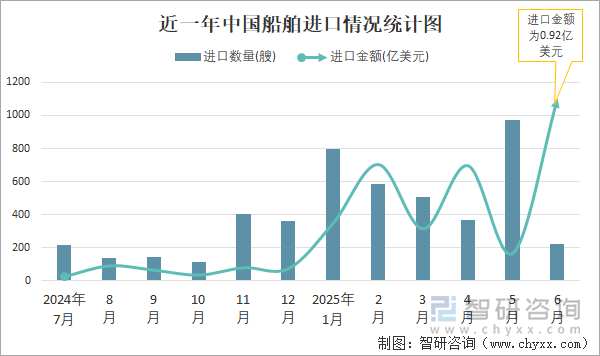
2025年6月中国船舶进出口数量分别为222艘和679艘
Chan Ye Xin Xi Wang· 2025-08-22 03:06
Core Insights - The report by Zhiyan Consulting highlights significant trends in China's shipbuilding industry from 2025 to 2031, focusing on investment potential and development forecasts [1]. Import and Export Data - In June 2025, China imported 222 ships, marking a year-on-year decrease of 66.8%, while the import value reached $0.92 million, showing a substantial increase of 918.6% [1]. - In the same month, China exported 679 ships, which represents a year-on-year increase of 31.8%, with an export value of $4.475 billion, reflecting a growth of 23.7% [1].

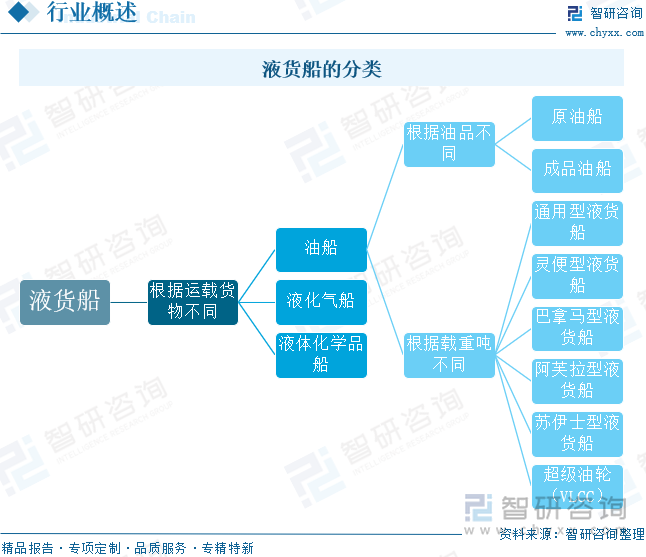
2025年中国液货船行业分类、发展背景、进出口情况、重点企业及未来趋势研判:2025年上半年液货船出口额同比增长91.73%,江苏省出口量全国第一[图]
Chan Ye Xin Xi Wang· 2025-08-22 01:21
Core Viewpoint - The liquid cargo ship industry in China is experiencing significant growth, driven by increasing exports and advancements in green shipping technology, positioning itself as a key player in the global market for low-carbon shipping solutions [1][10]. Industry Overview - Liquid cargo ships are specialized vessels for transporting liquid goods, including oil, chemicals, and liquefied gases, and have become a crucial growth point for China's shipbuilding exports [3][10]. - The industry is categorized into three main types: oil tankers, liquefied gas carriers, and chemical tankers, each designed for specific liquid cargoes [3]. Development Background - The water transport industry is undergoing a transformation towards modern logistics systems, with China's water transport volume growing from 6.657 billion tons in 2017 to 9.811 billion tons in 2024, reflecting a compound annual growth rate of 5.7% [5]. - The implementation of regional trade agreements and initiatives like the Belt and Road Initiative is enhancing the water transport network, benefiting the liquid cargo ship industry [5]. Industry Chain - The liquid cargo ship industry chain includes upstream raw materials (steel, non-ferrous metals), midstream manufacturing (shipbuilding), and downstream services (transportation and leasing of liquid goods) [7]. Current Industry Status - In 2024, China is expected to export 222 liquid cargo ships, a year-on-year increase of 54.17%, with an export value of 44.185 billion yuan, up 48.98% [10]. - The first half of 2025 shows continued growth, with 136 ships exported, a 37.37% increase from the previous year, and an export value of 29.761 billion yuan, up 91.73% [10]. Key Enterprises - The industry is led by China Shipbuilding Group, with major players including Dalian Shipbuilding, COSCO Shipping Development, and Jiangsu New Yangzi Shipbuilding, among others [17][18]. - These companies are enhancing their competitive edge through technological advancements and expanding their production capabilities [17]. Development Trends - The industry is moving towards larger and more specialized vessels to meet diverse market demands, particularly in LNG and chemical transportation [24][25]. - Green technology is becoming a focal point, with companies developing LNG dual-fuel and ammonia-fueled vessels, as well as innovative designs for carbon capture and storage [27].
9月将集中亮相!一图梳理军工新域新质力量概念
天天基金网· 2025-08-21 11:36
Core Viewpoint - The article discusses the recent activity in the military industry stocks, highlighting the impact of the upcoming military parade and the associated "parade market" trends observed in previous years [5]. Group 1: Military Equipment and Technology - The military parade will showcase domestically produced main battle equipment, including new-generation tanks, carrier-based aircraft, and fighter jets, emphasizing the PLA's operational capabilities [4]. - The parade will feature advanced equipment such as hypersonic weapons, air defense systems, and strategic missiles, demonstrating the military's strong deterrent capabilities [4]. - The focus will be on new types of unmanned intelligent systems and electronic warfare capabilities, reflecting the military's adaptation to technological advancements and evolving warfare [4]. Group 2: Market Trends and Analysis - Historical analysis shows that military stocks typically experience a rally 1-2 months prior to major parades, with military indices rising in the lead-up to these events [5]. - The strength of the "parade market" is influenced by overall market conditions and risk appetite, with significant past gains noted, such as an 84% excess return in the military sector during the 2015 parade [5]. - Post-parade, military stocks may face short-term adjustments, but long-term performance will be driven by the fundamentals of the military industry [5].




重磅发布,信息量巨大!“阅兵牛”蓄势待发?国防军工ETF(512810)交投火热,溢价吸筹!
Xin Lang Ji Jin· 2025-08-20 12:01
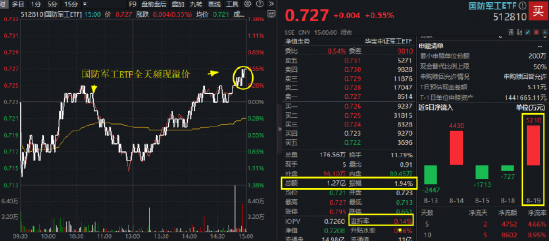
Core Viewpoint - The A-share market experienced a strong rebound, with the Shanghai Composite Index reaching a ten-year high, driven by significant trading volume and positive sentiment in the defense and military sector due to a major military parade announcement [1][3]. Group 1: Market Performance - The A-share market recorded a trading volume of 2.45 trillion yuan, maintaining above 2 trillion yuan for six consecutive trading days [1]. - The defense and military sector saw increased activity, particularly the high-profile defense ETF (512810), which rose by 0.55% during the day [1]. - The ETF (512810) attracted over 520 million yuan in a single day, indicating strong investor interest, with a closing premium rate of 0.14% [1]. Group 2: Key Stocks and Movements - The defense ETF (512810) constituents showed a mixed performance, with notable gains from companies like Guangqi Technology, which surged by 9.99%, while major stocks like China Shipbuilding and Great Wall Military fell over 3% [3][4]. - The trading volume for the ETF (512810) reached 1.27 billion yuan, continuing a trend of over 1 billion yuan in daily trading for seven consecutive days [1]. Group 3: Military Parade Impact - A significant military parade is set to showcase new military capabilities, including a new structure of military forces and advanced weaponry, which is expected to positively influence the defense sector [3][4]. - The parade will feature new-generation traditional weapons and advanced technologies such as unmanned systems and hypersonic capabilities, potentially redefining global military technology competition [5][6]. - Historical data indicates that previous military parades have led to a surge in the defense sector, suggesting a similar pattern may occur this time [7]. Group 4: Long-term Outlook - The defense industry is expected to undergo a significant transformation, driven by the strategic goal of building a world-class military, marking the beginning of a new golden era for the sector [7]. - The ETF (512810) encompasses a wide range of themes, including commercial aerospace, low-altitude economy, and military AI, making it an efficient tool for investing in core defense assets [7].

海洋经济板块8月20日跌0.98%,中科海讯领跌,主力资金净流出19.04亿元


Sou Hu Cai Jing· 2025-08-20 09:20
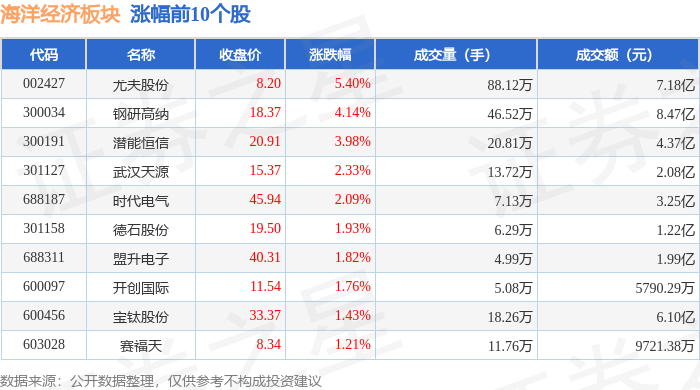
Core Viewpoint - The marine economy sector experienced a decline of 0.98% on August 20, with Zhongke Haixun leading the drop, while the Shanghai Composite Index rose by 1.04% and the Shenzhen Component Index increased by 0.89% [1][2]. Group 1: Market Performance - The marine economy sector's stocks showed mixed performance, with notable gainers including Youfu Co. (up 5.40% to 8.20), Gangyan High-tech (up 4.14% to 18.37), and Qianeng Hengxin (up 3.98% to 20.91) [1]. - Conversely, Zhongke Haixun saw a significant drop of 13.73% to 56.48, followed by Southern Road Machinery down 10.00% to 47.25 [2]. Group 2: Trading Volume and Capital Flow - The marine economy sector recorded a net outflow of 1.904 billion yuan from institutional investors, while retail investors saw a net inflow of 1.797 billion yuan [2][3]. - The trading volume for Youfu Co. reached 881,200 shares with a transaction value of 718 million yuan, while Zhongke Haixun had a trading volume of 269,000 shares with a transaction value of 1.588 billion yuan [1][2]. Group 3: Individual Stock Capital Flow - Gangyan High-tech had a net inflow of 66.03 million yuan from institutional investors, while retail investors experienced a net outflow of 57.27 million yuan [3]. - Youfu Co. saw a net inflow of 62.68 million yuan from institutional investors, with retail investors also facing a net outflow of 63.38 million yuan [3].
多部门联合召开光伏产业座谈会丨盘前情报
Sou Hu Cai Jing· 2025-08-20 00:35
Market Overview - On August 19, the A-share market experienced a slight decline with the Shanghai Composite Index down 0.02%, the Shenzhen Component Index down 0.12%, and the ChiNext Index down 0.17% [2][3] - The total trading volume in the Shanghai and Shenzhen markets was 2.59 trillion yuan, a decrease of 175.8 billion yuan compared to the previous trading day, marking the fifth consecutive day of trading volume exceeding 2 trillion yuan [2] - Over 2900 stocks in the market rose, indicating a mixed performance among individual stocks [2] Sector Performance - The top-performing sectors included liquor, Huawei HiSilicon, CPO, and humanoid robots, while sectors such as insurance, military industry, securities, and gaming saw declines [2] International Market - In the U.S. market, the Dow Jones Industrial Average rose by 10.45 points to close at 44,922.27, a gain of 0.02%, while the S&P 500 fell by 37.78 points to 6,411.37, a decline of 0.59%, and the Nasdaq Composite dropped by 314.82 points to 21,314.95, a decrease of 1.46% [4][5] - European markets saw all three major indices rise, with the UK FTSE 100 up 0.34%, the French CAC40 up 1.21%, and the German DAX up 0.45% [4][5] - International oil prices fell, with WTI crude oil down 1.69% to $62.35 per barrel and Brent crude down 1.22% to $65.79 per barrel [4][5] Policy Developments - A joint meeting was held by multiple departments to discuss the photovoltaic industry, emphasizing the need for regulatory measures to ensure healthy competition and sustainable development within the sector [6] - The meeting highlighted the importance of managing project investments, curbing low-price competition, ensuring product quality, and promoting industry self-regulation [6] Pension Policy Changes - New regulations regarding personal pension withdrawals will take effect on September 1, introducing three additional scenarios for withdrawal eligibility [7] AI and Manufacturing Initiatives - Shanghai has released an implementation plan to accelerate the development of "AI + manufacturing," focusing on deploying industrial robots in high-risk work environments to enhance production efficiency and safety [8] Satellite Internet Development - Guangdong Province has announced policies to promote high-quality development in commercial aerospace, encouraging industries to procure domestic satellite data and products [9][11] - The region aims to implement significant application scenarios for satellite internet services in various innovative fields [10][11] Commercial Space Launches - The successful launch of the Lijian-1 Yao-10 rocket marks a significant step in commercial space endeavors, with multiple satellites successfully placed into orbit [12] - The development of satellite internet is seen as a strategic resource, crucial for both defense and commercial interests [12] Investment Insights - Analysts suggest that the current market environment favors stable performance in A-shares, with a focus on growth sectors such as technology and advanced manufacturing [13][14] - There is a notable shift in investment style towards larger market capitalization stocks within the AI industry, indicating a strengthening consensus among institutional investors [14]






中国船舶今起复牌,中国重工终止上市申请获受理 | 快讯
Hua Xia Shi Bao· 2025-08-19 11:51
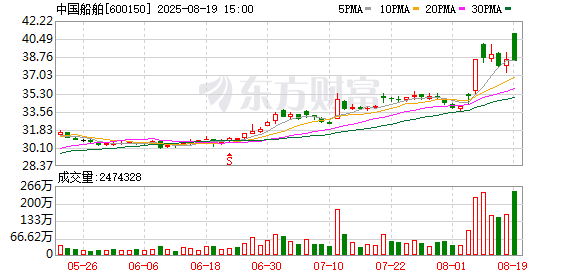
Core Viewpoint - China Shipbuilding Industry Co., Ltd. (China Shipbuilding) has completed a share swap merger with China Shipbuilding Heavy Industry Co., Ltd. (China Heavy Industry), leading to the latter's delisting and the consolidation of assets and liabilities under China Shipbuilding [2][3]. Group 1: Stock Performance - On August 19, China Shipbuilding resumed trading with a 6.44% increase at the opening, reaching a peak of 39.98 CNY per share before closing at 38.38 CNY, a slight decrease of 0.31% [2]. - The stock price of China Shipbuilding has increased over 30% from April 18 to the present [2]. Group 2: Merger Details - The share swap ratio is set at 1:0.1335, meaning each share of China Heavy Industry can be exchanged for 0.1335 shares of China Shipbuilding, with the swap prices determined at 37.84 CNY and 5.05 CNY per share, respectively [3]. - The total transaction value for the merger amounts to 115.15 billion CNY [3]. Group 3: Financial Performance - As of August 19, China Shipbuilding's market capitalization stands at 171.7 billion CNY [4]. - The company anticipates a net profit of 2.8 billion to 3.1 billion CNY for the first half of the year, representing a year-on-year growth of 98.25% to 119.49% [4]. - The non-recurring net profit is expected to be between 2.635 billion and 2.935 billion CNY, reflecting a growth of 119.89% to 144.93% year-on-year [4]. Group 4: Future Outlook - As of May 2025, China Shipbuilding holds 322 civil ship orders totaling 24.61 million deadweight tons, with production capacity scheduled until 2029 [4]. - The merger is expected to enhance the comprehensive competitiveness of the Chinese shipbuilding industry through synergistic effects [4].
国防军工行业8月19日资金流向日报
Zheng Quan Shi Bao Wang· 2025-08-19 09:13
Market Overview - The Shanghai Composite Index fell by 0.02% on August 19, with 18 out of the 28 sectors experiencing gains, led by the comprehensive and communication sectors, which rose by 3.48% and 1.87% respectively [1] - The non-banking financial and defense industry sectors had the largest declines, down by 1.64% and 1.55% respectively [1] Capital Flow Analysis - The main capital outflow from the two markets totaled 61.83 billion yuan, with six sectors seeing net inflows [1] - The home appliance sector led the net inflow with 2.175 billion yuan and a daily increase of 0.87%, followed by the food and beverage sector with a net inflow of 1.981 billion yuan and a daily increase of 1.04% [1] Defense Industry Performance - The defense industry saw a decline of 1.55% with a net capital outflow of 7.930 billion yuan [2] - Out of 139 stocks in the defense sector, 29 stocks increased, with 4 hitting the daily limit up, while 108 stocks declined [2] - The top three stocks with net inflows in the defense sector were Haige Communication (3.34 billion yuan), Qiyi Er (1.53 billion yuan), and Taihao Technology (1.52 billion yuan) [2] Defense Industry Capital Inflow and Outflow - The top stocks for capital inflow in the defense sector included: - Haige Communication: +2.49% with a capital flow of 334.18 million yuan - Qiyi Er: +2.61% with a capital flow of 152.70 million yuan - Taihao Technology: +10.05% with a capital flow of 151.85 million yuan [4] - The top stocks for capital outflow included: - China Shipbuilding: -0.31% with a capital outflow of 1.266 billion yuan - Jingjiawei: -7.50% with a capital outflow of 914.19 million yuan - Inner Mongolia First Machinery: -3.96% with a capital outflow of 655.36 million yuan [4]


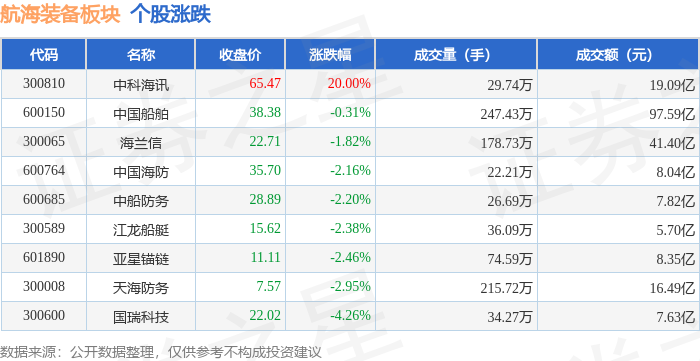
航海装备板块8月19日跌0.42%,国瑞科技领跌,主力资金净流出23.13亿元
Zheng Xing Xing Ye Ri Bao· 2025-08-19 08:37
Market Overview - The marine equipment sector experienced a decline of 0.42% on August 19, with Guorui Technology leading the losses [1] - The Shanghai Composite Index closed at 3727.29, down 0.02%, while the Shenzhen Component Index closed at 11821.63, down 0.12% [1] Stock Performance - Notable stock movements included: - Yihard Technology (300810) surged by 20.00% to a closing price of 65.47, with a trading volume of 297,400 shares and a transaction value of 1.909 billion [1] - Guorui Technology (300600) fell by 4.26% to a closing price of 22.02, with a trading volume of 342,700 shares and a transaction value of 763 million [1] - Other companies like China Shipbuilding (600150) and Jianglong Shipbuilding (300589) also saw declines of 0.31% and 2.38%, respectively [1] Capital Flow - The marine equipment sector saw a net outflow of 2.313 billion from main funds, while retail investors contributed a net inflow of 2.226 billion [1] - Specific stock capital flows included: - China Haifang (600764) had a main fund net outflow of 48.276 million and a retail net inflow of 63.059 million [2] - Guorui Technology (300600) experienced a main fund net outflow of 74.836 million but a retail net inflow of 77.005 million [2] - Jianglong Shipbuilding (300589) faced a significant main fund net outflow of 86.541 million, while retail investors contributed a net inflow of 94.508 million [2]