HAIER SMART HOME(600690)

Search documents
“717”现象级大促再出圈,苏宁易购与海尔做对了什么
Jing Ji Guan Cha Wang· 2025-07-28 09:44
Core Insights - The 11th "717" event by Suning.com and Haier has evolved into a significant marketing IP in the home appliance industry, marking a new wave of consumer demand for appliances during the summer heat [1][2][8] - The event has seen a substantial increase in sales, with Haier's overall appliance sales on Suning.com growing by 28% year-on-year, and air conditioning sales doubling [2][12] Group 1: Event Evolution and Impact - The "717" event has transformed from a brand festival to a lifestyle shopping festival, with sales scale increasing over tenfold since its inception in 2015, where the first day's sales exceeded 300 million yuan [8][12] - The partnership between Suning.com and Haier has led to the development of a new consumption culture symbol, focusing on user experience and value creation [9][11] Group 2: Product and Service Innovations - The "Three Good Standards" introduced during this year's event emphasize good products, good services, and good experiences, with over 20 trend-setting products launched [4][5] - Service upgrades include a comprehensive service model with long-term warranties and dedicated customer service roles, enhancing user trust and satisfaction [4][11] Group 3: Market Trends and Future Outlook - The smart home appliance market is projected to grow significantly, with an expected market size of approximately 5.9 trillion yuan by 2025, and smart appliances' penetration rate increasing to 50% [12][13] - The event aligns with national policies promoting green and energy-efficient products, indicating a strategic opportunity for the home appliance industry [12][14]


家电行业周报(25年第30周):8月空调排产同比下降7%,第三批国补资金下达-20250728
Guoxin Securities· 2025-07-28 09:32
Investment Rating - The report maintains an "Outperform the Market" rating for the home appliance industry [4][5][58]. Core Insights - The home appliance sector is expected to benefit from the third batch of 690 billion yuan in national subsidies aimed at promoting consumption through old-for-new programs, which is anticipated to sustain robust demand growth [2][20]. - In August, air conditioner production saw a year-on-year decline of 7.1%, with domestic sales decreasing by 5.3% and exports down by 9.5%. This decline is attributed to the seasonal slowdown and increased inventory levels [1][17]. - The second quarter saw a decrease in the proportion of heavy holdings in home appliance stocks, with a notable increase in black electrical appliances, indicating a shift in investment focus [3][22]. Summary by Sections 1. Investment Recommendations - Key recommendations include Midea Group, Gree Electric, Haier Smart Home, TCL Smart Home, and Hisense Home Appliances in the white goods sector, and Boss Electric in kitchen appliances [3][12][15]. 2. Market Trends and Production Insights - August marked the beginning of the air conditioning off-season, leading to a production slowdown. Domestic production decreased by 5% while export production fell by 10% [1][17]. - The third batch of national subsidies is expected to provide a significant boost to domestic demand, with over 2.8 billion people applying for the old-for-new subsidies, resulting in sales exceeding 1.6 trillion yuan [2][20]. 3. Heavy Holdings and Market Performance - The proportion of heavy holdings in home appliance stocks decreased to 3.3% in Q2, with white goods seeing the largest decline. However, the sector remains overweight compared to the overall market [3][22]. - The home appliance sector experienced a relative loss of 1.65% this week compared to the broader market [30]. 4. Key Data Tracking - Raw material prices have shown an upward trend, with LME copper and aluminum prices increasing by 1.2% and 2.3% respectively [32]. - The shipping index for exports has decreased, with significant drops in rates for routes to the US West and East coasts [42]. 5. Company Earnings Forecasts - Earnings per share (EPS) forecasts for key companies include Midea Group at 5.62 yuan for 2025, Gree Electric at 6.34 yuan, and Haier Smart Home at 2.26 yuan [4][55].



海尔智家(600690):近期跟踪点评:国补资金顺利衔接,重视公司经营弹性
Huachuang Securities· 2025-07-28 09:16
Investment Rating - The report maintains a "Strong Buy" rating for Haier Smart Home (600690) with a target price of 34.5 CNY [2][8]. Core Views - The recent allocation of 69 billion CNY in national subsidies is expected to positively impact Haier's air conditioning business, particularly in northern China and the European and American markets, leading to improved revenue and profit [2][8]. - The company is anticipated to benefit from high temperatures in major cities, which have reached an average maximum of 31.1°C, the highest in five years, driving demand for air conditioning [8]. - The report highlights that Haier's air conditioning sales in the northeast region have seen a significant increase, with retail sales growth exceeding 300% in early July due to the heat [8]. - The U.S. real estate market is expected to improve, which may positively influence demand for home appliances, as there is a strong correlation between real estate and appliance sales [8]. - The report emphasizes that Haier's management has shown confidence in the company's future by increasing their shareholdings, indicating a positive outlook for the second half of the year [8]. Financial Summary - Total revenue is projected to grow from 285,981 million CNY in 2024 to 354,115 million CNY in 2027, with year-on-year growth rates of 9.4%, 8.4%, 7.2%, and 6.5% respectively [4]. - Net profit attributable to shareholders is expected to increase from 18,741 million CNY in 2024 to 26,426 million CNY in 2027, with growth rates of 12.9%, 13.0%, 12.2%, and 11.3% [4]. - Earnings per share (EPS) are forecasted to rise from 2.00 CNY in 2024 to 2.82 CNY in 2027, with corresponding price-to-earnings (PE) ratios decreasing from 13 to 9 [4][8].
行业首创!海尔消费金融携云闪付重构分期生态
Sou Hu Cai Jing· 2025-07-28 08:42
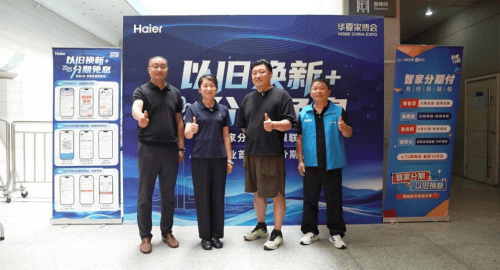
Core Viewpoint - The integration of Haier Consumer Finance with UnionPay Cloud Flash Payment marks a significant innovation in the home appliance retail sector, creating a new ecosystem that combines installment services with national subsidies, thereby enhancing consumer experience and driving sales growth [1][3]. Group 1: Innovations and Solutions - Haier Consumer Finance addresses traditional pain points in appliance installment plans, such as the disconnection between subsidies and installment options, by integrating national and corporate subsidies into a single platform [3]. - The company leverages financial technology to achieve "millisecond-level" credit response times, increasing installment approval efficiency by three times [3]. - The service is embedded in thousands of Haier retail stores, creating a closed-loop system that encompasses product selection, subsidies, installments, and fulfillment [3]. Group 2: Market Impact and Consumer Response - The new model has shown a strong consumer pull effect, with average transaction values at participating stores in pilot regions like Shanxi and Xi'an increasing by over 30%, and the proportion of bundled purchase users rising to 45% [3]. - A customer at the Qingdao Huaxia Home Expo reported significant savings of over 11,000 yuan from national subsidies when purchasing a full set of Haier appliances, with a manageable monthly installment plan [5]. - Sales staff noted a clear increase in sales attributed to the installment option, with more customers opting for installment purchases, enhancing the overall shopping experience [5][6]. Group 3: Strategic Advantages - Haier Consumer Finance benefits from the extensive resources of the Haier Group, allowing it to effectively meet the consumption needs of home appliance users [6]. - The integration of national subsidies and interest-free installments into a single offering enhances the shopping experience for consumers, eliminating the need to choose between different subsidy options [6].
海尔智家(600690) - 海尔智家股份有限公司核心员工持股计划权益归属的公告
2025-07-28 08:15
证券代码:600690 证券简称:海尔智家 编号:临2025-050 本公司董事会及全体董事保证本公告内容不存在任何虚假记载、误导性陈 述或者重大遗漏,并对其内容的真实性、准确性和完整性承担法律责任。 海尔智家股份有限公司(以下简称"公司"或"海尔智家")于近期办理了公 司2023年A股/H股核心员工持股计划、2024年A股/H股核心员工持股计划(合称 "核心员工持股计划")权益归属相关事宜,具体如下: 一、核心员工持股计划情况介绍 (一)2023年A股/H股核心员工持股计划 1、履行的批准及审议程序 公司于2023年4月27日召开第十一届董事会第五次会议和第十一届监事会第 五次会议,于2023年6月26日召开2022年年度股东大会,审议通过了《海尔智家股 份有限公司2023年度A股核心员工持股计划(草案)及摘要》(以下简称"2023年 A股核心员工持股计划")、《海尔智家股份有限公司2023年度H股核心员工持股计 划(草案)及摘要》(以下简称"2023年H股核心员工持股计划")等相关议案, 同意实施公司2023年A股核心员工持股计划和2023年H股核心员工持股计划。2023 年A股核心员工持股计划参与员工不 ...
金十图示:2025年07月28日(周一)富时中国A50指数成分股午盘收盘行情一览:银行股走势分化,石油、煤炭、电力股走低
news flash· 2025-07-28 03:38
Market Overview - The FTSE China A50 Index showed mixed performance among bank stocks, while oil, coal, and electric power stocks declined [1][6] Banking Sector - Everbright Bank had a market capitalization of 242.84 billion with a trading volume of 0.38 billion, closing at 4.11, up by 0.03 (0.74%) [3] Insurance Sector - China Life Insurance had a market capitalization of 382.10 billion, with a trading volume of 1.46 billion, closing at 59.62, up by 1.12 (2.99%) [3] - China Pacific Insurance had a market capitalization of 371.44 billion, with a trading volume of 1.02 billion, closing at 38.61, up by 1.54 (2.65%) [3] - Ping An Insurance had a market capitalization of 1,085.69 billion, with a trading volume of 5.02 billion, closing at 8.64, up by 0.17 (2.01%) [3] Alcohol Industry - Kweichow Moutai had a market capitalization of 1,806.43 billion, with a trading volume of 3.41 billion, closing at 122.78, down by 16.99 (-1.17%) [3] - Shanxi Fenjiu had a market capitalization of 221.85 billion, with a trading volume of 1.14 billion, closing at 1438.01, down by 3.73 (-2.01%) [3] - Wuliangye had a market capitalization of 476.58 billion, with a trading volume of 1.31 billion, closing at 181.85, down by 0.76 (-0.62%) [3] Technology Sector - Haiguang Information had a market capitalization of 246.59 billion, with a trading volume of 1.20 billion, closing at 341.73, down by 0.23 (-0.07%) [3] - Northern Huachuang had a market capitalization of 282.22 billion, with a trading volume of 4.45 billion, closing at 674.60, up by 1.30 (0.19%) [3] - Cambricon Technologies had a market capitalization of 32.38 billion, with a trading volume of 1.79 billion, closing at 139.31, down by 2.18 (-1.54%) [3] Energy Sector - Sinopec had a market capitalization of 269.58 billion, with a trading volume of 5.34 billion, closing at 5.88, down by 0.11 (-1.27%) [3] - PetroChina had a market capitalization of 1,566.66 billion, with a trading volume of 8.05 billion, closing at 8.56, down by 0.06 (-1.08%) [3] Automotive Sector - BYD had a market capitalization of 1,846.26 billion, with a trading volume of 5.87 billion, closing at 37.78, down by 0.47 (-2.26%) [3] Securities Sector - CITIC Securities had a market capitalization of 363.53 billion, with a trading volume of 32.66 billion, closing at 29.86, up by 0.41 (2.03%) [4] Consumer Electronics - Luxshare Precision had a market capitalization of 272.89 billion, with a trading volume of 23.13 billion, closing at 28.83, up by 0.17 (0.59%) [4] Home Appliances - Gree Electric had a market capitalization of 228.16 billion, with a trading volume of 10.44 billion, closing at 25.72, down by 0.09 (-0.19%) [4] Pharmaceutical Sector - Heng Rui Medicine had a market capitalization of 404.93 billion, with a trading volume of 4.53 billion, closing at 48.52, up by 4.61 (8.17%) [4]







国补复盘:以旧换新效果复盘及趋势展望
2025-07-28 01:42
Summary of Conference Call on National Subsidy Policy and Home Appliance Industry Industry Overview - The conference call discusses the home appliance industry in China, particularly focusing on the impact of the national subsidy policy (国补政策) on sales and market dynamics [1][2][19]. Key Points and Arguments National Subsidy Policy Impact - The national subsidy policy has significantly stimulated the home appliance sector, with a cumulative year-on-year growth rate of 31% in retail sales for the first half of 2025, contributing approximately 1,400 billion yuan to overall retail growth [1][20]. - The total subsidy amount for 2025 is expected to reach 3,000 billion yuan, effectively meeting market demand [1][21]. - The policy emphasizes energy efficiency standards, benefiting leading companies with high-efficiency products and robust offline channel layouts [1][3][19]. Market Performance - Air conditioning sales have shown remarkable growth, with online sales growth nearing 30% [1][22]. - Emerging categories like robotic vacuum cleaners and water purifiers are experiencing strong growth, with year-on-year increases exceeding 40% [1][25]. - Traditional appliances like range hoods and gas stoves maintain double-digit growth, while integrated stoves have seen a decline of 20-30% [22]. Company Performance - Midea and Haier have significantly increased their market shares in the air conditioning segment, with Midea's retail growth exceeding 40% and Haier achieving over 100% growth [3][23]. - Xiaomi continues to perform strongly in the refrigerator and washing machine sectors, aiming for a top-three position in the industry [3][24]. - Companies with high energy efficiency products and well-established offline channels are the primary beneficiaries of the subsidy policy [23]. Historical Context and Lessons Learned - The previous subsidy policies (2008-2012) had a notable impact on rural household penetration rates, but demand exhaustion and corporate financing issues led to increased profit volatility [1][11]. - The current policy is designed to avoid the pitfalls of the past by focusing on energy efficiency and supporting small retailers [19][25]. Future Outlook - There is a high probability that the subsidy policy will continue into 2026, with new energy efficiency upgrades and subsidies for refrigerators expected to drive product structure improvements [26]. - Leading companies are anticipated to maintain strong performance, with expected profit growth in double digits and dividend yields exceeding 4% [27]. Other Important Insights - The subsidy policy is seen as a crucial economic support measure, especially in light of ongoing macroeconomic pressures [25]. - The competitive landscape is expected to shift post-policy withdrawal, with leading companies likely to enhance their market share and profitability as smaller players exit the market [18]. This summary encapsulates the key insights from the conference call regarding the national subsidy policy's impact on the home appliance industry, highlighting market dynamics, company performances, and future expectations.
家电周报:国补第三批资金690亿已下达,大疆官宣首款扫地机-20250727
Shenwan Hongyuan Securities· 2025-07-27 11:14
Investment Rating - The report maintains a positive outlook on the home appliance sector, particularly highlighting the white goods segment as undervalued with high dividend yields and stable growth potential [5]. Core Insights - The report emphasizes the impact of government subsidies, with the third batch of 690 billion yuan allocated to support the consumption of old appliances, which is expected to stimulate demand in the home appliance market [4][11]. - The introduction of DJI's first robotic vacuum cleaner, ROMO, marks a significant entry into the market, indicating competitive dynamics in the home appliance sector [12]. - The report notes a general increase in sales volume across various appliance categories, with a particular focus on air conditioners and kitchen appliances, despite a decline in average selling prices [2][3][30][34][36]. Summary by Sections Air Conditioning Data - Online sales of air conditioners reached 9.18 million units in June 2025, a year-on-year increase of 27.9%, while offline sales were 1.032 million units, up 40.4% [2][30]. - The average online price decreased by 5.6% to 2,429 yuan per unit, and the offline average price fell by 2.5% to 4,031 yuan per unit [2][30]. Kitchen Appliance Data - Sales of range hoods increased, with online sales at 565,000 units (up 13.7%) and offline sales at 180,000 units (up 32.8%) in June 2025 [3][34]. - The average online price for range hoods decreased by 2.0% to 1,662 yuan, while the offline price increased by 4.8% to 4,674 yuan [3][34]. - Dishwasher sales also saw growth, with online sales at 192,000 units (up 8.9%) and offline sales at 49,000 units (up 24.3%) [3][36]. Industry Dynamics - The home appliance sector underperformed compared to the CSI 300 index, with the sector index remaining flat while the CSI 300 rose by 1.7% [4][6]. - Key companies such as Marsman and Lek Electric showed significant gains, while others like Huaxiang and Supor faced declines [4][8]. Investment Highlights - The report identifies three main investment themes: 1. White goods benefiting from favorable real estate policies and government incentives [5]. 2. Export-oriented companies like Ousheng Electric and Dechang Co. that are seeing stable income growth [5]. 3. Core component manufacturers like Huaxiang and Sanhua Intelligent Control, which are expected to benefit from increased demand in the white goods sector [5].




家用电器25W30周观点:国补第三批资金下达,关注政策接续效果-20250727
Huafu Securities· 2025-07-27 08:14
Investment Rating - The report maintains an "Outperform" rating for the home appliance sector [8]. Core Insights - The third batch of national subsidies has been allocated, with a focus on the effectiveness of policy continuity. The consumption upgrade policy has driven rapid growth in retail sales of home appliances and other categories, with over 280 million people applying for the subsidy, resulting in sales exceeding 1.6 trillion yuan [3][12][20]. - The retail sales of major home appliance categories have shown significant year-on-year growth, with air conditioning and audio-visual equipment increasing by 30.7% and 25.4%, respectively, contributing to a 5% growth in total retail sales [3][12][20]. Summary by Sections Investment Suggestions - The report suggests focusing on the following areas due to expected recovery in domestic demand supported by policy: 1. Major appliances benefiting from the old-for-new policy, recommending companies like Midea Group, Haier Smart Home, Gree Electric, and TCL Electronics [5][21]. 2. The pet industry, which is expected to remain resilient against economic cycles, with recommendations for companies like Guibao Pet and Zhongchong Co [5][21]. 3. Small appliances and branded apparel, which may see demand recovery from a low base, recommending companies like Bear Electric and Anta Sports [5][21]. 4. Electric two-wheelers, with a strong outlook for domestic sales improvement, recommending companies like Ninebot and Yadea [5][21]. Market Data - The home appliance sector experienced a slight increase of 0.3% this week, with specific segments showing varied performance: white goods down 0.1%, black goods up 0.8%, small appliances up 1.1%, and kitchen appliances up 2.5% [4][25]. - Raw material prices have seen a decrease, with LME copper and aluminum down by 1.46% and 1.04%, respectively [4][25]. Industry Trends - The report highlights the long-term theme of international expansion, recommending attention to leading companies in clean appliances and major appliances that are gaining global market share [6][22]. - The restructuring of global manufacturing continues to favor Chinese manufacturing, with recommendations for companies like Midea Group and Haier Smart Home, which are leading in global market share for major appliances and tools [6][22]. Company Performance Tracking - The report includes detailed sales data tracking for key companies in various segments, indicating performance trends and market positioning [36][37][41][42].
趋势研判!2025年中国智能建筑行业发展全景分析:随着城镇化建设的大举推进,智能建筑市场不断扩大,市场规模约6630.67亿元 [图]
Chan Ye Xin Xi Wang· 2025-07-27 01:28
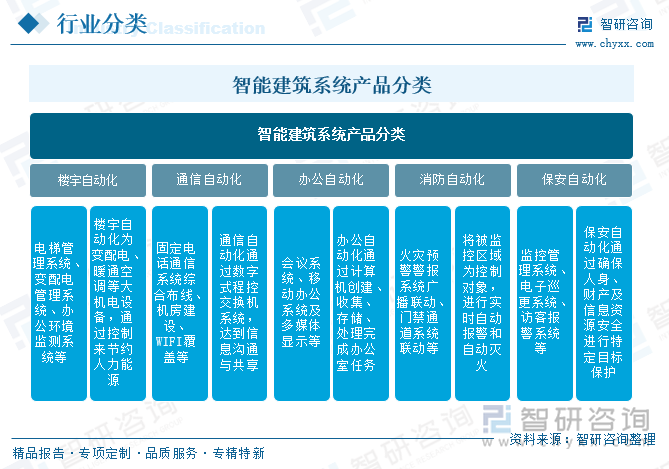
Core Insights - The smart building market in China is projected to reach a scale of 675.397 billion yuan in 2024, with segments including smart residential buildings at 232.752 billion yuan, smart public buildings at 156.376 billion yuan, and smart industrial buildings at 286.269 billion yuan [1][10] - The demand for smart buildings is driven by the application of smart technologies in new constructions and the intelligent renovation of existing buildings [10][12] - The global smart building market is expected to grow to 335.637 billion USD in 2024, with a year-on-year increase of 1.54% [8] Smart Building Industry Classification and Characteristics - Smart buildings integrate building equipment, office automation, and communication network systems to provide a safe, efficient, comfortable, and convenient environment [2][4] - The technological foundation of smart buildings includes building automation, communication automation, office automation, fire safety automation, and security automation [2] Current Development Status of the Smart Building Industry - The smart building sector has expanded from office buildings to residential areas, utilizing modern control technologies and integrating various systems [4][10] - The market is characterized by increasing competition, with both international brands and domestic companies actively participating [4][10] Smart Building Industry Development Trends - The future of smart buildings is focused on sustainable development technologies, with innovations in eco-friendly materials, advanced energy management, and the integration of AI and IoT [25] - The industry is expected to continue growing, driven by technological advancements that enhance efficiency and improve living quality [25] Smart Building Industry Competitive Landscape - Major international players like Johnson Controls, Honeywell, and Schneider dominate the high-end market, while domestic companies such as Huawei, Haier Smart Home, and Dashi Intelligent focus on mid to low-end markets [18][20] - The competition encompasses various dimensions, including technology, pricing, branding, and ecosystem development [18] Key Companies in the Smart Building Sector - Haier Smart Home reported a global revenue of 285.981 billion yuan in 2024, with a year-on-year growth of 4.29% [21] - Dashi Intelligent achieved a total revenue of 3.171 billion yuan in 2024, with significant contributions from its smart space solutions [23]