CNOOC(600938)

Search documents
能源ETF(159930)开盘跌2.27%,重仓股中国神华跌0.78%,中国石油跌1.69%
Xin Lang Cai Jing· 2025-10-13 01:36
Core Viewpoint - The Energy ETF (159930) opened with a decline of 2.27%, indicating a negative market sentiment towards energy stocks [1] Group 1: ETF Performance - The Energy ETF (159930) opened at 1.333 yuan, reflecting a drop in value [1] - Since its establishment on August 23, 2013, the fund has achieved a return of 37.76% [1] - The fund's performance over the past month shows a return of 3.11% [1] Group 2: Major Holdings Performance - Major holdings in the Energy ETF experienced declines, including: - China Shenhua down 0.78% - China Petroleum down 1.69% - China Petrochemical down 1.30% - Shaanxi Coal and Chemical Industry down 1.79% - China National Offshore Oil Corporation down 1.64% - Yanzhou Coal Mining down 2.28% - Jereh Group down 3.94% - China Coal Energy down 1.68% - Shanxi Coking Coal down 2.60% - Meijin Energy down 2.82% [1] Group 3: Management Information - The Energy ETF is managed by Huatai-PineBridge Fund Management Co., Ltd. [1] - The fund managers are Dong Jin and Sun Hao [1]



石油化工行业周报:俄罗斯炼厂停产规模创新高,乌拉尔原油出口增加-20251012
Shenwan Hongyuan Securities· 2025-10-12 13:15
Investment Rating - The report maintains a positive outlook on the petrochemical industry [2] Core Views - The report highlights the unprecedented scale of refinery shutdowns in Russia, leading to increased Ural crude oil exports. As of the end of September, 38% of Russia's refining capacity (approximately 338,000 tons per day) was offline, primarily due to drone attacks from Ukraine [3][4][5] - The upstream sector is experiencing a decline in oil prices, while day rates for jack-up rigs are increasing. Brent crude oil futures closed at $62.73 per barrel, down 2.79% from the previous week [3][18] - The refining sector is seeing a drop in overseas refined oil crack spreads, while olefin spreads are rising. The Singapore refining margin for major products was $20.06 per barrel, down $1.48 from the previous week [3][54] - The polyester sector shows signs of recovery, with expectations for improved profitability as supply and demand conditions improve [3][13] Summary by Sections Upstream Sector - Brent crude oil prices decreased to $62.73 per barrel, with a weekly decline of 2.79%. U.S. commercial crude oil inventories increased by 5.507 million barrels to 420 million barrels [3][20] - The number of U.S. drilling rigs decreased by 2 to 547, with a year-on-year reduction of 39 rigs [3][32] Refining Sector - The report notes a significant drop in Russian refining capacity due to drone attacks, with a 5.08% quarter-on-quarter decline in processing volume in Q3 2025 [3][9] - The report indicates that the domestic refining product spread has improved, but remains at a low level [3][51] Polyester Sector - The report indicates that PTA profitability has declined, while polyester filament profitability has increased. The average price of PTA in East China was 4,528.6 yuan per ton, down 1.69% week-on-week [3][13] - The report expresses optimism for leading polyester companies such as Tongkun Co. and Wankai New Materials, anticipating a gradual improvement in the industry [3][13] Investment Recommendations - The report recommends focusing on leading refining companies such as Hengli Petrochemical, Rongsheng Petrochemical, and Sinopec, as well as upstream oil service companies like CNOOC Services and Haiyou Engineering [3][13]


OPEC+持续增产,地缘风险有望缓和:石油化工行业周报第423期(20251006—20251011)-20251012
EBSCN· 2025-10-12 12:52
Investment Rating - The report maintains an "Overweight" rating for the oil and petrochemical industry [5] Core Views - The geopolitical risks in the Middle East have significantly eased following the ceasefire agreement between Israel and Hamas, which is expected to reduce the geopolitical risk premium on oil prices [1][10] - OPEC+ plans to increase production by 137,000 barrels per day in November, although the actual increase may fall short of this target due to limited spare capacity among member countries [2][14] - The reintroduction of tariffs by the U.S. on imports from China may negatively impact global oil demand, leading to a supply surplus and potential downward pressure on oil prices in the fourth quarter [3][19] Summary by Sections OPEC+ Production and Geopolitical Risks - The ceasefire agreement in the Israel-Hamas conflict is expected to alleviate geopolitical tensions, potentially lowering oil prices [1][10] - OPEC+ has announced a cautious increase in production, with a total increase of 1.75 million barrels per day recorded so far in 2025 [2][14] - The production capacity of major OPEC+ members varies, with Saudi Arabia having significant spare capacity while Russia's production is constrained [2][14] Tariff Risks and Demand Outlook - The U.S. will impose a 100% tariff on imports from China starting November 1, which could disrupt global oil demand [3][19] - The IEA projects a global oil demand increase of 740,000 barrels per day in 2025, while supply is expected to grow by 2.7 million barrels per day, leading to a potential oversupply situation [3][19] Investment Recommendations - The report suggests a long-term positive outlook for major oil companies and oil service sectors, emphasizing the potential for recovery in chemical demand due to macroeconomic improvements [4] - Specific companies to watch include China National Petroleum Corporation, Sinopec, and CNOOC, along with their respective oil service subsidiaries [4]

原油周报:中东地缘风险降温,油价周内下跌-20251012
Xinda Securities· 2025-10-12 12:04
Investment Rating - The report maintains a "Positive" investment rating for the oil processing industry [1]. Core Insights - International oil prices have decreased as of October 10, 2025, with Brent and WTI prices at $62.73 and $58.90 per barrel, respectively, reflecting a decline of 2.79% and 3.25% from the previous week [2][20]. - The report highlights concerns over supply surplus due to OPEC's planned production increase and the resumption of oil exports from the Kurdish region, alongside geopolitical tensions in the Middle East [2][9]. - The oil and petrochemical sector has shown resilience, with a 2.99% increase in the sector's performance compared to a 0.51% decline in the broader market (CSI 300) [10][13]. Oil Price Review - As of October 10, 2025, Brent crude futures settled at $62.73 per barrel, down $1.80 (-2.79%) from the previous week, while WTI crude futures settled at $58.90 per barrel, down $1.98 (-3.25%) [2][20]. - The report notes that the Urals crude price remained stable at $65.49 per barrel, while ESPO crude increased by $0.53 (+0.88%) to $60.43 per barrel [2][20]. Offshore Drilling Services - The number of global offshore self-elevating drilling rigs was 371, a decrease of 1 from the previous week, while floating drilling rigs increased by 3 to a total of 132 [24][33]. U.S. Oil Supply - U.S. crude oil production reached 13.629 million barrels per day, an increase of 124,000 barrels from the previous week [46]. - The number of active drilling rigs in the U.S. decreased by 4 to 418, and the number of fracturing fleets also decreased by 4 to 175 [46]. U.S. Oil Demand - U.S. refinery crude processing increased to 16.297 million barrels per day, up 129,000 barrels from the previous week, with a refinery utilization rate of 92.40%, up 1.0 percentage points [56]. - The report indicates that U.S. gasoline and distillate inventories have decreased, suggesting a rise in oil demand [2][9]. U.S. Oil Inventory - As of October 3, 2025, total U.S. crude oil inventories stood at 827 million barrels, an increase of 4 million barrels (+0.49%) from the previous week [65]. - Strategic oil reserves were at 407 million barrels, up 285,000 barrels (+0.07%), while commercial crude oil inventories rose by 3.715 million barrels (+0.89%) to 420 million barrels [65].

中国加速与海合会能源合作,锁定长期供应应对全球动荡
Sou Hu Cai Jing· 2025-10-12 10:53
Core Insights - China's energy cooperation with Gulf Cooperation Council (GCC) countries has deepened significantly in recent years, driven by global energy market volatility and US-China trade tensions, with long-term procurement agreements solidifying energy ties and ensuring energy security [1][6][12] Energy Supply Agreements - In April 2025, China National Offshore Oil Corporation (CNOOC) signed a five-year LNG supply agreement with Abu Dhabi National Oil Company (ADNOC) to supply 500,000 tons annually starting in 2026 [3] - ADNOC also reached agreements with two other Chinese companies for long-term LNG contracts, effectively reducing market volatility risks for Chinese buyers amid increasing US sanctions on Iranian oil [3][6] - China's imports from GCC countries in 2023 included approximately 201 million tons of crude oil and 18 million tons of LNG, accounting for one-third and one-quarter of its total imports, respectively [5] Strategic Diversification - Iraq, as China's third-largest crude oil supplier, is expected to double its production to 500,000 barrels per day by 2030, enhancing China's crude oil imports from Iraq beyond the current 1.2 million barrels per day [4] - The long-term contracts with GCC countries serve as a strategic hedge against external pressures, reducing reliance on sanctioned nations [6][12] Broader Energy Network - China is expanding its energy strategy beyond GCC countries by collaborating with ASEAN nations to build a more extensive Asian energy network, enhancing traditional and clean energy cooperation [7] - The first trilateral summit in May 2025 among China, GCC, and ASEAN focused on strengthening energy supply chains and investing in new energy sources [7] Clean Energy Collaboration - Cooperation in clean energy is accelerating, with GCC countries aiming to diversify their economies and reduce oil dependency, as seen in Saudi Arabia's Vision 2030 and UAE's Net Zero 2050 strategy [8] - China has become a key partner in the energy transition for GCC countries, with significant investments in renewable energy projects [8] Bilateral Trade Growth - In 2024, bilateral trade between China and the UAE surpassed $100 billion, reflecting extensive economic ties beyond energy [10] Geopolitical Considerations - The geopolitical landscape poses challenges, with regional instability and external pressures impacting China's energy strategy, necessitating a balance between economic interests and geopolitical considerations [13]


3177元/kW!明阳预中标中海油600MW海上风电项目
Xin Lang Cai Jing· 2025-10-12 02:08
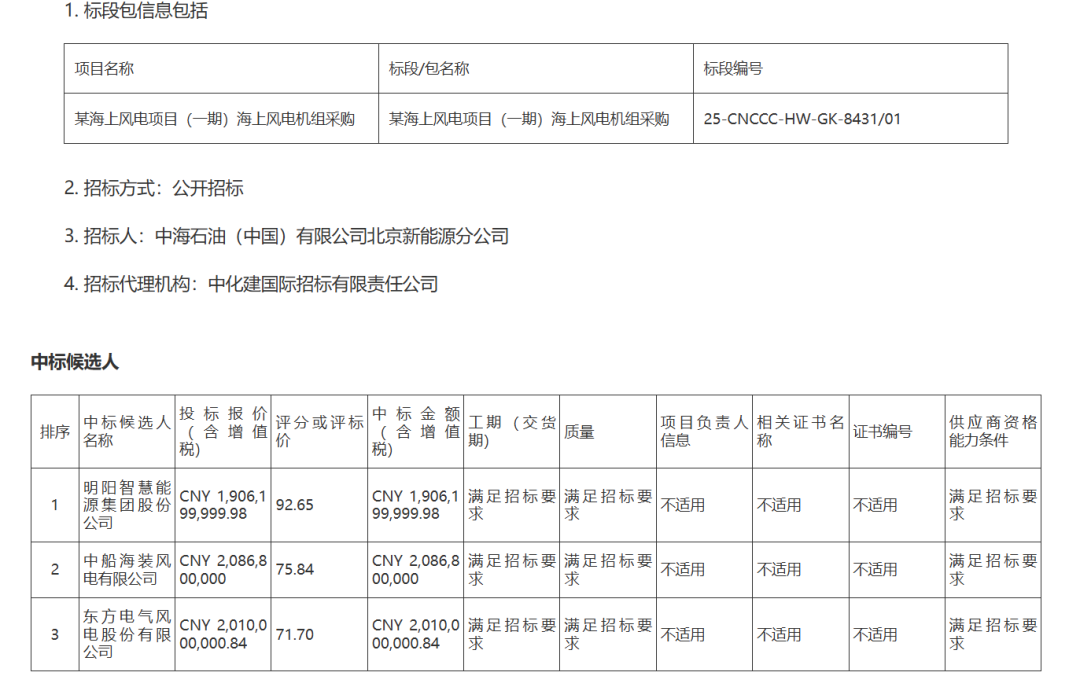
Core Insights - CNOOC's offshore wind power project (Phase I) has announced the procurement of wind turbine units, with Mingyang Smart Energy being the first candidate for the bid at a price of CNY 1.906 billion, equivalent to CNY 3,177 per kW [1] Group 1: Project Details - The project is located in the western sea area of Hainan Province, with a center offshore distance of approximately 29 km and a site area of about 60 square kilometers [3] - The planned installed capacity for the project is 600 MW, and the foundation type for the wind turbines will be steel pipe piles [3] Group 2: Bidder Information - Mingyang Smart Energy's bid was evaluated with a score of 92.65, meeting all tender requirements [3] - Other bidders included China Shipbuilding Industry Corporation and Dongfang Electric Corporation, with bids of CNY 2.087 billion and CNY 2.010 billion respectively [3] Group 3: Technical Specifications - The wind turbines must have a single unit capacity of 10 MW and be suitable for the environmental conditions of the project site, with operational temperature ranges from -10 to 45 degrees Celsius [4] - The design life of the turbines should not be less than 25 years, and they must withstand extreme wind speeds of up to 70 m/s [4]

加沙停火,原油地缘溢价效应减弱
Minsheng Securities· 2025-10-11 13:59
石化周报 加沙停火,原油地缘溢价效应减弱 2025 年 10 月 11 日 ➢ 加沙停火,原油地缘溢价效应减弱。由于特朗普 9 月 29 日宣布以色列总理 已同意美方就结束加沙冲突提出的"20 点计划",从而十一假期期间油价表现走 弱;10 月 10 日,以色列国防军发表声明,加沙停火第一阶段协议已于当地 10 日中午 12 时(北京时间 17 时)生效,中东局部停火导致原油所包含的地缘溢价 效应减弱。OPEC+方面,10 月 1 日第 62 次 JMMC 会议召开,伊朗、科威特、 阿联酋、哈萨克斯坦、阿曼、俄罗斯更新了 25 年 9 月至 26 年 6 月的补偿减产 计划,其中,25 年 9~12 月计划补偿减产 23.2、20.3、26.6、30.3 万桶/日,第 63 次 JMMC 会议将于 11 月 30 日举行;10 月 5 日,此前自愿减产的八个 OPEC+ 国家宣布将逐步取消 165 万桶/日的减产,11 月份将率先进行 13.7 万桶/日的增 产,且下一次八国会议将于 11 月 2 日举行。我们认为,目前的地缘形式下, OPEC+的补偿减产仍需持续跟踪,若补偿减产能够有效兑现,则油价仍具备较强 ...


受地缘政治与OPEC+产量政策博弈影响,9月油价宽幅震荡 | 投研报告
Zhong Guo Neng Yuan Wang· 2025-10-11 01:05
Core Insights - In September 2025, the average price of Brent crude oil futures was $67.6 per barrel, a month-on-month increase of $0.3 per barrel, while the WTI crude oil futures averaged $63.6 per barrel, a decrease of $0.4 per barrel [2][3] - Geopolitical tensions, including the U.S. attack on Venezuelan vessels and ongoing conflicts involving Israel and Russia, have contributed to fluctuations in oil prices, alongside OPEC+'s decision to extend production increases [2][3] Oil Price Review - Brent crude oil futures closed at $67.0 per barrel at the end of September, while WTI crude oil futures closed at $72.4 per barrel [2] - The U.S. significantly increased its crude oil exports, leading to a reduction in inventory levels, despite seasonal refinery maintenance impacting demand [2][3] Supply and Demand Dynamics - OPEC+ announced an extension of production increases for October and November, with a collective reduction target extended until the end of 2026 [3] - Major energy agencies project an increase in global oil demand, with estimates for 2025 ranging from 74,000 to 130,000 barrels per day [3] Industry Policy Developments - A joint announcement from seven ministries in China outlined a plan to stabilize growth in the petrochemical industry, emphasizing strict controls on new refining capacity [4][5] - The plan aims to optimize supply-side conditions in the refining and chemical sectors, amidst global uncertainties [5] Price Forecasts - The expected price range for Brent crude oil in 2025 is between $65 and $75 per barrel, while WTI crude oil is projected to be between $60 and $70 per barrel [5] Recommended Stocks - Key investment recommendations include China National Offshore Oil Corporation (CNOOC), China Petroleum, Satellite Chemical, and CNOOC Development [6]


油气行业2025年9月月报:受地缘政治与OPEC+产量政策博弈影响,9月油价宽幅震荡-20251010
Guoxin Securities· 2025-10-10 12:56
Investment Rating - The oil and gas industry is rated as "Outperform" [6] Core Views - Oil prices experienced wide fluctuations in September due to geopolitical tensions and OPEC+ production policies, with Brent crude averaging $67.6 per barrel and WTI averaging $63.6 per barrel [2][14] - OPEC+ announced an extension of production increases for October and November, aiming to gradually lift voluntary production cuts established earlier [3][18] - Major energy agencies project an increase in global oil demand, with expected growth of 740,000 to 1.3 million barrels per day in 2025 and 700,000 to 1.38 million barrels per day in 2026 [4][19] Summary by Sections Oil Price Review - In September, Brent crude futures averaged $67.6 per barrel, up $0.3 from the previous month, while WTI averaged $63.6 per barrel, down $0.4 [2][14] - Geopolitical events, including U.S. actions against Venezuela and conflicts in the Middle East, contributed to price volatility [2][14] Supply Side Analysis - OPEC+ plans to continue increasing production, with a collective reduction target extended to 2026 and voluntary cuts to be gradually lifted [3][18] - The group has increased production by 41,100 barrels per day in May, June, and July, and by 54,800 barrels per day in August and September [3][18] Demand Side Analysis - Forecasts indicate that oil demand will rise in 2025, with OPEC, IEA, and EIA projecting demand increases of 130,000 to 1.05 million barrels per day [4][19] - The demand for oil is expected to continue growing into 2026, with similar projections for increased consumption [4][19] Industry Policy and Outlook - China's petrochemical industry is facing overcapacity, leading to stricter controls on new refining projects and a focus on optimizing supply [5][20] - The expected price range for Brent crude in 2025 is projected to be between $65 and $75 per barrel, while WTI is expected to range from $60 to $70 per barrel [5][20] Company Performance and Recommendations - Key companies such as CNOOC, PetroChina, Satellite Chemical, and CNOOC Development are recommended for investment, all rated as "Outperform" [6][5]
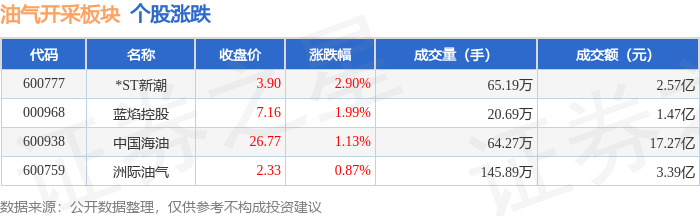
油气开采板块10月10日涨1.52%,*ST新潮领涨,主力资金净流出6662.21万元
Zheng Xing Xing Ye Ri Bao· 2025-10-10 08:52
Group 1 - The oil and gas extraction sector increased by 1.52% on October 10, with *ST Xinchao leading the gains [1] - The Shanghai Composite Index closed at 3897.03, down 0.94%, while the Shenzhen Component Index closed at 13355.42, down 2.7% [1] - The closing prices and percentage changes for key stocks in the oil and gas extraction sector are as follows: *ST Xinchao at 3.90 (+2.90%), Blue Flame Holdings at 7.16 (+1.99%), and China National Offshore Oil at 26.77 (+1.13%) [1] Group 2 - The net capital flow in the oil and gas extraction sector showed a net outflow of 66.62 million yuan from main funds, while retail funds saw a net inflow of 8.75 million yuan [1] - Detailed capital flow for specific stocks indicates that *ST Xinchao experienced a main fund net outflow of 17.53 million yuan, while retail funds had a net inflow of 5.51 million yuan [2] - Other stocks like Blue Flame Holdings and Intercontinental Oil & Gas also reported net outflows from main and speculative funds, with varying net inflows from retail investors [2]