CSEC,China Shenhua(601088)

Search documents
中国神华20250522
2025-07-16 06:13
Summary of Conference Call Records Company Overview - The conference call discusses China Shenhua Energy Company, which operates in multiple sectors including coal, power generation, coal chemical, and transportation [1][2]. Key Financial Metrics - In 2024, the company achieved a revenue of 338.3 billion yuan, a year-on-year decrease of 1.4% [1]. - The net profit attributable to shareholders was 58.6 billion yuan, down 1.7% year-on-year [1]. - In Q1 2024, revenue was 69.5 billion yuan, reflecting a significant year-on-year decline of 41% compared to over 80 billion yuan in Q1 2023 [2]. - The total profit for Q1 2025 is projected to decline by 16.6% [4]. Coal Industry Insights - The coal price has significantly decreased, with the current market price falling below the production and sales costs, impacting overall performance [2]. - The production volume reached 327 million tons in 2024, a year-on-year increase of 0.8%, while sales volume was 459 million tons, supported by policy measures [2]. - The average spot sales price was 617 yuan per ton, down 1.8% year-on-year [3]. Cost and Profitability - The sales cost increased by 1.45% year-on-year, with self-produced coal costs remaining stable at 179 yuan per ton [3]. - The gross profit margin decreased by 2 percentage points to 30% [3]. - The transportation segment saw a decline in gross profit margins due to rising costs, with railway transport turnover increasing by 0.9% [5]. Power Generation Performance - The power generation segment showed resilience, with profits increasing by 2% in 2024, driven by a 5.3% increase in electricity consumption [4]. - However, Q1 2024 saw a decline in total power generation and consumption due to seasonal demand fatigue [4]. Future Outlook and Risks - The company is focusing on new projects in the coal and power sectors, with significant capital expenditures planned [7]. - The projected earnings per share (EPS) for 2025 to 2027 are estimated at 2.72, 2.80, and 2.77 yuan, respectively [8]. - Risks include macroeconomic uncertainties, insufficient domestic demand, and potential impacts from state-owned enterprise reforms [8]. Dividend Policy - The company declared a dividend of 2.26 yuan per share for 2024, with a payout ratio of 76.5%, reflecting a year-on-year increase of 1.3 percentage points [7]. Market and Policy Environment - The company is actively managing its market value and has room for growth despite current challenges [9]. - The credit rating for coal-related businesses remains high, indicating low default risk, although the sector is cyclical [10]. Conclusion - The conference call highlighted the challenges faced by China Shenhua Energy in the coal and power sectors, while also emphasizing the company's strategic focus on new projects and maintaining a strong dividend policy amidst a fluctuating market environment [11].

等待新一轮政策信号前的结构性机会
2025-07-16 06:13
Summary of Conference Call Industry or Company Involved - The conference call primarily discusses the macroeconomic environment, policy signals, and various industry sectors including oil and gas, chemicals, construction materials, and transportation. Core Points and Arguments 1. **Policy Signals and Economic Outlook** - The discussion highlights the anticipation of new policy signals before identifying structural opportunities in the market. The recent easing of tariffs between the US and China is noted, although uncertainty remains regarding future negotiations [1][2][3]. 2. **Impact of Tariffs on Trade** - In April, the US collected approximately $1-2 billion in additional tariffs from China, which is insufficient to offset the fiscal risks posed by tax cuts. This indicates a potential expansion risk in the US fiscal situation [2]. 3. **Domestic Economic Conditions** - The domestic economy shows signs of slowing down, particularly in exports to the US, which have declined due to tariff tensions. There is a concern that the temporary boost in exports may not be sustainable [3][4]. 4. **Fiscal Policy and Debt Issuance** - The Chinese government has been proactive in fiscal policy, issuing a significant amount of debt to stimulate the economy. Approximately 2 trillion yuan of bonds were issued in the last quarter, with expectations for continued issuance [4][5][6]. 5. **Monetary Policy Outlook** - The potential for further monetary easing is discussed, especially as inflation indicators (CPI and PPI) are expected to decline. This could provide more room for liquidity support in the economy [7][8]. 6. **Oil and Gas Sector Analysis** - The oil and gas sector is experiencing a decline in capital expenditure, with a noted 18% drop in the previous year. Demand uncertainties, particularly due to US-China trade relations, are highlighted as a significant concern [10][11]. 7. **Construction Materials and Steel Industry** - The construction materials sector is entering a seasonal downturn, with prices under pressure. However, there are expectations for a rebound in demand as the market transitions from a slow to a peak season [24][26]. 8. **Transportation Sector Insights** - The shipping industry has seen a significant price increase, with container shipping rates doubling in the past month. However, a potential decline in demand is anticipated as the rush for shipping eases [31][32]. 9. **Investment Recommendations** - The call suggests focusing on companies with strong dividend yields and stable fundamentals, particularly in the construction materials and transportation sectors. Specific companies like China Shenhua and Shaanxi Coal are recommended for their strong dividend attributes [29][36]. Other Important but Possibly Overlooked Content 1. **Emerging Opportunities in New Materials** - Companies involved in domestic substitutes for new materials are highlighted as long-term investment opportunities [24]. 2. **Market Sentiment and Stock Performance** - The performance of small-cap stocks is noted, with fluctuations indicating a lack of strong market direction. However, some stocks have shown resilience and potential for recovery [24]. 3. **Global Economic Factors** - The call acknowledges ongoing global uncertainties, including geopolitical tensions and their potential impact on market dynamics, particularly in the commodities sector [19][20]. 4. **Sector-Specific Risks** - The chemical sector faces challenges due to demand uncertainties and potential overcapacity, which could hinder price recovery despite favorable cost conditions [11][12]. 5. **Future Monitoring of Policy Changes** - The need for ongoing observation of policy developments, particularly in fiscal and monetary areas, is emphasized as critical for future investment strategies [6][8].




6月统计局数据点评:火电同比延续正增,进口降幅再度扩大
Changjiang Securities· 2025-07-16 02:11
Investment Rating - The industry investment rating is "Positive" and maintained [9] Core Viewpoints - The report anticipates seasonal improvement in thermal coal demand due to high temperatures in July and August, which may lead to a short-term price recovery for thermal coal. The coal sector is currently underweight, with attractive dividend yields and defensive allocation value [2][25] - For coking coal, there is a rebound in prices driven by strong policy expectations and market sentiment, but the bargaining power of coking coal remains relatively weak in the black industry chain, limiting short-term upside potential [2][34] Supply Summary - Domestic coal production in June reached 42.107 million tons, a year-on-year increase of 3.0% and a month-on-month increase of 4.4%. The total coal production for the first half of the year was 240.5 million tons, up 5.4% year-on-year [6][14] - Coal imports in June fell to 33.04 million tons, a decrease of 25.93% year-on-year and 8.3% month-on-month. Cumulative imports for the first half of the year were 221.7 million tons, down 11.1% year-on-year [18][21] Demand Summary - In June, thermal power generation increased by 1.1% year-on-year and 7.0% month-on-month, with total domestic power generation reaching 796.3 billion kWh, up 1.7% year-on-year [24][27] - Non-electric coal demand, particularly in cement production, saw a decline, with June production at 15.547 million tons, down 5.3% year-on-year [29][33] - The steel sector showed a significant year-on-year decrease in production, with crude steel output in June at 8.318 million tons, down 9.2% year-on-year [33][38] Future Outlook - The report suggests that thermal coal prices may see further support due to seasonal demand increases and the current low inventory levels at power plants. Key factors to monitor include supply conditions, high-temperature weather, and sustained demand release [25][27] - For coking coal, while recent price rebounds are noted, the report indicates limited short-term upside due to weak bargaining power and strong expectations of a seasonal downturn [34][38]


国信证券晨会纪要-20250716



Guoxin Securities· 2025-07-16 01:31
Macro and Strategy - June financial data shows a significant rebound in credit, with new social financing reaching 4.20 trillion yuan, exceeding expectations of 3.71 trillion yuan, and new RMB loans at 2.24 trillion yuan, surpassing the forecast of 1.84 trillion yuan [8][9][10] - The M2 money supply grew by 8.3% year-on-year, indicating a recovery in domestic economic momentum as private sector balance sheet expansion improves [8][9] - The "seesaw effect" between government financing and corporate loans has weakened, suggesting a shift in credit dynamics as local governments approach their annual debt targets [9][10] Retail Industry - The jewelry market is projected to grow steadily, with the market size reaching 728 billion yuan in 2024, reflecting a compound annual growth rate of 3.6% since 2019 [11][12] - The top five companies in the jewelry sector hold a market share of 41.4%, indicating increasing industry concentration as consumer preferences shift towards quality and design [11][12] - The retail sector is benefiting from the recent Amazon Prime Day, which generated an estimated $24.1 billion in sales, a 30% increase year-on-year, highlighting the growth potential in cross-border e-commerce [13][14] Food and Beverage Industry - The food and beverage sector saw a 0.92% increase, underperforming the Shanghai Composite Index by 0.17 percentage points [14] - The liquor market is stabilizing, with major brands focusing on brand positioning and market health, while the overall demand remains under pressure [15][16] - Recommendations include leading brands like Kweichow Moutai and Wuliangye, which have shown resilience and potential for recovery [15][16] Construction and Building Materials - The construction materials sector is expected to improve due to a shift towards healthy competition and urban renewal initiatives, with a focus on technological innovation [17][18] - Cement prices have stabilized, with a slight decrease of 0.4% week-on-week, while demand remains steady despite seasonal fluctuations [17][18] - Recommendations include companies like Three Trees and China National Building Material, which are well-positioned to benefit from domestic demand [18] Computer Industry - The AI ASIC market is rapidly expanding, with a projected market size growth from $14.8 billion in 2024 to $83.8 billion by 2030, reflecting a compound annual growth rate of 33.5% [19][20] - The price advantage of AI ASIC chips over GPUs is significant, with average prices of $5,236 compared to $8,001 for GPUs, making them more attractive for specific applications [19][20] - Companies like Google and Amazon are accelerating their development of ASIC chips, indicating strong future demand in this sector [21] Home Appliances - The home appliance sector is experiencing stable growth in domestic sales, driven by government subsidies, while exports face challenges due to high bases and tariff impacts [22][23] - White goods are seeing a slight increase in domestic sales, with air conditioning units showing a 9.5% growth in domestic shipments [22][23] - Recommendations include leading brands such as Midea and Gree, which are expected to maintain strong performance [22][23] Pharmaceutical Industry - Merck's acquisition of Verona for $10 billion aims to enhance its portfolio with a new COPD treatment, indicating strong growth potential in respiratory therapies [27][28] - WuXi AppTec is projected to achieve a 102% increase in net profit for the first half of 2025, reflecting robust operational performance [29] - The pharmaceutical sector is showing resilience, with a focus on innovative treatments and strategic acquisitions [27][28] Coal Industry - The coal market is expected to stabilize as domestic production increases and imports decrease, with a projected production of 4.85 billion tons in 2025, a 2% increase year-on-year [31][32] - Demand for coal is anticipated to improve in the second half of the year, particularly for non-electric uses such as chemical production [33] - Recommendations include leading coal companies like China Shenhua and China Coal Energy, which are well-positioned to benefit from market dynamics [34] Electronics Industry - The electronics sector is experiencing positive momentum, with a 0.93% increase in stock performance, driven by strong demand in the optical and semiconductor segments [34] - The industry is expected to see significant catalysts in the coming months, particularly in the context of AI and cloud computing advancements [34] - Companies involved in ASIC development are likely to benefit from the ongoing trends in computing and data processing [34]
428家公司预计净利润翻倍
Sou Hu Cai Jing· 2025-07-16 01:08
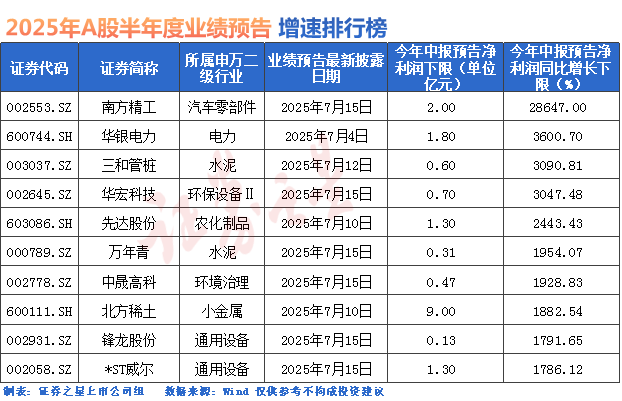
Group 1 - A total of 1525 A-share listed companies disclosed their mid-year performance forecasts, with 662 companies expecting positive growth, representing 43.41% of the total [2] - The industries showing strong performance include biomedicine, basic chemicals, artificial intelligence, semiconductors, rare earths, gold, and securities [2] - 869 companies are expected to see a year-on-year net profit increase, with 428 companies forecasting over 100% growth [3] Group 2 - China Shenhua is projected to have the highest net profit at 25.6 billion yuan, followed by Zijin Mining and Guotai Junan with 23.2 billion yuan and 19.557 billion yuan respectively [3][4] - Companies like Lixun Precision and Xinyisheng are experiencing significant growth due to their strategic positioning and market demand, particularly in high-end manufacturing and AI-related investments [4] - Some companies have seen their stock prices surge significantly following positive earnings forecasts, with Huayin Power's stock hitting the limit up six times in seven days [5] Group 3 - Analysts predict an overall improvement in A-share performance in the second half of the year, driven by a moderate recovery in the macro economy and sustained high demand in sectors like electronics and communications [5] - The focus on expanding domestic demand is expected to benefit leading companies in consumer sectors such as automotive and home appliances [5]






中国神华20250715
2025-07-16 00:55
Summary of China Shenhua's Conference Call Company Overview - **Company**: China Shenhua Energy Company Limited - **Industry**: Coal and Power Generation Key Points and Arguments Industry and Market Dynamics - China Shenhua is actively responding to pressures in the coal market by expanding production, increasing sales, and reducing costs to maintain a competitive edge. The complete cost of coal resources remains below 300 RMB, ensuring profitability [2][3] - In the first half of 2025, coal prices experienced a significant decline, with spot prices at northern ports dropping over 25% compared to the previous year. However, a rebound was noted in July due to rising temperatures and increased electricity demand [4][5] - The coal industry is currently experiencing a rebound after a period of significant price drops, but long-term pressures from the development of new energy systems are expected to keep prices under pressure in the fourth quarter and beyond [6] Company Performance and Strategy - China Shenhua's long-term contract signing and fulfillment rates are strong, with a high reliance on long-term contracts for coal supply to power plants, which helps stabilize supply amidst market fluctuations [2][7] - The company has implemented effective cost control measures, resulting in improved performance in production costs, including labor and consumable costs [3] - Despite the decline in coal prices, thermal power remains the mainstay of electricity supply, indicating that the importance of coal and thermal power will not change easily [2][9] Financial Outlook and Dividends - China Shenhua maintains a high return and sustainable dividend policy, with a three-year return plan (2025-2027) set at no less than 65%. The company is also exploring mid-term profit distribution to support this policy [2][18] - The company reported a profit increase in Q2 2025, attributed to effective cost control measures, and plans to continue these efforts in the second half of the year [20] Challenges and Future Considerations - The company faces challenges from price inversions and changes in supply-demand relationships, with long-term contract prices currently at 666 RMB while spot prices are at 632 RMB [12] - There are no clear indications of a new round of supply-side reforms, but ongoing market changes and structural adjustments are being monitored [8] - The construction of a unified national market is expected to have a profound impact on the coal and electricity sectors, promoting self-regulation and competition [15] Operational Measures - China Shenhua has initiated a "100-day safety production campaign" to enhance production efficiency and market share, achieving significant results in cost control and operational efficiency [11][21] - The company is committed to maintaining strict cost management, including labor costs, to enhance competitiveness in the current challenging market environment [19] Future Outlook - Despite current pressures, China Shenhua is confident in its integrated industrial chain advantages and aims to achieve its annual targets while contributing to the healthy development of the Chinese capital market [24] Additional Important Information - The half-year report is scheduled for release at the end of August, which will include detailed production, sales, and financial information [23]
A股逾1500家公司预告中报业绩 428家公司预计净利润翻倍
Shen Zhen Shang Bao· 2025-07-15 16:44
Group 1 - As of July 15, 2025, 1,525 A-share listed companies disclosed their mid-year performance forecasts, with 662 companies expecting profit increases, accounting for 43.41% of the total [1] - 857 companies forecasted profit declines, representing 56.19% of the total, while 6 companies had uncertain forecasts [1] - Industries such as biomedicine, basic chemicals, artificial intelligence, semiconductors, rare earths, gold, and securities showed strong performance [1] Group 2 - A total of 869 companies expect a year-on-year profit increase, with 428 companies forecasting over 100% growth [1] - Notable companies with significant profit growth include Southern Precision with a 35,784% increase, Huayin Power with 4,423%, and Sanhe Pile with 3,889% [1] Group 3 - China Shenhua leads in net profit forecasts, expecting a maximum of 25.6 billion yuan, followed by Zijin Mining and Guotai Junan with 23.2 billion yuan and 19.557 billion yuan respectively [3] - 139 companies expect net profits exceeding 500 million yuan, with 72 companies forecasting over 1 billion yuan [3] Group 4 - Leading companies attribute their performance growth to various factors, such as Lixun Precision's strong risk resistance and global production capacity optimization [4] - New Yisheng benefits from increased demand for AI-related computing power and product structure optimization [4] - Huayin Power's significant profit increase is attributed to higher electricity generation and lower fuel costs [4] Group 5 - Some companies experienced significant stock price increases following their performance forecasts, with Huayin Power's stock hitting 6 limit-ups in 7 days [5] - Analysts predict an overall improvement in A-share performance in the second half of the year, driven by a moderate economic recovery and high demand in sectors like electronics and communications [5]



半年盘点|煤价持续下探,多家煤企预告上半年业绩亏损
Di Yi Cai Jing· 2025-07-15 14:39
Group 1: Industry Overview - The coal market is experiencing a significant oversupply, with production increasing while consumption grows at a slower pace, leading to a structural imbalance [3] - The average coal price has been declining, with the spot price for 5500 kcal thermal coal dropping to 623 yuan per ton, a year-on-year decrease of 257 yuan [2] - The total profit of the coal industry in the first five months of the year fell to 126.4 billion yuan, a year-on-year decline of 50.6%, with 53.6% of companies reporting losses [2] Group 2: Company Performance - Yongtai Energy (600157.SH) expects a net profit of 120 to 150 million yuan for the first half of the year, a decline of 89.9% to 87.4% year-on-year, primarily due to a temporary decrease in power generation and falling coal prices [1] - Dayou Energy (600403.SH) anticipates a net loss of 820 million yuan for the first half of the year, an increase in loss of 330 million yuan year-on-year, attributed to a 29% drop in average coal prices [1] - China Shenhua (601088.SH) projects a net profit of 23.6 to 25.6 billion yuan for the first half of the year, a decline of 13.2% to 20% year-on-year, due to decreased sales volume and average selling prices [2] Group 3: Future Outlook - The coal industry is expected to continue facing downward pressure on prices, with a forecast for the third quarter indicating a continued decline, although there may be temporary rebounds during peak electricity demand periods [4] - Companies are planning to respond to the challenging market conditions by improving production quality and implementing refined management practices [4]


煤炭行业2025年中期投资策略:煤价探底,基本面向好
Guoxin Securities· 2025-07-15 09:27
Supply: Marginal Increment Significantly Reduced - Domestic coal production from January to May increased by approximately 130 million tons year-on-year, while imports decreased by about 16 million tons, indicating an overall increase in supply [3][7] - The domestic raw coal production reached 1.99 billion tons from January to May, reflecting a year-on-year increase of 6%. However, the growth rate is expected to narrow in the second half of the year, with an estimated total production of around 4.85 billion tons for 2025, representing a year-on-year increase of 9 million tons (2%) [3][9] - The decrease in imports is attributed to weak demand, high inventory levels, and diminishing price advantages of imported coal. For the first five months of 2025, coal imports totaled 19 million tons, a year-on-year decrease of approximately 16 million tons (8%) [3][64] Demand: Short-term Improvement Expected, Medium-term Resilience Visible - National commodity coal consumption from January to May reached 2.05 billion tons, showing a slight year-on-year increase of 0.1 billion tons (0.5%). The demand is expected to improve in the second half of the year as the consumption peak season approaches [3][4] - In the thermal power sector, the demand is under pressure due to slowing electricity growth and competition from renewable energy. However, the demand for thermal power is expected to rebound in the second half of the year [3][4] - Non-electric demand, particularly from the chemical sector, remains strong, with significant year-on-year growth in coal-to-PVC, coal-to-ethylene glycol, and coal-to-methanol production [3][4] Inventory: High Port Inventory Declining, De-stocking Remains Focus - Port inventories are currently at high levels but are expected to decline as demand improves in the peak consumption season. The focus will remain on de-stocking [4] Price: Thermal Coal Prices at Bottom, Coking Coal Prices Showing Stages of Rebound - The average market price of Qinhuangdao Q5500 thermal coal fell by approximately 199 yuan/ton in the first half of 2025, a year-on-year decrease of 23%. However, there is potential for price rebound as supply-demand dynamics improve [3][57] Investment Recommendations: High Dividend Value Still Exists, Stage Game Elasticity - The report suggests that despite the downward pressure on coal prices, there is still potential for a rebound in the second half of the year. The resilience of coal demand is viewed positively in the medium term [3][4] - Key investment targets include stable-performing coal companies such as China Shenhua, China Coal Energy, and Shaanxi Coal and Chemical Industry, as well as elastic stocks like Electric Power Investment and Jinko Coal Industry [3][4]


多家A股公司公布上半年业绩预告!“预增王”、“盈利王”都是谁
Zheng Quan Zhi Xing· 2025-07-15 08:33
Group 1 - The A-share market is experiencing a wave of impressive performance forecasts for the first half of 2025, with several companies showing significant growth and large-scale leaders emerging [1] - Southern Precision (002553) leads the net profit growth ranking with an astonishing increase of nearly 300 times, driven by investment income [1][2] - Huayin Power (600744) and Sanhe Pile (003037) follow with net profit growth exceeding 30 times, indicating strong performance in their respective sectors [1][2] Group 2 - Southern Precision forecasts a net profit of 200 million to 250 million yuan for the first half of 2025, representing a year-on-year increase of 28,647% to 35,784% [2] - The significant growth for Southern Precision is attributed to changes in the fair value of external investments and gains from the reduction of external investment equity, impacting pre-tax profit by approximately 174 million to 194 million yuan [2] - Huayin Power ranks second with a 36-fold increase in net profit, primarily due to increased power generation and reduced fuel costs [3] Group 3 - Sanhe Pile ranks third with a nearly 31-fold increase in net profit, driven by market demand and a focus on core business areas, particularly in emerging sectors like photovoltaics and hydropower [3] - China Shenhua (601088) remains the "profit king" despite a slight decline in performance, with a net profit forecast of 236 million yuan, down 15.7% year-on-year [4][5] - Zijin Mining (601899) ranks second in net profit scale with 232 million yuan, benefiting from a 25.84% increase in international gold prices and a 17% rise in gold production [6] Group 4 - Guotai Junan (601211) ranks third in net profit scale with 152.83 million yuan, attributed to rapid growth in wealth management and proprietary investment businesses [6] - The coal industry outlook is improving due to seasonal demand increases and regulatory policies, with current coal prices at a temporary low [5]