
SHCI(601225)

Search documents
中证内地资源主题指数上涨0.29%,前十大权重包含中国海油等
Jin Rong Jie· 2025-07-17 10:42
Core Viewpoint - The China Securities Index for domestic resources has shown positive performance, with a recent increase in value and significant year-to-date growth, indicating a favorable market trend for resource-related stocks [1]. Group 1: Index Performance - The China Securities Index for domestic resources rose by 0.29% to 3511.13 points, with a trading volume of 35.435 billion yuan [1]. - Over the past month, the index has increased by 1.37%, by 5.59% over the last three months, and by 5.12% year-to-date [1]. Group 2: Index Composition - The top ten holdings in the China Securities Index for domestic resources are: Zijin Mining (15.56%), China Shenhua (6.62%), China Petroleum (5.46%), China Petrochemical (4.52%), Northern Rare Earth (4.1%), Shaanxi Coal and Chemical (3.98%), China National Offshore Oil (3.32%), Luoyang Molybdenum (3.07%), China Aluminum (3.06%), and Shandong Gold (2.99%) [1]. - The index is primarily composed of the materials sector (68.47%) and the energy sector (31.53%) [2]. Group 3: Market Structure - The Shanghai Stock Exchange accounts for 78.58% of the index's holdings, while the Shenzhen Stock Exchange represents 21.42% [1]. - The index samples are adjusted biannually, with changes implemented on the next trading day following the second Friday of June and December [2]. Group 4: Related Funds - Public funds tracking the domestic resources index include Minsheng Jianyin China Securities Domestic Resources C and Minsheng Jianyin China Securities Domestic Resources A [3].



陕西煤业(601225):西北煤炭明珠,聚焦构建“煤电一体化”发展格局
Dongxing Securities· 2025-07-17 02:23
Investment Rating - The report gives a "Strong Buy" rating for Shaanxi Coal Industry [2][69] Core Views - Shaanxi Coal Industry focuses on building a "coal-electricity integration" development model, enhancing operational stability and profitability through strategic acquisitions and investments [3][11][69] - The company has shown resilience in performance despite declining coal prices, with stable revenue and profit growth [27][28][69] - The upcoming summer coal demand and regulatory changes are expected to support a rebound in coal prices, positively impacting the company's performance [12][59] Summary by Sections Company Overview - Shaanxi Coal Industry is the only large-scale listed coal enterprise in Shaanxi, primarily engaged in coal mining, washing, transportation, and sales [3][24] - The company is backed by Shaanxi Coal Group, which holds 65.25% of its shares [3][24] Financial Performance - In 2024, the company achieved a revenue of CNY 1841.45 billion, a year-on-year increase of 7.77%, and a net profit of CNY 223.60 billion, up 5.28% [27][28] - In Q1 2025, despite a 0.71% decline in revenue to CNY 401.62 billion, net profit rose by 3.29% to CNY 48.05 billion [28][69] Resource and Production - The company has abundant coal resources, with a total resource volume of 17.931 billion tons and a mining life of over 70 years [4][38] - In 2024, coal production reached a historical high of 170.4846 million tons, a 4.13% increase year-on-year [43][44] Railway Infrastructure - The company has developed a self-operated railway network to support its coal business, enhancing logistics and market reach [5][52] - In 2023, railway transport volume was 167.1896 million tons, a 35.21% increase, while in 2024, it slightly decreased to 166.2825 million tons [5][52] Electricity Business - The acquisition of Shaanxi Coal Power in 2024 has enabled the company to implement a "coal-electricity integration" model, enhancing profitability [11][54] - In 2024, total electricity generation was 37.615 billion kWh, a 4.41% increase, with electricity revenue of CNY 16.176 billion [11][54] Investment and Dividends - The company plans to significantly increase capital expenditure in 2025 to CNY 135.59 billion, with a focus on electricity projects [61][69] - The company maintains a high dividend payout, with total cash dividends reaching CNY 13.070 billion in 2024, representing 58.45% of net profit [12][64]

等待新一轮政策信号前的结构性机会
2025-07-16 06:13
Summary of Conference Call Industry or Company Involved - The conference call primarily discusses the macroeconomic environment, policy signals, and various industry sectors including oil and gas, chemicals, construction materials, and transportation. Core Points and Arguments 1. **Policy Signals and Economic Outlook** - The discussion highlights the anticipation of new policy signals before identifying structural opportunities in the market. The recent easing of tariffs between the US and China is noted, although uncertainty remains regarding future negotiations [1][2][3]. 2. **Impact of Tariffs on Trade** - In April, the US collected approximately $1-2 billion in additional tariffs from China, which is insufficient to offset the fiscal risks posed by tax cuts. This indicates a potential expansion risk in the US fiscal situation [2]. 3. **Domestic Economic Conditions** - The domestic economy shows signs of slowing down, particularly in exports to the US, which have declined due to tariff tensions. There is a concern that the temporary boost in exports may not be sustainable [3][4]. 4. **Fiscal Policy and Debt Issuance** - The Chinese government has been proactive in fiscal policy, issuing a significant amount of debt to stimulate the economy. Approximately 2 trillion yuan of bonds were issued in the last quarter, with expectations for continued issuance [4][5][6]. 5. **Monetary Policy Outlook** - The potential for further monetary easing is discussed, especially as inflation indicators (CPI and PPI) are expected to decline. This could provide more room for liquidity support in the economy [7][8]. 6. **Oil and Gas Sector Analysis** - The oil and gas sector is experiencing a decline in capital expenditure, with a noted 18% drop in the previous year. Demand uncertainties, particularly due to US-China trade relations, are highlighted as a significant concern [10][11]. 7. **Construction Materials and Steel Industry** - The construction materials sector is entering a seasonal downturn, with prices under pressure. However, there are expectations for a rebound in demand as the market transitions from a slow to a peak season [24][26]. 8. **Transportation Sector Insights** - The shipping industry has seen a significant price increase, with container shipping rates doubling in the past month. However, a potential decline in demand is anticipated as the rush for shipping eases [31][32]. 9. **Investment Recommendations** - The call suggests focusing on companies with strong dividend yields and stable fundamentals, particularly in the construction materials and transportation sectors. Specific companies like China Shenhua and Shaanxi Coal are recommended for their strong dividend attributes [29][36]. Other Important but Possibly Overlooked Content 1. **Emerging Opportunities in New Materials** - Companies involved in domestic substitutes for new materials are highlighted as long-term investment opportunities [24]. 2. **Market Sentiment and Stock Performance** - The performance of small-cap stocks is noted, with fluctuations indicating a lack of strong market direction. However, some stocks have shown resilience and potential for recovery [24]. 3. **Global Economic Factors** - The call acknowledges ongoing global uncertainties, including geopolitical tensions and their potential impact on market dynamics, particularly in the commodities sector [19][20]. 4. **Sector-Specific Risks** - The chemical sector faces challenges due to demand uncertainties and potential overcapacity, which could hinder price recovery despite favorable cost conditions [11][12]. 5. **Future Monitoring of Policy Changes** - The need for ongoing observation of policy developments, particularly in fiscal and monetary areas, is emphasized as critical for future investment strategies [6][8].




陕西煤业20250711
2025-07-16 06:13
Summary of Conference Call Company and Industry - The conference call primarily discusses the coal industry and a specific coal company’s performance and market conditions. Key Points and Arguments 1. **Price Stability**: The average selling price of coal has stabilized around 380, with slight increases noted in June compared to May, which was also around 380 [1][2] 2. **Market Recovery**: There are indications of market recovery as the price has returned to approximately 390 or above, although real-time comprehensive data is not available [2] 3. **Import Coal Predictions**: It is anticipated that coal imports will decrease, with projections suggesting a reduction of several million tons for the year [3] 4. **Production Capacity**: The company is operating at full production capacity, indicating limited room for growth in output [4] 5. **Regulatory Environment**: There are ongoing discussions about expediting the approval process for new mining projects, which is currently complex and time-consuming [5] 6. **Industry Self-Regulation Challenges**: The coal industry faces challenges in self-regulation, necessitating administrative intervention due to the complexity and diversity of enterprises involved [6][7] 7. **Sales Strategy**: The company is focused on maintaining profit margins through strategic sales policies, despite the current market conditions [8] 8. **Dividend Policy**: The company plans to maintain or increase dividend payouts, reflecting confidence in financial performance despite price fluctuations [9] 9. **Cost Management**: The production cost is stable at around 290, with expectations that costs will remain manageable throughout the year [10] 10. **Long-term Resource Availability**: The company estimates that current resources can sustain production for approximately 70 years, assuming no significant depletion occurs [15][16] Other Important but Overlooked Content - **Impact of Freight Costs**: The discussion includes the implications of freight costs on revenue and how they are accounted for in financial reporting [12][14] - **Coal Production Data**: Clarification on the production data and how certain companies are not included in the reported figures [16] - **Electricity Generation Contribution**: The coal company’s contribution to electricity generation is noted, with figures indicating a slight increase in revenue from this segment [17][18] This summary encapsulates the essential insights from the conference call, highlighting the company's current market position, strategic outlook, and operational challenges within the coal industry.
6月统计局数据点评:火电同比延续正增,进口降幅再度扩大
Changjiang Securities· 2025-07-16 02:11
Investment Rating - The industry investment rating is "Positive" and maintained [9] Core Viewpoints - The report anticipates seasonal improvement in thermal coal demand due to high temperatures in July and August, which may lead to a short-term price recovery for thermal coal. The coal sector is currently underweight, with attractive dividend yields and defensive allocation value [2][25] - For coking coal, there is a rebound in prices driven by strong policy expectations and market sentiment, but the bargaining power of coking coal remains relatively weak in the black industry chain, limiting short-term upside potential [2][34] Supply Summary - Domestic coal production in June reached 42.107 million tons, a year-on-year increase of 3.0% and a month-on-month increase of 4.4%. The total coal production for the first half of the year was 240.5 million tons, up 5.4% year-on-year [6][14] - Coal imports in June fell to 33.04 million tons, a decrease of 25.93% year-on-year and 8.3% month-on-month. Cumulative imports for the first half of the year were 221.7 million tons, down 11.1% year-on-year [18][21] Demand Summary - In June, thermal power generation increased by 1.1% year-on-year and 7.0% month-on-month, with total domestic power generation reaching 796.3 billion kWh, up 1.7% year-on-year [24][27] - Non-electric coal demand, particularly in cement production, saw a decline, with June production at 15.547 million tons, down 5.3% year-on-year [29][33] - The steel sector showed a significant year-on-year decrease in production, with crude steel output in June at 8.318 million tons, down 9.2% year-on-year [33][38] Future Outlook - The report suggests that thermal coal prices may see further support due to seasonal demand increases and the current low inventory levels at power plants. Key factors to monitor include supply conditions, high-temperature weather, and sustained demand release [25][27] - For coking coal, while recent price rebounds are noted, the report indicates limited short-term upside due to weak bargaining power and strong expectations of a seasonal downturn [34][38]

国信证券晨会纪要-20250716



Guoxin Securities· 2025-07-16 01:31
Macro and Strategy - June financial data shows a significant rebound in credit, with new social financing reaching 4.20 trillion yuan, exceeding expectations of 3.71 trillion yuan, and new RMB loans at 2.24 trillion yuan, surpassing the forecast of 1.84 trillion yuan [8][9][10] - The M2 money supply grew by 8.3% year-on-year, indicating a recovery in domestic economic momentum as private sector balance sheet expansion improves [8][9] - The "seesaw effect" between government financing and corporate loans has weakened, suggesting a shift in credit dynamics as local governments approach their annual debt targets [9][10] Retail Industry - The jewelry market is projected to grow steadily, with the market size reaching 728 billion yuan in 2024, reflecting a compound annual growth rate of 3.6% since 2019 [11][12] - The top five companies in the jewelry sector hold a market share of 41.4%, indicating increasing industry concentration as consumer preferences shift towards quality and design [11][12] - The retail sector is benefiting from the recent Amazon Prime Day, which generated an estimated $24.1 billion in sales, a 30% increase year-on-year, highlighting the growth potential in cross-border e-commerce [13][14] Food and Beverage Industry - The food and beverage sector saw a 0.92% increase, underperforming the Shanghai Composite Index by 0.17 percentage points [14] - The liquor market is stabilizing, with major brands focusing on brand positioning and market health, while the overall demand remains under pressure [15][16] - Recommendations include leading brands like Kweichow Moutai and Wuliangye, which have shown resilience and potential for recovery [15][16] Construction and Building Materials - The construction materials sector is expected to improve due to a shift towards healthy competition and urban renewal initiatives, with a focus on technological innovation [17][18] - Cement prices have stabilized, with a slight decrease of 0.4% week-on-week, while demand remains steady despite seasonal fluctuations [17][18] - Recommendations include companies like Three Trees and China National Building Material, which are well-positioned to benefit from domestic demand [18] Computer Industry - The AI ASIC market is rapidly expanding, with a projected market size growth from $14.8 billion in 2024 to $83.8 billion by 2030, reflecting a compound annual growth rate of 33.5% [19][20] - The price advantage of AI ASIC chips over GPUs is significant, with average prices of $5,236 compared to $8,001 for GPUs, making them more attractive for specific applications [19][20] - Companies like Google and Amazon are accelerating their development of ASIC chips, indicating strong future demand in this sector [21] Home Appliances - The home appliance sector is experiencing stable growth in domestic sales, driven by government subsidies, while exports face challenges due to high bases and tariff impacts [22][23] - White goods are seeing a slight increase in domestic sales, with air conditioning units showing a 9.5% growth in domestic shipments [22][23] - Recommendations include leading brands such as Midea and Gree, which are expected to maintain strong performance [22][23] Pharmaceutical Industry - Merck's acquisition of Verona for $10 billion aims to enhance its portfolio with a new COPD treatment, indicating strong growth potential in respiratory therapies [27][28] - WuXi AppTec is projected to achieve a 102% increase in net profit for the first half of 2025, reflecting robust operational performance [29] - The pharmaceutical sector is showing resilience, with a focus on innovative treatments and strategic acquisitions [27][28] Coal Industry - The coal market is expected to stabilize as domestic production increases and imports decrease, with a projected production of 4.85 billion tons in 2025, a 2% increase year-on-year [31][32] - Demand for coal is anticipated to improve in the second half of the year, particularly for non-electric uses such as chemical production [33] - Recommendations include leading coal companies like China Shenhua and China Coal Energy, which are well-positioned to benefit from market dynamics [34] Electronics Industry - The electronics sector is experiencing positive momentum, with a 0.93% increase in stock performance, driven by strong demand in the optical and semiconductor segments [34] - The industry is expected to see significant catalysts in the coming months, particularly in the context of AI and cloud computing advancements [34] - Companies involved in ASIC development are likely to benefit from the ongoing trends in computing and data processing [34]
电力行业跟踪报告:对标产业交易估值,火电资产显著低估
Haitong Securities International· 2025-07-15 11:37
Investment Rating - The report suggests that domestic thermal power companies have low PE valuations and potential for higher dividends, with overseas leaders like Duke Energy having PEs around 20 [2][10]. Core Insights - The report highlights that thermal power asset acquisition/sale transactions have PB valuations significantly higher than the secondary market valuations for thermal power stocks, indicating that thermal power stocks are undervalued [1][11]. - It notes that since 2022, there have been multiple asset transactions, primarily in northern and central regions, with 7 acquisitions (4 by power companies and 3 by coal companies) and 4 sales (all by power companies) [2][10]. - The median PB valuation for thermal power assets in these transactions is 1.3, while the median PB for listed thermal power companies is 0.9, suggesting a disparity in valuation [11][12]. - The median PE valuation for thermal power assets exceeds 10, with a range of 7.2 to 31.8 for the relevant transactions, indicating that industry capital values thermal assets at a premium [12]. Summary by Sections Investment Advice - Domestic thermal power companies are viewed as having low PE valuations with room for dividend increases, while international leaders are valued around 20 times PE [2][10]. Asset Transactions - The report details 11 acquisition/sale cases, with 3 having negative book values but acquired at a premium, and the remaining 8 having PBs ranging from 1.0 to 2.6 [11][12]. - The report emphasizes that the thermal power sector is experiencing significant asset transactions, particularly in the northern and central regions of China [2][10]. Valuation Metrics - The report indicates that the median PB for thermal power assets is 1.3, compared to 0.9 for listed companies, highlighting the undervaluation of thermal power stocks [11][12]. - The median PE for thermal power assets is noted to be over 10, with a range of 7.2 to 31.8, suggesting that industry capital values thermal assets at a higher level than the secondary market [12].




煤炭行业资金流出榜:永泰能源、陕西煤业等净流出资金居前
Zheng Quan Shi Bao Wang· 2025-07-15 09:27
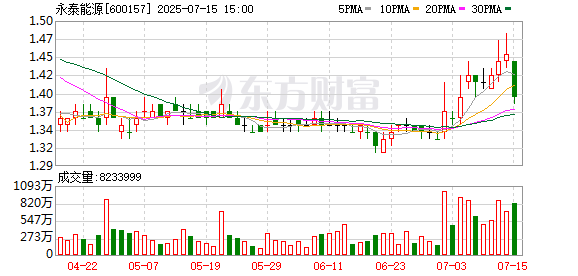
Market Overview - The Shanghai Composite Index fell by 0.42% on July 15, with six industries rising, led by telecommunications and computers, which increased by 4.61% and 1.42% respectively [2] - The coal industry experienced the largest decline, dropping by 1.92% [2] Capital Flow - The main capital outflow from the two markets totaled 41.186 billion yuan, with only three industries seeing net inflows: telecommunications (2.151 billion yuan), computers (1.839 billion yuan), and a minor inflow in the comprehensive sector (178.56 thousand yuan) [2] - The power equipment industry had the highest net outflow, totaling 5.055 billion yuan, followed by the non-ferrous metals industry with a net outflow of 4.508 billion yuan [2] Coal Industry Analysis - The coal industry saw a net outflow of 8.81 million yuan, with 37 stocks in the sector; only three stocks rose while 33 fell [3] - The top net inflow stock in the coal sector was Xinji Energy, with an inflow of 28.766 million yuan, followed by Yunwei Co. and Xindaozhou A, with inflows of 6.0482 million yuan and 3.6807 million yuan respectively [3][5] - Major stocks with significant net outflows included Yongtai Energy (net outflow of 118.2494 million yuan), Shaanxi Coal and Energy (78.1593 million yuan), and Shanxi Coking Coal (69.0028 million yuan) [4] Individual Stock Performance - The following stocks in the coal industry had notable declines: - Yongtai Energy: -4.14% with a turnover rate of 3.77% and a net outflow of 118.2494 million yuan [4] - Shaanxi Coal and Energy: -1.64% with a turnover rate of 0.48% and a net outflow of 78.1593 million yuan [4] - Shanxi Coking Coal: -3.01% with a turnover rate of 1.73% and a net outflow of 69.0028 million yuan [4]


煤炭行业2025年中期投资策略:煤价探底,基本面向好
Guoxin Securities· 2025-07-15 09:27
Supply: Marginal Increment Significantly Reduced - Domestic coal production from January to May increased by approximately 130 million tons year-on-year, while imports decreased by about 16 million tons, indicating an overall increase in supply [3][7] - The domestic raw coal production reached 1.99 billion tons from January to May, reflecting a year-on-year increase of 6%. However, the growth rate is expected to narrow in the second half of the year, with an estimated total production of around 4.85 billion tons for 2025, representing a year-on-year increase of 9 million tons (2%) [3][9] - The decrease in imports is attributed to weak demand, high inventory levels, and diminishing price advantages of imported coal. For the first five months of 2025, coal imports totaled 19 million tons, a year-on-year decrease of approximately 16 million tons (8%) [3][64] Demand: Short-term Improvement Expected, Medium-term Resilience Visible - National commodity coal consumption from January to May reached 2.05 billion tons, showing a slight year-on-year increase of 0.1 billion tons (0.5%). The demand is expected to improve in the second half of the year as the consumption peak season approaches [3][4] - In the thermal power sector, the demand is under pressure due to slowing electricity growth and competition from renewable energy. However, the demand for thermal power is expected to rebound in the second half of the year [3][4] - Non-electric demand, particularly from the chemical sector, remains strong, with significant year-on-year growth in coal-to-PVC, coal-to-ethylene glycol, and coal-to-methanol production [3][4] Inventory: High Port Inventory Declining, De-stocking Remains Focus - Port inventories are currently at high levels but are expected to decline as demand improves in the peak consumption season. The focus will remain on de-stocking [4] Price: Thermal Coal Prices at Bottom, Coking Coal Prices Showing Stages of Rebound - The average market price of Qinhuangdao Q5500 thermal coal fell by approximately 199 yuan/ton in the first half of 2025, a year-on-year decrease of 23%. However, there is potential for price rebound as supply-demand dynamics improve [3][57] Investment Recommendations: High Dividend Value Still Exists, Stage Game Elasticity - The report suggests that despite the downward pressure on coal prices, there is still potential for a rebound in the second half of the year. The resilience of coal demand is viewed positively in the medium term [3][4] - Key investment targets include stable-performing coal companies such as China Shenhua, China Coal Energy, and Shaanxi Coal and Chemical Industry, as well as elastic stocks like Electric Power Investment and Jinko Coal Industry [3][4]


能源周报(20250707-20250713):美或进一步对俄制裁,本周油价上涨-20250714
Huachuang Securities· 2025-07-14 09:12
Investment Strategy - Crude oil supply is expected to remain limited due to declining global oil and gas capital expenditures, with a significant reduction of nearly 122% from 2014 levels to $351 billion in 2021 [9][30][31] - Geopolitical tensions, particularly the Russia-Ukraine conflict, have exacerbated concerns over energy supply, with the EU planning to reduce oil imports from Russia by 90% by the end of 2022 [10][31] - Brent crude oil prices increased to $71.97 per barrel, up 2.95% week-on-week, while WTI prices rose to $67.93 per barrel, up 2.46% [11][32] Coal Industry - The average market price for Qinhuangdao port thermal coal (Q5500) rose to 628 RMB/ton, a 1.06% increase from the previous week, driven by improved demand and trading conditions [12][13] - Coal production is gradually recovering, with total inventory at ports reported at 26.9 million tons, down 2.46% week-on-week, indicating a tightening supply [12][13] - The domestic coal consumption for key power plants increased to 4.88 million tons per day, a 6.09% rise from the previous week, reflecting higher electricity demand due to ongoing high temperatures [12][13] Coking Coal - Coking coal prices have seen a slight increase, with the price for Shanxi main coking coal at 1,350 RMB/ton, up 9.76% week-on-week, as supply conditions improve [14][15] - The overall supply-demand situation for coking coal is improving, with increased orders from steel mills and a decrease in inventory levels [14][15] Natural Gas - The EIA projects that U.S. natural gas production and consumption will reach record highs in 2025, with expected consumption of 91.4 billion cubic feet per day [16][17] - U.S. natural gas prices decreased to $3.33 per million British thermal units, down 2.9% from the previous week, while European gas prices increased [16][17] - The EU has reached an agreement on a natural gas price cap, which may lead to liquidity issues and potential supply shortages [17] Oilfield Services - The oilfield services sector is experiencing a recovery in demand due to increased capital expenditures from major oil companies, which are projected to reach 581.738 billion RMB in 2023, reflecting a compound annual growth rate of 6% since 2018 [18][19] - The number of active drilling rigs globally decreased to 1,576, with a notable decline in the Middle East and the U.S. [19]


