CMES(601872)

Search documents
招商轮船股价跌5.08%,易方达基金旗下1只基金位居十大流通股东,持有4100.64万股浮亏损失1886.3万元
Xin Lang Cai Jing· 2025-10-15 03:10
Core Points - The stock price of China Merchants Energy Shipping Co., Ltd. dropped by 5.08% to 8.60 CNY per share, with a trading volume of 377 million CNY and a turnover rate of 0.53%, resulting in a total market capitalization of 69.441 billion CNY [1] Company Overview - China Merchants Energy Shipping Co., Ltd. is located at No. 9 Zhongshan East Road, Shanghai, and was established on December 31, 2004, with its listing date on December 1, 2006 [1] - The company primarily engages in international crude oil, domestic and international dry bulk, domestic roll-on/roll-off, and domestic and international general cargo shipping [1] - The revenue composition of the company includes: 86.38% from transportation services, 6.75% from other income, 4.77% from merchandise sales, and 2.10% from shipping support services [1] Shareholder Information - E Fund's Hu Shen 300 ETF (510310) is among the top ten circulating shareholders of China Merchants Energy Shipping, having increased its holdings by 3.7813 million shares in Q2, totaling 41.0064 million shares, which represents 0.51% of the circulating shares [2] - The fund has a current scale of 266.516 billion CNY and has achieved a year-to-date return of 17.99%, ranking 2762 out of 4220 in its category [2] - The fund manager, Yu Haiyan, has a tenure of 14 years and 314 days, with a total asset scale of 385.764 billion CNY, achieving a best return of 159.9% during the tenure [2]

快递“反内卷”有望带来业绩修复,中美互征港口费有望带动航运运价上行 | 投研报告
Zhong Guo Neng Yuan Wang· 2025-10-14 03:15
Core Viewpoints - The transportation industry is experiencing a decline in passenger flight volumes following the National Day holiday, with overall and domestic flight volumes down by 0.6% week-on-week, but still above 2019 levels [1][3] - The implementation of reciprocal port fees between China and the US is expected to impact over 40% of shipping capacity, with Chinese shipping companies being the most affected [2] Shipping Industry - The upcoming US port fee measures will take effect on October 14, prompting China to respond with special port fees for US vessels [2] - Different shipping segments will experience varying impacts, with container shipping likely facing the least disruption, while oil and dry bulk shipping will be more significantly affected [2] - Short-term price fluctuations may occur due to initial policy confusion, but major container shipping companies have committed to not raising prices to maintain competitiveness [2] - Oil shipping rates are expected to perform strongly in the short to medium term due to seasonal effects and recent geopolitical developments [2] Aviation Industry - The overall and domestic passenger flight volumes have decreased post-holiday, but remain above 2019 levels, indicating a recovery trend [3] - The average ticket price for domestic economy class is stable, with a slight year-on-year increase of 0.3% [3] - The domestic aviation market is expected to continue improving in supply-demand dynamics, with ticket prices likely stabilizing [3][4] Express Delivery Industry - The "anti-involution" policy has led to price increases in the express delivery sector, with most regions now participating in this trend [4] - The industry is expected to see improved profitability in the fourth quarter due to reduced competition and better regulatory balance [4] - Recommendations include focusing on companies like SF Express and the Tongda system, which are expected to benefit from the ongoing policy changes [4][5]




交通运输行业周报:假期出货放缓原油运价下跌,2025年国庆中秋假期国际航线恢复-20251014
Bank of China Securities· 2025-10-14 03:08
Investment Rating - The report rates the transportation industry as "Outperform" [2] Core Views - The report highlights a slowdown in holiday shipments and a decline in crude oil shipping rates, while container shipping rates for long-distance routes have rebounded [3][14] - Shenzhen has introduced detailed policies to support low-altitude economic development, and international flight routes have resumed during the 2025 National Day and Mid-Autumn Festival holidays [3][16] - China's express delivery volume reached 150 billion packages ahead of schedule, with strategic cooperation agreements signed between YTO Express and Huizhou [3][23] Summary by Sections Industry Hotspot Events - Holiday shipments have slowed, leading to a drop in crude oil shipping rates, while container shipping rates for long-distance routes have rebounded. The China Import Crude Oil Comprehensive Index (CTFI) was reported at 1407.48 points, down 26.2% from September 25 [3][14] - Shenzhen's transportation bureau released measures to support low-altitude economic development, effective from October 9, 2025, to December 31, 2026. During the holiday, civil aviation transported 19.138 million passengers, with an average of 2.392 million passengers per day, a year-on-year increase of 3.2% [3][16][18] - As of October 11, 2025, China's express delivery volume surpassed 150 billion packages, achieving this goal 37 days ahead of schedule compared to 2024. A strategic cooperation agreement was signed between the Huizhou government and YTO Express [3][23][24] Industry High-Frequency Data Tracking - The Baltic Air Freight Price Index increased month-on-month but decreased year-on-year. The Shanghai outbound air freight price index was reported at 4621.00 points, down 5.3% year-on-year but up 1.3% month-on-month [28] - In September 2025, domestic cargo flights increased by 3.05% year-on-year, while international flights rose by 15.86% year-on-year [33] - The SCFI index for container shipping was reported at 1160.42 points, up 4.12% week-on-week but down 43.74% year-on-year [40] Investment Recommendations - The report suggests focusing on the equipment and manufacturing industrial product export chain, recommending companies such as COSCO Shipping, China Merchants Energy Shipping, and Huamao Logistics [4] - It also highlights investment opportunities in the low-altitude economy, recommending CITIC Offshore Helicopter [4] - The report advises attention to the road and rail sector, recommending companies like Gansu Expressway, Beijing-Shanghai High-Speed Railway, and Anhui Expressway [4][5]





交通运输行业周报(20251006-20251012):聚焦:中国对美船舶港口征费反制,关注中美摩擦背景下航运股投资机会-20251013
Huachuang Securities· 2025-10-13 05:37
证 券 研 究 报 告 交通运输行业周报(20251006-20251012) 聚焦:中国对美船舶港口征费反制,关注中美 推荐(维持) 摩擦背景下航运股投资机会 我们建议关注中美贸易摩擦航运股投资机会,油轮、干散运费有望受益于短期 混乱风险溢价,推荐中远海能、招商轮船、招商南油、海通发展,同时建议关 注中美谈判进展。 行业研究 证券分析师:梁婉怡 邮箱:liangwanyi@hcyjs.com 执业编号:S0360523080001 证券分析师:霍鹏浩 邮箱:huopenghao@hcyjs.com 执业编号:S0360524030001 交通运输 2025 年 10 月 13 日 华创证券研究所 证券分析师:吴一凡 邮箱:wuyifan@hcyjs.com 执业编号:S0360516090002 证券分析师:吴晨玥 邮箱:wuchenyue@hcyjs.com 执业编号:S0360523070001 证券分析师:卢浩敏 邮箱:luhaomin@hcyjs.com 执业编号:S0360524090001 证券分析师:李清影 邮箱:liqingying@hcyjs.com 执业编号:S0360525080004 ...


中方港口费反制航运造船再迎历史机会,滞港效率损失油散运费受益,关注中国制造船舶是否豁免
Shenwan Hongyuan Securities· 2025-10-12 11:51
Investment Rating - The report does not explicitly state an investment rating for the industry Core Views - The shipping and shipbuilding industry is poised for historical opportunities due to China's countermeasures against the U.S. shipping fees, which may lead to non-linear price increases in the short term and a reduction in available vessels in the medium term [19][20] - The report highlights the potential for a surge in shipbuilding orders if U.S. investments in Chinese shipbuilding are exempted from tariffs, and the implications of U.S.-China negotiations on the industry [19][20] Summary by Sections 1. Industry Market Performance - The transportation index increased by 1.09%, outperforming the CSI 300 index by 1.60 percentage points, with the road freight sector showing the highest increase of 3.04% [4][5] - Shipping data indicates that the coastal dry bulk freight index in China remained stable, while the Shanghai export container freight index rose by 4.12% [4][5] 2. Sub-industry Weekly Insights - The shipping and shipbuilding sector is expected to benefit from China's recent regulatory changes, which impose special port fees on U.S. vessels, potentially leading to increased operational costs for U.S. shipping companies [20][21] - The report identifies key companies to watch, including China Shipping and China State Shipbuilding, as they may benefit from these developments [19] 3. High Dividend Stocks in Transportation - The report lists high dividend stocks in the transportation sector, including China Shipping (603167.SH) with a projected dividend yield of 10.92% and Daqin Railway (601006.SH) with a yield of 3.75% [17] - The report emphasizes the importance of dividend yields as a factor for investment decisions in the transportation sector [17] 4. ETF Size Changes - The report provides data on the changes in the size of various ETFs related to the transportation sector, indicating a general trend of growth in assets under management [13][14] 5. Potential Investment Opportunities - The report suggests that the shipping sector, particularly oil tankers and dry bulk carriers, may present significant investment opportunities due to the ongoing geopolitical tensions and regulatory changes [19][20] - Companies such as China Shipping and China State Shipbuilding are highlighted as potential beneficiaries of these market dynamics [19]


中国对美船舶征收港口费,油散混乱加剧或迎机会,关注中国造船是否豁免:中国反制美国301法案,对美船舶收取港口费点评
Shenwan Hongyuan Securities· 2025-10-12 07:14
Investment Rating - The report provides an investment rating of "Overweight" for the shipping and port industry, indicating a positive outlook compared to the overall market performance [16]. Core Insights - The report discusses China's implementation of special port fees for U.S. vessels as a countermeasure to the U.S. 301 tariff investigation, which is expected to create opportunities in the shipping sector [3][4]. - The special port fees will be charged based on net tonnage, starting at 400 RMB per net ton in October 2025 and increasing to 1120 RMB by April 2028 [10][11]. - The impact on shipping capacity is significant, as the number of affected U.S. vessels is limited, totaling 6445 ships with a combined deadweight tonnage of 52.87 million, representing 1.9% of the global fleet [5][6]. - The report highlights potential price increases in shipping rates due to the high costs of the new fees, which may not be offset by freight rates [10][12]. Summary by Sections Section 1: China's Countermeasures - On October 10, the Ministry of Transport announced the collection of special port fees for U.S. vessels starting October 14, 2025, targeting various categories of U.S.-owned or operated ships [3][4]. - The short implementation window may lead to operational challenges for vessels already en route to China, potentially causing disputes and inefficiencies in the market [4][5]. Section 2: Fee Structure - The fee structure is phased, with the initial charge set at 400 RMB per net ton, increasing to 640 RMB, 880 RMB, and finally 1120 RMB over the next few years [10][11]. - The report emphasizes that the fees are significantly higher than current freight rates, making it difficult for affected vessels to absorb these costs [10][12]. Section 3: Impact on Shipping Companies - The report identifies key shipping companies that may be affected, including those with significant U.S. ownership or operations, such as Star Bulk and Intl Seaways [7][8]. - It notes that the operational adjustments required to mitigate the impact of these fees could lead to inefficiencies and increased freight rates in the market [9][10]. Section 4: Comparison with U.S. 301 Tariff - The report compares the Chinese port fees with the U.S. 301 tariff measures, highlighting the potential for both sides to impact shipping operations significantly [12][14]. - It mentions that major shipping companies are already planning to adjust their global capacity to avoid additional costs associated with the U.S. tariffs [12].
中国反制美国301法案,对美船舶收取港口费点评:中国对美船舶征收港口费,油散混乱加剧或迎机会,关注中国造船是否豁免
Shenwan Hongyuan Securities· 2025-10-12 06:13
Investment Rating - The report gives an "Overweight" rating for the shipping and port industry, indicating a positive outlook for investment opportunities in this sector [3][18]. Core Insights - The Chinese government has announced a special port fee for U.S. vessels starting from October 14, 2025, as a countermeasure against the U.S. 301 tariff investigation [3][4]. - The fee structure is phased, starting at 400 RMB per net ton in 2025 and increasing to 1120 RMB by 2028, which could significantly impact shipping costs and operational decisions for affected vessels [3][10]. - The limited number of U.S. flagged and built vessels (6445 ships totaling 52.87 million deadweight tons, representing 1.9% of the global fleet) suggests that the impact may be concentrated but significant for certain shipping companies [5][9]. - The report highlights potential beneficiaries in the shipping sector, particularly Chinese shipbuilders and operators, if exemptions are granted for vessels with U.S. investments [3][4]. Summary by Sections Section 1: Overview of the Port Fee - The special port fee targets U.S. owned or operated vessels, including those with significant U.S. ownership [3][5]. - The fee will be charged per voyage, with a cap of five voyages per year for each vessel [10]. Section 2: Impact on Shipping Capacity - The report notes that the U.S. shipping capacity is limited, which may create historical opportunities for Chinese shipping companies [3][4]. - The operational challenges posed by the new fees could lead to increased freight rates due to reduced available shipping capacity and efficiency losses [3][10]. Section 3: Price Impact Analysis - The initial fee levels are expected to be significantly higher than current freight rates, making it difficult for affected vessels to absorb these costs [10]. - Short-term disruptions may lead to non-linear increases in freight rates, particularly for oil and bulk shipping [3][10]. Section 4: Recommendations - The report recommends specific companies for investment, including China Merchants Energy Shipping, China Shipbuilding Industry, and others in the shipbuilding sector [3][18].
2025年《财富》可持续发展峰会精彩观点荟萃
财富FORTUNE· 2025-10-11 13:21
Core Insights - The 2025 Fortune Sustainable Development Summit was successfully held in Fuzhou, focusing on the theme "Intelligent Era, Intelligent Coexistence" and gathering nearly 200 global business leaders, policymakers, and academic experts to explore sustainable development paths empowered by technology [1] Group 1: Key Themes and Discussions - The summit featured 40 speakers from various sectors including AI, internet, manufacturing, new energy, finance, and health, discussing how smart technologies can accelerate growth while avoiding excessive environmental consumption [1] - Key topics included the social responsibilities of multinational companies in a fragmented geopolitical landscape and the protection of human creativity and development rights in an algorithm-driven era [1] Group 2: ESG Practices and Globalization - Companies are encouraged to ensure that suppliers meeting ESG standards will gain more orders and global opportunities, highlighting the competitive edge of Chinese suppliers in quality, cost, and delivery [6] - The urgency for green and low-carbon transformation in the chemical industry is emphasized, aligning with national dual carbon goals and the increasing demand for green materials from international brand clients [6] Group 3: Sustainable Consumption and Corporate Responsibility - The importance of circular economy practices is highlighted, where manufacturers must innovate in product design and lifecycle management, while consumers are also encouraged to participate in sustainable practices [30] - The wine industry is recognized as a participant in environmental practices, emphasizing the necessity of establishing a good ecological environment as a fundamental requirement [33] Group 4: Financial Instruments and ESG Integration - Green financial products like green bonds are seen as a driving force for companies to integrate international ESG concepts into their development, effectively addressing regulatory challenges and attracting international capital [41] - Companies are advised to balance production activities with ecological diversity protection, ensuring that sustainable financial tools align with their sustainability goals [45] Group 5: Technological Innovations in ESG - The application of cutting-edge technologies such as AI and big data is crucial for enhancing ESG management, transitioning from compliance to data-driven value creation [62] - Companies are encouraged to leverage technology to improve operational efficiency and sustainability, with a focus on accurate and transparent data for ESG disclosures [68]







交运行业2025Q3业绩前瞻:快递三季报验证利润修复弹性,造船进入业绩释放,把握油运造船上行机会
Shenwan Hongyuan Securities· 2025-10-10 13:49
Investment Rating - The report maintains an "Overweight" rating for the transportation industry, indicating a positive outlook compared to the overall market performance [12]. Core Insights - The report highlights a recovery in profits for the express delivery sector driven by anti-competition policies, with an expected increase in prices leading to improved profitability for companies like Shentong Express and YTO Express [5][6]. - The shipping sector is experiencing strong demand, particularly for oil tankers, with historical high freight rates observed in August and September 2025. The report anticipates continued demand growth due to OPEC+ production increases and a release of pent-up inventory demand [5]. - The shipbuilding industry is in a phase of profit release as high-priced orders are being delivered, with a strong demand for replacing old vessels. The report notes that the implementation of the 301 policy is expected to stimulate order volumes and ship prices [5]. - The airline sector is projected to see significant improvements in operational performance due to increased capacity and a recovery in international travel, with major airlines like China Eastern Airlines and Southern Airlines expected to benefit [5][6]. - The report also indicates that the highway and railway sectors are likely to maintain growth in traffic volumes, with improvements in railway freight performance anticipated due to the retraction of previous freight rate reductions [5]. Summary by Sections Shipping - Oil tanker freight rates reached historical highs in August and September 2025, with a projected 14% decline in VLCC market rates for Q3, while Cape-sized bulk carriers are expected to see a 19% increase in rates [5]. - The report recommends companies such as China Merchants Energy Shipping and China Merchants Heavy Industry, highlighting the strong demand and supply constraints in the sector [5]. Shipbuilding - The shipbuilding industry is characterized by a tight supply-demand balance, with ongoing demand for replacing old vessels. The report suggests that the implementation of the 301 policy will positively impact order volumes and ship prices [5]. - Recommended companies include China Shipbuilding Industry Corporation and China State Shipbuilding Corporation, which are expected to benefit from the current market dynamics [5]. Airlines - The airline sector is entering a peak travel season with increased capacity and improved passenger flow. The report anticipates significant operational improvements for major airlines due to favorable external factors such as lower oil prices [5][6]. - Companies like China Eastern Airlines and Spring Airlines are highlighted as key beneficiaries of this trend [5]. Express Delivery - The express delivery sector is expected to see a recovery in profits due to rising prices and reduced competition. The report notes a 12.3% year-on-year growth in express delivery volume in August 2025 [5]. - Recommended companies include Shentong Express and YTO Express, which are expected to benefit from the ongoing price increases [5]. Highway and Railway - The report forecasts growth in highway traffic and railway passenger and freight volumes, with a notable increase in railway freight performance expected in Q3 2025 [5]. - Recommended companies include Zhejiang Huhangyong and Beijing-Shanghai High-Speed Railway, which are expected to perform well in the current environment [5].




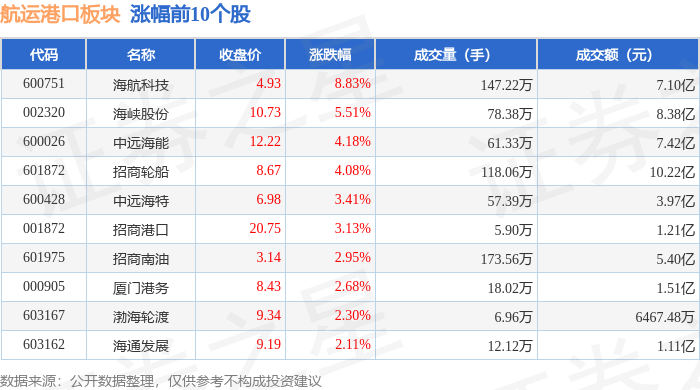
航运港口板块10月10日涨1.68%,海航科技领涨,主力资金净流入1.82亿元
Zheng Xing Xing Ye Ri Bao· 2025-10-10 08:46
Core Viewpoint - The shipping and port sector experienced a rise of 1.68% on October 10, with HNA Technology leading the gains, while the overall market indices, Shanghai Composite and Shenzhen Component, saw declines of 0.94% and 2.7% respectively [1]. Group 1: Market Performance - The Shanghai Composite Index closed at 3897.03, down 0.94% [1]. - The Shenzhen Component Index closed at 13355.42, down 2.7% [1]. - The shipping and port sector stocks showed varied performance, with HNA Technology closing at 4.93, up 8.83% [1]. Group 2: Individual Stock Performance - HNA Technology (600751) led the sector with a closing price of 4.93 and a trading volume of 1.47 million shares, resulting in a transaction value of 710 million yuan [1]. - Other notable performers included: - Haixia Co. (002320) at 10.73, up 5.51% with a transaction value of 838 million yuan [1]. - Shen Cishen (600026) at 12.22, up 4.18% with a transaction value of 742 million yuan [1]. - China Merchants Shipping (601872) at 8.67, up 4.08% with a transaction value of 1.02 billion yuan [1]. Group 3: Capital Flow - The shipping and port sector saw a net inflow of 182 million yuan from institutional investors, while retail investors experienced a net outflow of 155 million yuan [2]. - The main stocks with significant capital inflow included: - HNA Technology with a net inflow of 49.32 million yuan [3]. - Haixia Co. with a net inflow of 45.18 million yuan [3]. - China Merchants Shipping with a net inflow of 43.99 million yuan [3].