CHINA COAL ENERGY(601898)

Search documents
涨势加速后,如何判断煤价潜在上涨空间?
Changjiang Securities· 2025-11-09 09:45
Investment Rating - The report maintains a "Positive" investment rating for the coal industry [9] Core Viewpoints - The coal price has accelerated its upward trend, with the current market price for Qinhuangdao thermal coal reaching 817 RMB/ton, an increase of 47 RMB/ton week-on-week. The report suggests that the price could potentially rise to 931 RMB/ton based on profit recovery scenarios for power plants [2][6][16] - The report emphasizes the importance of understanding cyclical trends over pinpointing absolute price peaks, highlighting a favorable environment for coal investments due to global monetary easing and a rebound in the coal cycle [2][7] Summary by Sections Weekly Tracking Summary - The coal index (Yangtze) increased by 4.53%, outperforming the CSI 300 index by 3.71 percentage points. The thermal coal index rose by 4.84%, while the coking coal index increased by 1.87% [16][20] - As of November 7, the market price for Qinhuangdao thermal coal was 817 RMB/ton, with a week-on-week increase of 47 RMB/ton. The main coking coal price at Jingtang Port was 1860 RMB/ton, up 100 RMB/ton [6][16] Supply and Demand Analysis - The report notes a tightening supply due to production checks and increased winter demand, predicting that coal prices in Q4 may exceed expectations. It highlights the importance of monitoring winter storage and port inventory changes [6][17] - The daily coal consumption across 25 provinces was 511.7 million tons, a decrease of 0.5% week-on-week, while coal supply increased slightly to 547.3 million tons [34] Price Projections - The report provides calculations indicating that if the profit margins for coal-fired power plants return to long-term averages, the acceptable market price for thermal coal could rise to 789 RMB/ton or even 931 RMB/ton under certain conditions [7][12] - The report also discusses the impact of upcoming capacity price adjustments in 2026, which could further influence coal pricing dynamics [7][12] Investment Recommendations - The report suggests a comprehensive embrace of the coal sector's "Davis Double Play" bottom reversal trend, recommending a diversified selection of stocks based on different strategies: balanced, aggressive, and stable leaders [2][7]



华福证券-煤炭行业:旺季临近煤价持续上涨,进口煤同环比下滑-251108
Xin Lang Cai Jing· 2025-11-08 11:14
Core Insights - The primary goal is to reverse the PPI trend, with September PPI's year-on-year decline narrowing to 2.3%, indicating a stabilization in PPI driven by coal prices [3] - The coal price is expected to remain stable, with 2025 potentially marking a policy bottom for coal prices, as supply-side policies are anticipated to be introduced [3] - The coal industry is experiencing a transformation, with limited supply elasticity due to strict capacity controls and increasing mining difficulties, particularly in eastern regions [3] Industry Summary - As of November 7, 2025, Qinhuangdao's 5500K thermal coal closing price is 817 RMB/ton, up 6.1% week-on-week, with significant price increases in Inner Mongolia, Shaanxi, and Shanxi [1] - Daily average production of thermal coal from 462 sample mines is 5.493 million tons, a week-on-week increase of 42,000 tons but a year-on-year decrease of 6.2% [1] - Methanol and urea operating rates are at 87.8% and 82.7%, respectively, both above historical levels [1] Company Recommendations - Companies with excellent resource endowments and stable operating performance, such as China Shenhua, China Coal Energy, and Shaanxi Coal, are recommended for investment [4] - Companies with production growth potential benefiting from a coal price cycle bottom, including Yanzhou Coal, Huayang Co., Guanghui Energy, Jinkong Coal, and Gansu Energy, are also suggested [4] - Companies with globally scarce resources benefiting from long-term supply tightness, such as Huaibei Mining, Pingmei Shenma, Shanxi Coking Coal, Lu'an Environmental Energy, and Shanmei International, are highlighted [4]




煤炭行业2025年三季报总结:环比大幅改善,龙头再次展现领跑能力
GUOTAI HAITONG SECURITIES· 2025-11-07 14:53
Investment Rating - The report rates the coal industry as "Overweight" [4] Core Views - The coal industry has shown a clear trend of recovery in Q3 2025, confirming that the bottom was reached in Q2 2025. It is expected that Q4 will see a full recovery to the levels seen at the beginning of the year [2][7] - The report recommends leading companies such as China Shenhua, Shaanxi Coal, and China Coal Energy, while also continuing to recommend Yanzhou Coal and Jinneng Holding [4][10] Summary by Sections Investment Highlights - In Q3 2025, the thermal coal sector exhibited a clear trend of revenue performance improvement, with net profit increasing by over 30% quarter-on-quarter. The bottom of the sector cycle was confirmed in Q2 2025 [7] - For the first three quarters of 2025, the electricity generation from thermal power accounted for 64.7% of total generation, remaining the primary source. Total electricity consumption reached 7.8 trillion kWh, a year-on-year increase of 4.6% [7][14] - National coal production in the first three quarters of 2025 increased by 2% year-on-year, with raw coal production at 3.57 billion tons [7][26] - The average price of thermal coal (Q5500) at Huanghua Port was 683.7 RMB/ton, a year-on-year decrease of 21.9% [7][33] Industry Review - Q2 2025 marked the official bottom of the current coal price decline cycle, with a narrowing of price declines in Q3. The total coal production for 2025 is expected to remain stable, with a slight year-on-year decrease in Q4 due to "overproduction" checks [13] - The report indicates that the demand for thermal coal is recovering, with Q3 showing a significant increase in electricity consumption and generation [14] Performance Analysis - In Q3 2025, the coal industry achieved revenues of 638.5 billion RMB, a quarter-on-quarter increase of 3.9% but a year-on-year decrease of 17.6%. Total profit was 77.28 billion RMB, down 45.8% year-on-year but up 12.4% quarter-on-quarter [8][51] - The coal sector's performance improved in Q3 2025, with a revenue of 297.9 billion RMB, a year-on-year decline of 16.5% but a quarter-on-quarter increase of 1.5% [8][53] Financial Analysis - The report notes that the operating cash flow of the coal sector has decreased significantly year-on-year, but there has been an improvement compared to H1 2025. The debt ratio of the coal sector has been continuously optimized, decreasing from 49.2% in 2020 to 46.8% in Q3 2025 [9][40] Outlook for 2026 - The report expresses optimism for a new upward cycle in the coal industry starting in 2026, driven by demand growth and stable supply. It predicts that coal prices may return to above 800 RMB/ton in the second half of 2026 [10][11]

中国中煤与华为签署战略合作协议,将在供应链稳定与安全等方面开展深入合作
Xin Lang Cai Jing· 2025-11-07 07:19
Core Viewpoint - China Coal Energy Group Co., Ltd. has signed a new phase strategic cooperation agreement with Huawei Technologies Co., Ltd. to enhance collaboration in various sectors including technological innovation, enterprise management, talent cultivation, smart manufacturing, digitalization, and supply chain stability and security [1] Group 1: Strategic Cooperation Areas - The agreement focuses on technological innovation and related industry development [1] - It emphasizes enterprise management and talent cultivation [1] - The collaboration will also cover smart manufacturing and digitalization [1] - Supply chain stability and security are key components of the partnership [1]
一文读懂 IEA《世界能源投资 2025》
GOLDEN SUN SECURITIES· 2025-11-07 07:08
Investment Rating - The report maintains a rating of "Buy" for several key companies in the coal mining sector, including Yanzhou Coal Mining Company, China Shenhua Energy, and others [5][12]. Core Insights - Global energy investment is projected to reach $3.3 trillion in 2025, marking a 2% increase from 2024, with a significant shift towards clean energy investments outpacing fossil fuels [1][4]. - The report highlights that while clean energy investments are surging, challenges such as grid bottlenecks, supply chain pressures, and regional imbalances pose significant risks to the energy transition [1][4]. - The focus of energy investments is irreversibly shifting towards clean energy, with the modernization of the grid, supply chain resilience, and financing in emerging markets being critical for successful transition [4][56]. Summary by Sections 1. Power Investment - Global power investment is expected to reach a record $1.5 trillion in 2024, driven by low-emission power, grid, and battery storage investments [16]. - Solar energy faces financial pressures due to overcapacity, while wind energy remains stable, and nuclear power is experiencing a revival [20][21]. - Grid investment is lagging behind renewable energy deployment, with significant bottlenecks in supply chains and labor shortages [48][49]. 2. Energy Supply - Fossil fuel supply investment is expected to decline by 2% in 2025, marking the first decrease since 2020, primarily due to falling oil prices and rising costs [2][56]. - Coal investment is at a record high driven by China and India, although growth rates are slowing [56][59]. - Investment in low-carbon technologies is robust, with liquid biofuels and low-emission hydrogen expected to see a 30% increase in 2025 [57]. 3. Terminal Demand - Electrification is accelerating, with significant investments in the transportation sector, while building investments are stagnating due to policy rollbacks and cost pressures [3][55]. - Industrial energy efficiency is rebounding in China and the U.S., but global low-emission steel investments are contracting significantly [3][55]. 4. Investment Strategy - The report recommends focusing on companies that are well-positioned in the coal mining sector, particularly those with strong performance metrics [9][12].
中煤能源(1898.HK):第三季盈利降幅收窄 反内卷带动煤炭价格回升
Ge Long Hui· 2025-11-06 12:46
Core Insights - The company's revenue for the first three quarters of 2025 was 110.58 billion yuan, a year-on-year decline of 21.2%, while the net profit attributable to shareholders was 11.18 billion yuan, down 28.5% year-on-year. The decline in net profit for the third quarter was 21.9%, which is an improvement compared to the 31.5% drop in the first half of the year [1] - The increase in coal prices since July is attributed to regulatory measures aimed at stabilizing coal supply, with the average selling price for coal in the third quarter estimated at approximately 482 yuan per ton, up from 470 yuan per ton in the first half [1] - The tightening of supply has led to a recovery in coal prices, with the comprehensive trading price for Qinhuangdao port thermal coal (Q5500) reaching 693 yuan per ton as of October 31, up about 5.3% from the low of 658 yuan per ton in early July [2] - The company has the potential to increase its dividend payout ratio or acquire assets to enhance profits, with a current dividend policy of no less than 30% and a proposed payout ratio of 35% for 2024 [2] - If coal prices continue to rise, there is potential for upward adjustments in profit forecasts for 2026, which would positively impact the company's stock performance [3]
国泰海通:25Q3煤企业绩环比改善显著 板块底部配置价值正逐步凸显
智通财经网· 2025-11-06 06:17
Core Viewpoint - The coal prices are expected to continue to decline year-on-year until the third quarter of 2025, but there has been a significant recovery in coal prices on a quarter-on-quarter basis in Q3 2025, leading to improved performance for coal companies. The supply constraints from production policies and the upcoming winter demand are expected to support coal prices, indicating a potential bottoming out of coal company performance [1][10]. Summary by Sections Coal Price and Company Performance - In Q3 2025, coal prices showed a significant quarter-on-quarter recovery, with Qinhuangdao power coal (Q5500, Shanxi origin) averaging 672 RMB/ton, up 6.47%, and Beijing-Tangshan coking coal averaging 1562 RMB/ton, up 18.76% [2]. - The 28 coal companies monitored by Guotai Junan achieved a total revenue of 302.30 billion RMB in Q3 2025, a quarter-on-quarter increase of 11%, and a net profit attributable to the parent company of 31.61 billion RMB, up 21% [2]. - Year-to-date performance for these companies showed a total revenue of 856.22 billion RMB, down 15.5% year-on-year, and a net profit of 113.46 billion RMB, down 28.1% year-on-year [3]. Cost and Expense Analysis - Total expenses for the 28 coal companies decreased by 3.1% year-on-year to 60.77 billion RMB in the first three quarters of 2025, with management expenses down 5.6% [4]. - The expense ratio increased to 12.20%, up 1.24 percentage points year-on-year, influenced by the decline in revenue [4]. Cash Flow and Debt - Operating cash flow for the 28 coal companies totaled 179.73 billion RMB, down 21% year-on-year, while interest-bearing debt increased by 21.46% to 573.07 billion RMB [8]. - The average asset-liability ratio was 51.3%, a slight decrease of 0.2 percentage points year-on-year [8]. Inventory and Receivables - The average accounts receivable turnover days increased to 31 days, up 19.5% year-on-year, indicating weakened collection capabilities [9]. - Inventory turnover days also increased to 28 days, reflecting a 20% year-on-year rise [9]. Investment Recommendations - The coal sector is characterized by low valuations, high dividend yields, and strong cash flow, presenting a bottoming investment opportunity [10][11]. - Key companies to watch include China Shenhua, Shaanxi Coal, and China Coal Energy, among others, categorized by stability and elasticity in coal prices [12].



柳暗花明又一村,Q3煤企业绩环比改善显著:——煤炭开采行业2025年三季报综述
Guohai Securities· 2025-11-05 13:34
Investment Rating - The report maintains a "Recommended" rating for the coal mining industry [1] Core Views - In Q3 2025, coal prices rebounded significantly, leading to a notable improvement in the performance of major listed coal companies. The average price of Qinhuangdao port thermal coal (Q5500, Shanxi origin) was 672 RMB/ton, up 6.47% quarter-on-quarter, while the average price of Jingtang port coking coal (Shanxi origin) was 1562 RMB/ton, up 18.76% quarter-on-quarter [4][9] - The report highlights that the performance of 28 key coal companies improved significantly in Q3 2025, with total operating revenue reaching 302.296 billion RMB, up 11% quarter-on-quarter, and net profit attributable to the parent company reaching 31.612 billion RMB, up 21% quarter-on-quarter [4][29] - The report suggests that the coal mining industry is showing signs of recovery, with the potential for sustained price strength due to seasonal demand and supply constraints [9][10] Summary by Sections 1. Overview of Q3 2025 - Coal prices rebounded in Q3 2025, driven by increased demand for thermal power amid summer electricity usage, while domestic production contracted due to safety regulations and weather conditions [4][9] - The average price of Qinhuangdao port thermal coal in Q3 2025 was 672 RMB/ton, a year-on-year decrease of 20.71%, while the average price of Jingtang port coking coal was 1562 RMB/ton, down 32.5% year-on-year [4][18] 2. Performance of Key Coal Companies - The 28 key coal companies reported a total operating revenue of 856.215 billion RMB for the first three quarters of 2025, a year-on-year decrease of 15.5%, and a net profit of 113.462 billion RMB, down 28.1% year-on-year [5][26] - In Q3 2025, the net profit attributable to the parent company for these companies was 31.612 billion RMB, reflecting a quarter-on-quarter increase of 21.4% [29] 3. Financial Metrics - The report indicates that the operating cash flow of the 28 coal companies decreased by 21% year-on-year to 179.734 billion RMB, while the average asset-liability ratio was 51.3%, a slight decrease of 0.2 percentage points year-on-year [8][9] - The average sales gross margin for these companies was 22.8%, down 7.9 percentage points year-on-year, and the average net profit margin was 4.6%, down 6.4 percentage points year-on-year [7][9] 4. Investment Strategy - The report emphasizes the value of the coal sector, suggesting that the current low valuation and high dividend yield present a good investment opportunity. It recommends focusing on companies with strong fundamentals and cash flow [9][10] - Key companies to watch include China Shenhua, Shaanxi Coal and Chemical Industry, and Yanzhou Coal Mining Company, among others [10][11]
煤价“乘冬”起飞,供需出现缺口,煤炭股还能火多久?
3 6 Ke· 2025-11-05 10:52
Group 1: Market Overview - The A-share coal sector has seen significant gains, with stocks like Antai Group and Baotailong hitting the daily limit, driven by increased winter coal demand and supply constraints [1] - The coal price is expected to continue rising due to a tightening supply side and increasing demand as winter approaches, potentially reversing the current oversupply situation [1][3] Group 2: Demand Drivers - The La Niña phenomenon is predicted to lead to a colder winter, increasing coal demand for heating by over 15% [2] - Abnormal weather patterns have already activated coal demand, with northern regions experiencing early heating needs and southern regions facing high temperatures [2] - Coastal power plants have seen a more than 15% year-on-year increase in daily coal consumption, with average daily power generation from coal-fired plants rising by 10.7% [2] Group 3: Supply Constraints - The National Energy Administration's checks on coal mine overproduction have led to a gradual reduction in supply, with August's coal output down 3.2% year-on-year [3] - The total coal production for the year is expected to decrease by 50 million tons, with December's supply gap projected to reach 15 to 20 million tons, the largest monthly gap of the year [4] Group 4: Leading Companies - China Shenhua has significant coal reserves, with 3.436 billion tons of coal resources and a mining lifespan exceeding 50 years, supported by high-quality coal from its core mining area [6] - Shaanxi Coal's coal resources amount to 1.7931 billion tons, with over 70 years of mining potential, primarily consisting of high-quality coal suitable for various industries [6] - Yanzhou Coal Mining Company has a robust production capacity of 160 million tons per year, with a projected 2024 coal output of 142 million tons, reflecting a year-on-year increase [7]


11月5日投资时钟(399391)指数涨0.03%,成份股国城矿业(000688)领涨
Sou Hu Cai Jing· 2025-11-05 09:55
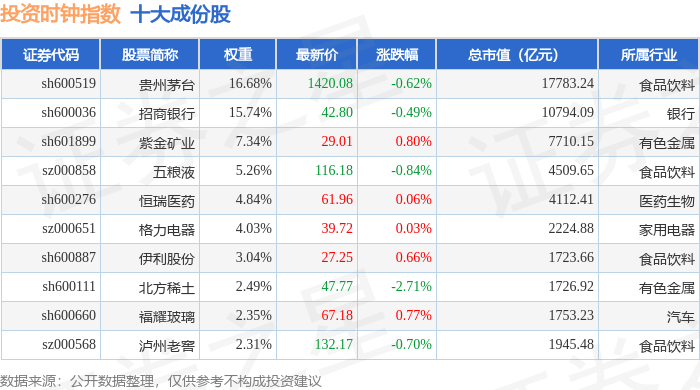
Market Overview - The Investment Clock Index (399391) closed at 3348.13 points, up 0.03%, with a trading volume of 78.792 billion yuan and a turnover rate of 0.81% [1] - Among the index constituents, 71 stocks rose while 28 stocks fell, with Guocheng Mining leading the gainers at a 9.42% increase and Dalian Shengya leading the decliners at a 9.99% decrease [1] Top Constituents - The top ten constituents of the Investment Clock Index are as follows: - Kweichow Moutai (sh600519) holds a weight of 16.68% and closed at 1420.08 yuan, down 0.62% with a market cap of 1778.324 billion yuan [1] - China Merchants Bank (sh600036) has a weight of 15.74%, closing at 42.80 yuan, down 0.49% with a market cap of 1079.409 billion yuan [1] - Yunnan Tin Company (sh601899) has a weight of 7.34%, closing at 29.01 yuan, up 0.80% with a market cap of 771.015 billion yuan [1] - Wuliangye Yibin (sz000858) has a weight of 5.26%, closing at 116.18 yuan, down 0.84% with a market cap of 450.965 billion yuan [1] - Hengrui Medicine (sh600276) has a weight of 4.84%, closing at 61.96 yuan, up 0.06% with a market cap of 411.241 billion yuan [1] - Gree Electric Appliances (sz000651) has a weight of 4.03%, closing at 39.72 yuan, up 0.03% with a market cap of 222.488 billion yuan [1] - Yili Industrial Group (sh600887) has a weight of 3.04%, closing at 27.25 yuan, up 0.66% with a market cap of 172.366 billion yuan [1] - Northern Rare Earth (sh600111) has a weight of 2.49%, closing at 47.77 yuan, down 2.71% with a market cap of 172.692 billion yuan [1] - Fuyao Glass (sh600660) has a weight of 2.35%, closing at 67.18 yuan, up 0.77% with a market cap of 175.323 billion yuan [1] - Jilin Chemical (sz000568) has a weight of 2.31%, closing at 132.17 yuan, down 0.70% with a market cap of 194.548 billion yuan [1] Capital Flow - The net outflow of main funds from the index constituents totaled 677 million yuan, while retail investors saw a net inflow of 708 million yuan [3] - Detailed capital flow for selected stocks includes: - China Zhongjin (601888) saw a main fund net inflow of 36.4 million yuan, while retail funds had a net outflow of 93.414 million yuan [3] - Jiangxi Copper (600362) had a main fund net inflow of 18.2 million yuan, with retail funds experiencing a net outflow of 70.3612 million yuan [3] - Weichai Power (000338) had a main fund net inflow of 13.5 million yuan, while retail funds had a net inflow of 1.60758 million yuan [3] - Giant Network (002558) had a main fund net inflow of 11.8 million yuan, with retail funds experiencing a net outflow of 65.0268 million yuan [3] - China Coal Energy (601898) had a main fund net inflow of 11.7 million yuan, while retail funds had a net outflow of 79.0666 million yuan [3]