
Nanhua Futures(603093)

Search documents
贵金属2025年四季度展望:再创新高,强势延续
Nan Hua Qi Huo· 2025-09-30 11:37
Report Industry Investment Rating No relevant information provided. Core Viewpoints of the Report - The upward cycle of gold is not over, and any adjustment in gold prices should be seen as a buying opportunity on dips. The long - term trend of gold is anchored to its monetary attribute, and with the decline of the US dollar currency system, global central banks will increase their gold allocation and reduce their US dollar allocation. [2][120] - In the fourth quarter, central bank gold purchases will act as a support, and investment demand will be the driving force. Investment demand will shift from uncertain hedging transactions to interest - rate cut transactions on the monetary policy side. The target price of London gold in Q4 2025 will move up to the $4000/ounce area, with support at $3600/ounce, and the domestic price will be in the range of 820 - 900 yuan/gram. [2][121] - Silver trends generally follow gold, but there are differences in fundamentals and volatility. The expected operating range of London silver in the fourth quarter is $42 - 50/ounce, and the domestic price is 10000 - 12000 yuan/kilogram. A strategy of buying on dips is recommended. [3][121] Summary According to the Table of Contents 1. Precious Metals Market Review - In 2025, the domestic and foreign precious metals markets continued the bull market in 2024, with strong upward momentum and the relative strength of gold and silver switching. The foreign market outperformed the domestic market, mainly due to the appreciation of the RMB. [9] - In the third quarter, the precious metals market had both synchronization and differentiation. Gold started to break through upwards in late August, silver followed gold's upward movement in late August after a period of adjustment, and platinum's price moved up following gold and silver after a large - scale fluctuation in July. [9] - As of September 19, 2025, all precious metals showed significant price increases compared to the end of 2024, with COMEX silver having the highest increase of 48.05%, and the gold - to - silver ratio decreased by 3.75%. [19] 2. Cross - Market Price Difference Fluctuations Caused by Concerns over US Tariff Policies - From late last year to the first quarter of this year, concerns about the US imposing gold import tariffs led to large - scale arbitrage trading, pushing up the price difference between COMEX gold and London gold. Similar arbitrage transactions have occurred multiple times since November 2024. [23] - In the third quarter of this year, a similar story of cross - market price differences in precious metals repeated. In July, the premium of COMEX futures over London spot in the gold, silver, platinum, and palladium markets widened rapidly due to concerns that the US might extend copper import tariff measures to precious metals. [26] 3. Broad Monetary Expectations Boost Precious Metals Valuation and Investment Demand 3.1 Q3 Real Interest Rate Decline Boosts Gold Valuation - In August, the enhanced expectation of the Fed's interest - rate cut pushed down the 10 - year US Treasury real interest rate, thereby boosting the valuation of gold. Although the non - farm payroll report in early August was far below expectations, the lack of a clear signal from the Fed and the time interval between FOMC meetings limited the increase in precious metals prices. [33] - During the period of increasing interest - rate cut expectations, the US dollar index remained resilient, with a limited depreciation range. Except for the Swedish krona, the other five major currencies depreciated against the US dollar in Q3 2025, with the Japanese yen having the largest depreciation. [35] 3.2 The Fed's Monetary Easing Expectation is the Main Cause of the Decline in Real Interest Rates - The mid - to long - term decline in the real interest rate of US Treasury bonds is mainly driven by the Fed's interest - rate cut and easing expectations. At the September FOMC meeting, the Fed cut interest rates by 25 basis points as expected. Market expectations indicate that the Fed will cut interest rates 1.728 times by the end of this year and 4.317 times by the end of 2026. [41] - The dot - plot of the September FOMC meeting shows that most Fed officials expect the Fed to cut interest rates twice this year and once each in 2026 and 2027. Compared with June, the expected number of interest - rate cuts has increased due to the Fed's shift towards the employment side in balancing inflation and employment. [45] - The Fed's September economic forecast shows an upward revision of the GDP growth rate forecast for 2025 - 2027, a downward revision of the unemployment rate forecast for 2026 and 2027, and an upward revision of the PCE forecast, reflecting the Fed officials' increased concern about inflation and reduced concern about the economy. [49] 3.3 The Fed's Broad Monetary Policy Still Has Room for Strengthening - In the fourth quarter, the US dollar index and the 10 - year US Treasury real interest rate are expected to decline further, which will continue to boost the valuation of precious metals. The Fed's interest - rate cut and possible suspension of balance - sheet reduction are likely to be further strengthened due to increased economic downward pressure in the US and the expected increase in the number of Fed officials favorable to Trump. [51] - The US economy may face greater downward pressure in the fourth quarter and 2026, as evidenced by the cooling of the employment market and the negative impact of trade tariffs on the economy. The Fed's independence is being challenged through institutional and personnel interventions, and there is also the issue of fiscal coercion. [53][63] - Since 2025, global gold investment demand has increased significantly, but there was a net outflow in May. The uncertainty brought about by Trump's policies has increased the demand for gold investment and allocation, but the "90 - day suspension period" of the "reciprocal tariff" policy and the cooling of uncertainty have led to a partial withdrawal of investment demand. [73][75] 4. Central Bank Gold Purchases as a Support - Central bank gold purchases have shown a slowdown this year. From the perspective of the fourth quarter and 2026, central bank gold purchases will act as a support rather than the core driving force for price increases. Central banks are expected to continue to support the gold market, with a concave - shaped demand curve that is more sensitive to price declines. [81] - Long - term, the relationship between central bank gold purchases and gold prices is asymmetric. Central banks are more likely to increase purchases when prices fall, and the inhibitory effect on price increases is weaker than the boosting effect on price increases when prices fall. [82] - As of July, the Polish central bank was the largest gold purchaser in 2025, but its gold purchases slowed down in the second half of the year. Many central banks, including those of Azerbaijan, Kazakhstan, China, and Turkey, maintained a good demand for gold. [89] - According to a survey by the World Gold Council, most central banks expect to increase their gold reserves and reduce their US dollar reserves in the next five years. In the next 12 months, 95% of central banks expect the global central bank's gold reserves to continue to increase. [90][91][98] 5. Precious Metals Market Outlook 5.1 Q4 2025 Outlook: Reaching New Highs and Maintaining Strength - In terms of influencing factors, the decline in the US dollar index and the US Treasury real interest rate has boosted the valuation of precious metals. The rise in the precious metals market in the first half of the year was mainly due to hedging demand and interest - rate cut expectations. Central bank gold purchases provided support, and market supply - demand imbalances in the first quarter also contributed to the rise. Gold entered a consolidation phase from late April to mid - August and broke through after late August. [119] - The demand for silver is weaker than that for gold. Industrial silver demand has stagnated, and the underdeveloped investment channels in the domestic market have limited investment demand. However, the deviation of the gold - to - silver ratio and the small market size of silver have created trading opportunities. [120] - The long - term upward cycle of gold is not over, and any price adjustment should be seen as a buying opportunity. In the fourth quarter, investment demand will shift, and the price of London gold is expected to reach the $4000/ounce area, with support at $3600/ounce. The expected operating range of London silver in the fourth quarter is $42 - 50/ounce. [2][3][121]

南华期货2025年度焦煤焦炭四季度展望:远端预期改善,持货意愿增强
Nan Hua Qi Huo· 2025-09-30 11:31
Group 1: Report Industry Investment Rating - Not provided in the document Group 2: Core Views of the Report - In Q4, under the constraints of the "Anti-Involution" and "Overproduction Inspection" policies, the domestic mine operating rate faces a theoretical upper limit, and the supply elasticity of coking coal is limited. As the starting year of the 15th Five-Year Plan in 2026, the long-term market expectation has significantly improved, and this year's winter storage scale is expected to be better than last year, providing phased support for coal and coke prices. However, the rebound height and sustainability of coal and coke prices ultimately depend on whether the supply-demand balance sheet of the downstream steel sector can achieve a "soft landing." The ideal scenario is for steel mills to proactively ease the steel inventory pressure through early maintenance and production cuts based on the anticipation of profit contraction, creating a favorable upward space for the industrial chain. Conversely, if the production adjustment of steel mills lags, the shrinking terminal demand will exacerbate the finished product inventory contradiction, triggering the negative feedback risk of the black industrial chain and restricting the rebound height of coal prices [1][54]. - The trading range of the coking coal main contract is (1100, 1300), and that of the coke main contract is (1550, 1800). Adopt a range-bound trading strategy for single-sided positions, and focus on the reverse spread between the January and May contracts of coking coal, with an recommended entry range of (-70, -60) [1][54]. Group 3: Summary by Directory Chapter 2: Market Review - In the first half of the year, due to factors such as the tariff war, the market had a generally pessimistic outlook on the far-month contracts. As a result, all links in the industrial chain continuously reduced speculative inventories, and the terminal replenishment willingness was low, leading to a deteriorating coking coal inventory structure. A large amount of inventory was积压 at the upstream mines, weakening their bargaining power and resulting in frequent price cuts for promotion. Although the supply-demand contradiction of coke itself was not prominent supported by high hot metal production, the coke price remained difficult to stabilize and showed overall weakness due to the collapse of cost support [2]. - Since June, the expected weak export did not occur. Instead, the year-on-year growth rate of steel exports remained high, and the inventory-to-sales ratio of the five major steel products continued to decline, indicating a healthy steel fundamentals. Meanwhile, the low domestic mine operation and insufficient imported arrivals led to a tightened coking coal supply. Domestically, affected by environmental protection restrictions and regional safety accidents, the operating rates of major coal-producing areas were generally lower than the seasonal average. In terms of imports, the shrinking import profit due to the continuous decline of domestic coal prices in the first half of the year suppressed the import enthusiasm, and the net import volume of coking coal decreased month by month. This structural gap laid the fundamental basis for the subsequent rebound of coking coal. From a valuation perspective, the basis of the coking coal main contract fluctuated between -150 and 150 yuan/ton in the past two years, and this value reached the upper limit at the end of May, indicating significant overselling in the futures market. Subsequently, coking coal started a valuation repair rebound. As the basis turned negative, the cash-and-carry funds entered the market, driving the long-dormant speculative demand to recover and promoting downstream coking enterprises to conduct concentrated replenishment, forming a spiral strengthening mechanism of "futures market rebound - stimulating downstream replenishment - mine de-stocking and price support" [6]. Chapter 3: Core Focus Points 3.1 Coking Coal Supply: Domestic Coal is Constrained by Policies, and the Operating Rate has a Theoretical Upper Limit - Since July, the national level has elevated the political significance of "anti-involution" in the coal industry to curb disorderly competition and stabilize coal prices. Shanxi Province, as the core production area of coking coal in China, accounts for nearly half of the output and is mainly composed of large state-owned mines, playing a strong exemplary and binding role in policy implementation. Shanxi proposed a production strategy of "increasing output to offset price decline" multiple times in the first half of the year, and there were also overproduction phenomena in some other provinces. From January to June, the output of above-scale industrial raw coal was 2.40 billion tons, a year-on-year increase of 5.4%, and the cumulative output was the highest in the same period of the past five years, overusing the production quota for the second half of the year to some extent. To achieve the policy goals of controlling production and stabilizing prices for the whole year, it is expected that major production areas (especially Shanxi, Inner Mongolia, and Shaanxi) will face strong overproduction inspection pressure before the end of the year, and the mine operating rate has a theoretical upper limit, which is expected to provide phased support for coking coal prices [11]. - The recently issued "Work Plan for Stable Growth of the Iron and Steel Industry (2025 - 2026)" by five departments clearly states that it is necessary to "stabilize the supply of raw fuels, increase the supply and price stability of raw fuels such as iron ore and coking coal, support the normal production of compliant mining enterprises, and avoid 'one-size-fits-all' industry rectification measures." This statement sends a clear policy signal that while ensuring safety production and compliant operation, more attention will be paid to the stability and continuity of the supply side to prevent sharp price fluctuations of raw materials caused by excessive supply tightening. Based on this orientation, the possibility of coking coal prices skyrocketing as in 2021 is relatively low. The current policy environment emphasizes "supply stability and price control" and "precise regulation," which is fundamentally different from the background of strong supply constraints and concentrated demand release in 2021. In addition, the strong overseas demand in 2021 provided additional support for prices, while although exports still show resilience this year, there is limited room for further growth on the basis of last year's high base, making it difficult to reproduce the combined effect of domestic and foreign demand [14]. 3.2 Coking Coal Imports: Pay Attention to the Impact of Imported Coal on the Balance Sheet - Currently, China's dependence on imported coking coal is approaching 20%, and the influence of imported coal on the domestic supply structure is continuously increasing. Since July, the price of Mongolian coal has rebounded by more than 300 yuan/ton from the low level, and the import profit has been rapidly repaired, significantly boosting the customs clearance enthusiasm of major ports such as Ganqimaodu. In terms of seaborne coal, as the domestic coking coal price rebounded, the import window was reopened. Recently, the coal shipments of major global coal-exporting countries have significantly increased, and it is expected that the arrivals of seaborne coking coal will remain at a high level in the fourth quarter. Against the background of the constraints on domestic coal mine operation by factors such as overproduction inspection, safety supervision, and environmental protection, the effective supplement of imported coal helps to relieve the supply pressure. On the other hand, the increasing import dependence also brings hidden concerns about the stability of coking coal supply. If domestic production continues to be restricted and there are disturbances in port transportation, policies, or geopolitics for imported coal (especially Mongolian coal with an increasing proportion), the coking coal supply-demand balance may be broken, significantly impacting prices. Therefore, coking coal imports will be one of the key variables affecting the coking coal market balance in the second half of the year [16]. 3.3 Demand: Positive Outlook at the End of the Year, Pay Attention to the Start Time of Winter Storage - During the Spring Festival, affected by factors such as coal mine holidays and logistics disruptions, the coking coal supply is temporarily tightened, and downstream enterprises usually conduct raw material reserves in advance to ensure production continuity, which is the "winter storage" process. The scale of winter storage is not only restricted by the actual supply but also affected by the downstream's expectation of the market in the coming year. When the expectation is optimistic, the replenishment is active; when it is pessimistic, the reserve is cautious. Looking back at the recent years' patterns, downstream coking plants usually start winter storage about 70 days before the Spring Festival, and the start time is strongly correlated with the rebound of the futures market. In most years, the winter storage behavior starts about one week after the rebound of the main contract and lasts until one week before the Spring Festival (except in 2024, when the market was overly pessimistic about the future, and the futures market did not show a seasonal rebound). The Spring Festival in 2025 is relatively late. Based on the historical winter storage rhythm, it is expected that this round of winter storage will start in mid-to-late November. Considering that 2026 is the starting year of the 15th Five-Year Plan and the policy expectation is positive, the market sentiment is expected to improve compared with last year. Therefore, although it is the traditional off-season, it is expected that the coking coal price will have strong bottom support and certain rebound potential at the end of this year [28]. Chapter 4: Valuation Feedback and Supply-Demand Outlook 4.1 Valuation Analysis - When the demand shrinks and causes steel mills to suffer losses, the profit pressure will be transmitted upstream along the industrial chain, usually manifested as steel mills reducing the purchase price of coke, thereby squeezing the coking profit. This feature was显著 in January - February and August - September 2024. In the first half of 2025, benefiting from the continuous decline of coking coal prices, the profits of steel mills and coking plants were generally stable, and there was no large-scale loss, especially the profit performance of steel mills was good. However, since July, as the expectation of the "Anti-Involution" policy has increased, the coking coal price has rebounded strongly, and the downstream profits have begun to be damaged. Coking plants have been the first to fall into losses, and the steel mill profits have also shrunk. Currently, most coking coal mines have turned losses into profits, and most steel products except for rebar can still maintain a profit of 50 - 100 yuan/ton, while coking plants have become the weakest link in the industrial chain, and some regions are approaching the break-even point or even suffering losses. Looking forward to the fourth quarter, if the coking coal price strengthens again due to supply contraction or the negative feedback of the black industrial chain occurs driven by weak demand, the downstream profits will be further pressured, ultimately leading to the reduction of blast furnace and coke oven production, which will in turn restrict the rebound space of coking coal prices [34]. 4.2 Supply-Demand Outlook - In the fourth quarter, under the constraints of the "Anti-Involution" and "Overproduction Inspection" policies, the operating rate of domestic coking coal mines has a theoretical upper limit, and the monthly average output may be lower than the same period in previous years. Meanwhile, the import profit of coking coal has been significantly repaired compared with the first half of the year, promoting the increase of coking coal imports, and the import proportion is expected to increase in the fourth quarter. Overall, although the imports effectively supplement the domestic supply, the coking coal market is unlikely to experience obvious oversupply under the limited domestic output. In addition, as the starting year of the 15th Five-Year Plan in 2026, the positive policy expectation boosts the market sentiment, and the downstream winter storage enthusiasm has increased. It is expected that this year's winter storage scale will be better than the same period last year, providing certain support for the coal price at the end of the year [37]. - There is a strong positive correlation between the short-term supply of coke and the immediate coking profit. As the post-festival coking coal replenishment demand temporarily declines and a round of coke price increase is implemented, the coking profit is expected to be slightly repaired, driving the short-term coke output to remain stable. Due to the high cost of starting and stopping coke ovens, coking plants usually maintain continuous production during the Spring Festival, so there is no significant seasonal characteristic in coke supply. It is expected that the output at the end of the year will be flexibly adjusted according to the coking profit. From the perspective of the capacity structure, the coke industry has been in a long-term overcapacity situation, resulting in its weak bargaining power in the industrial chain. The price mainly follows the fluctuation of the cost-side coking coal, showing obvious cost-driven characteristics. Although the winter storage demand for coking coal in the fourth quarter will support the coke price to a certain extent, limited by the bargaining power, the strength and sustainability of the coke price rebound are expected to be less than those of coking coal. It is recommended that industrial customers pay attention to the selling hedging opportunities of the near-month main contracts to avoid the risk of adverse price fluctuations [39]. - Recently, the rebound of coal prices has caused the steel mill profits to decline from the high level, and some products such as rebar have suffered losses, indicating that the pressure of profit contraction is being transmitted. However, most steel mills can still maintain a profitable state and have not reached the critical point of the negative feedback of the black industrial chain. It is expected that the hot metal production will remain resilient in the short term. However, as the traditional off-season for the black industry in the fourth quarter, the weakening demand will impact the steel supply-demand balance sheet, and the current relatively high hot metal production of over 2.4 million tons per day is difficult to maintain for a long time. In addition, there is also the pressure to meet the annual crude steel production reduction target in the fourth quarter, which may prompt steel mills to adjust their production plans in advance, helping to ease the steel inventory pressure. However, once the production adjustment of steel mills lags or the actual implementation of the crude steel production reduction policy is less than expected, the steel inventory pressure may further increase. Compared with the first half of the year, the absolute value of steel mill profits has significantly decreased, and the sensitivity of steel mills to losses has increased. If the profits are squeezed again, it is easy to trigger a negative feedback decline in the black industrial chain [50].
南华期货2025年度有色金属锌四度展望:内外格局分化,破局契机将至
Nan Hua Qi Huo· 2025-09-30 10:18
Report Industry Investment Rating No relevant content provided. Core Viewpoints of the Report - In the third quarter, the pattern of stronger LME zinc and weaker SHFE zinc became more apparent. Macroscopically, domestic narratives such as anti - involution initially boosted non - ferrous metal prices, and the domestic economy had a weak recovery. Subsequently, the Fed's interest rate cut and strengthened subsequent rate - cut expectations drove up the metal sector. However, the price trends of LME zinc and SHFE zinc diverged significantly. Fundamentally, the center of LME zinc moved up while SHFE zinc was suppressed and continued to build a bottom. This was due to overseas smelter cut - offs and production reductions, while domestic smelter operating rates were strongly maintained driven by profits, leading to continuous depletion of overseas inventories. Additionally, the weakening of the internal - external price ratio and its trending phenomenon made it difficult to open the export window in China, resulting in an over - supply of refined zinc that was difficult to consume. It is predicted that SHFE zinc will still follow a bearish logic, but the downward amplitude will be limited due to the support of LME zinc, and it is expected to have a weak and volatile trend in the fourth quarter, with an operating range of 21,580 - 22,300 yuan/ton [1]. - The strategies include: from now until the end of October, if overseas inventories are not visibly increased and the rate - cut expectation remains unchanged, the internal - external positive arbitrage logic remains. When the export window opens or approaches, internal - external reverse arbitrage should be the main strategy. Also, conduct high - selling and low - buying within the range, and sell hedges or sell out - of - the - money call options on rallies [2]. Summary by Relevant Catalogs Chapter 1: Viewpoint Summary - The pattern of stronger LME zinc and weaker SHFE zinc is obvious in the third quarter. The subsequent trend of SHFE zinc is expected to be weakly volatile, with a predicted operating range of 21,580 - 22,300 yuan/ton in the fourth quarter [1]. - Investment strategies are proposed, including internal - external arbitrage operations and other trading strategies [2]. Chapter 2: Market Review - In the first half of the year, zinc prices were weak in January and then had a wide - range oscillation in the first quarter. The core contradiction in the first quarter was the initial manifestation of loose expectations and the weakening of actual demand. In January, the expected increase in zinc ore production and the winter stockpiling demand of zinc smelters jointly pushed up the zinc concentrate processing fee. From February to March, the reduction in smelter production around the Spring Festival led to a lower inventory - building amplitude than in previous years, and the absolute value of social inventory was at a historical low. Coupled with the "Golden Three, Silver Four" peak - season expectation, it provided some support for zinc prices. In the second quarter, the main market fluctuations of zinc ingots were caused by Trump's reciprocal tariffs, which impacted the trade situation and market sentiment. In early April, zinc prices followed the market decline due to the unexpectedly high tariff intensity and global pessimistic sentiment. Then, until the end of May, zinc prices returned to the fundamental logic, and the oscillation amplitude of SHFE zinc weakened from strong to weak, maintaining a supply - surplus logic of strong supply and weak demand [3]. - In the third quarter, the core trading logic was the game between macro - level benefits and weak fundamentals, with an overall trend of rising first and then falling. Macroscopically, anti - involution sentiment provided some upward impetus to zinc, especially due to its common demand attributes with both black and non - ferrous metals, and the increase was more prominent. The Fed's interest rate - cut expectation and the weakening of the US dollar index also provided support. However, with the supply growth far exceeding the demand growth, the supply - surplus pattern of SHFE zinc's fundamentals was obvious. As a result, the trend of zinc prices was more entangled compared with other non - ferrous metals. At the end of the quarter, the Fed's interest rate cut met expectations, and the positive impact of the rate - cut story was exhausted, resulting in a weak and volatile trend [3]. Chapter 3: Core Focus Points 3.1 Macro - Outlook: Optimistic - Globally, major economies led by the US have started an interest rate - cut cycle. The Bank of Canada and the Bank of Japan recently cut interest rates by 25 basis points, following the Fed. According to the Fed's economic summary on September 17, most officials expect the interest rate to be in the range of 3.50 - 3.75 this year, indicating at least two more rate cuts, while some are more conservative with an expectation of 4.0 - 4.25. The median expectations of the federal funds rate at the end of 2025, 2026, and 2027 are lowered to 3.6%, 3.4%, and 3.1% respectively. The short - term rate - cut expectation has been digested by the market, and the subsequent continuous rate cuts will drive up the prices of basic metals [8]. - In terms of employment, the median expectations of the unemployment rate in the next two years are lowered to 4.4% and 4.3%. Fed Chairman Powell proposed that this rate cut is a risk - management measure to cope with the rapid downward revision of the labor market. The market generally expects a correlation between employment data and the benchmark interest rate [11]. - Domestically, the economy started a weak recovery from July's anti - involution to August. Policies have achieved good results in supporting the overall economy. In August, China's exports denominated in US dollars increased by 4.4% year - on - year, and imports increased by 1.3% year - on - year. In terms of prices, China's CPI in August decreased by 0.4% year - on - year from positive, and the core CPI increase rebounded to 0.9%; the year - on - year decline of PPI narrowed to 2.9%. In the future, in addition to the main tones of industrial anti - involution and a unified large market, two major policies that will have a greater impact on basic metals this year are the moderately loose monetary policy mainly through reverse repurchase and the local debt and special debt policies to expand domestic demand. Domestic macro - factors are expected to have a positive impact on basic metals this year, and the extent depends on the policy scale [15][16]. - The overall macro - impact on future zinc prices has two interpretations centered around the US dollar index. The downward trend of the US dollar index is inevitable, driven by the Fed's monetary policy and Trump's tariff policy. The decline of the US dollar index is beneficial to commodities denominated in US dollars. However, if economic growth is suppressed by inflation and tariffs, leading to a weakening of demand and employment data, it will have a negative impact. Currently, according to the Samuelson's rule, the economy is not on the recession track, so in the short term, the overall outlook is positive, and long - term macro - data needs to be continuously monitored [18]. 3.2 Internal - External Price Difference: Opportunities for Export and Arbitrage - Since June this year, the price difference between LME zinc and SHFE zinc has been expanding, and it still shows an expanding trend in terms of import profit and loss. The main reason is the difference in internal and external fundamentals. Overseas smelters have low operating willingness due to the low processing - fee benchmark at the beginning of the year (80 US dollars/dry ton) and the impact of losses in 2024. In contrast, domestic smelters have cost advantages, and the increase in processing fees in the first half of the year strongly drove up their operating rates [20]. - It is recommended that investors pay attention to the internal - external reverse - arbitrage opportunity of going long on the domestic market and short on the overseas market. Currently, the export profit and loss is approaching the break - even line, and there is hope for zinc ingot exports to Southeast Asia to make a profit at the end of the year. After zinc ingot exports start, the internal - external price difference may return to a reasonable range [25]. 3.3 Change in Term Structure: Domestic Loose Expectations May Be Exhausted - The term structure of SHFE zinc quietly changed at the end of August. Under the dual influence of macro - narratives such as anti - involution and the oscillation of processing fees, SHFE zinc has changed from a B - structure to a C - structure [26]. - The inconsistent internal and external inventories are also the main factor for the expanding price difference. LME inventory has been in a de - stocking cycle since the beginning of the year, and the change in inventory reveals the weak supply of overseas smelters and the change in inventory structure. The continuous increase in the proportion of canceled warrants in LME warehouses means that more inventory is used for delivery or pick - up rather than storage [27]. - The market may be trading on the logic that the processing fee will decline, leading to losses in the smelting end and a tight supply of refined zinc in the long - term. The start of losses in the smelting end will lead to a decrease in the demand for the mining end, resulting in a tight supply of zinc elements as a whole [29]. Chapter 4: Valuation Feedback and Supply - Demand Outlook 4.1 Zinc Concentrate - **Overseas Mine Production**: According to ILZSG statistics, from January to July 2025, the global zinc concentrate production was 7.1918 million tons, a year - on - year increase of 6.91%; among them, overseas zinc concentrate production was 4.8518 million tons, a year - on - year increase of 7.91%. Overseas zinc mines have a stable production increase, with most of the increment coming from leading mining enterprises. Due to problems such as force majeure, grade decline, and low recovery rate in mines last year, the production increment this year is obvious, and there is a significant improvement in the second quarter compared with the first quarter. In terms of price, the CIF price of zinc concentrate is tied to LME zinc. Although the imported - ore TC is gradually rising, domestic mines still have a price advantage. In terms of cost, the C1 cost of overseas mines was about 1,950 US dollars/ton at the beginning of the year, and with the obvious upward trend of LME zinc, mines are generally profitable [33][35]. - **Domestic Mine Production**: According to SMM statistics, from January to July 2025, the domestic zinc concentrate production was 2.0679 million metal tons, a cumulative year - on - year decrease of 0.76%. With the production increase of domestic mines in the second quarter, the mine output has increased, but it is still in a relatively tight situation compared with overseas. Affected by the high TC, domestic mine profits have shrunk. Coupled with the weak trend of SHFE zinc, it is difficult for the TC to maintain an upward trend in the future [37]. - **Imports**: Due to the significant recovery of overseas mine production this year, the supply - surplus situation in the mining end has been further transmitted to the import end. The imported zinc concentrate TC has been driven to rise, from a low of - 20 US dollars/dry ton at the beginning of the year to the latest 100 US dollars/dry ton. The processing profit of imported ore has gradually recovered, but the continuous weakening of the internal - external price ratio makes it difficult to increase the smelting end's willingness to purchase. From January to August 2025, the cumulative import of zinc concentrate was 3.5027 million metal tons, a cumulative year - on - year increase of 43.07% [41][42]. - **Overall Supply and Inventory**: Combining domestic production and imports, the total supply from January to August was 4.1662 million metal tons, a cumulative year - on - year increase of 14.14%. The increment mainly came from the recovery of overseas mine production and the production increase of domestic projects. In terms of inventory, the zinc - ore port inventory is likely to maintain a seasonal stable increase in the future, and the smelter's raw - material inventory days will remain stable. In the long - term, in the fourth quarter, due to the winter shutdown of some mines, the domestic mine supply will shrink to some extent, and the processing fee will maintain a weak and volatile trend, while the imported processing fee is likely to maintain an upward trend. After the internal - external price ratio strengthens, imports may make up for the supply shrinkage. Affected by the strong smelting end, there may be a slight shortage of zinc ore in 2026 [44]. 4.2 Zinc Ingot - **Overseas Inventory and Structure**: Most of the time this year, LME zinc was in a contango structure because of the large number of overseas smelter cut - offs and production reductions, indicating an expected supply shrinkage and a stronger long - term price. In late March, due to the unexpectedly high Trump tariffs, the long - term pessimistic sentiment was short - lived. By June, LME zinc started continuous de - stocking, the inter - month price difference narrowed, and the spot price gradually strengthened due to the decrease in the number of deliverable warrants, forming the current deep - back structure. Although the current inventory has not reached the extreme value, its impact on prices, resonating with the interest rate - cut expectation, forms an upward driving force [50]. - **Domestic Zinc Ingot Production**: According to SMM data, from January to July 2024, the domestic refined - zinc production was about 3.8425 million tons, a cumulative year - on - year increase of 4.65%. The supply - surplus situation in the mining end has been continuously transmitted to the ingot end. The upward trend of TC and the stable by - product revenue have repaired the smelter's profit, driving up the operating rate and putting pressure on the supply end, which suppresses zinc prices [52]. - **Import and Export**: From January to May 2025, China's net import of refined zinc was about 154,900 tons, a cumulative year - on - year decrease of 15.08%, mostly from countries along the Belt and Road. Affected by the internal - external price ratio, the import window has been closed for a long time this year. In terms of exports, the import profit and loss still shows a weakening trend. Recently, the export profit and loss of Southeast Asian spot zinc is approaching the break - even line, and there is hope for the export window to open in 2025. According to past data, large - scale exports require the import profit and loss to be below - 4,800 yuan/ton. Currently, the internal - external arbitrage is still in a positive - arbitrage trend [55]. 4.3 Demand - **Domestic Demand** - **Real Estate**: This year, the real - estate industry in China is characterized by a decline in development investment, a decrease in sales area and sales volume, and poor capital availability. In the future, although macro - policies will provide some support, the weak self - demand will still lead to a weak trend. Real - estate policies mainly focus on the structural adjustment of the supply end and the loosening of the demand end. The supply end includes the revitalization of existing stocks, the acquisition of existing houses with special bonds and their transformation into affordable housing to accelerate commodity de - stocking, and strict control of new land use. The demand end includes lowering the first - home mortgage rate and provident - fund rate and relaxing purchase restrictions. Overall, this year's real - estate policies aim to maintain stability and transformation, and the overall basic situation is expected to be maintained, with the decline difficult to deepen further. However, considering the poor overall economic environment, real - estate developers' willingness to acquire land is low, and the area from land acquisition to new construction and completion of houses will continue to decline [61]. - **Automobile**: According to data from the China Association of Automobile Manufacturers, from January to August 2025, the cumulative automobile production reached 21.051 million vehicles, a year - on - year increase of 12.7%; the sales volume was 21.128 million vehicles, a year - on - year increase of 12.6%, for the first time achieving a production and sales volume of over 20 million vehicles in the first eight months. The cumulative production and sales of new - energy vehicles were 9.625 million/9.62 million vehicles, a year - on - year increase of 37.3%/36.7%, with a penetration rate of 45.5%. From January to August, the export volume was 4.292 million vehicles, a year - on - year increase of 13.7%, and the single - month export volume in August was 611,000 vehicles, a year - on - year increase of 19.6%. The export volume of new - energy vehicles from January to August was 1.532 million vehicles, a year - on - year increase of 87.3%, accounting for 35.7% of the total automobile export volume, and the single - month export volume in August was 224,000 vehicles, a year - on - year increase of 100%. Looking forward to 2026, according to the "Automobile Industry Stable - Growth Work Plan (2025 - 2026)", the sales volume of new - energy vehicles is expected to reach 18 - 20 million vehicles, accounting for more than 50% of the total automobile sales volume, becoming the absolute market leader. The total automobile export volume will exceed 5 million vehicles in 2026, and the proportion of new - energy vehicle exports will exceed 60%. With continuous policy subsidies to promote consumption, the stable growth of the automobile industry will stably drive the demand for zinc, maintaining an annual zinc consumption of 700,000 - 900,000 tons [66]. - **Home Appliances**: In 2026, the white - goods industry is expected to remain stable. In the export market, the double risks of the US's additional tariffs on Chinese home - appliance products and emerging markets have an impact on home - appliance production. Since March
南华期货苹果四季度展望:优果率问题是否会引发价格的持续上涨?
Nan Hua Qi Huo· 2025-09-30 09:01
Group 1: Report Industry Investment Rating - No relevant content provided Group 2: Core Viewpoints of the Report - In Q4 2025, the logic of low apple premium fruit rate may support price increase before the end of the year, but there may be a situation of high opening and low closing later. For AP2511 and AP2512 contracts, the delivery logic will support price increase, while the AP2601 contract may be a watershed with a pattern of high in the front and low in the back. The price fluctuation range of the AP2601 contract in Q4 is predicted to be 8300 - 9300, with an overall structure of rising first and then falling [2] - The later trend of apples may replicate the 23/24 production season. The AP2511 and AP2512 contracts still have the possibility of further increase, but the AP2601 contract as the main contract has a low possibility of maintaining a high price [26] Group 3: Summary by Relevant Catalogs Chapter 2: Market Review - In Q3 2025, the apple futures price fluctuated and rose, with a quarterly increase of nearly 14% and more than 1000 points. The core factor was the concern that the low premium fruit rate would lead to fewer deliverable fruits. There were three stages of increase: in July, affected by the lower - than - expected quality of early - maturing varieties and low inventory of late Fuji, the price rose, with a large - amplitude callback at the end of July and early August; from August to early September, due to the prominent problem of premium fruit rate of Gala and bad weather, the price rose with better continuity, and there was a 4% decline on September 9; from mid - to late September, after the decline on September 9 was quickly repaired, the price continued to rise, reaching a new high of 8619 on September 29 [3] Chapter 3: Core Concerns 3.1 This year's apple quality problems are numerous - **Inventory situation**: In the 24/25 season, due to the concern of over - production, the入库 amount was lower than expected. The de - stocking speed was fast before June and slowed down after entering the off - season. As of September 25, the national apple inventory was 14.79 million tons according to Zhuochuang data and 12.18 million tons according to Steel Union data, both slightly lower than last year and at a historically low level [8] - **Yield situation**: The apple planting area in the 25/26 season is similar to that in the 24/25 season. According to bagging data, Zhuochuang predicts a yield of 3659.04 million tons, a 2.03% year - on - year decrease, while Steel Union predicts 3736.64 million tons, a 2.35% year - on - year increase. Overall, the yield change is about ±2% compared with last year. After entering the bag - removing period, the small fruit size of late Fuji became prominent, and the national yield is likely to be revised down [13][14] - **Quality situation**: This year's apple quality problems were prominent in early - maturing fruits, including small fruit size, green - returning, and water - cracking. The price of early - maturing Qin Yang showed a high - opening and low - closing trend. The quality problems of Gala apples were mainly fruit rust and water - cracking, with a serious market polarization. The size of Western early Fuji was smaller than before, and the price first rose and then fell. The price of Shandong Red General also declined. The price of early - picked Fuji was higher than last year, but the size of late Fuji was smaller than last year, and the National Day rain may affect the quality [19][20] 3.2 How many deliverable fruits are there? - Due to the poor quality of apples in the 25/26 production season, the number of deliverable fruits will be far less than that in the 24/25 production season. For now, it's impossible to estimate the number of apples meeting the delivery rules. The AP2510 and AP2511 contracts may have high - price deliveries, and the AP2601 contract may have the most intense delivery game. The 03, 04, and 05 contracts have great uncertainties and are more affected by consumption factors [24] Chapter 4: Valuation Feedback and Supply - Demand Outlook 4.1 Apple Valuation Feedback - Using simple statistics, the current apple valuation is at about 75% of the past five - year level, relatively high but still with upward space. Since the listing of apples, the current price is less than 50%. The apple futures delivery rules have been modified many times. There is a possibility that the later trend of apples will replicate the 23/24 production season [25] 4.2 Apple Supply - Demand Outlook - Apple supply is basically determined with the harvest of late Fuji, and the final confirmation is when the cold - storage inventory data is released. This year, the inventory may be higher due to the expected yield reduction, late harvest, small fruit size, and poor quality. The consumption end needs to focus on key nodes such as the Spring Festival, and the apple price has tended to decline after the Spring Festival in the past few years [28]
多元金融板块9月30日跌0.95%,中粮资本领跌,主力资金净流出5.7亿元
Zheng Xing Xing Ye Ri Bao· 2025-09-30 08:51
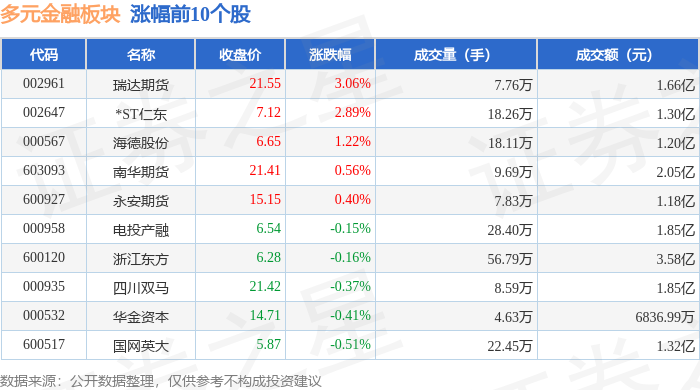
Core Viewpoint - The diversified financial sector experienced a decline of 0.95% on September 30, with COFCO Capital leading the drop, while the Shanghai Composite Index rose by 0.52% and the Shenzhen Component Index increased by 0.35% [1] Group 1: Market Performance - The diversified financial sector's stocks showed mixed performance, with notable gainers including Ruida Futures (up 3.06%) and ST Rendong (up 2.89%), while several stocks like ST Xiongmao and ST Rendong faced declines [1][2] - The trading volume for Ruida Futures reached 77,600 lots, with a transaction value of approximately 166 million yuan [1] Group 2: Capital Flow - The diversified financial sector saw a net outflow of 570 million yuan from major funds, while retail investors contributed a net inflow of 464 million yuan [2] - The capital flow data indicates that stocks like Haide Co. and ST Xiongmao experienced significant net inflows from retail investors, despite overall negative trends in major and speculative funds [3]





南华金属日报:贵金属维持强势,但建议轻仓过节-20250930
Nan Hua Qi Huo· 2025-09-30 08:39
Report Investment Rating - No investment rating for the industry is provided in the report. Core View - The medium to long - term outlook for precious metals is bullish, and in the short - term, the technical form is also strong with potential for further upward movement. London gold has reached above 3800, and its resistance level has shifted up to 4000; London silver's resistance has lifted to 50. However, due to the approaching National Day holiday and the increase in short - term futures positions, it is recommended to hold light long positions during the holiday [2][5]. Summary by Directory Market Review - On Monday, the precious metals sector continued to rise strongly. Gold broke through the 3800 mark and reached a new high, while platinum and silver also hit stage highs, and palladium was close to its July high. The recent rise in precious metals is due to the influx of medium - to - long - term ETF investment demand and short - term futures capital buying, driven by concerns about the Fed's independence, the upcoming interest - rate cut cycle, and the risk of a government shutdown caused by the difficult passage of the US temporary budget bill. The House passed a temporary budget bill on September 19 to maintain government funding until November 21, but the Senate's vote on the same day did not reach the passing threshold. With the approaching National Day holiday and the large previous gains in precious metals, there is an increased risk of a short - term pullback due to profit - taking. COMEX Gold 2512 contract closed at $3862.9 per ounce, up 1.42%; US Silver 2512 contract closed at $47.11 per ounce, up 0.97%. SHFE Gold 2512 main contract closed at 866.52 yuan per gram, up 1.35%; SHFE Silver 2512 contract closed at 10939 yuan per kilogram, up 3.92% [2]. Interest - Rate Cut Expectations and Fund Holdings - Interest - rate cut expectations are cooling. According to CME "FedWatch" data, the probability of the Fed keeping interest rates unchanged in October is 10.2%, and the probability of a 25 - basis - point cut is 89.8%. For December, the probability of keeping rates unchanged is 2.5%, the probability of a cumulative 25 - basis - point cut is 29.9%, and the probability of a cumulative 50 - basis - point cut is 67.6%. In January, the probability of a cumulative 25 - basis - point cut is 16.6%, a cumulative 50 - basis - point cut is 49.2%, and a cumulative 75 - basis - point cut is 32.9%. In terms of long - term funds, SPDR Gold ETF holdings increased by 6.01 tons to 1011.73 tons; iShares Silver ETF holdings increased by 159.51 tons to 15521.35 tons. SHFE silver inventory increased by 31.4 tons to 1189.6 tons, and SGX silver inventory decreased by 35.4 tons to 1217 tons in the week ending September 19 [3]. This Week's Focus - This week's key data includes the non - farm payrolls report on Friday and US ISM PMI during the week. There will also be many speeches by Fed officials. On Tuesday at 18:00, Fed Vice - Chair Jefferson will speak. On Wednesday at 01:00, 2025 FOMC voter and Chicago Fed President Goolsbee will speak; at 07:10, 2026 FOMC voter and Dallas Fed President Logan will speak; at 08:30, Fed Vice - Chair Jefferson will speak. On Thursday at 22:30, 2026 FOMC voter and Dallas Fed President Logan will speak. On Friday at 18:05, FOMC permanent voter and New York Fed President Williams will speak at the farewell symposium of the Dutch central bank governor [4]. Price and Inventory Data - **Precious Metals Futures and Spot Prices**: SHFE Gold main - continuous contract is at 866.52 yuan per gram, up 1.22%; SGX Gold TD is at 862.5 yuan per gram, up 1.13%; CME Gold main contract is at $3862.9 per ounce, up 1.93%; SHFE Silver main - continuous contract is at 10939 yuan per kilogram, up 2.89%; SGX Silver TD is at 10878 yuan per kilogram, up 3.1%; CME Silver main contract is at $47.11 per ounce, up 1.61% [6]. - **Inventory and Holdings**: SHFE gold inventory is 68628 kilograms, up 4.26%; CME gold inventory is 1242.4729 tons, down 0.0003 tons; SHFE gold holdings are 263220 lots, down 0.41%; SPDR gold holdings are 1011.73 tons, up 0.6%; SHFE silver inventory is 1189.648 tons, up 2.71%; CME silver inventory is 16531.0249 tons, up 0.21%; SGX silver inventory is 1216.965 tons, down 2.83%; SHFE silver holdings are 508967 lots, down 6.48%; SLV silver holdings are 15521.351058 tons, up 1.04% [13][16]. - **Stock, Bond, and Commodity Overview**: The US dollar index is at 97.9486, down 0.25%; the US dollar against the Chinese yuan is at 7.1276, up 0.26%; the Dow Jones Industrial Average is at 46316.07 points, up 0.15%; WTI crude oil spot is at $63.45 per barrel, down 3.45%; LmeS copper 03 is at $10428.5 per ton, up 2.19%; the 10 - year US Treasury yield is at 4.15%, down 1.19%; the 10 - year US real interest rate is at 1.8%, down 1.1%; the 10 - 2 - year US Treasury yield spread is at 0.52%, down 8.77% [21].
南华期货2025年度烧碱四季度展望:把握阶段性供需错配机会
Nan Hua Qi Huo· 2025-09-30 00:47
Group 1: Report Industry Investment Rating - Not provided Group 2: Core Views of the Report - In the fourth quarter, the overall supply - demand contradiction of caustic soda is limited, and prices may be more affected by phased restocking demand. High开工 and high production are expected to continue, and long - term supply faces pressure. New alumina projects support demand, but alumina's surplus fundamentals and low prices cap the upside of caustic soda prices. Export expectations are cautiously optimistic, and costs are supported. Attention should be paid to phased supply - demand mismatches [1]. - The price of caustic soda is expected to fluctuate widely in the range of 2,400 - 2,800 yuan/ton [1]. Group 3: Summary by Relevant Catalogs Chapter 2: Third - Quarter Market Review of Caustic Soda - In the third quarter, caustic soda showed a wide - range oscillation pattern, with prices mainly in the range of 2,400 - 2,800 yuan/ton, affected by policy expectations and fundamental changes [1]. - From late June to early July, the market rose strongly, supported by stable spot prices and then driven by policy expectations. From late July to early August, the market corrected due to eased policy statements, cooled market sentiment, and weakened spot supply - demand. In mid - August, the market rebounded due to marginal improvement in fundamentals. From late August to mid - September, the market declined again after the end of phased restocking [2]. Chapter 3: Core Concerns of Caustic Soda - Caustic soda exports: As of now, exports this year are 860,000 tons more than the same period last year. Annual exports are expected to reach about 4.1 million tons, accounting for 10% - 11% of apparent demand. However, August export data was below expectations, and there are rumors of new energy process adjustments affecting demand [16]. - Alumina production and alkali - stocking rhythm: Many alumina capacities are to be put into production from the end of 2025 to early 2026, supporting caustic soda demand. But alumina's surplus fundamentals and low prices may limit caustic soda's upside and affect alumina's production progress [17]. - Supply policies and costs: Chlor - alkali comprehensive profits are high, so the possibility of active supply - side production cuts is small. However, policy expectations may have an unexpected impact on supply and cost - side raw material pricing [18]. Chapter 4: Valuation Feedback and Supply - Demand Outlook of Caustic Soda 4.1 High Profits, Continued Supply Pressure of Caustic Soda - From January to September, caustic soda production totaled 31.58 million tons, a year - on - year increase of 2.1%. This year's new caustic soda capacity is estimated to be around 2.4 million tons, with a capacity growth rate of 4.8% - 4.9%. By the end of the year, the capacity base may rise to 51 - 52 million tons. But actual implementation is less optimistic, with few certain new capacities in the fourth quarter [19]. - High profits limit caustic soda price increases, but there have been periods of high profits in history due to short - term supply - demand mismatches [22]. 4.2 Waiting for Alumina Production to Materialize - From the end of 2025 to the first quarter of 2026, there are still many alumina capacities to be put into production, creating caustic soda stocking demand in the fourth quarter. However, alumina's surplus situation and low prices limit caustic soda's upside. Non - aluminum demand is fragmented, and short - term restocking at low prices has some price support but does not change the supply - demand balance [25]. 4.3 Exports are Key - From January to August 2025, caustic soda exports were 2.68 million tons, a year - on - year increase of 47.16%, due to increased Southeast Asian demand and domestic price advantages. In the short - to - medium term, export expectations remain high, but there are rumors of overseas process adjustments affecting demand. In October, export orders improved, supporting demand [39][40].
南华期货股份有限公司关于全资子公司完成工商变更登记并换发营业执照的公告
Shang Hai Zheng Quan Bao· 2025-09-29 21:59
证券代码:603093 证券简称:南华期货 公告编号:2025-063 南华期货股份有限公司 2、名称:浙江南华资本管理有限公司 3、类型:有限责任公司 4、住所:浙江省杭州市上城区横店大厦601室 5、法定代表人:贾晓龙 6、注册资本:陆亿元整 关于全资子公司完成工商变更登记并换发营业执照的公告 本公司董事会及全体董事保证本公告内容不存在任何虚假记载、误导性陈述或者重大遗漏,并对其内容 的真实性、准确性和完整性承担法律责任。 南华期货股份有限公司全资子公司浙江南华资本管理有限公司、南华基金管理有限公司于近日完成工商 变更登记,并分别取得杭州市上城区市场监督管理局、东阳市市场监督管理局换发的《营业执照》。变 更后的相关信息如下: 一、浙江南华资本管理有限公司相关信息 1、统一社会信用代码:91330102069216416W 4、住所:浙江省东阳市横店影视产业实验区商务楼 5、法定代表人:朱坚 6、注册资本:叁亿伍仟万元整 7、成立日期:2016年11月17日 7、成立日期:2013年5月20日 8、营业期限:2013年5月20日至2043年5月19日 9、经营范围:一般项目:货物进出口;技术进出口;食品销售 ...
南华期货:关于全资子公司完成工商变更登记并换发营业执照的公告
Zheng Quan Ri Bao· 2025-09-29 12:47
Group 1 - Nanhua Futures announced the completion of business registration changes for its wholly-owned subsidiaries, Zhejiang Nanhua Capital Management Co., Ltd. and Nanhua Fund Management Co., Ltd. [2] - The new business licenses were issued by the Market Supervision Administration of Hangzhou's Shangcheng District and Dongyang City [2]
南华期货棉花四季度展望:新季丰产之下,套保压?凸显
Nan Hua Qi Huo· 2025-09-29 11:20
Report Overview - **Title**: Nanhua Futures' Outlook for Cotton in the Fourth Quarter [1] - **Author**: Chen Jianing [2] - **Investment Advisory License Number**: Z0020097 [2] - **Investment Advisory Business Qualification**: CSRC License [2011] No. 1290 [2] 1. Investment Rating - The report does not provide an industry investment rating. 2. Core Views - In the third quarter, Zhengzhou cotton (Zhengmian) showed a volatile pattern. Domestic cotton consumption was better than expected, with strong domestic demand and "rush - export" orders for external demand. Xinjiang cotton destocking accelerated, supporting cotton prices. However, the expected high - yield of new cotton and poor downstream profits limited price increases. US cotton was in a tug - of - war between slow export sign - ups and a decline in production expectations, with high unpriced contracts, maintaining a narrow - range consolidation. [2] - In the fourth quarter, the listing of new domestic cotton will ease the supply shortage. Ginners may be cautious in purchasing, and the high - yield pattern of Xinjiang cotton will bring significant hedging pressure. Domestic demand may maintain moderate growth, but external sales may not sustain previous strong performance after the "rush - export" orders. Cotton prices lack upward drivers. [2] - The predicted price range for Zhengmian is 13,000 - 14,500 yuan/ton. The recommended strategy is to short on price rebounds and pay attention to the 1 - 5 reverse spread opportunity. [2] 3. Summary by Directory 3.1. Market Review - **Zhengzhou Cotton**: In the third quarter, Zhengmian fluctuated in the range of 13,500 - 14,400 yuan/ton. After being impacted by tariff policies in the first half of the year, it gradually recovered as tariff policy implementation was postponed. With better - than - expected consumption and reduced imports, Xinjiang cotton destocking accelerated, and inventory was low at the end of the year. However, the expected high - yield of new cotton and poor spinning profits limited price increases. [2] - **US Cotton**: US cotton fluctuated in the range of 65 - 70 cents/pound. Slow export progress at the beginning of the year was followed by price declines due to tariff policies. After reaching the export sign - up target, prices recovered. High unpriced contracts in the third quarter suppressed prices, and it oscillated narrowly between slow export sign - ups and expected production decline. [7] 3.2. Core Concerns 3.2.1. Import Quotas and Cotton Destocking - From January to August 2025, China's cumulative cotton imports were 590,000 tons, a significant year - on - year decrease of 2.05 million tons, and cumulative棉纱 imports were 910,000 tons, a year - on - year decrease of 610,000 tons. Monthly cotton imports in the third quarter were at a near - decade low. [9] - On August 25, the National Development and Reform Commission issued an additional 200,000 - ton cotton import sliding - duty processing trade quota, which had limited impact on market sentiment. With favorable import profits, cotton imports may slightly increase in the fourth quarter, and the price gap between domestic and foreign cotton may narrow slightly. [9] - Due to reduced imports and increased downstream demand in Xinjiang, domestic cotton destocking accelerated. As of the end of August, China's cotton industrial and commercial inventory was only 2.374 million tons, a year - on - year decrease of 622,000 tons. After the listing of new cotton in the fourth quarter, the inventory shortage can be alleviated, but imports may remain low, and domestic cotton supply and demand may still be tight at the end of the year. [14] 3.2.2. New - Season High - Yield and Hedging Pressure - In the new season, with the support of the cotton target price subsidy policy, farmers' enthusiasm for cotton planting remained high, and the planting area in Xinjiang increased. The expected cotton output in Xinjiang for the 25/26 season is 7.108 million tons, a year - on - year increase of 8.1%. [16] - The concentrated listing of new cotton is postponed to the National Day holiday. Currently, the purchase price of machine - picked seed cotton is stable with a slight decline. Ginners may be cautious in purchasing, and cotton prices may face significant hedging pressure in the fourth quarter. [17] 3.2.3. Domestic and Foreign Sales - **Domestic Sales**: From January to August 2025, China's retail sales of clothing, footwear, and textiles reached 940.04 billion yuan, a year - on - year increase of 3.91%. Downstream demand is in the peak season, but with expanded spinning capacity, orders decreased, and spinning profits were limited. Domestic textile and apparel sales may maintain moderate growth in the fourth quarter. [19] - **Foreign Sales**: From January to August 2025, China's total textile and clothing exports were 197.275 billion US dollars, basically the same as the previous year. Cotton product exports showed a "quantity - for - price" trend, and export profits were squeezed under US tariff pressure. Although exports to emerging markets increased, the bright performance of the export market may not be sustainable in the short term without improved US - China tariff policies. [21] 3.2.4. US New - Season Production and Export - In the 25/26 season, due to a low cotton - grain price ratio, US cotton planting area decreased. The USDA expects the new - season planting area to be 56.427 million mu, a year - on - year decrease of 16.9%. Although the weather in cotton - growing areas improved, the expected output is 2.879 million tons, a year - on - year decrease of 259,000 tons. [25] - As of September 11, US cotton export sign - ups were slow. However, tariff negotiation policies may help stabilize US agricultural product exports, and the subsequent adjustment of US foreign tariff policies needs attention. [30] 3.2.5. Global Production and Consumption - According to the USDA's September report, the expected global cotton output in the 25/26 season is 25.622 million tons, a year - on - year decrease of 335,000 tons. China and Brazil are expected to increase production, while the US, Australia, and Turkey will see output declines. [34] - Global cotton consumption is expected to reach 25.872 million tons, a year - on - year decrease of 70,000 tons. China's consumption is expected to decline slightly, and Southeast Asian countries' consumption will be basically the same as the previous year. [35] 3.3. Valuation Feedback and Supply - Demand Outlook - In the fourth quarter, with the listing of new cotton in the Northern Hemisphere, the pressure of high - yield in China will become apparent. Ginners may be cautious in purchasing, and cotton prices may face hedging pressure and have a phased decline. [37] - In the long - term, if China's high - yield situation continues and the US - China situation remains unchanged, the quota for cotton imports may remain low. With the support of Xinjiang's spinning capacity and high operating rates, domestic cotton destocking may be fast, and Zhengmian may rebound after reaching the bottom. [37]