
Nanhua Futures(603093)

Search documents
南华期货2025年度集运四季度展望:行到水穷处,坐看云起时
Nan Hua Qi Huo· 2025-09-29 09:09
1. Report Industry Investment Rating There is no information regarding the report industry investment rating in the provided content. 2. Core Viewpoints of the Report - The freight rate is expected to show a "U" - shaped movement. The European - line freight rate and futures price are predicted to remain in a weak and volatile state in the medium term until November, and then start to rebound. The short - term fluctuation range is expected to be between 900 and 1200 points [6][7]. - For trading strategies, the 12 - contract can be considered for low - buying opportunities, the medium - term high - selling strategy can continue, and the long - term strategy depends on the situation. A positive spread strategy for the 12 - 02 contracts can be attempted when their prices converge, and a "selling over - the - counter options + buying futures" hedging combination can be tried [8]. - The current supply - demand situation shows that the demand is weak overall, especially in the European line, and the supply growth rate has decreased as expected, but the stock still has pressure, resulting in a continued oversupply situation [6][30]. 3. Summary by Relevant Catalogs 3.1 Viewpoint Summary - **Trend Forecast**: The demand is relatively weak this year. The off - season is expected to last until November, and then pick up. The supply still has an oversupply situation due to insufficient idle capacity. The European - line freight rate and futures price are expected to be weak in the medium term and rebound in November. However, variables such as shipping company actions and macro - level impacts need to be noted [6]. - **Interval Outlook**: The short - term fluctuation range of the long - term European - line freight rate is [900, 1200] points [7]. - **Strategy Outlook**: The 12 - contract can be considered for low - buying opportunities, the medium - term high - selling strategy can continue, and the long - term strategy depends on the situation. A positive spread strategy for the 12 - 02 contracts can be attempted when their prices converge, and a "selling over - the - counter options + buying futures" hedging combination can be tried [8]. - **Risk Points**: Red Sea resumption of navigation, unexpected development of tariffs, etc. [9] 3.2 Market Review - **Container Shipping Freight Rate Review**: In the third quarter, the European - line settlement freight rate first rose seasonally in early July and then declined. The decline was mainly due to the "off - peak in peak season" of booking demand. The European - line spot freight rate index also showed a downward trend. The US - West line freight rate fluctuated widely due to factors such as tariffs and port fees. Overall, the third quarter showed an "off - peak in peak season" situation [12][13]. - **Container Shipping Futures Price Review**: The container shipping index (European line) futures price first rose with seasonal demand recovery and then declined due to oversupply. After reaching the lowest point in September, it rebounded slightly with shipping company price support. The volatility in the third quarter was relatively narrow [18]. - **Demand "Off - peak in Peak Season"**: The global container shipping market demand maintained a certain seasonality in the third quarter, but the year - on - year growth rate was relatively low. The European - line demand was relatively poor, as reflected by the low congestion index of European ports. The euro - zone economy was in a weak recovery state, unable to provide strong support for the futures price [23][25][28]. - **Supply Growth Rate Declined, Stock Still under Pressure**: - **High Effective Capacity**: The global container ship capacity growth rate has gradually slowed down but remains relatively high, higher than the average. This is one of the reasons for the high overall supply stock [30]. - **Slowdown in New Ship Orders and Deliveries**: In July and August, the new order volume and shipbuilding completion volume of container ships decreased significantly year - on - year, indicating that the market capacity is relatively saturated and the demand is not strong [40]. - **Stable Red Sea Diversion Structure**: The Red Sea diversion continues, and the transit volume of the Suez Canal is still low. However, the current diversion pattern is relatively stable, and its supporting effect on the freight rate of the Asia - Europe route is relatively weak [42]. 3.3 Core Concerns - **Tariff Changes**: In the third quarter, tariff changes were relatively small compared to the second quarter. However, recent US tariff announcements on EU and other products will have a negative impact on the international trade environment and the container shipping market in the medium and long term. The follow - up results of China - US tariff negotiations also need to be continuously monitored [46][47]. - **Shipping Company Measures**: Shipping companies have been issuing price - increase letters, but the actual implementation effect has been poor except in June. However, their price - increasing actions can have a short - term positive impact on the futures market sentiment. Whether shipping companies can maintain the current price quotes will affect the valuation of the futures price [50]. - **Fundamentals**: In the fourth quarter, the demand is expected to remain weak until November and then pick up, but overall it may still be relatively weak. The supply growth rate is expected to continue to decline but remain at a high level, and the oversupply situation will continue [53]. 3.4 Valuation Feedback and Supply - Demand Outlook - **Valuation**: Currently, the valuation is weak but has the potential to increase. The shipping companies' price - supporting actions in mid - October have led to a recovery in the futures price valuation. The current basis has converged to a reasonable range [54][55]. - **Demand Side**: - **Trade - Related Macroeconomic Indicators**: The OECD composite leading indicator shows that China's overall export demand in the fourth quarter may be relatively stable but slightly weak [56]. - **Trade Recovery**: Based on past experience, China's export trade data usually increases from mid - November, but there is a possibility of blurred seasonality this year [58]. - **Authoritative Institution Forecasts**: Clarksons has raised the trade volume forecast for the Asia - Europe route in the next two years, but the increase is relatively small [60]. - **Supply Outlook**: The total container ship capacity in 2025 is expected to increase by 6.6% year - on - year, and the capacity of 17000 + container ships is expected to increase by 6.1% year - on - year. The oversupply situation is expected to continue in the fourth quarter [60][63].

南华期货(603093) - 南华期货股份有限公司关于全资子公司完成工商变更登记并换发营业执照的公告
2025-09-29 09:00
证券代码:603093 证券简称:南华期货 公告编号:2025-063 南华期货股份有限公司 关于全资子公司完成工商变更登记并换发营业执照 的公告 本公司董事会及全体董事保证本公告内容不存在任何虚假记载、误导性陈述 或者重大遗漏,并对其内容的真实性、准确性和完整性承担法律责任。 9、经营范围:一般项目:货物进出口;技术进出口;食品销售(仅销售预 包装食品);汽车零配件零售;汽车零配件批发;五金产品批发;食用农产品批 发;计算机软硬件及辅助设备批发;成品油批发(不含危险化学品);日用品批 发;畜牧渔业饲料销售;石油制品销售(不含危险化学品);棉、麻销售;办公 用品销售;纸浆销售;机械零件、零部件销售;机械设备销售;金属材料销售; 橡胶制品销售;金属结构销售;建筑材料销售;金银制品销售;煤炭及制品销售; 日用玻璃制品销售;非金属矿及制品销售;水泥制品销售;日用百货销售;化工 产品销售(不含许可类化工产品);产业用纺织制成品销售;普通货物仓储服务 1、统一社会信用代码:91330102069216416W 2、名称:浙江南华资本管理有限公司 3、类型:有限责任公司 4、住所:浙江省杭州市上城区横店大厦 601 室 ...
南华期货两全资子公司完成工商变更并换发执照
Xin Lang Cai Jing· 2025-09-29 08:50
近日,南华期货股份有限公司全资子公司浙江南华资本管理有限公司、南华基金管理有限公司完成工商 变更登记,并分别取得杭州市上城区市场监督管理局、东阳市市场监督管理局换发的《营业执照》。浙 江南华资本管理有限公司注册资本为陆亿元整,法定代表人为贾晓龙;南华基金管理有限公司注册资本 为叁亿伍仟万元整,法定代表人为朱坚。两公司均已公布变更后的详细信息,包括统一社会信用代码、 住所、经营范围等内容。 ...
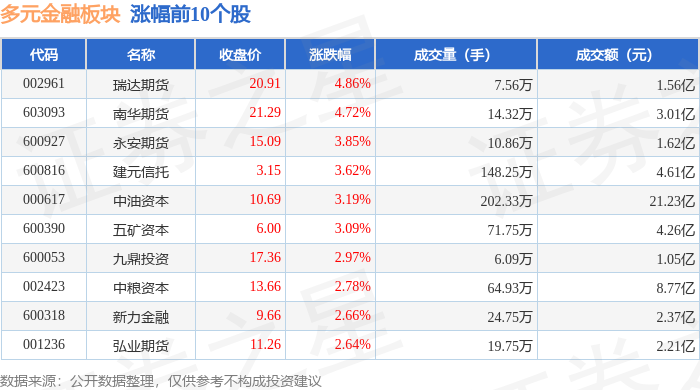
多元金融板块9月29日涨2.2%,瑞达期货领涨,主力资金净流入2.54亿元
Zheng Xing Xing Ye Ri Bao· 2025-09-29 08:45
Market Performance - The diversified financial sector rose by 2.2% on September 29, with Ruida Futures leading the gains [1] - The Shanghai Composite Index closed at 3862.53, up 0.9%, while the Shenzhen Component Index closed at 13479.43, up 2.05% [1] Individual Stock Performance - Ruida Futures (002961) closed at 20.91, with a gain of 4.86% and a trading volume of 75,600 lots, totaling a transaction value of 156 million [1] - Nanhua Futures (603093) closed at 21.29, up 4.72%, with a trading volume of 143,200 lots and a transaction value of 301 million [1] - Yong'an Futures (600927) closed at 15.09, increasing by 3.85%, with a trading volume of 108,600 lots and a transaction value of 162 million [1] - Other notable performers include Jianyuan Trust (600816) up 3.62%, Zhongyou Capital (000617) up 3.19%, and Yukuang Capital (600390) up 3.09% [1] Capital Flow Analysis - The diversified financial sector saw a net inflow of 254 million from main funds, while retail investors experienced a net outflow of approximately 96.58 million [2][3] - Main funds showed significant net inflows in stocks like Zhonghai Capital (000617) with 71.1 million and Yuexiu Capital (000987) with 64.07 million [3] - Conversely, retail investors withdrew from stocks such as Zhonghai Capital and Yuexiu Capital, with outflows of 34.12 million and 33.85 million respectively [3]



A股突变,大涨!
中国基金报· 2025-09-29 08:09
Market Overview - The A-share market saw all three major indices rise, with the ChiNext Index increasing by 2.75% and the Shanghai Composite Index closing at 3862.53 points, up 0.90% [1][4] - The total trading volume in the Shanghai and Shenzhen markets reached 2.16 trillion yuan, an increase of 146 billion yuan compared to the previous trading day [4] Sector Performance - The brokerage and precious metals sectors led the market gains, with the brokerage sector rising by 4.89% and the precious metals sector increasing by 4.3% [4][12] - Solid-state battery and lithium battery-related sectors also performed well, with the solid-state battery index surging [17] Brokerage Stocks - Brokerage stocks experienced a significant afternoon rally, with major players like Huatai Securities and GF Securities hitting the daily limit of 10% [7][8] - The average daily trading volume and margin financing indicators for brokerages reached historical highs, indicating strong market activity [10] Precious Metals - The precious metals sector saw notable increases, with spot gold breaking through the $3810 mark, reaching a new historical high of $3813.93 per ounce [11][12] - Key stocks in the precious metals sector, such as Shengda Resources and Zhaojin Mining, recorded substantial gains [12][13] Solid-State Battery Sector - The solid-state battery index showed strong performance, with companies like EVE Energy and Ganfeng Lithium seeing significant stock price increases [18][19] - Research advancements in solid-state battery technology from Tsinghua University contributed to the sector's positive momentum [20]






商品策略周报:节前继续观望-20250929
Nan Hua Qi Huo· 2025-09-29 04:48
Report Summary 1. Report Industry Investment Rating No relevant content provided. 2. Core Viewpoints of the Report - The anti - involution theme in the commodity market has entered a cooling stage, and the overall market is in a weak and volatile atmosphere. Trend strategies have low win - rates and odds, and it is difficult to operate [2][3][5]. - With the approaching of the National Day holiday, funds are flowing out. Investors should control their positions or stay in cash to avoid holiday risks [3][5]. - In terms of specific sectors, agricultural products are weak, while precious metals are strong [3]. - The market is currently affected by sudden news, with unclear main contradictions and insufficiently low valuations. It is advisable to wait patiently [4]. 3. Summary by Related Catalogs Market Overview - Various sudden news, such as Argentina's suspension of agricultural product tariffs, Indonesia's copper mine suspension, and Russia's refinery attacks, have caused short - term shocks to the market, increasing trading difficulty and hampering strategy execution [4]. - The anti - involution theme market is in a cooling cycle, and the market is now trading the real - end logic of surplus varieties. The supply - demand patterns of soda ash, PVC and other varieties remain loose, and downstream demand is weak [4]. Product Strategy Recommendations - Abandon market prediction. Stable account profitability depends on strategy, risk control, and execution [5]. - The net value performance of the Chase the Wind 1 and Chase the Wind 2 strategy products is good. Chase the Wind 2 is in a free trial period and is worth trying for non - subscribed customers [5]. Data Tables - **Plate Fund Flow**: The total capital flow is 322 million yuan. Precious metals have an inflow of 3.022 billion yuan, non - ferrous metals 1.405 billion yuan, while black metals have an outflow of 2.959 billion yuan, energy 165 million yuan, chemicals 846 million yuan, feed and breeding 555 million yuan, oils and fats 1.597 billion yuan, and soft commodities have an inflow of 73 million yuan [9]. - **Black and Non - ferrous Weekly Data**: Data such as price percentile, inventory percentile, valuation percentile, etc. are provided for various black and non - ferrous metal varieties, including iron ore, rebar, gold, etc. [9]. - **Energy and Chemical Weekly Data**: Similar data is presented for energy and chemical products like fuel oil, low - sulfur oil, asphalt, etc. [11]. - **Agricultural Product Weekly Data**: Data for agricultural products such as soybean meal, rapeseed meal, soybean oil, etc. are given [12].
南华期货2025年国债四季度展望:等待政策重心的回摆时刻
Nan Hua Qi Huo· 2025-09-28 11:34
1. Report Industry Investment Rating No information provided. 2. Core Viewpoints of the Report - Risk assets and regulatory disturbances were the main reasons for the multiple declines in the bond market in the third quarter, indicating that the core drivers of fundamentals and liquidity remained unchanged, and there was no risk of a cyclical reversal from the underlying framework of the bond market [1][16]. - Most of the negative disturbances in the third quarter were unrelated to the fundamentals and liquidity levels and were fully reflected in the current pricing, so there was no reason to be pessimistic about the fourth quarter. The central bank provided consistent support in terms of liquidity throughout the third quarter. The weakening of fundamental data in August increased the necessity of macro - policy support, which might lead to a shift in the focus of monetary policy towards "stable growth" [5]. - In the fourth quarter, the bond market may face pressure at the beginning, but there may be a downward opportunity with the implementation of policy加码. The central government may increase overall policies, and monetary policy may be implemented first by the end of the year. The central level of treasury bond yields in the fourth quarter may decline slightly compared to the end of the third quarter, with the yield of the 10 - year treasury bond at the end of the third quarter around 1.87% and may fall below 1.8%, and the quarterly oscillation range around 1.78% - 1.95% [5]. 3. Summary by Relevant Catalogs 3.1 Third Quarter: Exogenous Factors Dominated - **Market Review** - **July**: Policy implementation and rising expectations led to a significant improvement in risk appetite. At the beginning of July, the bond market continued the strong and narrow - range oscillation trend of the second quarter. The implementation of anti - involution policies and the announcement of a trillion - level infrastructure project in Yajiang Motuo Hydropower Station worried the market about the double impact of "rising inflation + significant investment increase" on bonds. The yield of the 10 - year treasury bond rose from 1.66% at the beginning of July to 1.74%, an increase of 8bp [19]. - **August**: The seesaw effect between the bond market and risk assets weakened as the A - share market turned to a structural market [16]. - **September**: Regulatory disturbances and marginal signals emerged. The release of the draft public offering fee opinion at the end of the third quarter had a new impact on the market [16]. - **Core Issues** - The key issues in looking forward to the fourth quarter were whether the above negative factors were fully reflected and whether the bond market logic could return to its own fundamentals [16]. 3.2 Valuation Still Has Room for Repair - **Domestic Loose Expectations Are Stable**: The short - end cost - performance of the 10 - year treasury bond has been repaired, and the expectation of interest rate cuts has declined [23]. - **The Cost - Performance of Stocks and Bonds Has Rebounded**: The cost - performance of stocks and bonds has improved, and the yield of the 10 - year treasury bond has a certain relationship with the dividend rates of the Shanghai Stock Exchange 50 and CSI 300 [37][39]. - **"Deposit Migration" Still Needs Observation**: No specific content was provided in the text. 3.3 Waiting for the Swing Moment of Policy Focus - **Monetary Policy Has Been Stable Since the Third Quarter**: Monetary policy has been stable overall since the third quarter. The central bank carried out a large - scale interest rate transmission system reform and actively maintained market sentiment through open - market operations, indicating that the supportive stance of monetary policy remained unchanged and the upward trend of bond market yields was limited [44]. - **Multi - Dimensional Reforms to Stabilize the Market** - **The Second Joint Meeting of the Central Bank and the Ministry of Finance**: On September 3, the joint working group of the central bank and the Ministry of Finance held the second group leader meeting, discussing issues such as financial market operation, government bond issuance management, central bank treasury bond trading operations, and improving the offshore RMB treasury bond issuance mechanism. This meeting was more focused on financial market operation and helped to stabilize market sentiment [49]. - **Changes in the Monetary Policy Framework: Adjustment of Primary Dealer Evaluation**: On September 12, relevant adjustments were made to the evaluation of primary dealers, which involved multiple aspects such as money market transmission, bond market market - making, and compliance and stable operation [51]. - **The Central Bank Adjusted the Bidding Mode of 14 - day Reverse Repos, Aligning with MLF**: On September 19, the central bank adjusted the bidding mode of 14 - day reverse repos to align with MLF, which had an impact on the market [52]. 3.4 Fundamentals: Pay Attention to the Risk of a Second Decline - In the first half of the year, GDP was significantly repaired with the support of the supply side. After seeing the problem of the decline in industrial enterprise profits, the policy shifted from stabilizing growth to stabilizing prices, which led to a slowdown in production. Since July, the manufacturing PMI reading has declined again, and industrial added value has decreased synchronously. After the data in August was released, the potential risk of a second decline may lead to a swing in the policy focus again [65].
南华期货煤焦产业周报:下游补库临近尾声,焦煤现货续涨存疑-20250927
Nan Hua Qi Huo· 2025-09-27 11:35
Report Industry Investment Rating No relevant information provided. Core Viewpoints of the Report - Recently, the operating rate of coking coal mines has been continuously rising, and Mongolian coal has been actively cleared through customs, resulting in a strong supply of coking coal. As pre - holiday restocking nears its end, there is a risk of marginal deterioration in the coking coal inventory structure after the holiday, and it is expected that the difficulty of holding up spot prices will gradually increase. The price increase of coke has officially started and is expected to be officially implemented during or after the National Day. At that time, the immediate coking profit is expected to improve slightly, and the probability of large - scale production cuts by coking enterprises in the short term is not high. Blast furnace steel mills are actively increasing production, with molten iron output remaining above 2.4 million tons, indicating strong demand for coke, and there is no obvious contradiction between supply and demand of coke. In the short term, the coking coal futures may face downward pressure, and the coke market will follow the trend of coking coal. In the long - term, "anti - involution" is the trading theme for the second half of the year, and attention should be paid to the impact of macro - sentiment fluctuations and mine over - production inspections on the coking coal and coke market. Market participants' expectations for the future are gradually improving, and their willingness to hold goods has also increased compared with the first half of the year. It is maintained that coking coal and coke are not considered as short - side allocations in the black - metal sector, and the main coking coal futures are expected to maintain a wide - range oscillatory pattern. A breakthrough above the previous high requires the introduction of substantial favorable policies or an unexpected decline in the mine operating rate. Subsequent attention should be paid to the recovery of terminal demand after the National Day, the Fourth Plenary Session of the Central Committee in late October, and the proposal of the 14th Five - Year Plan [2]. Summary According to Relevant Catalogs Chapter 1: Core Contradictions and Strategy Recommendations 1.1 Core Contradictions - **Proximal Trading Logic**: The number of available days of coking coal inventory for downstream coking enterprises is higher than the seasonal average, and the restocking logic has temporarily ended. After the holiday, upstream mines will face greater inventory pressure, and it is expected that the difficulty of holding up spot prices will increase. As the "Silver October" peak season approaches, attention should be paid to the recovery of terminal demand after the holiday. In the short term, the inventory pressure of finished steel products is relatively large, showing obvious characteristics of a non - prosperous peak season, and there is still pressure in the real - world steel market [4]. - **Distal Trading Expectations**: "Anti - involution" is the key trading focus for the second half of the year, and macro - sentiment will repeatedly dominate the trend of coking coal and coke futures. Attention should be paid to the Fourth Plenary Session of the Central Committee in October and the 14th Five - Year Plan. The Federal Reserve cut interest rates by 25 basis points as expected, and the market expects two more interest rate cuts this year. The loose liquidity supports the overall valuation of commodities [12]. 1.2 Trading - Type Strategy Recommendations - **Trend Judgement**: The coking coal and coke futures are expected to oscillate within a range. The JM2601 coking coal futures are expected to trade between 1100 - 1350 yuan/ton, and the J2601 coke futures are expected to trade between 1600 - 1850 yuan/ton. - **Strategy Recommendations**: Short the coking profit on the futures market when the price is high, with the recommended entry range for the 01 coke/coking coal ratio being (1.5 - 1.55); conduct a reverse spread trade for coking coal 1 - 5, with the recommended entry range being (- 70, - 60); go long on the coking coal 2605 contract when the price is low, with the recommended entry range being (1200, 1250) [13]. - **Basis, Calendar Spread, and Hedging Arbitrage Strategy Recommendations**: Recently, the basis of Mongolian No. 5 coking coal at the port has strengthened slightly, and the coke basis has oscillated at a low level. There is no definite opportunity for positive cash - futures arbitrage. It is recommended to pay attention to the reverse spread trade for coking coal 1 - 5. The reasons for going long on the far - month contract are: the 01 contract has industrial hedging short positions and warehouse - receipt pressure, while the short - side force in the far - month 05 contract is weak; the 01 contract has position - limit constraints, while the far - month contract has fewer restrictions; the Dalian Commodity Exchange has expanded the number of delivery warehouses and delivery capacity, which is beneficial for short - side delivery, and the near - month coking coal contract is restricted. Short the coking profit on the futures market when the price is high, with the recommended entry range for the 01 coke/coking coal ratio being (1.5 - 1.55) [14]. 1.3 Industry Customer Operation Recommendations - **Price Range Forecast**: The monthly price range forecast for coking coal is 1100 - 1350 yuan/ton, with a current volatility of 38.64% and a historical percentile of 76.02%. The monthly price range forecast for coke is 1600 - 1850 yuan/ton, with a current volatility of 32.23% and a historical percentile of 69.14%. - **Risk Management Strategy Recommendations**: For inventory hedging, coking enterprises worried about future price declines can short the J2601 coke contract, with a recommended hedging ratio of 25% at the entry range of (1780, 1830) and 50% at the entry range of (1830 - 1880). For procurement management, coking plants worried about future price increases can go long on the JM2605 coking coal contract, with a recommended hedging ratio of 50% at the entry range of (1150, 1200) and 25% at the entry range of (1200, 1250) [15]. 1.4 Basic Data Overview - **Coking Coal and Coke Weekly Data**: The operating rate and daily output of coking coal mines and coal - washing plants have increased. The inventory of coking coal in some mines has decreased, while the inventory of coking coal in coking enterprises and some ports has increased. The operating rate and daily output of coking enterprises and steel mills' coking departments have decreased slightly. The inventory of coke in coking enterprises has decreased, while the inventory of coke in steel mills and some ports has increased [16][18]. - **Coking Coal and Coke Spot Prices**: The prices of most coking coal and coke products have increased compared with the previous week. The immediate coking profit has decreased, while the import profit of some coking coal has increased [19]. - **Coking Coal and Coke Futures Prices**: The coking coal and coke futures prices have fluctuated. The basis of some coking coal has strengthened, and the calendar spreads of coking coal and coke have changed. The coking profit on the futures market has fluctuated at a low level, and the ratios of main contracts have changed slightly [20][21]. - **Black - Metal Warehouse - Receipt Report**: The warehouse - receipt quantities of some black - metal products have changed, with the warehouse - receipt quantity of coking coal decreasing and the warehouse - receipt quantity of coke increasing [22]. Chapter 2: This Week's Important Information and Next Week's Attention Events 2.1 This Week's Important Information - **Positive Information**: The Ministry of Industry and Information Technology and other departments jointly issued the "Steel Industry Steady - Growth Work Plan (2025 - 2026)", setting an average annual growth target of about 4% for the added value of the steel industry in the next two years. Some regions have entered the winter heating season. Yunnan steel enterprises have taken substantial steps in "anti - involution". The coke price in Xingtai market is planned to increase. Import Mongolian coal ports will be closed during the National Day holiday and resume normal clearance on October 8 [23]. - **Negative Information**: Affected by a typhoon, a major steel trading hub in Guangdong was closed for management. The US President announced a new round of high - tariff measures on multiple imported products starting from October 1 [23]. 2.2 Next Week's Important Events to Watch - September 30: Pay attention to China's official manufacturing PMI for September. - October 1: Pay attention to the US ADP employment number and ISM manufacturing PMI for September. - October 2: Pay attention to the US initial jobless claims for the week ending September 27. - October 3: Pay attention to the US seasonally - adjusted non - farm payrolls for September [24]. Chapter 3: Futures Market Interpretation 3.1 Price - Volume and Fund Interpretation - **Unilateral Trend**: The recent rebound of the main coking coal contract JM2601 failed to break through the key resistance level, and the price fell back after encountering resistance. Currently, it is still operating within a wide - range oscillatory range of 1100 - 1350 yuan/ton. As the pre - holiday restocking market temporarily ends, market trading has become lighter, and the upward momentum on the futures market has shown a marginal weakening trend. It is expected to continue the range - oscillatory pattern in the short term [24]. - **Fund Trends**: The net short positions of key profitable seats in the coking coal market have fluctuated slightly, indicating that short - side funds have different views on the future market, and the coking coal market is expected to continue to oscillate in the short term. The profitable seats in the coke market have changed from net long to net short, suggesting that the market's confidence in the coke fundamentals has weakened, and the bearish sentiment is gradually dominant [26]. - **Calendar Spread Structure**: The coking coal and coke markets generally show a deep - contango structure. The 1 - 5 calendar spread of coking coal has strengthened slightly, while the 1 - 5 calendar spread of coke has fluctuated little [31]. - **Basis Structure**: Recently, the basis of Mongolian No. 5 coking coal at the port has strengthened slightly, and the coke basis has oscillated at a low level [38]. - **Spread Structure**: The coking profit on the futures market has continued to fluctuate at a low level this week. It is recommended to maintain the idea of shorting the coking profit on the futures market when the price is high [43]. Chapter 4: Valuation and Profit Analysis 4.1 Upstream - Downstream Profit Tracking in the Industrial Chain - Recently, with the start of pre - holiday restocking, the cost of coking coal for the blast furnace has increased, and the immediate coking profit has shrunk rapidly. The profit of blast furnaces has improved slightly, and steel mills are more motivated to increase production. Mainstream coking enterprises have initiated a round of price increases, which are expected to be implemented during the National Day, and the immediate coking profit is expected to expand slightly [45]. 4.2 Import - Export Profit Tracking - In the first half of the year, due to the long - term decline in domestic coal prices, the import profit of Mongolian coal shrank, and the import volume decreased significantly year - on - year. Since June, the average increase in coking coal spot prices has exceeded 300 yuan/ton, the import profit of Mongolian coal under long - term contracts has recovered, and the enthusiasm for customs clearance at ports has increased significantly. This week, the average daily number of customs - cleared vehicles at ports has exceeded 1200, higher than the same period in previous years, and the proportion of Mongolian coal imports is expected to continue to increase. The import profit of seaborne coal is a synchronous indicator of coal shipping volume, and coal shipping volume is a leading indicator of coking coal import volume. It is estimated that there will be some pressure on the arrival of coking coal at ports in the future [49][55]. Chapter 5: Supply - Demand and Inventory Deduction 5.1 Supply - Side and Deduction - Limited by over - production inspections and safety supervision pressure, the production - increase space for coking coal mines in the fourth quarter may be relatively limited. It is estimated that the average weekly output of coking coal in October will be 9.9 - 9.95 million tons. In terms of imports, the enthusiasm for customs clearance of Mongolian coal has increased significantly, and the shipping volume of seaborne coal has also shown an increasing trend due to the recovery of import profit. It is estimated that the net import volume of coking coal in October will be 9.8 million tons, equivalent to an average weekly net import volume of about 2.21 million tons. Recently, the profit per ton of coke has shrunk rapidly, suppressing the enthusiasm for coke production increase. It is estimated that the weekly coke output in October will be maintained at 7.85 - 7.9 million tons [72]. 5.2 Demand - Side and Deduction - This week, the molten iron output has increased slightly month - on - month, the profit in the blast - furnace segment has improved slightly, and high molten - iron output is expected to be maintained. Based on maintenance data, it is estimated that the average daily molten iron output next week will be 2.42 million tons, basically the same as this week [78]. 5.3 Supply - Demand Balance Sheet Deduction - For coking coal, the operating rate of domestic mines has continued to increase this week. The immediate supply - demand balance of coking coal corresponds to 2.4184 million tons of molten iron. Downstream steel mills are actively resuming production, and there is some resilience in blast - furnace molten iron in the short term. The coking coal market maintains a tight supply - demand balance. For coke, the immediate coking profit has shrunk, the operating rate of coking enterprises has decreased slightly month - on - month, and the immediate supply - demand balance of coke corresponds to 2.4075 million tons of molten iron. There is no obvious static supply - demand contradiction. After the pre - National Day downstream restocking logic ends, there is a possibility of marginal deterioration in the coking coal inventory structure after the holiday, and it will be more difficult to hold up spot prices. The immediate coking profit is expected to expand slightly, and it is expected that the operating rate of coking enterprises will remain stable in the short term. Blast - furnace production is highly stable, and the molten iron output has increased steadily in the past two weeks. There is no obvious supply - demand contradiction in the coke market. It is expected that the spot price will be in a dilemma after the first - round price increase is implemented [80].
螺纹钢、热卷产业险管理日报-20250927
Nan Hua Qi Huo· 2025-09-27 07:34
Report Industry Investment Rating No relevant content provided. Core Viewpoints - This week, the supply and demand of the five major steel products increased compared to the previous week, and the inventory changed from an increase to a decrease. The apparent demand for rebar increased week-on-week, while that for hot-rolled coils decreased. Seasonally, the week-on-week rebound of rebar demand is in line with expectations and is likely the high or second-high point for the second half of the year, but the current demand remains weak, suggesting limited improvement in the future. The inventory shows a pattern of "decreasing rebar and increasing hot-rolled coils," and all products are in a state of super-seasonal inventory accumulation. High supply exerts pressure on the market, but high molten iron production and pre-holiday raw material restocking support costs. However, post-holiday restocking may weaken, and continuous super-seasonal inventory accumulation could lead to negative feedback and production cuts [3]. Summary by Related Catalogs Price Forecast and Risk Management Strategies - **Price Forecast**: The predicted monthly range for the 01 contract of rebar is 3000 - 3300, with a current volatility of 11.63% and a volatility percentile of 16.5%. For hot-rolled coils, the range is 3200 - 3500, with a volatility of 11.11% and a percentile of 9.72% [2]. - **Risk Management Strategies**: - **Inventory Management**: For high finished product inventory, sell rebar or hot-rolled coil futures (30% for RB2501 at 3150 - 3200 and 30% for HC2501 at 3350 - 3400) to lock in profits. Also, sell call options (20% for RB2601C3400 at 35 - 45) to reduce costs and lock in selling prices [2]. - **Procurement Management**: For low procurement inventory, buy rebar or hot-rolled coil futures (30% for RB2601 and HC2601 at 3050 - 3100 and 3250 - 3300) to lock in procurement costs. Sell put options (20% for RB2601P3000 at 50 - 60) to collect premiums and lock in buying prices [2]. Market Data - **Futures and Spot Prices**: On September 26, 2025, rebar futures prices decreased compared to the previous day, with the 01 contract closing at 3114 (-53). Spot prices also declined, e.g., the national average was 3288 (-18). Hot-rolled coil futures and spot prices also fell, with the 01 contract closing at 3313 (-45) and the Shanghai spot price at 3370 (-30) [7]. - **Overseas Data**: Hot-rolled coil FOB export prices in China, Japan, India, etc., decreased slightly week-on-week. CFR import prices in some regions also declined [8]. - **Spreads**: The rebar 01 - 05 month spread was -57 (+1), and the hot-rolled coil 10 - 01 month spread was 82 (+20). The spot spread between hot-rolled coils and rebar in Shanghai was 130 (-30) [8]. - **Ratios**: The 01 rebar/01 iron ore ratio was 3.93 (+0.0136), and the 01 rebar/01 coke ratio was 1.84 (+0.04) [9]. - **Seasonal Data**: Various seasonal charts are provided, including rebar and hot-rolled coil basis, month spreads, and profit margins [10][11][12].
南华期货棉花棉纱周报:新棉上市放缓,增产压显现-20250927
Nan Hua Qi Huo· 2025-09-27 02:51
1. Report Industry Investment Rating - The report suggests a bearish strategy for cotton investment [5] 2. Core View of the Report - Zhengzhou cotton continued its weak performance this week. New cotton listing is delayed, and downstream demand shows signs of weakening. With new cotton about to enter the market, cotton prices face significant hedging pressure [3][5] 3. Summary by Relevant Catalogs Domestic Market - **Supply**: As of September 18, the national new cotton picking progress was 0.8%, up 0.3 percentage points year - on - year and down 0.2 percentage points from the four - year average. The national delivery rate was 15.8%, up 6 percentage points year - on - year and 7.1 percentage points from the four - year average [1] - **Import**: In August, China's cotton import volume was 70,000 tons, a month - on - month increase of 20,000 tons and a year - on - year decrease of 80,000 tons. The棉纱 import volume was 130,000 tons, a month - on - month increase of 20,000 tons and a year - on - year increase of 20,000 tons [1] - **Demand**: In August, domestic textile and clothing retail sales were 104.5 billion yuan, a month - on - month increase of 8.74% and a year - on - year increase of 3.1%. Textile and clothing export volume was $26.539 billion, a month - on - month decrease of 0.85% and a year - on - year decrease of 5% [1] - **Inventory**: As of September 15, the national cotton industrial and commercial inventory was 2.038 million tons, a decrease of 336,000 tons from the end of August. Commercial inventory was 1.1759 million tons, a decrease of 305,800 tons, and industrial inventory was 862,100 tons, a decrease of 30,200 tons [1] International Market - **US Supply**: As of September 21, the US cotton boll opening rate was 60%, 2 percentage points behind year - on - year and 1 percentage point ahead of the five - year average. The picking progress was 12%, 1 percentage point behind year - on - year and the same as the five - year average. The overall good and excellent rate of cotton plants was 47%, a month - on - month decrease of 5 percentage points and a year - on - year increase of 10 percentage points [1] - **US Demand**: From September 12 - 18, the net signing of US 25/26 - year - old upland cotton was 19,527 tons, a month - on - month decrease of 54% and a decrease of 54% compared with the four - week average. The shipment of upland cotton was 31,116 tons, a month - on - month increase of 14% and an increase of 6% compared with the four - week average. The net signing of Pima cotton was 1,928 tons, and the shipment was 1,179 tons. There were no new signings for 26/27 - year - old upland and Pima cotton this week [1] - **Southeast Asian Supply**: As of recently, India's cotton planting area was 10.964 million hectares, a 2.5% decrease from the same period last year. Some southern states had an increase in planting area, but due to rainfall, there are still differences in the market's prediction of India's new - year cotton output [1] - **Southeast Asian Demand**: In August, Vietnam's textile and clothing export volume was $3.86 billion, a month - on - month decrease of 1.3% and a year - on - year decrease of 4.8%. Bangladesh's clothing export volume was $3.17 billion, a month - on - month decrease of 20.1% and a year - on - year decrease of 4.7%. In July, India's clothing export volume was $1.34 billion, a month - on - month increase of 2.2% and a year - on - year increase of 4.8%. In August, Pakistan's textile and clothing export volume was $1.524 billion, a month - on - month decrease of 9.29% and a year - on - year decrease of 7.34% [4] Market Outlook - New cotton in Xinjiang may be concentrated on the market during the National Day. Downstream yarn mills maintain stable load and replenish raw materials as needed, but the overall operating rate of fabric mills has slightly decreased, and the off - take speed of finished products has slowed down. Brazil's cotton production is expected to increase, but its market expansion faces challenges. Last week, the weekly export volume of US cotton decreased [3]