
Roborock(688169)

Search documents
赴港IPO遇阻,石头科技如何直面合规短板?
Zhong Jin Zai Xian· 2025-09-24 05:43
Core Viewpoint - Stone Technology, a leading company in the cleaning robot sector, faces significant compliance challenges and growth model difficulties as its Hong Kong IPO process encounters regulatory scrutiny from the China Securities Regulatory Commission (CSRC) regarding business qualifications, data security, and ownership structure [1][2][3] Financial Performance - In the first half of 2025, Stone Technology reported a revenue increase of 78.96% to 7.903 billion yuan, contrasting sharply with a net profit decline of 39.55% to 678 million yuan [1] - The company's operating cash flow turned negative for the first time since its listing in 2020, dropping from 1.03 billion yuan in the same period last year to -823 million yuan [1] Compliance Challenges - The company faces substantial risks related to compliance with telecommunications and advertising business qualifications, as its overseas revenue reached 53.48% in 2024, exceeding the 50% foreign ownership limit for certain value-added telecommunications services [2] - Data security issues have arisen due to the company's app having over 1.7 million daily active users, with concerns about data sharing with overseas partners, prompting regulatory inquiries into its data management practices [2] Governance Issues - There are inconsistencies in the identification of the controlling shareholder, which raises concerns about corporate governance and its implications for decision-making stability and foreign investment qualifications [3] - The regulatory focus on compliance and governance transparency in the Hong Kong market contrasts with the previous emphasis on technological innovation and growth during the company's listing on the STAR Market [3] Strategic Implications - The challenges faced by Stone Technology in its IPO process may serve as a critical learning opportunity, emphasizing the need for improved compliance capabilities to transition from market share leadership to sustainable development and regain investor confidence [3]

科创50ETF指数(588040)涨超1.7%,半导体设备领涨市场
Xin Lang Cai Jing· 2025-09-24 02:59
Group 1 - The Shanghai Stock Exchange Sci-Tech Innovation Board 50 Index (000688) has seen a strong increase of 1.74%, with notable gains from component stocks such as Shengmei Shanghai (688082) up 9.99%, Huahai Qingshi (688120) up 7.10%, and Hehui Optoelectronics (688538) up 7.04% [1] - The Sci-Tech 50 ETF Index (588040) also rose by 1.74%, with the latest price reported at 1.46 yuan [1] - Semiconductor equipment is leading the market, with Shengmei Shanghai reaching a new high following the announcement of its first KrF process front-end coating and developing equipment, Ultra Lith KrF, which was delivered to a major logic wafer factory in China on September 8, 2025 [1] Group 2 - The Sci-Tech 50 ETF Index closely tracks the performance of the Sci-Tech Innovation Board 50 Index, which consists of 50 securities with large market capitalization and good liquidity, reflecting the overall performance of representative sci-tech enterprises [2] - As of August 29, 2025, the top ten weighted stocks in the Sci-Tech Innovation Board 50 Index include Cambricon (688256), SMIC (688981), Haiguang Information (688041), and others, collectively accounting for 60.25% of the index [2] - The Sci-Tech 50 ETF Index is complemented by other products such as the Sci-Tech 50 Enhanced ETF (588460) and various connection funds [2]


石头科技(688169):25H1:业绩符合预期,后续盈利同比改善
ZHONGTAI SECURITIES· 2025-09-23 11:00
Investment Rating - The investment rating for the company is "Buy" (maintained) [4] Core Views - The report indicates that the company is at a turning point for profit margin improvement, with expectations for continued growth in sales and profitability across various product lines [12] - The company’s revenue and profit performance in the first half of 2025 met expectations, with a forecast for ongoing improvements in profit margins [5][13] Financial Summary - Total shares outstanding: 259.11 million [2] - Market price: 200.22 CNY [2] - Market capitalization: 51,878.28 million CNY [2] - Revenue projections for 2023A to 2027E show significant growth, with 2025E revenue expected to reach 18,382 million CNY, reflecting a year-over-year growth rate of 54% [4] - Net profit for 2023A is projected at 2,051 million CNY, with a decline expected in 2024A and 2025E, followed by recovery in subsequent years [4] Product Performance - The company’s revenue from robotic vacuum cleaners in Q2 2025 was 35 billion CNY, showing a 50% year-over-year increase, driven by domestic subsidies and market penetration in new regions [7] - The washing machine segment saw a remarkable revenue increase of 700% in Q2 2025 compared to Q1 2025, indicating strong market demand and successful product launches [9] - The company anticipates a reduction in losses for its washer-dryer integrated machines in the second half of 2025 as promotional efforts taper off [10] Profitability Analysis - The net profit margin for Q2 2025 was 9.2%, showing a year-over-year decline but an improvement from the previous quarter [11] - The report highlights that the company is expected to achieve profitability in the washing machine segment moving forward, with both domestic and international sales contributing positively [11]
机器人指数ETF(560770)小幅震荡,机构:看好机器人成为科技成长配置主线
2 1 Shi Ji Jing Ji Bao Dao· 2025-09-23 02:27
Core Viewpoint - The robotics sector is experiencing significant growth driven by advancements in AI and robotics technology, with recent developments indicating a strong potential for future applications and market expansion [1][2][3] Market Performance - As of September 23, the major indices showed mixed performance, with the Shanghai and Shenzhen markets' trading volume exceeding 545.6 billion yuan, an increase of 59.5 billion yuan from the previous day [1] - The CSI Robotics Index rose by 2.99% during the week of September 15-19, outperforming the Shanghai Composite Index, which fell by 1.3% [1] Company Developments - Zhiyuan Robotics achieved a significant milestone by obtaining the first CR certification for humanoid robot datasets, indicating progress in standardization and quality evaluation in the industry [1][2] - The AgiBot World dataset from Zhiyuan Robotics surpassed Google's dataset in scale by ten times and expanded its application scenarios by 100 times, covering essential tasks across various environments [2] Policy Support - Central and local governments are actively promoting the development of robotics, with the Ministry of Science and Technology facilitating the application of humanoid robots in sectors like automotive manufacturing and logistics [2] Investment Outlook - Analysts from CITIC Securities express optimism about the robotics sector, highlighting the acceleration of Tesla's Optimus project and the potential for continued market growth [2] - The CSI Robotics Index is characterized by a small-cap style, with an average market capitalization of 20.4 billion yuan for its constituent stocks, indicating higher volatility and growth potential [3] Historical Performance - Since the "924" market rally in 2024, the CSI Robotics Index ETF has seen a cumulative increase of 94.7%, outperforming the CSI 1000 Index, which rose by 67.58% during the same period [3]


北京石头世纪科技股份有限公司关于以集中竞价交易方式回购公司股份的进展公告
Shang Hai Zheng Quan Bao· 2025-09-22 21:01
登录新浪财经APP 搜索【信披】查看更多考评等级 证券代码:688169 证券简称:石头科技公告编号:2025-084 北京石头世纪科技股份有限公司 关于以集中竞价交易方式回购公司股份的进展公告 本公司董事会及全体董事保证本公告内容不存在任何虚假记载、误导性陈述或者重大遗漏,并对其内容 的真实性、准确性和完整性承担法律责任。 重要内容提示: ■ 一、回购股份的基本情况 北京石头世纪科技股份有限公司(以下简称"公司")于2025年4月2日召开第三届董事会第四次会议,会 议审议通过了《关于以集中竞价交易方式回购公司股份方案的议案》,并于2025年4月4日披露了《北京 石头世纪科技股份有限公司关于以集中竞价交易方式回购公司股份的回购报告书》。公司拟使用5,000 万元(含)至10,000万元(含)自有资金以集中竞价方式回购股份,回购价格不超过人民币373.74元/股 (含),用于实施员工持股计划及/或股权激励,回购期限自公司董事会审议通过回购方案之日起12个 月内。 二、回购股份的进展情况 根据《上市公司股份回购规则》《上海证券交易所上市公司自律监管指引第7号一一回购股份》等相关 规定,现将公司回购进展情况公告如下 ...
石头科技:累计回购公司股份369036股
Zheng Quan Ri Bao· 2025-09-22 14:07
(文章来源:证券日报) 证券日报网讯 9月22日晚间,石头科技发布公告称,截至2025年9月22日,公司通过上海证券交易所交 易系统以集中竞价交易方式已累计回购股份369,036股,已回购股份占公司总股本(以公司2025年9月 22日总股本259,106,368股计算)的比例为0.1424%。 ...

家电行业周报(25年第38周):8月空调产销好于排产预期,家电出口额延续小幅下降-20250922
Guoxin Securities· 2025-09-22 14:02
Investment Rating - The report maintains an "Outperform the Market" rating for the home appliance industry [5][61]. Core Views - The home appliance sector shows resilience in domestic sales driven by promotional policies for high-end air conditioning units, while exports face challenges due to tariffs and market conditions [16][22]. - The overall performance of the home appliance industry is expected to stabilize as companies expand overseas sales channels and enhance brand influence [22][12]. Summary by Sections 1. Investment Recommendations - Key recommendations include major players such as Midea Group, Gree Electric Appliances, Haier Smart Home, TCL Smart, and Hisense Home Appliances for white goods; Boss Electric for kitchen appliances; and Bear Electric, Roborock, and Ecovacs for small appliances [4][12]. 2. Research Tracking and Investment Thoughts - August air conditioning production and sales exceeded expectations, with domestic sales up 1.2% and total production at 12.881 million units, a 9.4% increase year-on-year [17]. - Home appliance exports in August decreased by 6.2% year-on-year, with air conditioning exports down 23.7%, while refrigerator exports increased by 4.4% [19][22]. - The U.S. home appliance retail sales grew by 2.6% in August, despite rising inventory levels due to tariff concerns [33]. 3. Key Data Tracking - The home appliance sector achieved a relative return of +2.04% this week, outperforming the broader market [36]. - Raw material prices showed a slight decrease, with copper and aluminum prices down by 0.9% and 0.4% respectively [39]. - Shipping indices for routes to the U.S. West Coast and East Coast increased by 6.37% and 4.14% respectively, while the European route saw a decrease of 4.31% [46]. 4. Company Announcements and Industry Dynamics - Haier Smart Home plans to grant up to 4.05 million restricted shares to 149 employees, with performance targets set for revenue and net profit growth [54]. - The industry faces challenges in the post-subsidy era, requiring companies to adapt strategies to regional market conditions [57].





石头科技(688169) - 北京石头世纪科技股份有限公司关于以集中竞价交易方式回购公司股份的进展公告
2025-09-22 09:16
北京石头世纪科技股份有限公司 关于以集中竞价交易方式回购公司股份的进展公告 本公司董事会及全体董事保证本公告内容不存在任何虚假记载、误导性陈述 或者重大遗漏,并对其内容的真实性、准确性和完整性承担法律责任。 重要内容提示: | 回购方案首次披露日 | 2025/4/4 | | | | | | --- | --- | --- | --- | --- | --- | | 回购方案实施期限 | 2025 年 4 月 4 月 1 | 2 | 日~2026 | 年 | 日 | | 预计回购金额 | 5,000万元~10,000万元 | | | | | | 回购用途 | □减少注册资本 √用于员工持股计划或股权激励 □用于转换公司可转债 | | | | | | | □为维护公司价值及股东权益 | | | | | | 累计已回购股数 | 36.9036万股 | | | | | | 累计已回购股数占总股本比例 | 0.1424% | | | | | | 累计已回购金额 | 7,386.52万元 | | | | | | 实际回购价格区间 | 175.01元/股~219.16元/股 | | | | | 一、回购股份的基本情况 证 ...
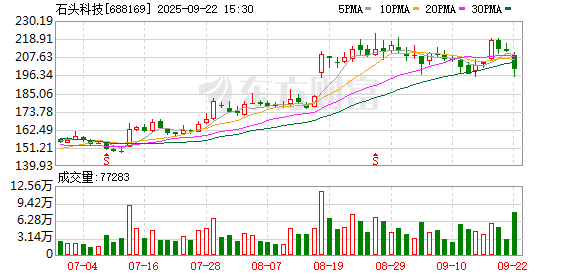
石头科技跌5.33% 开源证券年内高位两度喊买入
Zhong Guo Jing Ji Wang· 2025-09-22 09:15
Group 1 - The stock price of Stone Technology (688169.SH) fell by 5.33% to 200.22 yuan as of the market close on September 22 [1] - On February 21, 2025, Stone Technology's stock reached a year-to-date high of 272.42 yuan during intraday trading [2] - Research analysts from Open Source Securities maintained a "buy" rating for Stone Technology, highlighting its potential to become a benchmark enterprise in AI robotics applications [2] Group 2 - Open Source Securities analysts also projected that Stone Technology's revenue for Q4 2024 would exceed expectations due to more aggressive product and marketing strategies, maintaining a "buy" rating [2]
石头科技:累计回购约37万股
Mei Ri Jing Ji Xin Wen· 2025-09-22 09:04
Group 1 - The core point of the article is that Stone Technology has announced a share buyback program, having repurchased approximately 370,000 shares, which represents 0.1424% of its total share capital as of September 22, 2025 [1] - The highest and lowest prices for the repurchased shares were 219.16 yuan and 175.01 yuan per share, respectively, with a total expenditure of approximately 73.87 million yuan [1] - As of the report date, the market capitalization of Stone Technology is 51.9 billion yuan [1] Group 2 - For the fiscal year 2024, the revenue composition of Stone Technology indicates that 99.78% of its revenue comes from smart robots and related hardware, while other businesses contribute only 0.22% [1]