GUJING(000596)

Search documents
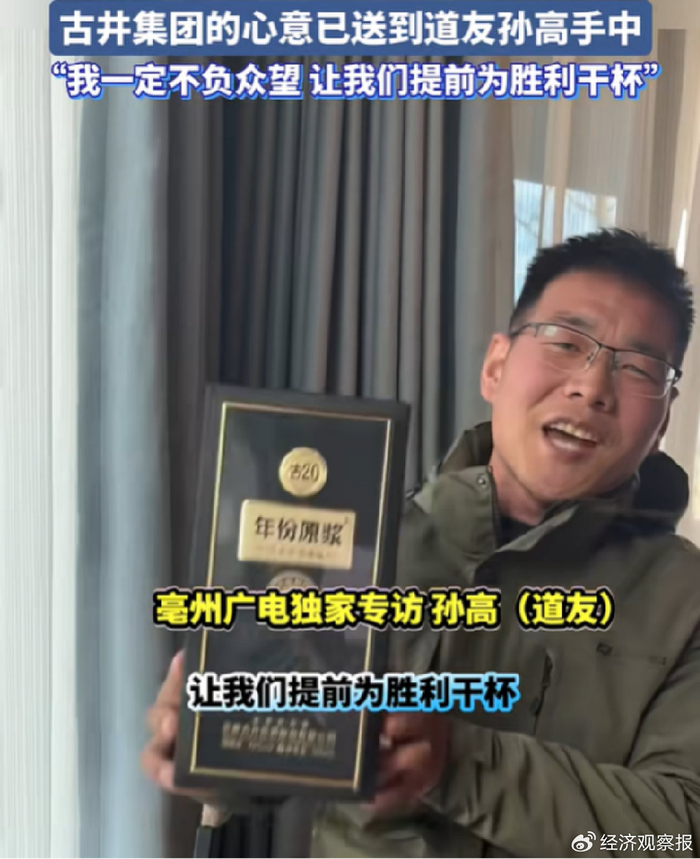
酒价内参11月26日价格发布:洋河梦之蓝M6+价格下跌15元/瓶,跌幅居前
Xin Lang Cai Jing· 2025-11-26 01:44
Group 1 - The core viewpoint of the article highlights a significant price adjustment in the Chinese liquor market, particularly among the top ten products, with an overall retail price drop of 69 yuan, totaling 9222 yuan, ending a four-day upward trend [1] - Among the products, Gujinggong Gu20 saw a price increase of 4 yuan per bottle, while the majority experienced price declines, with Yanghe Dream Blue M6+ dropping by 15 yuan per bottle, marking the largest decrease [1][4] - The article notes that prior to this price adjustment, there was a period of price stabilization and increase in the white liquor market, indicating accumulated pressure for a correction [1] Group 2 - Liu Feng, Chief Economist at the International Research Institute of Green Finance, emphasized the resilience of the liquor industry in China, despite challenges such as declining production and market segmentation, due to its essential role in social and emotional contexts [2] - Looking ahead to the 14th Five-Year Plan, Liu pointed out trends driven by consumer rationality and health consciousness, with a focus on quality and cultural value as key purchasing motivations [2] - Liu suggested that liquor companies should adopt a "1+N" product strategy, maintaining core flagship products while introducing a variety of lower-alcohol and fruit wines to meet changing consumer demands [2]





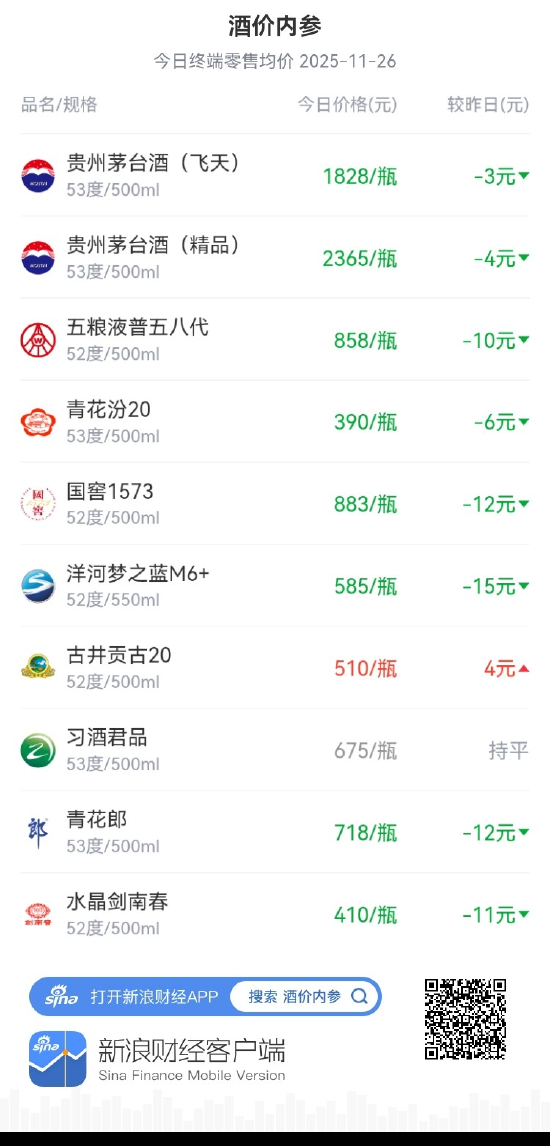
为胜利干杯!古井贡酒为勇士送“家乡味”助威
Jing Ji Guan Cha Bao· 2025-11-26 00:21
Core Viewpoint - The story of Sun Gao, a contestant in the extreme wilderness survival challenge, highlights the emotional connection between the local community and the Gujinggong liquor brand, showcasing how the brand transcends its product identity to become a symbol of hometown pride and cultural heritage [1][3][4]. Group 1: Brand and Community Connection - Gujinggong liquor has become a living carrier of hometown memories and emotions, deeply integrated into the lives of local people, symbolizing reunion and blessings during festive occasions [3]. - The gesture of Gujing Group sending a farewell gift to Sun Gao's wife, which includes Gujinggong liquor, reflects the brand's commitment to emotional engagement with consumers and recognition of ordinary people's struggles [4]. - Sun Gao's determination and the support from his wife illustrate the ordinary person's courage and dedication, further enhancing the brand's narrative [4]. Group 2: Cultural Empowerment and Global Expansion - Gujinggong liquor is not limited to domestic market development but is accelerating its global expansion, using culture as a bridge to create new growth opportunities amidst structural adjustments in the domestic liquor industry [5][8]. - The "Global Reading of Bo" initiative invites global audiences to engage with the rich cultural heritage of Bozhou, enhancing the understanding and appreciation of Chinese liquor culture [6][8]. - This dual approach of "product + culture" strengthens the brand's cultural depth and showcases the craftsmanship and heritage of Chinese liquor on the world stage [8].
酒价内参11月25日价格发布 市场整体续涨青花郎五连阳
Xin Lang Cai Jing· 2025-11-25 01:57
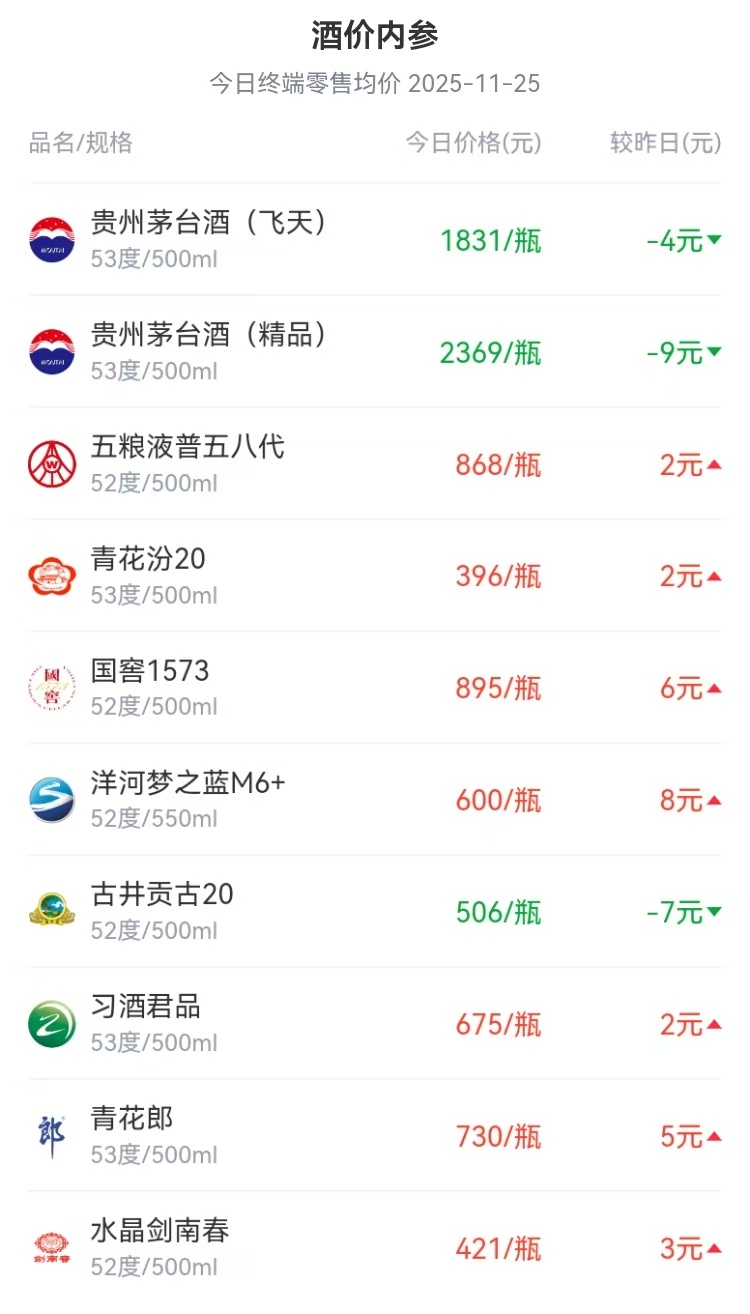
Core Insights - The retail prices of the top ten liquor products in the white liquor market have continued to rise, with an overall price of 9,291 yuan for a bundled sale, marking an increase of 8 yuan from the previous day, achieving four consecutive days of price increases [1] Price Movements - Yanghe Dream Blue M6+ saw a strong performance with a daily price increase of 8 yuan per bottle [1] - Guojiao 1573's price increased by 6 yuan per bottle [1] - Qinghualang's price rose by 5 yuan per bottle, marking five consecutive days of increases [1] - Prices for Shuijing Jian'nan Chun and Xijiu Junpin increased by 3 yuan and 2 yuan per bottle, respectively, showing stable trends [1] - Qinghualan 20's price rose by 2 yuan per bottle, while Wuliangye Pu 58's price also increased by 2 yuan per bottle [1] - In contrast, the prices of some products decreased, with the boutique Moutai and Gujing Gong Gu 20 dropping by 9 yuan and 7 yuan per bottle, respectively [1] - Feitian Moutai's price fell by 4 yuan per bottle [1] Specific Product Prices - Feitian Moutai: 1,831 yuan per bottle, down 470 yuan [3] - Boutique Moutai: 2,369 yuan per bottle, down 9 yuan [3] - Wuliangye Pu 58: 868 yuan per bottle, up 2 yuan [3] - Qinghualan 20: 396 yuan per bottle, up 2 yuan [3] - Guojiao 1573: 895 yuan per bottle, up 670 yuan [3] - Yanghe Dream Blue M6+: 600 yuan per bottle [3] - Gujing Gong Gu 20: 506 yuan per bottle, down 7 yuan [3] - Qinghualang: 730 yuan per bottle, down 570 yuan [4] - Shuijing Jian'nan Chun: 421 yuan per bottle, up 3 yuan [4] - Xijiu Junpin: 675 yuan per bottle, up 2 yuan [4]
今日白酒市场整体续涨 青花郎五连阳
Ge Long Hui· 2025-11-25 01:21
Core Insights - The retail average price of the top ten liquor products in the white liquor market continues to rise, reaching 9,291 yuan, an increase of 8 yuan from the previous day, marking four consecutive days of price increases [1] Price Movements - Yanghe Dream Blue M6+ shows strong performance with a daily price increase of 8 yuan per bottle [1] - Guojiao 1573 price increased by 6 yuan per bottle [1] - Qinghua Lang price rose by 5 yuan per bottle, achieving five consecutive days of increases, leading the market [1] - Crystal Jian Nan Chun and Xijiu Junpin prices increased by 3 yuan and 2 yuan per bottle, respectively, showing stable trends [1] - Qinghua Fen 20 price increased by 2 yuan per bottle [1] - Wuliangye Pu 58 price also rose by 2 yuan per bottle [1] Price Declines - Premium Moutai and Gujing Gong Gu 20 experienced significant declines, with prices dropping by 9 yuan and 7 yuan per bottle, respectively [1] - Feitian Moutai price decreased by 4 yuan per bottle [1]
中国必选消费品11月价格报告:白酒批价多数下跌,方便食品与调味品价格回升
Haitong Securities International· 2025-11-24 13:11
Investment Rating - The report assigns an "Outperform" rating to multiple companies in the essential consumer goods sector, including Guizhou Moutai, Wuliangye, and others [1]. Core Insights - The wholesale prices of Baijiu have mostly declined, while prices for instant foods and condiments have rebounded [1][10]. - Discounts for convenience foods and seasonings have narrowed compared to the end of October, indicating a potential recovery in consumer spending [19][38]. - The report highlights the stability of discounts for infant formula and beer, while discounts for liquid milk and soft drinks have increased [21][38]. Summary by Sections Baijiu Pricing - The wholesale prices for various Baijiu brands, such as Moutai and Wuliangye, have shown significant declines compared to previous months and year-to-date figures [9][40]. - For instance, the price of Feitian Moutai (case) is 1650 yuan, down by 110 yuan from last month, and down 590 yuan year-to-date [40]. Consumer Goods Discounts - Convenience foods have seen an increase in average and median discount rates, moving from 93.2%/95.9% at the end of October to 95.8%/97.0% [19][38]. - Seasonings also experienced a rise in discount rates, from 83.7%/84.9% to 85.9%/88.9% [19][38]. - In contrast, liquid milk discounts have widened, with average rates dropping from 69.6% to 66.0% [21][38]. Company Ratings - The report lists several companies with an "Outperform" rating, including: - Guizhou Moutai - Wuliangye - Luzhou Laojiao - Shanxi Fenjiu - Yanghe - Others [1].
A股白酒年报图鉴:最“有钱”的不是茅台 酒鬼酒等股价增长3倍的逻辑在哪
Mei Ri Jing Ji Xin Wen· 2025-11-24 07:53
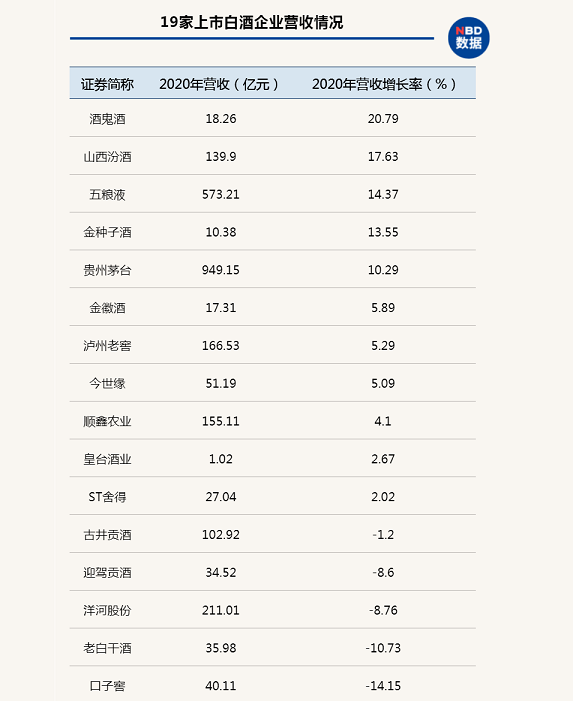
Core Insights - The Chinese liquor market, particularly the baijiu sector, experienced significant growth in 2020, with A-shares leading globally. The overall revenue for 19 listed baijiu companies reached 258.94 billion yuan, a year-on-year increase of 6.58% [1][5] - The net profit attributable to shareholders for these companies totaled 92.068 billion yuan, reflecting a growth of 11.95% compared to the previous year [1][5] - There is a notable divergence in performance among baijiu companies, with leading brands like Moutai and Wuliangye achieving double-digit growth, while some smaller brands faced significant declines [4][9] Revenue Performance - In 2020, 19 listed baijiu companies reported a total revenue of 258.94 billion yuan, with 11 companies showing positive growth and 8 experiencing negative growth [2][5] - The highest revenue growth was recorded by Jiugui Liquor at 20.79%, while Qingqing Qiao experienced a decline of 39.07%, marking a difference of 59.86 percentage points [2][3] - The top three companies by revenue were Moutai (94.915 billion yuan), Wuliangye (57.321 billion yuan), and Yanghe (21.101 billion yuan) [4] Profit Analysis - The six leading baijiu companies accounted for over 90% of the total profits in the sector, with Moutai alone contributing more than 36% of total revenue and over 50% of total profits [7][9] - Moutai's net profit reached 46.697 billion yuan, with a growth rate of 13.33%, while Wuliangye's net profit was 19.955 billion yuan, growing by 14.67% [6][7] - Jiugui Liquor showed remarkable performance with a net profit growth of 64.15%, while Qingqing Qiao reported a significant loss of 1.15 billion yuan [6][7] Market Dynamics - The pandemic initially impacted the baijiu industry negatively, but leading brands demonstrated resilience, with Moutai, Wuliangye, and Shanxi Fenjiu achieving substantial growth [9] - The disparity in performance is evident, with some companies like Shanxi Fenjiu and Jiugui Liquor seeing stock prices increase over threefold, while others struggled [9][11] - The overall tax contributions from the baijiu sector increased significantly, with a 48% rise in the first quarter of 2021 compared to the previous year, attributed to a recovery from the pandemic [14][15] Financial Health - As of March 2021, Wuliangye had the highest cash reserves among listed baijiu companies, totaling 73.38 billion yuan, while Moutai had approximately 50.743 billion yuan [17][18] - The financial strength of these companies is crucial for their ability to invest and expand in a competitive market [17] Compensation Trends - Moutai reported the highest average employee salary in the sector at over 300,000 yuan, while the lowest was at less than 52,000 yuan for Huangtai Liquor [19][20] - The management compensation for Moutai was relatively low compared to other companies, with total management salaries below 3.72 million yuan [21][23]

食品饮料行业2026年上半年投资策略:曙光渐近,蓄力前行
Dongguan Securities· 2025-11-24 05:13
Group 1 - The food and beverage industry underperformed the CSI 300 index from January to October 2025, with the SW food and beverage index declining by 5.52%, the largest drop among all Shenwan first-level industries, lagging behind the CSI 300 by 23.46 percentage points [5][14][15] - All sub-sectors within the food and beverage industry also underperformed the CSI 300 index, with the beer sector experiencing the largest decline of 10.74%, while the health products sector saw an increase of 15.02% [15][19] - The overall valuation of the food and beverage industry is below the historical average, with a PE ratio of approximately 21 times as of October 31, 2025, compared to a five-year average of 32 times [19][21] Group 2 - The liquor sector is undergoing a deep adjustment, with sales under pressure due to weak demand recovery and restrictions on alcohol consumption, leading to a significant decline in sales during key festive periods [23][24] - Major liquor companies are pragmatically lowering growth targets to alleviate channel pressures, with firms like Moutai and Wuliangye adopting flexible strategies in response to market changes [29][30] - Liquor companies are actively embracing new consumption trends by innovating products and channels, focusing on younger consumers and developing lower-alcohol products to cater to changing preferences [30][32] Group 3 - The beer sector is experiencing stable sales, with a focus on the recovery of consumption scenarios and the ongoing trend of product structure upgrades [3][14] - Beer companies are leveraging instant retail channels to contribute to sales growth, although cost advantages may narrow in the future [3][17] - The third quarter of 2025 saw a decline in beer sales, but there are expectations for marginal improvements moving forward [3][18] Group 4 - The condiment sector is expected to benefit from the recovery of the restaurant industry, which will drive demand growth for condiments [19][20] - Health-oriented products are pushing for structural optimization within the condiment industry, with leading companies likely to increase their market share [20][21] - The overall cost for condiment companies is anticipated to remain manageable, despite a slowdown in growth during the third quarter [22][23] Group 5 - The dairy sector is witnessing a weak recovery in demand, with a focus on supply and demand structures [23][25] - The penetration rate of low-temperature milk is expected to increase, supported by online channels and instant retail contributing to sales growth [25][26] - Leading dairy companies are likely to enhance their competitive advantages in the market [26][27] Group 6 - The snack sector is experiencing steady growth, with an increase in per capita consumption and a focus on core products driving company performance [27][28] - Companies in the snack sector are utilizing multiple channels to enhance market competitiveness, although performance remains varied across the sector [28][30] - The overall market size of the snack industry is steadily increasing, with significant growth potential in consumer spending [27][28]

酒价内参11月24日价格发布 整体价格延续升势青花郎领涨五连阳
Xin Lang Cai Jing· 2025-11-24 00:55
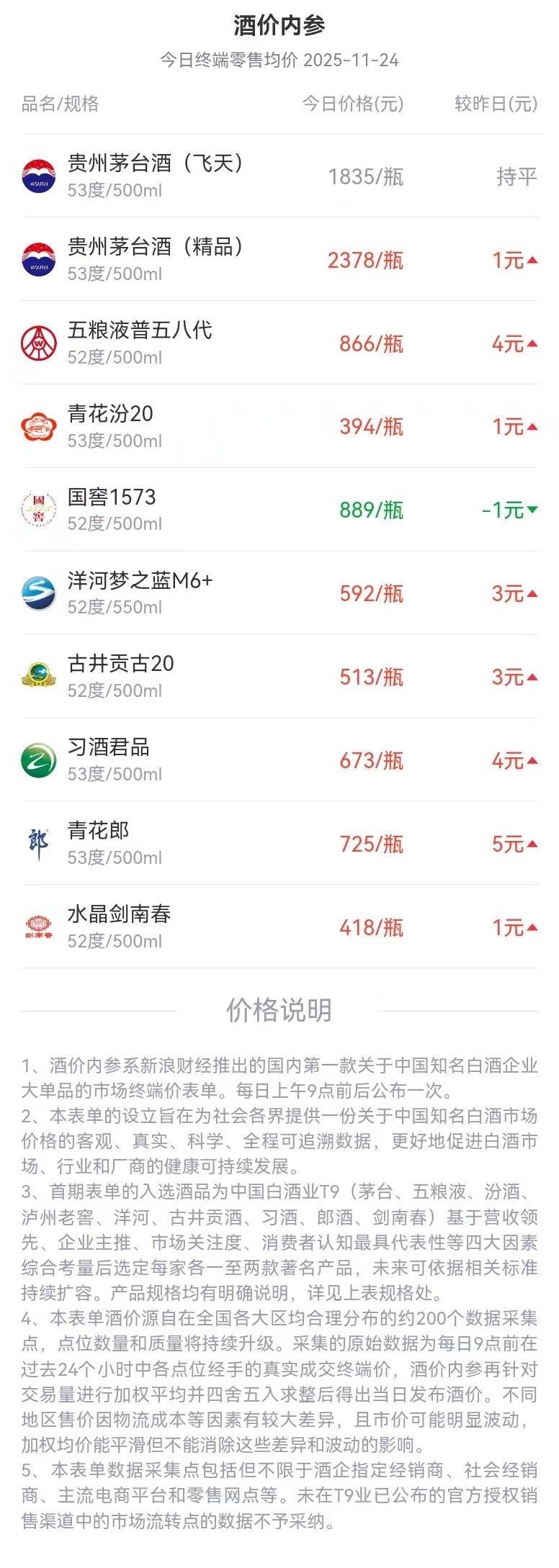
Core Viewpoint - The white liquor market shows a strong performance with a general price increase across the top ten products, indicating positive market sentiment and consumer demand [1]. Price Trends - The average retail price of the top ten white liquor products reached 9283 yuan, an increase of 21 yuan from the previous day, marking a recent high in daily price growth [1]. - Qinghua Lang leads the market with a price increase of 5 yuan per bottle, achieving its fifth consecutive day of price rise [1]. - Xijiu Junpin and Wuliangye Pu Wu Ba Dai both saw a price increase of 4 yuan per bottle, reflecting a steady upward trend [1]. - Yanghe Dream Blue M6+ and Gujing Gong Gu 20 both increased by 3 yuan per bottle, while most products maintained stable or slightly rising prices [1]. - Moutai's boutique price ended its recent decline with a 1 yuan increase, while Feitian Moutai's price remained unchanged [1]. Product Pricing Summary - The following are the current prices and changes for notable products: - Feitian Moutai 53°/500ml: 1835 yuan, unchanged [3] - Boutique Moutai 53°/500ml: 2378 yuan, up 1 yuan [3] - Wuliangye Pu Wu Ba Dai 52°/500ml: 866 yuan, up 4 yuan [3] - Qinghua Fen 20 53°/500ml: 394 yuan, up 1 yuan [3] - Guojiao 1573 52°/500ml: 889 yuan, down 1 yuan [3] - Yanghe Dream Blue M6+ 52°/550ml: 592 yuan, up 3 yuan [4] - Gujing Gong Gu 20 52°/500ml: 513 yuan, up 3 yuan [4] - Xijiu Junpin 53°/500ml: 673 yuan, up 4 yuan [4] - Qinghua Lang 53°/500ml: 725 yuan, up 5 yuan [4] - Shuijing Jian Nan Chun 52°/500ml: 418 yuan, up 1 yuan [4]
酒价内参11月21日价格发布 整体价格温和回落青花郎逆势上扬
Xin Lang Cai Jing· 2025-11-21 01:08
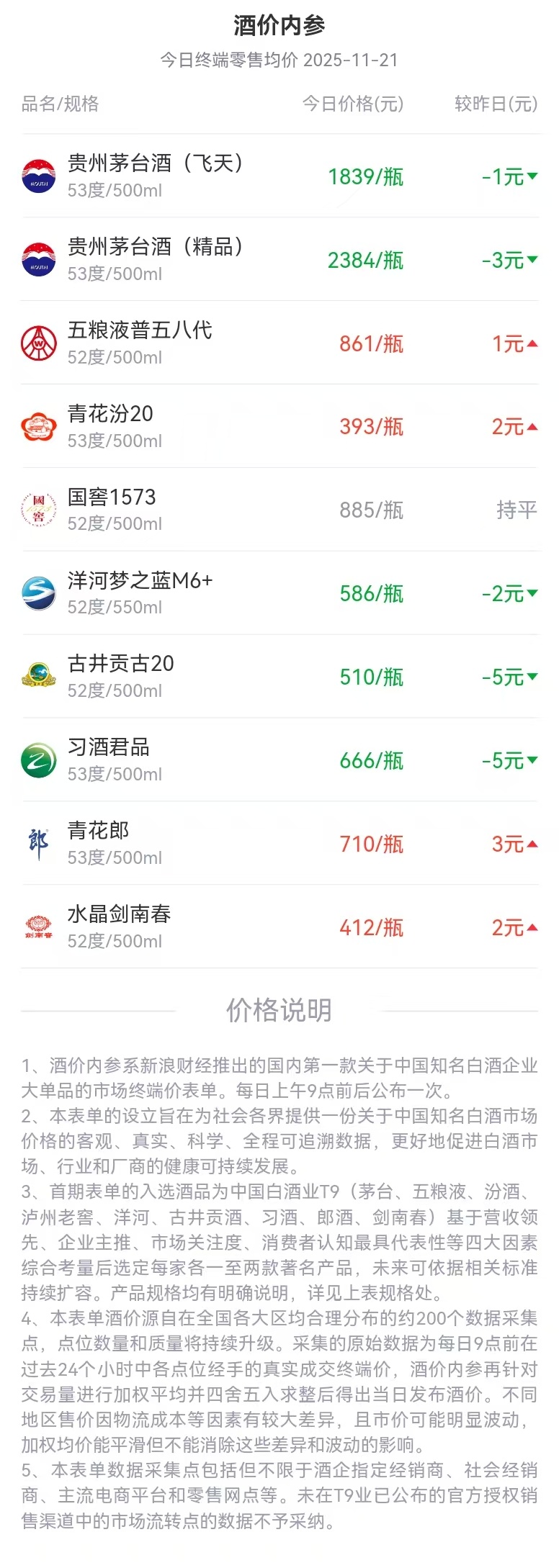
Core Insights - The retail prices of major Chinese liquor brands have shown a slight decline, indicating a market adjustment phase following the Double Eleven shopping festival and platform governance changes [1][6] - The overall average price for a packaged set of ten major liquor products is 9,246 yuan, down by 8 yuan from the previous day [1] - Notable price movements include an increase in the price of Qinghua Lang by 3 yuan per bottle, while Guizhou Moutai and other brands experienced minor declines [1][3] Price Movements - Guizhou Moutai (Feitian) price is 1,839 yuan per bottle, down by 1 yuan [3] - Guizhou Moutai (Jingpin) price is 2,384 yuan per bottle, down by 3 yuan [3] - Wuliangye (Pu 58) price is 861 yuan per bottle, up by 1 yuan [3] - Qinghua Fen 20 price is 393 yuan per bottle, up by 2 yuan [3] - Gujing Gong (Gu 20) price is 510 yuan per bottle, down by 5 yuan [4] - Xijiu Junpin price is 666 yuan per bottle, down by 570 yuan [4] - Qinghua Lang price is 710 yuan per bottle, up by 3 yuan [4] - Shuijing Jian Nan Chun price is 412 yuan per bottle, up by 2 yuan [4] Market Trends - The market is currently in a narrow consolidation phase, reflecting adjustments in supply and demand dynamics [1] - The data collection for liquor prices is sourced from approximately 200 points across major regions, ensuring a comprehensive representation of market conditions [6][7] - The price table aims to provide an objective and traceable overview of the Chinese liquor market, promoting sustainable industry development [6]
黄淮名酒这10年
Sou Hu Cai Jing· 2025-11-20 15:16
Core Insights - The Huanghuai famous liquor summit held in Zibo, Shandong, highlighted the significant growth and development of liquor enterprises from Anhui, Shandong, Henan, and Jiangsu over the past decade, with a market scale increase from approximately 1150 billion yuan in 2014 to 2369 billion yuan in 2024, more than doubling in size [2][3] Market Growth - The market scale of the Huanghuai liquor region has seen a substantial increase, with the total market size surpassing 2000 billion yuan by 2024, reaching 2369 billion yuan [2] - The number of large-scale enterprises in the Huanghuai liquor region decreased from 424 in 2014 to 283 in 2024, indicating a rise in market concentration and competitiveness [3] Brand Development - In 2014, only Yanghe had a sales scale exceeding 10 billion yuan, while by 2024, half of the top 10 listed liquor companies in China were from the Huanghuai region, with Gujing Gongjiu achieving 235.78 billion yuan in revenue and joining the top brands [3] - The successful upgrade of price bands has allowed Huanghuai liquor brands to break through previous limitations, with mainstream consumer prices rising from around 80 yuan in 2014 to 200 yuan and beyond by 2018 [3][4] Price Band Strategy - Huanghuai liquor companies have successfully established a complete pricing system covering mass-market, mid-range, and high-end products, with price ceilings reaching up to 2000 yuan by 2024 [3][4] - The introduction of high-quality products in the 100-600 yuan price range has allowed these companies to capture both the value-for-money and premium market segments [3][4] Innovation and Standards - The past decade has seen significant innovation in product categories, with various new fragrance types and industry standards being established, positioning Huanghuai liquor companies at the forefront of the industry [4] - Multiple national-level standards have been created for different types of Huanghuai liquor, enhancing the overall quality and marketability of the products [4] Production Capacity and Storage - The cancellation of the white liquor production limit in 2019 allowed Huanghuai liquor companies to expand their production capacity significantly, with many top enterprises doubling their capacity over the past decade [5][6] - Yanghe has achieved the highest production capacity for solid-state liquor and the largest storage capacity for high-quality original liquor globally [5][6]