
GUJING(000596)

Search documents
高盛白酒深度研究:控货去库存筑底,Q3迎最暗时刻,茅五目标价大调(附全名单评级)
Zhi Tong Cai Jing· 2025-09-18 12:56
Core Viewpoint - The Chinese liquor industry is approaching a critical seasonal test in Q3 2025, with cautious market sentiment prevailing. Goldman Sachs predicts that Q3 2025 may represent a low point in valuation for the industry, with some stocks already reflecting a "bottoming" expectation. Target prices for leading companies like Moutai and Wuliangye have been adjusted upwards [1][2]. Group 1: Market Conditions - The liquor industry is facing dual pressures from ongoing anti-extravagance policies and a reduction in the length of the Mid-Autumn Festival and National Day holidays, leading to weakened retail momentum [2]. - Companies are focusing on inventory normalization through measures such as waiving prepayments and controlling shipment volumes, which may pressure short-term performance but help return inventory levels to normal [2]. - Despite a significant decline in wholesale prices for Moutai and Wuliangye, some retailers have slightly increased end prices in anticipation of brand-controlled inventory to support profits [2][3]. Group 2: Valuation and Stock Performance - The stock prices of liquor companies have risen by 24% since Q3, with a 17% increase in price-to-earnings ratios, indicating that the market has already absorbed the impact of policy changes [2]. - The average target price for liquor stocks has been raised by 6%, with mid-to-high-end liquor valuation multiples adjusted upwards by 13% to 19% [2]. - The high dividend yields of leading companies like Moutai and Wuliangye provide a valuation safety net, with potential price increases of 20% to 30% based on normalized earnings projections for 2027 [4]. Group 3: Company-Specific Adjustments - Moutai's target price has been adjusted from 1742 yuan to 1724 yuan, reflecting a 3% to 4% decrease in earnings expectations due to policy impacts [5]. - Wuliangye's target price has been raised from 139 yuan to 145 yuan, despite a 5% to 8% reduction in earnings expectations, as its valuation multiple has been increased from 17 times to 18.5 times [5]. - Other companies like Luzhou Laojiao and Gujing Gongjiu have also seen adjustments in their target prices and earnings expectations, reflecting varying degrees of resilience and market conditions [5]. Group 4: Investment Strategy - The current "low point" in Q3 is viewed as a critical phase for the industry, with inventory control measures potentially laying the groundwork for recovery in 2026 as policies ease [6]. - Investment recommendations focus on leading companies with strong dividend yields and brand strength, as well as those with significant valuation adjustments and earnings resilience [7].







文轩指数 | 2025上半年中国上市白酒活力排名
Sou Hu Cai Jing· 2025-09-17 23:46
Core Viewpoint - The Chinese liquor industry is at a crossroads in the first half of 2025, with leading companies showing solid financial performance, but the industry environment is changing, necessitating innovation and new development models for sustained competitiveness [2][3]. Group 1: Financial Performance - In the first half of 2025, leading liquor companies like Kweichow Moutai reported revenue of 91.094 billion yuan, a year-on-year increase of 9.16%, and a net profit of 45.403 billion yuan, up 8.89% [2]. - Among 22 listed liquor companies, 6 maintained growth in both revenue and net profit, including Kweichow Moutai, Wuliangye, Shanxi Fenjiu, and others [3]. - The total revenue of 22 listed liquor companies was approximately 242.4 billion yuan, with a total net profit of about 95.1 billion yuan [5]. Group 2: Industry Challenges - The industry is experiencing a period of "volume reduction, revenue stabilization, and profit decline," with many companies facing declining sales [3][6]. - The number of large-scale liquor enterprises decreased by over 100 year-on-year, with total sales revenue of 330.42 billion yuan and profits down by 10.93% [5]. - The market is seeing a concentration of market share towards leading companies, putting pressure on smaller enterprises [6]. Group 3: Innovation and Development - Companies are focusing on innovation to adapt to changing consumer preferences, with an emphasis on younger demographics and digitalization [4]. - R&D investments are increasing, with Wuliangye's R&D expenses reaching 210 million yuan, a year-on-year increase of 31.2% [3]. - The low-alcohol market is projected to exceed 74 billion yuan by 2025, with a compound annual growth rate of 25% [7]. Group 4: Market Trends - The trend towards low-alcohol products is gaining momentum, with companies like Wuliangye and Luzhou Laojiao launching successful low-alcohol products [7][8]. - Technological advancements are key to the success of low-alcohol products, with various companies developing innovative production techniques [8]. - The industry is shifting from channel competition to technology competition, as companies seek new growth paths [8].

白酒板块2025年中报业绩综述:报表释压,加速筑底
Minsheng Securities· 2025-09-17 10:35
Investment Rating - The report suggests a recommendation for strong brands such as Guizhou Moutai, Wuliangye, and Luzhou Laojiao, as well as Shanxi Fenjiu, which has a clear growth path in a counter-cyclical environment [5]. Core Insights - The industry is currently in a phase of accelerated bottoming, transitioning from "passive clearing" to "active adjustment" due to ongoing pressures from excess supply and demand scenarios [3][5]. - The first half of 2025 saw a negative growth in revenue and net profit for major liquor companies, marking the first negative growth in this cycle [15]. - The report highlights a structural opportunity during the volume adjustment period, with market pricing increasingly favoring dividend yield and market share [3][5]. Summary by Sections Industry Overview - The white liquor industry faced challenges in the first half of 2025, including slow macroeconomic recovery and strict alcohol prohibition policies, leading to a decline in consumption scenarios and continued pressure on demand [5]. - The overall revenue and net profit for 17 major liquor companies were 2368.3 billion and 944.6 billion respectively, with a year-on-year decline of 0.4% and 0.9% [15]. Performance Analysis - In Q2 2025, the revenue and net profit for the industry were 867.2 billion and 313.4 billion respectively, reflecting a year-on-year decline of 4.7% and 7.3%, marking the first negative growth in revenue during this cycle [15]. - High-end liquor maintained positive growth, while the mid-range and regional brands experienced declines [20][22]. Market Dynamics - The report indicates that the market is shifting focus from short-term recovery scenarios to verifying the bottom of demand trends through year-on-year comparisons [3]. - The report anticipates a recovery in the third quarter, driven by seasonal consumption events such as Mid-Autumn Festival and National Day, which may accelerate the bottoming process of the fundamentals [5]. Investment Recommendations - The report recommends focusing on brands with strong market positions and growth potential, including Guizhou Moutai, Wuliangye, Luzhou Laojiao, and regional leaders like Guyi Gongjiu and Jinhui Jiu [5].


白酒掀起“降度竞赛”,济南市场尚难寻觅
Qi Lu Wan Bao Wang· 2025-09-17 09:48
Core Viewpoint - The white liquor industry is experiencing a "low-degree competition" as several companies, including Wuliangye and Gujinggongjiu, have launched low-degree liquor products to attract younger consumers and adapt to changing market dynamics [1][5]. Industry Trends - Since late August, multiple liquor companies have introduced low-degree white liquor, indicating a shift in consumer preferences and market strategies [1]. - The overall number of large-scale liquor enterprises in China has decreased, with 887 companies reported in mid-2025, down over 100 from the previous year [4]. - The production of white liquor has declined by 5.8% year-on-year, with sales revenue slightly increasing by 0.19% to 330.42 billion yuan, while profits fell by 10.93% to 87.69 billion yuan [4]. Market Response - Retailers have been cautious about stocking new low-degree products, with many still focusing on high-degree liquor, which dominates the market [2][3]. - The current market for low-degree liquor is primarily driven by local brands, with only a small percentage of low-degree options available in stores [2][3]. Consumer Insights - The primary consumer base for liquor remains middle-aged and older individuals, with younger consumers showing a preference for purchasing low-degree liquor through online channels or convenience stores [3]. - A survey indicated that only 19% of young consumers prefer white liquor, while 52% favor beer and 29% prefer foreign or fruit wines [4]. Strategic Initiatives - Major liquor companies are launching low-degree products as a strategy to engage younger consumers and expand into casual drinking scenarios [5]. - Companies like Gujinggongjiu and Wuliangye have recently introduced new low-degree products, indicating a competitive push in this segment [5]. Challenges - The definition of low-degree liquor varies, complicating market positioning and consumer understanding [6]. - The industry faces challenges in establishing consumption habits and market recognition for low-degree liquor, as traditional consumption scenarios remain dominated by high-degree products [7].
茅台官宣!吃喝板块震荡走弱,白酒领跌!低位布局时机或至?
Xin Lang Ji Jin· 2025-09-17 06:37
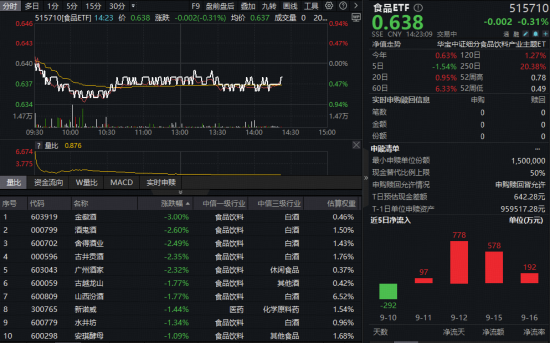
Group 1 - The food and beverage sector experienced a volatile pullback on September 17, with the Food ETF (515710) opening lower and maintaining a downward trend throughout the day, closing down 0.31% [1][2] - Several liquor stocks, particularly Kweichow Moutai, faced significant declines, with Jinhuijiu down 3%, and others like Jiu Gui Jiu and She De Jiu Ye dropping over 2% [1][3] - The overall sentiment in the liquor market is affected by recent clarifications from Kweichow Moutai regarding false promotional activities, emphasizing the stability of their distribution channels [1][3] Group 2 - Pacific Securities noted that the liquor sector is at a "fundamental bottom and low valuation" phase, with potential for weak recovery in demand as the Mid-Autumn Festival approaches [3][4] - The food and beverage sector is seeing mixed performance, with meat products and liquor leading gains, while snacks and beer are experiencing declines [3][4] - Current valuations in the food and beverage sector are at low levels, suggesting a favorable time for investment, with the Food ETF's price-to-earnings ratio at 21.12, marking a low point in the last decade [3][4] Group 3 - Everbright Securities indicated that the liquor sector is undergoing adjustments due to policy impacts, with a noticeable decline in demand, but a potential recovery is expected in the latter half of the year [4][5] - Xiangcai Securities highlighted the low valuation levels in the sector, suggesting opportunities for alpha generation through high-quality stocks [4][5] - The focus should be on companies with stable demand and strong risk resistance, as well as those innovating in new products and channels [5]

中国白酒行业 - 第三季度前瞻 - 理性发货下的低谷,需求仍与政策、宏观相关;股价反映市场情绪触底-China Spirits_ 3Q Preview_ trough on rational shipment w_demand still tied to policy_macro; ;stocks reflect sentiment bottoming,
2025-09-17 01:51
Summary of Conference Call on China Spirits Industry Industry Overview - The spirits industry in China is currently facing challenges due to the ongoing impact of the anti-extravagance policy, which has affected consumer demand and retail momentum. [1][2][11] - The third quarter of 2025 (3Q25) is expected to be the trough for the industry, with a projected sales decline of 5% to 27% across various brands, excluding Moutai and Jiugui. [1][2][21] Key Points and Arguments Demand and Sales Trends - Retail momentum is anticipated to remain weak, particularly during the peak season due to fewer holiday days compared to previous years. [1] - A significant decline in retail volume is expected, with estimates of a 30% drop in August and a 15-20% decline during the peak season. [11] - The wholesale pricing remains under pressure, with notable declines in prices for key brands like Feitian Moutai and Common Wuliangye. [19][27] Shipment and Inventory Management - Spirits companies are prioritizing channel health by implementing deeper destocking and tighter shipment controls to ease distributor financing burdens. [1][2] - The trend of controlling shipments is crucial for maintaining channel inventory and supporting wholesale prices, especially for high-end spirits. [18][27] Financial Forecasts and Revisions - Sales and net profit forecasts for super-premium and upper-mid-end spirits have been revised down by up to 6% and 17% respectively for 2025E-27E. [2][42] - Despite the cautious outlook, target multiples have been raised by 9-19% to reflect a more normalized valuation level amid market re-rating. [2] Product Strategy and Market Positioning - Companies are focusing on product strategy to navigate the current market challenges, including reinforcing mid-end and mass portfolios and innovating lower-degree liquor products for younger consumers. [11] - The emphasis on residential banquets and product mix shifts is seen as a potential catalyst for recovery. [11] Dividend and Shareholder Returns - There is potential for enhancement in shareholder returns, with increased dividend payout forecasts for companies like Wuliangye. [11][43] Additional Important Insights - The anti-extravagance policy's impact is expected to gradually normalize, potentially boosting sentiment during the 2026 Chinese New Year holiday season. [11] - The affordability of high-end spirits has improved, which may support residential demand as policy headwinds ease. [31] - The spirits sector has seen a rotation towards laggards, indicating a market sentiment shift towards recovery narratives. [12][42] Conclusion - The China spirits industry is navigating a challenging environment with significant policy impacts affecting demand and pricing. However, strategic adjustments in shipment control, product offerings, and potential improvements in affordability may provide pathways for recovery in the coming years. [1][2][11][12]
白酒降度“低调”如何激活市场活力
Bei Jing Shang Bao· 2025-09-17 00:09
Core Viewpoint - The Chinese liquor industry is shifting from a "business necessity" to a "lifestyle enjoyment" approach, with many companies launching lower-alcohol products to attract younger consumers and enhance market vitality [2][3][4]. Group 1: Industry Trends - Several major liquor companies, including Wuliangye, Luzhou Laojiao, and Shui Jing Fang, are actively introducing lower-alcohol products, indicating a trend towards product diversification and market adaptation [2][3]. - The market for low-alcohol liquor is projected to grow significantly, from approximately 20 billion yuan in 2020 to about 57 billion yuan in 2024, with an expected compound annual growth rate of 30% [4]. Group 2: Consumer Demographics - The primary consumer demographic for liquor is shifting, with older generations gradually exiting the market, while younger consumers, particularly those born after 1985, are becoming the main growth drivers [3][4]. - The younger generation prefers personalized, lower-alcohol, and social drinking experiences, which necessitates a strategic shift for liquor companies to engage this demographic effectively [3][5]. Group 3: Marketing and Sales Strategies - Companies need to adopt innovative marketing strategies, utilizing new media and experiential marketing to resonate with younger consumers and stimulate brand engagement [5][6]. - The current market faces challenges, including a lack of consumption scenarios for low-alcohol products and limited channel profitability, which may hinder sales unless companies implement supportive policies [5][6]. Group 4: Future Directions - Lowering alcohol content is seen as a starting point for companies to connect with younger consumers, but deeper engagement with consumer preferences and behaviors is essential for long-term success [6]. - The industry is entering a new era characterized by rational consumption attitudes, where understanding and responding to the needs of younger consumers will be crucial for driving growth [6].
古井贡酒:截至2025年9月10日公司的股东人数为46446户
Zheng Quan Ri Bao Wang· 2025-09-16 11:41
Core Viewpoint - As of September 10, 2025, the number of shareholders for Gujinggongjiu (000596) is reported to be 46,446 [1] Summary by Category - **Company Information** - Gujinggongjiu has a total of 46,446 shareholders as of the specified date [1]
古井贡酒:“以价换量”营收微增,主动降速去库存
Xin Lang Cai Jing· 2025-09-16 02:31
Core Viewpoint - The company, Gujing Gongjiu, reported a slight increase in revenue and profit for the first half of 2025, indicating resilience in a challenging market, but underlying issues such as weak growth, structural imbalances, and external expansion challenges are evident [1][6][7] Financial Performance - The company achieved total revenue of 13.88 billion yuan, a year-on-year increase of 0.54%, and a net profit of 3.66 billion yuan, up 2.49% year-on-year [1] - The second quarter saw a significant decline in revenue to 4.73 billion yuan, down 14.23% year-on-year, and net profit dropped to 1.33 billion yuan, down 11.63% [2] - The company's net profit margin improved to 26.38%, up 0.50 percentage points year-on-year, primarily due to reduced sales expenses [3] Product Structure - The company experienced a "volume increase, price decrease" trend, with total sales volume reaching 81,400 tons, up 10.67%, but the average ex-factory price fell by 8.22% to 167,500 yuan per ton [3] - The core product "Nianfen Yuanjiang" generated revenue of 10.96 billion yuan, with a sales volume increase of 10.80%, but the price per ton decreased by 8.31% to 235,200 yuan [3] Regional Performance - The company’s revenue from the Central China region was 12.30 billion yuan, accounting for 88.60% of total revenue, reflecting strong brand presence in its home market [4] - Revenue from the North China region fell by 27.04% to 0.81 billion yuan, and South China revenue decreased by 5.84% to 0.77 billion yuan, indicating challenges in expanding beyond its home market [4] Strategic Initiatives - The company is focusing on online sales, which reached 0.57 billion yuan, a year-on-year increase of 40.19%, while offline sales declined by 0.67% [5] - New product launches aimed at younger consumers, such as the 26° "Light Gu20," reflect the company's efforts to innovate and adapt to market changes [5] Overall Assessment - The company's performance shows a complex situation of apparent stability but underlying concerns regarding sustainable growth, reliance on internal adjustments, and challenges in expanding its market presence [6][7]
白酒底部价值,大众品把握龙头
2025-09-15 14:57
Summary of Key Points from Conference Call Records Industry Overview Baijiu Industry - The baijiu sector has reached a bottom in fundamentals, with valuations at low levels and market expectations recovering. Demand-side pressures are dissipating, and seasonal catalysts are expected to boost interest in brands like Luzhou Laojiao and Zhenjiu Shede for short-term opportunities, while Moutai, Fenjiu, and Gujing Gongjiu are recommended for long-term investment [1][2][4] Beverage and Snack Industry - The beverage sector is favorable for leading companies such as Nongfu Spring and Dongpeng Beverage, while the snack sector shows good alignment between valuation and growth potential. Key products to watch for Q4 catalysts include Weijia and Yanjinpuzi, with Yili identified as a bottom-value recovery company [1][5] Whisky Industry - In 2024, whisky imports are expected to decline by approximately 40%, with high-aged whisky's share also decreasing. Instant consumption channels now account for over 30% of sales, with dining and home consumption being the primary scenarios [3][13] Beer Industry - Both Yanjing Beer and Zhujiang Beer have seen their valuations drop to attractive levels, with Yanjing at 23-24 times earnings and Zhujiang at 21 times, both reflecting 2025 valuation levels. These companies are noted for their growth potential driven by flagship products [19] Company-Specific Insights Zhenjiu Lid - Zhenjiu Lid has launched an equity payment plan to bind the interests of alliance merchants, with the first quarter's alliance contributing approximately 320 million yuan in revenue. The acupuncture business is projected to account for 5% of the company's total revenue in 2024 [6][8][7] Baijun Co., Ltd. - Baijun's major shareholder transferred 6% of shares to Homa's Liu Jianbo, which is expected to empower Baijun in business expansion and overseas market development. The shareholding structure remains stable, providing opportunities for deeper collaboration [12] Restaurant Chain Industry - The restaurant chain sector has shown signs of recovery since Q2 2025, with stable performance from leading companies like Lihua Bao and Baba Foods. The frozen food leader Anjins has also shown significant improvement in revenue [10][11] Zhujiang Beer - Zhujiang Beer is focusing on expanding its market share through its flagship product, Pure Draft 97, while also launching new products to maintain competitiveness. The company is developing its "15th Five-Year Plan" for future growth [15][17][18] H&H International Holdings - H&H International expects high single-digit revenue growth for the year, with EBITDA margins around 15%. The health supplement business is performing well, while the milk powder segment anticipates low double-digit growth [20] Jianhe Health - Jianhe Health's fundamentals are improving, driven by new consumer customer acquisition in China and profitability improvements in its overseas subsidiaries. The company is expected to see good performance in Q3 due to new orders [21][22] Additional Insights - The baijiu sector is currently viewed as a mid-to-long-term value investment opportunity, with market expectations warming up as demand-side pressures ease [2] - The innovative model of the Wan Shang Alliance is expected to have a significant impact on the company's financials, with a focus on long-term development and binding interests with distributors [9]


