
GUJING(000596)

Search documents
中国消费品7月价格报告:多数白酒批价回归平稳,液奶与啤酒折扣降低
Haitong Securities International· 2025-08-01 13:32
Investment Rating - The report assigns an "Outperform" rating to multiple companies in the consumer staples sector, including Guizhou Moutai, Wuliangye, Luzhou Laojiao, and others [1]. Core Insights - The report highlights that most baijiu wholesale prices have stabilized, with specific price changes noted for various brands. For instance, the price of Feitian Moutai (case) is 1915 yuan, down by 35 yuan from the previous month, and down 665 yuan year-on-year [3][9]. - Discounts on liquid milk and beer have decreased compared to previous months, indicating a shift in pricing strategies within the consumer goods market [5][22]. Summary by Sections Baijiu Pricing - Guizhou Moutai's prices for different products have shown a decline, with Feitian Moutai (case) at 1915 yuan, down 35 yuan month-on-month and 665 yuan year-on-year [3][9]. - Wuliangye's eighth-generation price is 930 yuan, stable compared to last month and unchanged year-on-year [4][9]. - Luzhou Laojiao's Guojiao 1573 remains at 860 yuan, unchanged from last month and down 40 yuan year-on-year [4][9]. Consumer Goods Discounts - The average discount rate for liquid milk has decreased to 79.1% from 73.8% at the end of June, while the median discount rate increased to 80.3% [5][22]. - Beer discounts have also seen a slight increase, with average and median rates at 83.6% and 87.0%, respectively, compared to 81.1% and 84.6% in late June [5][22]. - Discounts for infant formula and instant foods have remained stable, with average rates at 93.0% and 94.3%, respectively [7][22].





白酒董秘盘点:迎驾贡酒董秘孙汪胜年薪23.1万为行业最低任职超七年
Xin Lang Cai Jing· 2025-08-01 12:07
Core Insights - The report highlights that in 2024, the total salary of A-share listed company secretaries reached 4.086 billion yuan, with an average annual salary of 710,000 yuan, indicating a significant financial commitment to this role [1] Salary Overview - In the liquor industry, the total salary for company secretaries in 2024 was 14.797 million yuan, with an average salary of 924,800 yuan, which is considerably higher than the market average [1] - The highest-paid company secretary, Zhu Jiafeng from Gujing Gongjiu, earned 2.2169 million yuan, despite a slight year-on-year decrease of 1.5% [1] - Xu Qinxiang from Kouzi Jiu followed with a salary of 1.8996 million yuan, remaining stable compared to the previous year [1] - Zhang Wei from Shede Jiuye experienced the largest salary drop of 67.12%, with a salary of 1.3063 million yuan [1] Performance Metrics - The report indicates that 2024 saw a total of 7 company secretaries with salary increases, while the majority of the 16 liquor companies reported a decline in stock prices [1] - The largest stock price drop was recorded by Shede Jiuye at 46.2%, followed by Jinzizijiu and Gujing Gongjiu with declines of 43.68% and 41.11% respectively [1] Demographics - The age distribution of company secretaries in the liquor industry ranges from 35 to 60 years, with over half aged between 40 and 50 [1] - The educational background shows that over 40% hold a bachelor's degree, while only one has an associate degree [1]


白酒董秘盘点:舍得酒业董秘张伟大幅降薪去年公司股价跌46.20%为行业跌幅最大
Xin Lang Cai Jing· 2025-08-01 12:05
Core Insights - The report highlights that in 2024, the total salary for A-share listed company secretaries reached 4.086 billion yuan, with an average annual salary of 708,000 yuan, indicating a significant role in capital operations [1] Salary Overview - A-share listed company secretaries' total salary in 2024 was 4.086 billion yuan, with an average salary of 708,000 yuan [1] - In the liquor industry, the total salary for secretaries was 14.797 million yuan, with an average salary of 924,800 yuan, significantly higher than the market average [1] Top Earners - Zhu Jiafeng, the secretary of Gujing Gongjiu, topped the salary list with 2.2169 million yuan, despite a slight year-on-year decrease of 1.5% [1] - Xu Qinxiang from Kouzi Jiao followed with a salary of 1.8996 million yuan, unchanged from the previous year [1] - Zhang Wei from Shede Jiuye ranked fourth with a salary of 1.3063 million yuan, experiencing a substantial decline of 67.12% year-on-year [1] - Li Yong from Luzhou Laojiao earned 1.0705 million yuan, marking an 11.85% increase year-on-year [1] Salary Changes - Among the secretaries with complete terms, 7 experienced salary increases in 2024 [1] - Excluding those with incomplete terms, the highest salary increase was recorded by the secretary of Huangtai Jiuye, with a rise to 184,100 yuan [1] - Zhang Wei from Shede Jiuye had the largest salary decrease, dropping from 1.9775 million yuan to 1.3063 million yuan, a decline of 671,200 yuan [1] Demographics - The age range of liquor industry secretaries is between 35 and 60 years, with over half aged between 40 and 50 [1] - The majority hold a bachelor's degree, accounting for over 40%, with only one having an associate degree [1] Market Performance - In 2023, liquor stocks faced a downturn, with 16 surveyed companies experiencing stock price declines in 2024 [1] - Shede Jiuye had the largest stock price drop at 46.2%, followed by Jinzizijiu and Gujing Gongjiu with declines of 43.68% and 41.11%, respectively [1]
白酒董秘盘点:迎驾贡酒董秘孙汪胜年薪23.1万为行业最低 任职超七年
Xin Lang Zheng Quan· 2025-08-01 10:47
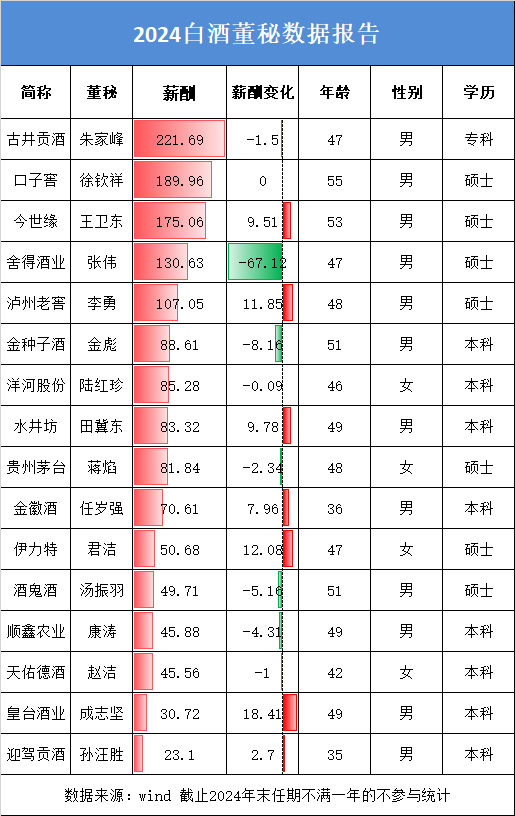
董秘作为连接投资者与上市公司的"桥梁",在上市公司资本运作中发挥着关键作用。新浪财经《2024年 度A股董秘数据报告》显示,2024年A股上市公司董秘薪酬合计达40.86亿元,平均年薪75.43万元。 分行业来看,白酒行业(根据申万二级行业分类)上市公司中,2024年度董秘薪酬总额为1479.7万元 (仅统计2024年度完整任期董秘),平均薪酬达92.48万元,远高于市场平均值。 古井贡酒董秘朱家峰以221.69万元年薪蝉联行业薪酬榜首,虽同比微降1.5%,但仍为唯一一位年薪突破 200万元董秘。口子窖董秘徐钦祥以189.96万元紧随其后,薪酬与上年持平。今世缘董秘王卫东以175.06 万元位列第三,年薪增长9.51%,增幅显著。 舍得酒业董秘张伟虽以130.63万元居第四,但其薪酬同比大幅下滑67.12%,成为行业最大降幅。泸州老 窖董秘李勇薪酬107.05万元,同比增长11.85%,跻身前五。 专题:专题|2024年度A股董秘数据报告:1144位董秘年薪超百万 占比超21% 从薪酬涨跌幅来看,2024年有完整任期的董秘中,有7位董秘薪酬上涨,皇台酒业董秘成志坚因2023年 任期不满一年而涨薪最多,达18. ...

白酒董秘盘点:舍得酒业董秘张伟大幅降薪 去年公司股价跌46.20%为行业跌幅最大
Xin Lang Zheng Quan· 2025-08-01 10:45
Core Insights - The report highlights that in 2024, the total salary of A-share listed company secretaries reached 4.086 billion yuan, with an average annual salary of 754,300 yuan, indicating a significant role in capital operations [1] Salary Overview - A total of 1,144 company secretaries earned over 1 million yuan, accounting for more than 21% of the total [1] - The white wine industry had a total salary of 14.797 million yuan for secretaries, with an average salary of 924,800 yuan, significantly higher than the market average [1] Top Earners - Zhu Jiafeng, the secretary of Gujing Gongjiu, topped the salary list with 2.2169 million yuan, despite a slight decrease of 1.5% year-on-year [1][2] - Xu Qinxiang from Kouzi Jiu followed with 1.8996 million yuan, maintaining his salary from the previous year [1][2] - Wang Weidong from Jinshiyuan ranked third with a salary of 1.7506 million yuan, showing a notable increase of 9.51% [1][2] Salary Changes - Zhang Wei from Shede Jiuye experienced the largest salary drop, from 1.9775 million yuan to 1.3063 million yuan, a decrease of 67.12% [4] - Li Yong from Luzhou Laojiao had a salary of 1.0705 million yuan, reflecting an increase of 11.85% year-on-year [1][4] Age and Education - The age of secretaries in the white wine industry ranges from 35 to 60 years, with over half aged between 40 and 50 [4] - The majority hold a bachelor's degree, accounting for over 40%, with only one having an associate degree [4] Stock Performance - In 2024, the stock prices of 16 listed white wine companies declined, with Shede Jiuye experiencing the largest drop at 46.2% [4][5] - Other notable declines included Jinzongzi Jiu at 43.68% and Gujing Gongjiu at 41.11% [5]
白酒董秘盘点:舍得酒业董秘张伟大幅降薪 去年公司股价跌46.2%为行业跌幅最大
Xin Lang Zheng Quan· 2025-08-01 10:43
舍得酒业董秘张伟虽以130.63万元居第四,但其薪酬同比大幅下滑67.12%,成为行业最大降幅。泸州老 窖董秘李勇薪酬107.05万元,同比增长11.85%,跻身前五。 董秘作为连接投资者与上市公司的"桥梁",在上市公司资本运作中发挥着关键作用。新浪财经《2024年 度A股董秘数据报告》显示,2024年A股上市公司董秘薪酬合计达40.86亿元,平均年薪75.43万元。 分行业来看,白酒行业(根据申万二级行业分类)上市公司中,2024年度董秘薪酬总额为1479.7万元 (仅统计2024年度完整任期董秘),平均薪酬达92.48万元,远高于市场平均值。 古井贡酒董秘朱家峰以221.69万元年薪蝉联行业薪酬榜首,虽同比微降1.5%,但仍为唯一一位年薪突破 200万元董秘。口子窖董秘徐钦祥以189.96万元紧随其后,薪酬与上年持平。今世缘董秘王卫东以175.06 万元位列第三,年薪增长9.51%,增幅显著。 专题:专题|2024年度A股董秘数据报告:1144位董秘年薪超百万 占比超21% 古井贡酒董秘朱家峰今年47岁,学历为大专,2024年薪酬较去年下降1.5万元。除担任公司董秘外,朱 家峰还任古井贡酒副总经理,总会计 ...
白酒董秘盘点:古井贡酒董秘朱家峰年薪221.69万元任职超10年学历为大专
Xin Lang Cai Jing· 2025-08-01 10:40
董秘作为连接投资者与上市公司的"桥梁",在上市公司资本运作中发挥着关键作用。新浪财经《2024年度A股董秘数据报告》显示,2024年A股上市公司董秘薪酬合计达40.86亿元,平均年薪7 分行业来看,白酒行业(根据申万二级行业分类)上市公司中,2024年度董秘薪酬总额为1479.7万元(仅统计2024年度完整任期董秘),平均薪酬达92.48万元,远高于市场平均值。 古井贡酒董秘朱家峰以221.69万元年薪蝉联行业薪酬榜首,虽同比微降1.5%,但仍为唯一一位年薪突破200万元董秘。口子窖董秘徐钦祥以189.96万元紧随其后,薪酬与上年持平。今世缘董 舍得酒业董秘张伟虽以130.63万元居第四,但其薪酬同比大幅下滑67.12%,成为行业最大降幅。泸州老窖董秘李勇薪酬107.05万元,同比增长11.85%,跻身前五。 古井贡酒董秘朱家峰今年47岁,学历为大专,2024年薪酬较去年下降1.5万元。除担任公司董秘外,朱家峰还任古井贡酒副总经理,总会计师。公司去年归母净利润55.17亿元,同比上涨20.2 迎驾贡酒董秘孙汪胜去年薪酬在白酒行业中最低,为23.1万元,较2023年上涨2.7万元。皇台酒业时任董秘成志坚年薪30 ...
食品饮料行业双周报(2025、07、18-2025、07、31):育儿补贴落地,关注中报业绩-20250801
Dongguan Securities· 2025-08-01 10:19
Investment Rating - The report maintains an "Overweight" rating for the food and beverage industry, expecting the industry index to outperform the market index by over 10% in the next six months [51]. Core Viewpoints - The implementation of childcare subsidies is expected to boost demand in the dairy sector, with a national standard of 3,600 yuan per child per year starting from January 1, 2025 [46]. - The report highlights the performance of various segments, noting that all sub-sectors underperformed compared to the CSI 300 index during the review period [9][11]. - The report suggests focusing on companies with strong certainty in high-end liquor, such as Kweichow Moutai, and also mentions potential in the beer and seasoning sectors due to seasonal demand increases [46][49]. Summary by Sections Market Review - From July 18 to July 31, 2025, the SW food and beverage industry index rose by 1.02%, ranking 25th among Shenwan's primary industries, lagging behind the CSI 300 index by approximately 1.74 percentage points [9][11]. - Approximately 37% of stocks in the industry recorded positive returns during this period, with notable gainers including Sunshine Dairy (+35.17%) and BeiYinMei (+22.40%) [13]. Industry Data Tracking - **Liquor Sector**: Prices for top brands like Feitian Moutai and Guojiao 1573 remained stable at 1,870 yuan and 835 yuan per bottle, respectively [19]. - **Seasoning Sector**: The price of soybean meal increased by 2.68% month-on-month, while white sugar prices decreased by 0.82% [22]. - **Beer Sector**: Barley prices rose by 0.45% month-on-month, with aluminum prices increasing by 0.15% [27]. - **Dairy Sector**: Fresh milk prices decreased to 3.03 yuan per kilogram, down 0.33% month-on-month [34]. - **Meat Sector**: The average wholesale price of pork fell to 20.45 yuan per kilogram, down 0.18 yuan from the previous period [36]. Important News - Beer exports saw a significant increase of 64.3% in June, while imports decreased by 20.1% [38]. - The report notes a stable price index for national liquor, with no significant fluctuations observed [39]. - The first half of 2025 saw a decline in profits for the beverage manufacturing sector, with a 2.1% year-on-year decrease [41]. Company Announcements - **East Peng Beverage**: Reported a 36.37% increase in total revenue for the first half of 2025 [44]. - **Jin Zai Food**: Announced a share buyback plan, purchasing 100,000 shares at prices between 12.67 and 12.70 yuan [45].




白酒董秘盘点:古井贡酒董秘朱家峰年薪221.69万元任职超10年 学历为大专
Xin Lang Zheng Quan· 2025-08-01 10:11
专题:专题|2024年度A股董秘数据报告:1144位董秘年薪超百万 占比超21% 董秘作为连接投资者与上市公司的"桥梁",在上市公司资本运作中发挥着关键作用。新浪财经《2024年 度A股董秘数据报告》显示,2024年A股上市公司董秘薪酬合计达40.86亿元,平均年薪75.43万元。 分行业来看,白酒行业(根据申万二级行业分类)上市公司中,2024年度董秘薪酬总额为1479.7万元 (仅统计2024年度完整任期董秘),平均薪酬达92.48万元,远高于市场平均值。 古井贡酒董秘朱家峰以221.69万元年薪蝉联行业薪酬榜首,虽同比微降1.5%,但仍为唯一一位年薪突破 200万元董秘。口子窖董秘徐钦祥以189.96万元紧随其后,薪酬与上年持平。今世缘董秘王卫东以175.06 万元位列第三,年薪增长9.51%,增幅显著。 舍得酒业董秘张伟虽以130.63万元居第四,但其薪酬同比大幅下滑67.12%,成为行业最大降幅。泸州老 窖董秘李勇薪酬107.05万元,同比增长11.85%,跻身前五。 从年龄分布来看,白酒行业董秘年龄在35-60岁之间,年龄最大的为60岁,年龄最小的为35岁,超一半 董秘年龄介于40-50之间。从学 ...
食品饮料行业上市公司财务总监PK:金种子酒陷亏损财务总监金昊薪酬达107.8万元
Xin Lang Cai Jing· 2025-08-01 03:03
剔除2024年开始任职的财务总监数据之后,薪酬最低的是麦趣尔财务总监许文,仅为1.66万元,许文现年59岁,从2015年8月开始任职。从2022年以来,麦趣尔已经连续亏损三年,从2023年 值得注意的是,白酒作为高毛利的现金奶牛行业,财务总监平均薪酬大幅超过行业均值。去年16家上市白酒公司(数据来源于choice,截止2024年末任期不满1年的不参与统计,包括部分公司 其中年薪超100万的财务总监达到8位,占到一半。年薪超200万的三名财务总监分别是水井坊蒋磊峰(464.75万元)、古井贡酒朱家峰(221.69万元)、金徽酒谢小强(216.85万元)。 薪酬最低的是皇台酒业刘会平,为30.72万元。其次是伊力特财务总监颜军,为42.32万元。 金字火腿CFO周国华年纪最大,达到64岁。周国华目前身兼数职,是金字火腿董事、总裁、财务总监,2021年12月开始担任CFO一职。元祖股份CFO刘政年纪最小,仅32岁,从2023年10月开始 从学历来看,以本科为主,占比达到58%;其次是硕士,达到28%。专科有16名,占比达到12.4%。此外博士有1名,为立高食品财务总监王世佳;中职也有一名,为春雪食品财务总监郝孔臣。 ...


