
CHANGAN AUTOMOBILE-B(000625)

Search documents
本田讴歌预告新一代RDX:首款双电机混合动力系统讴歌车型;理想调整基座模型业务:詹锟接手,VLA 研发整合丨汽车交通日报
创业邦· 2026-01-15 10:15
Group 1 - Major automotive manufacturers, including Hyundai and Porsche, will voluntarily recall over 344,000 vehicles in South Korea due to various parts defects [2] - Li Auto has appointed Zhan Kun to lead the base model business, focusing on the integration of the VLA (Vision-Language-Action) model for autonomous driving and smart cockpit technologies [2] - CATL and Changan Automobile signed a five-year strategic cooperation memorandum to enhance collaboration in technology application, market expansion, and brand promotion [2] Group 2 - Acura has announced the development of the next-generation RDX compact SUV, which will be the first Acura model equipped with a dual-motor hybrid system [2]





【快讯】每日快讯(2026年1月15日)
乘联分会· 2026-01-15 08:54
Domestic News - The Ministry of Industry and Information Technology, the National Development and Reform Commission, and the State Administration for Market Regulation held a meeting to regulate the competitive order in the new energy vehicle industry, emphasizing innovation and quality while resisting price wars [2] - The General Administration of Customs predicts that lithium battery exports will grow by 26.2% by 2025, with total exports reaching 26.99 trillion yuan, a 6.1% increase year-on-year [3] - Shanghai plans to achieve large-scale implementation of high-level autonomous driving applications by 2027, aiming to create a globally leading intelligent connected vehicle industry cluster [4] - Sichuan province is advancing the recycling and utilization of used power batteries from new energy vehicles, establishing a standardized and efficient recycling system [5] - Changan Automobile and CATL signed a memorandum to deepen their strategic partnership, focusing on joint branding, technology, and market expansion [7] - Zeekr has received authorization for a new patent related to vehicle turning in place, enhancing its technological capabilities [8] - Dongfeng Fengshen plans to launch eight new and upgraded models over the next three years, with a reported sales increase of 37% in 2025 [9] - Xiaomi's Lei Jun announced the progress of the winter high-speed long-distance testing of the YU7 model, focusing on smart driving and endurance [10] International News - A consulting firm predicts that global electric vehicle sales will exceed 20 million units by 2025, with a 20% increase in registrations, and China's market expected to grow by 17% [11] - Honda will update its "H" logo for new electric and hybrid models, with the first vehicles featuring the new logo expected to launch in 2027 [12] - Lucid Motors plans to start vehicle production in Saudi Arabia by the end of this year, with a goal of reaching an annual production capacity of 150,000 vehicles by 2029 [13] - Russia's passenger car sales are projected to decline by 15.6% in 2025, falling to 1.326 million units [14] Commercial Vehicles - Shanghai has issued the "Mosu Zhixing" action plan to promote the application of unmanned logistics vehicles, focusing on innovative and high-tech operational models [16] - Times Automotive has introduced a dual subsidy scheme in response to national policies, aimed at supporting the replacement of old vehicles and promoting green travel [17][18] - Zhengzhou Nissan officially launched the new pickup model, Jin Ruiqi, with a starting price of 86,800 yuan [19] - JAC's high-end light truck has successfully rolled off the assembly line in Algeria, marking a significant milestone in local production [20]

【月度排名】2025年12月皮卡厂商批发销量排名快报
乘联分会· 2026-01-15 08:54
Core Viewpoint - The article highlights the robust performance of the pickup truck market in China, with significant year-on-year growth in both sales and production, driven by strong demand in specific regions and the increasing export of Chinese pickup trucks [2][3]. Pickup Truck Sales - In December 2025, the pickup truck market sold 52,000 units, marking an 8.8% year-on-year increase and reaching a five-year high. For the entire year, sales totaled 589,000 units, up 11.8% year-on-year [2]. - December 2025 production reached 48,000 units, a 5.2% increase year-on-year, with total production for the year at 575,000 units, reflecting a 14% year-on-year growth [2]. - Great Wall Motors continues to lead the market, with strong performances from other manufacturers like Changan, SAIC Maxus, and JAC Motors. The market remains characterized by a "one strong, many strong" structure [2]. Regional Demand - The main demand for pickup trucks is concentrated in the Southwest and Northwest regions, which accounted for 46% of total demand in December 2025. In contrast, the performance in the Beijing-Tianjin-Hebei region was weaker [2]. Export Performance - In December 2025, China exported 28,000 pickup trucks, a 12% year-on-year increase, although it saw a 7% month-on-month decline. Total exports for the year reached 300,000 units, up 21% year-on-year [3]. - By 2024, exports are expected to account for 45% of total pickup truck sales, increasing to 50% in 2025, indicating a strong acceleration in the export of Chinese-made pickups [3]. New Energy Pickup Trucks - In December 2025, sales of new energy pickup trucks were 6,000 units, a 3% year-on-year decrease and a 30% month-on-month decline. However, total sales for the year reached 73,000 units, reflecting a remarkable 243% year-on-year growth [3]. - The article notes that the demand for electric light trucks is surging, positioning electrification as a key factor for commercial vehicles to gain road rights. The growth potential for the pickup market is expected to improve with the development of electrification and passengerization [3].



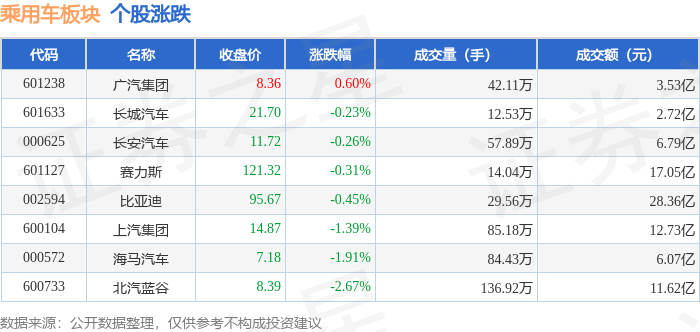
乘用车板块1月15日跌0.58%,北汽蓝谷领跌,主力资金净流出8.72亿元
Zheng Xing Xing Ye Ri Bao· 2026-01-15 08:53
Core Viewpoint - The passenger car sector experienced a decline of 0.58% on January 15, with Beiqi Blue Valley leading the drop, while the Shanghai Composite Index fell by 0.33% and the Shenzhen Component Index rose by 0.41% [1]. Group 1: Market Performance - The closing price for GAC Group was 8.36, with an increase of 0.60% and a trading volume of 421,100 shares, amounting to 353 million yuan [1]. - Great Wall Motors closed at 21.70, down by 0.23%, with a trading volume of 125,300 shares and a transaction value of 272 million yuan [1]. - Changan Automobile's closing price was 11.72, decreasing by 0.26%, with a trading volume of 578,900 shares and a transaction value of 679 million yuan [1]. - The closing price for Seres was 121.32, down by 0.31%, with a trading volume of 140,400 shares and a transaction value of 1.705 billion yuan [1]. - BYD closed at 95.67, down by 0.45%, with a trading volume of 295,600 shares and a transaction value of 2.836 billion yuan [1]. - SAIC Motor's closing price was 14.87, down by 1.39%, with a trading volume of 851,800 shares and a transaction value of 1.273 billion yuan [1]. - Haima Automobile closed at 7.18, down by 1.91%, with a trading volume of 844,300 shares and a transaction value of 607 million yuan [1]. - Beiqi Blue Valley closed at 8.39, down by 2.67%, with a trading volume of 1,369,200 shares and a transaction value of 1.162 billion yuan [1]. Group 2: Fund Flow Analysis - The passenger car sector saw a net outflow of 872 million yuan from main funds, while retail funds had a net inflow of 540 million yuan [1]. - GAC Group experienced a net inflow of 23.84 million yuan from main funds, while retail funds had a net outflow of 46.64 million yuan [2]. - Great Wall Motors had a net outflow of 0.7565 million yuan from main funds, with a net inflow of 15.78 million yuan from retail funds [2]. - Changan Automobile faced a net outflow of 44.50 million yuan from main funds, while retail funds had a net inflow of 28.43 million yuan [2]. - Beiqi Blue Valley had a significant net outflow of 164 million yuan from main funds, with a net inflow of 91.78 million yuan from retail funds [2]. - BYD saw a net outflow of 32.57 million yuan from main funds, while retail funds had a net inflow of 301 million yuan [2].



长安汽车(000625) - 关于部分限制性股票回购注销完成的公告
2026-01-15 08:46
证券代码:000625(200625) 证券简称:长安汽车(长安 B) 公告编号:2026-02 重庆长安汽车股份有限公司 关于部分限制性股票回购注销完成的公告 本公司及董事会全体成员保证信息披露的内容真实、准确、完整,没有虚假记载、 误导性陈述或重大遗漏。 特别提示: 1.重庆长安汽车股份有限公司(以下简称"公司")本次回购注销原 32 名激励对象已获授但尚未解除限售的 A 股限制性股票共 1,161,948 股,占回购 注销前公司总股本的 0.01%。 2.中国证券登记结算有限责任公司深圳分公司确认已于 2026 年 1 月 15 日办理完成公司本次部分限制性股票回购注销事宜。本次注销符合法律、行政 法规、部门规章、规范性文件、公司章程、股权激励计划等的相关规定。 2.2020 年 7 月 29 日至 2020 年 8 月 16 日,公司将 A 股限制性股票激励 计划首次授予拟激励对象的姓名和职务进行了公示,公示期内,公司监事会未 收到任何人对拟激励对象名单提出的异议。 3.2021 年 1 月 6 日,公司收到中国兵器装备集团有限公司转发的国务院 国有资产监督管理委员会《关于重庆长安汽车股份有限公司实施 ...
宁德时代、中国长安汽车,重要签署!
Mei Ri Jing Ji Xin Wen· 2026-01-15 07:29
据宁德时代官方微信号1月15日消息,1月14日,中国长安汽车与宁德时代在重庆签署为期五年的全面深化战略伙伴关系备忘录,围绕技术应用、市场拓展、 模式创新、海外布局及品牌传播等方向开展合作。中国长安汽车总经理赵非与宁德时代市场体系联席总裁韩伟代表双方签署,重庆市副市长郑向东、中国长 安汽车董事长朱华荣、宁德时代董事长兼CEO曾毓群出席并见证签约。 图片来源:每日经济新闻 梁枭 摄 中国长安汽车作为经国务院批准、于2025年新设立的中央大型汽车集团,业务覆盖整车、核心零部件、汽车金融与服务等多个领域,正全力打造智能汽车机 器人、飞行汽车等代表新质生产力的未来产业。 去年,宁德时代还与首汽集团、东风商用车签署战略合作协议,在多个领域推进合作,引领行业发展。 据宁德时代官网,2025年9月25日,宁德时代与首汽集团签署战略合作协议。双方将在汽车客运、汽车租赁、汽车服务、汽车能源供应等领域推进车辆电动 化转型、售后服务、废旧电池回收、充换电设施布局合作,围绕国家"双碳"目标,加快打造出行服务新能源转型发展"新样板"。 首汽集团作为全方位汽车出行服务提供商,旗下拥有庞大的车辆运营规模、多元的出行服务场景与成熟的高端服务经 ...
宁德时代与中国长安签署备忘录
Bei Jing Shang Bao· 2026-01-15 06:04
Core Viewpoint - Ningde Times has signed a five-year strategic partnership memorandum with Changan Automobile, focusing on various innovative areas such as battery swapping, smart automotive robotics, flying cars, and embodied intelligence [1] Group 1 - The partnership aims to explore cross-industry and cross-scenario collaboration methods [1] - Both companies will expand their technological applications and commercial implementation space over the next five years [1]
宁德时代与中国长安汽车签署五年深化战略合作备忘录
Ge Long Hui· 2026-01-15 04:45
格隆汇1月15日|1月14日,中国长安汽车与宁德时代在重庆签署为期五年的全面深化战略伙伴关系备忘 录,围绕技术应用、市场拓展、模式创新、海外布局及品牌传播等方向开展合作。 ...
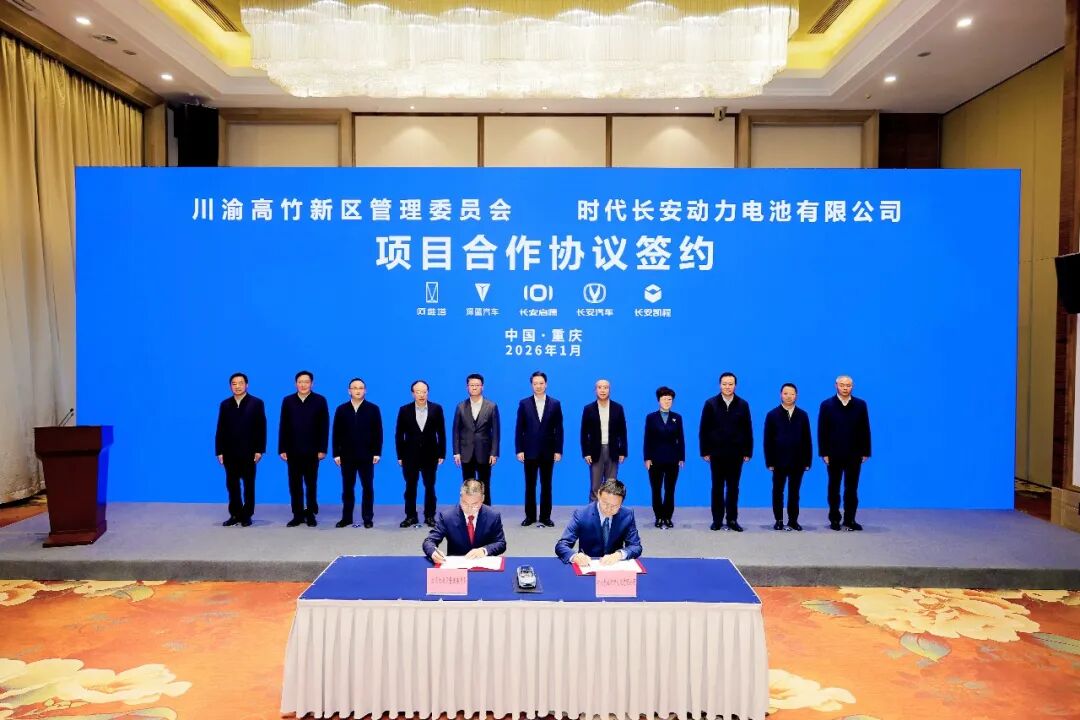
总投资55亿,宁德时代与长安汽车重庆签约,新能源汽车产业链协同再添重磅布局!
Xin Lang Cai Jing· 2026-01-15 03:33
Core Insights - The collaboration between CATL and Changan Automobile marks a significant strategic move in the new energy vehicle (NEV) industry, with a total investment of 5.5 billion yuan for a battery production base in Chongqing [1][6] - This project aims to enhance the production capacity of core components for NEVs in the Chengdu-Chongqing region, injecting new momentum into cross-provincial industrial cooperation [1][6] Project Overview - The joint venture, named Times Changan Power Battery Co., Ltd., will establish a 25GWh battery production base on approximately 1,000 acres in the Chongqing High Bamboo New District [3][8] - The project is designed to be a leading technology base for NEV battery supply, incorporating CATL's latest battery manufacturing processes to meet the needs of Changan's core NEV brands [3][8] Economic Impact - The site preparation is complete, with construction expected to start in Q1 2026 and production anticipated to begin in the second half of 2027, reaching full capacity within three years [3][8] - Once fully operational, the project is projected to generate an annual output value of approximately 10 billion yuan, contribute 300 million yuan in annual tax revenue, and create around 2,500 direct jobs, while also stimulating the upstream and downstream supply chain [3][8] Regional Significance - The High Bamboo New District is the only cross-provincial co-built new area in China, serving as a vital platform for industrial collaboration [4][9] - The project will leverage Chongqing's logistics, market, and industrial cluster advantages to enhance the local NEV supply chain, contributing to Chongqing's goal of becoming a globally influential hub for smart and connected NEVs [4][9] Strategic Integration - The establishment of the new company and the signing of the project indicate CATL's commitment to deeply integrate into the Chengdu-Chongqing NEV industry chain through both capital and physical projects [4][9]
中国长安汽车与宁德时代全面深化战略伙伴关系
Zheng Quan Shi Bao Wang· 2026-01-14 15:28
Core Viewpoint - China Changan Automobile Group Co., Ltd. has signed a memorandum of strategic partnership with Contemporary Amperex Technology Co., Limited (CATL) to enhance collaboration in the electric vehicle market [1] Group 1: Strategic Partnership - The partnership will focus on joint branding, cutting-edge technology, terminal promotion, overseas markets, high-quality supply assurance, and joint ventures [1] - This collaboration aims to jointly explore the new energy vehicle market [1] Group 2: Battery Project - A signing ceremony for the Times Changan Power Battery Project was held, which is a key strategic initiative for Changan Automobile [1] - The project is located in the North Beibei area of the Chuan-Yu High Bamboo New District and will primarily supply advanced new energy vehicle batteries for brands such as Avita, Deep Blue, and Changan Qiyuan [1] - The establishment of this project is expected to accelerate the development of the intelligent connected new energy vehicle industry in the Chengdu-Chongqing region [1]