WLY(000858)

Search documents
酒价内参11月14日价格发布 飞天茅台终端价微跌2元
Xin Lang Cai Jing· 2025-11-14 00:29
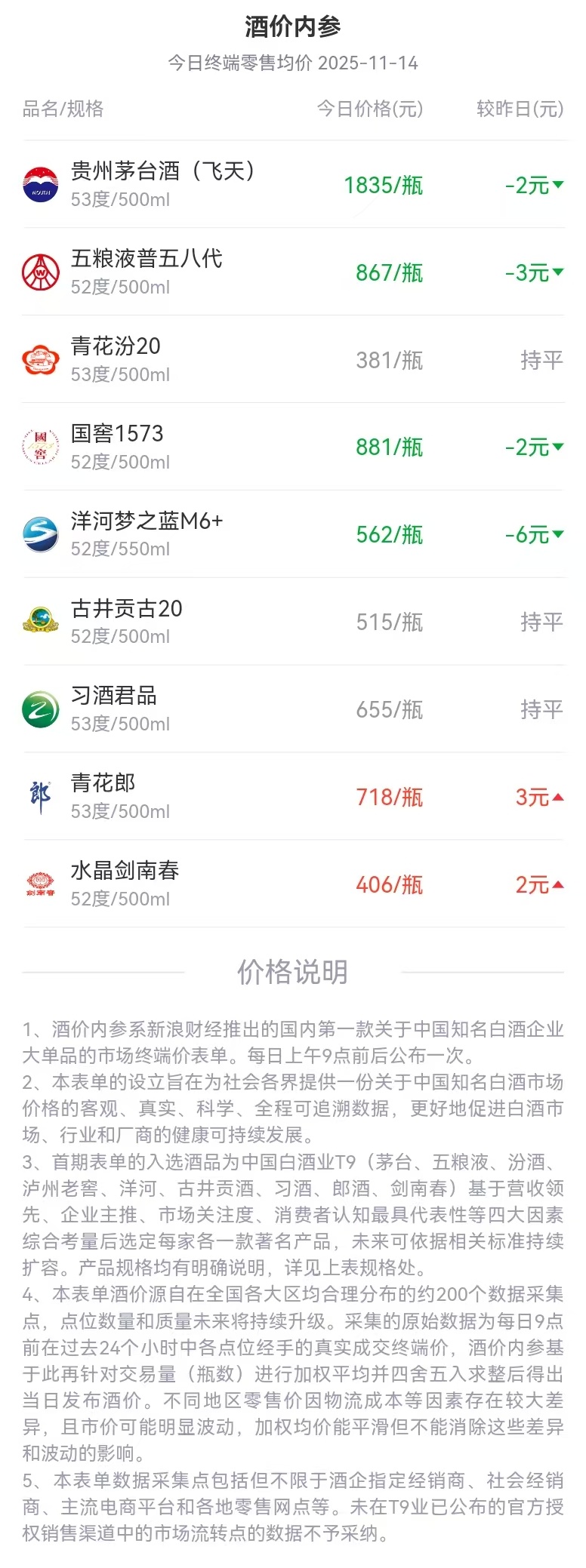
Core Insights - The average retail price of major Chinese liquor brands has shown a slight decline, with Moutai's price dropping by 2 yuan per bottle compared to the previous day [1][3] - Other notable brands, such as Wuliangye and Guojiao 1573, also experienced minor price reductions of 2-3 yuan per bottle, while Yanghe's Dream Blue M6+ saw a more significant drop of 6 yuan per bottle [1][3] - The overall retail price for a bundled package of the nine major products decreased by 8 yuan compared to the previous day, indicating a trend of price stabilization among certain products [1] Price Summary - Moutai (Feitian): 1835 yuan/bottle, down 2 yuan [3] - Wuliangye (Pu Wuliang): 867 yuan/bottle, down 370 yuan [3] - Qinghua Fen 20: 381 yuan/bottle, stable [3] - Guojiao 1573: 881 yuan/bottle, down 2 yuan [3] - Yanghe Dream Blue M6+: 562 yuan/bottle, down 6 yuan [3] - Gujing Gong 20: 515 yuan/bottle, stable [3] - Xijiu Junpin: 655 yuan/bottle, stable [3] Data Collection and Methodology - The price data is collected from approximately 200 points across major regions in China, ensuring a comprehensive representation of the market [6][7] - The data reflects actual transaction prices from the past 24 hours, weighted by transaction volume to provide an average price [6][7] - The initiative aims to provide an objective and traceable dataset to promote the healthy and sustainable development of the liquor market [6]







消费大利好,汇金重仓的6家消费龙头,全是低估值+高净利
Sou Hu Cai Jing· 2025-11-13 22:52
Core Insights - Central Huijin's significant investments in high-profit consumer stocks indicate a strategic focus on undervalued, high-net-margin companies in the consumer sector [3][5][10] Group 1: Central Huijin's Investment Strategy - Central Huijin holds over 3 trillion yuan in assets and has invested in 152 stocks, with a total market value of 3.02 trillion yuan as of Q1 2025 [3] - The investment strategy emphasizes large-cap stocks and industry leaders, particularly those with strong profitability and dividend levels [3][10] - The consumer sector is highlighted as a key area of focus, with a notable recovery in the CPI and core CPI, signaling a potential resurgence in consumer spending [3][5] Group 2: Performance of Key Consumer Stocks - Leading companies in the liquor industry, such as Kweichow Moutai, have exceptionally high profit margins, with a gross margin of 91.9% and a net margin of 52.2% [5] - Other prominent liquor brands like Wuliangye and Luzhou Laojiao also exhibit strong profitability, with net margins of 38% and 47% respectively [5] - In the home appliance sector, Midea Group shows a net margin of 10.64% and a price-to-earnings ratio of 12.1, indicating solid financial health [5] Group 3: Retail and Consumer Electronics - Retail companies like Dashang Group and Chongqing Department Store have net margins of 10.24% and 8.62%, respectively, showcasing their profitability [7] - The consumer electronics sector is experiencing a rebound, driven by new product categories such as AI smartphones and smart wearables, supported by recent subsidy policies [8] - The resilience of leading consumer companies is evident, with the CSI Consumer 50 Index constituents showing a 19.82% year-on-year increase in net profit for the first three quarters of 2025 [10] Group 4: Market Valuation and Future Outlook - The CSI Consumer 50 Index is currently at a historical low valuation, with a price-to-earnings ratio of 17.39, indicating potential for growth [10] - The average dividend yield of the index's constituents is 3.84%, surpassing the yield of ten-year government bonds, making it an attractive investment [10] - Continued government support for consumer spending, including subsidies for appliances and vehicles, is expected to drive growth in the retail sector [8][10]
11月13日深证龙头(399653)指数涨1.73%,成份股瑞达期货(002961)领涨
Sou Hu Cai Jing· 2025-11-13 10:06
Core Insights - The Shenzhen Leading Index (399653) closed at 3104.35 points, up 1.73%, with a trading volume of 105.65 billion yuan and a turnover rate of 0.96% [1] - Among the index constituents, 36 stocks rose while 12 fell, with Ruida Futures leading the gainers at an increase of 8.07%, and Binjiang Group leading the decliners with a drop of 3.33% [1] Index Constituents Summary - The top ten constituents of the Shenzhen Leading Index include: - Ningde Times (20.44% weight) at 415.60 yuan, up 7.56%, with a market cap of 1896.42 billion yuan [1] - Zhongji Xuchuang (8.35% weight) at 481.00 yuan, down 2.19%, with a market cap of 534.45 billion yuan [1] - Midea Group (7.67% weight) at 79.60 yuan, up 0.14%, with a market cap of 611.73 billion yuan [1] - Luxshare Precision (6.06% weight) at 57.38 yuan, down 0.68%, with a market cap of 417.85 billion yuan [1] - Sungrow Power (5.67% weight) at 190.51 yuan, up 1.53%, with a market cap of 394.97 billion yuan [1] - BYD (5.25% weight) at 99.83 yuan, up 2.11%, with a market cap of 910.17 billion yuan [1] - Wugong Liquor (4.41% weight) at 121.20 yuan, up 0.68%, with a market cap of 470.45 billion yuan [1] - Gree Electric (3.53% weight) at 41.00 yuan, down 0.36%, with a market cap of 229.66 billion yuan [1] - ZTE Corporation (2.83% weight) at 40.35 yuan, up 1.56%, with a market cap of 193.02 billion yuan [1] - Yuanlefang A (2.75% weight) at 4.04 yuan, unchanged, with a market cap of 151.15 billion yuan [1] Capital Flow Analysis - The net inflow of main funds into the Shenzhen Leading Index constituents totaled 3.862 billion yuan, while retail investors experienced a net outflow of 684 million yuan [1] - Notable capital flows include: - Ningde Times saw a net inflow of 2.655 billion yuan from main funds, while retail investors had a net outflow of 448 million yuan [2] - BYD had a net inflow of 607 million yuan from main funds, with retail investors experiencing a net outflow of 208 million yuan [2] - Zhongji Xuchuang had a net inflow of 409 million yuan from main funds, while retail investors had a negligible outflow [2]






美团闪购“双11”战报:白酒品类增长领跑
Bei Jing Shang Bao· 2025-11-13 09:40
Core Insights - The report highlights significant growth in the liquor category, particularly in the sales of major brands during the specified period [1] Group 1: Sales Performance - The trading volume of Wuliangye increased by 487% year-on-year [1] - The trading volume of Moutai surged by 612% year-on-year [1] - The trading volume of Jian Nan Chun rose by 556% year-on-year [1]

白酒板块11月13日涨0.57%,金徽酒领涨,主力资金净流出2.44亿元
Zheng Xing Xing Ye Ri Bao· 2025-11-13 08:44
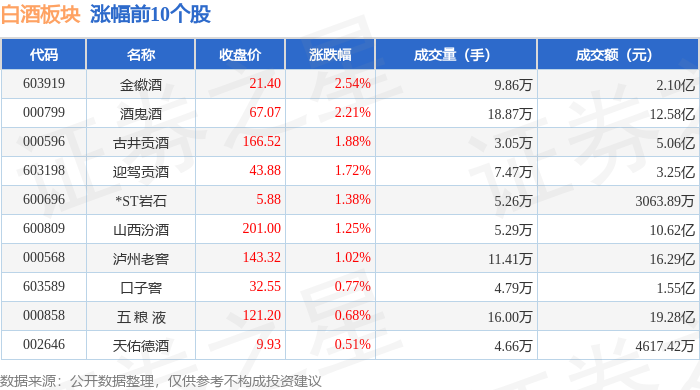
Market Overview - The liquor sector experienced a rise of 0.57% on November 13, with Jinhuijiu leading the gains [1] - The Shanghai Composite Index closed at 4029.5, up 0.73%, while the Shenzhen Component Index closed at 13476.52, up 1.78% [1] Individual Stock Performance - Jinhuijiu (616809) closed at 21.40, with an increase of 2.54% and a trading volume of 98,600 shares, amounting to a transaction value of 210 million yuan [1] - Other notable performers include: - Si Gu Dian (000799) at 67.07, up 2.21% [1] - Gujing Gongjiu (000596) at 166.52, up 1.88% [1] - Yingjia Gongjiu (603198) at 43.88, up 1.72% [1] - Shanxi Fenjiu (600809) at 201.00, up 1.25% [1] Capital Flow Analysis - The liquor sector saw a net outflow of 244 million yuan from institutional investors, while retail investors experienced a net outflow of 141 million yuan [2] - Conversely, speculative funds recorded a net inflow of 385 million yuan [2] Detailed Capital Flow for Selected Stocks - Jiu Guo Dian (000799) had a net inflow of 85.10 million yuan from institutional investors, while retail investors saw a net outflow of 95.90 million yuan [3] - Luzhou Laojiao (000568) experienced a net inflow of 66.31 million yuan from institutional investors, with a net outflow of 119 million yuan from retail investors [3] - Moutai (600519) closed at 1470.38, with a slight increase of 0.36% and a trading volume of 31,200 shares, resulting in a transaction value of 456.9 million yuan [2]


19只白酒股上涨 贵州茅台1470.38元/股收盘
Bei Jing Shang Bao· 2025-11-13 08:04
Core Viewpoint - The liquor sector is experiencing a significant shift, with expectations of a fundamental turning point in Q3 2026, following a period of decline in Q4 2024 and resilience in Q1 2025 [1] Group 1: Market Performance - On November 13, the three major indices collectively rose, with the Shanghai Composite Index closing at 4029.50 points, up 0.73% [1] - The liquor sector index closed at 2372.47 points, increasing by 0.61%, with 19 liquor stocks showing gains [1] Group 2: Individual Stock Performance - Kweichow Moutai closed at 1470.38 CNY per share, up 0.36% [1] - Wuliangye closed at 121.20 CNY per share, up 0.68% [1] - Shanxi Fenjiu closed at 201.00 CNY per share, up 1.25% [1] - Luzhou Laojiao closed at 143.32 CNY per share, up 1.02% [1] - Yanghe Brewery closed at 70.39 CNY per share, up 0.13% [1] Group 3: Industry Analysis - According to a report by Shenwan Hongyuan, the liquor sector has accelerated its clearing process in Q3, with expectations of a fundamental turning point in Q3 2026 [1] - The report indicates that since Q4 2024, some companies have begun to decline, but the top brands still showed growth due to resilient sales in Q1 2025 [1] - The industry demand environment has faced significant pressure since Q2 2025, with a notable lack of consumption scenarios, leading to further clearing in Q3 2025 [1]
研报掘金丨长江证券:维持五粮液“买入”评级,有望迎来业绩稳步回升
Ge Long Hui A P P· 2025-11-13 08:00
Core Viewpoint - Wuliangye's net profit for the first three quarters of 2025 is 21.511 billion yuan, reflecting a decrease of 13.72%, with Q3 net profit at 2.019 billion yuan, down 65.62% [1] Financial Performance - The company has initiated an adjustment period, breaking the rigid target constraints, which is expected to alleviate pressure on distributors and gradually reduce inventory [1] - The downward pressure on wholesale prices is anticipated to ease over time [1] Future Outlook - Given the company's strong brand advantage, it is expected that performance will steadily recover alongside industry demand recovery [1] - Projected EPS for 2025 and 2026 are 6.8 yuan and 6.97 yuan respectively, corresponding to a PE ratio of 17 times at the current stock price [1] - The investment rating is maintained at "Buy" [1]

茅台跌、五粮液崩:这不是白酒的事,是中国的事
Sou Hu Cai Jing· 2025-11-13 04:51
Group 1 - The core point of the article highlights the stagnation of Guizhou Moutai's growth, with a significant slowdown in revenue and profit growth in the third quarter of 2025, indicating a broader economic issue in China [1][2][12][24] - Guizhou Moutai reported a revenue of 128.4 billion yuan for the first three quarters of 2025, a year-on-year increase of 6.36%, and a net profit of 64.6 billion yuan, up 6.28% [2] - In the third quarter alone, Moutai's revenue was 39 billion yuan, with a mere 0.56% year-on-year growth, and net profit was 19.2 billion yuan, growing only 0.48% [2][12] Group 2 - The report indicates a drastic decline in the contract liabilities of Moutai, which fell to 7.7 billion yuan, a 23% decrease from the previous year, suggesting that distributors are hesitant to stock up on Moutai products [5][6] - Moutai's accounts receivable, indicating "selling on credit," have surged, with a near doubling in the third quarter compared to the previous quarter and a nearly fourfold increase year-on-year [7][8] Group 3 - The performance of Wuliangye is even more alarming, with a reported revenue of 60.9 billion yuan for the first three quarters of 2025, a 10% decline, and a net profit of 21.5 billion yuan, down 13% [12][15] - In the third quarter, Wuliangye's revenue plummeted to 8 billion yuan, a staggering 52% year-on-year drop, and net profit fell by 65% to 2 billion yuan [15][12] Group 4 - Smaller liquor companies are facing severe challenges, with Kuozi Jiao reporting a net cash outflow of 390 million yuan in the third quarter, marking the first negative cash flow in a decade [17] - The inventory pressure is rising across the industry, with many companies unable to sell their products, leading to increased stock levels similar to the real estate market [17] Group 5 - The article suggests that the decline in high-end liquor sales is not solely due to government restrictions but is more reflective of a broader economic downturn, with reduced consumer spending and social gatherings [19][18] - The overall sentiment indicates that the slowdown in liquor sales, particularly for Moutai and Wuliangye, serves as a barometer for the Chinese economy, reflecting a lack of liquidity and consumer confidence [24][22]
年轻人不买账,白酒这次真要凉?
3 6 Ke· 2025-11-13 03:02
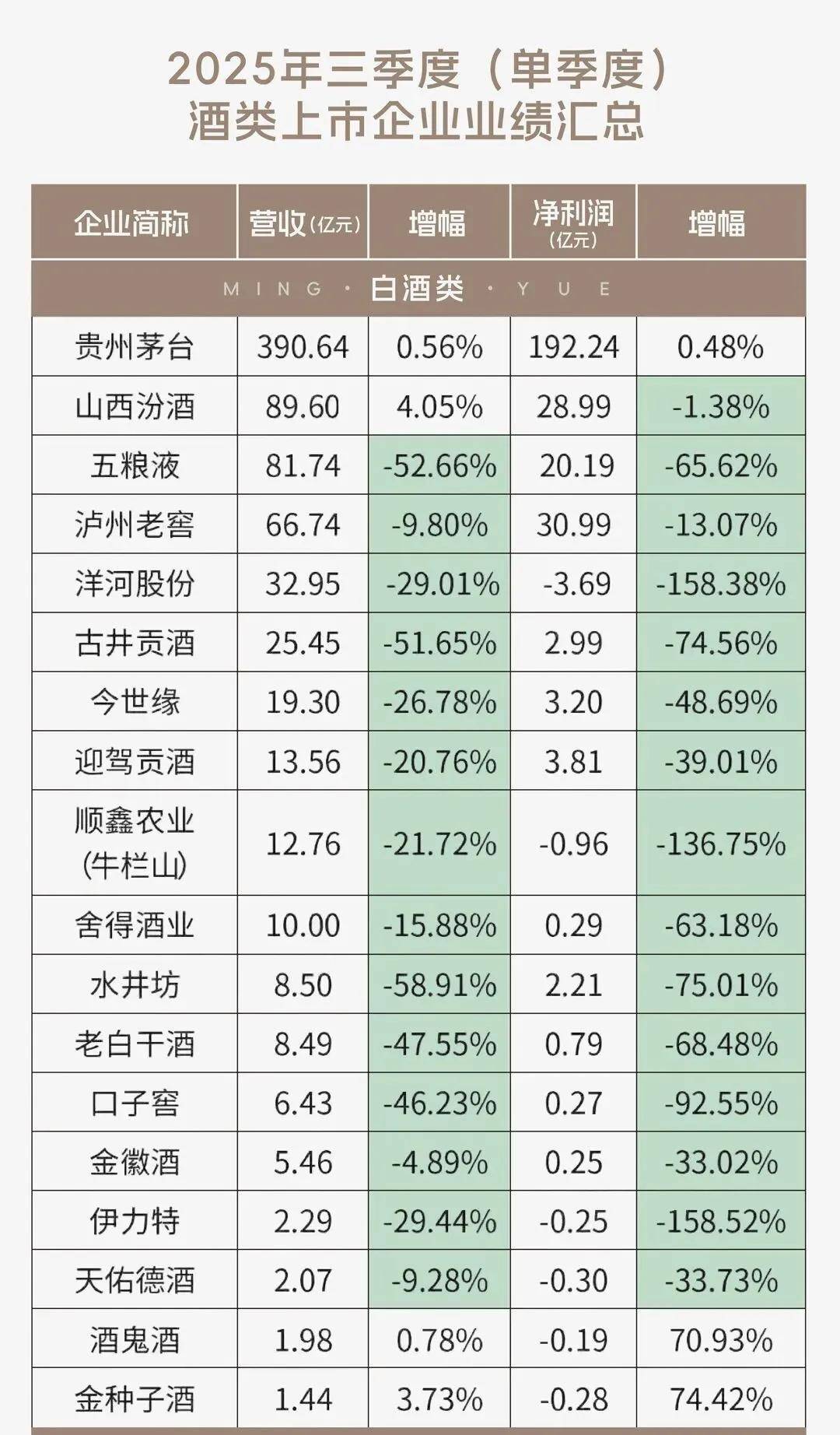
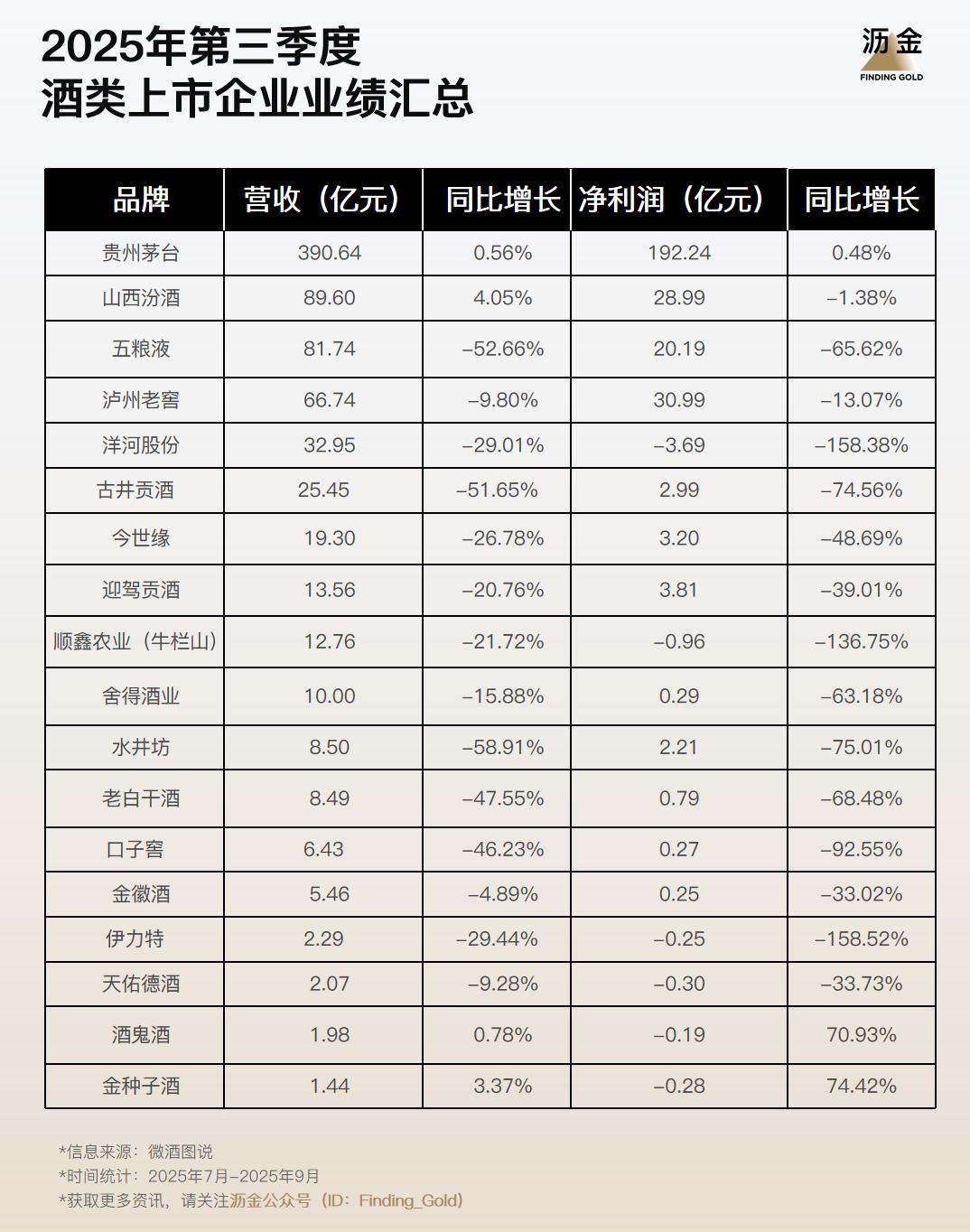
Core Viewpoint - The Chinese liquor industry, particularly the baijiu sector, is experiencing significant revenue and profit declines, with most companies facing challenges except for a few leading brands [1][4]. Financial Performance - Major brands like Kweichow Moutai reported a revenue of 39.064 billion yuan with a slight growth of 0.56%, while others like Wuliangye saw a drastic revenue drop of 52.66% to 8.174 billion yuan [2]. - The net profit for Kweichow Moutai was 19.224 billion yuan, reflecting a growth of 0.48%, whereas Wuliangye's net profit plummeted by 65.62% to 2.019 billion yuan [2]. - Other brands such as Yanghe and Gujing Gongjiu also reported significant declines in both revenue and net profit, indicating a broader industry downturn [2]. Market Sentiment and Public Perception - The introduction of the "ban on alcohol" in June is viewed as a catalyst for the current downturn, leading to reduced consumption in both public and business settings [1][4]. - Social media discussions have intensified around the notion that "baijiu is failing," with extreme expressions of pessimism emerging [3][4]. - The price of Kweichow Moutai's scattered bottles fell below 1,500 yuan, reflecting market panic and a loss of confidence [4]. Historical Context and Cycles - The baijiu industry has undergone four significant downturns since the establishment of New China, with each cycle characterized by structural adjustments and eventual recovery [6][11]. - The current downturn is seen as a continuation of a long-term structural adjustment rather than a sudden collapse, with historical patterns suggesting potential for recovery [8][11]. Cultural and Generational Shifts - The narrative surrounding baijiu has shifted, with younger generations perceiving it as a symbol of social pressure rather than a status symbol, leading to a disconnect in cultural significance [20][21]. - The traditional values associated with baijiu are being challenged by changing social dynamics, where younger consumers prioritize personal identity over societal expectations [22][23]. Future Outlook - The baijiu industry faces the challenge of redefining its narrative to resonate with contemporary consumers, particularly the younger demographic that shapes public discourse [25][27]. - Recovery will depend not only on price stabilization but also on rebuilding cultural relevance and consumer trust in the brand [28].
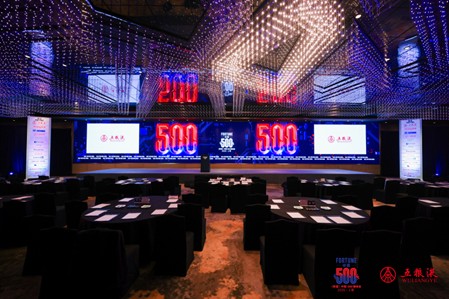
五粮液飘香2025年《财富》中国500强峰会 以东方智慧共绘未来商业新图景
Zhong Jin Zai Xian· 2025-11-13 02:09
Core Viewpoint - The 2025 Fortune China 500 Summit held in Shanghai highlighted the strength and influence of Chinese enterprises, with Wuliangye being a key participant and showcasing its leadership in the liquor industry [1][5]. Group 1: Event Overview - The summit attracted leaders from the Fortune China 500 companies and innovative business figures, focusing on the theme "Navigating Trends and Expanding Territories: The Next 25 Years of the 21st Century" [1]. - Wuliangye served as the chief strategic partner and designated liquor for the summit, enhancing the event's cultural atmosphere [3]. Group 2: Wuliangye's Performance - Wuliangye ranked 146th in the 2025 Fortune China 500 list with a revenue of $27.142 billion in 2024, improving its position by 5 spots from the previous year and leading the beverage industry [3][5]. - The company's steady rise in the Fortune list reflects its strong product quality, brand value, and market performance, signaling the resilience of the Chinese liquor industry [5]. Group 3: Brand Presentation - Wuliangye showcased a variety of high-end products at the summit, including its classic series and the newly launched 29° Wuliangye "First Sight," which attracted significant attention from attendees [7]. - The company received the EFQM Global Award (7 Diamonds), a prestigious quality management certification, underscoring its commitment to excellence [7]. Group 4: Strategic Vision - Wuliangye aims to become a world-class enterprise characterized by product excellence, brand prestige, innovation leadership, and modern governance, aligning with China's high-quality development goals [10]. - The company is expanding its global market presence, leveraging international platforms like the Fortune China 500 Summit to promote Chinese liquor [10][12]. Group 5: Cultural Impact - Wuliangye's participation in high-profile international business events is establishing its image as a standard in global business, combining cultural confidence with international expression [12]. - The summit represents both challenges and opportunities for Chinese enterprises, with Wuliangye poised to contribute to a new chapter of "harmony and beauty" in business [13].