
WLY(000858)

Search documents
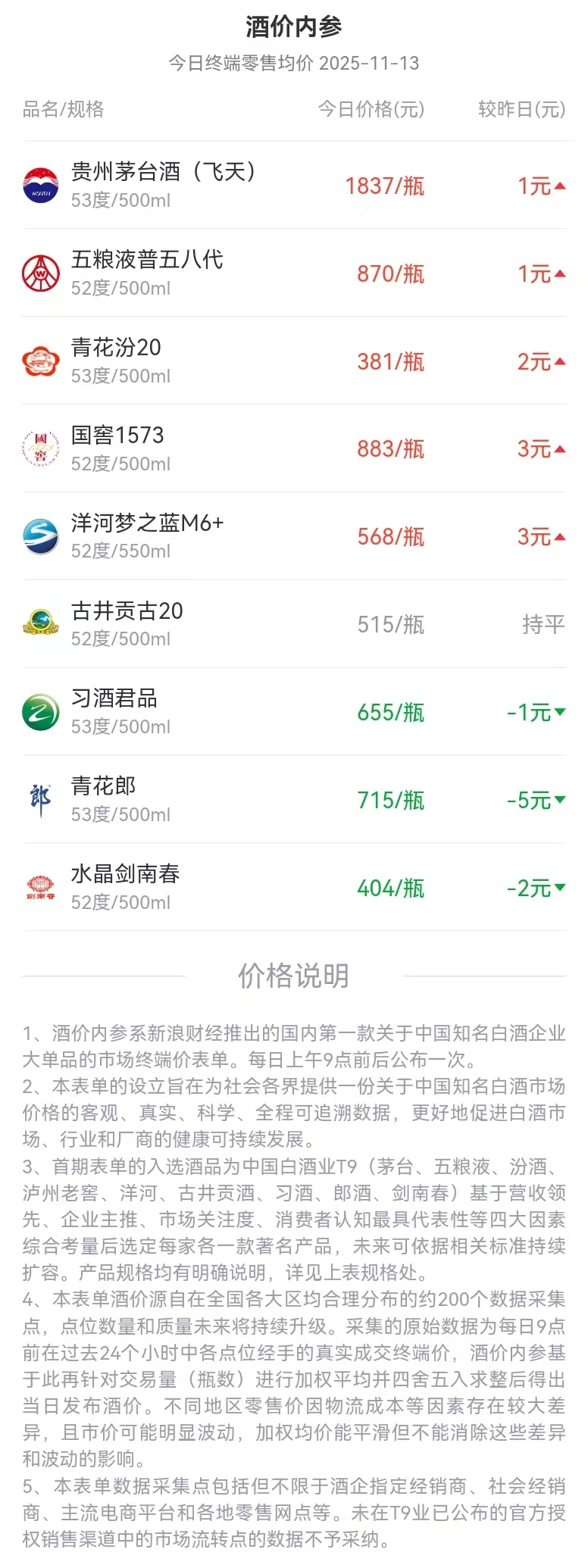
酒价内参11.13价格发布 飞天茅台终端价再小涨
Xin Lang Cai Jing· 2025-11-13 00:08
Core Insights - The average retail price of major Chinese liquor brands has shown a slight increase following the Double Eleven shopping festival, indicating a stable market trend for the industry [1] Price Trends - Moutai's Feitian liquor saw a price increase of 1 yuan per bottle, reaching 1837 yuan [3] - Other notable brands such as Guojiao 1573 and Yanghe Dream Blue M6+ both increased by 3 yuan per bottle, indicating a leading price rise among major products [1][3] - Wuliangye's Pu Wuhai edition increased by 1 yuan, showing signs of price stabilization [1] - Qinghua Fen 20 also experienced a price rise of 2 yuan, while Guqingong Gu 20 remained stable [1] - On the downside, Qinghua Lang saw a significant drop of 5 yuan per bottle, while Xijiu Junpin and Shuijing Jianan Chun decreased by 1-2 yuan, which is considered normal market fluctuation [1] Data Collection and Reporting - The price data is collected from approximately 200 points across major regions, including authorized distributors and retail outlets, ensuring a comprehensive representation of the market [6][7] - The data is published daily by Sina Finance, aiming to provide an objective and traceable overview of the Chinese liquor market [6]






五粮液(000858):五粮液2025年三季报点评:龙头担当,开启调整
Changjiang Securities· 2025-11-12 23:30
Investment Rating - The investment rating for the company is "Buy" and is maintained [6]. Core Views - The company reported a total revenue of 60.945 billion yuan for Q1-Q3 2025, a decrease of 10.26% year-on-year, and a net profit attributable to shareholders of 21.511 billion yuan, down 13.72% [2][4]. - In Q3 2025, the company experienced a significant decline in revenue, reporting 8.174 billion yuan, a drop of 52.66%, and a net profit of 2.019 billion yuan, down 65.62% [2][4]. - The decline in revenue and profit is attributed to the deep adjustment period in the liquor industry and the slower-than-expected recovery in effective demand [10]. Summary by Sections Financial Performance - For Q1-Q3 2025, the company's total revenue was 60.945 billion yuan, with a net profit of 21.511 billion yuan and a non-recurring net profit of 21.495 billion yuan, reflecting a year-on-year decline of 10.26% and 13.72% respectively [2][4]. - In Q3 2025, the total revenue was 8.174 billion yuan, with a net profit of 2.019 billion yuan and a non-recurring net profit of 2.015 billion yuan, showing a year-on-year decline of 52.66% and 65.62% respectively [2][4]. Market Dynamics - The company is breaking the rigid constraints of its targets and entering an adjustment phase, which is expected to alleviate pressure on distributors and gradually reduce inventory [10]. - The company's gross profit margin decreased by 13.53 percentage points to 62.64% in Q3 2025, while the net profit margin fell by 9.31 percentage points to 24.7% [10]. Future Outlook - The company is expected to see a gradual recovery in performance as industry demand stabilizes, with projected EPS of 6.8 yuan and 6.97 yuan for 2025 and 2026 respectively, corresponding to a PE ratio of 17 times [10].
双11酒水大战真相!年轻人不再囤酒,酒企集体反抗电商平台
Sou Hu Cai Jing· 2025-11-12 21:57
Core Viewpoint - The Chinese liquor industry is experiencing significant price fluctuations and a shift in consumer behavior, leading to a fierce battle between liquor companies and e-commerce platforms over pricing and market control [1][3][16]. Group 1: Price Anomalies and Market Polarization - During this year's Double 11 shopping festival, the price of 53-degree 500ml Flying Moutai has dropped to 1499 yuan per bottle on major e-commerce platforms, aligning with the official guidance price [3][5]. - Other premium liquors, such as Junpin Xijiu and Jinsha, have also seen drastic price reductions, with some dropping below 400 yuan [5]. - The price disparity among different brands indicates a profound transformation in the liquor market, with online subsidies clashing with manufacturers' pricing strategies [5][16]. Group 2: Liquor Companies' Countermeasures - In response to the aggressive pricing strategies of e-commerce platforms, major liquor companies have adopted a more assertive stance, publicly disclosing authorized sales channels and naming unauthorized sellers [7][10]. - The collective action from at least eight liquor manufacturers, including Moutai and Wuliangye, reflects a significant shift towards reclaiming control over distribution channels [7][10]. - Maintaining price stability is crucial for liquor companies, as the chaos in pricing can undermine brand positioning and market confidence [10][16]. Group 3: E-commerce Platforms' Strategies - E-commerce platforms have adjusted their subsidy strategies, continuing to offer significant discounts on top-tier products like Moutai to attract high-end consumers [8][10]. - However, the overall subsidy for liquor has decreased as platforms redirect resources to other categories, indicating a shift in focus [10][11]. - The normalization of subsidies has diminished the effectiveness of promotional events, leading to a decline in sales compared to previous campaigns [10][11]. Group 4: Changing Consumer Behavior - The demographic of liquor consumers is shifting, with a significant portion of new customers being young individuals aged 18-29, who now make up 30% of the market [11][13]. - Young consumers are moving away from traditional bulk purchasing habits, opting instead for immediate consumption facilitated by rapid delivery services [13][16]. - This generational change is impacting the demand for high-end liquor, as traditional drinking cultures are being rejected by younger consumers [13][16]. Group 5: Channel Transformation and Distributor Challenges - Traditional distributors are facing significant challenges due to the aggressive pricing from online platforms, leading to reduced profit margins and some exiting the industry [15][16]. - Liquor companies are caught in a dilemma between maintaining price stability and assisting distributors in clearing inventory [15][16]. - The rise of instant retail is accelerating changes in distribution channels, prompting liquor companies to explore new sales models [15][16].

五粮液等企业与中国国际展览中心集团有限公司签署协议

Zheng Quan Shi Bao Wang· 2025-11-12 15:32
Core Viewpoint - The Fourth China International Supply Chain Promotion Expo Sichuan Promotion Conference and Signing Ceremony was held in Chengdu, showcasing the commitment of representative companies to enhance the optimization and resilience of industrial and supply chains in Sichuan and across China [1] Group 1: Event Overview - The event took place on November 11 and included 16 representative companies, such as Wuliangye, Dongfang Electric, and Jiuzhou Group, signing agreements with the China International Exhibition Center Group [1] - The expo serves as a national platform for companies to display innovative achievements and deepen international cooperation [1] Group 2: Industry Impact - The collaboration aims to contribute to the optimization and upgrading of the industrial and supply chains in Sichuan province and nationwide [1] - The initiative emphasizes enhancing the resilience and safety levels of the supply chain, showcasing the strength and wisdom of Sichuan [1]
段永平再发声!吃喝板块继续上攻,食品ETF(515710)日线四连阳!机构:或可关注食饮板块左侧布局窗口
Xin Lang Ji Jin· 2025-11-12 11:45
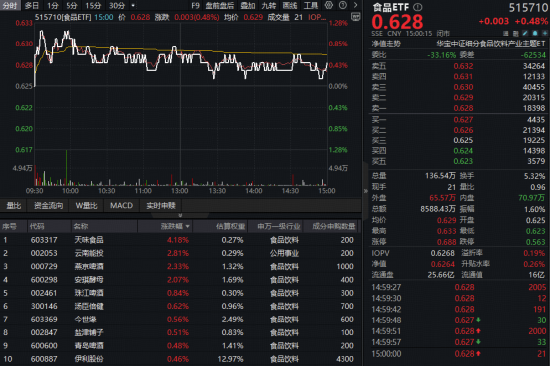
Core Viewpoint - The food and beverage sector continues to rise, with the Food ETF (515710) showing a positive trend and notable gains in key stocks like Tianwei Food and Guizhou Moutai [1][3]. Group 1: Market Performance - The Food ETF (515710) experienced a daily increase of 0.48%, marking its fourth consecutive day of gains, with an intraday peak increase of 1.28% [1]. - Major consumer goods stocks led the gains, with Tianwei Food rising by 4.18%, and other companies like Yunnan Energy Investment and Yanjing Beer also showing significant increases [1][2]. Group 2: Key Holdings - Guizhou Moutai is the largest holding in the Food ETF (515710), accounting for 14.89% of the fund's net asset value as of Q3 2025 [3][4]. - Other significant holdings include Wuliangye and Yili Group, with respective holdings of 14.65% and 12.49% [4]. Group 3: Valuation Insights - The food and beverage sector is currently at a historical low valuation, with the Food ETF's underlying index P/E ratio at 21.21, placing it in the 11.74% percentile over the past decade, indicating a favorable long-term investment opportunity [4][5]. - The liquor sector has undergone five years of adjustment, with current market sentiment improving as companies adjust their operational strategies [5][6]. Group 4: Future Outlook - Analysts suggest that the food and beverage sector is entering a potential recovery phase, with a focus on new consumption trends and low valuations [6]. - The Food ETF (515710) is recommended for investors looking to capitalize on core assets in the food and beverage sector, with a significant portion of its holdings in high-end liquor and dairy products [6].

17只白酒股下跌贵州茅台1465.15元/股收盘
Xin Lang Cai Jing· 2025-11-12 10:32
Core Viewpoint - The article discusses the recent performance of the liquor market, particularly focusing on the white liquor sector, highlighting a collective decline in major indices and specific stock movements within the industry [1]. Industry Summary - On November 12, the three major indices collectively fell, with the Shanghai Composite Index closing at 4000.14 points, down 0.07% [1]. - The white liquor sector closed at 2358.04 points, experiencing a slight decline of 0.04%, with 17 out of 20 white liquor stocks reporting losses [1]. Company Summary - Individual stock performances included: - Kweichow Moutai closed at 1465.15 CNY per share, up 0.42% [1]. - Wuliangye closed at 120.38 CNY per share, down 0.33% [1]. - Shanxi Fenjiu closed at 198.52 CNY per share, down 0.52% [1]. - Luzhou Laojiao closed at 141.87 CNY per share, unchanged [1]. - According to a report by Shenwan Hongyuan, the financial results of leading brands began to clear in Q2, with further acceleration in Q3, indicating a potential bottoming out [1]. - The report anticipates a year-on-year decline in overall industry sales volume of 20%-30% in Q3, driven by a low base in Q2 2024 [1].
11月12日投资时钟(399391)指数跌0.01%,成份股华侨城A(000069)领跌
Sou Hu Cai Jing· 2025-11-12 10:04
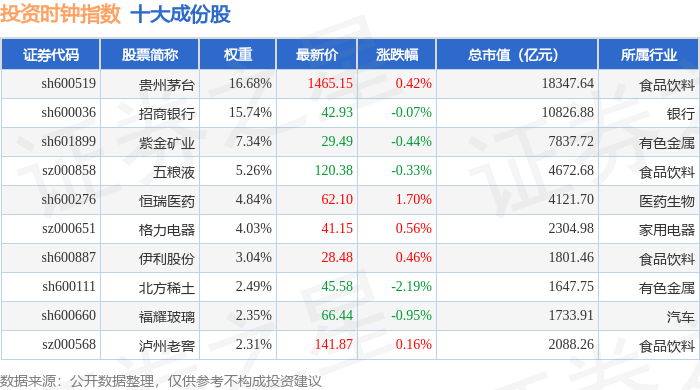
Core Viewpoint - The Investment Clock Index (399391) closed at 3417.47 points, down 0.01%, with a trading volume of 89.182 billion yuan and a turnover rate of 0.94% on November 12 [1] Group 1: Index Performance - Among the constituent stocks of the Investment Clock Index, 28 stocks rose while 71 stocks fell, with China Aluminum leading the gainers at a 6.65% increase and Overseas Chinese Town A leading the decliners at a 4.1% decrease [1] - The top ten constituent stocks of the Investment Clock Index include Kweichow Moutai, China Merchants Bank, and others, with Kweichow Moutai holding the highest weight at 16.68% [1] Group 2: Stock Details - Kweichow Moutai's latest price is 1465.15 yuan, with a slight increase of 0.42% [1] - China Merchants Bank's latest price is 42.93 yuan, with a minor decrease of 0.07% [1] - The total market capitalization of Kweichow Moutai is approximately 183.48 billion yuan, while China Merchants Bank's market cap is around 108.27 billion yuan [1] Group 3: Capital Flow - The net outflow of main funds from the constituent stocks totaled 2.074 billion yuan, while retail investors saw a net inflow of 1.909 billion yuan [1] - The detailed capital flow indicates that China Aluminum had a net inflow of 390 million yuan from main funds, while it experienced a net outflow of 278.5 million yuan from speculative funds [2]




17只白酒股下跌 贵州茅台1465.15元/股收盘
Bei Jing Shang Bao· 2025-11-12 09:25
Core Viewpoint - The overall market experienced a decline, with the Shanghai Composite Index dropping to 4000.14 points, down 0.07%, and the liquor sector also saw a slight decrease, indicating ongoing challenges in the industry [1]. Industry Summary - The liquor sector closed at 2358.04 points, with a minor decline of 0.04%, and 17 liquor stocks reported losses [1]. - In Q3, the industry is expected to see a year-on-year decline in sales volume of 20%-30%, driven by a low base in Q2 2024, as the market seeks to balance volume and price [1]. - Looking ahead, the industry may face double-digit sales volume decline pressure in Q1 2026, with continued pressure on financial reports, but stabilization is anticipated in Q2 2026, and a potential turning point in fundamentals could occur in Q3 2026 [1]. Company Summary - Kweichow Moutai's stock closed at 1465.15 CNY per share, up 0.42%, while Wuliangye's stock closed at 120.38 CNY per share, down 0.33% [1]. - Shanxi Fenjiu's stock closed at 198.52 CNY per share, down 0.52%, and Luzhou Laojiao's stock closed at 141.87 CNY per share, up 0.16% [1]. - Yanghe's stock closed at 70.30 CNY per share, down 0.71% [1].
五粮液亮相2025年《财富》中国500强峰会 为全球商业对话注入和美活力
Xin Hua Cai Jing· 2025-11-12 07:57
Group 1 - The 2025 Fortune China 500 Summit was held in Shanghai, where Wuliangye ranked 146th, leading the liquor industry [1] - The summit's theme was "Navigating Trends: The Next 25 Years of the 21st Century," featuring discussions on macroeconomics, global industrial layout, green transformation, and changing consumer trends [1] - Wuliangye showcased its brand culture through a specially designed exhibition and tasting events, highlighting the deep cultural heritage and exceptional quality of Chinese liquor [1] Group 2 - The Wuliangye brand culture exhibition focused on "Harmony and Beauty," blending traditional heritage with contemporary aesthetics [2] - The exhibition displayed various representative products, including the classic Wuliangye series and the 29° Wuliangye "First Encounter," which received positive feedback for its unique flavor profile [2] - Guests experienced a unique tasting method during the themed dinner, enhancing their understanding of the charm of Chinese liquor and fostering international business cooperation [2] Group 3 - As a representative of Chinese liquor, Wuliangye is committed to high-quality development, enhancing brand influence and value [3] - The company actively participates in international high-end platforms to share the cultural stories and quality of Chinese liquor, promoting sustainable high-quality development [3] - Wuliangye aims to deepen brand construction and promote the international dissemination of Chinese liquor culture, contributing to global cultural exchange [3]
最长双十一,酒业对电商的态度变了吗?
Xin Lang Cai Jing· 2025-11-12 07:47
Core Insights - The article discusses the contrasting dynamics between traditional liquor channels and e-commerce platforms during the extended "Double 11" shopping festival, highlighting the urgent need for liquor companies to balance pricing systems and market scale [2][3] Group 1: Market Dynamics - E-commerce platforms are aggressively pushing prices down, with notable discounts such as the price of Moutai dropping to 1499 yuan per bottle due to "hundred billion subsidies" [2] - Liquor companies are responding with measures to stabilize prices, including Moutai's announcement of a buyback plan worth 1.5 to 3 billion yuan and a cash dividend of approximately 30 billion yuan to shareholders [2][3] - The frequency of liquor companies' public statements regarding channel management has increased, indicating a heightened concern over unauthorized sales and counterfeit products [4] Group 2: Channel Management - Liquor companies are focusing on maintaining price integrity through e-commerce, viewing it primarily as a branding tool rather than a volume driver [3][4] - A collective effort among major liquor brands to regulate channels has emerged, with at least eight companies, including Moutai and Wuliangye, announcing official authorized stores [3][4] - The counterfeit rate in e-commerce channels for Wuliangye reached 16.65% from January to May, prompting companies to take action to protect brand reputation [4] Group 3: E-commerce Strategies - E-commerce platforms are seen as significant sales drivers, with companies like 1919 reporting a 20-fold increase in flash sale orders on Tmall since October [4][5] - The direct collaboration between platforms and distributors is bypassing liquor companies' channel controls, contributing to low-price sourcing [5] - Companies are adapting to the rise of instant retail, which is shifting pricing power from producers to channels and consumers [6] Group 4: Consumer Engagement - Liquor companies are increasingly embracing instant retail to enhance consumer experience, with initiatives like special promotions and interactive campaigns [8][10] - The focus on younger consumers is evident, with brands adjusting marketing strategies to resonate with this demographic, as seen with the "Happy Niubi Barrel" campaign [8][9] - The integration of cultural and tourism experiences is becoming a new frontier for consumer engagement, with companies developing immersive brand experiences [10] Group 5: Future Outlook - The industry is shifting towards a collaborative ecosystem between liquor companies and e-commerce platforms, aiming for a "co-build, share, and coexist" relationship [7][10] - Companies are recognizing the need for a multi-channel strategy that balances immediate sales with long-term brand value [10]
