WLY(000858)

Search documents
白酒概念涨3.01%,主力资金净流入这些股
Zheng Quan Shi Bao Wang· 2025-11-10 08:29
Group 1 - The liquor concept sector rose by 3.01%, ranking third among concept sectors, with 45 stocks increasing in value, including Zhongrui Co., Shide Liquor, and Kuaijishan hitting the daily limit [1][2] - Leading stocks in the liquor sector included Luzhou Laojiao, Gujing Gongjiu, and Shanxi Fenjiu, which increased by 8.23%, 6.73%, and 6.35% respectively [1][2] - The sector saw a net inflow of 2.787 billion yuan from main funds, with 30 stocks receiving net inflows, and 7 stocks exceeding 100 million yuan in net inflow [2][3] Group 2 - The top net inflow stock was Kweichow Moutai, with a net inflow of 833 million yuan, followed by Wuliangye, Jiu Gui Jiu, and Shide Liquor with net inflows of 608 million yuan, 386 million yuan, and 258 million yuan respectively [2][3] - Zhongrui Co., ST Yanshi, and Kuaijishan had the highest net inflow ratios at 34.96%, 22.05%, and 20.99% respectively [3] - The overall performance of the liquor sector indicates strong investor interest and confidence, as evidenced by the significant net inflows and stock price increases [2][3]




食品饮料行业周报:白酒Q3降速释压,关注高股息饮料标的-20251110
Haitong Securities International· 2025-11-10 08:26
Investment Rating - Investment advice favors growth targets in beverages, food ingredients, and snacks, while revising expectations for Chinese baijiu [6][18]. Core Insights - The report highlights a focus on low valuation and high dividend yielding stocks within the soft drink sector, indicating potential for fundamental and valuation recovery as competition eases and consumer power improves [10][18]. - Chinese baijiu sector shows a significant decline in Q3, with revenues down 18% year-on-year and net profits down 22%, indicating a need for destocking and potential for market stabilization [7][18]. - The report emphasizes the importance of innovative supply and channel strategies among liquor companies to seek growth despite demand pressures [8][18]. Summary by Sections Investment Recommendations - Focus on flexible targets in Chinese baijiu such as ZJLD, Shede Spirits, and Luzhou Laojiao, while mid-term stable targets include Wuliangye and Kweichow Moutai [6][18]. - In the beverage sector, key growth targets include Eastroc Beverage and Nongfu Spring, alongside high dividend, low valuation options like Uni-President China and Want Want China Holdings [6][18]. - Snack and food ingredient growth targets include Three Squirrels and Guilin Seamild Foods, while beer targets include Tsingtao Brewery and China Resources Beer Holdings [6][18]. Baijiu Sector Analysis - Q3 reports indicate a significant revenue decline for the baijiu sector, with Moutai emphasizing high-quality growth and announcing a new dividend and buyback plan to boost market confidence [7][8][18]. - The report notes that the industry is still in a destocking phase, with potential for capital markets to bottom out early despite ongoing demand pressures [7][18]. Consumer Goods Sector Insights - The soft drink sector is highlighted for its high return on equity (ROE) and good cash flow characteristics, making it a quality dividend asset [10][18]. - Recent performance of Uni-President China shows a profit of RMB 2.01 billion for Q3, marking a 23.06% year-on-year increase, indicating strong growth potential [11][18].


10月CPI反弹+提振内需政策,旅游ETF涨5%,食品饮料ETF下半年狂“吸金”超29亿,居同类第一
Sou Hu Cai Jing· 2025-11-10 08:18
Group 1 - The core viewpoint of the news highlights a surge in consumer stocks in A-shares, particularly in sectors such as duty-free, airports, tourism, food, and liquor, with significant gains in companies like China Duty Free and Kweichow Moutai [1][2] - The October CPI increased by 0.2% year-on-year and month-on-month, marking the highest level in eight months, while the core CPI rose by 1.2%, continuing a six-month upward trend [2] - The implementation of new duty-free policies in Hainan saw a shopping amount of 5.06 billion yuan and 72,900 shoppers in the first week, representing year-on-year growth of 34.86% and 3.37% respectively [2] Group 2 - The tourism ETF rose by 5%, with major holdings including China Duty Free and Shanghai Airport, indicating strong investor interest in the sector [3] - The food and beverage ETF increased by 2.99%, with a total scale of 6.064 billion yuan and a net inflow of 2.973 billion yuan in the second half of the year, leading its category [3] - The current price-to-earnings (PE) ratio for the food index stands at 20.59, which is at the 7.55% historical percentile over the past decade, suggesting a potential value opportunity in the consumer sector [2]

20只白酒股上涨 贵州茅台1462.30元/股收盘
Bei Jing Shang Bao· 2025-11-10 07:43
Core Viewpoint - The stock market showed positive performance on November 10, with the Shanghai Composite Index rising by 0.53%, driven by strong gains in the liquor sector, particularly among leading brands [1] Industry Summary - The liquor sector index closed at 2349.92 points, up by 2.92%, with 20 liquor stocks experiencing increases, including Shede Liquor and Jiu Gui Liquor hitting the daily limit [1] - Major liquor companies such as Kweichow Moutai, Wuliangye, Shanxi Fenjiu, Luzhou Laojiao, and Yanghe Brewery all reported significant stock price increases, with Luzhou Laojiao leading at an 8.23% rise [1] Company Summary - Kweichow Moutai's closing price reached 1462.30 CNY per share, up by 2.02% [1] - Wuliangye closed at 120.80 CNY per share, up by 3.47% [1] - Shanxi Fenjiu closed at 198.99 CNY per share, up by 6.35% [1] - Luzhou Laojiao closed at 142.49 CNY per share, up by 8.23% [1] - Yanghe Brewery closed at 71.55 CNY per share, up by 3.01% [1] Analyst Insights - CITIC Securities indicated that while short-term consumption recovery may fluctuate, the medium to long-term demand remains resilient, suggesting that leading liquor companies are likely to maintain steady growth due to their brand strength and channel management capabilities [1]

CPI反弹,旅游ETF涨5%,食品饮料ETF下半年吸金29亿
Sou Hu Cai Jing· 2025-11-10 05:48
Group 1 - A-share consumer stocks, including duty-free, airport, tourism, food, and liquor sectors, experienced a surge, with companies like China Duty Free Group and Kweichow Moutai hitting the daily limit [1][2] - The tourism ETF rose by 5% in the afternoon session, while the food and beverage ETF increased by 2.99% [1][3] - The latest food index PE stands at 20.59 times, which is at the 7.55% historical percentile over the past decade, indicating a potential rebound in the consumer sector [2] Group 2 - In October, the CPI increased by 0.2% year-on-year and month-on-month, reaching the highest level in eight months, while the core CPI rose by 1.2% [2] - The implementation of new duty-free policies in Hainan saw shopping amounts reach 506 million yuan, with a year-on-year growth of 34.86% [2] - The food and beverage ETF has a total scale of 6.064 billion yuan, with a net inflow of 2.973 billion yuan in the second half of the year, leading its category [3]




舍得酒业涨停!食品饮料ETF(159843)涨超3%,机构:珍惜当前白酒低位布局机会
2 1 Shi Ji Jing Ji Bao Dao· 2025-11-10 05:45
Group 1 - The technology sector experienced a pullback while the consumer sector saw a significant surge, with companies like Shede Spirits and Jiu Gui Jiu hitting their daily limit up [1] - The surge in the consumer sector is attributed to three main factors: the Ministry of Finance's report on continued fiscal policies to boost consumption, positive signals from the CPI data, and the upcoming closure of Hainan Island which is expected to accelerate economic development [1] - The leading companies in the food and beverage sector, such as Kweichow Moutai and Wuliangye, have reported their Q3 2025 earnings, indicating that the most challenging period for the liquor industry may be over [1] Group 2 - The Food and Beverage ETF (159843) tracks the Guozhen Food Index, which includes top stocks like Kweichow Moutai and Wuliangye, suggesting a focus on leading companies in the sector [2] - Analysts from CITIC Securities believe the food and beverage industry is gradually bottoming out, recommending to seize the current low valuation opportunities in the liquor sector [2] - According to China International Capital Corporation, the liquor industry is expected to see improvements in 2026, with a recovery phase beginning in the first half of next year, benefiting leading liquor companies with strong market share [2]


A股白酒股涨幅扩大,舍得酒业涨停,酒鬼酒逼近涨停
Ge Long Hui· 2025-11-10 05:19
Core Viewpoint - The A-share market has seen a significant increase in the prices of liquor stocks, with several companies reaching their daily price limits or experiencing substantial gains [1] Group 1: Stock Performance - Shede Liquor has reached its daily limit up [1] - Jiu Gui Jiu is close to reaching its daily limit up [1] - Luzhou Laojiao has increased by over 7% [1] - Shanxi Fenjiu and Gujing Gongjiu have both risen by over 6% [1] - Yingjia Gongjiu has increased by over 5% [1] - Jinhui Liquor has risen by over 4% [1] - Shuijingfang, Jinzizijiu, Jianshiyuan, Wuliangye, and Laobai Ganjiu have all increased by over 3% [1] - Kweichow Moutai has risen by nearly 2% [1]

食品饮料行业周报:茅台公告分红+回购,重视底部战略布局期-20251110
Shenwan Hongyuan Securities· 2025-11-10 03:44
Investment Rating - The report maintains a positive outlook on the food and beverage industry, indicating that it has entered a strategic allocation period for quality companies [4][8]. Core Views - Despite the need for patience regarding fundamental improvements, the report highlights significant revenue declines for major liquor companies, with a focus on finding a balance between volume and price [4][8]. - The report emphasizes that long-term investors can start pricing quality companies as the market approaches a predictable bottom [4][8]. - Key recommendations include premium liquor brands such as Luzhou Laojiao, Kweichow Moutai, Shanxi Fenjiu, and Wuliangye, along with consumer staples like Yili, Qingdao Beer, and Anjuke Food [4][8]. Summary by Sections 1. Weekly Perspective on Food and Beverage - The food and beverage sector experienced a decline of 0.56% last week, with liquor down 0.84%, underperforming the Shanghai Composite Index by 1.64 percentage points [7]. - The top gainers included Anji Food (+13.87%), Huifa Food (+13.07%), and Babi Food (+11.32%) [7]. 2. Market Performance of Food and Beverage Sectors - The report notes that the food and beverage industry underperformed the Shenwan A index by 1.20 percentage points from November 3 to November 7, 2025 [45]. - Sub-sectors such as food processing and leisure foods outperformed the index, while liquor categories, including white liquor and other alcoholic beverages, lagged behind [45]. 3. Industry Events and Updates - Kweichow Moutai announced a stock buyback plan of between 1.5 billion and 3 billion yuan and a cash dividend distribution of 30 billion yuan [2][9]. - The report indicates that Moutai's revenue growth slowed to 0.35% year-on-year in Q3 2025, while Wuliangye's revenue fell by 53% [9]. 4. Valuation Table - The food and beverage sector's dynamic PE is reported at 20.22x, with a premium rate of 23%, while the liquor sector's dynamic PE stands at 18.93x, with a premium rate of 15% [33].

A股白酒股拉升,舍得酒业涨近7%,山西汾酒涨超4%
Ge Long Hui· 2025-11-10 03:11
Core Viewpoint - The A-share market has seen a significant rise in liquor stocks, indicating positive investor sentiment in this sector [1] Group 1: Stock Performance - Zhongrui Co. and Kuaijishan both reached the daily limit increase, showcasing strong market interest [1] - Shede Liquor increased nearly 7%, while Luzhou Laojiao and Gujing Gongjiu rose over 5% [1] - Yinjia Gongjiu, Shanxi Fenjiu, and Jiu Gui Jiu saw increases of over 4% [1] - Jinhuijiu, Laiyifen, and Guyue Longshan rose over 3%, while Jinzhongzi Jiu, Wushang Group, Wuliangye, and Shui Jing Fang increased over 2% [1] - Kweichow Moutai experienced a rise of over 1% [1]


近5日合计“吸金”2.6亿元,同类规模最大的自由现金流ETF(159201)冲击4连涨
Sou Hu Cai Jing· 2025-11-10 02:25
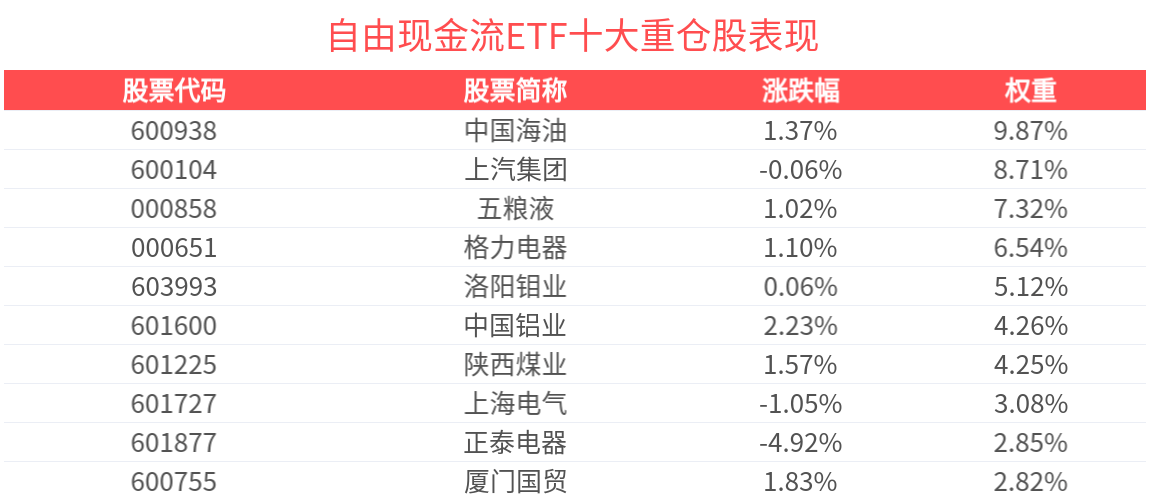
Core Insights - The Guozheng Free Cash Flow Index has increased by 0.56% as of November 10, 2025, with leading stocks including Yuntianhua, Shoulv Hotel, Changbao Co., Huaren Health, and Baiyin Nonferrous Metals [1] - The Free Cash Flow ETF (159201) has seen a 0.5% rise, marking its fourth consecutive increase, with the latest price at 1.22 yuan [1] - The Free Cash Flow ETF has recorded a net inflow of 260 million yuan over the past five trading days, with a total share count reaching a new high of 4.706 billion shares [1] Performance Metrics - As of November 7, 2025, the Free Cash Flow ETF has achieved a net value increase of 24.13% over the past six months [2] - The ETF's highest single-month return since inception is 7%, with the longest consecutive monthly increase being six months and a maximum increase of 22.69% [2] - The ETF has a historical six-month profit probability of 100% and an average monthly return of 3.2% [2] Risk and Recovery - The maximum drawdown for the Free Cash Flow ETF in the last six months is 3.65%, which is the smallest among comparable funds [2] - The recovery time after drawdown is 35 days, indicating the fastest recovery among similar funds [2] Fee Structure and Tracking Accuracy - The management fee for the Free Cash Flow ETF is 0.15%, and the custody fee is 0.05%, both of which are the lowest among comparable funds [3] - The tracking error over the past two months is 0.052%, demonstrating the highest tracking accuracy among similar funds [3] Top Holdings - The top ten weighted stocks in the Guozheng Free Cash Flow Index account for 54.79% of the index, with major holdings including China National Offshore Oil Corporation, SAIC Motor, Wuliangye, and Gree Electric Appliances [3][5]