
WLY(000858)

Search documents
频推低度酒 白酒企业拥抱“消费驱动”
Bei Jing Shang Bao· 2025-09-02 16:30
Core Insights - The Chinese liquor industry is undergoing a deep adjustment, influenced by changing consumer habits and market competition, leading to a divergence in performance among companies [1][5] - Major companies like Kweichow Moutai and Wuliangye have shown steady growth in revenue and net profit, while many others are experiencing declines [3][5] - The shift towards consumer-driven strategies is crucial for companies to adapt to market demands, with a focus on low-alcohol products to attract younger consumers [1][6][7] Industry Performance - In the first half of the year, the number of large-scale liquor companies decreased to 887, indicating a contraction in the industry [5] - The liquor production volume was 1.9159 million kiloliters, down 5.8% year-on-year, while sales revenue slightly increased by 0.19% to 330.42 billion yuan [5] - Profit for the industry fell by 10.93% to 87.687 billion yuan, reflecting a challenging market environment [5] Market Trends - The average inventory turnover days for the industry increased by 10% to 900 days, with 60% of companies experiencing price inversions, particularly in the 800-1500 yuan price range [3] - The low-end and light bottle liquor segments are performing relatively well, with the main consumer price range being 50-200 yuan [3][4] - High-end liquor products in the 500-800 yuan range are facing significant price inversions due to oversupply and reduced demand for gift and business consumption [4][5] Consumer Behavior - There is a notable shift in consumer purchasing behavior towards online channels, with many consumers preferring to buy liquor online rather than in physical stores [6] - Companies are responding to changing consumer preferences by launching low-alcohol products, with several brands introducing new offerings aimed at younger demographics [6][7] - The trend towards health-conscious consumption is driving the demand for low-alcohol options, which helps companies expand their market reach and adapt to evolving consumer needs [7]




中国必选消费9月投资策略:资金面影响更大,关注低位股和权重股
Haitong Securities International· 2025-09-02 14:52
Investment Focus - The report emphasizes the importance of fund flows in the market, suggesting a focus on low-position stocks and heavyweight stocks within the consumer staples sector [1][6] - Key stocks recommended for investment include Guizhou Moutai, Wuliangye, and Yili, all rated as "Outperform" [1] Industry Overview - In August 2025, five out of eight tracked essential consumer sectors showed positive growth, while three sectors experienced negative growth. The sectors with single-digit growth included soft drinks (+3.9%), frozen foods (+2.0%), condiments (+1.9%), dining (+0.5%), and dairy products (+0.5%). The declining sectors were mass-market and below baijiu (-3.8%), mid-to-high-end baijiu (-1.9%), and beer (-0.6%) [3][8] - The report notes that the new alcohol ban continues to impact high-ticket dining businesses and related consumer goods, leading to short-term effects on the supply chain [3][8] Price Trends - In August, the wholesale prices of mid-to-high-end baijiu generally declined, with specific price points for various products such as Guizhou Moutai and Wuliangye showing significant year-on-year decreases [4][20][22] - The report indicates that the price index for consumer goods has seen fluctuations, with most categories experiencing increased discount rates compared to the previous month [4] Cost Analysis - The report highlights that the cost index for consumer goods has mostly increased, with specific increases noted in instant noodles (+1.30%), frozen foods (+1.15%), and soft drinks (+0.78%) [4] - The report also mentions that packaging material prices have shown mixed trends, with paper and glass prices increasing while plastic prices have decreased [4] Fund Flow Insights - As of the end of August, net inflows from Hong Kong Stock Connect amounted to 103.23 billion yuan, with the consumer staples sector's market capitalization share rising to 5.22% [5] - The report notes that the valuation of A-share food and beverage companies has increased, with the historical PE ratio rising to 21.6x, indicating a shift in market sentiment [5] Stock Recommendations - The report suggests focusing on heavyweight stocks with solid fundamentals, such as Yili, Shanxi Fenjiu, and Guizhou Moutai, as well as low-position stocks like Qingdao Beer and Mengniu Dairy [6] - The report warns of potential risks in the soft drink sector, predicting a weakening of fundamentals in the coming year [6]



2025白酒中报深度变革:浓酱加速萎缩,清香强化引领……
Sou Hu Cai Jing· 2025-09-02 10:40
Core Viewpoint - The Chinese liquor industry is entering a deep adjustment period characterized by policy adjustments, consumption structure transformation, and intensified competition, leading to a slowdown or negative growth in the revenue of listed liquor companies in 2025 [1][5][14] Group 1: Industry Performance - In the first half of 2025, only five out of 17 liquor companies reported revenue growth, with Moutai, Wuliangye, Gujing, Jinhui, and Fenjiu showing positive growth, while 12 companies, including Jiu Gui, experienced negative growth, with Jiu Gui's revenue declining by 43% [2][3] - The overall revenue of the liquor industry is expected to face a slowdown, with a significant number of companies reporting negative profit growth, including a staggering 750.54% decline for Jinzizi [2][3] Group 2: Market Dynamics - The liquor industry is undergoing structural changes, with a notable decline in government and business consumption, leading to a shift in consumer behavior towards lower-priced products [5][10] - The market for strong aroma liquor is projected to grow to over 300 billion yuan by 2025, but with a low compound annual growth rate of only 3%, indicating a challenging environment for regional liquor companies [7][10] Group 3: Product Segmentation - The introduction of new national standards for sauce-flavored liquor is expected to accelerate industry reshuffling, imposing significant cost pressures on small and medium-sized distilleries [8][10] - Clear aroma liquor is gaining traction among younger consumers, with its market share increasing significantly, reflecting a shift in consumer preferences towards lighter and more affordable options [11][12] Group 4: Future Outlook - The liquor industry is anticipated to continue facing challenges, with a projected 7.2% decline in production in the first half of 2025, marking the eighth consecutive year of decline [5][10] - The market is expected to transition from "barbaric expansion" to "structural growth," with leading companies likely to increase their market share as weaker players exit [10][14]



白酒板块9月2日涨0.48%,金徽酒领涨,主力资金净流出1.7亿元
Zheng Xing Xing Ye Ri Bao· 2025-09-02 08:55
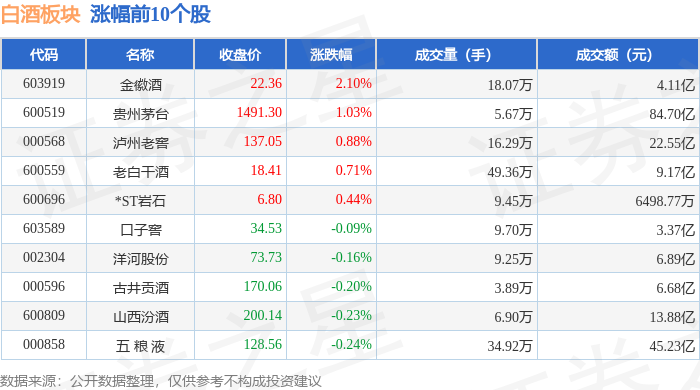
Group 1 - The liquor sector experienced a slight increase of 0.48% on September 2, with Jinhuijiu leading the gains [1] - The Shanghai Composite Index closed at 3858.13, down 0.45%, while the Shenzhen Component Index closed at 12553.84, down 2.14% [1] - Key stocks in the liquor sector showed varied performance, with Guizhou Moutai closing at 1491.30, up 1.03%, and Wuliangye down 0.24% at 128.56 [1] Group 2 - The liquor sector saw a net outflow of 170 million yuan from main funds and 374 million yuan from speculative funds, while retail investors contributed a net inflow of 544 million yuan [2] - The trading volume and turnover for major liquor stocks varied, with Guizhou Moutai having a turnover of 8.47 billion yuan and a trading volume of 56,700 shares [2] - The net inflow from retail investors was notable in several stocks, including Jinhuijiu, which saw a net inflow of 966,030 yuan from speculative funds [3]
15只白酒股下跌 贵州茅台上涨1.03%
Bei Jing Shang Bao· 2025-09-02 08:29
Group 1 - The overall market sentiment is negative, with major indices experiencing collective declines, particularly the Shanghai Composite Index which closed at 3858.13 points, down 0.45% [1] - The liquor sector also faced a downturn, closing at 2365.71 points, down 0.69%, with 15 liquor stocks declining, while Kweichow Moutai saw a slight increase of 1.03% [1] - Individual stock performances varied, with Kweichow Moutai closing at 1491.30 CNY per share, Wuliangye at 128.56 CNY per share down 0.24%, Shanxi Fenjiu at 200.14 CNY per share down 0.23%, Luzhou Laojiao at 137.05 CNY per share up 0.88%, and Yanghe Brewery at 73.73 CNY per share down 0.16% [1] Group 2 - The liquor sector reported a decline in revenue for the first half of 2025, achieving 239.7 billion CNY, a year-on-year decrease of 0.9%, with the second quarter alone seeing a revenue drop of 5.0% year-on-year [2] - The concentration of revenue among leading liquor companies is increasing, with the CR2 revenue share reaching 62.6% in Q2 2025, up 6.0 percentage points year-on-year [2] - The sector is experiencing a significant divergence, with revenue excluding the top two companies declining by 18.2% year-on-year in Q2 2025, indicating a worsening trend [2] - The pre-receipt balance for the sector at the end of Q2 2025 was 37.5 billion CNY, down 2.4% year-on-year, while the combined revenue and pre-receipt amount showed a decline of 10.1% year-on-year, indicating a more severe drop than revenue alone [2] - Liquor companies are generally controlling volume and stabilizing prices, delaying shipment schedules, which reflects cautious channel payment sentiments due to inventory pressures and weak market prices [2]
食品饮料及新消费行业跟踪报告:茶饮上半年业绩亮眼,泡泡玛特新品成爆款
Shanghai Aijian Securities· 2025-09-02 06:34
Investment Rating - The food and beverage industry is rated as "stronger than the market" [1] Core Views - The food and beverage industry index increased by 2.13% in the week of August 25-29, outperforming the Shanghai Composite Index, which rose by 0.84% [9] - The industry is currently at a historical low valuation, with a PE-TTM of 22.51x, corresponding to the 17th percentile over the past 15 years [16] - The liquor sector is expected to see a weak recovery in demand as policy pressures ease, with leading companies like Kweichow Moutai and Wuliangye showing strong dividend potential [6] Summary by Sections Weekly Performance - The food and beverage industry outperformed the market with a 2.13% increase, ranking 7th among 31 sub-industries [9] - The snack sector saw the highest increase at 10.20%, followed by dairy products at 2.67% and liquor at 2.14% [12] Liquor Sector - Wuliangye launched a new 29° product aimed at attracting younger consumers, reflecting a trend towards modernizing the liquor market [26] - The price of Feitian Moutai has decreased, with current prices at 1820 RMB for original and 1795 RMB for scattered [25] Tea Beverage Sector - Mixue Group reported a revenue of 14.88 billion RMB in the first half of 2025, a 39.3% year-on-year increase, with a net profit of 2.72 billion RMB, up 44.1% [32] - The number of Mixue stores reached 53,014, a 22.7% increase year-on-year, with a significant expansion in mainland China [33] New Consumption - Pop Mart's new mini LABUBU product saw over 1 million units sold within minutes of its launch, indicating strong consumer demand and improved production capacity [38] - The company has significantly increased its production capacity to 30 million units in August, ten times that of the previous year [38] Cost Indicators - Prices for sugar and glass have slightly decreased, which may positively impact the cost structure of the food and beverage industry [39]



白酒板块午盘微跌 贵州茅台上涨0.81%
Bei Jing Shang Bao· 2025-09-02 06:15
Group 1 - The three major indices collectively declined, with the Shanghai Composite Index closing at 3844.84 points, down 0.79% [1] - The liquor sector also experienced a downturn, closing at 2372.83 points, down 0.41%, with 12 liquor stocks declining [1] - Individual stock performances varied, with Kweichow Moutai closing at 1488.07 CNY per share, up 0.81%, while Wuliangye closed at 128.85 CNY per share, down 0.02% [1] Group 2 - Guojin Securities reported that the liquor sector's semi-annual reports met market expectations, with liquor companies generally accelerating performance in Q2 2025 [1] - Market sentiment remains marginally positive despite recent declines in mainstream product prices, which aligns with expectations [1] - The recent drop in wholesale prices is attributed to channels preemptively moving inventory ahead of the Mid-Autumn Festival and National Day [1]
329元紧跟五粮液!这才是29度“舍得自在”的战略深意
Xin Lang Cai Jing· 2025-09-02 04:39
Core Insights - The low-alcohol competition in the liquor industry is expanding from leading brands to the entire sector, with Shide Liquor's launch of the 29-degree product "Shide Zizai" aimed at the young market and the growing low-alcohol segment [1][5][10] Pricing Strategy - "Shide Zizai" is priced at 329 yuan for a 500ml bottle, strategically positioned within the mid-range market, leveraging high-quality ingredients to justify its price [2][4] - The pricing strategy is designed to attract both quality-conscious consumers and price-sensitive customers, providing a 70 yuan advantage over competitors like Wuliangye [4][7] Market Positioning - The product is not a shift towards low-alcohol but rather a horizontal extension of Shide's existing old liquor strategy, maintaining a focus on high-quality aged liquor while expanding the consumer base [5][10] - Shide Liquor's core competitiveness remains anchored in its "old liquor strategy," with a significant portion of revenue coming from mid-to-high-end products [5][10] Industry Context - The mid-range market (300-500 yuan) is recognized as a "golden zone" for growth, particularly appealing to younger consumers whose purchasing power is increasing [4][5] - The introduction of low-alcohol products by major brands is seen as a strategic response to competitors, ensuring that established brands do not cede the young market to newcomers [8][10] Long-term Strategy - Major liquor companies are adopting a cautious approach to the young market, focusing on gradual integration of low-alcohol products rather than immediate shifts in brand identity [10] - The strategy emphasizes leveraging existing market education efforts, allowing companies to capitalize on the growing young consumer base without alienating traditional customers [10]


2025上半年川股财报亮点:五粮液利润居首,蜀道装备净利增速惊人
Sou Hu Cai Jing· 2025-09-02 04:09
Core Insights - The overall performance of Sichuan A-share listed companies in the first half of 2025 is strong, with 179 companies reporting a total net profit of 56.37 billion yuan, and over 77% of these companies achieving profitability [1][4]. Financial Performance - Wuliangye (000858.SZ) leads with a net profit of 19.49 billion yuan, followed by Luzhou Laojiao (000568.SZ) with 7.66 billion yuan [1]. - Sichuan Changhong (600839.SH) tops the revenue chart with 56.71 billion yuan in operating income, showcasing its strong revenue-generating capability [1]. - Shudao Equipment (300540.SZ) exhibits an extraordinary net profit growth rate of 5972.30%, attributed to enhanced external business development, with a revenue of 205 million yuan, up 35.24% year-on-year [1]. Key Players - Chengdu Bank (601838.SH) ranks third in net profit with 6.62 billion yuan, highlighting the significant role of state-owned enterprises in Sichuan's economy [1]. - Other companies like Xinyi Technology (300502.SZ), Sichuan Road and Bridge (600039.SH), and others also reported net profits exceeding 1 billion yuan, forming the first tier of profitable Sichuan enterprises [2]. Earnings Per Share - Luzhou Laojiao leads in earnings per share at 5.21 yuan, followed closely by Wuliangye at 5.02 yuan and Xinyi Technology at 3.97 yuan, indicating strong returns for investors [2]. Challenges - Tongwei Co., Ltd. (600438.SH) reported a net loss of 4.96 billion yuan, a decline of 58.35% year-on-year, primarily due to falling prices in the photovoltaic industry [4]. - Despite some companies facing challenges, the overall performance of Sichuan A-share listed companies remains robust, contributing positively to the local economy and providing investment opportunities [4].


五粮液(000858):收入略超预期,现金流表现优异
China Post Securities· 2025-09-02 04:06
Investment Rating - The report maintains a "Buy" rating for the company, indicating an expected relative increase in stock price of over 20% compared to the benchmark index within the next six months [8][14]. Core Insights - The company reported a slight revenue increase in the first half of 2025, achieving operating income of 527.71 billion yuan, a year-on-year growth of 4.19%, and a net profit attributable to shareholders of 194.92 billion yuan, up 2.28% year-on-year [3][4]. - The cash flow performance is strong, with cash receipts from sales reaching 694.67 billion yuan, a significant year-on-year increase of 39.92% [3]. - The company is expected to achieve revenue growth of 1.09%, 4.23%, and 7.15% for the years 2025, 2026, and 2027, respectively, with net profit projections of 315.08 billion yuan, 329.13 billion yuan, and 357.03 billion yuan for the same years [6][10]. Company Overview - The latest closing price of the company's stock is 128.87 yuan, with a total market capitalization of 500.2 billion yuan [2]. - The company has a total share capital of 3.882 billion shares, with a price-to-earnings ratio of 15.70 [2]. Financial Performance - In the second quarter of 2025, the company achieved operating income of 158.31 billion yuan, with a net profit of 46.32 billion yuan, reflecting a slight decline in profitability compared to the previous year [4]. - The gross profit margin for the first half of 2025 was 76.83%, with a net profit margin of 36.94%, showing a minor decrease from the previous year [3]. Product and Market Development - The company launched new products in the first half of 2025, including drinking-type products, and expanded its market presence by adding 7,990 new distribution points [5]. - The company has successfully developed 60 corporate clients and increased its market share in key cities [5].