WLY(000858)

Search documents
被投资者建议向茅台学习“如何提升小股东信心”,五粮液回应
Xin Lang Cai Jing· 2026-01-27 06:22
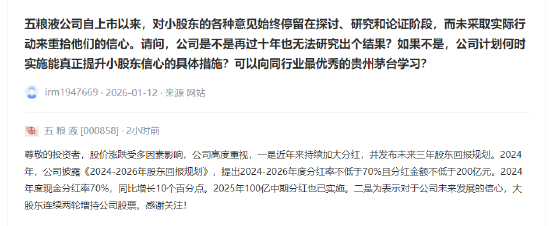
新浪财经"酒价内参"重磅上线 知名白酒真实市场价尽在掌握 责任编辑:李思阳 新浪财经"酒价内参"重磅上线 知名白酒真实市场价尽在掌握 近日,有投资者在互动平台提问,五粮液公司自上市以来,对小股东的各种意见始终停留在探讨、研究 和论证阶段,而未采取实际行动来重拾他们的信心。请问,公司是不是再过十年也无法研究出个结果? 如果不是,公司计划何时实施能真正提升小股东信心的具体措施?可以向同行业最优秀的贵州茅台学 习? 对此,五粮液回应表示,尊敬的投资者,股价涨跌受多因素影响,公司高度重视,一是近年来持续加大 分红,并发布未来三年股东回报规划。2024年,公司披露《2024-2026年股东回报规划》,提出2024- 2026年度分红率不低于70%且分红金额不低于200亿元。2024年度现金分红率70%,同比增长10个百分 点。2025年100亿中期分红也已实施。二是为表示对于公司未来发展的信心,大股东连续两轮增持公司 股票。感谢关注! 近日,有投资者在互动平台提问,五粮液公司自上市以来,对小股东的各种意见始终停留在探讨、研究 和论证阶段,而未采取实际行动来重拾他们的信心。请问,公司是不是再过十年也无法研究出个结果? 如 ...


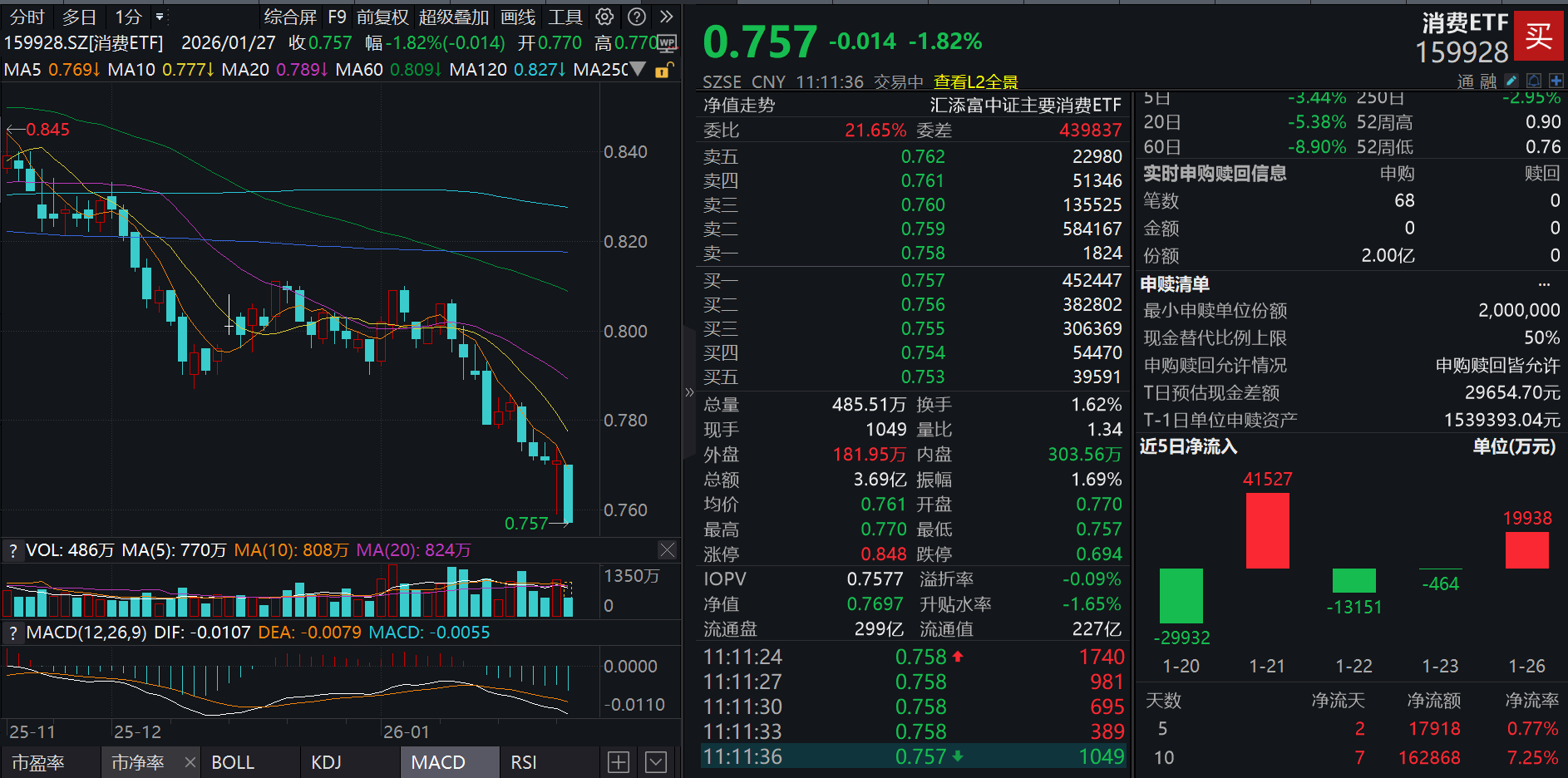
洋河股份净利预降六成,70亿分红承诺告吹,再跌超3%!消费ETF(159928)回调近2%,狂揽2亿份净申购!2026白酒板块如何看?
Xin Lang Cai Jing· 2026-01-27 03:35
Core Viewpoint - The liquor sector is experiencing a downturn, with Yanghe Co. seeing significant declines in stock prices and a bleak profit forecast for 2025, indicating a challenging environment for the industry [1][3]. Group 1: Company Performance - Yanghe Co. has forecasted a net profit decline of 62.18%-68.30% for 2025, estimating a loss of 1.451 billion to 1.859 billion yuan in Q4 2025 [1]. - The company has also retracted its previous commitment to a minimum 7 billion yuan dividend [1]. - Other major liquor companies like Wuliangye, Luzhou Laojiao, and Shanxi Fenjiu have also seen stock price declines, while Kweichow Moutai has shown slight gains [1]. Group 2: Market Trends - The consumption ETF has seen a near 2% drop, with a transaction volume of 400 million yuan, indicating a cautious market sentiment [2]. - The liquor sector is in a phase of inventory reduction and price stabilization, with companies adjusting their strategies in response to external pressures [3][6]. Group 3: Policy and Economic Environment - New policies aimed at boosting consumer spending are expected to be introduced, including measures to expand inbound consumption and promote the replacement of durable goods [1]. - The overall market sentiment is improving, with expectations that the worst period for liquor sales is over, aided by easing consumption restrictions [6]. Group 4: Investment Insights - The liquor sector is currently characterized by low expectations, low valuations, and low public fund holdings, presenting a potential buying opportunity [7]. - High dividend yields from leading liquor companies are expected to attract investors, as they commit to returning at least 100% of their net profits as dividends [7]. - Historical data suggests that high-end liquor stocks like Moutai and Wuliangye may lead the recovery in the sector, similar to past cycles [8].




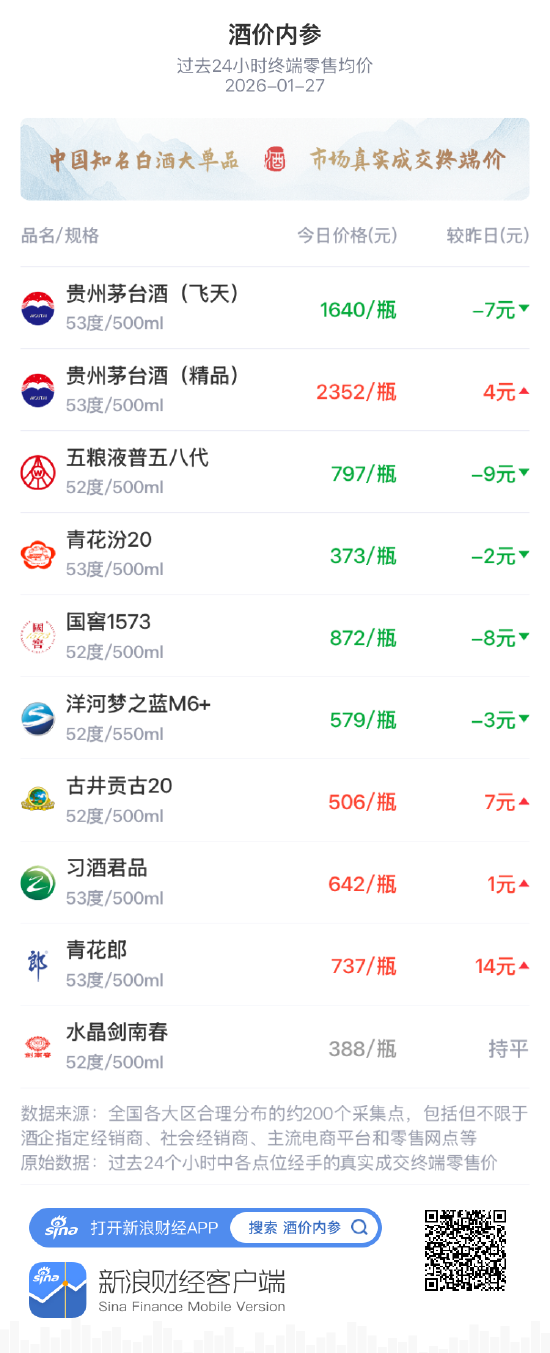
酒价内参1月27日价格发布 青花汾20下跌2元/瓶
Xin Lang Cai Jing· 2026-01-27 01:36
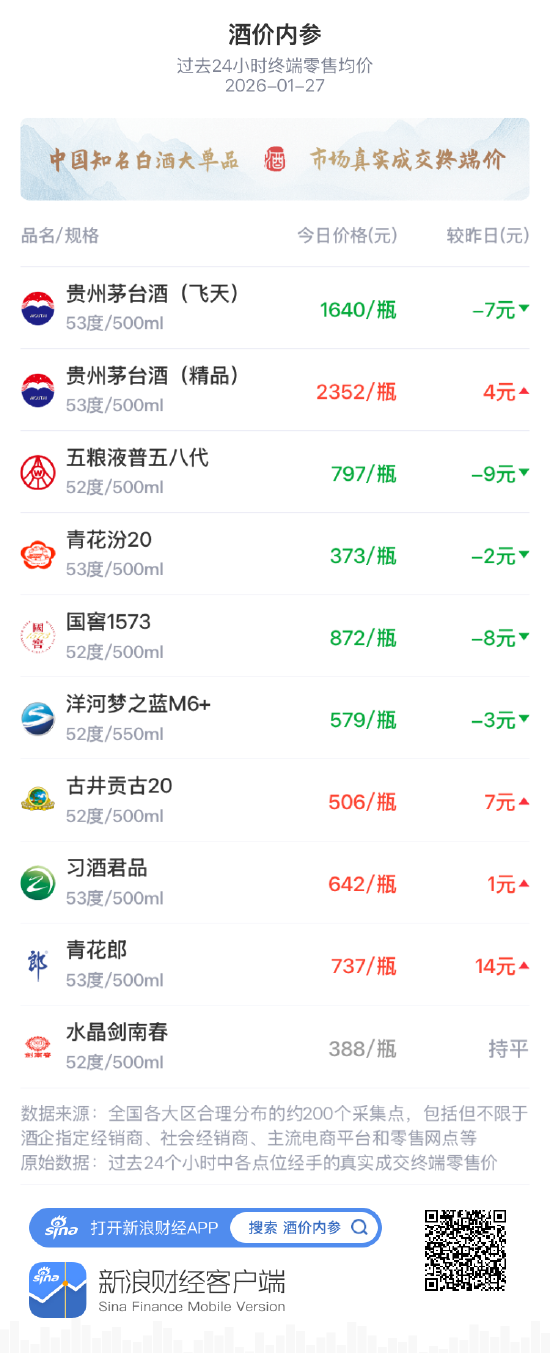
Core Insights - The Chinese liquor market is experiencing a mixed trend in retail prices for its top ten products, with an overall slight decline in total price [1][4] - The market shows signs of stabilization, with some products increasing in price while others decrease [1][4] Price Movements - The total retail price for a package of the top ten liquor products is 8886 yuan, down 3 yuan from the previous day [1] - Four products saw price increases, while five experienced declines, with one remaining stable [1] - The leading price increase was for Qinghua Lang, which rose by 14 yuan per bottle, marking five consecutive days of price growth [1][3] - Other notable increases include Gujing Gonggu 20 and Jingpin Moutai, which rose by 7 yuan and 4 yuan per bottle, respectively [1][2] - On the decline side, Wuliangye dropped by 9 yuan, and Guojiao 1573 fell by 8 yuan per bottle [1][2] Market Context - The data is sourced from approximately 200 collection points across various regions, aiming to provide an objective and traceable overview of the liquor market prices [4] - The introduction of new sales channels for Moutai products has begun to influence market prices, particularly for the Flying Moutai and Premium Moutai [4] - The liquor sector is currently navigating a challenging period, with institutional holdings at historical lows, yet there are signs of potential recovery as Moutai's sales exceed expectations [4]
酒价内参1月27日价格发布 五粮液下跌9元/瓶
Xin Lang Cai Jing· 2026-01-27 01:21
Core Viewpoint - The Chinese liquor market is experiencing a mixed trend in retail prices for major products, with the overall average price for the top ten products showing a slight decline, indicating market stabilization with varied performance among core products [1][5]. Price Trends - The total retail price for a package of the top ten liquor products is 8,886 yuan, down by 3 yuan from the previous day [1][5]. - In today's market, there are four products that increased in price, five that decreased, and one that remained stable [6]. - The price increases are led by Qinghua Lang, which rose by 14 yuan per bottle, marking five consecutive days of price increases; Gujing Gonggu 20 and Premium Moutai increased by 7 yuan and 4 yuan per bottle, respectively; Xijiu Junpin saw a slight increase of 1 yuan per bottle [1][6]. - On the downside, Wuliangye dropped by 9 yuan per bottle; Guojiao 1573 fell by 8 yuan; and Feitian Moutai decreased by 7 yuan due to the regular supply from the iMoutai platform; Mengzhilun M6+ and Qinghua Fen 20 decreased by 3 yuan and 2 yuan, respectively; and Shuijing Jianan Chun remained unchanged [1][6]. Market Data Collection - The "Liquor Price Reference" collects data from approximately 200 sampling points across various regions, including designated distributors, social distributors, e-commerce platforms, and retail outlets, aiming to provide objective and traceable market price data [4][9]. - The introduction of new sales channels for Feitian Moutai and Premium Moutai has begun to show a magnetic influence on their market retail prices [4][9]. Industry Context - The liquor sector is currently experiencing a struggle between a "dark moment" and signs of recovery, with institutional holdings at a historical low since 2015, impacting the performance of leading companies like Yanghe [4][9]. - Despite the pessimistic market sentiment, Moutai's sales in January exceeded expectations, and Yanghe has committed to a 100% dividend, indicating potential recovery signals [4][9]. - Public fund holdings in liquor stocks have decreased for nine consecutive quarters, now at 2.9%, close to 2015 levels, suggesting a possible bottoming out in the market [4][9].
酒价内参1月27日价格发布 精品茅台上涨4元/瓶
Xin Lang Cai Jing· 2026-01-27 01:16
Core Viewpoint - The Chinese liquor market is experiencing a mixed trend in retail prices for major products, with the overall average price for the top ten products showing a slight decline, indicating market stabilization with varied performance among core products [1][5]. Price Trends - The total retail price for a package of the top ten liquor products is 8,886 yuan, down 3 yuan from the previous day [1][5]. - In today's market, there are four products that increased in price, five that decreased, and one that remained stable [6]. - The price increases are led by Qinghua Lang, which rose by 14 yuan per bottle, marking five consecutive days of price increases [1][6]. - Other products that saw price increases include Gujing Gonggu 20 (up 7 yuan), and Boutique Moutai (up 4 yuan), while Xijiu Junpin saw a slight increase of 1 yuan [1][6]. - On the downside, Wuliangye dropped by 9 yuan, Guojiao 1573 by 8 yuan, and Feitian Moutai decreased by 7 yuan due to the impact of the iMoutai platform's regular supply [1][6]. Market Data Collection - The "Liquor Price Reference" collects data from approximately 200 sampling points across various regions, including designated distributors, social distributors, e-commerce platforms, and retail outlets, aiming to provide objective and traceable market price data [4][9]. - The introduction of new sales channels for Feitian Moutai and Boutique Moutai has begun to show a magnetic influence on their market retail prices [4][9]. Industry Context - The liquor sector is currently experiencing a struggle between a "dark moment" and signs of recovery, with institutional holdings at a historical low since 2015, impacting the performance of leading companies like Yanghe [4][9]. - Despite the pessimism, Moutai's sales in January exceeded expectations, and Yanghe has committed to a 100% dividend, indicating potential recovery signals [4][9]. - Public fund holdings in liquor stocks have dropped to 2.9%, close to 2015 levels, suggesting a possible "golden pit" for investment as market sentiment shifts [4][9].
食品饮料2025年四季度基金持仓分析:白酒持仓继续下降,食品配置环比回升
Shenwan Hongyuan Securities· 2026-01-26 15:01
Investment Rating - The investment rating for the food and beverage sector is "Buy" for key companies such as Kweichow Moutai, Wuliangye, and Luzhou Laojiao [44]. Core Insights - The report indicates a continued decline in the holdings of the food and beverage sector within mutual funds, with the top 20 holdings' market value as a percentage of total fund equity investments decreasing to 16.31% in Q4 2025, down 0.47 percentage points from Q3 2025 [5][21]. - Kweichow Moutai's market value as a percentage of total fund equity investments is 1.31%, a decrease of 0.06 percentage points from the previous quarter, while Wuliangye and Luzhou Laojiao also saw declines [9][10]. - The food and beverage sector's weight in the total A-share market capitalization has decreased to 4.04%, down 0.66 percentage points [25]. Summary by Sections Fund Holdings Analysis - In Q4 2025, the number of funds holding Kweichow Moutai remained stable at 1,048, while Wuliangye saw a decrease of 109 funds to 175, and Luzhou Laojiao's holdings dropped by 18 to 128 [21]. - The concentration of holdings in the food and beverage sector is low, with only one company (Kweichow Moutai) in the top 20 holdings [7][8]. Sector Allocation - The food and beverage sector's heavy stock holdings accounted for 6.10% of total fund equity investments, a decrease of 0.28 percentage points from the previous quarter [25]. - The white liquor sector's heavy stock holdings accounted for 5.13%, also down 0.4 percentage points, indicating a position close to levels seen in Q1 2010 [25][39]. Individual Stock Performance - The report highlights that Kweichow Moutai, Wuliangye, and Luzhou Laojiao are currently below their average allocation levels since 2009, indicating potential undervaluation [9][10]. - The report notes that the allocation coefficient for the white liquor sector is 1.92, which is below the historical average of 2.11, suggesting a potential for recovery [25][39]. Northbound Capital Changes - In Q4 2025, the northbound capital holdings for major food and beverage stocks showed a mixed trend, with Shuanghui Development seeing an increase of 0.13 percentage points, while Kweichow Moutai and Wuliangye experienced declines of 0.48 and 0.58 percentage points, respectively [44][45].

食品饮料行业深度报告:2025Q4基金食品饮料持仓分析:持仓继续下降,结构向大众品倾斜
Soochow Securities· 2026-01-26 12:24
Investment Rating - The report maintains an "Increase" rating for the food and beverage industry [1] Core Insights - The food and beverage sector continues to see a decline in holdings, with a shift towards mass-market products. The proportion of active equity funds in the food and beverage sector decreased to 4.04% in Q4 2025, down from 4.18% in Q3 2025, reflecting a 0.14 percentage point decline [9][15] - The report highlights a continued reduction in allocations to alcoholic beverages, while holdings in mass-market products have shown signs of recovery. The proportion of holdings in white liquor decreased by 0.29 percentage points to 2.92% in Q4 2025 [14][17] - Major consumer funds have reduced their allocations to alcoholic beverages, with a notable decrease of 2.22 percentage points in white liquor holdings, while overall food and beverage allocations have increased [17][21] Summary by Sections 1. Food and Beverage Holdings Continue to Decline, Structure Shifts Towards Mass-Market Products - As of Q4 2025, the total scale of active equity fund heavy holdings is approximately 19.4 trillion yuan, with food and beverage holdings at 78.4 billion yuan, reflecting a 9.01% decline [9][10] - The decline in alcoholic beverage holdings is evident, with white liquor allocations decreasing to 2.92% and beer and pre-mixed drinks also seeing slight reductions [14][15] 2. Holdings Become More Diversified, Capturing Marginal Recovery Themes - The number of heavy holdings in the food and beverage sector has become more diversified, with only Kweichow Moutai remaining in the top 20 heavy holdings [24] - The report notes that the top five stocks with the largest increase in heavy holdings include Baba Foods, Yingjia Gongjiu, Youran Dairy, Ximai Foods, and Modern Animal Husbandry [28][29] 3. Investment Recommendations - The report suggests five key directions for investment: focusing on functional health foods, improving supply chains and product/channel resonance in leading snack companies, expanding quality retail formats, investing in long-lifecycle beverage leaders, and tracking sectors with potential recovery such as dairy and large-scale dining [10][29]
张坤四季报:困难只是暂时的,中国消费“有鱼可钓”!
市值风云· 2026-01-26 10:15
Core Viewpoint - The current market pricing for some high-quality companies is very low, making them attractive even for privatization [1][12]. Group 1: Fund Performance - In Q4 2025, the assets under management by Zhang Kun decreased to 48.3 billion, with a quarterly shrinkage of over 8 billion [4]. - The performance of Zhang Kun's four funds showed significant structural differentiation, with the largest fund, E Fund Blue Chip Select Mixed Fund, losing nearly 9% in Q4, underperforming its benchmark by over 6% [4][5]. - In contrast, the E Fund Asia Select Stock Fund achieved a positive return of 4.5% in Q4, outperforming its benchmark by over 2%, and had an annual increase of nearly 42% for 2025 [4][5]. Group 2: Sector Adjustments - Zhang Kun continued to reduce holdings in the liquor sector, albeit at a slower pace compared to Q3 2025, maintaining a near 10% position in leading liquor stocks like Kweichow Moutai and Wuliangye [6]. - Significant reductions were also observed in pharmaceutical and media stocks, with JD Health seeing its holdings cut by about half [8]. Group 3: Consumer Market Outlook - Zhang Kun expressed optimism about the future of domestic consumption, citing that the current weak consumption data is not a long-term trend [10]. - He believes that the Chinese government's goal of reaching a middle-income level by 2035 indicates substantial growth potential for income, which will enhance consumer spending [11]. - The stabilization of housing prices, which have been a barrier to consumer confidence, is expected to further boost spending as wealth perception improves [11]. Group 4: Technology and Innovation - A strong domestic consumer market is viewed as a crucial driver for technological innovation, with examples from leading AI models abroad demonstrating the revenue potential from consumer subscriptions [12]. - Zhang Kun emphasized that with a stronger consumer environment, domestic tech companies could generate more income to support research and development, accelerating their growth to catch up with global leaders [12]. Group 5: Long-term Investment Perspective - Despite short-term pressures, Zhang Kun maintains a long-term positive outlook on China's consumption potential and economic development, positioning for investments in quality companies that will grow alongside rising living standards [13].

刘晓庆、梁朝伟、岳云鹏...白酒旺季明星扎堆代言
2 1 Shi Ji Jing Ji Bao Dao· 2026-01-26 09:19
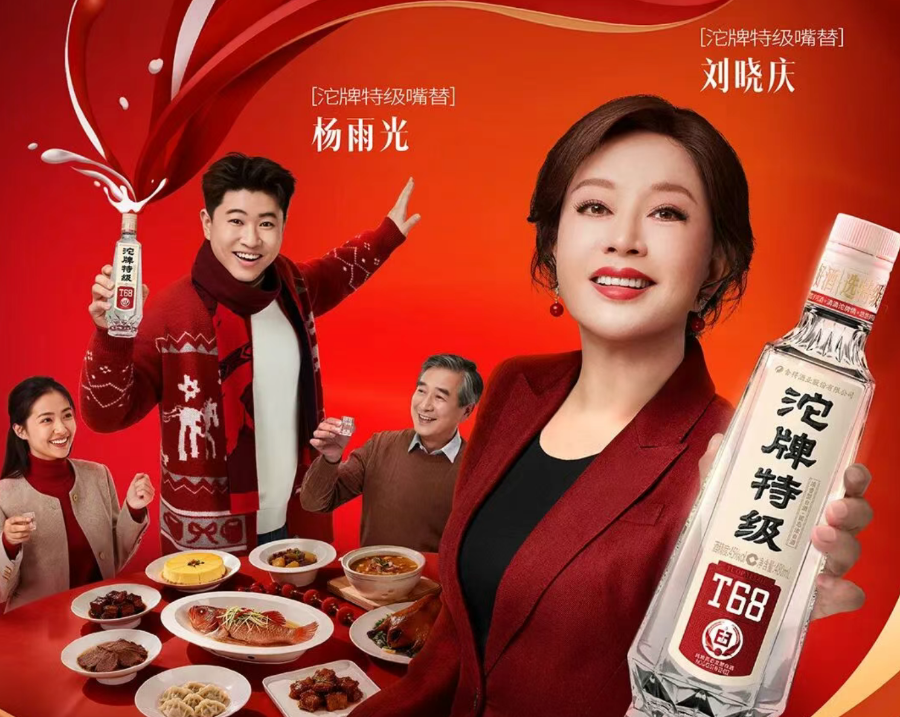
Group 1: Brand Collaborations and Marketing Strategies - Tuo Pai Jiu has announced celebrity endorsements with Liu Xiaoqing and Yang Yuguang, aiming to enhance brand visibility through live streaming on Douyin [1] - The trend of celebrity endorsements in the liquor industry is increasing, with brands like Shui Jing Fang and Gu Xiao Jiu also engaging well-known figures to boost sales and brand image [3][5] - The shift in marketing strategy reflects a move towards more consumer-friendly approaches, with brands seeking to connect with younger audiences through relatable celebrities [6][8] Group 2: Industry Performance and Trends - The white liquor production in China has seen a significant decline, with a 19% drop in December 2025 compared to the previous year, marking the ninth consecutive year of decline [9][11] - The total production for 2025 was reported at 354.9 million liters, a cumulative decrease of 12.1% [9][11] - The changing landscape of the liquor market is evident, with a notable increase in the import of white spirits, particularly vodka and tequila, indicating a shift in consumer preferences [13] Group 3: Company-Specific Developments - Yanghe Co. has projected a significant decline in profits for 2025, estimating earnings between 2.116 billion to 2.524 billion yuan, a decrease of 62% to 68% year-on-year [28] - The company attributes this downturn to intensified competition and reduced market demand, particularly affecting mid-range and high-end products [28] - Yanghe has also announced a new cash dividend policy, committing to distribute at least 100% of the net profit to shareholders from 2025 to 2027 [29]


五粮液:坚守品质初心 打造可持续质量管理新引擎
Xin Hua Cai Jing· 2026-01-26 09:03
Core Viewpoint - The article emphasizes the importance of quality management and innovation for the Chinese liquor company Wuliangye in navigating industry changes and maintaining its competitive edge in the face of uncertainty [1][6]. Group 1: Quality Management - Wuliangye has established a comprehensive quality management system, including a sample wine library that has accumulated over 220,000 bottles, which supports product quality tracking and authenticity verification [2][5]. - The company has implemented a three-dimensional integrated quality management model focusing on employee integration, process integration, and data integration, ensuring quality control across 93 process steps, 310 operations, and 218 inspection points [2][10]. - Wuliangye has received the "National Quality Award" four times, making it the only liquor company to achieve this distinction, and has been recognized for its quality management excellence with a nomination for the "Fifth China Quality Award" [5][6]. Group 2: Innovation and Technology - Wuliangye combines traditional brewing wisdom with modern management and digital technologies, establishing seven national-level innovation platforms to enhance quality management through scientific research [7][9]. - The company has integrated automation and AI technologies into its production control systems, achieving a 50% increase in data-driven decision-making, which enhances predictive quality management [9][10]. - Wuliangye's approach to quality management transforms abstract quality requirements into quantifiable, traceable, and optimizable capabilities, providing a resilient quality advantage during industry adjustments [9][10]. Group 3: Sustainable Development - Wuliangye adheres to a long-term perspective on quality management, integrating ecological protection and cultural development into its operational strategy to ensure sustainable brand value [10][11]. - The company promotes green development practices, aiming for "zero-carbon" production and conducting carbon footprint evaluations for its products to support environmental sustainability [10][11]. - Wuliangye emphasizes the importance of quality culture, implementing comprehensive quality education and ESG assessments for suppliers to enhance sustainable development across the industry chain [11].