WLY(000858)

Search documents
白酒2026:迟到且漫长的筑底才开始
Sou Hu Cai Jing· 2026-01-09 01:01
Core Viewpoint - The white liquor industry is experiencing its most severe adjustment since 2015, driven by increased regulatory pressures, generational shifts in consumption, and high channel inventory, leading to a transition from "scale expansion" to "value cultivation" [4][5][22] Industry Overview - In 2025, the white liquor industry faced a dual contraction in external environment and internal ecology, with the liquor industry being recognized as a "historical classic industry" [5][6] - The implementation of new standards for sauce-flavored liquor and stricter food labeling regulations aims to enhance transparency and curb false advertising [5][6] - The revised regulations on government spending have led to a significant decline in high-end liquor consumption, with a reported drop of about two-thirds in high-end liquor opening rates from May to August [5][6] Market Performance - In the first half of 2025, the number of large-scale liquor enterprises decreased by over 100, with production down by 5.8% and profits down by 10.93% [6] - By November 2025, production had decreased by 11.3% year-on-year, with a record low monthly decline of 13.8% [6] - The total revenue of 20 A-share liquor companies fell by 5.90% to 317.79 billion yuan, with net profits down by 6.93% [6] Stock Market Trends - The white liquor sector saw a significant decline in market value, with the index dropping to 2694.38 points by the end of 2025, reflecting a total market capitalization of 2.88 trillion yuan [6] - Only one company, Jinhui Liquor, saw a slight increase in stock price, while 11 companies experienced declines exceeding 20% [7] Price Dynamics - The price of major liquor products has been declining, with average retail prices dropping by over 30% by the end of 2025 [12] - The price of certain well-known liquor brands fell back to levels not seen since 2017, indicating a collapse of the previous price rigidity [8][12] Inventory Challenges - The average inventory turnover days for the industry reached 900 days in the first half of 2025, increasing to 1424 days by the end of the third quarter [13] - The total inventory of 20 listed liquor companies exceeded 170 billion yuan by the end of the third quarter, marking an 11% year-on-year increase [13] Strategic Responses - Liquor companies have begun to implement measures such as price stabilization and inventory control, with major brands like Moutai and Wuliangye taking steps to manage supply and innovate product offerings [9][19] - The industry is witnessing a shift towards mid-range and low-end products, as well as a focus on cash flow management among distributors [16][19] Future Outlook - Analysts predict that the white liquor sector may have entered a bottoming phase, with potential for performance recovery in 2026 as inventory issues are addressed and macroeconomic conditions improve [19][20] - The strategic focus for leading companies in 2026 will be on core business consolidation and adapting to changing consumer demands [20][21]




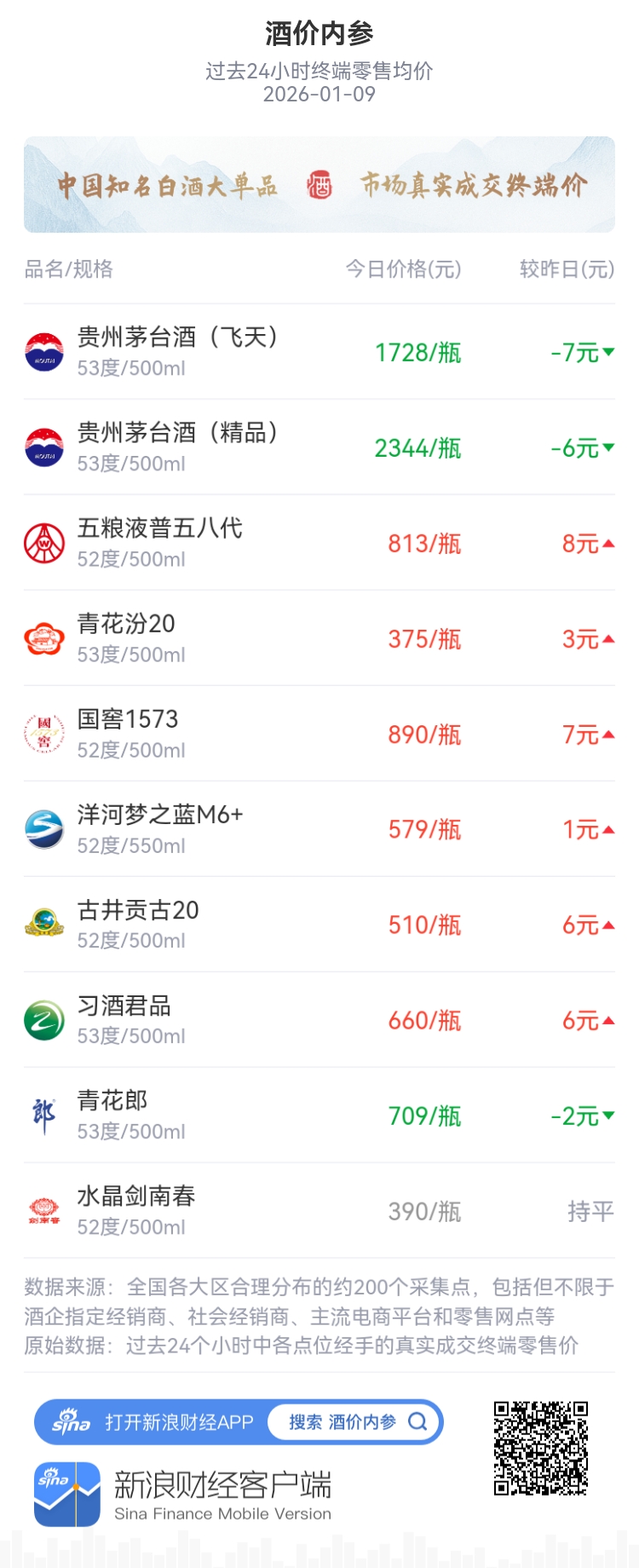
酒价内参1月9日价格发布 市场普遍反弹整体价格温和回升
Xin Lang Cai Jing· 2026-01-09 00:57
Core Viewpoint - The Chinese liquor market has experienced a rebound in retail prices for the top ten products after a period of decline, indicating a stabilization in market sentiment and pricing recovery [1]. Price Trends - The overall retail price for a bundled package of the top ten liquor products is 8998 yuan, reflecting an increase of 16 yuan from the previous day [1]. - Most products have shown signs of stabilization after reaching temporary low points, with a general upward trend in prices observed [1]. Notable Price Increases - Wuliangye Pu Wubai (五粮液普五八代) saw the most significant price increase, rising by 8 yuan per bottle [1][3]. - Guojiao 1573 (国窖1573) increased by 7 yuan per bottle [1][3]. - Both Guqingong 20 (古井贡古20) and Xijiu Junpin (习酒君品) rose by 6 yuan per bottle [1][4]. - Qinghua Fen 20 (青花汾20) increased by 3 yuan per bottle, while Yanghe Dream Blue M6+ (洋河梦之蓝M6+) saw a slight increase of 1 yuan per bottle, marking five consecutive days of price increases [1][4]. Price Decreases - Feitian Moutai (飞天茅台) experienced a decrease of 7 yuan per bottle [1][3]. - Premium Moutai (精品茅台) dropped by 670 yuan per bottle, indicating a significant decline [3]. - Qinghua Lang (青花郎) fell by 2 yuan per bottle [1][4]. Market Sentiment - The overall market is showing a rebound with most brands experiencing price recovery and moderate volume increases, suggesting a calming of market sentiment compared to previous days [1].


五粮液1月8日全情报分析报告:「2025年白酒低迷五粮液承压净利大跌」对股价有消极影响
36氪· 2026-01-08 13:35
Core Viewpoint - The article discusses the recent performance and market sentiment surrounding Wuliangye, highlighting both positive and negative factors affecting its stock price and overall business outlook [7][12][13]. Market Performance Summary - On January 8, Wuliangye's stock price decreased by 0.58%, closing at 106.90, with a trading volume of 129,100 shares [5][6]. - The stock has shown a 3-day decline of 0.93% and a 5-day decline of 0.43%, with a total market capitalization of 414.944 billion [7]. Sentiment Analysis - As of January 8, there were 428 pieces of online sentiment data related to Wuliangye, with 21.7% being positive, 31.3% negative, and 47.0% neutral, indicating a predominantly negative sentiment [8]. - The primary channel for this sentiment was WeChat, accounting for 10.75% of the total mentions [10]. Positive Factors - Valuation Recovery: Wuliangye is expected to stabilize during the current valuation recovery phase in the liquor industry, suggesting long-term value that may attract investors [12]. - Inventory Clearance: Accelerated inventory clearance in Q3 may lead to short-term profit declines but will alleviate inventory pressure and improve liquidity for future growth [12]. - Channel Adjustment: Adjustments in channel strategy are aimed at better inventory and sales management, enhancing operational efficiency [12]. Negative Factors - Significant Profit Decline: A 65.6% year-on-year drop in net profit in Q3 raises concerns about the company's short-term financial health, potentially pressuring the stock price [13]. - Decrease in Active Fund Holdings: Wuliangye fell out of the top twenty active fund holdings, indicating reduced confidence from institutional investors and lower demand for its stock [13]. Overall Outlook - In the short term, Wuliangye's stock may face pressure due to the significant profit decline and reduced institutional holdings. However, long-term prospects could improve with successful inventory clearance and channel adjustments, alongside a recovery in liquor industry valuations [12][13].

业绩承压!白酒行业深度调整,经销商大会释放积极信号
Zheng Quan Shi Bao· 2026-01-08 10:39
Core Viewpoint - The white liquor industry is experiencing significant performance declines, with companies like Kuozi Jiao (口子窖) projecting a 50% to 60% decrease in net profit for 2025, reflecting broader market expectations of continued pressure on growth [1][2]. Industry Performance - Kuozi Jiao expects a net profit of 662 million to 828 million yuan for 2025, a substantial drop compared to the previous year [1]. - The white liquor sector is undergoing a deep adjustment, with many companies facing growth challenges and setting modest targets for 2026 [1][2]. - According to a report by招商证券, the white liquor industry's revenue, net profit, and cash collection for Q3 2025 are projected to decline by 18.4%, 22.2%, and 26.7% year-on-year, respectively [2]. Causes of Decline - Kuozi Jiao attributes its profit decline to falling demand and policy impacts, with high-end product sales significantly decreasing [2]. - The industry is experiencing structural adjustments, with a noted increase in market differentiation and channel changes [2][3]. - 国信证券 forecasts that the revenue and net profit declines will continue to widen, with profit margins under sustained pressure due to reduced consumer demand and weakened channel capabilities [3]. Strategic Responses - Major white liquor companies are actively engaging in strategic meetings to outline their annual results and plans for 2026, signaling a commitment to stabilize and innovate despite market challenges [4]. - Guizhou Moutai emphasizes a consumer-centric approach and aims to enhance market precision and service levels while maintaining stable product pricing [4]. - Wuliangye is focusing on proactive market adjustments and inventory management to navigate the complexities of the current industry landscape [4][5]. Market Adjustments - The leading companies are entering a phase of active adjustment, with Moutai and Wuliangye implementing strategies to optimize supply-demand structures and channel ecosystems [5]. - The consensus among top liquor firms is to prioritize high-quality development and align strategies with consumer needs to achieve balanced pricing and supply [5].

业绩承压!白酒行业深度调整,经销商大会释放积极信号
证券时报· 2026-01-08 10:35
Core Viewpoint - The white liquor industry is experiencing a significant downturn, with companies like Kuozi Jiao forecasting a 50% to 60% decrease in net profit for 2025, reflecting broader market expectations of declining performance across the sector [1][3]. Group 1: Industry Performance - Kuozi Jiao expects a net profit of 6.62 billion to 8.28 billion yuan for 2025, a substantial decrease compared to the previous year [1]. - The white liquor industry is undergoing a deep adjustment, with many companies facing growth pressures and setting modest growth targets for 2026 [1][4]. - According to a report by招商证券, the white liquor industry's revenue, net profit, and cash collection for Q3 2025 are projected to decline by 18.4%, 22.2%, and 26.7% year-on-year, respectively [3]. Group 2: Causes of Decline - Kuozi Jiao attributes its profit decline to falling demand and policy impacts, with a significant drop in sales of high-end products leading to reduced revenue [3]. - The industry is experiencing structural adjustments, as highlighted by the chairman of Wuliangye, who described 2025 as an exceptionally challenging year for the sector [3]. Group 3: Strategic Responses - Major white liquor companies are actively engaging in strategic meetings to outline their plans for 2026, focusing on stabilizing their market positions and enhancing operational resilience [6][7]. - Wuliangye's chairman emphasized the need for proactive adjustments to market conditions, including stabilizing product prices and helping channels manage inventory [7]. - Companies are shifting their focus towards high-quality development and aligning their strategies with consumer demand to achieve better supply-demand matching and price balance [8].

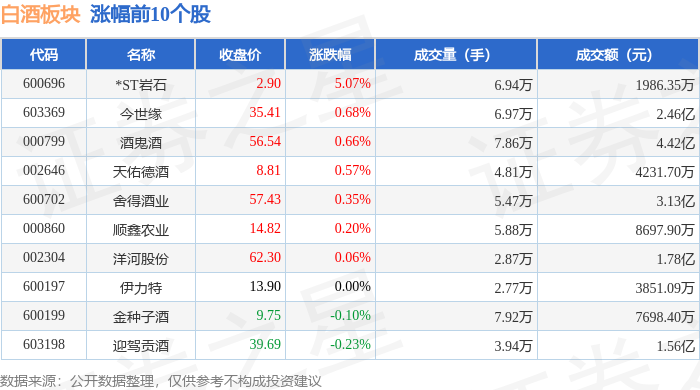
白酒板块1月8日跌0.64%,古井贡酒领跌,主力资金净流出6.98亿元
Zheng Xing Xing Ye Ri Bao· 2026-01-08 08:51
证券之星消息,1月8日白酒板块较上一交易日下跌0.64%,古井贡酒领跌。当日上证指数报收于 4082.98,下跌0.07%。深证成指报收于13959.48,下跌0.51%。白酒板块个股涨跌见下表: | 代码 | 名称 | 主力净流入(元) | 主力净占比 游资净流入 (元) | | 游资净占比 散户净流入 (元) | | 散户净占比 | | --- | --- | --- | --- | --- | --- | --- | --- | | 600696 | *ST岩石 | = 477.49万 | 24.04% | -9.06万 | -0.46% | -468.43万 | -23.58% | | 002646 天佑德酒 | | 70.31万 | 1.66% | -338.89万 | -8.01% | 268.58万 | 6.35% | | 600197 | 伊力特 | -162.35万 | -4.22% | -364.81万 | -9.47% | 527.16万 | 13.69% | | 603369 | 今世缘 | -204.99万 | -0.83% | 587.93万 | 2.39% | -382.94万 ...
预见2026|白酒经历更艰难一年后,消费者和场景重构刚刚开始
Di Yi Cai Jing Zi Xun· 2026-01-08 08:13
Core Insights - The white liquor industry is experiencing a significant downturn, with 2025 being particularly challenging due to rational consumption and ongoing anti-corruption efforts, prompting companies to reassess their market strategies [1][4] Group 1: Market Conditions - Many liquor businesses, including those in Tianjin, reported losses in 2025, with sales figures dropping significantly compared to previous years, indicating a severe market contraction [2][4] - The average retail price of major liquor brands has decreased by 30% in 2025, with 99% of premium liquor prices falling [3][4] - The industry is facing a deep adjustment period, with many companies experiencing double-digit declines in revenue and net profit in the third quarter of 2025 [4] Group 2: Changes in Business Strategy - Liquor companies are shifting their focus from traditional sales models to consumer-centric approaches, emphasizing supply-demand matching and price balance [6][8] - There is a notable trend of companies avoiding long-term contracts with suppliers to mitigate financial risks associated with unsold inventory [3][4] - New growth models are emerging, with companies like Moutai and Fenjiu focusing on consumer engagement and exploring new consumption scenarios [6][7] Group 3: Consumer Behavior and Preferences - The demand for liquor is declining, particularly in corporate gifting and festive occasions, leading to increased competition and pressure on distributors [3][5] - The industry is witnessing a shift towards lower-alcohol products and innovative offerings to attract younger consumers and diversify market reach [7][8] - The implementation of new regulations against wasteful consumption has further altered drinking scenarios, compelling companies to adapt their strategies [7][8]

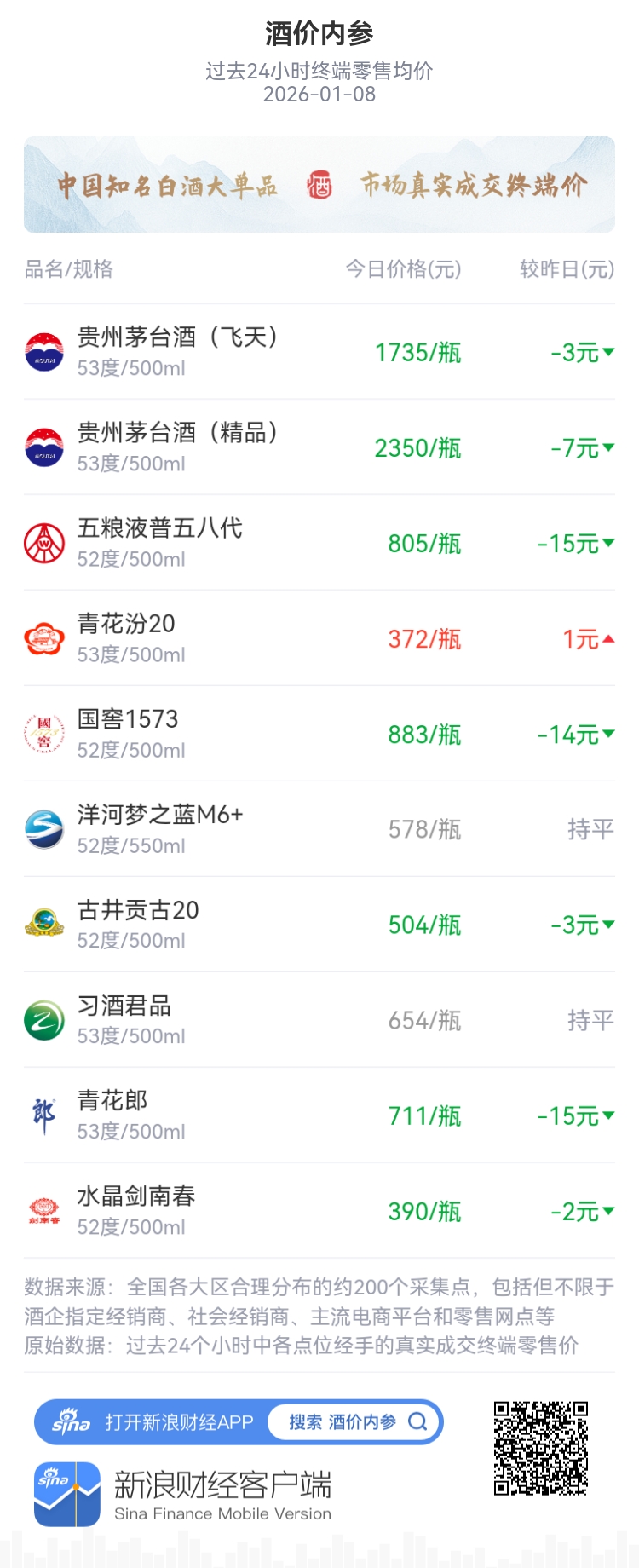
酒价内参1月8日价格发布 青花郎环比下跌15元/瓶
Xin Lang Cai Jing· 2026-01-08 01:25
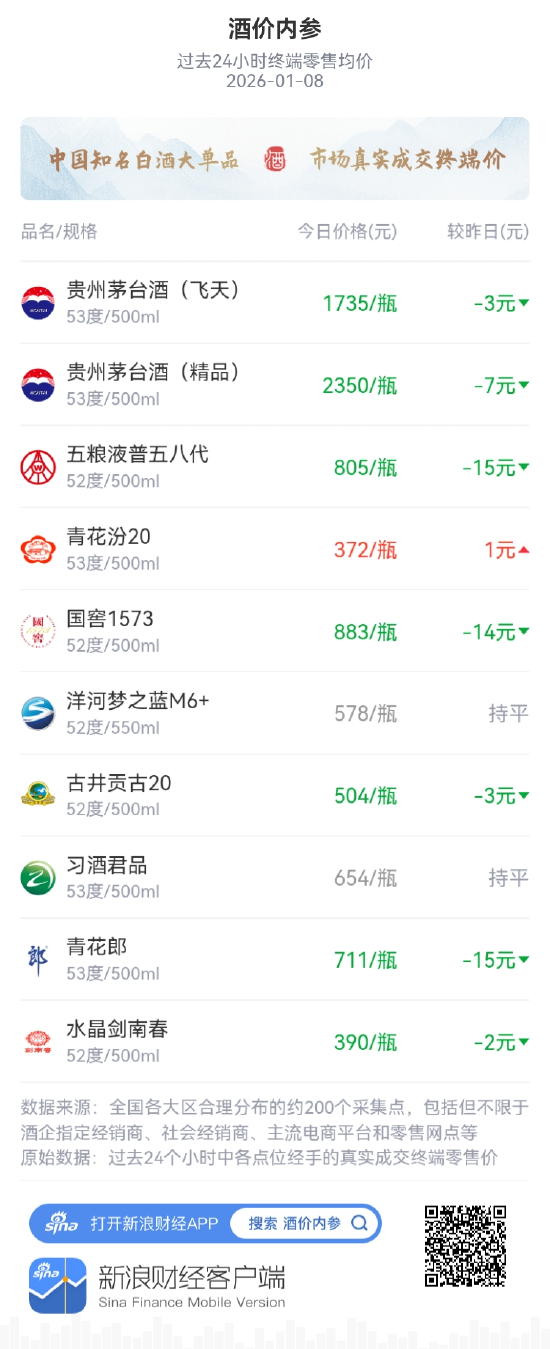
Core Insights - The core viewpoint of the news is that the Chinese liquor market, particularly the top ten liquor products, has experienced a significant decline in retail prices, indicating a downward pressure on the market and a lack of confidence among consumers [1][6][7]. Price Trends - The average retail price of the top ten liquor products dropped to 8,982 yuan on January 8, down 58 yuan from the previous day, marking the lowest point since November 18 of the previous year [1][6]. - Seven out of the ten products saw price declines, with notable drops including Wuliangye (down 15 yuan) and Qinghua Lang (down 15 yuan) [7][9]. - Other products that experienced price reductions include Guojiao 1573 (down 14 yuan), boutique Moutai (down 7 yuan), and others with smaller declines [7][10]. Market Sentiment - The overall market is characterized by a widespread decline, reflecting insufficient confidence among consumers and investors [7][8]. - Only one product, Qinghua Fen 20, saw a slight increase of 1 yuan, while others remained stable [7][9]. Data Collection Methodology - The data for the liquor price reference is sourced from approximately 200 collection points across various regions, including designated distributors, social distributors, major e-commerce platforms, and retail outlets, ensuring a comprehensive and objective representation of market prices [2][7]. ESG Rankings - Five liquor companies were included in the "2025 China ESG Top 100" list published by Sina Finance, with rankings as follows: Kweichow Moutai (27th), Wuliangye (53rd), Gujing Gongjiu (74th), Shanxi Fenjiu (89th), and Shede Jiuye (97th) [2][7]. - The rankings are based on a comprehensive evaluation of ESG performance among over 5,000 A-share listed companies and Hong Kong-listed mainland enterprises, aiming to promote sustainable development in the industry [2][7].
酒价内参1月8日价格发布 精品茅台价格下跌7元/瓶
Xin Lang Cai Jing· 2026-01-08 01:25
Core Insights - The core viewpoint of the news is that the Chinese liquor market, particularly the top ten liquor products, has experienced a significant decline in retail prices, indicating a downward pressure on the market and a lack of confidence among consumers [1][6]. Price Trends - The average retail price of the top ten liquor products has decreased, with a total price of 8982 yuan for a bundled sale, down 58 yuan from the previous day, marking a new low since November 18 of the previous year [1][6]. - Seven out of the ten products have seen price declines, with notable drops including Wuliangye (down 15 yuan/bottle) and Qinghua Lang (down 15 yuan/bottle) [7][1]. - Other products such as Guojiao 1573 and premium Moutai also experienced price reductions of 14 yuan and 7 yuan per bottle, respectively [7][1]. Market Sentiment - The overall market is characterized by a broad decline, reflecting insufficient confidence among consumers, as indicated by the simultaneous price drops of leading brands and core products [7][1]. Data Collection Methodology - The data for the liquor price reference is sourced from approximately 200 collection points across various regions, including designated distributors, social distributors, mainstream e-commerce platforms, and retail outlets, aiming to provide objective and traceable market price data [2][7]. ESG Rankings - Five liquor companies were included in the "2025 China ESG Top 100" list published by Sina Finance, with rankings as follows: Kweichow Moutai (27th), Wuliangye (53rd), Gujing Gongjiu (74th), Shanxi Fenjiu (89th), and Shede Jiuye (97th) [2][7]. - The rankings are based on a comprehensive evaluation of ESG performance among over 5,000 A-share listed companies and Hong Kong-listed mainland enterprises, utilizing 18 industry-specific ESG evaluation models [2][7].
酒价内参1月8日价格发布 市场普跌探底整体价格创新低
Xin Lang Cai Jing· 2026-01-08 01:01
Core Insights - The Chinese liquor market is experiencing a significant decline in retail prices for the top ten products, with an overall drop in market confidence [1] - The total retail price for a bundled sale of the top ten products is 8,982 yuan, marking a decrease of 58 yuan from the previous day, the lowest since November 18 of the previous year [1] Price Movements - Seven out of the ten major liquor products saw price declines, with notable drops including: - Wuliangye (普五八代) down 15 yuan per bottle - Qinghua Lang (青花郎) down 15 yuan per bottle - Guojiao 1573 (国窖1573) down 14 yuan per bottle - Premium Moutai (精品茅台) down 7 yuan per bottle - Feitian Moutai (飞天茅台) down 3 yuan per bottle - Ancient Liquor (古井贡古20) down 3 yuan per bottle - Crystal Jiananshun (水晶剑南春) down 2 yuan per bottle [1][3][4] - The only product to see a price increase was Qinghua Fen (青花汾20), which rose by 1 yuan per bottle [1] Market Sentiment - The overall market is characterized by a downward trend, reflecting a lack of confidence among consumers and investors [1] - The price adjustments across leading brands indicate a broader issue within the industry, as multiple core products are experiencing simultaneous price declines [1]