Bank of Ningbo(002142)

Search documents
宁波银行跌2.16%,成交额4.90亿元,主力资金净流入2734.11万元
Xin Lang Cai Jing· 2025-11-17 03:16
截至9月30日,宁波银行股东户数11.84万,较上期增加15.44%;人均流通股55735股,较上期减少 13.38%。2025年1月-9月,宁波银行实现营业收入0.00元;归母净利润224.45亿元,同比增长8.39%。 分红方面,宁波银行A股上市后累计派现358.04亿元。近三年,累计派现132.07亿元。 机构持仓方面,截止2025年9月30日,宁波银行十大流通股东中,香港中央结算有限公司位居第四大流 通股东,持股2.81亿股,相比上期增加3200.53万股。 责任编辑:小浪快报 宁波银行今年以来股价涨23.79%,近5个交易日跌1.36%,近20日涨5.73%,近60日涨3.13%。 资料显示,宁波银行股份有限公司位于浙江省宁波市鄞州区宁东路345号,成立日期1997年4月10日,上 市日期2007年7月19日,公司主营业务涉及吸收公众存款;发放短期、中期和长期贷款;办理国内外结算; 办理票据承兑与贴现;发行金融债券;代理发行、代理兑付、承销政府债券;买卖政府债券、金融债券;从 事同业拆借;从事银行卡业务;提供信用证服务及担保;代理收付款项及代理保险业务;提供保管箱服务。 主营业务收入构成为:公司业务 ...

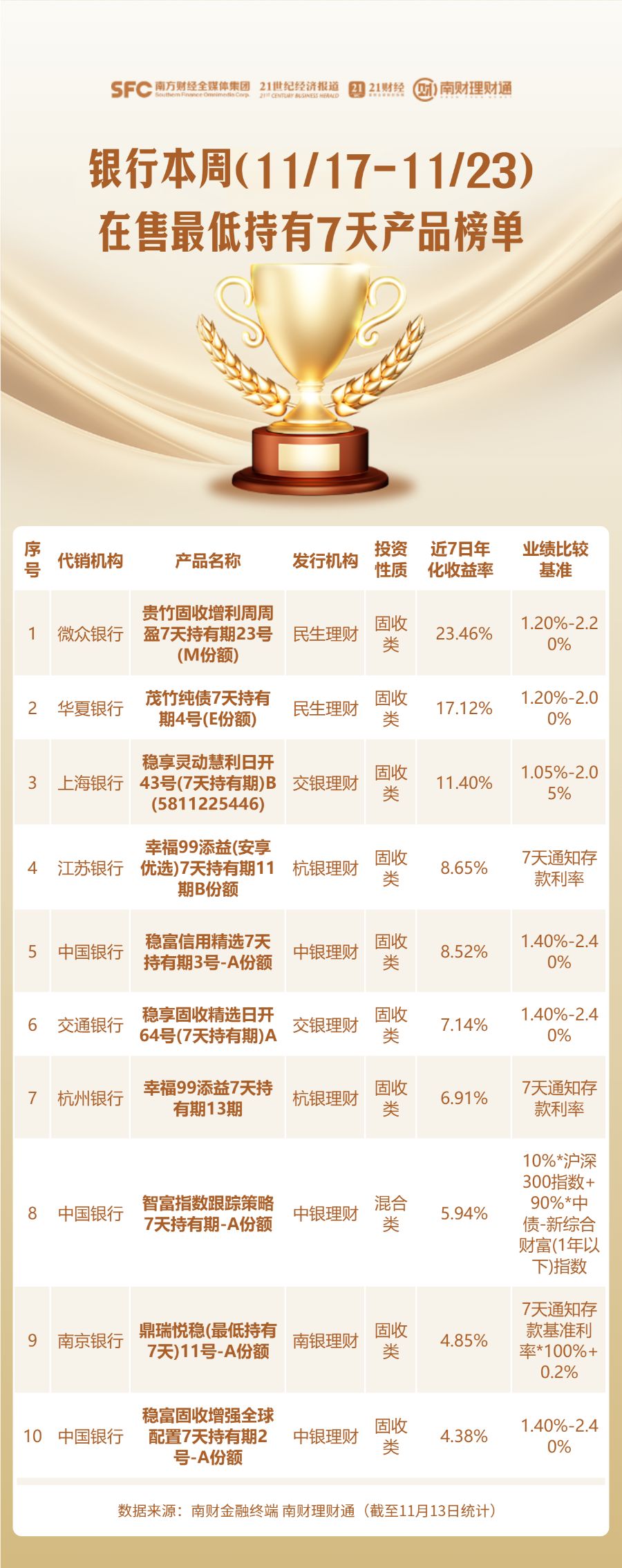
本周各银行在售“固收+”产品哪家强?
2 1 Shi Ji Jing Ji Bao Dao· 2025-11-17 01:20
Core Viewpoint - The article emphasizes the importance of selecting suitable wealth management products, particularly "fixed income+" products, from various banks, highlighting the need for investors to discern among numerous similar offerings [1][5]. Summary by Category Performance Ranking - The article presents a performance ranking of wealth management products based on their annualized returns over the past month, three months, and six months, with a focus on the three-month annualized yield for recent market performance [1][5]. Institutions Involved - A total of 28 banks are involved in the distribution of these wealth management products, including major institutions such as Industrial and Commercial Bank of China, Bank of China, Agricultural Bank of China, and others [1]. Product Selection - The ranking aims to assist investors in identifying high-performing products, with specific attention to the "fixed income+" category, which has gained popularity among investors seeking stable returns [1][5]. Market Dynamics - The article notes that the availability of these products may vary due to factors such as sold-out quotas or differences in product listings across banks, suggesting that investors should verify product availability through the respective bank's app [1].







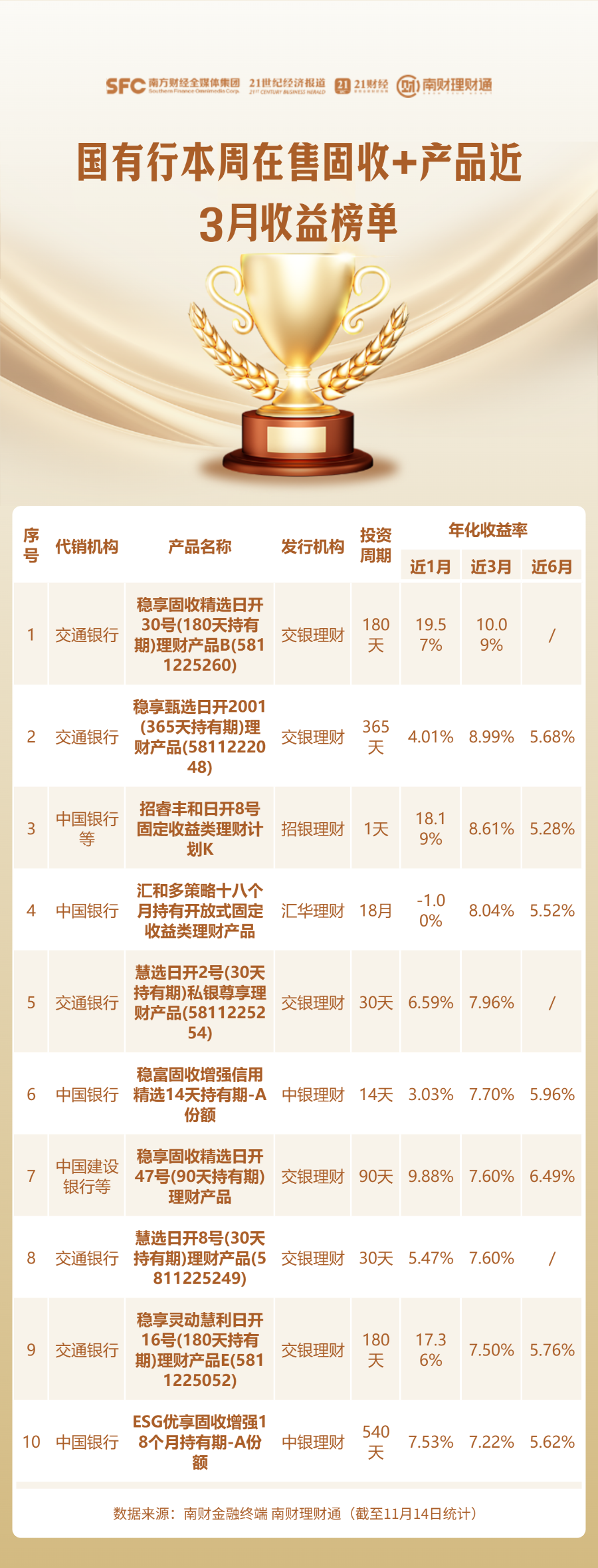
最低持有期榜单出炉!互联网银行7天持有期代销产品收益最高
2 1 Shi Ji Jing Ji Bao Dao· 2025-11-17 01:20
Core Insights - The article focuses on the performance of bank wealth management products with varying minimum holding periods, aiming to help investors identify and select high-performing products [1][5][12] Summary by Category Performance Rankings - The article provides a ranking of wealth management products based on their annualized returns for different holding periods: 7 days, 14 days, 30 days, and 60 days [1][5][12] - For the 7-day holding period, the top-performing product is from Minsheng Bank with an annualized return of 17.12% [4] - For the 14-day holding period, Minsheng Bank's product also leads with a return of 19.88% [6] - In the 30-day category, Minsheng Bank again tops the list with a return of 21.98% [10] - The 60-day holding period shows a leading return of 9.74% from Minsheng Bank [13] Product Categories - The products are categorized into fixed income and mixed types, with specific focus on their respective annualized returns and performance benchmarks [4][10][13] - The rankings are based on data from 28 distribution institutions, including major banks like ICBC, Bank of China, and Agricultural Bank of China [1] Investor Guidance - The article emphasizes the importance of checking the actual availability of products on bank apps, as some may be sold out or not displayed uniformly across different clients [1] - It aims to reduce the selection cost for investors by providing a clear performance overview of available products [1][5]
财政支持力度同比下降,M1增速见顶回落:银行业周报(20251110-20251116)-20251116
Huachuang Securities· 2025-11-16 14:42
Group 1 - The core view of the report indicates a decline in fiscal support year-on-year, with M1 growth peaking and then receding [1][3] - The report highlights a decrease in credit volume, with October RMB loan growth at 6.5% year-on-year, a reduction of 0.12 percentage points month-on-month, and a new loan addition of 220 billion yuan, which is 280 billion yuan less than the previous year [2] - The report emphasizes the importance of "supply-demand balance" in the credit market, noting that weak demand in the household sector, particularly for short-term loans, is a significant factor [2] Group 2 - M1 and M2 growth rates fell by 1 percentage point and 0.2 percentage points respectively in October, with M1 at 6.2% and M2 at 8.2% [3] - The report suggests that the decline in M1 growth is attributed to a booming capital market, leading to a shift of deposits from residents and enterprises to non-bank deposits [3] - The investment recommendation remains focused on the banking sector, highlighting that the long-term investment value of banks continues to be strong, with a suggestion to focus on state-owned banks and quality regional banks [4][9] Group 3 - The report provides a detailed analysis of the banking sector's performance, indicating that the Shenyin & Wanguo Bank Index rose by 1.70% during the week, outperforming the CSI 300 Index by 2.78 percentage points [8] - It notes that the overall market performance for the week saw major indices decline, with the CSI 300 down by 1.08% and the Shanghai Composite Index down by 0.18% [8] - The report also includes a forecast for key companies, with EPS and PE ratios provided for several banks, indicating a positive outlook for banks like Ningbo Bank and Jiangsu Bank [10]




银行经营与定价思考:配置正当其时
Guotou Securities· 2025-11-16 09:35
Investment Rating - The report maintains an investment rating of "Outperform the Market - A" [4] Core Viewpoints - The banking sector is experiencing a significant divergence in credit growth, with state-owned banks increasing their share of new credit while smaller banks are seeing a decline [1][2] - The net interest margin for commercial banks has stabilized, with a slight increase observed in shareholding banks [3] - The report emphasizes the importance of increasing bond allocations to drive total asset growth, particularly for state-owned and city commercial banks [2] - The overall asset quality of banks remains stable, but there is a noticeable divergence, with non-listed banks experiencing a rise in non-performing loans [9][20] - The report suggests that the banking sector is currently undervalued, with A-share banks trading at a price-to-book ratio of 0.73 and Hong Kong-listed state-owned banks at 0.55 [10][11] Summary by Sections Section 1: Credit Growth and Market Dynamics - Recent financial data indicates that new RMB loans and social financing are significantly lower than the same period last year, reflecting weak financing demand [1] - The decline in real estate loans and the low credit dependence of light asset industries are impacting the competitive landscape among banks [1] Section 2: Asset Growth and Bond Allocation - State-owned and city commercial banks have shown a notable increase in total asset growth compared to joint-stock banks, attributed to their stronger liability bases and increased bond allocations [2] - The report anticipates a continued trend of credit expansion among banks with strong credit growth potential and increased bond allocations [2] Section 3: Net Interest Margin and Profitability - The net interest margin for commercial banks was reported at 1.42% for the first three quarters of the year, indicating stabilization [3] - The report notes that banks with a higher proportion of credit business and better middle-income advantages are likely to perform better in terms of fundamentals [10] Section 4: Asset Quality and Non-Performing Loans - The non-performing loan ratio for commercial banks was reported at 1.52%, with a slight increase observed [9][20] - State-owned and shareholding banks maintained stable non-performing loan ratios, while city and rural commercial banks experienced a faster increase [9][20] Section 5: Market Valuation and Investment Opportunities - The report highlights that the current valuation of the banking sector is significantly lower than that of banks in major international economies, suggesting potential for valuation recovery [10][11] - The report recommends focusing on state-owned banks, China Merchants Bank, and Ningbo Bank as investment opportunities [12]
银行板块持续回暖,下半年近900家机构扎堆调研
Di Yi Cai Jing· 2025-11-14 14:04
Group 1: Market Performance - The A-share banking sector has shown a continuous recovery since the fourth quarter, with bank stocks, including ICBC and ABC, reaching new highs on November 14. The China Securities Banking Index rose by 0.25%, with a cumulative increase of 1.69% over four trading days this week [1] - Institutional attention towards listed banks has increased significantly, with 23 listed banks being investigated by 891 institutions from July 1 to November 14, totaling 139 investigations [1] Group 2: Focus of Institutional Research - The main focus of institutional research includes the phase trends of net interest margins, changes in asset quality, and optimization of non-interest income structures [1] - Among the banks investigated, city commercial banks and rural commercial banks have become the focal point, with 14 out of 23 listed banks located in the Jiangsu, Zhejiang, and Shanghai regions [2] Group 3: Key Banks Under Investigation - Jiangsu Bank received the highest number of investigations at 83, followed by Chongqing Rural Commercial Bank, Ningbo Bank, and Shanghai Bank with 76, 75, and 70 investigations respectively [3] - Foreign institutions have shown a preference for Ningbo Bank, which attracted 47 foreign institutions for research, along with significant interest in Hangzhou Bank, Jiangsu Bank, and Ruifeng Bank [2] Group 4: Net Interest Margin and Asset Quality - Net interest margin remains a core concern for institutions, with many banks reporting signs of stabilization in their net interest margins in their semi-annual and quarterly reports [4] - Banks have successfully alleviated the downward pressure on interest margins by adjusting their liability pricing structures and expanding low-cost deposits [4][5] Group 5: Asset Quality Management - Institutions are closely monitoring asset quality, with banks like Ningbo Bank emphasizing a prudent risk preference and strict credit risk management to maintain asset quality within industry-leading levels [5][6] - Guizhou Bank reported a decrease in its non-performing loan ratio to 1.63%, with a robust provision coverage ratio of 239.59% [6] Group 6: Non-Interest Income and Market Strategies - As net interest margins face structural pressure, the importance of non-interest income has increased, with banks focusing on bond investment strategies and the recovery of intermediary business income [7] - Banks are adjusting their fee and commission income structures, with some smaller institutions experiencing declines in self-operated wealth management income due to regulatory impacts [8] Group 7: Future Outlook - Analysts predict that the influx of incremental funds will continue to support the banking sector, with expectations of increased demand for bank stocks from passive ETFs and insurance funds [9]

宁波银行深圳分行助力电商企业拓销路
Sou Hu Cai Jing· 2025-11-14 11:30
Core Insights - Ningbo Bank's Shenzhen branch launched the "Red Cat Plan" in collaboration with Xiaohongshu to support brand e-commerce enterprises in expanding their sales channels [1][3] - The event attracted representatives from leading regional brands, focusing on leveraging the power of "grass planting" to inject new growth momentum into brands amidst the digital economy wave [1][3] Group 1: Event Overview - The launch event included participation from Shenzhen Municipal Bureau of Commerce, Xiaohongshu's commercialization department, and official service providers, emphasizing policy dissemination [1][3] - The event featured nearly a hundred representatives from top regional brands such as Zhongshun Jierou and Weijian Medical, discussing strategies for growth in the digital economy [1][3] Group 2: Key Presentations - Ningbo Bank's Vice President, Gan Yu, highlighted the "Bobo Zhiliao" series as a key project aimed at creating value for enterprises by facilitating communication and empowerment [3][4] - The Shenzhen Municipal Bureau of Commerce provided a detailed introduction to practical policies for the e-commerce industry, aiming to foster innovation and development through a favorable business environment [3][4] Group 3: Marketing Strategies - Li Xiaoxiao from Juxing Media shared insights on optimizing content operations and aligning with advertising policies to create high-conversion content for brands [3][4] - Wang Jiawei from Juxing Media presented case studies from various industries, discussing how to overcome high customer conversion challenges by integrating content and advertising strategies [3][4] Group 4: Future Directions - Ningbo Bank's Deputy General Manager, Zhou Xiaoqian, introduced services under the "Bobo Zhiliao" initiative, including the "Red Cat Plan" and KOS services, aimed at transforming "grass planting" into sales [4] - The bank emphasized its commitment to a comprehensive support system through the "Bobo Zhiliao" series, focusing on professional, digital, international, and platform-based empowerment for consumer brands and the e-commerce sector [4]

银行视角看25Q3货币政策执行报告:重提跨周期调节,保持合理利率比价关系维护息差稳定
Orient Securities· 2025-11-14 05:34
Investment Rating - The report maintains a "Positive" investment rating for the banking sector, indicating an expectation of relative outperformance compared to market benchmarks [6]. Core Viewpoints - The report highlights a cautious optimism regarding the banking sector's performance in Q4 2025, driven by stabilizing interest margins and improving fundamentals despite external uncertainties [3][4]. - It emphasizes the importance of maintaining a reasonable interest rate spread to support net interest margins, with a focus on effective monetary policy transmission [9][11]. Summary by Sections Investment Recommendations and Targets - The report identifies two main investment lines: 1. High-quality small and medium-sized banks with stable fundamentals, including targets like Chongqing Rural Commercial Bank (601077, Buy), Ningbo Bank (002142, Buy), and Nanjing Bank (601009, Buy) [4]. 2. Large state-owned banks with solid defensive value, such as Industrial and Commercial Bank of China (601398, Not Rated) and Agricultural Bank of China (601288, Not Rated) [4]. Banking Industry Overview - The report discusses the current state of the banking industry, noting a stabilization in interest margins and a cautious approach to monetary policy, with a focus on cross-cycle adjustments to enhance macroeconomic governance [9][11]. - It also mentions the need for a comprehensive macro-prudential management system to address risks in small financial institutions, suggesting that mergers and restructuring may accelerate [11]. Monetary Policy and Financial Conditions - The report indicates that the monetary policy will continue to be moderately accommodative, with a focus on maintaining reasonable growth in financial aggregates and credit [9][10]. - It highlights that the credit growth rate is expected to decline marginally, with a projected loan growth rate of 6.6% in Q3 2025 [9]. Interest Rate Dynamics - The report stresses the importance of maintaining a reasonable interest rate spread, with specific guidelines for banks to avoid issuing loans at rates lower than government bond yields [9][11]. - It notes that as of Q3 2025, the net interest margin for listed banks has stabilized, benefiting from a significant reduction in funding costs [9][11].


10月金融数据点评:社融增速仍承压,信贷偏弱,票据冲量
Orient Securities· 2025-11-14 04:45
Investment Rating - The report maintains a "Positive" outlook for the banking sector as of Q4 2025 [5][21]. Core Viewpoints - The report highlights that the growth of social financing remains under pressure, with a year-on-year increase of 8.5% in October 2025, which is a decrease of 0.2 percentage points compared to August [8][9]. - Credit growth is weak, with a notable reliance on bill financing to compensate for the decline in traditional loans [13][14]. - The report suggests that the banking sector is expected to show relative strength due to stabilizing interest margins and positive fundamental changes [21][22]. Summary by Sections Social Financing and Credit - In October 2025, social financing increased by 8.5% year-on-year, with a total increment of 815 billion yuan, which is 597 billion yuan less than the previous year [9][10]. - The total amount of RMB loans decreased by 201 million yuan, with a year-on-year decline of 3.166 billion yuan, indicating a seasonal dip in credit [8][9]. - Government bond issuance saw a year-on-year decrease of 560.2 billion yuan, further weakening the support for social financing [10][11]. - Direct corporate financing increased by 189.4 billion yuan, with bond financing up by 148.2 billion yuan and stock financing up by 41.2 billion yuan [10][11]. Loan Structure - Total RMB loans grew by 6.5% year-on-year, with new loans amounting to 220 billion yuan, which is 280 billion yuan less than the previous year [13][14]. - Household loans saw a significant decline, with short-term and medium-to-long-term loans both under pressure, leading to a year-on-year decrease of 5.156 billion yuan [13][14]. - Corporate loans primarily relied on bill discounting, which increased by 331.2 billion yuan year-on-year, while general loans saw a notable decrease [14][15]. Monetary Supply - M1 and M2 growth rates showed marginal declines, with M1 growing by 6.2% and M2 by 8.2% year-on-year [18][19]. - In October 2025, new RMB deposits totaled 610 billion yuan, with a year-on-year increase of 100 billion yuan, despite a significant drop in household deposits [18][20]. - Non-bank deposits increased significantly, indicating a shift away from traditional household savings [18][20]. Investment Recommendations - The report recommends focusing on high-quality small and medium-sized banks, with specific buy ratings for Chongqing Rural Commercial Bank, Ningbo Bank, Nanjing Bank, and Hangzhou Bank [21][22]. - It also suggests considering state-owned banks with stable fundamentals, such as Industrial and Commercial Bank of China, China Construction Bank, and Agricultural Bank of China, which are currently unrated [21][22].
银行业“量价质”跟踪(二十):新型政策性工具放量,存款季节性流出
Donghai Securities· 2025-11-14 03:50
Investment Rating - The industry investment rating is "Market Weight" indicating that the industry index is expected to perform within -10% to 10% relative to the CSI 300 index over the next six months [26]. Core Insights - The report highlights a slowdown in credit and government financing, with new policy tools being introduced to stimulate lending. The total social financing stock grew by 8.5% year-on-year, while RMB loans increased by 6.3% year-on-year [4][5]. - The report emphasizes the importance of new policy tools that are expected to have a positive impact on credit growth, particularly in sectors like technology innovation and infrastructure [4][5]. - The report notes that the loan interest rates have remained stable, with the average interest rate for new corporate loans and personal housing loans both at approximately 3.1% [4][5]. Summary by Sections Credit and Financing Trends - As of October, the total social financing stock increased by 8.5% year-on-year, while RMB loans grew by 6.3% year-on-year. The M2 and M1 money supply grew by 8.2% and 6.2% respectively [4]. - New corporate loans decreased by 201 billion RMB year-on-year, reflecting weak demand in the real economy [4]. - The report indicates that the introduction of new policy tools, particularly in the form of entrusted loans, is aimed at stabilizing credit growth [4][5]. Loan and Deposit Dynamics - The report notes a seasonal outflow of deposits post-quarter, with both M2 and M1 growth rates declining. This is attributed to seasonal factors and a slowdown in credit and government bond issuance [4]. - The average interest rates for new loans have stabilized, which is expected to ease pressure on interest margins in 2025 compared to 2024 [4][5]. Investment Recommendations - The report suggests focusing on the impact of new policy tools on credit dynamics in the upcoming months, particularly in the context of government financing becoming less robust [5]. - It is recommended to monitor the banking sector's performance, as the dividend advantage of the banking sector is expected to attract medium to long-term capital [5].