
BYD(002594)

Search documents
王力宏现身比亚迪高层饭局,外界猜测或有代言合作
Xin Lang Cai Jing· 2026-02-27 05:09
Group 1 - Wang Leehom recently attended a high-level dinner with BYD executives, including Vice President Li Ke and General Manager of Brand and Public Relations Li Yunfei [1][3] - On February 25, Wang Leehom visited BYD's headquarters in Shenzhen, where he toured the core technology exhibition and experienced the Yangwang U9 and Fangcheng Leopard models [1][3] - There is speculation that the recent interactions between Wang Leehom and BYD may indicate a potential endorsement collaboration, although BYD has not officially announced any related news [4]



2026年1月海外新能源汽车销量排行
数说新能源· 2026-02-27 03:02
Core Insights - The article discusses the sales performance of electric and hybrid vehicles in overseas markets for January 2026, highlighting key brands and their respective sales figures [4][5]. Group 1: Electric Vehicle Sales - Tesla leads the overseas pure electric vehicle sales with 4.0 million units sold in January 2026 [5]. - BYD follows Tesla with 2.0 million units, while Volkswagen ranks third with 1.6 million units sold [5]. - Other notable brands include Renault (1.4 million), BMW (1.3 million), and KIA (1.2 million) [5]. Group 2: Hybrid Vehicle Sales - BYD also dominates the hybrid vehicle market with 2.17 million units sold in January 2026 [5]. - Volkswagen and BMW follow with sales of 1.13 million and 1.04 million units, respectively [5]. - Mercedes and Audi both sold 0.95 million units, showcasing strong competition in the hybrid segment [5]. Group 3: Regional Sales Performance - Germany leads the sales of plug-in hybrid vehicles with 2.2 million units, followed closely by the UK with 2.0 million units [4]. - Italy and Israel each recorded 1.0 million units, while Spain and the Netherlands had sales of 0.9 million and 0.8 million units, respectively [4]. - Other countries like Brazil, Ireland, and Australia also contributed to the overall sales figures, indicating a growing market for hybrid vehicles in these regions [4].

比亚迪日本研究(上)急于开店
日经中文网· 2026-02-27 02:53
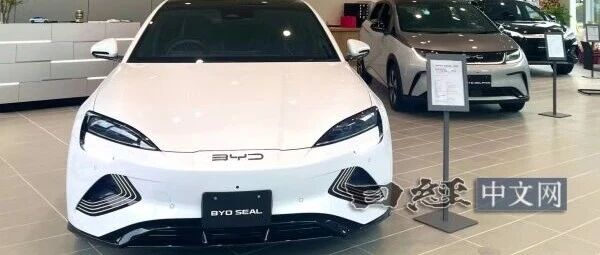
比亚迪汽车港北新城店店内 比亚迪于2023年涉足日本乘用车市场。消费者对中国品牌眼光苛刻。为了提高知名度并得到消费者的信 赖,增开专卖店从一开始就是重要课题。 比亚迪正在日本加快开店速度。比亚迪2025年在日本EV销量增长7成,达到3731辆。按厂商排名位居第 五,但销量增长未达预期。主要原因在于消费者对中国汽车的疑虑仍未消除。比亚迪在日本正迎来关键 时刻…… 中国纯电动汽车(EV)大型企业比亚迪(BYD)正在日本全国加快开店速度。比亚迪从2026年开始在 日本的地方城市开设小型门店,以较低的成本来扩大门店网络。比亚迪将在2026年夏季投放作为日本独 有规格的轻型EV,在EV领域全面展开价格竞争。目前比亚迪的日本销量并未像预期的那样增长,危机 感十分强烈。能否通过扩大门店网络来扭转局面,比亚迪在日本正迎来关键时刻。 "为了销售轻型EV,将覆盖地方的小规模商圈",比亚迪日本法人的社长东福寺厚树如此强调。 仅展示1至2辆汽车 比亚迪在日本一直以主要城市及县厅所在地为中心开设销售店。为了加快开店速度,比亚迪决定开设汽 车销售行业中较为罕见的小型门店。 这些门店将开设在人口低于50万人的日本核心地方城市。仅展示1至2 ...
比亚迪财险靠投资翻身,车险车均保费下降了
Sou Hu Cai Jing· 2026-02-27 02:46
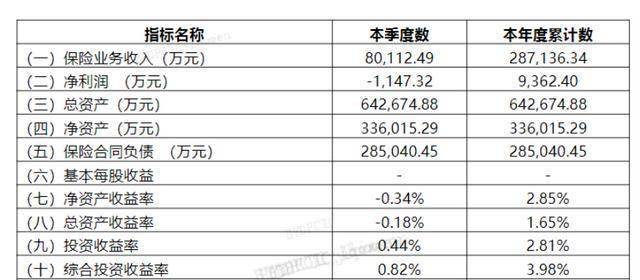
Core Viewpoint - BYD's insurance subsidiary has achieved profitability in 2025, contrary to market expectations of a longer cultivation period after its acquisition of 100% of Yi'an Insurance in May 2023 [6]. Financial Performance - In 2025, BYD Insurance reported insurance business revenue of 2.871 billion yuan, a year-on-year increase of 112.56%, and a net profit of 93.62 million yuan, recovering from a net loss of 169 million yuan in 2024 [7]. - The comprehensive cost ratio for BYD Insurance in 2025 was 102.49%, significantly reduced from 308.81% in 2024 [8]. - The comprehensive investment return rate for BYD Insurance in 2025 was 3.98%, up from 2.41% in the previous year [10]. Operational Efficiency - BYD Insurance achieved a direct sales channel for its insurance products, with direct sales premiums amounting to 2.897 billion yuan in 2025, and an average premium per vehicle of 4,054.53 yuan, down from 4,500 yuan in 2024 [9]. Challenges Ahead - Despite returning to profitability in 2025, BYD Insurance faces challenges such as pressure from underwriting losses, as the overall cost ratio remains above 100%, indicating ongoing core insurance business losses [11]. - The comprehensive solvency adequacy ratio decreased to 589.95% by the end of Q4 2025, down 66.60 percentage points from the previous quarter [11]. - There are risks associated with related-party transactions, as BYD Insurance has engaged in significant transactions with BYD Auto, with 13 major related-party transactions recorded in 2025 [11].
不是巧合,今年春节,电动车返乡不再是「勇敢者的游戏」
3 6 Ke· 2026-02-27 02:44
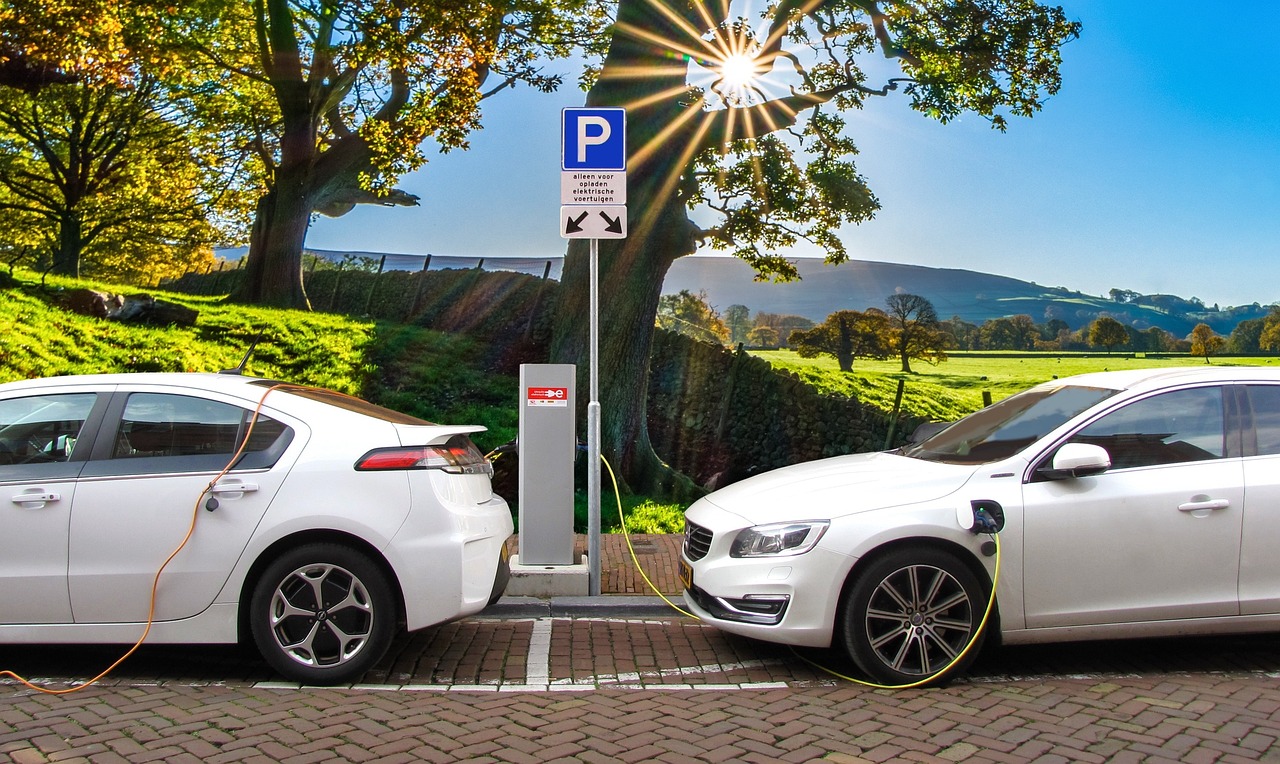
Core Viewpoint - The electric vehicle (EV) charging experience has significantly improved during the recent Spring Festival, with fewer complaints from EV owners due to enhanced infrastructure and smarter charging solutions [3][4][18]. Group 1: Infrastructure Improvements - The number of charging sessions on highways reached 6.021 million, with a total charging volume of 14,976.75 million kWh, marking a 52.01% increase in daily average charging volume compared to last year [4]. - Major EV manufacturers like NIO and Li Auto have significantly increased their charging infrastructure, with NIO accounting for 15% of the total charging volume on highways during the specified period [4][6]. - Local governments are also investing in charging infrastructure, including mobile charging robots and emergency charging vehicles, to alleviate peak demand issues [6][8]. Group 2: User Behavior Changes - EV owners are adapting their travel strategies, such as planning trips to avoid congested charging stations and utilizing fast charging stations in smaller towns instead of busy service areas [7][8]. - The integration of advanced navigation and charging station information in vehicle systems allows drivers to optimize their routes and avoid long wait times at charging stations [7][8]. Group 3: Technological Advancements - The industry is moving towards faster charging technologies, with companies like BYD developing megawatt-level fast charging stations capable of delivering up to 1000 kW [9][12]. - Major automakers are also investing in high-voltage platforms and fast charging capabilities, with BMW, Toyota, and Mercedes-Benz announcing significant advancements in their EV technologies [14][16]. - The trend towards fast charging is expected to continue, making it accessible to more mainstream vehicles, thus enhancing the overall EV ownership experience [16][18]. Group 4: Future Outlook - The charging infrastructure is projected to expand further, with over 10,000 new charging guns planned for installation in highway service areas this year, including a significant portion being high-power fast chargers [9]. - The overall EV industry is expected to mature, with better coordination between vehicle manufacturers, battery suppliers, and charging infrastructure providers, leading to a more seamless experience for EV users [13][19].
电动汽车市场洞察,全球前20强生产商排名及市场份额
QYResearch· 2026-02-27 02:23
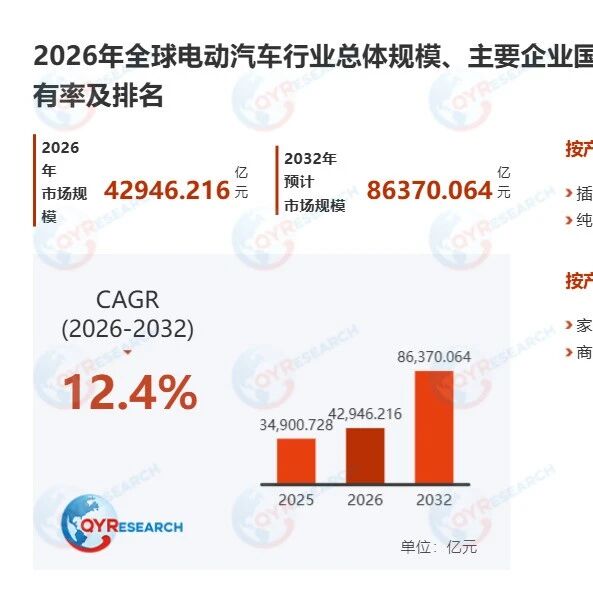
Core Viewpoint - Electric vehicles (EVs) are essential for decarbonizing the transportation sector, offering higher energy conversion efficiency, instant torque, lower noise, and zero tailpipe emissions [2] Market Size - The global electric vehicle market is projected to reach $1,269.9 billion by 2032, with a compound annual growth rate (CAGR) of 12.35% over the coming years [3] Market Landscape - Major global electric vehicle manufacturers include BYD, Tesla, BMW, Volkswagen, Li Auto, Seres Group, Geely, Mercedes-Benz, Volvo, SAIC Motor, Hyundai-Kia, Stellantis, Great Wall Motors, Renault, Chery, NIO, Toyota, GAC Group, Xpeng, Leap Motor, Xiaomi, Ford, and BAIC Group [5][6] - The top five manufacturers hold approximately 47% of the market share [6] Industry Development Opportunities - Advancements in battery technology, thermal management systems, 800V high-voltage architecture, and vehicle electronic platforms provide opportunities for performance enhancement and cost reduction, allowing electric vehicles to penetrate a broader price range [11] - The integration of vehicles with energy systems is expanding application boundaries, promoting a shift from one-time vehicle sales to ongoing service models [11] - The acceleration of electrification in light commercial vehicles, logistics, shared mobility, and emerging markets creates new growth paths for companies with scalable manufacturing, cost control, and localized operations [11] Key Obstacles - Uneven progress in charging network construction across regions affects user experience and convenience [10] - Price fluctuations of key battery materials, supply chain geopolitical risks, and an immature recycling system challenge cost control and long-term stability [10] - Consumer expectations regarding range performance, low-temperature operation, maintenance costs, and second-hand value, along with subsidy policy reductions and electricity price volatility, slow market penetration [10]




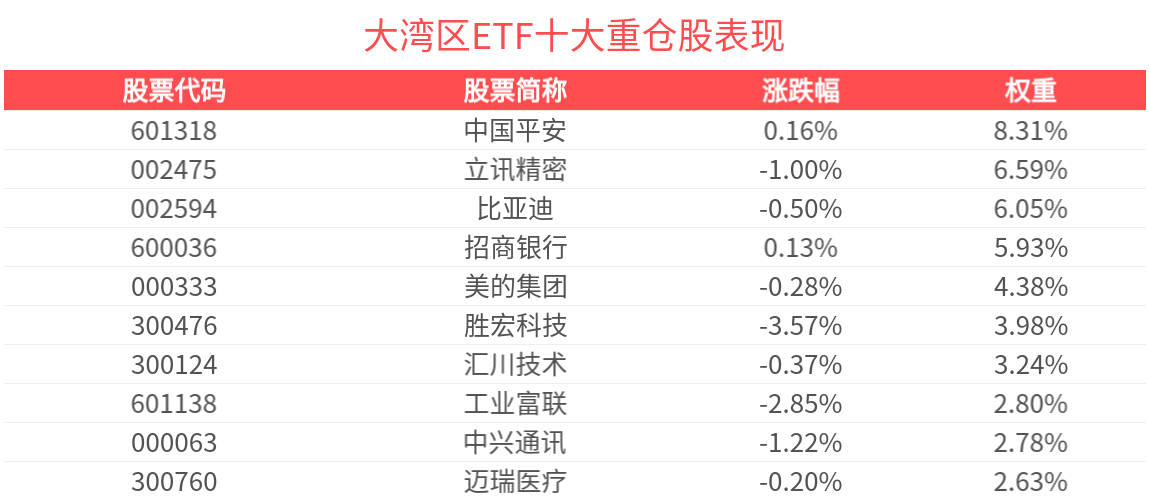
中证粤港澳大湾区发展主题指数下跌0.79%,大湾区ETF(512970)成立以来超越基准年化收益达3.30%
Sou Hu Cai Jing· 2026-02-27 02:00
Group 1 - The core index, the CSI Guangdong-Hong Kong-Macao Greater Bay Area Development Theme Index (931000), has seen a decline of 0.79% as of February 27, 2026 [1] - Among the constituent stocks, Huatai Medical led with a gain of 1.53%, while Yingweike experienced the largest drop at 4.12% [1] - The Greater Bay Area ETF (512970) is currently experiencing a stalemate, with a latest quote of 0 yuan, and has accumulated a rise of 0.86% over the past two weeks [1] Group 2 - The Greater Bay Area ETF closely tracks the CSI Guangdong-Hong Kong-Macao Greater Bay Area Development Theme Index, which reflects the overall performance of listed companies benefiting from the Greater Bay Area development [2] - As of January 30, 2026, the top ten weighted stocks in the index include China Ping An, Luxshare Precision, BYD, and others, accounting for a total of 44.55% of the index [2] - The index includes a maximum of 50 Hong Kong market securities, 300 companies from the Shanghai-Hong Kong-Shenzhen markets, and 100 mainland market securities that align with the Greater Bay Area development theme [2]




研判2026!中国汽车焊装设备行业焊接方法、产业链、市场规模、重点企业及未来前景:汽车产业快速发展,带动焊装设备规模增至360.48亿元[图]
Chan Ye Xin Xi Wang· 2026-02-27 01:20
Industry Overview - The automotive welding equipment industry is crucial for the manufacturing process, which includes stamping, welding, painting, and assembly, with welding being the most complex and quality-determining phase [1][8] - Recent advancements in automation and intelligence in the automotive industry have led to the upgrade of welding equipment technology, transitioning from traditional welding robots to advanced techniques such as laser welding and friction stir welding, enhancing quality and efficiency while reducing labor dependency [1][8] Market Dynamics - The Chinese automotive welding equipment market is projected to reach 36.048 billion yuan by 2025, with a year-on-year growth of 3.96%. The automotive modification sector is expected to grow to 16.391 billion yuan (4.69% growth), while the new capacity sector is anticipated to reach 19.657 billion yuan (3.35% growth) [1][8] - The automotive industry is a pillar of the national economy, with a long industrial chain and strong correlation, playing a significant role in stabilizing industrial economic growth [8] Industry Development Trends - The industry is expected to accelerate towards high automation and intelligent systems, integrating robotic welding, visual guidance, online detection, and autonomous path planning for a fully automated welding process [13] - There will be continuous breakthroughs in high precision and high performance to meet the stringent quality requirements of new energy vehicles and lightweight bodies, with advanced technologies like high-dynamic welding robots and laser welding becoming more prevalent [14] - Flexibility and modular design will become core focuses, allowing for quick switching and expansion of production lines to accommodate various models and materials, thus supporting agile and sustainable development in the welding system [15] Key Companies - Tianyong Intelligent Equipment Co., Ltd. focuses on intelligent automation equipment and has seen a decline in specialized equipment manufacturing revenue, reporting 269 million yuan in the first half of 2025, down 15.94% year-on-year [10][11] - Sanfeng Intelligent Equipment Group Co., Ltd. provides comprehensive solutions for intelligent welding production lines, reporting 573 million yuan in revenue for its intelligent welding production line in the first half of 2025, a year-on-year increase of 1.96% [11][12]


研判2026!中国汽车线束行业产业链、产量、需求量、市场规模、竞争格局、发展趋势:在汽车电动化、智能化趋势下,行业迎来供需两端增长的黄金期[图]
Chan Ye Xin Xi Wang· 2026-02-27 01:13
Core Viewpoint - The automotive wiring harness industry is experiencing stable growth driven by increasing demand for advanced automotive features and the ongoing trend of electrification and intelligence in vehicles [1][10]. Industry Overview - Automotive wiring harnesses are essential components that facilitate energy transfer and signal transmission within vehicles, categorized into main harnesses and small harnesses based on their functions [3][7]. - The industry is supported by a stable supply of raw materials, particularly copper, which is crucial for high-voltage harnesses due to its excellent conductivity [6][10]. Market Demand and Supply - The demand for automotive wiring harnesses is driven by the growing consumer need for advanced safety and comfort features, such as automatic emergency braking and voice recognition systems [1][10]. - By 2025, the production of automotive wiring harnesses in China is projected to reach 3.025 billion sets, with a year-on-year increase of 2.5%, while demand is expected to hit 2.414 billion sets, up 3.5% [10]. Market Size and Growth - The market size of the automotive wiring harness industry in China is anticipated to reach 139.19 billion yuan by 2025, reflecting a year-on-year growth of 4.2% [10]. - The demand for wiring harnesses in the new energy vehicle sector is expected to grow significantly, with the market size projected to reach 81.785 billion yuan by 2025, a year-on-year increase of 27.0% [11]. Competitive Landscape - The global automotive wiring harness market is dominated by major players from Japan and Europe, while Chinese companies are gradually entering the supply chain, particularly in the new energy vehicle segment [12]. - Key domestic companies include Luxshare Precision, Huagong Electric, and Yongding Co., which are gaining recognition for their capabilities in manufacturing and supplying wiring harnesses [12][13]. Development Trends - The industry is moving towards high-voltage and high-frequency transmission to meet the demands of electric and intelligent vehicles [15]. - There is a strong emphasis on lightweight materials to reduce vehicle weight and improve fuel efficiency, as automotive wiring harnesses contribute significantly to overall vehicle weight [16]. - Automation in production processes is expected to increase, enhancing efficiency and capacity in wiring harness manufacturing [18].





智驾平权系列六:AI 智能涌现新阶段,智驾 VLA 与世界模型之争
Changjiang Securities· 2026-02-27 00:50
Investment Rating - The report maintains a "Positive" investment rating for the automotive and automotive parts industry [11] Core Insights - The report highlights a significant leap in the development of general artificial intelligence large models, with continuous breakthroughs in model scale, training paradigms, and reasoning capabilities, establishing a solid technological foundation for various AI applications. Intelligent driving, being an application of "physical AI," is evolving towards large models, marking a new phase of intelligent emergence [3][6] Summary by Sections Introduction: AI Empowerment, Intelligent Driving Enters the Large Model Era - The report discusses the rapid development of general artificial intelligence large models, emphasizing their role in enhancing intelligent driving through technological iterations [6][19] Emergence of General Large Model Capabilities - The AI large model era is characterized by the use of the Transformer architecture, exponential increases in computing power, and the accumulation of vast multimodal data, leading to critical breakthroughs in AI applications [7][21] Progression of Intelligent Driving Large Models - Intelligent driving has transitioned from rule-based models to end-to-end large models, gradually evolving towards VLA (Vision-Language-Action) and world models, enhancing deep reasoning and decision-making capabilities [8][50] Investment Recommendations - The report suggests that the continuous emergence of AI large model capabilities will accelerate the commercialization of high-level intelligent driving. Key recommendations include companies like XPeng Motors, BYD, and Geely in the vehicle sector, and Top Group and Bertelson in the parts sector [9]





