BYD(002594)

Search documents
夯实发展质量,增强投资回报,深市“质量回报双提升”行动取得积极成效
Mei Ri Jing Ji Xin Wen· 2025-12-23 06:29
Group 1 - The core initiative "Quality Return Dual Improvement" launched by the Shenzhen Stock Exchange aims to enhance the development quality and investment value return capability of listed companies, with 471 companies already disclosing their action plans by November 2025 [1] - These 471 companies represent significant market influence, with 293 being part of the Shenzhen Component Index and 88 part of the CSI 300 Index, collectively accounting for approximately 50% of the total market capitalization of the Shenzhen market [1] - The initiative has seen active participation from private enterprises, which make up nearly 70% of the companies involved, demonstrating a strong commitment to quality and return [1] Group 2 - Companies are focusing on core business development, with examples like Mindray Medical investing heavily in R&D for product upgrades and Shenghong Technology enhancing global competitiveness through acquisitions [2] - There is a strong emphasis on technological innovation, with BYD's R&D expenditure reaching 54.2 billion yuan in 2024, and Guoli Micro's R&D investment exceeding 50% of its revenue [2] - Companies are also improving governance and information disclosure, with Anker Innovations enhancing its governance structure and Xiandai Intelligent increasing the transparency of its disclosures [2] Group 3 - Companies are increasing their dividend and share repurchase efforts, with BOE Technology Group and others disclosing future shareholder return plans, and Anke Bio achieving a cumulative dividend amounting to 63% of its net profit since listing [3] - Key stakeholders are actively increasing their holdings, with major shareholders of GoerTek purchasing 47.44 million shares for approximately 1 billion yuan, reflecting confidence in the company's value [3] - Companies are enhancing communication with investors through various channels, with ZTE maintaining regular contact and providing updates on financial performance [3] Group 4 - ESG practices are being integrated into business strategies, with Longyuan Power linking ESG performance to management incentives and continuously upgrading its ESG disclosure systems [4] - The overall quality of companies is improving, with the "dual improvement" companies achieving a total revenue of 9.8 trillion yuan in 2024, a 3.6% increase year-on-year, and a net profit of 743.39 billion yuan [4] - In the first three quarters of 2025, these companies reported a revenue of 7.5 trillion yuan, reflecting a 6.9% year-on-year growth [4] Group 5 - R&D investment among "dual improvement" companies accounted for 4.3% of their revenue in the first half of 2025, with a total R&D expenditure representing 59.5% of the Shenzhen market [5] - The number of R&D personnel increased by 4.6% in 2024, averaging 1,944 employees, which constitutes 19.4% of the workforce [5] - The effectiveness of information disclosure has improved, with 58.6% of "dual improvement" companies receiving an A rating in 2024, an increase of 11.3 percentage points from before the initiative [5] Group 6 - The level of returns to investors has significantly increased, with a compound annual growth rate of 10.0% in total dividends from 2022 to 2024, and dividends in 2024 accounting for 43.6% of net profits [6] - Approximately 80% of the companies have maintained consistent dividends over the past three years, enhancing market confidence [6] - The average number of investor engagements per company was 9.0 in 2024, with an average of 134 institutional investors participating in research [6] Group 7 - The market response has been positive, with an average stock price increase of 77.2% for the 471 "dual improvement" companies from February 2024 to November 2025, outperforming the Shenzhen Component Index [7] - The total market capitalization of these companies reached 21.2 trillion yuan by November 2025, an increase of 8.1 trillion yuan since the initiative began, representing 50% of the total market capitalization of the Shenzhen market [7] - The number of companies with market capitalizations exceeding 100 billion yuan increased by 80, while those exceeding 1 trillion yuan increased by 21 since the initiative's launch [7]

2025,中国汽车业定格局之年|36氪年度透视
Xin Lang Cai Jing· 2025-12-23 05:48
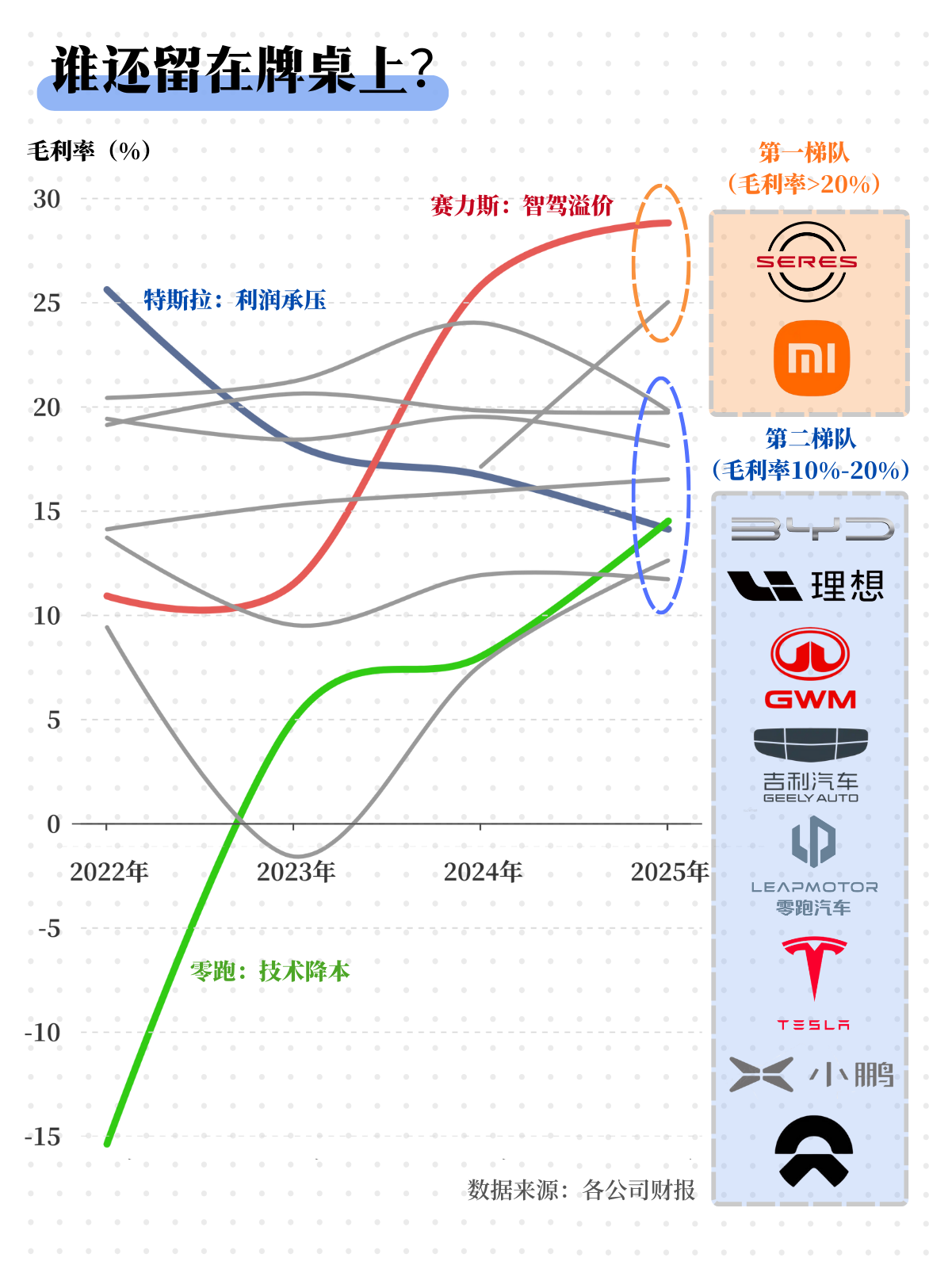
Core Viewpoint - The Chinese automotive market is undergoing significant changes, with a shift from price competition to a focus on technology and profit margins as key survival metrics by 2025 [1][6][7]. Group 1: Market Dynamics - The automotive industry in China cannot sustain too many brands, leading to a harsh reality of market differentiation rather than mere competition [1]. - Price wars have evolved into a long-term battle, where technological advantages are the only remaining cards for survival [1][6]. - Companies like Seres and Xiaomi are maintaining a gross margin above 20%, while traditional profit leaders like Tesla and BYD are facing unprecedented profit pressures [1][6]. Group 2: Technological Advancements - The industry is witnessing a "subtraction revolution" in technology, exemplified by BYD's cost reduction strategies, which have led to a 20% decrease in overall costs [3][10]. - The integration of electric drive systems and advancements in silicon carbide technology are crucial for cost reduction and efficiency improvements [3][10]. Group 3: Global Expansion - The shift towards international markets is becoming essential, with BYD's overseas sales experiencing a dramatic increase, doubling in volume [1][6]. - By 2025, the competition will not only be about pricing but will also encompass technology definition rights, global pricing power, and control over the supply chain [7]. Group 4: Market Share and Competition - New entrants like Xiaomi are making significant inroads into the market, capturing 25% of the 200,000-300,000 RMB segment with a single product [1][5]. - The traditional luxury market is being reshaped, with companies like WM Motor effectively clearing out competition from established brands like BMW, Benz, and Audi (BBA) [1][6].

锂电产业链景气度持续攀升,电池ETF、电池ETF、电池50ETF上涨
Ge Long Hui A P P· 2025-12-23 05:36
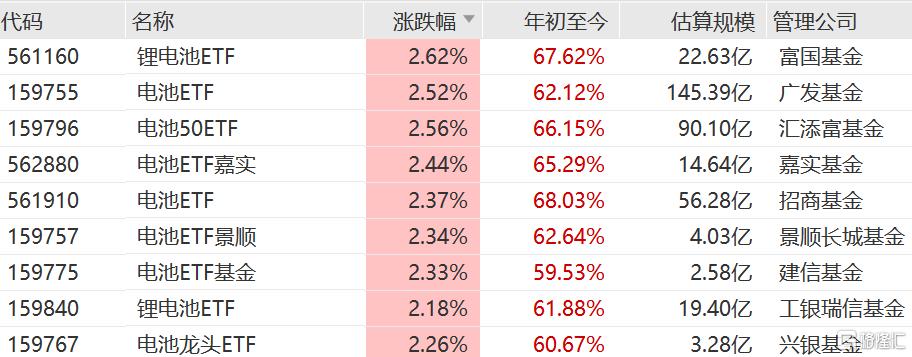
从行业基本面看,11月动力电池装车量稳步增长。 多氟多、天赐材料大涨,带动锂电池ETF、电池ETF、电池50ETF、电池ETF基金、电池龙头有ETF、电池ETF景顺、电池ETF嘉实 涨超2%,年内涨幅超60%。 | 代码 | 名称 | 涨跌幅 ▼ | 年初至今 | 估算规模 管理公司 | | | --- | --- | --- | --- | --- | --- | | 561160 | 锂电池ETF | 2.62% | 67.62% | 22.63 亿 | 富国基金 | | 159755 | 电池ETF | 2.52% | 62.12% | 145.39亿 | 广发基金 | | 159796 | 电池50ETF | 2.56% | 66.15% | 90.10亿 | 汇添富其金 | | 562880 | 电池ETF嘉实 | 2.44% | 65.29% | 14.64 Z | 嘉实基金 | | 561910 | 电池ETF | 2.37% | 68.03% | 56.28 Z | 招商基金 | | 159757 | 电池ETF景顺 | 2.34% | 62.64% | 4.03亿 | 景顺长城基金 | | ...

比亚迪11月在欧洲的销量猛增逾两倍 增速继续快于欧洲本土和外国竞争对手
Xin Lang Cai Jing· 2025-12-23 05:27
Core Insights - BYD's sales in Europe surged over twofold last month, continuing to outpace both local and foreign competitors [1] Group 1: Sales Performance - In November, BYD's new car registrations in Europe skyrocketed from 4,821 units last year to 16,158 units [1] - Including the UK, Iceland, Liechtenstein, Norway, and Switzerland, sales more than doubled to 21,133 units [1] - From January to November, BYD's total sales in Europe reached 159,869 units, compared to Volkswagen's 3,263,542 units and Tesla's 203,382 units [1] Group 2: Competitor Analysis - In November, Tesla's registrations in the EU fell by over 34% year-on-year to 12,130 units [1] - When including the UK, Iceland, Liechtenstein, Norway, and Switzerland, Tesla's sales declined nearly 12% to 22,801 units [1]
特斯拉11月在欧盟注册量下降34%,比亚迪增长235%
Ge Long Hui· 2025-12-23 05:10
Group 1 - The core point of the article highlights the contrasting performance of various automotive manufacturers in the EU market for November, with Toyota experiencing a decline in new car registrations while BYD saw significant growth [1] Group 2 - Toyota's new car registrations in the EU decreased by 9.2% in November [1] - Stellantis (STLA.US) reported a slight increase in registrations, growing by 0.3% [1] - Tesla's registrations fell sharply by 34% [1] - BYD achieved remarkable growth in registrations, increasing by 235% [1]


特斯拉在欧盟、英国和欧洲自由贸易联盟的市场份额降至2.1%
Ge Long Hui· 2025-12-23 05:09
格隆汇12月23日|欧洲汽车制造商协会:11月份,特斯拉在欧盟、英国和欧洲自由贸易联盟的市场份额 降至2.1%,而比亚迪的市场份额为2%;特斯拉纯电动汽车的市场份额为9%。 ...
上月比亚迪乘用车出口同比激增313.4%,全球多市场夺冠
Bei Jing Ri Bao Ke Hu Duan· 2025-12-23 04:16
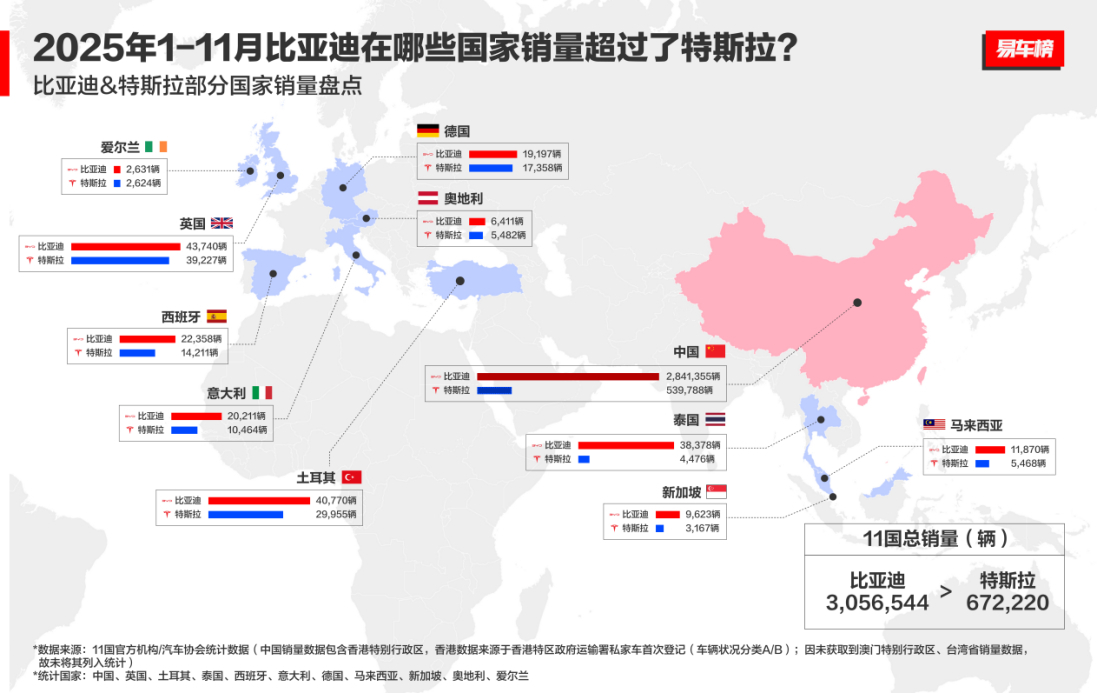
11月,比亚迪在巴西、土耳其、意大利、西班牙、匈牙利、克罗地亚等国拿下了新能源汽车销量第一,在新加坡等国家获得全品牌销冠。1-11月累计表现同 样不俗,在巴西、土耳其、西班牙、意大利等国,比亚迪位列新能源汽车品牌销量榜首;在新加坡、中国香港等地区市场荣膺全品牌销量第一,备受消费者 认可。 2025年1-11月,比亚迪在英国、德国、意大利、西班牙、奥地利、爱尔兰、马来西亚、土耳其、新加坡、泰国、中国等11个汽车核心国家市场,销量已经全 面超越特斯拉。凭借多元化产品矩阵,比亚迪精准契合了全球不同市场消费者的差异化需求。同时,通过推进自建滚装船、本地化生产、构建完善的服务体 系等一系列协同举措,为其海外拓展提供了坚实支撑。在这些出海策略的有力推动下,比亚迪出海狂飙全球领跑。 截至目前,比亚迪新能源汽车出海足迹累计已遍布119个国家和地区。在刚刚过去的12月18日,比亚迪举行了第1500万辆新能源汽车下线仪式,成为首家达 成这一里程碑的车企,标志着中国汽车工业正式迈入全球引领新阶段。以比亚迪为代表的中国汽车品牌不再是跟随者,而是推动新秩序建立的引领者。在这 场关乎全球未来出行变革的历史画卷中,中国汽车品牌正落笔生辉。 ...
德铁买中国巴士,德财长“恼火”
Huan Qiu Shi Bao· 2025-12-23 03:56
Group 1 - The core issue revolves around the German railway company, Deutsche Bahn, ordering over 3,300 buses, including approximately 200 electric intercity buses from the Chinese company BYD, which has sparked controversy in Germany [1][2] - German Vice Chancellor and Finance Minister, Christian Lindner, expressed frustration over Deutsche Bahn's decision, advocating for a preference for German and European brands in public procurement [1] - The order from Deutsche Bahn is valued at over 1 billion euros, with delivery scheduled between 2027 and 2032, primarily consisting of hybrid and electric models, with most buses supplied by MAN and a small portion by BYD [1] Group 2 - The announcement of this large order coincides with the EU's relaxation of the "fuel vehicle ban," raising concerns about the competitive position of German automotive manufacturers against Chinese electric vehicle advancements [2] - Lindner acknowledged the significant progress made by China in electric vehicle technology, attributing it to strong government support, and highlighted the challenges faced by German manufacturers in catching up [2] - Experts suggest that the EU's delay in enforcing the "fuel vehicle ban" may provide Chinese companies with more time to enhance their competitive edge in the automotive market [2]
见证历史!A股年成交额突破406万亿,19股年成交额超万亿
Xin Lang Cai Jing· 2025-12-23 03:18
Core Insights - The total trading volume of A-shares in 2025 has exceeded 406 trillion yuan, marking a historical high for the market [2][6] - The average daily trading volume reached 1.72 trillion yuan, also a record for the year [5][6] - Notable trading days included August 25, 27, 28, and September 18, where trading volumes surpassed 3 trillion yuan on four separate occasions, setting an annual record [5] Trading Volume Data - As of December 22, 2025, the total trading volume was 405.55 trillion yuan, with a daily trading volume of 18.82 billion shares and 188.22 billion yuan [3][7] - The trading volume for December 19 was 17.49 billion yuan, and for December 18, it was 16.77 billion yuan [3][7] - A total of 19 stocks have recorded trading volumes exceeding 1 trillion yuan this year, with companies like Zhongji Xuchuang, Dongfang Caifu, and Xinyisheng surpassing 2 trillion yuan [3][7] Individual Stock Performance - Zhongji Xuchuang (300308.SZ) recorded a trading volume of approximately 24.18 trillion yuan with a price increase of 402.48% [4][8] - Dongfang Caifu (300059.SZ) had a trading volume of about 23.40 trillion yuan but experienced a decline of 10.35% [4][8] - Xinyisheng (300502.SZ) achieved a trading volume of around 22.26 trillion yuan with a significant increase of 463.08% [4][8] - Other notable stocks include Hanwujing-U (688256.SH) with 19.04 trillion yuan and a 95.25% increase, and Ningde Times (300750.SZ) with 18.92 trillion yuan and a 43.79% increase [4][8]






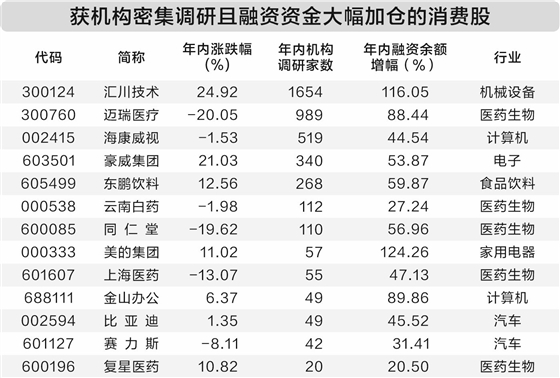
这些消费股获机构密集调研且融资资金大幅加仓(名单)
Zheng Quan Shi Bao Wang· 2025-12-23 01:20
Group 1 - The consumer sector shows signs of stabilization and rebound, with the Wind Consumer Index rising by 1.33% last Friday and continuing to increase by 0.13% on Monday [1] - The retail and dairy sectors have seen significant increases, with the Wind Retail Index up 7.44% and the Wind Dairy Index up 5.35% since December [2] - Over 20 ETFs related to consumption themes have seen a net inflow of over 2.2 billion yuan since December, with the Fortune CSI Tourism Theme ETF receiving nearly 1.4 billion yuan [2] Group 2 - The long-term growth resilience of China's consumer market is evident, with retail sales expected to rise from 39.1 trillion yuan in 2020 to 48.3 trillion yuan in 2024, averaging a growth rate of 5.5% [3] - The Wind Consumer Index has underperformed this year, with a year-to-date increase of only 5.34%, significantly lower than other popular indices [3] - The average price-to-earnings ratio of the Wind Consumer Index is 23.31, well below the 10-year average of 28.56 [3] Group 3 - Institutions predict that the total net profit of the Wind Consumer Index constituents will reach nearly 460 billion yuan in 2025, an increase of 8.63% from the previous year, with growth rates expected to exceed 14% in 2026 and 2027 [4] - The Wind Consumer Index and the Wind Domestic Demand Upgrade Index consist of 87 stocks across 12 industries, including pharmaceuticals, automotive, electronics, and food and beverage [4] - The average year-to-date increase for the 87 constituent stocks is over 29%, driven primarily by high-performing electronics and pharmaceuticals stocks [4] Group 4 - As of December 19, the total financing balance for the 87 constituent stocks is close to 320 billion yuan, an increase of over 45% from the end of last year, with more than 70% of the stocks seeing increased financing [4] - Thirteen stocks with a financing balance increase of at least 20%, over 20 institutional surveys, and a year-to-date increase of less than 25% are primarily in the pharmaceuticals, food and beverage, and home appliance sectors [4] Group 5 - Huichuan Technology, Mindray Medical, and Hikvision have received the highest number of institutional surveys this year, with Huichuan Technology's stock price increasing nearly 25% [5] - Mindray Medical has been surveyed by nearly 1,000 institutions, while Hikvision has received over 500 surveys [5] - Dongpeng Beverage has been surveyed by nearly 270 institutions, with a stock price increase of around 12% [5]