CATL(300750)

Search documents
锂电产业链双周报(2026年2月第2期):宁德亿纬等推出员工持股及激励计划,美国OBBBA法案细则更新
Guoxin Securities· 2026-02-23 10:45
Investment Rating - The investment rating for the lithium battery industry is "Outperform the Market" (maintained) [1] Core Insights - The lithium salt price has decreased, while the prices of battery cells have increased slightly. As of February 13, the price of lithium carbonate is 144,000 CNY per ton, down by 17,000 CNY from two weeks ago. The prices of ternary cathodes, lithium iron phosphate cathodes, electrolytes, and lithium hexafluorophosphate have also decreased, while the prices of anodes and separators remain stable. The prices for square ternary power cells, lithium iron phosphate power cells, and energy storage cells have increased slightly [2][3] - The solid-state battery industry is accelerating its commercialization, with the first national standard for automotive solid-state batteries expected to be reviewed and approved in April and officially released in July. Companies like Gotion High-Tech and BASF are collaborating to develop solid-state battery technology [3][10][11] - The domestic new energy vehicle sales in January 2026 reached 945,000 units, a slight year-on-year increase, while the penetration rate is 40.3%, up by 1.3 percentage points year-on-year [3][12] Industry Dynamics - The report highlights several leading companies in the lithium battery sector that are undervalued amid improving demand, including CATL, EVE Energy, and others. It also points to companies leading in low-altitude economy and robotics, solid-state and sodium battery materials, and charging pile industries [3] - The U.S. Treasury Department has updated details regarding the OBBBA Act, tightening certification for specific foreign entities and detailing the calculation of material assistance ratios [3][13][14] - The report notes significant investments in battery production projects, including an 80GWh project by Chuangneng in Wuhan and a 33 billion CNY investment by Penghui Energy for new battery production lines [10][18] Price Trends - The report provides a detailed overview of lithium battery material prices as of February 13, 2026, indicating a decrease in lithium carbonate prices by 10.4% compared to two weeks prior, while other materials like nickel sulfate and cobalt sulfate have shown varying price changes [19] - The price of square lithium iron phosphate batteries has increased by 1.5% to 0.336 CNY/Wh, while the price of square ternary power cells remains stable at 0.582 CNY/Wh [19]


宁德时代股价异动,纳入恒指与业绩稳健成主因
Jing Ji Guan Cha Wang· 2026-02-23 09:46
Group 1 - The core point of the article highlights the stock price movement of CATL, which rose by 3.14% to close at 542.50 HKD on February 23, 2026, influenced by its inclusion in the Hang Seng Index and strong market performance [1] - CATL's Q3 2025 report shows a robust performance with a net profit of 49.034 billion CNY, representing a year-on-year increase of 36.20%. The energy storage business is emerging as a second growth curve with a higher gross margin than power batteries [1] - The company is accelerating its global capacity expansion, with the first phase of its Hungary factory expected to be completed by the end of 2025, while domestic expansions in Shandong and Guangdong are ongoing [1] Group 2 - The stock market sentiment is positive, with technical indicators showing that the stock price is above the 20-day moving average and the MACD histogram is in positive territory [2] - A total of 16 institutions are covering CATL in February 2026, with 94% giving a "buy" or "hold" rating, and the average target price set at 619.99 HKD [2] - The termination of the equity swap transaction with Yongtai Technology is interpreted by the market as a reduction in cooperation uncertainty, contributing to a more favorable funding environment [1]
锂电产业链双周报(2026年2月第2期):宁德亿纬等推出员工持股及激励计划,美国OBBBA法案细则更新-20260223
Guoxin Securities· 2026-02-23 07:54
Investment Rating - The investment rating for the lithium battery industry is "Outperform the Market" (maintained) [1] Core Insights - The lithium salt price has decreased, while cell prices have increased. As of February 13, the price of lithium carbonate is 144,000 yuan/ton, down 17,000 yuan/ton from two weeks ago. The prices of ternary cathodes, lithium iron phosphate cathodes, electrolytes, and lithium hexafluorophosphate have also decreased, while the prices of anodes and separators remain stable. The prices for square ternary power cells, lithium iron phosphate power cells, and energy storage cells have increased slightly [2][3] - The solid-state battery industry is accelerating, with the first national standard for automotive solid-state batteries expected to be reviewed and approved in April and officially released in July. Companies like Gotion High-Tech and BASF are collaborating to develop solid-state battery technology [3][10] - The report suggests focusing on leading companies in the lithium battery industry with low valuations amid improving demand, including CATL, EVE Energy, and others [3] Industry Dynamics - The domestic new energy vehicle sales in January 2026 reached 945,000 units, a slight year-on-year increase but a 45% decrease month-on-month. The penetration rate of new energy vehicles in China is 40.3%, up 1.3 percentage points year-on-year [3] - In January 2026, new energy vehicle sales in nine European countries reached 205,200 units, a 20% year-on-year increase but a 37% month-on-month decrease. The penetration rate in Europe is 30.6%, up 7.1 percentage points year-on-year [3] - The U.S. saw new energy vehicle sales of 77,600 units in January 2026, a 31% year-on-year decrease and a 30% month-on-month decrease, with a penetration rate of 7.0% [3] Company Developments - CATL announced an employee stock ownership plan on February 9, 2026, with a total investment of no more than 743 million yuan, involving approximately 404,680 shares [3][15] - EVE Energy released its seventh stock option and restricted stock incentive plan on February 13, 2026, with a total of 150 million shares to be granted [3][18] - The U.S. Treasury Department updated details on the OBBBA Act on February 12, 2026, tightening certification for specific foreign entities and detailing the calculation of material assistance ratios [3][13][14] Market Performance - Over the past two weeks, the lithium battery sector has increased by 4.1%, while the battery chemicals sector has risen by 4.7%. The lithium-specific equipment sector has decreased by 1.8% [7] - Key stock price changes from February 8 to February 13 include a 1.0% decrease for CATL and a 12.3% increase for Enjie [7]
韩国“唯一领先战略技术”被中国反超
Guan Cha Zhe Wang· 2026-02-22 10:31
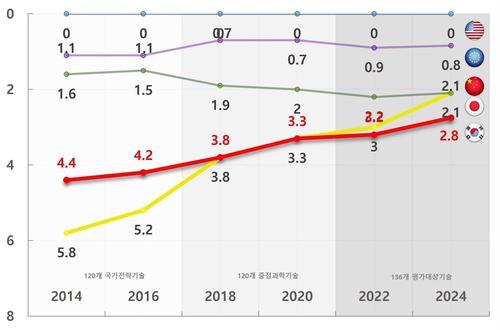
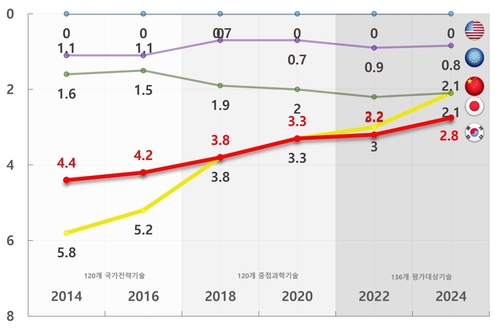
Core Insights - The technology gap between South Korea and China in key strategic sectors is widening, particularly in the secondary battery sector where China has overtaken South Korea [1][3] - South Korea's overall technology level is assessed at 82.8% compared to the United States, with a significant gap of 2.8 years behind the U.S. and 0.7 years behind China [3] Group 1: Technology Assessment - In the secondary battery sector, South Korea was leading by 0.9 years in 2022 but has now fallen behind China by 0.2 years in 2024 [1] - South Korea ranks second in the semiconductor and display sectors but is now lagging behind the U.S. by 0.7 years and China by 0.8 years [3] - The report evaluates 136 core technologies across 11 sectors, analyzing papers and patents from South Korea, China, Japan, Europe, and the U.S. [1] Group 2: Market Dynamics - The global market share of South Korean electric vehicle batteries has decreased from 35% in 2020 to 23% in 2023, with projections to drop further to 16% by October 2025 [5] - Despite a growing global electric vehicle market, the growth rate is expected to decline significantly from 25%-28% to around 15% by 2025 [4] - South Korean battery companies are facing intense competition from Chinese firms like CATL and BYD, which have a substantial lead in revenue and market share [5] Group 3: Domestic Market Disparities - The domestic market for South Korean secondary batteries is only about 2% of China's, with the energy storage market at just 1% of China's [6] - South Korean companies have over 90% of their production facilities located overseas, while Chinese companies like CATL and BYD have about 97% of their capacity concentrated domestically [6] - The market share of South Korean companies in Europe has dropped from over 60% in 2022 to below 40% recently due to strong competition from Chinese firms [6] Group 4: Material Dependency - South Korean battery manufacturers are heavily reliant on China for core materials that constitute 60% of the cost of secondary batteries [7] - Chinese companies dominate the global supply of four key materials used in battery production, holding an 80% market share [7]

韩媒称韩国“唯一领先战略技术”二次电池,被中国反超
Guan Cha Zhe Wang· 2026-02-22 10:27
Core Insights - The technology gap between South Korea and China in key strategic sectors is widening, particularly in the secondary battery field, where China has overtaken South Korea as of 2024 [1][3] - South Korea's overall technology level is assessed at 82.8% compared to the United States, with a significant gap of 2.8 years, while the gap with China has increased to 0.7 years [3] Group 1: Technology Assessment - In the secondary battery sector, South Korea was leading by 0.9 years in 2022 but has fallen behind China by 0.2 years in 2024 [1] - The evaluation covered 136 core technologies across 11 sectors, analyzing papers and patents from South Korea, China, Japan, Europe, and the United States [1] - South Korea's semiconductor and display sectors have also seen a decline, with a lag of 0.7 years behind the U.S. and 0.8 years behind China as of 2024 [3] Group 2: Market Dynamics - The global market share of South Korean electric vehicle battery manufacturers has decreased from 35% in 2020 to 23% in 2023, with projections of further decline to 16% by October 2025 [5] - Despite the growth in global electric vehicle sales, the growth rate is expected to drop significantly from 25%-28% to around 15% by 2025 [4] - South Korean battery companies are facing intense competition from Chinese firms like CATL and BYD, which have a substantial market presence [5] Group 3: Domestic Market Disparities - The domestic market for South Korean secondary batteries is only about 2% of China's, with the energy storage market at approximately 1% [6] - South Korean companies have over 90% of their production facilities located overseas, while Chinese firms like CATL and BYD have about 97% of their capacity concentrated domestically [6] - The market share of South Korean companies in Europe has dropped from over 60% in 2022 to below 40% recently due to strong competition from Chinese firms [6] Group 4: Material Dependency - South Korean battery manufacturers are heavily reliant on China for core materials that constitute 60% of secondary battery costs, with Chinese companies controlling around 80% of the global market for these materials [7]

崔东树:1月我国电池供需逐步改善 重卡电池暴增
智通财经网· 2026-02-22 06:12
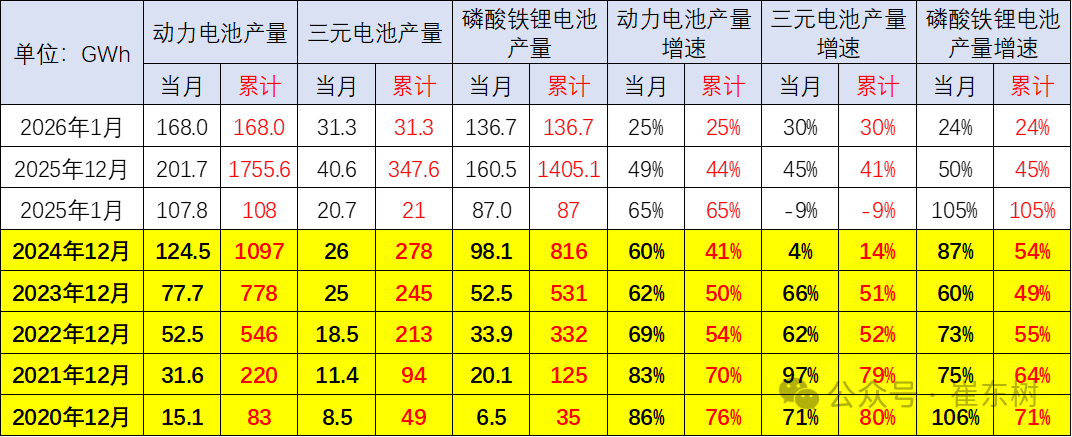
Core Insights - The overall performance of the power battery market in January 2026 is weak, with both exports and domestic sales showing mediocre results, leading to a decline in the growth rate of battery production from over 40% to 25% year-on-year [1][3][9] Group 1: Battery Production and Demand - In January 2026, the total production of power and other batteries reached 168 GWh, marking a 25% increase year-on-year [1] - The demand for installed batteries is heavily reliant on the surge in heavy-duty vehicle batteries due to high subsidies [1][3] - The installation rate of power batteries has decreased significantly, dropping to 25% in January 2026, with ternary batteries at 30% and lithium iron phosphate batteries at 24% [2][4] Group 2: Market Trends and Changes - The demand for batteries in the energy storage sector has increased rapidly, influenced by the global energy crisis stemming from the Russia-Ukraine conflict, leading to a notable decline in the proportion of installed batteries [3][8] - The growth rate of power batteries has lagged behind the growth of complete vehicles in 2021 and 2022, with a low installation rate expected for 2023 and 2024 [3][4] - The market for pure electric passenger vehicles continues to dominate, while plug-in hybrid passenger vehicles have risen to second place in terms of battery demand [7][8] Group 3: Competitive Landscape - The competitive landscape of battery manufacturers remains relatively stable, with the number of supporting battery companies at a low of 33 in January 2026 [10][11] - CATL's market share increased to 50.1% in the first quarter of 2026, while BYD's share decreased to 17.5%, indicating a significant concentration of market power among leading manufacturers [15] - The trend of vehicle manufacturers increasingly collaborating with battery producers is becoming more pronounced, suggesting a shift towards integrated supply chains in the industry [12][15]
低温、循环、成本:钠电为何可能吃下电动化下半场
高工锂电· 2026-02-21 11:49
Core Viewpoint - The article emphasizes the growing importance of sodium batteries in the electric vehicle (EV) market, particularly in cold climates, and suggests that sodium batteries will play a crucial role in the second half of the electrification process, alongside lithium batteries [4][5]. Group 1: Market Trends and Projections - According to the China Association of Automobile Manufacturers, by 2025, the share of new energy vehicles in total domestic car sales will exceed 50%, reaching 50.8%, with some months last year seeing penetration rates close to 60% [4]. - The article highlights the challenges faced by lithium batteries in northern markets, particularly regarding performance in low temperatures, which sodium batteries are well-suited to address [4][6]. Group 2: Sodium Battery Advantages - Sodium batteries have significant advantages in low-temperature scenarios and cycle life, making them particularly suitable for cold environments in northern regions [4][6]. - Testing conducted by CATL and Changan Automobile showed that vehicles equipped with sodium batteries maintained nearly three times the discharge power at -30°C compared to conventional lithium iron phosphate models, and over 90% capacity retention at -40°C [6]. Group 3: Commercialization and Product Development - CATL has been actively delivering sodium battery products and has a clear commercialization strategy, moving from commercial vehicle trials to passenger vehicle winter testing [7][8]. - The company has launched various sodium battery products, including those for heavy-duty trucks and passenger vehicles, and has emphasized the importance of low-temperature performance in its marketing [9][10]. Group 4: Strategic Partnerships and Infrastructure - CATL plans to establish over 3,000 battery swap stations across more than 140 cities by 2026, particularly in cold regions, to enhance the efficiency of sodium battery usage [11][12]. - The integration of sodium batteries with battery swap networks is expected to alleviate consumer concerns about range anxiety and open up new market opportunities [12][13]. Group 5: Supply Chain and Technological Synergies - The expansion into the sodium battery market is anticipated to drive significant changes in the supply chain, leveraging similarities between lithium and sodium supply systems [14][15]. - CATL's partnership with Rongbai Technology for sodium battery cathode materials is expected to boost production capacity significantly, with a projected 101% year-on-year increase in sodium battery cathode production by 2025 [16][17]. Group 6: Future Applications and Market Impact - CATL is expected to apply sodium batteries extensively in the energy storage sector by 2026, aligning with recent regulatory changes that reduce investment uncertainties in storage solutions [18][19]. - The introduction of new pricing mechanisms for independent storage systems is likely to enhance the investment appeal of sodium battery storage solutions [19][20].
美国1750亿美元关税退税,对A股的影响(附50股)
Sou Hu Cai Jing· 2026-02-21 11:41
Group 1 - The core point of the article is that the recent US Supreme Court ruling on the $175 billion tariff refund has significant implications for both China and the A-share market, despite the refund being an internal US matter [2][6][28] - The $175 billion in tariffs was primarily collected from imports, including a 10% tariff on Chinese goods, and is now being refunded to US importers [8][10] - The refund will indirectly benefit Chinese companies as US importers, who have been financially strained by tariffs, will use the refunded money to pay off debts to Chinese suppliers and resume orders [12][14][28] Group 2 - The immediate impact on the A-share market is expected to be positive, with a potential "opening red" for A-shares as market sentiment improves following the ruling [40][46] - The ruling is seen as a signal that the previous high tariffs on Chinese goods may not be a permanent state, which could lead to a more favorable environment for Chinese exports [20][48] - Structural opportunities in the A-share market are identified, focusing on five main lines: export-oriented sectors, domestic substitution, strategic resources, domestic consumption, and new energy [51][62][88] Group 3 - Export-oriented sectors, particularly those with high exposure to the US market, are expected to benefit directly from the tariff refunds, with companies like Midea Group and Haier expected to see improved performance [52][72][73] - Domestic substitution and self-sufficiency in sectors like semiconductors and military equipment are highlighted as long-term strategic focuses, with companies like SMIC and AVIC Shenyang Aircraft being key players [53][78][86] - Strategic resources such as rare earths and gold are also expected to see price support due to ongoing global supply chain disruptions, benefiting companies like Northern Rare Earth and Shandong Gold [56][87]




宁德时代终止股权置换交易,股价波动引关注
Jing Ji Guan Cha Wang· 2026-02-21 06:42
经济观察网 2026年2月中旬,宁德时代与永太科技的股权置换交易终止成为焦点。永太科技于2月14日 公告,因交易各方未能就方案达成一致,决定终止筹划以发行股份购买宁德时代持有的永太高新25%股 权。行业分析指出,天赐材料子公司诉永太科技商业秘密侵权,索赔金额达8.87亿元,是交易的主要障 碍,直接影响估值与合作信任。此外,宁德时代于2月16日被纳入恒生指数成分股,可能带来被动资金 配置。 股票近期走势 财报分析 根据2026年2月19日的市场解读,宁德时代2025年三季报显示稳健表现:前三季度归母净利润近500亿 元,同比增长显著;储能业务成为第二增长曲线,毛利率高于动力电池;经营现金流超800亿元,体现 强健的财务质量。分析认为,公司成本控制与产品结构优化支撑了盈利韧性。 以上内容基于公开资料整理,不构成投资建议。 宁德时代股价在2026年2月13日出现波动,收盘报365.34元,单日下跌2.80%,振幅3.19%;主力资金净 流出11.52亿元,换手率0.52%。同期,电力设备板块下跌2.03%,电池板块下跌1.59%。截至2月13日, 宁德时代5日涨跌幅为-1.02%,20日涨跌幅为3.70%,市盈率( ...
【兴证策略张启尧团队】2026年出海链有哪些投资机会?
Xin Lang Cai Jing· 2026-02-21 01:42
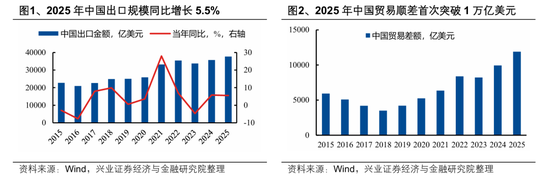
Group 1 - In 2025, China's foreign trade showed strong resilience, with total exports reaching a historical high, growing by 5.5% year-on-year, despite a complex external environment [1][57] - China's trade surplus exceeded $1 trillion for the first time, marking a significant increase of 19.8% year-on-year [1][57] - The net export of goods and services contributed 1.64 percentage points to GDP growth, the second-highest level since 2007, only behind 2021 [3] Group 2 - The diversification of external demand has strengthened, with emerging markets compensating for the decline in exports to the US, which fell by 19.79% year-on-year [6] - Exports to ASEAN, Africa, and the Middle East saw significant growth rates of 25.9%, 13.64%, and 9.7% respectively, contributing positively to the overall export scale [6] - The share of US exports in China's total exports decreased by 3.53 percentage points to 11.15% [6] Group 3 - The product structure of China's foreign trade is shifting towards higher value chains, with high-end products like electrical machinery, machinery, automobiles, and ships being the main export drivers [8] - Traditional light industrial products such as furniture and toys have seen a decline in export scale due to tariff friction and industrial chain relocation [8] Group 4 - The restructuring of global supply chains is creating significant opportunities for Chinese companies, with a notable increase in the number of Chinese enterprises establishing production capacities abroad, reaching 229 in 2025, nearly doubling from 2024 [18] - ASEAN, Mexico, and India are the primary destinations for Chinese production capacity outflows, with ASEAN covering a wide range of industries [18] Group 5 - The AI expansion cycle is a core focus in the Chinese capital market, with significant growth expected in AI computing hardware, supported by macro investment scales and healthy balance sheets of major tech companies [29][30] - The capital expenditure of major cloud service providers is projected to increase significantly, reflecting strong demand for AI computing [35] Group 6 - Cultural and technological value output is becoming a major trend for Chinese enterprises going abroad, with significant growth in IP exports and innovative products in sectors like gaming and new dining [39][41] - The Chinese innovative pharmaceutical sector is increasingly integrated into the global supply chain, with more products commercialized in the US and Europe [41] Group 7 - Key sectors with strong overseas expansion opportunities in 2026 include new energy (batteries, grid equipment), machinery, TMT (technology, media, telecommunications), and innovative pharmaceuticals [46] - The gaming industry is also highlighted for its potential, with significant overseas revenue growth expected [49]