Goldman Sachs(GS)

Search documents
高盛交易员:进入12月时,美股有了“更清晰的起点”
Hua Er Jie Jian Wen· 2025-11-28 00:29
Core Insights - A turbulent November has reset market positions and sentiment, providing a clearer path for U.S. stocks entering December [1] Group 1: Market Sentiment and Positioning - Prior to November, there was an overly optimistic sentiment in the market, with even long-term bears turning bullish, which led to significant market adjustments [2] - The adjustment was reflected in the internal market structure, with Goldman Sachs' unprofitable tech stock index dropping approximately 23% from peak to trough, and the most shorted stock basket declining about 29% [2] - The excessive bullish sentiment towards major tech stocks has cooled, with the options market showing a return to neutral positioning [6] Group 2: Market Breadth and Volatility - Market breadth has significantly improved, with the S&P 500's advancing/declining stock ratio moving from -150 to +150, indicating broader participation in market gains [8] - The Volatility Panic Index has decreased from its monthly high to 5, slightly above its three-year average of 4.6, signaling a cooling of panic sentiment [11] Group 3: Systematic Fund Flows and Investment Themes - Systematic funds have completed their de-risking process, with an estimated $16 billion sold in the S&P 500 over the past month, transitioning to a mild buying scenario of approximately $4.7 billion for the next month [13] - The investment theme around artificial intelligence (AI) is expanding, with companies in traditional sectors beginning to implement AI tools that enhance cost reduction and profit improvement [15] - Goldman Sachs has introduced a new stock basket index to capture the theme of "using AI rather than selling AI," reflecting a shift from narrative to measurable productivity [15]


高盛警示:裁员潮持续蔓延 美国就业市场疲软迹象加剧
Zhi Tong Cai Jing· 2025-11-27 23:59
Core Insights - Goldman Sachs warns that the U.S. labor market may be softening, with private sector data indicating a rising trend in layoffs across multiple industries [1] - WARN filings, which indicate planned mass layoffs, have surged to the highest level since 2016, excluding the pandemic spike, marking the most significant increase tracked by Goldman Sachs in nearly a decade [1] - The report highlights that layoffs in sectors such as technology, industrial products, and food and beverage are major contributing factors to this trend [1] Group 1 - The Challenger, Gray & Christmas data shows that corporate layoff announcements have reached unprecedented levels outside of recession periods, raising concerns about labor market weakness [1][2] - Goldman Sachs economists express that the increasing layoffs signal a worrying trend, as job seekers are finding it increasingly difficult to secure new employment [1][2] - Major companies, including Amazon, have announced significant job cuts, with Amazon planning to reduce approximately 14,000 positions to streamline operations and transition to artificial intelligence [1] Group 2 - WARN filings serve as an important indicator of employer behavior, suggesting that more companies are considering layoffs and efficiency improvements in the coming months [2] - Despite the rise in WARN notifications, initial jobless claims remain low, indicating that government reports may not fully reflect the deterioration of the job market [2] - There is ongoing concern about the impact of artificial intelligence on layoffs, but current evidence does not show that AI is a major driver of the recent wave of layoffs [2]
华尔街齐声看好新兴市场:2026将再迎强劲一年!
智通财经网· 2025-11-27 23:41
Group 1 - Major banks on Wall Street are preparing for another strong year in emerging markets, driven by a weak dollar and a surge in investments in artificial intelligence [1] - Emerging market bonds denominated in local currencies are expected to yield a 7% return, the best since 2020, with currency indices rising over 6% [1] - Morgan Stanley predicts that returns on local currency emerging market bonds will reach about 8% by mid-2026, while dollar-denominated emerging market bonds are expected to see "high single-digit" growth in the next 12 months [1] Group 2 - Other banks, including Bank of America and Goldman Sachs, also forecast a weakening dollar, with Bank of America predicting over 10% returns on local emerging market bonds next year, particularly recommending the Turkish lira and Brazilian real [2] - JPMorgan highlights significant corporate capital expenditure plans in artificial intelligence, predicting that by 2028, U.S. capital spending related to AI will reach $628 billion, impacting emerging markets through technology exports and rising metal prices [2] - JPMorgan expects $40 billion to $50 billion in inflows into emerging bond funds next year, driven by improved market sentiment and structural low holdings of emerging market assets [2]


Here's what big bank CEOs have said about AI's impact on head count
Yahoo Finance· 2025-11-27 19:41
Core Insights - The implementation of AI in banking is expected to enhance efficiency but also lead to job reductions, with executives acknowledging the need for adaptation in workforce strategies [2][4][22]. Group 1: Executive Perspectives on AI and Employment - Jamie Dimon, CEO of JPMorgan, stated that while AI will change job roles, it could also create new opportunities in cybersecurity and maintain or increase headcount if managed well [1][5]. - David Solomon, CEO of Goldman Sachs, emphasized that AI will allow the bank to afford more high-value employees, although it will also lead to a slowdown in hiring and potential job cuts [8][10]. - Jane Fraser, CEO of Citigroup, noted that generative AI is already improving productivity significantly, but expressed concern that it might negatively impact the job market before its benefits are fully realized [17][18]. Group 2: Expected Changes in Workforce - Marianne Lake, CEO of consumer and community banking at JPMorgan, projected a 10% reduction in headcount in operations by 2029 due to increased efficiency from AI [6]. - Charles Scharf, CEO of Wells Fargo, indicated that the bank has already reduced its workforce by nearly 25% since 2019 and expects this trend to continue, attributing it to inefficiencies [21][23]. - Brian Moynihan, CEO of Bank of America, acknowledged that while AI has reduced the size of some departments, the focus is on retraining employees for roles that AI cannot fulfill [25].


Goldman Sachs flags 'growing signs of weakness' in the US jobs market as layoffs mount
Business Insider· 2025-11-27 17:40
Core Insights - Goldman Sachs researchers indicate that the US labor market is showing signs of softening, with a notable increase in layoffs across various industries, marking the highest level of planned mass layoffs since 2016, excluding pandemic-related spikes [1][5] Layoff Trends - Layoff announcements have reached unprecedented levels outside of a recession, with significant cuts reported in sectors such as technology, industrial goods, and food and beverage [2] - The rise in layoffs is concerning as it reflects "growing signs of weakness" in the labor market, with workers facing challenges in securing new employment [3][4] WARN Notices - The increase in WARN notices, which are required for companies with over 100 employees before layoffs, serves as a key indicator of employer behavior and potential job cuts [5] - Publicly traded companies have begun discussing potential layoffs during earnings calls, suggesting a trend towards workforce reductions and efficiency measures in the near future [6] Jobless Claims and Economic Indicators - Despite the rise in layoffs, weekly jobless claims remain low, indicating that government reports may not yet fully capture the labor market's deterioration [7] - Historical data shows that jobless claims typically lag behind private layoff trackers by about two months, hinting at a possible increase in federal job loss data as winter progresses [7] Impact of AI on Employment - Concerns about artificial intelligence leading to workforce reductions are present, but current evidence does not support the notion that AI is a significant driver of recent layoffs [8]

[DowJonesToday]Dow Jones Market Update: Thanksgiving Holiday Sees US Markets Closed, Rate Cut Hopes Drove Wednesday’s Rally
Stock Market News· 2025-11-27 14:09
Market Overview - The U.S. stock market is closed on November 27, 2025, for Thanksgiving, with trading resuming on November 28, 2025, in a shortened session [1] - The latest market data reflects performance from November 26, 2025, where the Dow Jones Industrial Average rose by 314.67 points (0.6679%) to reach 47,427.12 [1] Market Drivers - Investor optimism regarding potential interest rate cuts by the Federal Reserve in December and renewed enthusiasm for the artificial intelligence (AI) sector drove the market rally [2] - This positive sentiment contributed to a four-day winning streak for benchmark indices, helping to recover earlier losses in November [2] - Global markets also benefited from the anticipation of rate cuts, despite the U.S. markets preparing for the holiday closure [2] Stock Performance - Boeing (BA) led the Dow components with a gain of 2.46%, reaching $186.92 [3] - Walmart (WMT) increased by 2.07% to $109.10, and Microsoft (MSFT) rose by 2.04% to $485.50 [3] - Financial institutions performed well, with Goldman Sachs (GS) climbing 1.71% to $816.01 and JPMorgan Chase (JPM) up 1.64% to $307.64 [3] - Conversely, Salesforce (CRM) was the biggest laggard, down 2.51% to $228.15, followed by Merck (MRK) down 0.73% to $104.63, and Honeywell (HON) decreasing 0.43% to $189.99 [3]




Goldman Sachs Stock: Is GS Outperforming the Financial Sector?
Yahoo Finance· 2025-11-27 13:59
New York-based The Goldman Sachs Group, Inc. (GS) is a financial institution that provides a range of financial services for corporations, financial institutions, governments, and high-net-worth individuals. With a market cap of $240.6 billion, the company specializes in investment banking, trading and principal investments, asset management and securities services. Companies worth $200 billion or more are generally described as “mega-cap stocks,” and GS definitely fits that description, with its market c ...
机构看金市:11月27日
Sou Hu Cai Jing· 2025-11-27 06:23
Core Viewpoint - The gold market is experiencing a complex interplay of bullish and bearish factors, leading to price fluctuations at high levels, with expectations of interest rate cuts from the Federal Reserve providing core support for gold prices [1][2]. Group 1: Market Dynamics - The market's expectation for a 25 basis point rate cut by the Federal Reserve in December has risen significantly from approximately 30%-40% to over 80% due to supportive comments from key officials [1]. - Geopolitical developments, such as progress in Russia-Ukraine negotiations, have diminished gold's appeal as a safe-haven asset, contrasting with the dovish shift in the Federal Reserve's monetary policy [1]. - Despite short-term adjustments, the long-term drivers for gold and silver prices remain robust, supported by macroeconomic factors such as sovereign debt issues and central bank gold purchases [2]. Group 2: Price Predictions - Goldman Sachs forecasts that gold prices could reach $4,900 per ounce next year, driven by sustained demand from central banks and ETFs, as well as a potential influx of retail investors seeking diversification [3]. - Deutsche Bank has raised its gold price forecast for 2026 from $4,000 to $4,450 per ounce, citing stable investor flows and strong central bank demand, while also noting that total demand continues to exceed supply [4]. - The bank predicts that ETF inflows will help maintain a price floor of $3,900 for gold in the coming year, although risks remain regarding the correlation between gold and risk assets [4].

高盛:2026年别只盯着AI,更看好医疗保健和海外股票
Sou Hu Cai Jing· 2025-11-27 06:17
Core Insights - The article highlights that "AI" has become a central theme in global stock markets over the past two years, with executives discussing its impact and investors flocking to companies benefiting from the AI trend [1] - Goldman Sachs' Greg Calnon expresses a belief that while the US stock market is expected to continue its upward trend next year, AI-related stocks may not be among the outperformers [1] - Calnon is optimistic about the overall market outlook for risk assets, citing favorable factors such as potential interest rate cuts by the Federal Reserve [1] Investment Opportunities - Calnon identifies three sectors that may present good investment opportunities outside of AI: small-cap stocks, healthcare stocks, and international equities [1]
如果俄乌达成协议,油价会跌多少?
Hua Er Jie Jian Wen· 2025-11-27 05:49
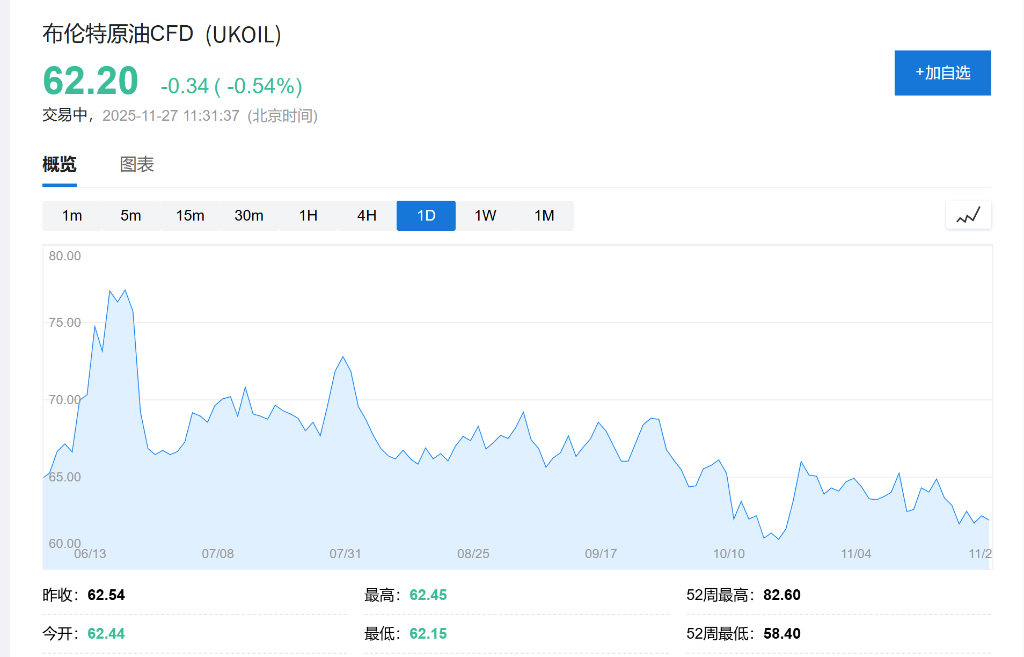
Core Viewpoint - Goldman Sachs' latest report quantifies the potential impact of a peace agreement on oil prices, indicating that the downside risk for refined oil is significantly greater than for crude oil [2][3] Group 1: Market Expectations and Price Projections - As of November 26, 2025, Brent crude oil prices have fallen to $62 per barrel, with European diesel crack spreads plummeting nearly 25% to $28 per barrel due to market expectations of peace negotiations between the U.S. and Russia [3] - In Goldman Sachs' baseline scenario, Russian liquid fuel production is projected to decline from 10.1 million barrels per day (mb/d) in Q4 2025 to 9.0 mb/d by the end of 2027, driven by ongoing drone attacks on Russian energy infrastructure and low oil prices [3] - Even without a peace agreement, strong non-Russian supply is expected to push Brent/WTI prices down to $56/$52 per barrel by 2026 [3] Group 2: Impact of Peace Agreement on Oil Prices - If a peace agreement is reached and sanctions on the Russian oil industry are lifted, Goldman Sachs estimates that Brent oil price forecasts for 2026 could be adjusted down by $4-$5 per barrel due to the gradual recovery of Russian production and the release of floating storage inventories [4][5] - Two recovery scenarios are outlined: a slow recovery maintaining production at 10.1 mb/d until 2027, leading to average Brent prices of $52/$58 for 2026/2027, and a rapid recovery returning to pre-war levels of 11.3 mb/d by the end of 2027, resulting in average prices of $51/$54 [6] Group 3: Refined Oil Price Risks - The impact of a peace agreement on refined oil prices is expected to be more direct and severe, with diesel margins projected to drop by $6-$8 per barrel if negotiations succeed [7][9] - The current risk premium for European diesel is estimated to include $7 per barrel above the physical fundamentals, indicating a significant adjustment could occur if sanctions are lifted and shipping costs normalize [9] Group 4: Trading Strategies - Goldman Sachs recommends shorting the Brent crude oil calendar spread from Q3 2026 to December 2028, reflecting a view on oversupply in 2026 [10] - Oil producers are advised to hedge against price declines in 2026, while consumers should consider the potential price drop in 2026 as an opportunity to hedge against future price increases starting in 2028 [10]