
Goldman Sachs(GS)

Search documents
外资“唱多”中国资产,硬科技成为新坐标
2 1 Shi Ji Jing Ji Bao Dao· 2025-11-28 13:36
Core Viewpoint - Foreign institutions are showing a significant shift in attitude towards Chinese technology stocks, with major investment banks like UBS, Goldman Sachs, Morgan Stanley, and JPMorgan expressing bullish views on the sector [1][3][4]. Group 1: Market Outlook - UBS has set a target for the Hang Seng Tech Index at 7100 points for the end of 2026, representing a nearly 27% increase from the closing price of 5599 points on November 28 [3]. - Morgan Stanley has raised its target for the CSI 300 Index to 4840 points by December 2026, indicating a stable growth outlook for Chinese stocks amid moderate earnings growth [4]. - JPMorgan has upgraded its rating on Chinese stocks to "overweight," suggesting a higher likelihood of significant gains in the coming year, particularly driven by AI adoption and consumption stimulus [4]. Group 2: Foreign Capital Inflow - In the first ten months of 2025, foreign capital inflow into the Chinese stock market reached $50.6 billion, significantly surpassing the $11.4 billion for the entire year of 2024, marking an increase of over three times [5]. - The technology sector has become a focal point for foreign investment, with foreign holdings in the electronics sector increasing, reaching a market value of 391.5 billion yuan by September 30, 2025 [5]. - Notable increases in foreign investment have also been observed in the new energy sector, with holdings in CATL rising to 265.66 billion yuan, an increase of over 100 billion yuan from the previous quarter [5]. Group 3: Investment Strategies - Foreign investors are focusing on structural allocations in the technology sector, particularly in semiconductors, AI applications, and communication equipment [5][6]. - The trend of foreign limited partners (LPs) returning to the Chinese primary market is evident, with significant investments being made in the hard technology sector, especially in AI [6][7]. - AI has emerged as a core investment focus, with various funds targeting early-stage AI projects and related sectors, indicating a long-term strategic shift rather than short-term speculation [7][8]. Group 4: Future Expectations - Experts believe that the trend of increasing foreign allocation to Chinese technology stocks is likely to continue, driven by ongoing economic recovery and innovation momentum in China [8]. - The focus on AI applications, semiconductors, and electronic components is expected to attract further foreign investment, as China develops its autonomous computing ecosystem [8].


X @The Wall Street Journal
The Wall Street Journal· 2025-11-28 11:04
Few people make partner at Goldman. Two brothers doing it within two years of each other is even more unusual. https://t.co/EyRsGtCRoD ...
JP Morgan, Goldman Sachs Predict Fed Will Cut Rates In December - SPDR S&P 500 (ARCA:SPY)
Benzinga· 2025-11-28 09:00
Core Viewpoint - JP Morgan and Goldman Sachs have adjusted their interest rate forecasts, now predicting a quarter-point cut by the Federal Reserve after its upcoming meeting on December 9-10 [1][2]. Group 1: JP Morgan's Shift in Outlook - JP Morgan has reversed its earlier stance of pausing rate cuts until January, influenced by recent comments from central bank officials [2]. - Chief U.S. economist Michael Feroli indicated that the latest communications from the Fed increase the likelihood of a rate cut in the near term [2]. - The bank had previously retracted its December forecast due to volatility in September's job data but has now reinstated its outlook [3]. Group 2: Goldman Sachs' Agreement - Goldman Sachs has aligned with JP Morgan's revised forecast, suggesting that previous employment reports may have solidified the expectation of a 25 basis points cut [3]. Group 3: Fed Officials' Signals - New York Fed President John Williams has indicated that current monetary policy is "modestly restrictive" and sees potential for further adjustments to achieve a neutral stance [3]. - Williams noted that inflation has stalled around 2.75%, while the labor market has returned to pre-pandemic conditions, with increased downside risks to employment [4]. Group 4: Market Sentiment - Market sentiment reflects a strong belief in a rate cut, with traders pricing in an approximately 84.7% chance of a cut according to CME Group's FedWatch tool [5]. - Despite some internal disagreements within the Fed, the consensus appears to favor a standard cut to mitigate economic harm [6]. Group 5: Market Reactions - Following the Thanksgiving holiday, major indices such as Dow Jones, S&P 500, and Nasdaq 100 saw positive trading, with the SPDR S&P 500 ETF Trust (SPY) up 0.69% and Invesco QQQ Trust ETF (QQQ) up 0.88% [6][7].

印度股市,创历史新高
第一财经· 2025-11-28 08:34
Core Viewpoint - The Indian stock market is experiencing a resurgence, with both the Nifty 50 and Sensex indices reaching historical highs due to factors such as corporate earnings recovery, favorable fiscal and monetary policies, and positive economic outlooks [4][5][6]. Group 1: Market Performance - On November 27, the Nifty 50 index rose by 0.4% to 26,310.45 points, while the Sensex index increased by 0.5% to 86,055.86 points, marking a significant rebound [5]. - The market is expected to see nearly 7% economic growth in Q3 of this year, with an overall growth forecast of 6.8% for the fiscal year ending March 2026 [5]. Group 2: Factors Driving Growth - Key drivers for the stock market rebound include early signs of corporate earnings recovery, valuation corrections, and supportive fiscal and monetary policies [5][6]. - The Nifty index's 12-month forward P/E ratio is currently at 22.7, down from 23-25 a year ago, indicating a narrowing gap between corporate earnings and stock valuations [6]. Group 3: Institutional Insights - Goldman Sachs has upgraded its rating on the Indian stock market to "overweight," citing four main reasons: policy support, earnings recovery, low foreign investment positions, and defensive valuations [7][9]. - The report highlights that the Indian central bank has implemented several easing measures, including interest rate cuts and tax reductions, which are expected to stimulate economic growth and consumer spending [7]. Group 4: Future Projections - Goldman Sachs predicts that the Nifty 50 index will rise by 14% to 29,000 points by the end of 2026, with a focus on sectors related to domestic themes such as finance, consumer goods, and defense [9]. - JPMorgan also forecasts the Nifty 50 index could reach 30,000 points by the end of 2026, driven by anticipated interest rate cuts and improved domestic demand [10][11].

「我曾家财万贯,也经历过三度破产」隐居房车的高盛前MD:「我对高盛并无怨言」
Xin Lang Cai Jing· 2025-11-28 05:43
Core Insights - The article discusses the life and experiences of Christian Alexander, a former managing director at Goldman Sachs, who has faced significant personal and financial challenges, including multiple bankruptcies and struggles with addiction [4][5][6]. Group 1: Personal Journey - Christian Alexander reflects on his past, stating he once had a bank account with $3 million but has also faced overdrafts of $300, illustrating the volatility of his financial situation [4]. - He estimates spending $500,000 on cocaine over several years, highlighting the severity of his addiction during his tenure at Goldman Sachs [5][6]. - After leaving Goldman Sachs in 2013, Alexander transitioned through various roles in banking but ultimately struggled with alcohol addiction, which persisted despite changes in his career [6][7]. Group 2: Career Background - Alexander worked at Goldman Sachs for nearly 14 years, with assignments in major financial hubs including New York, London, Hong Kong, and Tokyo, and was considered a top employee with potential for partnership [6][10]. - Following his departure from Goldman Sachs, he held positions at JPMorgan and Société Générale before moving into headhunting, where he experienced a rise in income but continued to battle personal demons [6][7]. - He has since become a freelance writer and is involved in the macro hedge fund industry, indicating a shift in his professional focus [8][10].

黄金暴涨57%仍未见顶?华尔街投行齐声看多:2026年或再涨20%,冲击5000美元
Sou Hu Cai Jing· 2025-11-28 04:13
Core Viewpoint - Gold prices experienced a slight decline after reaching a near two-week high, as investors assess the likelihood of a Federal Reserve rate cut in December, with market bets on rate cuts increasing significantly [1][6]. Market Performance - Spot gold fell by 0.1%, trading around $4158 [2]. - Since hitting a record high of $4381.21 on October 20, gold has retreated approximately 5% but remains above the critical $4000 level [4]. Analyst Insights - Carsten Menke from Julius Baer expects the consolidation in gold prices to continue, as the effects of the previous correction have not been fully digested [4]. - Factors supporting gold prices include a slowing U.S. economy leading to lower interest rates, a weak dollar, ongoing safe-haven demand, and strong central bank purchases [4]. Federal Reserve Signals - The Federal Reserve has sent mixed signals regarding the timing and extent of rate cuts, increasing demand for hedging in overnight interest rate-related options and derivatives [4]. - The probability of a rate cut in December has surged to 85%, up from 30% a week prior, according to CME FedWatch data [6]. Future Price Predictions - Bank of America projects a target price of $5000 per ounce for gold, indicating a potential increase of 19% from current levels, driven by persistent fundamental forces [8]. - Goldman Sachs anticipates a price of $4900 per ounce by the end of next year, reflecting a 17% increase [9]. - Deutsche Bank forecasts gold could reach $4950 per ounce by 2026, suggesting an 18% upside potential [13]. - HSBC offers a more moderate outlook, predicting gold prices will fluctuate between $3600 and $4400 per ounce by 2026, with the upper limit indicating a 5% increase [15]. Demand Drivers - Central bank purchases are expected to remain strong, particularly as countries seek to diversify reserves in light of geopolitical tensions [10][12]. - The anticipated global rate cuts are expected to enhance the appeal of non-yielding assets like gold [11].


摩根大通:2027年油价或跌破每桶40美元大关
Zhong Guo Hua Gong Bao· 2025-11-28 03:09
Group 1 - Morgan Stanley predicts that Brent crude oil prices may drop to over $30 per barrel by 2027 due to severe market oversupply issues [1] - Brent crude oil prices have fallen by 14% this year, stabilizing at $62.59 per barrel as of November 24 [1] - Analysts are closely monitoring potential peace negotiations in Ukraine, which could lead to a relaxation of sanctions on Russia and further downward pressure on energy prices [1] Group 2 - Goldman Sachs forecasts that oil prices will continue to decline from current levels, with West Texas Intermediate crude oil averaging $53 per barrel in 2026 [2] - Goldman Sachs anticipates a daily oversupply of 2 million barrels in 2026, indicating a significant market imbalance [2] - The firm suggests that 2026 will mark the end of the current large-scale oil supply shock affecting the market [2]
国际黄金期货价格小幅收跌,高盛将黄金列为最推荐做多的大宗商品
Huan Qiu Wang· 2025-11-28 01:00
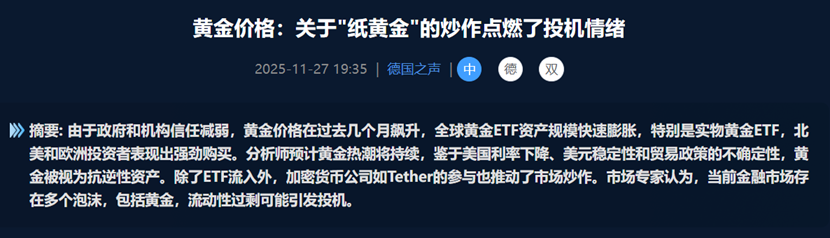
Core Viewpoint - The international precious metals futures market is experiencing mixed results, with COMEX gold futures declining by 0.3% and COMEX silver futures increasing by 0.41, driven by expectations of Federal Reserve rate cuts, a weaker dollar, and varying industrial demand [1][2]. Group 1: Market Analysis - Analysts suggest that the recent surge in gold prices indicates a weakening trust in the U.S. government and institutions [1]. - Martin Siegert from Baden-Württemberg Bank anticipates that the current gold trend will continue, citing strong inflows into gold ETFs as a key supporting factor [1]. - The World Gold Council reported a 6% increase in global gold ETF assets from $472 billion in September to $503 billion in October, with a significant monthly inflow of $82 billion in October, surpassing the average monthly inflow of $71 billion for the year [2]. Group 2: Future Projections - Goldman Sachs has identified gold as the most recommended commodity to go long on, with expectations that gold prices could rise to $4,900 per ounce by late next year, driven by central bank purchases and declining interest rates [2].
高盛交易员:进入12月时,美股有了“更清晰的起点”
Hua Er Jie Jian Wen· 2025-11-28 00:29
Core Insights - A turbulent November has reset market positions and sentiment, providing a clearer path for U.S. stocks entering December [1] Group 1: Market Sentiment and Positioning - Prior to November, there was an overly optimistic sentiment in the market, with even long-term bears turning bullish, which led to significant market adjustments [2] - The adjustment was reflected in the internal market structure, with Goldman Sachs' unprofitable tech stock index dropping approximately 23% from peak to trough, and the most shorted stock basket declining about 29% [2] - The excessive bullish sentiment towards major tech stocks has cooled, with the options market showing a return to neutral positioning [6] Group 2: Market Breadth and Volatility - Market breadth has significantly improved, with the S&P 500's advancing/declining stock ratio moving from -150 to +150, indicating broader participation in market gains [8] - The Volatility Panic Index has decreased from its monthly high to 5, slightly above its three-year average of 4.6, signaling a cooling of panic sentiment [11] Group 3: Systematic Fund Flows and Investment Themes - Systematic funds have completed their de-risking process, with an estimated $16 billion sold in the S&P 500 over the past month, transitioning to a mild buying scenario of approximately $4.7 billion for the next month [13] - The investment theme around artificial intelligence (AI) is expanding, with companies in traditional sectors beginning to implement AI tools that enhance cost reduction and profit improvement [15] - Goldman Sachs has introduced a new stock basket index to capture the theme of "using AI rather than selling AI," reflecting a shift from narrative to measurable productivity [15]

高盛警示:裁员潮持续蔓延 美国就业市场疲软迹象加剧
Zhi Tong Cai Jing· 2025-11-27 23:59
Core Insights - Goldman Sachs warns that the U.S. labor market may be softening, with private sector data indicating a rising trend in layoffs across multiple industries [1] - WARN filings, which indicate planned mass layoffs, have surged to the highest level since 2016, excluding the pandemic spike, marking the most significant increase tracked by Goldman Sachs in nearly a decade [1] - The report highlights that layoffs in sectors such as technology, industrial products, and food and beverage are major contributing factors to this trend [1] Group 1 - The Challenger, Gray & Christmas data shows that corporate layoff announcements have reached unprecedented levels outside of recession periods, raising concerns about labor market weakness [1][2] - Goldman Sachs economists express that the increasing layoffs signal a worrying trend, as job seekers are finding it increasingly difficult to secure new employment [1][2] - Major companies, including Amazon, have announced significant job cuts, with Amazon planning to reduce approximately 14,000 positions to streamline operations and transition to artificial intelligence [1] Group 2 - WARN filings serve as an important indicator of employer behavior, suggesting that more companies are considering layoffs and efficiency improvements in the coming months [2] - Despite the rise in WARN notifications, initial jobless claims remain low, indicating that government reports may not fully reflect the deterioration of the job market [2] - There is ongoing concern about the impact of artificial intelligence on layoffs, but current evidence does not show that AI is a major driver of the recent wave of layoffs [2]