LI AUTO(LI)

Search documents
日产N6、别克至境世家、新款蓝电E5上市!小鹏联手华为推出下一代增程发电机!多款新车登录工信部!11月车企销量公布!丨一周大事件
电动车公社· 2025-12-07 16:05
New Car Launches - Dongfeng Nissan N6 launched with a limited-time price of 91,900 to 121,900 yuan, featuring a hybrid system with a 75kW engine and a 155kW motor, offering a pure electric range of 170-180 km [1][3][9] - New Blue Energy E5 Plus launched at a limited-time price of 119,800 yuan, equipped with a 70kW engine and a 160kW motor, providing a pure electric range of 230 km [1][12][17] - Buick Zhijing Shijia launched with a price range of 439,900 to 469,900 yuan, featuring a 132kW engine and a dual-motor system, offering a pure electric range of 224 km [1][20][25] Company Dynamics - Xiaomi Auto has surpassed 500,000 cumulative deliveries, achieving its annual target ahead of schedule [1][28][29] - XPeng Motors collaborates with Huawei to launch a next-generation range extender generator with over 92% efficiency [1][32][35] - Changan Automobile is set to roll out its 30 millionth vehicle, becoming the first Chinese brand to reach this milestone [1][36][40] Sales Performance - BYD sold 474,921 passenger vehicles in November, maintaining a leading position in the new energy sector [1][71][73] - Changan Automobile's November sales reached 283,000 units, with over 125,000 in new energy vehicles [1][76][79] - SAIC-GM-Wuling achieved 118,726 new energy vehicle sales in November, marking three consecutive months of over 100,000 units sold [1][81] - Chery's new energy vehicle sales reached 116,794 units in November, continuing its growth trend [1][82][86] - Hongmeng Zhixing delivered 81,864 units in November, benefiting from increased production capacity [1][87][90] - Leap Motor delivered 70,327 units in November, showing strong market performance [1][91][92] - Great Wall Motors sold 40,113 new energy vehicles in November, reflecting a significant growth in its transition to new energy [1][95][96] - XPeng Motors delivered 36,728 units in November, with a year-to-date growth of 156% [1][98][99] - NIO delivered 36,275 units in November, with a notable increase in sales [1][100][106] - Li Auto delivered 33,181 units in November, maintaining a positive outlook despite market pressures [1][107][109] - Deep Blue Automotive delivered 33,060 units in November, with strong performance from its S05 model [1][111][113] - BAIC New Energy sold 32,328 units in November, with a significant year-on-year increase [1][114][115] - Lantu Automotive delivered 20,005 units in November, marking a strong sales milestone [1][116][118] - FAW Bestune sold 15,793 new energy vehicles in November, with a focus on young consumers [1][119][123] - Avita delivered 14,057 units in November, achieving a historical high [1][124][125] - Zhiji delivered 13,577 units in November, with a focus on expanding its product line [1][126][128] - Jishi Automotive delivered 1,452 units in November, showing steady growth in international markets [1][129][132] Industry News - A new national standard for steer-by-wire technology has been released, removing mandatory mechanical connections [2][133][135] - Global penetration of new energy vehicles is on the rise, projected to reach 25.2% by Q4 2025 [2][138][140] - South Korea's automotive exports have declined for the first time in recent years, with a forecasted drop in total exports [2][143][145]







微博1301万博主描述接理想商务
理想TOP2· 2025-12-07 14:34
Group 1 - The article discusses the recent engagement of a social media influencer with the automotive brand Li Auto, highlighting that the influencer has only promoted this brand in the past year [1] - The influencer has successfully recommended several vehicles from Li Auto to friends and followers, resulting in actual purchases, which the influencer believes have generated enough profit to justify the advertising costs [1] - The influencer emphasizes the importance of personal integrity and ethical standards in their role as a future brand ambassador, stating that they must lead by example in their recommendations [1] Group 2 - The article mentions a call for deeper discussions regarding the actual operational status and long-term fundamentals of Li Auto, indicating a focus on community engagement rather than technical or casual car enthusiast discussions [2]

11月新势力榜单:蔚来困于盈利,理想反弹乏力
Feng Huang Wang Cai Jing· 2025-12-07 14:03
Core Insights - The delivery rankings of new car manufacturers have undergone significant changes in November, with a reshuffling of positions following the "golden September and silver October" period [1] Group 1: Delivery Rankings - Hongmeng Zhixing topped the delivery chart with 81,864 units, achieving a year-on-year growth of 90% and a month-on-month increase of 20% [2][3] - Leap Motor maintained its position as the "single brand champion" with 70,327 units delivered, marking its second consecutive month above 70,000 [4] - Xiaomi entered the top three with over 40,000 units, while BYD's Fangchengbao emerged as a dark horse with 37,405 units [5] Group 2: Competitive Landscape - In the second tier, brands like Xiaopeng (36,728 units) and NIO (36,275 units) are in close competition, with Ideal (33,181 units) and Deep Blue (33,060 units) also in the mix [5][21] - Zeekr accelerated its growth with 28,843 units, while Lantu broke the 20,000 mark for the first time [6] Group 3: Financial Performance and Market Challenges - Despite high delivery numbers, companies like Leap Motor face challenges in profitability, with a net profit of 150 million yuan in Q3, down 8% from the previous quarter [12][13] - Xiaomi's automotive division reported a 700 million yuan operating profit in Q3, making it the fastest to achieve profitability among new forces, yet its stock price has been under pressure due to negative publicity [14][15] - NIO's stock fell 20% in November after lowering its Q4 delivery guidance, indicating challenges in meeting profitability targets [24][30] Group 4: Strategic Adjustments - Xiaopeng is transitioning to a dual strategy of pure electric and range-extended vehicles, with plans to launch three new range-extended models in Q1 next year [19][20] - NIO is focusing on high-end models to improve overall gross margins, while also facing pressure to enhance profitability [22][26] - Ideal is adjusting its organizational structure and technology to address ongoing challenges, with a focus on ramping up production of its new electric model [28][30]



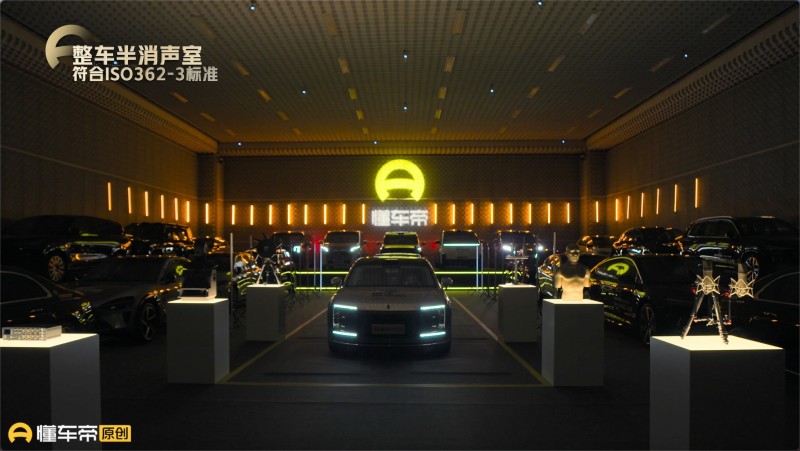
50款顶流车型静谧性对比,国产新能源车隔音全面领先
Sou Hu Wang· 2025-12-07 12:50
Core Insights - The article highlights the increasing importance of cabin quietness and in-car audio systems as core elements defining the comfort of the "mobile third living space" for consumers [1][6] - The launch of the "Dongche Voice Academy" by Dongche Di aims to help consumers better understand vehicle sound insulation levels and audio technology through comprehensive testing of 50 popular models [1][3] Group 1: Testing and Results - The testing involved collaboration with authoritative testing organizations and well-known music producers, focusing on various dimensions such as driving noise, static insulation, and subjective audio quality [1][3] - Results indicate that domestic electric vehicles excel in acoustic performance, with key indicators like driving noise and static insulation matching or surpassing those of foreign brands [1][3] - 80% of the five-star rated models were from domestic brands, and 90% of models with driving noise below 50 dBA were also from domestic brands, showcasing the maturity of domestic automakers in acoustic tuning [3][4] Group 2: Comparative Performance - In cross-brand comparisons, models like the Yangwang U8 and Xiaomi YU7 demonstrated outstanding performance in dynamic and static insulation, respectively, with no significant differences in acoustic experience compared to luxury brands [4][6] - Continuous investment in sound insulation materials, acoustic structure design, and proprietary algorithm development has allowed mainstream domestic brands to reach the acoustic quality of traditional luxury brands [4][7] Group 3: Consumer Insights - The study provides valuable insights for consumers regarding audio quality and quietness when purchasing new vehicles, emphasizing that price is not the sole determinant of audio performance [6][7] - The correlation between vehicle price and audio quality is not absolute, as demonstrated by the Lynk & Co 900, which offers high-quality audio performance at a lower price point [6][7] - The article suggests that the core value of in-car audio systems lies in technical adaptation and meeting consumer needs rather than merely the number of speakers or power ratings [7]
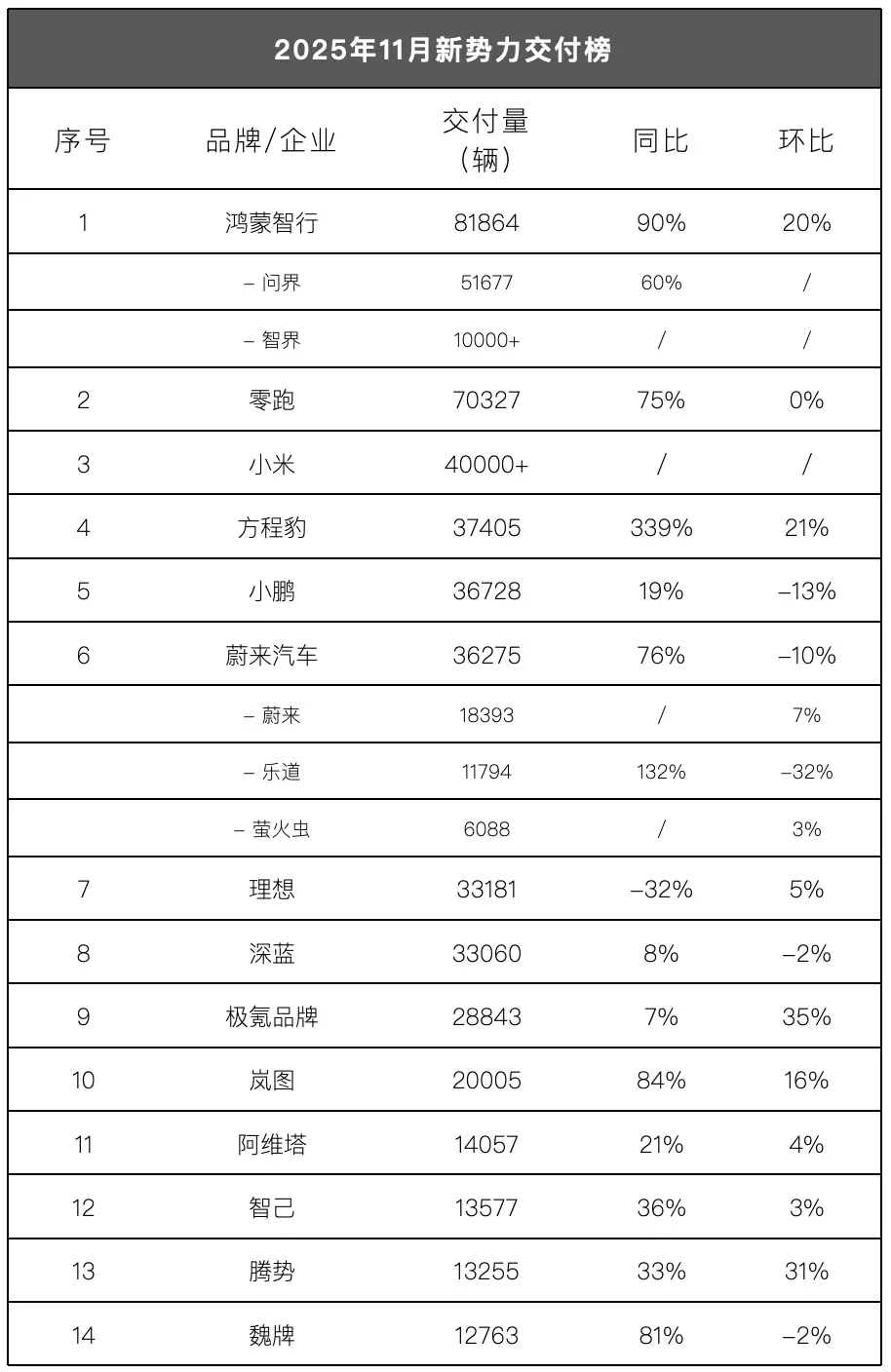
11月新势力榜单:蔚来困于盈利,理想反弹乏力
凤凰网财经· 2025-12-07 12:07
Core Viewpoint - The delivery rankings of new car manufacturers have undergone significant changes in November, with a reshuffling of positions following the "golden September and silver October" period, highlighting the competitive landscape in the electric vehicle market [4][6]. Group 1: Delivery Rankings - Hongmeng Zhixing topped the delivery chart with 81,864 vehicles delivered, a year-on-year increase of 90% and a month-on-month increase of 20%, becoming the "alliance leader" among new forces [5][10]. - Leap Motor maintained its position as the "single brand champion" with 70,327 vehicles delivered, indicating a strong competitive dynamic between the top two players [6][17]. - Xiaomi entered the third position with over 40,000 vehicles delivered, while BYD's Fangchengbao emerged as a dark horse with 37,405 vehicles, intensifying competition in the 30,000 to 40,000 vehicle range [7][19]. Group 2: Market Dynamics - The second tier of manufacturers is characterized by fierce competition, with brands like Xiaopeng and NIO facing challenges in maintaining their delivery volumes amid strategic adjustments and market pressures [24][26]. - NIO delivered 36,275 vehicles in November, a year-on-year increase of 76.3%, but faced stock price declines due to lowered fourth-quarter delivery guidance [28][29]. - Li Auto's deliveries reached 33,181 vehicles, showing signs of recovery, but the company still faces challenges in scaling production and maintaining profitability [32]. Group 3: Financial Performance and Market Sentiment - Xiaomi's automotive division reported a significant operating profit of 700 million yuan in Q3, making it the fastest profitable new force, despite facing negative market sentiment due to various controversies [20][21]. - Leap Motor's stock price fell by 9% in November, raising concerns about its ability to balance scale and profitability, especially in competitive price segments [17][18]. - The overall market sentiment reflects a growing scrutiny on profitability and sustainability, with companies needing to demonstrate not just sales growth but also healthy financial performance to meet investor expectations [36][37].

阿里系 App 禁止豆包手机登录;库克被曝出现“不明原因手部颤抖”;众擎T800人形机器人一脚踹倒自家CEO | AI周报
AI前线· 2025-12-07 05:33
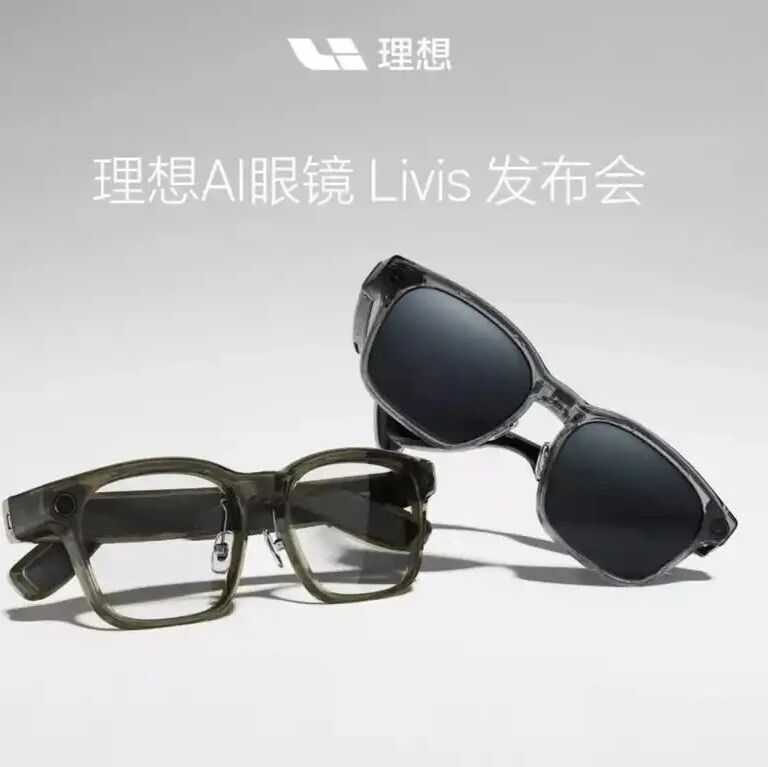
Group 1 - Doubao mobile assistant faces login restrictions from Alibaba apps, including Taobao and Xianyu, due to security measures [3][4] - Doubao assistant claims it does not bypass authentication for sensitive operations and plans to adjust AI capabilities in certain scenarios [4][5] - The initial release of Doubao mobile assistant sold out quickly, with second-hand prices significantly higher than the official price, indicating strong market interest [5] Group 2 - The T800 humanoid robot from Zhongqing Robotics gained attention after a video showed it kicking the CEO, highlighting the robot's capabilities [6][9] - T800 is priced starting at 180,000 yuan and features advanced joint modules and sensory technology for various tasks [9] Group 3 - Jiuyue Automotive is undergoing bankruptcy restructuring, with plans to introduce new investors while Baidu seeks to exit its investment [10][11] - The restructuring faces challenges due to significant debt, estimated at 7 billion yuan, with major stakeholders like Geely and Baidu involved [11] Group 4 - Apple CEO Tim Cook reportedly experiences hand tremors, raising concerns among employees amid significant executive turnover at the company [12][13] Group 5 - New Oriental employee expresses dissatisfaction with the company's overtime culture, leading to internal repercussions [14][15] - The employee's complaints highlight issues with work-life balance and management practices within the company [14][15] Group 6 - Canon's Zhongshan factory announced generous severance packages for laid-off employees, with compensation reaching up to 400,000 yuan [16] - The factory's closure is part of a broader trend of production capacity shifting to Southeast Asia [16] Group 7 - A controversy arose when the chairman of Aibisen rejected the position due to dissatisfaction with a salary of 4.35 million yuan, which was later attributed to a clerical error [17] Group 8 - Meta's CEO Mark Zuckerberg plans to shift focus away from the metaverse, with the division having incurred losses exceeding 70 billion dollars [18][19] Group 9 - Microsoft denies reports of lowering AI sales targets, clarifying the distinction between growth goals and sales quotas [20][21] Group 10 - Nvidia launched the Alpamayo-R1 model, aimed at advancing autonomous driving technology through a new visual language model [28][29] Group 11 - Li Auto introduced its first AI smart glasses, Livis, with a starting price of 1,699 yuan after subsidies, aiming to integrate AI capabilities into daily life [30][31] Group 12 - MiHoYo's co-founder launched an AI chat model, AnuNeko, which aims to create interactive NPCs for gaming, reflecting a unique approach to AI integration in games [33][34] Group 13 - SenseTime released the NEO architecture for multimodal models, marking a significant advancement in AI capabilities [35]





AI眼镜可能还救不了理想汽车股价
首席商业评论· 2025-12-07 04:50
Core Viewpoint - The article discusses the launch of Li Auto's AI glasses, Livis, amidst the company's financial struggles, highlighting the potential of the product to redefine user interaction and create new value beyond the automotive sector [3][28]. Group 1: Product Overview - Li Auto launched its first wearable device, the Livis AI glasses, priced at 1999 yuan, with a promotional price of 1699 yuan after subsidies [3]. - The Livis glasses weigh only 36 grams and feature ergonomic design for comfort, making them one of the most comfortable options in the market [7]. - The glasses are equipped with custom optical lenses from Zeiss, reducing 99% of reflective light and achieving a light transmittance of 92% [10]. - Key AI functionalities include a 12-megapixel camera, open-ear headphones, and deep integration with Li Auto vehicles, allowing users to control their cars with voice commands [11][14]. Group 2: Financial Performance - In Q3 2025, Li Auto reported a revenue of 27.36 billion yuan, a significant decline of 36.2% year-on-year, with a net loss of 624 million yuan [18][20]. - Vehicle sales revenue dropped to 25.87 billion yuan, down 37.4% year-on-year, and the vehicle gross margin fell to 15.5%, a decrease of over 5 percentage points [19][20]. - The company faced a 39% year-on-year drop in vehicle deliveries, with core models experiencing significant sales pressure [22]. Group 3: Market Challenges - Li Auto's market position is threatened by increasing competition, particularly as rivals quickly adopt similar features and technologies [25]. - The shift in consumer preference towards pure electric vehicles has diminished the advantages of Li Auto's extended-range technology [25]. - The company is navigating a challenging environment with declining sales across its product lines and increased competition from brands like Xiaomi and Aion [25][36]. Group 4: Strategic Direction - Li Auto is investing heavily in R&D, with plans to allocate 111 billion yuan in 2024, focusing significantly on artificial intelligence [30]. - The Livis glasses are positioned as a key component of Li Auto's strategy to expand into the "embodied intelligence" space, aiming to enhance user experience beyond automotive applications [32]. - The company recognizes the need to strengthen its core automotive business while exploring new technological avenues, indicating a dual focus on immediate market challenges and long-term innovation [36][38].
以理想汽车为例,探寻自动驾驶的「大脑」进化史 - VLA 架构解析
自动驾驶之心· 2025-12-07 02:05
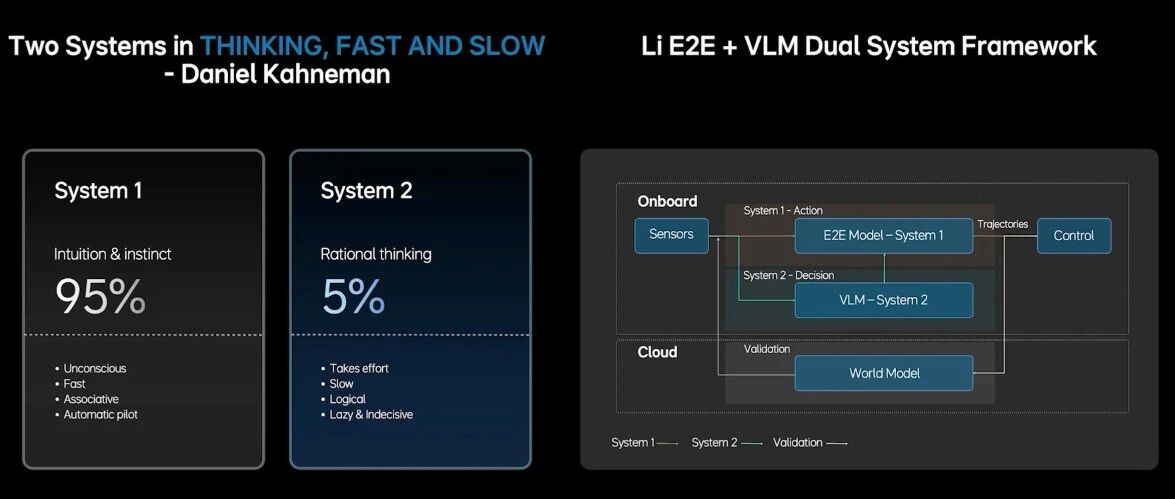
作者 | 我要吃鸡腿 编辑 | 自动驾驶之心 原文链接: https://zhuanlan.zhihu.com/p/1965839552158623077 点击下方 卡片 ,关注" 自动驾驶之心 "公众号 戳我-> 领取 自动驾驶近30个 方向 学习 路线 >>自动驾驶前沿信息获取 → 自动驾驶之心知识星球 本文只做学术分享,如有侵权,联系删文 在自动驾驶这个飞速迭代的领域,技术范式的更迭快得令人目不暇接。前年,行业言必称BEV(鸟瞰图视 角);去年,"端到端"(End-to-End)又成了新的技术高地。然而,每一种范式在解决旧问题的同时,似乎都 在催生新的挑战。 传统的"端到端"自动驾驶,即VA(Vision-Action,视觉-行动)模型,就暴露出一个深刻的矛盾:它就像一个 车技高超但沉默寡言的"老司机"。它能凭借海量数据训练出的"直觉",在复杂的路况中做出令人惊叹的丝滑操 作。但当您坐在副驾,心脏漏跳一拍后问它:"刚才为什么突然减速?"——它答不上来。 这就是"黑箱"问题:系统能"做对",但我们不知道它"为何做对"。这种无法解释、无法沟通的特性,带来了巨 大的信任危机。 自动驾驶的三大范式演进。(a) ...
一位常年做GPU优化的人对理想能让Orin跑VLA很高评价
理想TOP2· 2025-12-06 15:16
2025年12月5日TOP2在北京与一位常年做GPU优化的群友线下交流,其认为理想能让Orin跑VLA是一 个很有水准的工作。 认同"理想是在教英伟达怎么压榨芯片能力"这句话既偏颇又有事实依据是get到理想这项工作很有水 准的核心锚点。 能够显著优化寄存器复用效率(Register Reuse),有效规避Orin架构上因寄存器压力过大导致的溢出 (Register Spilling)。 理想可能通过显式插入Ampere架构特有的异步拷贝指令(Async Copy),将计算流水线与显存访问 的延迟掩盖(Latency Hiding)做到极致。 敢于投入资源深耕此领域,证明了理想团队具备深入分析SASS(流多处理器汇编)并在指令级挖掘 硬件潜能的核心能力。这是一项高门槛的系统工程。 2025年8月8日,理想詹锟表示:"我们与英伟达进行了深度架构对齐,基于PTX(Parallel Thread Execution)指令集重构了底层算子,并打造了自研推理引擎,成功突破了通用TensorRT算子集的性能 天花板。" 詹锟提及的与英伟达深度交流,实质是指在Orin芯片(Ampere架构)微架构层面获得了原厂级的技 术指引 ...

李想承认错误,理想摸索新路
财富FORTUNE· 2025-12-06 13:04
Core Viewpoint - The article discusses the challenges faced by Li Auto in 2025, highlighting its transition from a profitable new energy vehicle company to a phase of declining sales and the introduction of new AI products as a potential growth avenue [2][5]. Financial Performance - Li Auto reported Q3 2025 revenue of 27.4 billion yuan, a year-on-year decrease of 36.2% [2] - Vehicle sales revenue was 25.9 billion yuan, down 37.4% year-on-year and 10.4% quarter-on-quarter [2] - The company incurred a net loss of 624.4 million yuan, contrasting with a net profit of 2.8 billion yuan in the same period last year [2] Market Dynamics - The demand for range-extended vehicles has declined, with their market share in the overall new energy vehicle wholesale structure dropping to 7.5% in October 2025 [3] - Increased competition in the range-extended vehicle segment is noted, with brands like XPeng and Buick launching their own models [3] Product Challenges - Li Auto's first pure electric model, the Li MEGA, faced a recall of 11,411 units due to a coolant defect, estimated to cost around 1.1 billion yuan [4] - The new electric SUVs, Li i8 and Li i6, have not stabilized in sales, with the i6 facing delivery delays due to sold-out production capacity for 2025 [4] Strategic Shift - CEO Li Xiang acknowledged the need to revert to a startup management model after three years of operating as a professional management organization [5] - The company aims to redefine itself as a "space robotics company" rather than just an automotive manufacturer, launching the AI smart glasses Livis as part of this vision [5] Future Outlook - The company anticipates that the true potential of AI glasses will emerge around 2027-2028, coinciding with advancements in autonomous driving technology [5] - The AI sector is still maturing, and the effectiveness of companies' strategies in this field remains to be validated over time [6]