
Morgan Stanley(MS)

Search documents
美联储5月议息会议前瞻:按兵不动,静待政策明朗化
Jin Shi Shu Ju· 2025-05-07 06:38
Core Viewpoint - The Federal Reserve is expected to maintain interest rates between 4.25% and 4.50% during the upcoming meeting, with a low probability of a rate cut in the near term, reflecting a cautious stance amid economic uncertainties [2][3][6]. Interest Rate Decision - The market anticipates a 2% chance of a 25 basis point rate cut in the upcoming meeting, with an overall expectation of 72 basis points of cuts throughout the year [2]. - Following a strong employment report, major banks like Goldman Sachs and Barclays have pushed back their rate cut predictions from June to July [2]. Economic Assessment - Morgan Stanley suggests that the Fed may downgrade its economic activity assessment from "sustained robust expansion" to "slowing growth" [3]. - The divergence between "soft data" (surveys) and "hard data" (actual economic indicators) is notable, with soft data showing deterioration while hard data remains resilient [6][10]. Inflation and Policy Stance - Many officials describe the current policy stance as "moderately tight," with some considering it "significantly tight" [9]. - The Fed is closely monitoring long-term inflation expectations, which remain stable, providing some reassurance [8]. Internal Disagreements and External Pressures - There is a mix of opinions within the Fed, with some officials advocating for a wait-and-see approach while others, like Waller, lean towards a more dovish stance [7]. - President Trump continues to exert pressure on the Fed to lower rates, emphasizing that the Fed's actions have been too slow [7]. Market Reactions - In the foreign exchange market, tactical buying of the dollar is suggested, although the impact of the Fed on currency markets is expected to be limited [12]. - In the stock market, there is a belief that the market has fully priced in the baseline predictions, but risks of recession remain significant, with a 45% probability assessed by the U.S. team [13].


摩根士丹利:中国-关税和刺激措施的下一步走向会如何?
摩根· 2025-05-07 02:10
Investment Rating - The report indicates a cautious outlook for the industry, with a projected GDP growth rate of 4.2% for China in 2025, reflecting a slowdown due to tariff impacts [2][3]. Core Insights - The report emphasizes that China's growth is expected to soften significantly in the second and third quarters of 2025, with persistent deflationary pressures [3][4]. - It highlights the reactive nature of current policy measures, including faster government bond issuance and modest monetary easing, aimed at supporting the economy amid tariff uncertainties [9][16]. - The report suggests that while tariffs are currently high, there is potential for de-escalation in trade tensions between the US and China, which could alleviate some economic pressures [17][21]. Summary by Sections Economic Growth - Real GDP growth is forecasted to decline to 4.2% in 2025, with a notable softening in growth expected during Q2 and Q3 [2][4]. - The GDP deflator indicates a prolonged period of deflation, with expectations of deflationary pressures lasting until at least 2026 [5][6]. Policy Measures - The report outlines a series of policy measures aimed at stimulating the economy, including a supplementary fiscal package of RMB 1-1.5 trillion and enhanced support for infrastructure and technology investments [9][16]. - Specific measures include unemployment insurance rebates for exporters and a relending facility to support service consumption [16]. Tariff Impact - The report discusses the significant impact of tariffs on China's exports, noting that the current trade-weighted tariff on Chinese goods is projected to decrease to 34% with exemptions, while headline reciprocal tariffs remain at 60% [20][22]. - It highlights the low elasticity of certain Chinese exports to tariff changes, indicating that many products are highly reliant on the Chinese market [28][30]. Investment Opportunities - The report identifies worthwhile investment areas, including manufacturing upgrades, urban infrastructure renewal, and basic scientific research, as sectors that may benefit from policy support [12][16]. - It also notes that the technology sector is expected to see increased capital expenditure, driven by AI adoption and government support [89][91]. Social Dynamics - The report points to evolving social dynamics that may trigger further policy pivots, particularly in response to changing consumer sentiment and economic conditions [13][16]. - It emphasizes the need for social welfare reforms to address low consumption rates and high household savings, which have been a barrier to economic growth [71][75].
OPEC+改写油市前景,高盛一个月内三次下调油价预测!
Jin Shi Shu Ju· 2025-05-06 09:17
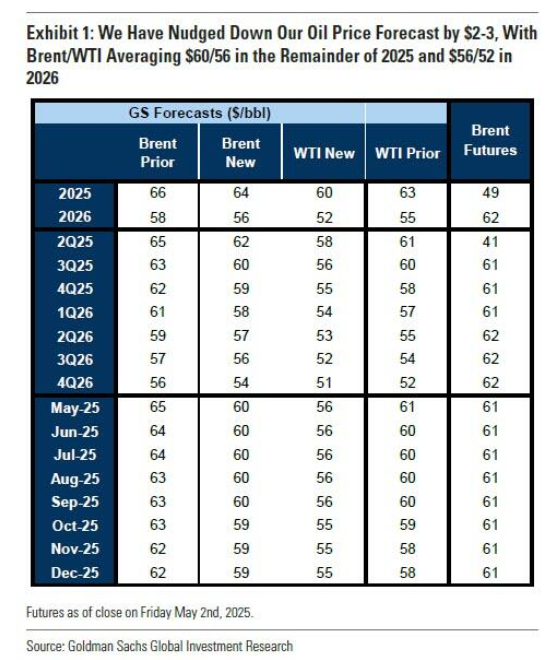
在OPEC+上周末决定6月份大幅增产后,高盛一个月内第三次下调了其油价预测。 在上周六的一次线上会议中,以沙特和俄罗斯为首的OPEC+主要产油国同意将日均产量提高41.1万桶,几乎是原计划增产量 的三倍,目的是惩罚像哈萨克斯坦这样长期违反该联盟配额规定的国家。 OPEC+在5月份已经实施了类似举措,标志着该联盟从捍卫油价的努力中急剧转向,现在看来这明显是一场针对美国页岩油 生产商以及哈萨克斯坦等各个超额生产的OPEC+成员国的价格战。 高盛的分析师现在预计,布伦特原油今年的平均价格为每桶60美元,低于此前预测的每桶63美元;美国基准WTI原油在2025 年的平均价格下调至56美元,低于此前预期的每桶59美元。 就明年而言,布伦特原油的平均价格预计为每桶56美元,低于此前的58美元,而WTI原油预计为每桶52美元,低于4月中旬 之前预测的每桶55美元。 | | | GS Forecasts ($/bbl) | | | Brent | | --- | --- | --- | --- | --- | --- | | | Brent Prior | Brent New | WTI New | WTI Prior | ...
全球航运数据下滑的意义:美联储降息会更迟,未来一两年全球增长会更差
Hua Er Jie Jian Wen· 2025-05-06 02:38
大摩警告,全球航运数据全面下滑,暗示物价上涨、经济增长放缓的双重风险。 据追风交易台消息,摩根士丹利分析师Seth B Carpenter团队在其最新研报中指出,全球航运数据,特别是美国的航运数据,正在经历"惊人的下降"。这种 下降并非偶然,而是对贸易、供应链以及未来经济状况的重要预警信号。 报告显示,美国空白航班(即承运人取消的航班)数量显著增加,等待靠岸的船只队列已经缩短;美国第一季度GDP出现多年来首次收缩,但根本原因并 非内需崩塌,而是进口激增导致的统计学效应,这意味着4月2日关税政策引发的"抢进口"潮正在迅速消退。 报告指出,虽然周五发布的非农就业报告确认实体经济暂时完好,但由于"抢进口"效应,短期内数据将继续呈现波动性,长期可能会导致经济逐渐放缓和 硬性数据的疲软。 作为亚洲贸易的关键指标,韩国出口数据整体也呈现下降趋势。4月前20天,韩国出口同比下降超过10%,但在月末最后10天显著恢复,使全月降幅保持 在个位数范围内。 大摩几个月前对供应链的深入分析显示,某些产品可能会转向越南、印度和其他临近国家生产,但短期内这类产品范围相当有限。简单来说,重新调整生 产要素需要时间并涉及相当大的成本。 报告 ...
【大摩:美联储不会先发制人】5月6日讯,摩根士丹利由首席美国经济学家Michael Gapen领衔的分析师团队在一份研报中写道:“鉴于美联储预计通胀将保持坚挺,且关税冲击可能会产生持续的通胀效应,美联储不太可能采取先发制人的行动。”虽然特朗普自4月2日的“解放日”以来已部分放宽关税举措,在一定程度上稳定了债市和股市。但投资者表示,市场对后续形势进展的整体焦虑情绪并没有消散。管理着8,370亿美元资产的PGIM Fixed Income公司联席首席投资官Gregory Peters表示:“我们建议投资者继续保
news flash· 2025-05-06 02:03
金十数据5月6日讯,摩根士丹利由首席美国经济学家Michael Gapen领衔的分析师团队在一份研报中写 道:"鉴于美联储预计通胀将保持坚挺,且关税冲击可能会产生持续的通胀效应,美联储不太可能采取 先发制人的行动。"虽然特朗普自4月2日的"解放日"以来已部分放宽关税举措,在一定程度上稳定了债 市和股市。但投资者表示,市场对后续形势进展的整体焦虑情绪并没有消散。管理着8,370亿美元资产 的PGIM Fixed Income公司联席首席投资官Gregory Peters表示:"我们建议投资者继续保持谨慎,降低风 险。" 大摩:美联储不会先发制人 ...
Morgan Stanley(MS) - 2025 Q1 - Quarterly Report
2025-05-05 20:13
Financial Performance - The company reported net revenues of $17.7 billion for Q1 2025, a 17% increase from $15.1 billion in Q1 2024[23]. - Net income applicable to the company was $4.3 billion, reflecting a 26% increase compared to $3.4 billion in the prior year quarter[23]. - Diluted earnings per common share rose to $2.60, up 29% from $2.02 in the prior year quarter[23]. - Net revenues for the three months ended March 31, 2025, increased to $17,739 million, up 17.3% from $15,136 million in the same period of 2024[40]. - Earnings applicable to common shareholders rose to $4,157 million, representing a 27.2% increase from $3,266 million year-over-year[40]. - Earnings per diluted common share increased to $2.60, compared to $2.02 in the prior year, reflecting a 28.7% growth[40]. - Return on equity (ROE) increased to 17.4%, up from 14.5% in the prior year, while return on tangible common equity (ROTCE) rose to 23.0% from 19.7%[40]. - Net income applicable to Morgan Stanley increased by 39% to $2,529 million from $1,819 million in the prior year[61]. Revenue Breakdown - Institutional Securities generated net revenues of $9.0 billion, driven by strong performance in Equity and Investment Banking[27]. - Wealth Management achieved net revenues of $7.3 billion, with a pre-tax margin of 26.6 and net new asset additions of $94 billion[27]. - Investment Management reported net revenues of $1.6 billion, primarily from asset management fees on average AUM of $1.7 trillion[27]. - Total net revenues increased by 28% to $8,983 million in Q1 2025 compared to $7,016 million in Q1 2024[61]. - Advisory revenues rose by 22% to $563 million, while Equity underwriting revenues decreased by 26% to $319 million[61]. - Fixed Income revenues increased by 22% to $677 million, contributing to total Investment Banking revenues of $1,559 million, an 8% increase year-over-year[63]. - Wealth Management net revenues grew by 6% to $7,327 million, driven by a 15% increase in asset management revenues to $4,396 million[80]. Expenses and Efficiency - The company’s expense efficiency ratio was 68%, with non-compensation expenses increasing by 12% to $4.5 billion due to higher execution-related expenses[27][28]. - The expense efficiency ratio improved to 68%, down from 71% in the previous year, indicating better cost management[40]. - Non-interest expenses rose by 20% to $5,611 million, primarily due to increased compensation and benefits expenses[77]. - Non-interest expenses rose by 5% to $5,332 million, mainly due to higher compensation and benefits expenses[95]. Credit and Risk Management - The provision for credit losses was $135 million, reflecting portfolio growth and a weaker macroeconomic outlook[29]. - Provision for credit losses increased to $91 million, reflecting portfolio growth and a deteriorating macroeconomic outlook[75]. - Provision for credit losses was $44 million, primarily related to specific loans, compared to a net release of $8 million in the prior year quarter[94]. Assets and Capital - Total assets increased to $1,300,296 million, up from $1,215,071 million at the end of 2024, reflecting a growth of 7%[40]. - Total assets under management (AUM) reached $1,669 billion, up from $1,479 billion in the prior year[110]. - CET1 capital increased to $76,975 million at March 31, 2025, up from $75,095 million at December 31, 2024, representing a growth of 2.5%[180]. - Total capital rose to $97,772 million at March 31, 2025, compared to $95,567 million at December 31, 2024, reflecting an increase of 2.3%[183]. - Total Risk-Weighted Assets (RWA) reached $502,622 million at March 31, 2025, up from $489,316 million at December 31, 2024, indicating a rise of 2.7%[184]. Liquidity and Funding - Average liquidity resources for the five months ended March 31, 2025, were $351,740 million, compared to $345,440 million at the end of 2024[40]. - Cash deposits with banks averaged $351.7 billion for the three months ended March 31, 2025, compared to $345.4 billion for the previous quarter, reflecting a growth of 1.0%[134]. - The Liquidity Coverage Ratio (LCR) stood at 130% as of March 31, 2025, consistent with the previous quarter's LCR of 130%[141]. - The company maintained sufficient liquidity resources to meet current and contingent funding obligations as modeled in its Liquidity Stress Tests[131]. Shareholder Returns - The company repurchased 8 million shares at an average price of $125.88 per share during the three months ended March 31, 2025, compared to 12 million shares at $86.79 in the same period last year[163]. - The common stock dividend announced on April 11, 2025, is $0.925 per share, payable on May 15, 2025[165]. Regulatory Compliance - The company is in compliance with all Total Loss-Absorbing Capacity (TLAC) requirements, with external TLAC at $268,879 million as of March 31, 2025[187]. - The Stress Capital Buffer (SCB) remains at 6.0% through September 30, 2025, contributing to a required CET1 ratio of 13.5%[192]. - The company plans to submit its capital plan and stress test results as part of the Federal Reserve's annual CCAR framework[191].
5月1日电,摩根士丹利计划向E*TRADE客户提供加密货币交易。
news flash· 2025-05-01 10:19
Group 1 - Morgan Stanley plans to offer cryptocurrency trading to E*TRADE clients [1]
每日投行/机构观点梳理(2025-04-30)
Jin Shi Shu Ju· 2025-04-30 15:32
Group 1 - Goldman Sachs significantly lowered the US Q1 GDP growth forecast to -0.8% due to an unexpected widening of the trade deficit in March, driven by increased consumer goods imports [1] - Morgan Stanley highlighted that uncertainty surrounding tariff policies and questions regarding the independence of the Federal Reserve may lead foreign investors to reduce their investments in the US [2] - Pantheon Macroeconomics indicated that the uncertainty from tariffs will limit any significant rebound in the French economy, projecting stagnation for the remainder of the year [3] Group 2 - ING reported that the euro has lost its status as a preferred alternative to the dollar, with most G10 currencies performing better than the euro recently [4] - ING also noted that news of potential reductions in auto tariffs by the Trump administration helped the dollar recover some of its recent losses [5] - Capital Economics stated that the impact of tariffs on the Eurozone economy is expected to intensify, with the economic sentiment index dropping from 95.2 to 93.6 in April [6] Group 3 - Deutsche Bank suggested that the European Central Bank should act more decisively to address increasing supply shocks and rising inflation [8] - Tianfeng Securities projected that the aerospace engine sector may stabilize and recover, with a significant portion of military electronic stocks held by active funds [9] - CITIC Securities reported that the implementation of new tax refund policies for departing travelers could boost domestic consumption, estimating a potential market space of nearly 100 billion [10]



原油期货现诡异“微笑曲线”!大摩解读:供应短期紧张、长期过剩
智通财经网· 2025-04-29 07:08
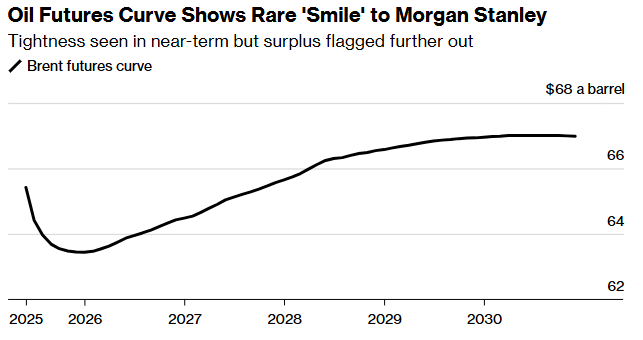
Group 1 - Morgan Stanley indicates that the global oil market is in a rare state, with futures prices showing recent supply tightness while signaling a future "meaningful surplus" [1] - The Brent crude oil futures curve is currently unusual, with the first nine contracts sloping downwards and then upwards, a pattern with almost no historical precedent [1] - In April, Brent crude oil prices fell by 12% due to the impact of the US-led trade war, OPEC+'s faster-than-expected supply increase, and rising surplus expectations [3] Group 2 - The current spot premium in Brent crude prices indicates a bullish sentiment, as traders are willing to pay a premium for immediate oil, but this is expected to shift to a futures premium by 2026 [3] - Analysts predict that Brent crude oil prices will drop to a low of $60 per barrel later this year, with current forecasts maintaining June futures at $65.03 per barrel [3] - Trade tariffs are expected to be a significant obstacle to oil demand, with a projected deficit in oil supply-demand balance in Q3, followed by a substantial surplus thereafter [3]
大摩敲响标普5500点虚破警钟:在波动中应坚持投资优质资产
Zhi Tong Cai Jing· 2025-04-29 03:01
Core Viewpoint - The S&P 500 index briefly surpassed the 5500 resistance level due to optimism surrounding potential tariff reductions between the US and China, as well as a shift in Federal Reserve policy, although analysts warn that this breakout is fragile [1] Group 1: Market Conditions - To sustain a breakthrough in the 5600-5650 range, four catalysts need substantial progress: meaningful tariff reductions, a dovish shift from the Federal Reserve, long-term interest rates below 4% without recession signals, and upward revisions in earnings expectations [1] - The correlation changes between bonds and stocks make yield trends crucial for market direction, with recent fluctuations in the 10-year US Treasury yield highlighting risks at the end of the cycle [1] - If the 10-year yield drops below 4% due to a compression of term premiums, it could drive stock market gains, while yields exceeding 4.5% may trigger risk-averse behavior [1] Group 2: Labor Market and Economic Indicators - A stable labor market is key to avoiding a pessimistic scenario where unemployment rises by 200 basis points; the market has not yet priced in a true labor market recession [1] - Continuous non-farm payroll growth exceeding 100,000 and stable initial jobless claims are necessary to reduce the current 40% probability of recession [1] Group 3: Investment Strategy - In an uncertain environment, the company recommends doubling down on high-quality stocks with earnings resilience that are undervalued by the market [1] - The focus should not be on cyclical sectors but rather on companies whose pricing reflects ISM levels below 44 and have historically smaller drawdowns during past recessions [1] - The company suggests overweighting US stocks over international equities, particularly those sensitive to dollar fluctuations, such as European and Japanese stocks [1] - The stability of US corporate earnings, quality factor advantages, and potential currency benefits create relative advantages in this volatile late-cycle period [1] - Investors are encouraged to use market volatility to increase allocations to quality assets, including defensive stocks and selected cyclical stocks, rather than chasing breakouts lacking fundamental confirmation [1]