Microsoft(MSFT)

Search documents
狂砸4万亿,美国四巨头“流血”搞AI,苹果:溜了溜了
3 6 Ke· 2026-02-09 12:44
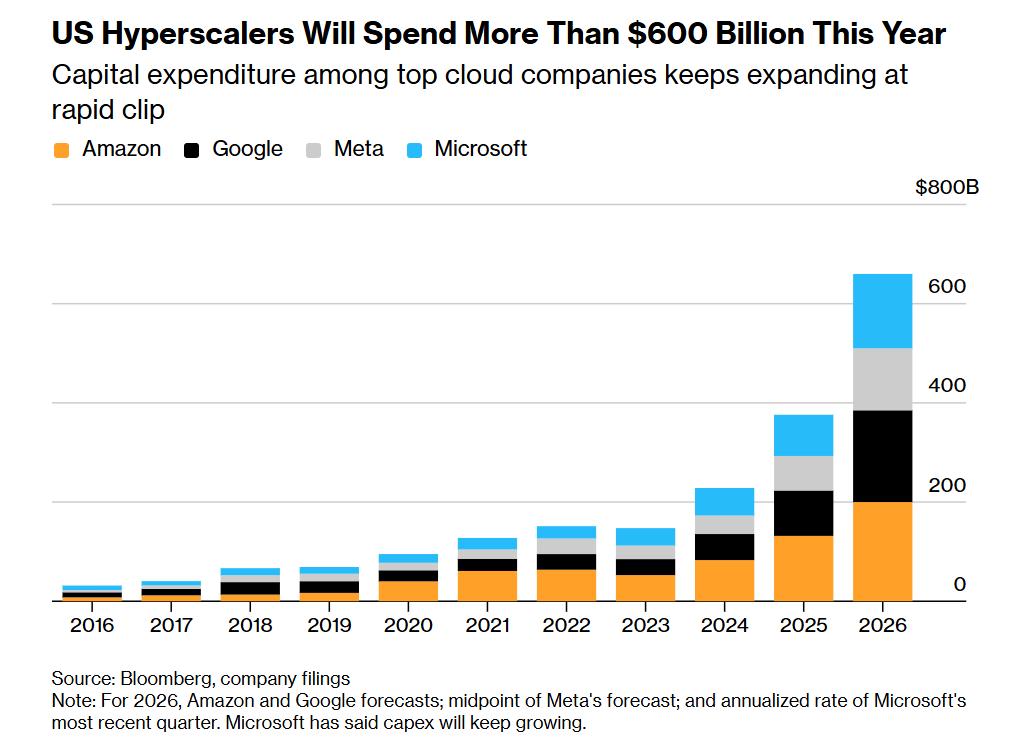
智东西2月9日消息,据等多家外媒报道,当前美国科技巨头们正深陷AI基建投资"狂潮",一年的总资本投入规模甚至超过欧洲单一发达国家全年GDP。 2026年,Meta、亚马逊、微软、谷歌四家美国科技巨头计划在AI基础设施建设方面支出的资本或超过6000亿美元(约合人民币41567亿元),相比去年暴 涨了70%以上,预测数据在6300亿美元到6700亿美元之间浮动。 ▲2026年美国四大科技巨头资本支出情况,2025年、2026年资本支出增幅极为明显 什么概念?这一数额大约相当于瑞典(6620亿美元)、以色列(6100亿美元)这些国家一年的GDP。 按照华尔街日报6700亿美元的预测数据,这一总支出占美国GDP的比例约为2.1%,仅次于美国1803年购买路易斯安那州(占GPD 3%)。相比之下,阿波 罗登月计划占GDP的比例只有0.2%,登月在AI基建投资面前已经沦为"计量单位"。 ▲项目支出占GDP的比重,图源:华尔街日报 不过相比这四大美国科技巨头在AI基建方面的加码投入,苹果公司则显得十分"特别",其为最近一个季度美国科技大厂中唯一一家资本支出同比减少的公 司。 在AI基建狂潮中,各大厂商策略不尽相同,在多家 ...






大摩力挺科技股:AI投资周期波动不改强劲基本面,反弹仍有后劲
Zhi Tong Cai Jing· 2026-02-09 12:39
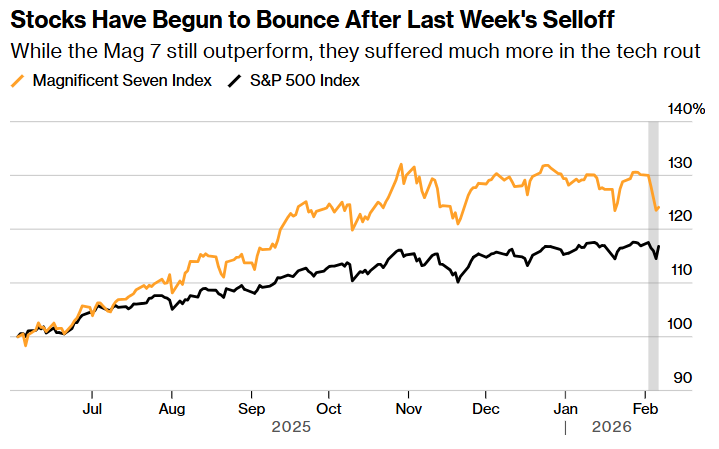
摩根士丹利策略师表示,由于人工智能的热潮支撑了强劲的销售前景,美国科技股还有进一步上涨的空 间。由Michael Wilson领导的团队表示,大型科技股的营收增长预期已达到"数十年来的最高水平",而 近期市场波动后,其估值有所下降。与此同时,软件股的暴跌也为微软(MSFT.US)和财捷(INTU.US)等 一些股票创造了"极具吸引力的买入机会"。 Wilson在一份报告中写道:"像上周那样的时期在重大投资周期中并不罕见。尽管如此,人工智能赋能 者行业的基本面依然强劲,我们认为人工智能采用者市场的价值仍然被低估了。" Wilson的观点或许能让那些开始质疑人工智能领域巨额投资回报的投资者感到安心。上周,纳斯达克 100指数遭遇了自去年12月以来最大的单周跌幅,那些被认为可能受到人工智能冲击的股票在Anthropic 新工具发布后纷纷下跌。 "七大科技巨头"指数目前的市盈率约为29倍,略低于五年平均水平。上周五有一些逢低买入者入场,但 市场走势表明这种情况可能只是暂时的,纳斯达克100指数期货周一下跌0.7%。 Wilson团队的分析显示,投资者尚未以更具结构性的方式加强对资本支出的约束。这位策略师表示,资 本支 ...

Stop Worrying About the Software Armageddon and Buy These 5 Stocks Now
Yahoo Finance· 2026-02-09 12:30
Starting with an Ives favorite in Palantir (PLTR). Dubbed as the “Messi of AI” by Ives, Palantir is a software company specializing in data integration, analytics, and AI-driven decision platforms for governments and enterprises worldwide. Palantir builds mission-critical software platforms that unify disparate data sources and apply analytics/AI to produce insights and operational decisions.Ives's bullishness about the software sector has been longstanding. Yet, it is not for all the names. Which ones, the ...


AI 竞赛终局:电力说了算?
3 6 Ke· 2026-02-09 12:28
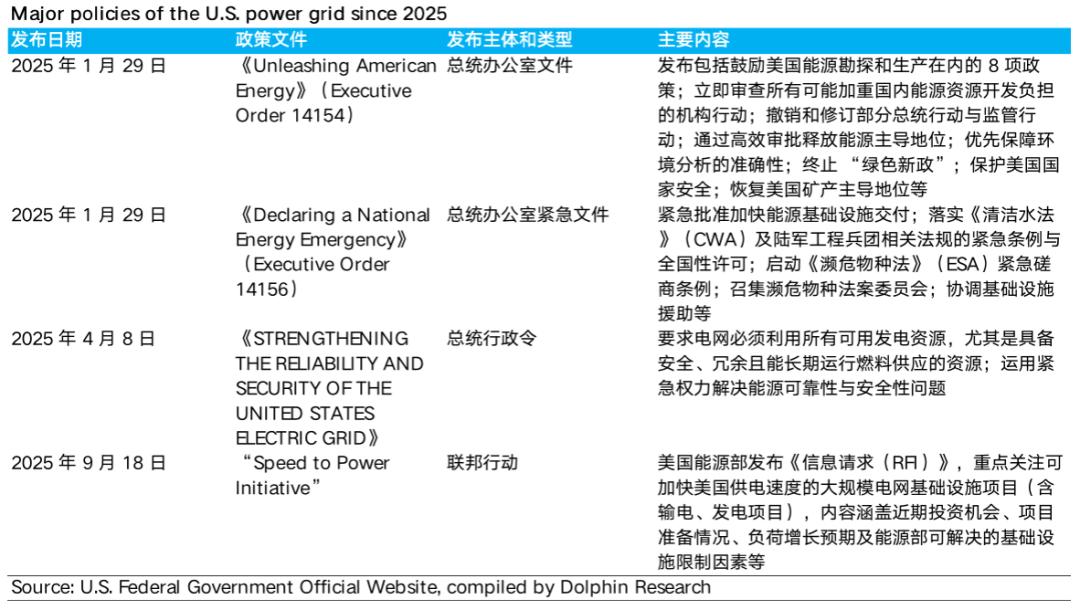
墙的一侧是每秒万亿次的浮点运算渴求;另一侧,则是平均电网年龄超 40 年、变压器短缺率高达 30%、扩建周期长达 5-10 年的基建泥潭。 也因此,海豚君对于北美缺电重点理解: 1)缺电背后是是一个中短期的供需差,还是一个长期的结构性问题? 2) 缺电 如何解决,解决的背后对应的怎样的细分赛道的投资机会? 本篇重点探讨第一个问题,重点理解一个高度成熟的国家,如何混到无电可用的。 | 发布日期 | 政策文件 | 发布主体和类型 | 主要内容 | | --- | --- | --- | --- | | 2025年1月29日 | 《Unleashing American 总统办公室文件 | | 发布包括鼓励美国能源勘探和生产在内的 8 项政 | | | Energy » (Executive | | 策:立即审查所有可能加重国内能源资源开发负担 | | | Order 14154) | | 的机构行动;撤销和修订部分总统行动与监管行 | | | | | 动:通过高效审批释放能源主导地位:优先保障环 | | | | | 境分析的准确性;终止"绿色新政";保护美国国 | | | | | 家安全:恢复美国矿产主导地位等 ...

摩根士丹利建议买入这9只被AI冲击的折价软件股
美股IPO· 2026-02-09 12:27
Core Viewpoint - The report highlights that high uncertainty has significantly impacted software valuation multiples, which have declined by approximately 33% since October 2025 [2] Group 1: Software Valuation - The average software valuation multiple has returned to around 4.4 times enterprise value/sales, reflecting levels seen during previous periods of high uncertainty in the public cloud sector [3] - Investors are underestimating the ability of existing vendors to benefit from AI adoption [3] Group 2: Investment Opportunities - The report suggests that pessimistic views on generative AI have led to a lack of trust in the ability of existing software vendors to participate in this innovation cycle [4] - Morgan Stanley identifies Microsoft, ServiceNow, Salesforce, Atlassian, Snowflake, Cloudflare, Shopify, and Palo Alto Networks as attractive investment opportunities due to their strong product cycles, improved financial metrics, and discounted valuations [4] - Microsoft is noted as a key player in significant innovation cycles, while the valuation of ServiceNow is described as "very attractive" [4] - Salesforce's AI-related annual recurring revenue has increased by 114% year-over-year [4] - Shopify is viewed as highly capable of capturing a larger share of the expanding online commerce market [4] Group 3: Long-term Opportunities - Generative AI represents a significant long-term opportunity, with an estimated potential to add approximately $400 billion to the broader enterprise software total addressable market by 2028 [5] - The key issue is not whether software will ultimately monetize in this innovation cycle, but rather which companies will participate [6]



美软件股危机未除!花旗:AI冲击或让终端价值蒸发三分之一
Hua Er Jie Jian Wen· 2026-02-09 12:08
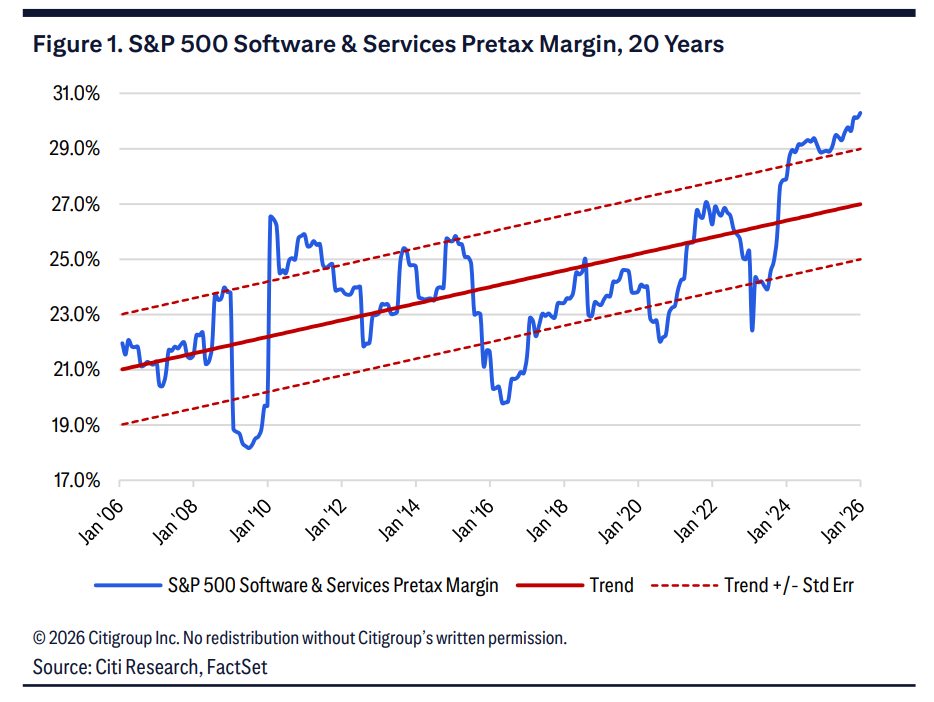
花旗指出,软件与服务板块正经历一场由"AI颠覆恐惧"引发的剧烈估值重估。 据追风交易台,花旗在2月6日发布的最新美股策略研报中认为,当前的市场抛售并非源于短期基本面恶化,而是投资者正在激进地重新定价该行 业的"终端价值"。 研报指出,市场正在计入未来利润率的结构性下降,目前股价已充分反映了终端倍数压缩10%的预期,并接近反映20%的压缩。然而,如果AI对 商业模式的冲击导致终端倍数压缩幅度达到30%,股价恐将跌至"解放日低点"甚至更低。 对投资者而言,尽管短期内可能因超卖出现反弹,但AI 带来的长期不确定性意味着软件股的"躺赢"时代结束,未来将进入剧烈的个股分化阶段。 花旗研报强调,软件与服务板块的暴跌(年初至今下跌20%,自2025年10月29日以来下跌28%)核心驱动力是对AI相关颠覆的担忧。这种担忧虽 然尚未完全体现在短期财报数字中,但已在股价上显露无疑——即通过"终端倍数压缩"的形式呈现。 微软作为该行业权重的核心(占比55%),其自1月28日财报发布以来的17%跌幅主导了整个板块的走势。花旗认为,市场正在迅速计入未来利润 率降低的预期,导致对长期增长前景的重新评估。尽管近期基本面依然强劲,但估值逆风 ...
北美云4QCapEx:算力投资积极
HTSC· 2026-02-09 11:40
Investment Rating - The report maintains a "Buy" rating for several key companies in the communication and AI computing chain, including沃尔核材, 奥飞数据, 锐捷网络, 中国移动, 新易盛, 中际旭创, 万国数据, 天孚通信, and 亨通光电 [8][39]. Core Insights - The North American cloud service providers (CSPs) have shown a significant increase in capital expenditures, with a year-on-year growth of 66.64% in Q4 2025, totaling $117.6 billion. This trend is expected to continue into 2026, with a projected capital expenditure of $570.77 billion, reflecting a 53.2% increase [2][12][13]. - Major CSPs such as Microsoft, Amazon, Meta, and Google are optimistic about their capital spending for 2026, with Microsoft estimating $115.2 billion, Amazon $161.3 billion, Meta $123.7 billion, and Google $170.5 billion [2][12][13]. - The report emphasizes the potential for growth in the global AI computing chain, including components like optical modules, liquid cooling, copper connections, and switches, driven by the increasing demand for computing power [1][11]. Summary by Sections Market Overview - The communication index fell by 6.95% last week, while the Shanghai Composite Index and Shenzhen Component Index decreased by 1.27% and 2.11%, respectively [1][11]. Key Companies and Dynamics - The report identifies a primary investment theme in the communication industry for 2026, focusing on the AI computing chain, with recommended companies including 中际旭创, 新易盛, 天孚通信, and others [3]. - The report highlights the strong performance of the four major North American cloud providers, collectively known as MAMG, which includes Microsoft, Amazon, Meta, and Google, with a total capital expenditure of $372.55 billion in 2025 [2][12]. Company Recommendations - Specific companies are recommended for investment based on their growth potential and market position, including: - 沃尔核材 (Target Price: 43.21) [39] - 奥飞数据 (Target Price: 31.17) [39] - 锐捷网络 (Target Price: 102.51) [39] - 中国移动 (Target Price: 126.20) [39] - 新易盛 (Target Price: 476.71) [39] - 中际旭创 (Target Price: 626.68) [39] - 万国数据 (Target Price: 45.83) [39] - 天孚通信 (Target Price: 211.92) [39] - 亨通光电 (Target Price: 25.73) [39]



资讯日报:日本自民党在众议院选举中取得胜利-20260209
Guoxin Securities Hongkong· 2026-02-09 11:30
资讯日报:日本自民党在众议院选举中取得胜利 股票市场概览 港股市场表现 美股市场表现 2026 年 2 月 9 日 资讯日报 海外市场主要股市上日表现 | 指数 | 收盘价 | 日常跌 | 周常失 | 年初至今 | | --- | --- | --- | --- | --- | | | | (%) | (%) | 湖铁 | | | | | | (%) | | 恒生指数 | 26.560 | (1.21) | (3.02) | 3.63 | | 恒生科技 | 5.346 | (1.11) | (6.51) | (3.08) | | 恒生国企 | 9.031 | (0.68) | (3.07) | 1.32 | | 上证指数 | 4.066 | (0.25) | (1.27) | 2.44 | | 日经225 | 53.818 | 0.81 | 1.75 | 7.78 | | 新加坡海峡 | 4.976 | (0.83) | 0.60 | 0.00 | | 标普500 | 6.798 | 1.97 | (0.10) | 1.27 | | 纳斯达克 | 22,541 | 2.18 | (1.84) | (0.91) ...
Big Tech stocks are treading water after $1 trillion sell-off week
CNBC· 2026-02-09 11:13
Big Tech stocks were treading water in premarket trading on Monday, after a bruising week that saw more than $1 trillion wiped from their market caps.As of 6:12 a.m. ET, Oracle was up 1.5% and Microsoft had edged 0.8% higher. Meta was down 0.3% and Amazon was down 0.1%. Alphabet fell 0.6% and Nvidia was down around 1% after rebounding 7.9% on Friday.The market grew jittery last week after expenditure outlooks continued to shoot through the roof in Big Tech earnings last week, as companies doubled down on AI ...


数据中心供配电设备行业跟踪:海外主要云厂商资本开支持续增长,DRAM价格小幅回落
Shanghai Aijian Securities· 2026-02-09 11:02
证券研究报告 行业研究 / 行业点评 2026 年 02 月 09 日 电力设备 一年内行业指数与沪深 300 指数对比走势: 资料来源:聚源数据,爱建证券研究所 相关研究 《数据中心供配电设备行业跟踪:甲骨文资本 开支环比高增,DRAM 价格小幅回落》 2026-02-03 《锂电行业跟踪:碳酸锂价格下跌,储能电芯 均价持续上涨》2026-02-03 《光储行业跟踪:电网侧独立新型储能容量电 价机制建立,光伏组件价格持续上涨》 2026-02-03 《电新行业 2025Q4 公募基金持仓分析》 2026-01-28 《数据中心供配电设备行业跟踪:韩国半导体 出口同比大幅增长,DRAM 价格持续上涨》 2026-01-27 朱攀 S0820525070001 021-32229888-25527 zhupan@ajzq.com 陆嘉怡 S0820124120008 021-32229888-25521 lujiayi@ajzq.com 行业及产业 海外主要云厂商资本开支持续增长, DRAM 价格小幅回落 ——数据中心供配电设备行业跟踪 强于大市 投资要点: 数据中心已成为电力设备行业核心增量应用场景,其发展趋 ...