TSMC(TSM)

Search documents
台积电2nm,交卷了
3 6 Ke· 2025-12-30 10:24
Core Insights - TSMC has officially announced the mass production of its 2nm technology, set to begin in Q4 2025, marking a significant milestone in the semiconductor industry [2][4] - The competition in advanced semiconductor processes is intensifying, with TSMC, Samsung, and Intel all vying for leadership in 2nm technology [2][5] Group 1: TSMC's 2nm Technology - TSMC's 2nm (N2) process aims for a 10%-15% performance increase at the same power consumption, and a 25%-30% reduction in power consumption at the same performance level [4] - The N2 process will utilize Gate-All-Around (GAA) transistors, enhancing electrostatic control and reducing leakage, while also improving transistor density by 15% for mixed designs and 20% for pure logic designs compared to the N3E process [4] - TSMC's initial 2nm production capacity has been largely booked, with Apple securing over half of the initial capacity, alongside other major clients like Qualcomm, MediaTek, AMD, and NVIDIA [4] Group 2: Samsung's 2nm Efforts - Samsung has launched its 2nm process with the Exynos 2600 mobile application processor, which boasts a 39% performance increase over its predecessor and a 113% improvement in generative AI capabilities [6] - The introduction of Heat Path Blockage (HPB) technology in the Exynos 2600 aims to address previous overheating issues that affected Samsung's chip performance [6][7] - Samsung's 2nm process is currently achieving a yield rate of 50%-60%, with ongoing discussions with AMD for collaborative development on next-generation CPU products [7] Group 3: Industry Financials and Pricing Trends - The global revenue for the top ten foundries reached $45.086 billion in Q3 2025, with TSMC leading at $33.063 billion, reflecting a 9.3% quarter-over-quarter growth [10] - TSMC's advanced process technologies (7nm and below) accounted for 74% of its total wafer revenue, with 3nm contributing 23%, 5nm 37%, and 7nm 14% [10] - TSMC plans to increase its 2nm capacity to 100,000 wafers per month by 2026, with prices for 2nm wafers expected to exceed $30,000, nearly double that of 4nm wafers [11][12] Group 4: Future Innovations and Trends - The semiconductor industry is shifting focus from size reduction to multi-dimensional innovation, with new materials and architectures being explored to overcome the limitations of traditional silicon-based chips [16][17] - Innovations such as Chiplet technology and advanced packaging techniques are being developed to enhance performance, integration, and reliability of chips, moving beyond mere size scaling [17]


台媒:台积电前副总跳槽英特尔恐涉泄密,业界传出在台住所搜出大量“先进制程机密资料”
Huan Qiu Wang Zi Xun· 2025-12-30 04:07
Core Insights - TSMC's former senior vice president, Luo Wei-ren, is under investigation for allegedly taking confidential documents to Intel, raising concerns in the semiconductor industry [1][2] - TSMC has filed a civil lawsuit against Luo for violating employment contracts and trade secret laws, suspecting he may have leaked or transferred company secrets to Intel [2] - The incident highlights ongoing issues of intellectual property theft in the semiconductor sector, with previous cases of technology leaks involving former employees [3] Group 1 - Luo Wei-ren, aged 75, retired from TSMC in July and joined Intel in October, causing a stir in the semiconductor industry [2] - TSMC's lawsuit against Luo includes claims of breach of contract and potential violations of national security laws, with assets valued over NT$2 billion at stake [2] - The investigation by Taiwan's High Prosecutors Office includes the possibility of detaining Luo, who has U.S. citizenship and has settled in the U.S. [2] Group 2 - TSMC has faced multiple incidents of confidential information leaks this year, including a case in May involving a 2nm technology leak by an engineer who moved to a Japanese company [3] - The article emphasizes that the competition in the semiconductor industry is not just a technical race but also involves personnel changes that can significantly impact a company's future competitiveness [3] - The situation serves as a reminder of the vulnerabilities in the semiconductor industry regarding employee transitions and the potential for technology redistribution [3]

亚马逊暂停在意大利开展无人机配送计划;小鹏汇天飞行汽车制造公司增资至9亿,增幅约38%丨智能制造日报
创业邦· 2025-12-30 04:03
Group 1 - Russia successfully launched 52 satellites using the "Soyuz-2.1b" rocket, which took off from the Vostochny Cosmodrome in the Amur region on December 28, with all satellites entering their designated orbits [2] - TSMC is experiencing tight capacity for advanced processes below 3nm, leading to a planned price increase for these processes starting January 1, 2026, due to high demand from clients like Nvidia and AMD [2] - Amazon has decided to suspend its drone delivery program in Italy, citing broader commercial regulatory issues despite progress in aviation regulations [2] Group 2 - XPeng's subsidiary, Guangzhou Huitian Flying Car Manufacturing Co., has increased its registered capital from 650 million RMB to 900 million RMB, marking an increase of approximately 38% [2]



两岸圆桌派|汪涛、陈凤馨:大陆过去对台湾是“溺爱”,可惜台湾人没有意识到
Guan Cha Zhe Wang· 2025-12-30 03:23
Core Viewpoint - The ongoing US-China technology war has reached a critical stage, with China making significant advancements in various technology sectors, raising questions about Taiwan's position and future opportunities in this context [1][17]. Group 1: China's Technological Advancements - According to the Australian Strategic Policy Institute's report, China has established a leading position in over 60 out of 70 key technology areas, significantly surpassing the US [5]. - The "14th Five-Year Plan" emphasizes six key areas for technological breakthroughs, including integrated circuits and advanced materials, while also identifying new economic growth points such as quantum technology and hydrogen energy [2][3]. - China's approach to technology development is characterized by a broad exploration of all available technologies rather than a selective focus, allowing for a diverse range of innovations [10][16]. Group 2: Market Dynamics and Investment - The success of Chinese tech companies like Cambricon and Moore Threads is attributed to market-driven investments rather than government funding, highlighting the importance of private capital in fostering innovation [7][21]. - The shift from government-selected winners to market-selected winners has led to a more dynamic and competitive tech landscape in China, enhancing the conversion of research into commercial applications [8][9]. Group 3: Implications for Taiwan - Taiwan's reliance on TSMC raises concerns about its long-term economic sustainability, as the island lacks other significant industries to support its economy if TSMC were to relocate [24][25]. - The historical investment in the semiconductor industry has created a strong foundation, but there is a pressing need for Taiwan to diversify its economic base beyond TSMC to avoid becoming overly dependent [22][26]. Group 4: Future Outlook - The ongoing technological competition suggests that the US's strategy of containment may be ineffective, as China's advancements continue to challenge the status quo [17][20]. - The potential for collaboration between the US and China is acknowledged, but the technology war is expected to persist, influencing global market dynamics and investment strategies [3][18].
大陆过去对台湾是“溺爱”,可惜台湾人没有意识到
Guan Cha Zhe Wang· 2025-12-30 02:39
Core Insights - The ongoing US-China tech war has reached a critical stage, with China making significant advancements in various technology sectors, indicating a shift in global power dynamics [1][9][26] Group 1: China's Technological Advancements - China has established a leading position in over 60 out of 70 key technology areas, significantly surpassing the US in many fields [5][21] - The "14th Five-Year Plan" emphasizes six key areas for technological breakthroughs, including integrated circuits and advanced materials, while also identifying new economic growth points such as quantum technology and hydrogen energy [2][4] - The focus on artificial intelligence application is expected to accelerate, leveraging China's extensive supply chain and market size [4][12] Group 2: Market Dynamics and Innovation - The shift from government-led to market-driven selection of technology winners is crucial for fostering innovation in China, allowing for a more dynamic and competitive environment [8][10] - Young tech entrepreneurs are emerging as key players, with their success contributing to a cycle of investment and innovation within the tech sector [9][21] - The ability to convert academic research into commercial applications remains a critical factor for China's technological success [5][21] Group 3: Implications for Taiwan - Taiwan's reliance on TSMC as its primary technological asset raises concerns about its long-term economic sustainability, especially if TSMC's operations are relocated [22][24] - The historical investment in the semiconductor industry has positioned Taiwan well, but there is a need for diversification to avoid over-dependence on a single entity [24][25] - The changing geopolitical landscape necessitates a reevaluation of Taiwan's role in the tech ecosystem, as it faces competition from mainland China's rapid advancements [22][26]

6年间单片晶圆毛利润暴涨3.3倍,台积电杀疯了
Sou Hu Cai Jing· 2025-12-30 02:39
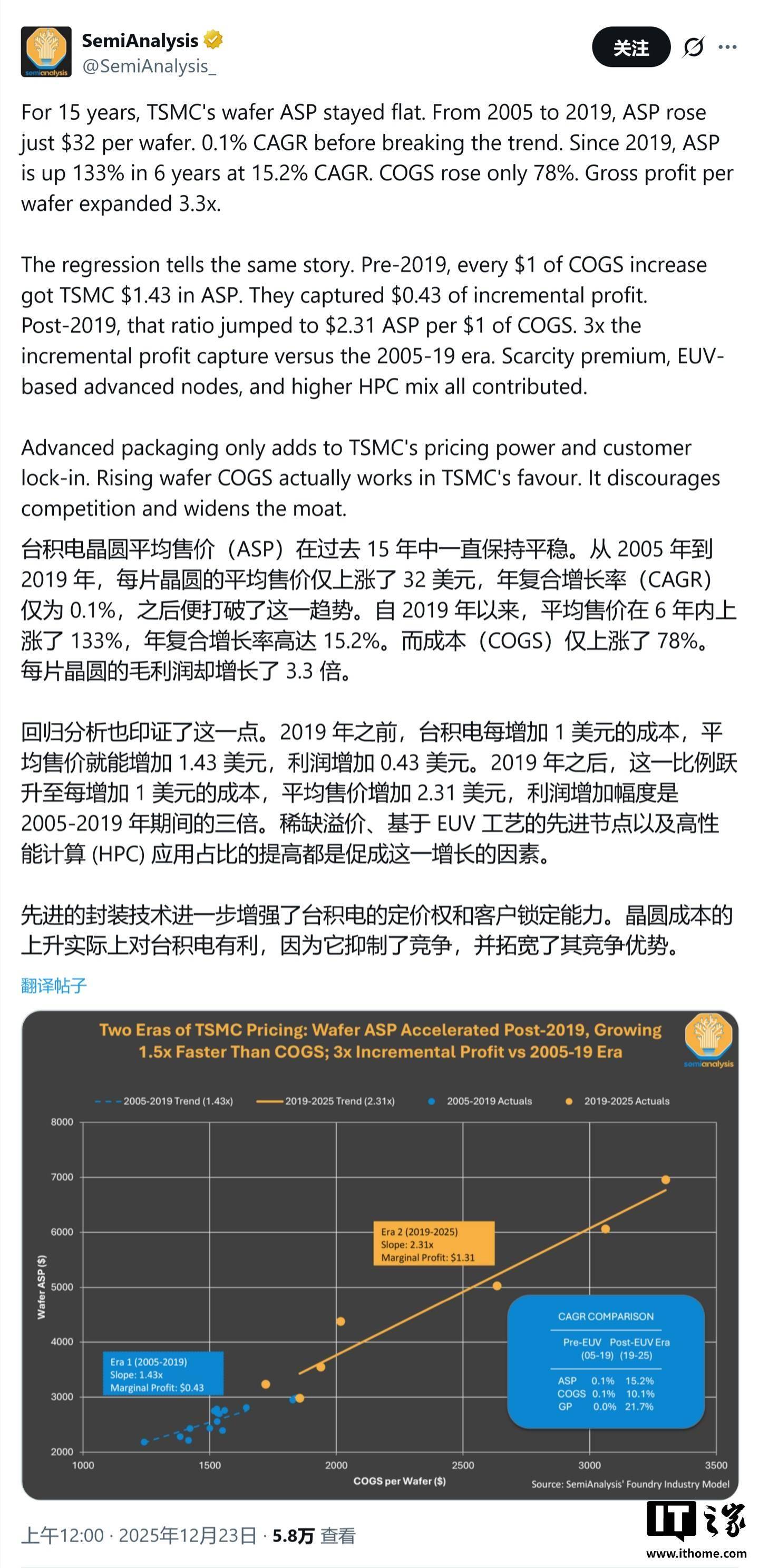
Group 1 - TSMC's pricing strategy was conservative from 2005 to 2019, with an average wafer price increase of only $32 over 15 years, reflecting a compound annual growth rate of just 0.1% [2] - In 2019, TSMC embraced EUV technology, leading to an average selling price (ASP) growth of 15.9% annually, resulting in a cumulative increase of 133% over six years [3] - TSMC's gross margin per wafer is projected to reach 3.3 times the 2019 level by 2025, indicating strong pricing power and the ability to pass increased costs to downstream customers [3] Group 2 - Prior to 2019, a $1 increase in production costs led to only a $1.43 increase in wafer price, yielding a profit increment of $0.43; post-2019, the same cost increase results in a $2.31 price rise, boosting profit increment to over $1.30 [3] - TSMC's success is attributed to strong demand from clients like NVIDIA, AMD, and Apple for AI and high-performance computing chips, which prioritize performance over price [3] - Unlike Samsung, which faces yield issues limiting its EUV capacity to in-house use, TSMC has established deep partnerships with top global chip designers through its Open Innovation Platform (OIP) [4] Group 3 - The current market structure, characterized by systemic supply shortages and high capital intensity, is expected to remain unchallenged until a true competitor emerges [5]
台积电2nm,悄然量产
半导体行业观察· 2025-12-30 01:45
Core Viewpoint - TSMC has quietly announced the commencement of volume production of its N2 (2nm) process technology, achieving its goal set for Q4 2025 without a formal press release [1][5]. Group 1: N2 Technology Overview - The N2 process utilizes the first-generation nanosheet transistor technology, providing significant improvements in performance and power consumption [1]. - TSMC's N2 technology is expected to be the most advanced in the semiconductor industry in terms of density and energy efficiency, addressing the growing demand for energy-efficient computing [1]. - The N2 design aims for a 10%-15% performance increase at the same power level and a 25%-30% reduction in power consumption at the same performance level [3][4]. Group 2: Performance Metrics - For mixed designs including logic, analog, and SRAM, transistor density is expected to increase by 15% compared to N3E, while pure logic designs will see a 20% increase [3][4]. - The N2 process will feature a significant reduction in power consumption, with estimates ranging from 25% to 30% compared to N3E [4]. Group 3: Production and Capacity - TSMC has begun production of 2nm chips at its Fab 22 facility near Kaohsiung, Taiwan, with expectations for ramp-up in capacity driven by demand from smartphones and high-performance computing AI applications in 2026 [5][8]. - The company is constructing two new fabs capable of N2 technology to meet the strong interest from partners, with plans to produce N2P and A16 chips starting in late 2026 [8]. Group 4: Future Developments - TSMC plans to introduce N2P, an enhanced version of the N2 process, which will further improve performance and power efficiency, with volume production expected in the second half of 2026 [8]. - The A16 chip, designed for complex AI and HPC processors, will also begin production in the second half of 2026, utilizing TSMC's advanced Super Power Rail design [8].
芯片涨价潮来了
半导体行业观察· 2025-12-30 01:45
Core Viewpoint - TSMC is set to increase advanced process pricing from 2026 to 2029 due to high demand driven by AI applications, with a projected price increase of 3% to 10% for advanced processes starting January 2026 [1][2][3]. Group 1: Pricing Strategy - TSMC has communicated with clients about raising prices for advanced processes over the next four years, reflecting increased production costs and high demand [1][3]. - Despite the price increase, clients are actively reserving advanced process capacity, indicating strong demand in the AI sector [2][3]. - The expected price increase for 2026 is in the single-digit percentage range, with variations based on client procurement levels [1][3]. Group 2: Capital Expenditure - TSMC's capital expenditure for 2026 is projected to reach a historical high of between $42 billion and $45 billion, maintaining a strong investment trend [3]. - The company has already reported a capital expenditure of $29.39 billion for the first three quarters of 2023, with expectations for the fourth quarter to reach between $10.61 billion and $12.61 billion [3]. - Global semiconductor manufacturing capital expenditure is estimated to reach $160 billion in 2023, primarily supported by TSMC and Micron's investments [4]. Group 3: Market Dynamics - The semiconductor industry is experiencing a seller's market for advanced processes, with rising costs reflected in pricing strategies across various segments, including wafer foundry and advanced packaging [5][6]. - The strong demand for AI chips positions TSMC at the core of the AI market, enhancing its bargaining power [6]. - The anticipated price increases in advanced packaging and memory also indicate a trend towards "chip inflation," which may impact consumer electronics demand [5][6].

深夜,史诗级暴跌!数字货币,重磅!人民币,破7!商业航天,大牛股预警
Sou Hu Cai Jing· 2025-12-30 00:27
Market Overview - US stock indices experienced slight declines, with the Dow Jones down 0.51%, Nasdaq down 0.5%, and S&P 500 down 0.35% due to volatility in commodity prices and limited progress in Ukraine ceasefire talks [1] - International oil prices rose over 2%, with WTI crude futures up 2.36% to $58.08 per barrel and Brent crude futures up 2.14% to $61.94 per barrel [1] - Precious metals saw significant declines, with COMEX gold futures down 4.45% to $4,350.2 per ounce and COMEX silver futures down 7.2% to $71.64 per ounce [1] Currency and Investment Outlook - Offshore RMB against USD broke 7, rising 0.06% as foreign institutions expressed positive expectations for the Chinese market, anticipating an "upward opportunity period" for Chinese assets by 2026 due to liquidity and policy support [2] - The People's Bank of China announced a plan to enhance the digital RMB management service system, set to be implemented on January 1, 2026, marking a transition to a "digital deposit currency" era [2] Corporate Announcements - Tianjian Technology issued a major risk warning, predicting a negative net profit for 2025 due to military product price adjustments, which may lead to a delisting risk warning [3] - Shenjian Co., a commercial aerospace stock, announced severe abnormal stock price fluctuations, indicating a potential rapid decline in stock value [3] Stock Market Dynamics - As of December 26, 2025, the total market capitalization reached 109 trillion yuan, with a record trading volume exceeding 400 trillion yuan for the year, and an average daily trading volume of 1.72 trillion yuan, up 62% year-on-year [4] - The A-share market in 2025 exhibited a pattern of "policy-driven + event-catalyzed + industry landing," with significant activity in AI hardware and commercial aerospace concepts [4] Fund and Investment Trends - Southbound funds recorded a net sell of 3.414 billion HKD, with major sell-offs in China Mobile and Alibaba, while China Merchants Bank saw net buying [5] - As of November 2025, the total scale of public funds in China reached 37.02 trillion yuan, marking the eighth record high this year, with significant growth in money market funds [5] Industry Developments - The first domestically produced 300 MW heavy-duty gas turbine project was officially put into operation, marking a significant milestone in China's gas turbine industry [13] - Intel completed the sale of 214.8 million shares to Nvidia for $5 billion, indicating ongoing strategic movements in the semiconductor sector [14] Corporate Strategies - JD.com and Yushutech launched their first offline store, marking a significant step in their collaboration in the smart robotics sector [6] - Guizhou Moutai plans to maintain its market supply of Moutai 1935 while focusing on the mass consumer market with Moutai Prince liquor, aiming for a sales target of 10 billion yuan [6]





贵金属风暴冲击市场情绪,美股三大指数集体收跌,中概股震荡走弱
Feng Huang Wang· 2025-12-29 22:52
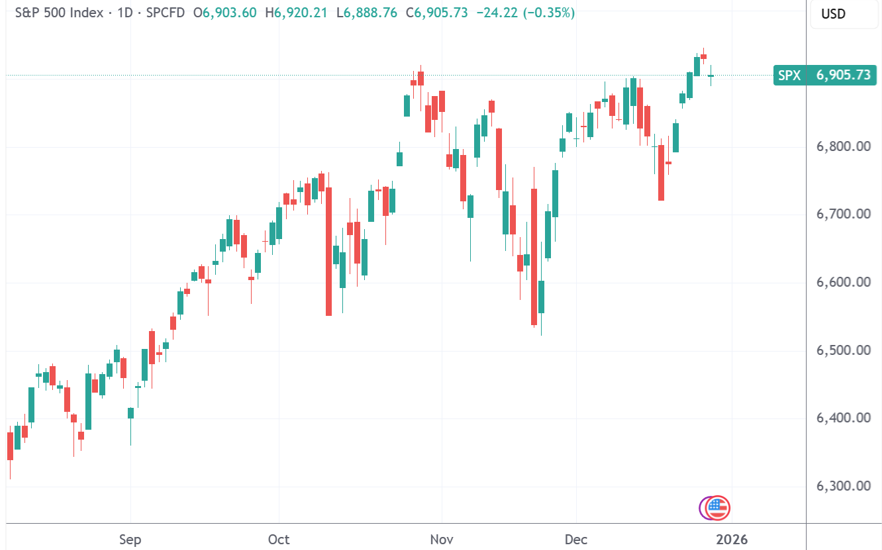
Market Performance - The U.S. stock market indices collectively declined due to heightened tensions from significant fluctuations in commodity prices, with the S&P 500 down 0.35% to 6905.74 points, the Nasdaq Composite down 0.5% to 23474.35 points, and the Dow Jones Industrial Average down 0.51% to 48461.93 points [1] - The mining sector experienced a collective drop, with First Majestic Silver down 4.13% and Newmont Mining down 5.64%, while lithium giant Albemarle fell by 3.62% [2] Commodity Market - Silver futures on Comex saw extreme volatility, reaching a high of $82 per ounce before plummeting to $71.6, marking a decrease of 7.20% [4] - Analysts suggest that precious metals have been severely overbought, and the recent declines may present a buying opportunity in the coming weeks [4] Company News - SoftBank Group announced a $4 billion acquisition of data center investment company DigitalBridge, marking a significant step in its artificial intelligence strategy [10] - Citigroup expects to record an after-tax loss of approximately $1.1 billion in Q4 related to the sale of its Russian business, with the transaction anticipated to complete next year [11] - Meta has acquired AI startup Manus, which was originally founded in China and later moved to Singapore, although financial terms of the deal were not disclosed [12] Sector-Specific Developments - Lululemon is facing a rare power struggle as founder Chip Wilson seeks to remove the current board, emphasizing the need for visionary leadership to drive the company's next phase of success [9] - Novo Nordisk has lowered the price of its weight loss drug semaglutide in China, following the impending expiration of its patent, with local companies preparing to introduce cheaper generic alternatives [8] Chinese Stocks - The Nasdaq Golden Dragon China Index fell by 0.67%, with notable declines in Alibaba (down 2.46%) and JD.com (down 0.44%), while NIO and NetEase saw gains of 4.71% and 0.92%, respectively [7]