TSMC(TSM)

Search documents
美股热门中概股盘前多数走高,百度涨超5%,小鹏汽车涨3%
Mei Ri Jing Ji Xin Wen· 2025-12-30 10:48
Group 1 - The core viewpoint of the article indicates that popular Chinese concept stocks in the US market are mostly rising before the market opens, with Baidu increasing by over 5% and Xpeng Motors rising by 3% [1] - Other notable stocks include Vipshop and NetEase, both of which have increased by over 2%, while TSMC and Alibaba have seen a modest rise of 0.3% [1]


全球芯片产能分布,仅供参考
半导体芯闻· 2025-12-30 10:24
Core Insights - The OECD report highlights the geographical distribution of wafer fabrication capacity, indicating that the top five economies (China, Taiwan, South Korea, Japan, and the USA) account for 87% of global wafer production capacity by September 2025 [2][5]. Geographical Distribution of Production Capacity - The report illustrates that South Korea's wafer production capacity is highly concentrated, with nearly 80% coming from nodes between 6nm and less than 22nm, primarily due to investments from major suppliers like SK Hynix and Samsung [5]. - In contrast, the USA's wafer production capacity is more diversified across various process nodes [5]. Concentration of Production Capacity Among Companies - The top ten semiconductor companies hold approximately 50% of the global wafer production capacity [6]. - In Japan, 73 companies operate wafer fabs with a total capacity exceeding 5 million wafers, with the top five companies accounting for 58% of Japan's total capacity [6]. Planned and Under Construction Capacity Growth - The majority of capacity investments are concentrated in the largest semiconductor-producing economies, driven by major companies operating in those regions [9]. - The USA, China, South Korea, Taiwan, Japan, Germany, and Singapore are identified as the countries with the largest growth in wafer production capacity [9]. Wafer Capacity by Chip Type - The report emphasizes that assessing wafer capacity distribution solely by node density is insufficient; chip type and business model must also be considered [11]. - China and Taiwan are the only two economies ranked among the top five producers for all six chip types analyzed [16]. Potential for Capacity Expansion by Chip Type - Capacity expansion potential varies significantly across chip types and economies, with notable growth in power chips and analog chips primarily occurring in China [18]. - The USA leads in upcoming capacity for analog chips, while China is set to dominate in mature logic chip production [19]. Mixed Manufacturing Capabilities of Fabs - Many fabs can produce multiple chip types, complicating the analysis of wafer capacity distribution [24]. - The presence of mixed-capacity fabs is particularly common in the production of analog and mature logic chips, while dedicated fabs are more prevalent for power semiconductors and advanced logic chips [26]. Average Wafer Fab Size by Chip Type - The average size of wafer fabs varies by chip type, with power, analog, and mature logic chips averaging between 30,000 to 50,000 WSPM, while advanced logic and general memory fabs are significantly larger [28]. Ownership and Wafer Capacity - Most wafer production capacity in the top five economies is owned by domestic companies, although foreign investment is increasing in some regions [32]. - The report notes that the ownership structure in the semiconductor industry can be complex, with many companies operating in multiple countries [33]. Wafer Capacity by Business Model - The report categorizes wafer capacity into three business models: IDM, pure foundry, and IDM-foundry, highlighting the evolving nature of semiconductor manufacturing [36]. - China and Taiwan are noted for having over 50% of their domestic wafer capacity coming from foundries rather than IDMs [38].

台积电2nm,正式量产
半导体芯闻· 2025-12-30 10:24
Core Viewpoint - TSMC has quietly announced the commencement of volume production of its N2 (2nm) process chips, achieving its previously stated goal for production in Q4 2025 [1][5]. Group 1: N2 Technology Overview - TSMC's N2 technology utilizes the first-generation nanosheet transistor technology, enhancing performance and power efficiency across all nodes [1]. - The N2 process aims for a 10%-15% performance improvement at the same power consumption and a 25%-30% reduction in power consumption at the same performance level [3][4]. - For mixed designs including logic, analog, and SRAM, transistor density is expected to increase by 15% compared to N3E, while pure logic designs will see a 20% increase [3]. Group 2: Production and Capacity - TSMC has begun production at its Fab 22 facility near Kaohsiung, Taiwan, with expectations for ramping capacity in 2026 driven by demand from smartphones and high-performance computing AI applications [5]. - The company is also constructing two new fabs capable of N2 process technology to meet the strong interest from partners, with plans to produce N2P and A16 chips starting in the second half of 2026 [7]. Group 3: Performance Enhancements - The N2P process, an enhanced version of N2, is set to further improve performance and power efficiency, while the A16 variant will utilize a Super Power Rail design tailored for complex AI and HPC processors [7].
台积电2nm,交卷了
3 6 Ke· 2025-12-30 10:24
Core Insights - TSMC has officially announced the mass production of its 2nm technology, set to begin in Q4 2025, marking a significant milestone in the semiconductor industry [2][4] - The competition in advanced semiconductor processes is intensifying, with TSMC, Samsung, and Intel all vying for leadership in 2nm technology [2][5] Group 1: TSMC's 2nm Technology - TSMC's 2nm (N2) process aims for a 10%-15% performance increase at the same power consumption, and a 25%-30% reduction in power consumption at the same performance level [4] - The N2 process will utilize Gate-All-Around (GAA) transistors, enhancing electrostatic control and reducing leakage, while also improving transistor density by 15% for mixed designs and 20% for pure logic designs compared to the N3E process [4] - TSMC's initial 2nm production capacity has been largely booked, with Apple securing over half of the initial capacity, alongside other major clients like Qualcomm, MediaTek, AMD, and NVIDIA [4] Group 2: Samsung's 2nm Efforts - Samsung has launched its 2nm process with the Exynos 2600 mobile application processor, which boasts a 39% performance increase over its predecessor and a 113% improvement in generative AI capabilities [6] - The introduction of Heat Path Blockage (HPB) technology in the Exynos 2600 aims to address previous overheating issues that affected Samsung's chip performance [6][7] - Samsung's 2nm process is currently achieving a yield rate of 50%-60%, with ongoing discussions with AMD for collaborative development on next-generation CPU products [7] Group 3: Industry Financials and Pricing Trends - The global revenue for the top ten foundries reached $45.086 billion in Q3 2025, with TSMC leading at $33.063 billion, reflecting a 9.3% quarter-over-quarter growth [10] - TSMC's advanced process technologies (7nm and below) accounted for 74% of its total wafer revenue, with 3nm contributing 23%, 5nm 37%, and 7nm 14% [10] - TSMC plans to increase its 2nm capacity to 100,000 wafers per month by 2026, with prices for 2nm wafers expected to exceed $30,000, nearly double that of 4nm wafers [11][12] Group 4: Future Innovations and Trends - The semiconductor industry is shifting focus from size reduction to multi-dimensional innovation, with new materials and architectures being explored to overcome the limitations of traditional silicon-based chips [16][17] - Innovations such as Chiplet technology and advanced packaging techniques are being developed to enhance performance, integration, and reliability of chips, moving beyond mere size scaling [17]
台媒:台积电前副总跳槽英特尔恐涉泄密,业界传出在台住所搜出大量“先进制程机密资料”
Huan Qiu Wang Zi Xun· 2025-12-30 04:07
Core Insights - TSMC's former senior vice president, Luo Wei-ren, is under investigation for allegedly taking confidential documents to Intel, raising concerns in the semiconductor industry [1][2] - TSMC has filed a civil lawsuit against Luo for violating employment contracts and trade secret laws, suspecting he may have leaked or transferred company secrets to Intel [2] - The incident highlights ongoing issues of intellectual property theft in the semiconductor sector, with previous cases of technology leaks involving former employees [3] Group 1 - Luo Wei-ren, aged 75, retired from TSMC in July and joined Intel in October, causing a stir in the semiconductor industry [2] - TSMC's lawsuit against Luo includes claims of breach of contract and potential violations of national security laws, with assets valued over NT$2 billion at stake [2] - The investigation by Taiwan's High Prosecutors Office includes the possibility of detaining Luo, who has U.S. citizenship and has settled in the U.S. [2] Group 2 - TSMC has faced multiple incidents of confidential information leaks this year, including a case in May involving a 2nm technology leak by an engineer who moved to a Japanese company [3] - The article emphasizes that the competition in the semiconductor industry is not just a technical race but also involves personnel changes that can significantly impact a company's future competitiveness [3] - The situation serves as a reminder of the vulnerabilities in the semiconductor industry regarding employee transitions and the potential for technology redistribution [3]

亚马逊暂停在意大利开展无人机配送计划;小鹏汇天飞行汽车制造公司增资至9亿,增幅约38%丨智能制造日报
创业邦· 2025-12-30 04:03
Group 1 - Russia successfully launched 52 satellites using the "Soyuz-2.1b" rocket, which took off from the Vostochny Cosmodrome in the Amur region on December 28, with all satellites entering their designated orbits [2] - TSMC is experiencing tight capacity for advanced processes below 3nm, leading to a planned price increase for these processes starting January 1, 2026, due to high demand from clients like Nvidia and AMD [2] - Amazon has decided to suspend its drone delivery program in Italy, citing broader commercial regulatory issues despite progress in aviation regulations [2] Group 2 - XPeng's subsidiary, Guangzhou Huitian Flying Car Manufacturing Co., has increased its registered capital from 650 million RMB to 900 million RMB, marking an increase of approximately 38% [2]



两岸圆桌派|汪涛、陈凤馨:大陆过去对台湾是“溺爱”,可惜台湾人没有意识到
Guan Cha Zhe Wang· 2025-12-30 03:23
Core Viewpoint - The ongoing US-China technology war has reached a critical stage, with China making significant advancements in various technology sectors, raising questions about Taiwan's position and future opportunities in this context [1][17]. Group 1: China's Technological Advancements - According to the Australian Strategic Policy Institute's report, China has established a leading position in over 60 out of 70 key technology areas, significantly surpassing the US [5]. - The "14th Five-Year Plan" emphasizes six key areas for technological breakthroughs, including integrated circuits and advanced materials, while also identifying new economic growth points such as quantum technology and hydrogen energy [2][3]. - China's approach to technology development is characterized by a broad exploration of all available technologies rather than a selective focus, allowing for a diverse range of innovations [10][16]. Group 2: Market Dynamics and Investment - The success of Chinese tech companies like Cambricon and Moore Threads is attributed to market-driven investments rather than government funding, highlighting the importance of private capital in fostering innovation [7][21]. - The shift from government-selected winners to market-selected winners has led to a more dynamic and competitive tech landscape in China, enhancing the conversion of research into commercial applications [8][9]. Group 3: Implications for Taiwan - Taiwan's reliance on TSMC raises concerns about its long-term economic sustainability, as the island lacks other significant industries to support its economy if TSMC were to relocate [24][25]. - The historical investment in the semiconductor industry has created a strong foundation, but there is a pressing need for Taiwan to diversify its economic base beyond TSMC to avoid becoming overly dependent [22][26]. Group 4: Future Outlook - The ongoing technological competition suggests that the US's strategy of containment may be ineffective, as China's advancements continue to challenge the status quo [17][20]. - The potential for collaboration between the US and China is acknowledged, but the technology war is expected to persist, influencing global market dynamics and investment strategies [3][18].
大陆过去对台湾是“溺爱”,可惜台湾人没有意识到
Guan Cha Zhe Wang· 2025-12-30 02:39
Core Insights - The ongoing US-China tech war has reached a critical stage, with China making significant advancements in various technology sectors, indicating a shift in global power dynamics [1][9][26] Group 1: China's Technological Advancements - China has established a leading position in over 60 out of 70 key technology areas, significantly surpassing the US in many fields [5][21] - The "14th Five-Year Plan" emphasizes six key areas for technological breakthroughs, including integrated circuits and advanced materials, while also identifying new economic growth points such as quantum technology and hydrogen energy [2][4] - The focus on artificial intelligence application is expected to accelerate, leveraging China's extensive supply chain and market size [4][12] Group 2: Market Dynamics and Innovation - The shift from government-led to market-driven selection of technology winners is crucial for fostering innovation in China, allowing for a more dynamic and competitive environment [8][10] - Young tech entrepreneurs are emerging as key players, with their success contributing to a cycle of investment and innovation within the tech sector [9][21] - The ability to convert academic research into commercial applications remains a critical factor for China's technological success [5][21] Group 3: Implications for Taiwan - Taiwan's reliance on TSMC as its primary technological asset raises concerns about its long-term economic sustainability, especially if TSMC's operations are relocated [22][24] - The historical investment in the semiconductor industry has positioned Taiwan well, but there is a need for diversification to avoid over-dependence on a single entity [24][25] - The changing geopolitical landscape necessitates a reevaluation of Taiwan's role in the tech ecosystem, as it faces competition from mainland China's rapid advancements [22][26]

6年间单片晶圆毛利润暴涨3.3倍,台积电杀疯了
Sou Hu Cai Jing· 2025-12-30 02:39
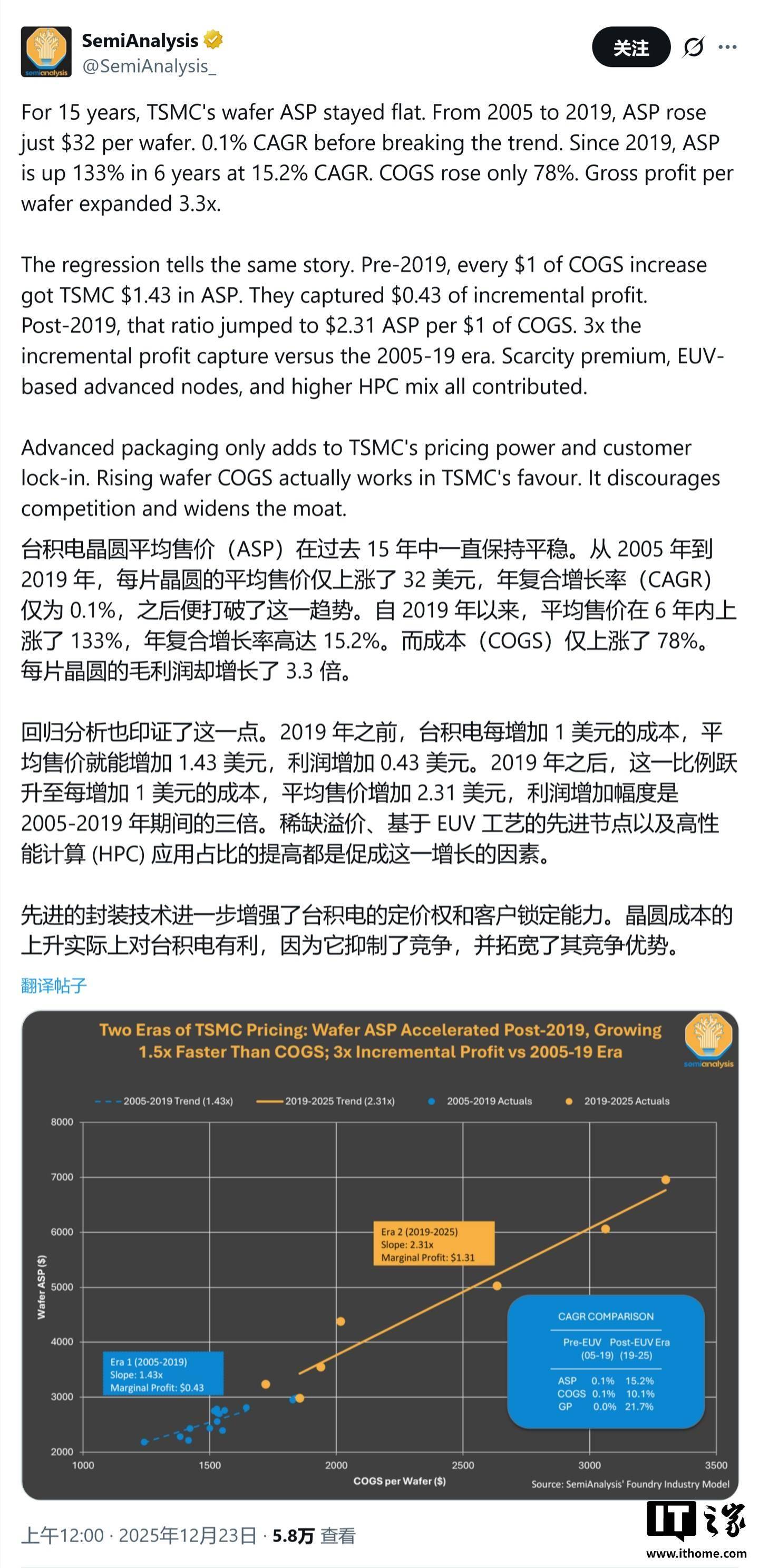
Group 1 - TSMC's pricing strategy was conservative from 2005 to 2019, with an average wafer price increase of only $32 over 15 years, reflecting a compound annual growth rate of just 0.1% [2] - In 2019, TSMC embraced EUV technology, leading to an average selling price (ASP) growth of 15.9% annually, resulting in a cumulative increase of 133% over six years [3] - TSMC's gross margin per wafer is projected to reach 3.3 times the 2019 level by 2025, indicating strong pricing power and the ability to pass increased costs to downstream customers [3] Group 2 - Prior to 2019, a $1 increase in production costs led to only a $1.43 increase in wafer price, yielding a profit increment of $0.43; post-2019, the same cost increase results in a $2.31 price rise, boosting profit increment to over $1.30 [3] - TSMC's success is attributed to strong demand from clients like NVIDIA, AMD, and Apple for AI and high-performance computing chips, which prioritize performance over price [3] - Unlike Samsung, which faces yield issues limiting its EUV capacity to in-house use, TSMC has established deep partnerships with top global chip designers through its Open Innovation Platform (OIP) [4] Group 3 - The current market structure, characterized by systemic supply shortages and high capital intensity, is expected to remain unchallenged until a true competitor emerges [5]
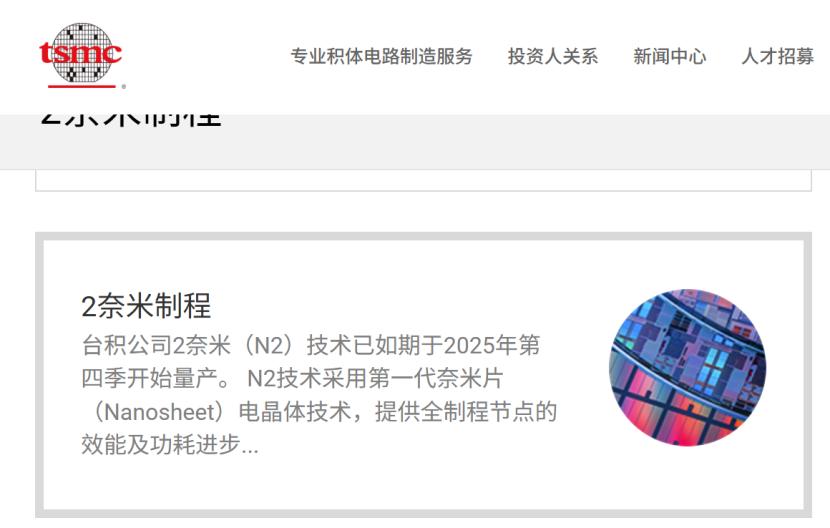
台积电2nm,悄然量产
半导体行业观察· 2025-12-30 01:45
Core Viewpoint - TSMC has quietly announced the commencement of volume production of its N2 (2nm) process technology, achieving its goal set for Q4 2025 without a formal press release [1][5]. Group 1: N2 Technology Overview - The N2 process utilizes the first-generation nanosheet transistor technology, providing significant improvements in performance and power consumption [1]. - TSMC's N2 technology is expected to be the most advanced in the semiconductor industry in terms of density and energy efficiency, addressing the growing demand for energy-efficient computing [1]. - The N2 design aims for a 10%-15% performance increase at the same power level and a 25%-30% reduction in power consumption at the same performance level [3][4]. Group 2: Performance Metrics - For mixed designs including logic, analog, and SRAM, transistor density is expected to increase by 15% compared to N3E, while pure logic designs will see a 20% increase [3][4]. - The N2 process will feature a significant reduction in power consumption, with estimates ranging from 25% to 30% compared to N3E [4]. Group 3: Production and Capacity - TSMC has begun production of 2nm chips at its Fab 22 facility near Kaohsiung, Taiwan, with expectations for ramp-up in capacity driven by demand from smartphones and high-performance computing AI applications in 2026 [5][8]. - The company is constructing two new fabs capable of N2 technology to meet the strong interest from partners, with plans to produce N2P and A16 chips starting in late 2026 [8]. Group 4: Future Developments - TSMC plans to introduce N2P, an enhanced version of the N2 process, which will further improve performance and power efficiency, with volume production expected in the second half of 2026 [8]. - The A16 chip, designed for complex AI and HPC processors, will also begin production in the second half of 2026, utilizing TSMC's advanced Super Power Rail design [8].