
牧原股份

Search documents
AI 钉钉 1.1 重磅发布:Agent OS 搭建生态底座,推动中国企业级 AI 进入 “协同干活” 新时代
Jin Rong Jie· 2025-12-23 04:56
Core Insights - DingTalk launched the world's first AI-driven work operating system, Agent OS, marking the beginning of a "human-AI collaboration" work model [1] - The release of Agent OS is a significant step away from mobile internet applications, transitioning into an AI-native work platform [4] Product Overview - Agent OS includes a product matrix featuring DingTalk ONE, DingTalk Real, AI search engine, general task processing Agent Wukong, and the enterprise AI platform DEAP, creating a comprehensive AI collaboration ecosystem [4] - DingTalk Real is defined as the "body of AI," providing a physical environment for safe and reliable execution of AI tasks in complex enterprise settings [4] - The upgraded AI products include AI search, AI forms, DingTalk A1, and AI transcription, enhancing functionality and user experience [5][6][7] AI Product Features - The "Order Agent" and "Quality Agent" in manufacturing can convert order images into production schedules and predict faults, while "AI Travel" can plan trips and compare prices, reducing costs by 15% [5] - The AI search engine has been upgraded to allow for secure and efficient information retrieval across various data sources [6] - The AI forms platform enables users to create applications with zero coding by uploading documents or images, facilitating a transition to AI applications [6] Hardware and Upgrades - DingTalk A1 has evolved from a personal assistant to a team assistant, integrating into various business processes and enabling centralized management of audio data [7] - The AI transcription product has added features such as cross-file AI Q&A and real-time translation, catering to the needs of international businesses [7]


消费股年末补涨!食品饮料ETF天弘昨日成交额近2500万元,农业ETF天弘近5日累计“吸金”超3100万元
2 1 Shi Ji Jing Ji Bao Dao· 2025-12-23 02:51
Group 1 - The core viewpoint of the article highlights a rebound in the consumer sector, particularly in food and beverage stocks, driven by recent policies aimed at boosting domestic demand and consumption [4] - The China Securities Food and Beverage Index experienced a slight decline of 0.03% at the close, with notable stocks such as Jingliang Holdings and Hongmian Co. reaching their daily limit up [1] - The China Securities Agricultural Index rose by 0.69%, with stocks like Roniu Mountain and Hainan Rubber also hitting their daily limit up [3] Group 2 - The Tianhong Food and Beverage ETF reported a trading volume of nearly 25 million yuan at the close, indicating active market participation [2] - The Tianhong Agricultural ETF saw a trading volume exceeding 32 million yuan, with significant net inflows over the past five trading days, totaling over 31 million yuan [3] - The Tianhong Food and Beverage ETF tracks the China Securities Food and Beverage Index, focusing on leading stocks in high-end and mid-range liquor, as well as other beverage and dairy segments [3] Group 3 - The consumer sector is currently experiencing a strategic opportunity period supported by intensive policy measures, with the food and beverage industry expected to benefit directly from the domestic demand boost [5] - Key trends in the industry include health-oriented and quality-focused consumption, alongside easing cost pressures, which enhance the profitability resilience of leading companies [5] - The consumer sector is showing signs of bottoming out, with policy dividends and fundamental recovery creating a resonant effect, indicating potential investment value [5]


国信证券晨会纪要-20251223
Guoxin Securities· 2025-12-23 01:20
Macro and Strategy - Silver prices have reached historical highs, driven by its dual industrial and financial attributes, with over 60% of silver used in industrial applications as of December 2025 [6][7] - The recent surge in silver prices was triggered by significant physical deliveries at the New York COMEX, with registered inventories dropping over 70% from their peak in 2020 [6] - Long-term demand for silver is expected to grow due to industrial applications in solar energy, AI, and electric vehicles, alongside continued global monetary easing [6] Industry and Company - The agricultural sector is witnessing a bullish trend in livestock prices, particularly for beef and milk, with expectations of a cyclical recovery in the meat and dairy markets [24][26] - The price of live pigs has increased to 11.57 CNY/kg, reflecting a week-on-week rise of 2.03%, while beef prices are also on an upward trajectory [24][26] - The media and internet industry has shown resilience, with a 0.54% increase in the sector, outperforming major indices, driven by upcoming IPOs and strong box office performances from films like "Avatar 3" [27][28] - The copper industry is facing a significant shift as long-term processing fees for copper concentrate have been set to zero, indicating a potential improvement in the industry structure [31] - The home appliance sector is experiencing a downturn, with retail sales down 19% year-on-year in November, although there are signs of recovery in exports for certain categories like refrigerators and washing machines [32][33]
2025年第218期:晨会纪要-20251223
Guohai Securities· 2025-12-23 00:48
Group 1: CRO Demand and Pricing - The demand for CRO services is recovering, with a tight supply of experimental monkeys leading to price increases. The price of 3-5 year old macaques has risen to 140,000 yuan each, indicating a supply-demand imbalance in the domestic innovative drug R&D sector [4][5]. - In 2025, from January to November, domestic financing for innovative drugs reached 4.086 billion USD, a year-on-year increase of 10.6% compared to 2024. This reflects a significant recovery in the demand for innovative drug R&D [4]. Group 2: Bond Market Strategies - As the year-end approaches, bond market strategies are converging towards reducing duration and increasing leverage. The interbank bond market leverage ratio increased by 0.23 percentage points to 107.68% as of December 19 [8][9]. - Funds are focusing on short- to medium-term credit bonds, with a notable shift towards buying credit bonds while net selling government bonds. This indicates a strategy of selling rates and buying credit [9]. Group 3: Automotive Industry Developments - Changan Deep Blue and BAIC Blue Valley's Arcfox have received the first batch of L3 level approval for autonomous driving vehicles, marking a significant milestone in China's policy and regulatory framework for autonomous vehicles [12]. - The Great Wall Ora 5 was launched with a suggested retail price range of 99,800 to 133,800 yuan, featuring advanced driver assistance systems and a design that continues the Ora "cat" series [13][14]. - The automotive sector's performance is closely aligned with the overall market, with the A-share automotive index showing a slight decline of 0.1% during the week of December 15 to 19 [11]. Group 4: Chemical Industry Insights - The price of liquid chlorine has increased to 114 yuan/ton, up 11.76% week-on-week, driven by improved demand from downstream industries [26]. - Industrial-grade lithium carbonate prices rose to 102,000 yuan/ton, an increase of 8.51%, while battery-grade lithium carbonate reached 104,250 yuan/ton, up 8.31%, indicating strong demand in the energy storage sector [26]. - The chemical industry is expected to benefit from a shift towards domestic substitutes for semiconductor materials due to geopolitical tensions, with a focus on companies involved in photolithography and electronic chemicals [17][19]. Group 5: Swine and Poultry Industry Trends - The swine industry is entering a phase of accelerated capacity reduction, with regulatory measures aimed at stabilizing pig prices. The expectation is that price adjustments will be gradual rather than abrupt [43]. - The poultry sector is showing signs of improvement, with a focus on the white feather chicken breeding segment, which has seen a steady increase in breeding stock [44]. Group 6: Real Estate Market Outlook - The report forecasts that in 2026, the total sales area of commercial housing will reach 780 million square meters, with significant contributions from third- and fourth-tier cities [49]. - The supply of new homes in first-tier cities is expected to decline due to reduced land supply, with a projected 28% year-on-year decrease in land transaction area [50]. - The new home price index is expected to perform better than the second-hand home price index, with a slight year-on-year decline of 1.2% for new homes compared to a 5.8% decline for second-hand homes [52].
生猪养殖行业简析报告
Jia Shi Zi Xun· 2025-12-22 14:16
Investment Rating - The report does not explicitly state an investment rating for the swine farming industry Core Insights - The swine farming industry in China is a strategic pillar for national economy and CPI stability, currently transitioning towards large-scale operations with a significant reduction in smallholders and a rise in large enterprises like Muyuan Foods, which has an annual output of 71.6 million pigs, creating a strong scale and cost moat [4] - The industry is characterized by two main business models: "self-breeding and self-raising" represented by Muyuan, and "company + farmer" represented by Wens, with feed costs accounting for approximately 75% of total breeding costs, highlighting the importance of cost control [5] - Future opportunities include the upgrade of consumption structure towards deep processing, the proliferation of intelligent breeding technologies, and the reassessment of assets due to self-sufficient breeding sources, while challenges include reliance on imported feed materials, ongoing risks from African swine fever mutations, and high fixed costs due to asset-heavy operations [6] Summary by Sections 1. Industry Position and Competitive Landscape - The Chinese swine farming industry is crucial for food security and CPI stability, primarily using a "three-way cross" breeding system for commercial production. The industry is accelerating towards scale, with an increasing number of large farms (over 50,000 heads) and a decreasing number of smallholders, with major players like Muyuan Foods dominating the market [4] 2. Business Model and Policy Evolution - The main business models are "self-breeding and self-raising" (capital-intensive, strong control) and "company + farmer" (light asset, rapid expansion). The policy focus has shifted from early environmental regulations and post-ASF supply guarantees to current "counter-cyclical regulation" and "capacity optimization," marking the end of the era of simple scale expansion [5][16] 3. Future Opportunities and Challenges - Opportunities lie in the upgrade of consumption structure, the spread of intelligent breeding technologies, and the reassessment of breeding assets. Challenges include strategic vulnerability due to dependence on imported feed materials, ongoing risks from ASF, and high fixed costs associated with transitioning from light to heavy assets [6][48][49][50] 4. Industry Overview - The swine industry is a cornerstone of China's food culture and economy, with pork consumption accounting for over 60% of meat consumption. The supply-demand dynamics are the most significant factors affecting the industry [7] 5. Breeding System - The breeding system in China primarily employs a three-way crossbreeding method, utilizing different breeds to enhance productivity and disease resistance [10] 6. Scale of the Industry - The swine industry is expected to see an output of over 700 million pigs by 2025, following a cyclical pattern of stability, decline, and recovery influenced by factors such as ASF [18] 7. Industry Chain - The swine farming industry chain includes upstream suppliers (feed, veterinary products), midstream farming entities, and downstream processing and retail sectors, with the farming segment being the core [22][24] 8. Cost Structure - Feed constitutes the largest portion of breeding costs, with energy feeds making up 75% of total feed costs. The cost structure varies significantly between different farming models [25][26] 9. Policy Changes - The last decade has seen a shift in policies from strict environmental regulations to a focus on capacity optimization and quality improvement, indicating a transition towards a more sustainable industry model [16] 10. Competitive Landscape - The competitive landscape is dominated by a few large enterprises, with Muyuan Foods leading the market with a significant output, allowing it to maintain a competitive edge during price downturns [35]
河南经济交出一份“韧性答卷”
He Nan Ri Bao· 2025-12-22 14:12
2025年进入"倒计时"。站在"十四五"收官、"十五五"开局这一重要时间节点,2025年河南经济"答卷"备 受关注。 2025年的河南经济发展有何亮点?面临哪些机遇与挑战?下一步发展的新动能蕴含在何处?回望2025 年,我们走得颇为不易,但却步步生花,可以说,河南经济交出了一份"韧性答卷"。 一 如今,郑州机场货运量突破100万吨历史大关。窥一斑而知全豹,今年以来,河南高速公路总里程突破1 万公里,加快构建便捷出海水运通道,努力打造全国统一大市场循环枢纽、国内国际市场双循环支点, 在融入服务全国统一大市场上不断走深走实、见行见效。 二 河南经济发展的底气何在?这源于经济大省的使命担当、近亿人口的内生动力、产业体系的扎实底座。 经济大省的责任担当。作为全国第六、中部第一经济体,河南的体量决定了它不能只算自己的账,更要 为全国发展大局扛稳责任。2022年7月,中央政治局会议首次提出"经济大省要勇挑大梁"。此后,中央 经济工作会议连续3年强化"经济大省挑大梁"这一时代命题。经济大省挑大梁,既是使命任务,也是战 略机遇。河南在"十五五"规划建议中明确,未来5年,经济大省挑大梁作用要更加彰显。 近1亿人口的内需潜力。截 ...
牧原股份:公司会根据实际经营需要,审慎确定具体融资金额
Zheng Quan Ri Bao Wang· 2025-12-22 13:44
Group 1 - The core viewpoint of the article is that Muyuan Foods (002714) is applying for credit limits from financial institutions to prepare for operational development needs, emphasizing that the credit limit does not equate to actual financing amounts [1] - The company will determine specific financing amounts based on actual operational needs and will adopt a more cautious operational strategy in the current market conditions [1] - The priority for the company is to ensure sufficient and safe cash flow while continuing to promote debt reduction efforts [1]
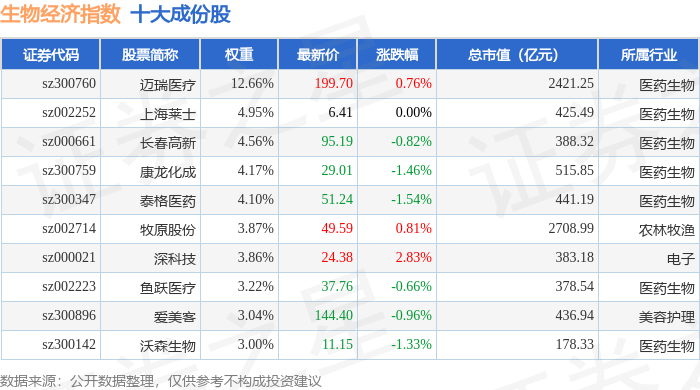
12月22日生物经济(970038)指数跌0.12%,成份股迪安诊断(300244)领跌
Sou Hu Cai Jing· 2025-12-22 11:35
Core Viewpoint - The Biotech Economy Index (970038) closed at 2120.29 points, down 0.12%, with a trading volume of 13.62 billion yuan and a turnover rate of 1.11% [1] Group 1: Index Performance - On the day, 16 stocks in the Biotech Economy Index rose, with Deep Technology leading at a 2.83% increase, while 30 stocks fell, with Dean Diagnostics leading the decline at 2.96% [1] - The net outflow of main funds from the Biotech Economy Index stocks totaled 640 million yuan, while retail investors saw a net inflow of 454 million yuan [1] Group 2: Top Constituents - The top ten constituents of the Biotech Economy Index include: - Mindray Medical (sz300760) with a weight of 12.66% and a market cap of 242.125 billion yuan [1] - Shizhu Aoshi (sz002252) with a weight of 4.95% and a market cap of 42.549 billion yuan [1] - Changchun High-tech (sz000661) with a weight of 4.56% and a market cap of 38.832 billion yuan [1] - Kanglong Chemical (sz300759) with a weight of 4.17% and a market cap of 51.585 billion yuan [1] - Taige Pharmaceutical (sz300347) with a weight of 4.10% and a market cap of 44.119 billion yuan [1] - Muyuan Foods (sz002714) with a weight of 3.87% and a market cap of 270.899 billion yuan [1] - Deep Technology (sz000021) with a weight of 3.86% and a market cap of 38.318 billion yuan [1] - Jiao Yue Medical (sz002223) with a weight of 3.22% and a market cap of 37.854 billion yuan [1] - Aimeike (sz300896) with a weight of 3.04% and a market cap of 43.694 billion yuan [1] - Watson Bio (sz300142) with a weight of 3.00% and a market cap of 17.833 billion yuan [1] Group 3: Fund Flow Details - The fund flow details indicate that Deep Technology had a main fund net inflow of 151 million yuan, while retail investors had a net outflow of 91.497 million yuan [2] - Kanglong Chemical experienced a main fund net inflow of 17.121 million yuan, with retail investors seeing a net inflow of 1.917 million yuan [2] - The Biotech Economy Index constituents underwent adjustments, adding 9 stocks and removing 9 stocks [2][3]

——农林牧渔行业周报:猪价承压,关注去化进程-20251222
Guohai Securities· 2025-12-22 11:03
Investment Rating - The report maintains a "Recommended" rating for the agriculture, forestry, animal husbandry, and fishery industry [1] Core Insights - The swine industry is entering an accelerated phase of capacity reduction, with a focus on positioning at the bottom of the market. Regulatory measures are being reinforced to stabilize pig prices, which are expected to face downward pressure in the short term due to increased market supply [3][15] - The poultry sector shows signs of fundamental improvement, with a focus on the white feather chicken breeding segment and potential price recovery in the future [4][28] - The animal health sector is closely monitoring the clinical trial progress of African swine fever vaccines, which could enhance market conditions for leading companies in the sector [5][38] - The pet industry continues to experience rapid growth, with domestic brands gaining strength and improving profitability [8][60] Summary by Sections Swine Industry - The average price of live pigs is reported at 11.53 CNY/kg, with a slight weekly increase. The number of breeding sows has decreased by 1.1% month-on-month [14][15] - Key investment recommendations include leading companies such as Muyuan Foods and Wens Foodstuffs, with additional attention on Dekang Agriculture and Shennong Group [3][15] Poultry Industry - The white feather chicken breeding segment has seen a total of 107.21 thousand sets updated from January to October 2025, with a balanced import and self-breeding ratio [4][28] - Recommended companies in this sector include San Nong Development and Lihua Shares [4][28] Animal Health - The animal health industry has faced losses for over three months, with expectations of continued low pig prices. The clinical trials for the African swine fever vaccine are a critical step towards commercialization [5][38] - Companies to watch include BioStock, Kexin Biological, and Ruipu Biological [5][38] Planting Industry - Grain prices are fluctuating, with corn prices at 2244 CNY/ton and wheat prices at 2515 CNY/ton. The pig-to-grain ratio is reported at 5.03 [44][48] - Investment suggestions focus on companies with strong positions in genetically modified seeds, such as Suqian Agricultural Development and Longping High-Tech [6][48] Feed Industry - Feed prices are experiencing fluctuations, with pig feed priced at 3.33 CNY/kg and chicken feed at 3.45 CNY/kg. The industry is expected to see increased concentration [49][50] - Recommended companies include Haida Group and He Feng Shares [49][50] Pet Industry - The pet market is projected to reach 300.2 billion CNY in 2024, with a year-on-year growth of 7.5%. The number of pet dogs and cats is also on the rise [59][60] - Recommended companies in the pet food sector include Guibao Pet, Zhongchong Shares, and Petty Shares [59][60]


2026年度中国期货市场投资报告:天气扰动豆系,去化主导生猪
Xin Ji Yuan Qi Huo· 2025-12-22 10:57
Report Industry Investment Rating - Not provided in the given content Core Viewpoints of the Report - In 2026, the global soybean supply is expected to remain loose. The price of US soybeans is still restricted by the global supply, while Brazil's soybean production is at a record - high level and Argentina's supply is sufficient. The implementation of the soybean purchase agreement will be a key factor affecting US soybean exports and price structure. The La Niña phenomenon may affect South American yields, and weather changes need to be monitored [2][77]. - China's soybean imports are expected to reach a new high in 2026, with a "low - first - then - high" supply rhythm. The soybean meal market is expected to continue the pattern of strong supply and weak demand, and the upward price space is limited [2][77]. - The pig production capacity is slowly being reduced. In the first half of 2026, the supply pressure of live pigs remains high, and prices are expected to fluctuate at a low level. The speed of production capacity reduction will be the key to the pig price trend in the second half of the year [2][78]. Summary by Relevant Catalogs 1. Market Review - **2025 Bean Market**: The 2025 bean market was mainly affected by trade relations, domestic soybean arrival rhythm, US soybean producing area weather and export expectations. The prices of domestic and foreign markets showed significant differentiation in March, and the price of US soybeans rebounded at the end of October, driving up the domestic soybean meal price [4]. - **Q1**: The domestic and foreign markets showed an initial differentiation, with the domestic market being stronger. The USDA report was bullish at the beginning of the year, and the price of US soybeans rebounded. The domestic soybean meal price was supported by the pre - Spring Festival stocking demand. The domestic and foreign markets began to diverge at the end of March [6]. - **Q2**: The supply pressure became prominent, and the price was under pressure. The domestic supply pressure increased significantly after May, and the soybean meal price lacked upward momentum. The US soybean market was supported by weather speculation and other factors [6]. - **Q3**: The US soybeans fluctuated in a range, and the domestic market was driven by costs. The price of US soybeans fell below 1000 cents in July and rebounded in August. The domestic soybean meal price was slightly boosted by import costs [6]. - **Q4**: Driven by trade sentiment, the price bottomed out and rebounded. The improvement of Sino - US relations significantly boosted the export expectations of US soybeans, driving up the domestic soybean meal price [7]. - **2025 Pig Market**: The 2025 pig market was affected by factors such as over - capacity, policy expectations, second - fattening sentiment and slaughter rhythm, showing a pattern of fluctuating downward and weak rebound [8][10]. - **Q1**: The demand was strong first and then weak, and the pig price fluctuated weakly. The pig price was relatively strong before the Spring Festival and then fell. The second - fattening and barring sentiment led to a rebound in the pig price in late February [11]. - **Q2**: The policy guidance began to appear, and the price first rose and then fell. The pig price rebounded in April and then fell in May. The second - fattening replenishment enthusiasm increased in June, and the pig price stopped falling and stabilized [11]. - **Q3**: The supply - demand imbalance intensified, and the spot and futures markets diverged. The pig price soared in July due to supply reduction and policy factors, and then fluctuated and fell in August. The futures market moved down in September [12]. - **Q4**: After the National Day, the demand entered the off - season, and the pig price fell sharply and then rebounded slightly. The futures market was under pressure and fluctuated at a low level [12]. 2. International Soybean Market Supply Analysis - **USDA Report**: The global soybean supply continues to be in a loose pattern. In the 2025/26 season, the global soybean production is estimated to be 423 million tons, with the ending inventory increasing by 4 million tons. The inventory - to - consumption ratio has increased both month - on - month and year - on - year [16]. - **US**: The 2025/26 US soybean inventory - to - consumption ratio is 6.74%, and the supply - demand fundamentals have been tightening in recent years. The short - term price has a bottom support, but the upward space is limited by the global supply [17][18]. - **South America**: The production data of South American soybeans remains unchanged in December. Brazil's production is expected to be 175 million tons, and Argentina's is 48.5 million tons. The overall supply remains loose, but South American weather is still a key concern [19]. - **Brazil**: The soybean sowing is coming to an end, and the production is expected to reach a record high. Multiple institutions predict that the 2025/26 production will be between 175 - 178 million tons. In 2025, the export volume reached a record high, and it is expected to continue to rise in 2026. The La Niña phenomenon may pose a threat to the yield [20][21]. - **Argentina**: The sowing progress is accelerating. The Buenos Aires Grain Exchange expects the 2025/26 production to be 48.5 million tons. The export tax has been reduced, and the export is expected to reach a six - year high [23][24]. - **US**: The soybean harvest is basically over, and the production is at a historical high. The weekly export volume has decreased month - on - month, but the cumulative year - on - year increase has continued to expand. The short - term export demand is still strong. The medium - and long - term export situation needs to pay attention to the impact of trade relations on trade flows. The soybean crushing volume in October set a new record, and it is expected to remain at a high level in the short term [27][28]. - **Trade Relations**: The Sino - US trade relations have entered a new stage of "transaction - based management". The stable trade of soybeans has become the balance of bilateral relations, but the structural contradictions have not been resolved. In 2026, trade relations are no longer the main trading line, but short - term disturbances still exist [31][34]. - **La Niña Disturbance**: The probability of a weak La Niña phenomenon in the next three months is 55%. The main impact is on South America, with the risk of reduced production in Argentina being the greatest. The actual weather conditions in South America and the intensity and duration of La Niña are the focus of the market [35][36]. 3. Domestic Soybean Market Supply - Demand Analysis - **Soybean Imports**: In 2025, China's soybean imports are expected to exceed 110 million tons for the first time, showing a "stable - first - then - high" pattern. In 2026, imports are expected to continue to grow, with a "low - first - then - high" rhythm, and the import value growth rate may continue to be lower than the import volume growth rate. The import scale of US soybeans depends on Sino - US trade relations [40][42]. - **Soybean Crushing**: In 2025, the national soybean crushing volume reached a historical high, showing a "low - first - then - high" pattern. The crushing profit showed a "high - first - then - low" and fluctuating downward trend. In 2026, the crushing industry is expected to continue to operate at a high level, but the growth rate will slow down, with a "low - first - then - high" seasonal rhythm [44][45]. - **Soybean Meal Inventory**: In 2025, the soybean meal inventory showed a "tight - first - then - loose" pattern. In 2026, if the arrival is uniform, the soybean meal supply will be slightly looser than in 2025. The inventory may bottom out in March - April and then gradually recover [46]. - **Demand**: In 2025, the trading volume of soybean meal fluctuated greatly. The overall demand for the breeding industry is stable, and the proportion of soybean meal added in feed continues to decline. In 2026, the demand for soybean meal will show the characteristics of "stable total demand and decreasing addition ratio", and the demand growth rate is expected to be lower than the feed production growth rate [48][52]. 4. Pig Market Supply - Demand Analysis - **Supply**: - **Price Decline**: Since 2025, the domestic pig price has been in a downward trend, and the prices of binary sows and piglets have also declined to varying degrees [56]. - **Capacity Regulation**: The Ministry of Agriculture and Rural Affairs has strengthened the regulation of pig production capacity, and listed companies in the pig - breeding industry have actively responded. As of October 2025, the inventory of breeding sows has declined to 39.9 million, and the production capacity reduction has accelerated [57][60]. - **Low Import Willingness**: The domestic pork supply is sufficient, and the import willingness of downstream purchasers and importers is weak. The pork import volume in October 2025 reached the lowest level of the year [66]. - **Profit Loss**: In 2025, the pig - breeding profit changed from profit to loss. In the first half of 2026, the pig supply is expected to be high, and the profit may continue to be under pressure. If the production capacity is significantly reduced in the second half of the year, the price and profit may recover [68]. - **Weakening of Second - Fattening Impact**: In the second half of 2025, policies restricted second - fattening, and leading enterprises responded actively. The influence of second - fattening on pig prices has weakened significantly, and the pig price trend is expected to be smoother in 2026 [69][72]. - **Demand**: In 2025, the pig demand showed typical seasonal characteristics. In the second half of the year, the terminal consumption recovered strongly, but the upward space of pig prices was restricted by the supply. In 2026, the pig market will continue the complex supply - demand game, and the short - term price may face a callback risk, while the medium - and long - term consumption growth space is limited [74][75]. 5. Summary and Outlook - **Soybean Meal**: With a loose global supply and accumulating domestic inventory, the overall upward space is limited. Attention should be paid to marginal variables such as South American weather speculation and the implementation of the Sino - US procurement agreement [77][78]. - **Pigs**: In the first half of the year, the supply pressure remains high, and the price is expected to fluctuate at a low level. Attention can be paid to the rebound opportunities brought by the seasonal consumption recovery, and the process of production capacity reduction and the effect of policy guidance should be closely monitored [78].