奔驰

Search documents
“马年特价车”滞销的smart困局难解
Xin Lang Cai Jing· 2026-02-08 16:26
Core Insights - Smart brand is facing declining sales despite launching new models and a limited edition vehicle, indicating challenges in the competitive electric vehicle market [2][4][6] Group 1: Sales Performance - Smart brand's retail sales in China were 42,292 units in 2023, a decline of over 7% from the previous year, and are projected to drop by 21.3% to 33,280 units in 2024 [2][4] - The limited edition "Year of the Horse" version of the Smart 1, priced at 139,900 yuan, has sold only 20-30 units since its launch, primarily due to its exclusion from tax exemption lists and local subsidies [1][6] - The traditional two-seater Smart 1 remains the best-selling model, with cumulative sales of 20,836 units in 2025, while larger models like Smart 3 and 5 have significantly lower sales [5][6] Group 2: Strategic Shift - Smart is transitioning from its traditional microcar image to focus on compact and mid-size SUVs, launching models like Smart 3 and 5 to capture a larger market share [3][4] - The upcoming Smart 6, a luxury hatchback exceeding 5 meters in length, aims to provide a unique experience in a crowded market and is set to launch in mid-2026 [4][6] Group 3: Market Positioning - Smart's strategy includes maintaining a premium brand image while adapting to consumer demands for larger vehicles and enhanced features, as the microcar segment is deemed insufficient for sustainability [3][4] - The brand is also facing increased competition from domestic manufacturers, which are gaining recognition for their technological advancements in electric vehicles [10][11] Group 4: Marketing and Consumer Engagement - Smart has implemented pricing strategies to boost sales, including significant price reductions for models like Smart 1 and 3, and has introduced promotional offers to attract buyers [7][8] - The brand acknowledges the emotional concerns of existing customers regarding new features being offered for free in newer models, indicating a need for better communication and engagement with loyal customers [8][9]
从疯狂开店到主动关店:车企渠道“瘦身”求生
经济观察报· 2026-02-08 06:36
不仅是新势力车企,随着中国汽车市场发生结构性转变,传统 车企的渠道也在持续调整,呈现出全新的发展态势。一场覆盖 全行业的渠道变革已然上演。 作者:周菊 封图:图虫创意 近日,理想汽车对销售渠道进行调整,计划在2026年上半年关闭约100家效益较低的零售门店, 部分一二线城市商超核心地段的门店也在其中。尽管理想汽车回应称,仅会调整关闭少量低效门 店,"关闭100家门店"系不实信息,但新势力车企调整缩减销售渠道已成为一个显著的行业现 象。 除了理想汽车,特斯拉、小鹏及蔚来等企业也有类似的渠道收缩举动。2025年,蔚来整合旗下三 个品牌的渠道和服务,乐道和萤火虫的车辆在蔚来NIOHouse展示销售,并关闭了部分商超门店; 广汽融合旗下埃安和昊铂两个新能源品牌的渠道;特斯拉减少了一线城市商超体验店数量,在传统 汽车商圈增设更多传统4S店形态的销售网点;小鹏早在2023年就推进"木星计划",关闭经营不 善、效率低下的直营门店,扩大授权经销商规模。"这标志着新势力已经从'跑马圈地'进入'精耕细 作'期。这个变化的核心是商业逻辑变了,以前烧钱换流量,现在必须算细账。高昂租金换不来销 量就是浪费,车企开始回归商业本质,砍掉低 ...



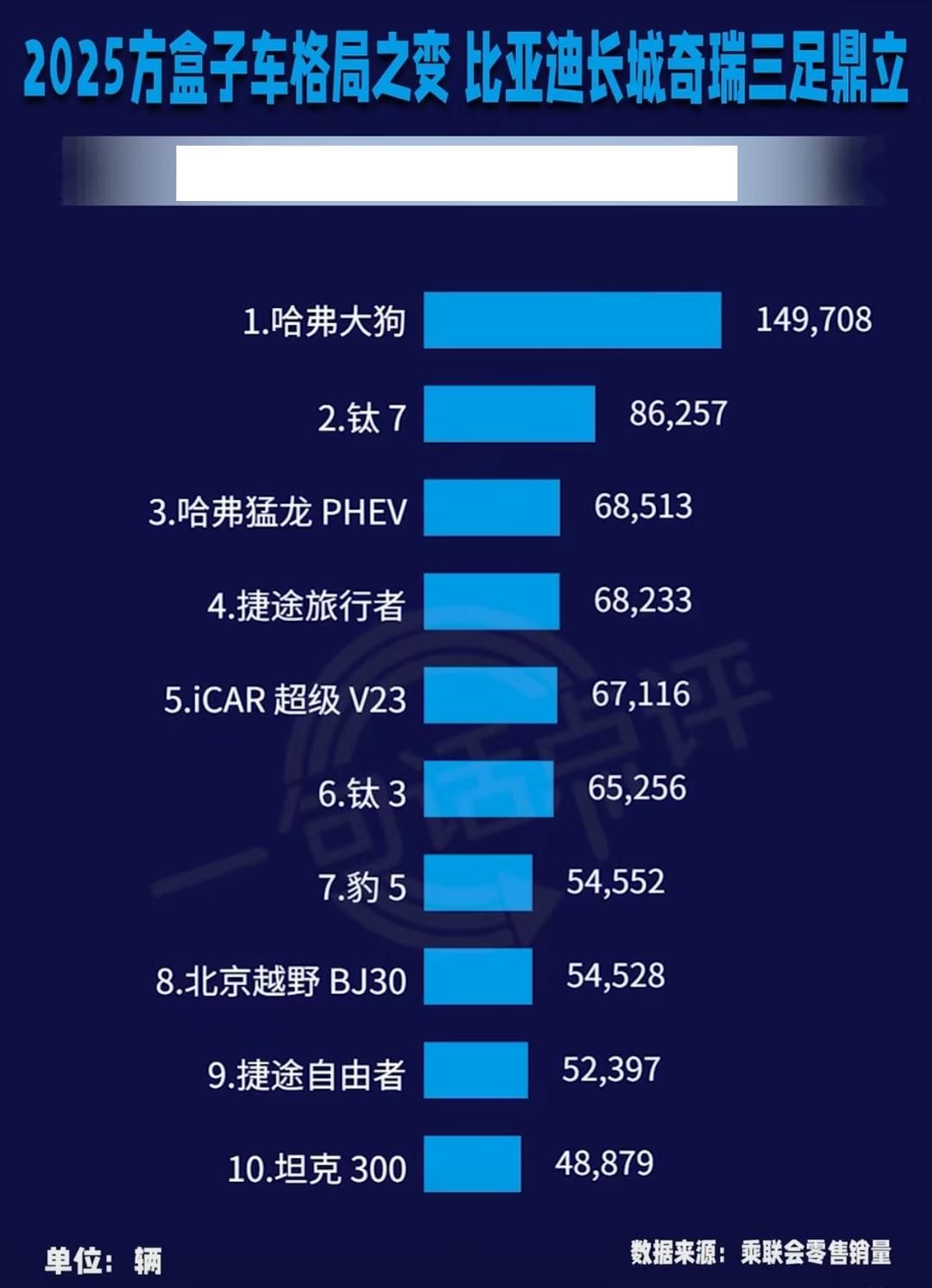
方盒子SUV:国产三强鼎立,外资彻底失势?
3 6 Ke· 2026-02-08 03:28
Core Insights - The era of domestic "boxy" SUVs in China has arrived, with significant market shifts favoring local brands over foreign luxury brands [1][12][19] - By 2025, the total sales of boxy SUVs in China are projected to exceed 1 million units, with domestic brands capturing over 90% of the market share [1][19] - Key players in this market include Great Wall, BYD, and Chery, which together account for 75% of the domestic boxy SUV sales [1][3] Market Dynamics - The shift in the boxy SUV market is attributed to changing consumer preferences towards outdoor activities and versatile vehicle performance, moving beyond traditional family use [4][12] - Great Wall has maintained its leading position with a projected sales volume of 452,000 units in 2025, representing over 30% of the domestic market [5][7] - BYD has emerged as a strong competitor, achieving sales of 235,000 units, leveraging its expertise in new energy technology [8][9] Competitive Landscape - Great Wall's strategy includes a diverse product range across various price segments (100,000 to 350,000 RMB) and multiple powertrain options, appealing to a broad consumer base [7][16] - BYD's success is driven by its "new energy + rugged" approach, with the Fangchengbao series, particularly the Titanium 7 model, achieving significant sales [9][19] - Chery focuses on high cost-performance vehicles, with sales of 397,000 units in 2025, targeting the mainstream consumer market [10][11] Emerging Players - Other brands like Beijing Off-road and Baojun are also making strides in the boxy SUV market, contributing to a vibrant competitive environment [11][19] - The overall market is characterized by a "three-legged" structure with multiple brands competing, providing consumers with a wider range of choices [11][19] Historical Context - The dominance of foreign brands in the boxy SUV segment has been challenged, as domestic brands have successfully integrated advanced technologies and consumer insights into their offerings [12][13][19] - The transition from foreign brand dominance to domestic leadership marks a significant evolution in the Chinese automotive industry, showcasing the capabilities of local manufacturers [19]


“马年特价车”滞销的 smart困局难解
Xin Lang Cai Jing· 2026-02-06 21:01
中经记者 郭阳琛 石英婧 上海报道 "精灵#1马年开运版上市近一个月,我们门店卖出二三十辆,但目前还有现车。主要原因在于这款车型 未进入2026年减免车辆购置税的新能源汽车车型目录,同时无法享受上海市以旧换新补贴政策。"1月28 日,smart上海闵行全功能体验店工作人员李维(化名)表示。 《中国经营报》记者注意到,smart精灵#1马年开运版于2026年元旦推出,限量1000辆,售价13.99万 元,是该车型的历史最低价。 "这个限量版反响不错,只是为了回馈smart车友,并非参与'价格战'。"1月30日,smart品牌方面向记者 回应,当前情绪价值备受用户关注,通过马年开运版这种特别个性化的版本,可以吸引更多用户,增强 用户黏性。 smart品牌过去以"两座微型车"著称,但在电动化转型过程中开始转向更主流的紧凑型和中型SUV市 场,接连推出精灵#3和精灵#5两款大车。已在工信部备案、即将在2026年上市的精灵#6,车长甚至超过 了特斯拉Model Y。 但smart品牌已经连续两年销量下滑。相关数据显示,2025年,smart品牌在中国市场零售销量为30799 辆,同比下降超7%。2023年,smart品 ...
车企渠道大变革:从“狂飙圈地”到“退守精耕”
Jing Ji Guan Cha Wang· 2026-02-06 16:30
有企业缩减渠道,也有企业在"逆势"扩张。例如,零跑汽车在近两个月内新增开业门店85家;小米汽车持续增加门店数量,1月新增9家,2月计划再增6家; 鸿蒙智行更是不得不进行渠道扩张,随着销量增长和车型增加,现有门店难以满足展示需求。有消息称,目前智界和尚界正在加速构建独立的销售网络,两 个品牌已召开了面向经销商的招商大会,且享界也在筹划单独建网。 传统车企大量关店 近日,理想汽车对销售渠道进行调整,计划在2026年上半年关闭约100家效益较低的零售门店,部分一二线城市商超核心地段的门店也在其中。尽管理想汽 车回应称,仅会调整关闭少量低效门店,"关闭100家门店"系不实信息,但新势力车企调整缩减销售渠道已成为一个显著的行业现象。 除了理想汽车,特斯拉、小鹏及蔚来等企业也有类似的渠道收缩举动。2025年,蔚来整合旗下三个品牌的渠道和服务,乐道和萤火虫的车辆在蔚来 NIOHouse展示销售,并关闭了部分商超门店;广汽融合旗下埃安和昊铂两个新能源品牌的渠道;特斯拉减少了一线城市商超体验店数量,在传统汽车商圈 增设更多传统4S店形态的销售网点;小鹏早在2023年就推进"木星计划",关闭经营不善、效率低下的直营门店,扩大授权 ...

政策调整需求回落,在欧车企碳排放积分生意“遇冷”
Guan Cha Zhe Wang· 2026-02-06 09:02
(文/观察者网 张家栋 编辑/高莘) 近日,《欧洲汽车新闻》报道称,受欧盟排放监管规则调整及市场不确定性影响,多家汽车制造商正在放缓甚至推迟2026年排放配额与积分合作机制的制定 节奏。 相比2025年初在欧车企为避免高额罚款而密集组建排放共享池、主动寻求积分合作的情况,今年行业整体态度明显转向谨慎,排放合规相关交易活跃度也随 之降温。 在前两年的欧洲市场,排放积分交易一度成为电动化布局领先车企的重要补充收入来源。 沃尔沃 欧洲汽车新闻 截至2025年前九个月,沃尔沃通过出售排放积分获得约24.4亿瑞典克朗(约17.1亿元人民币)收入;特斯拉2025年全球监管积分收入约19.9亿美元(约143亿 元人民币)。 企业层面的积极度随之快速下降,沃尔沃首席执行官萨缪尔森表示,碳排放额度的市场价值正在被重新审视,政策弹性提升后,积分交易的重要性下降。他 还补充称,部分企业此前按照既定政策节奏加速电动化投入,但规则中途调整削弱了相关商业回报。 马自达欧洲首席执行官滕·布林克表示,公司将根据今年电动车市场需求表现,在第一季度结束后再决定是否参与2026年的配额合作安排。 值得一提的是,在欧洲碳排放监管力度放宽前的2025 ...

一边筑壁垒,一边送补贴!欧盟与德国对中国电动车,为何态度截然相反?
Zhong Guo Neng Yuan Wang· 2026-02-06 08:04
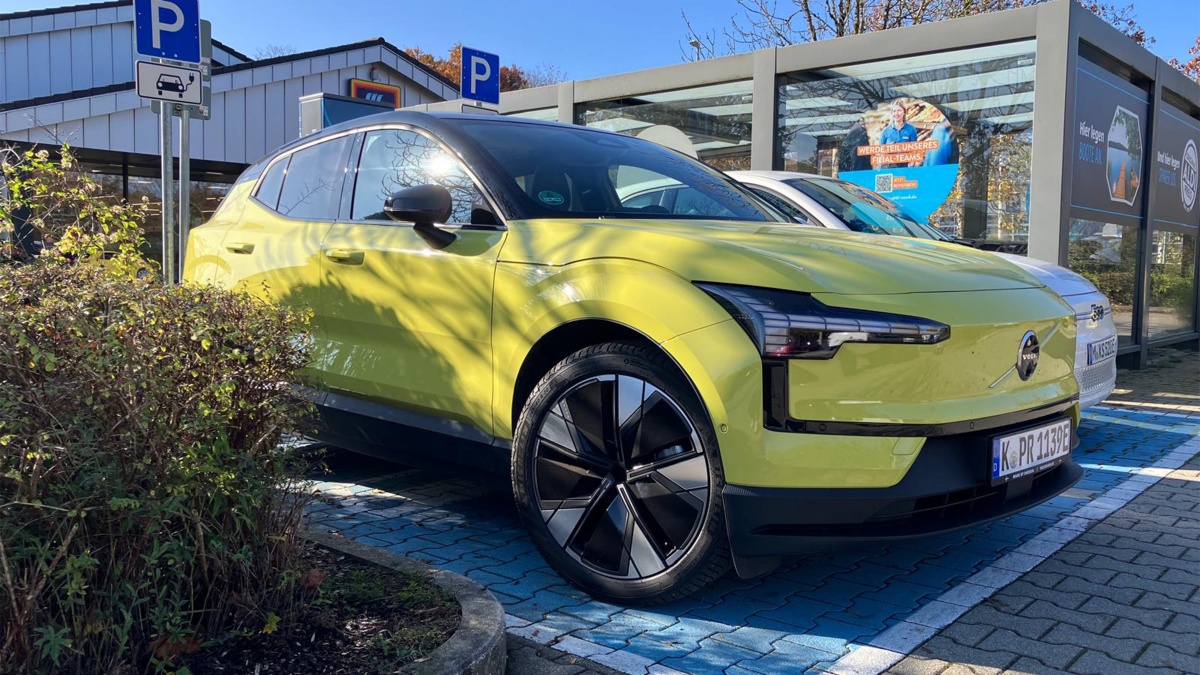
Core Insights - The article discusses the evolving trade dynamics between China and Europe regarding electric vehicles, highlighting a dual approach where the EU is tightening regulations while Germany is opening its market [1][4]. Group 1: EU Regulatory Framework - The EU has shifted its strategy from using tariffs to establish a complex regulatory framework aimed at creating a "minimum import price" for Chinese electric vehicles, which is intended to ensure fair competition [2][3]. - This new regulatory approach includes detailed measures to prevent "cross-subsidization risks," indicating a proactive stance in reshaping market competition conditions [2][3]. Group 2: Germany's Market Strategy - Germany has announced a €3 billion subsidy plan for electric vehicles that is brand-neutral, contrasting with the EU's protective measures, aimed at stabilizing domestic demand amid a significant drop in new registrations [4][5]. - The subsidy plan is designed not only for short-term market stimulation but also to encourage competition and innovation within the domestic automotive industry, acknowledging the advantages of Chinese companies in supply chain efficiency [4][5]. Group 3: Challenges for Chinese Automakers - Chinese electric vehicle manufacturers face a dual challenge of complying with stringent EU regulations while simultaneously expanding their market presence in Germany [6][7]. - The need for deep localization is emphasized, requiring Chinese companies to establish R&D centers in Europe and adapt their operations to align with local market demands and regulatory frameworks [7][8]. Group 4: Future Competitive Landscape - The competition will increasingly focus on regulatory standards and the ability to influence future norms in areas such as carbon footprint and data security, necessitating a proactive approach from Chinese firms [7][8]. - The article concludes that the interplay between EU regulations and German market strategies represents a broader trend in global industrial cooperation, highlighting the need for strategic foresight and local adaptation by Chinese companies [8].
有辆30指数2026年首月大涨近20%,折射春节前二手车需求强劲
Zhong Guo Qi Che Bao Wang· 2026-02-06 05:51
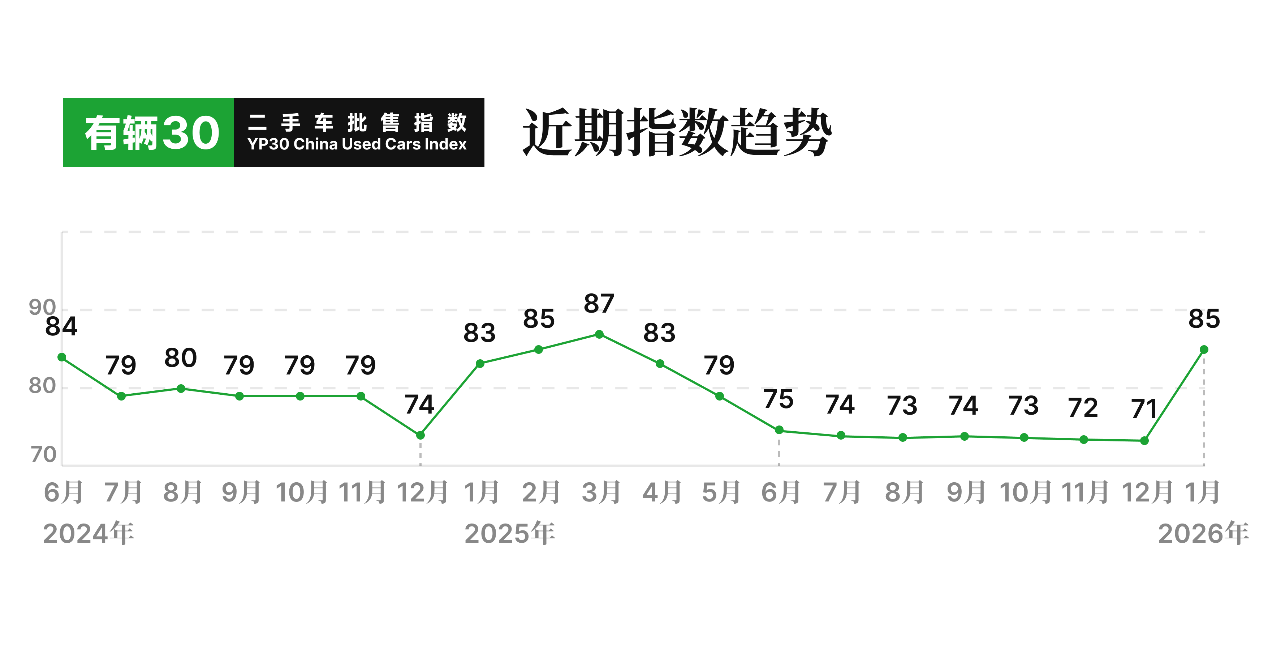
Core Insights - The "Youliang 30 Used Car Wholesale Index" recorded a significant increase of 19.7% month-on-month in January 2026, reaching 85 points, driven by strong demand in the automotive consumption market before the Spring Festival, marking the largest monthly increase since its inception [1] - The index now includes a complete list of 30 benchmark models, enhancing its transparency and market reference value, providing a clearer and more credible quantitative framework for observing the dynamics of the Chinese used car market [1][2] Index Composition - The 30 benchmark models represent high liquidity and typical market indicators across various segments, covering brands from China, the US, Germany, and Japan, aimed at reflecting the overall trends in the Chinese used car market [2] - Notable models include Chinese brands like Great Wall Haval H6 and BYD Song, German brands like Volkswagen Golf and BMW 3 Series, Japanese brands like Honda CR-V and Toyota RAV4, and American brands like Tesla Model Y and Buick GL8 [2] Market Trends - The index data for January 2026 reveals a profound structural adjustment beneath the overall market prosperity, with mid-to-large vehicles experiencing a price increase of 27.1% year-on-year, significantly higher than the average market increase of 11.1% for compact cars [4] - Chinese brands led the market with a year-on-year price increase of 36.9%, reflecting advancements in technology, product strength, and market recognition, while German brands maintained a robust 34.6% increase [7] - In contrast, Korean and French brands faced declines of 9.0% and 13.8% respectively, indicating challenges in market share and brand influence [7] Vehicle Type Dynamics - The market has seen a notable shift in demand, with MPV prices soaring by 35.7%, becoming the fastest-growing category, while traditional SUV prices saw a modest increase of 3.2% and sedans increased by 18.6% [10] Circulation and Transactions - The liquidity of used car sources in China continues to rise, with total used car transactions in 2026 surpassing 20 million units, reaching 20.108 million, a year-on-year increase of 2.52%, and an increasing proportion of interprovincial transactions [13] - The "Youliang 30 Index" provides innovative analysis on interprovincial circulation, with Sichuan province entering the top 5 in interprovincial procurement in January 2026 [13] Index Value and Macro Significance - The "Youliang 30 Index" serves as a quantifiable and traceable "data dashboard" for industry governance and market fluctuation assessment, helping relevant departments gauge the true structure of the current consumption market and consumer confidence levels [22] - The index's monthly data series creates a dynamic price map, allowing for scientific measurement and analysis of the impact of policies like "trade-in" on the circulation segment [22] - The transparency and standardization of the "Youliang 30 Index" respond to national requirements for market data element commercialization and the establishment of a high-standard market system, facilitating the transition of the used car industry from a traditional "experience-driven" model to a "data-driven" modernized development phase [22]
车长五米四,新能源车还能再大点吗?
远川研究所· 2026-02-05 13:13
Core Viewpoint - The article discusses the trend of larger SUVs in the Chinese automotive market, highlighting the shift towards three-row SUVs that cater to family needs and the growing consumer preference for spacious vehicles [5][10][30]. Group 1: Market Trends - The introduction of the Tesla Model YL and the success of large three-row SUVs have significantly impacted Tesla's delivery volumes, indicating a strong consumer preference for larger vehicles [5][7]. - The trend of larger vehicles is evident, with new models like the Denza N9 and N8L showcasing lengths exceeding 5 meters, which aligns with the growing demand for spacious SUVs [7][10]. - The market share of mid-to-large SUVs has seen a notable increase, with mid-large SUVs maintaining a market share of 3%-4% since September 2022, while large SUVs remain below 2% [12][13]. Group 2: Consumer Preferences - The demand for larger SUVs is driven by family-oriented needs, where consumers prioritize space and comfort for both daily use and family outings [26][30]. - The average vehicle ownership in China is projected to reach 52.9 vehicles per 100 households by 2025, indicating a strong market for family-sized vehicles [28]. - The article emphasizes that the preference for larger vehicles is not unique to China, as similar trends are observed globally, particularly in the U.S. and Europe [33]. Group 3: Technological Factors - The increase in vehicle size is attributed to the design of electric vehicles, which require more space for battery placement, leading to wider and longer vehicle dimensions [20][21]. - Advances in battery technology have allowed for larger battery capacities in SUVs, with many new models featuring batteries exceeding 80 kWh, enhancing their range and appeal [23][24]. - The integration of battery technology into vehicle design has improved the overall space within the cabin, allowing for more comfortable seating arrangements and features [30].


销量连跌两年,中国区CEO黯然离开,宝马中国战略大溃败?
Sou Hu Cai Jing· 2026-02-05 07:11
2026年1月30日,宝马集团突然官宣关键人事调整:自4月1日起,柯睿辰将接替高翔,出任宝马集团大中华区总裁兼首席执行官,而在中 国任职超过十年的高翔则结束在华任期,回归集团另有安排。 提前两个月官宣换帅,本身就不寻常。更令外界诧异的是,高翔在这个岗位上仅仅坐了两年。而接替他的柯睿辰,虽然是一位在宝马集 团效力27年的"老将",却从未有过中国市场的工作经历。 这种"空降"式的安排,与宝马过去二十年来多数的大中华区总裁形成了鲜明对比。从史登科到康思远,从高乐到高翔,他们都是从中国 市场的基层一步步成长起来的。 更敏感的是,本次高层轮岗还发生在一个极为特殊的时间点。宝马在中国市场销量已连续两年出现两位数下滑,电动化与智能化转型迟 缓,传统豪华品牌优势正在被迅速侵蚀。 当"换帅"与"失速"同时出现,宝马中国的未来,是一片灰色的阴霾。 一场持续两年的"自由落体" 如果要用一个词来形容宝马中国过去两年的表现,"自由落体"恐怕再合适不过。 2023年,对于宝马中国而言是一个值得骄傲的年份。那一年,宝马在中国市场共售出82.5万辆汽车,创下历史新高,中国市场也连续第 十年稳居宝马全球最大单一市场的宝座。然而,彼时的宝马或许 ...