
星展银行

Search documents
每日机构分析:12月2日
Xin Hua Cai Jing· 2025-12-02 10:51
·星展银行预计,新加坡2026年平均核心通胀率为1.0%,整体通胀率为1.2%,虽从2025年周期性低点回 升,但仍处于温和可控区间。2025年新加坡通胀已显著降温,主因进口及国内成本增长持续疲软。展望 2026年,尽管全球价格下行势头减弱,但企业向消费者转嫁成本的能力有限,通胀失控风险较低。 ·华侨银行策略师表示,日本央行行长植田和男12月1日的讲话释放明确信号,似为12月或1月加息做铺 垫,市场加息预期显著升温。即便日本央行在12月加息,其后续是否再度长期按兵不动仍是关键问题。 日元要实现持续性复苏,还需更强政策指引、财政审慎姿态及美元整体走弱配合。 ·三菱日联金融集团(MUFG)分析师指出,尽管印度央行可能加大外汇市场干预力度以支撑卢比,但 受经常账户赤字扩大和外资疲软影响,卢比仍将承压。随着进口攀升与资本外流持续,美元兑印度卢比 将在2026年升破90,并在同年第三季度触及90.80,创历史新低。受强劲GDP数据、财政整顿放缓及资 本外流影响,市场对印度央行近期降息的预期减弱。 ·野村证券指出,泰国南部宋卡府和洛坤府严重洪灾将主要加剧增长担忧,而非推升通胀。两地GDP合 计占全国2.6%,灾情恐重创本 ...
【环球财经】星展银行:预计2026年新加坡经济增长1.8% 现代服务业与建筑业将提供支撑
Xin Hua Cai Jing· 2025-12-02 03:38
Group 1 - The core viewpoint of the report is that Singapore's economic growth is expected to slow down from 4.0% in 2025 to 1.8% in 2026 due to uncertainties in global tariff policies and fluctuations in the technology cycle [1] - Singapore's economy, being highly export-oriented, will face challenges from "2Ts": tariffs and the tech cycle, which will suppress trade-related sectors [1] - Despite external headwinds, Singapore's economy is characterized by "prudent resilience," supported by two internal engines: the modern services sector and a booming construction industry [1] Group 2 - The modern services sector, which includes finance, information communication, and professional services, will continue to act as an economic buffer due to Singapore's status as a global business hub and the benefits of digital transformation [1] - The construction industry is expected to be a growth highlight in 2026, driven by major infrastructure projects such as Changi Airport Terminal 5, Tuas Port, North-South Corridor, and integrated resort expansions [1] Group 3 - In terms of inflation and monetary policy, inflation in Singapore is expected to bottom out and rebound moderately, with overall inflation and core inflation projected at 1.2% and 1.0% respectively for 2026 [2] - The Monetary Authority of Singapore (MAS) is anticipated to maintain current monetary policy parameters in 2026 to retain flexibility in responding to fluctuations [2] Group 4 - The report predicts that the USD/SGD exchange rate will fluctuate between 1.25 and 1.30 in 2026 [3] - The Singapore government is updating its economic blueprint through the "Economic Strategy Review" to ensure long-term economic competitiveness amid increasing global economic fragmentation [3]
每日机构分析:12月1日
Xin Hua Cai Jing· 2025-12-01 10:52
Group 1 - DBS Bank expects improvement in Indonesia's economy in Q4 2025, raising the 2026 growth forecast due to potential easing policies [1] - Barclays no longer predicts a rate cut from the Reserve Bank of India in December, maintaining a neutral stance on interest rates, while suggesting that Indian economic growth may have peaked [2] - Goldman Sachs indicates a high likelihood of a 25 basis point rate cut by the Federal Reserve in December, driven by a weak labor market [4] Group 2 - UOB highlights strong GDP performance in India's second fiscal quarter, reducing the necessity for a rate cut, and raises the 2026 GDP growth forecast from 6.9% to 7.3% [1][2] - CBI criticizes the UK Chancellor's £26 billion tax increase plan, stating it burdens businesses and fails to address high energy costs, leading to a decline in the service sector's business activity index [2] - S&P Global notes that South Korea's manufacturing PMI remains below the growth threshold, reflecting domestic economic weakness and external pressures, although demand from Asian countries partially offsets declines from the US and Japan [2] Group 3 - Danske Bank predicts that Italian government bonds will continue to outperform in the Eurozone market, benefiting from potential credit rating upgrades and inclusion in more benchmark indices [3] - Moody's states that the UK's recent budget aligns with its Aa3 rating, although it warns of execution risks in fiscal consolidation efforts [3] - The European fixed income head at Invesco suggests that France may face multiple sovereign credit rating downgrades due to political instability ahead of the 2027 presidential election [3]
白银和伦铜双双创历史新高,原因详解
Hua Er Jie Jian Wen· 2025-12-01 10:02
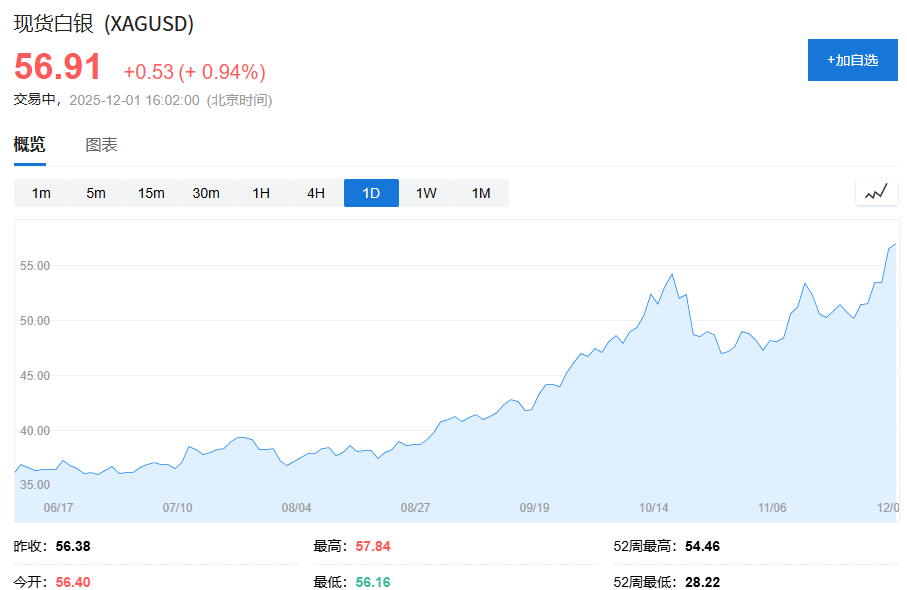
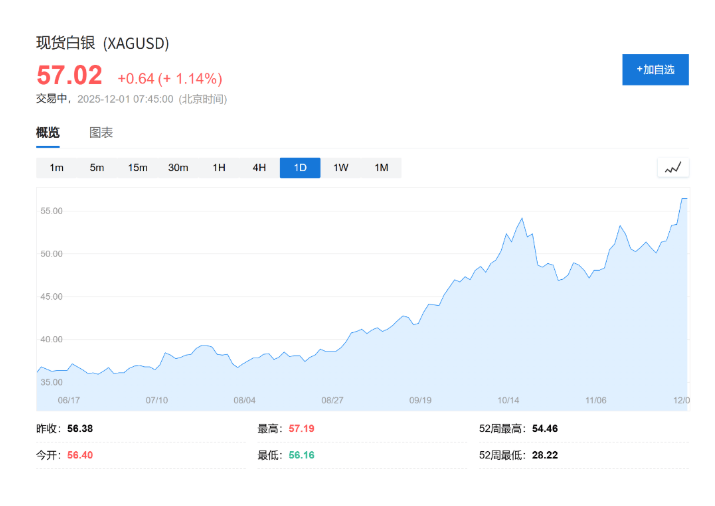
Core Viewpoint - The prices of silver and copper have surged to historical highs due to tightening global supply and expectations of monetary policy easing, reflecting a strong optimistic sentiment in the precious metals market and highlighting specific supply-demand imbalances for silver and copper [1][3][7]. Supply and Demand Dynamics - Silver prices reached an all-time high of over $57 per ounce on December 1, with a daily increase of approximately 1%, while silver futures on the New York Mercantile Exchange hit $57.81 [1][3]. - Concerns over supply shortages and expectations of interest rate cuts by the Federal Reserve have driven the rapid price increase [3][10]. - China's silver inventory has fallen to a seven-year low, directly linked to record export volumes in October, with over 660 tons exported, marking a historical peak [8][9]. - The significant inventory depletion in China is attributed to cross-border tariff arbitrage activities, exacerbating global supply tightness [3][8]. Market Trends and Investor Sentiment - The copper price also reached a record high of $11,210.5 per ton on the London Metal Exchange, with a 13% increase since late August, driven by similar supply constraints and arbitrage activities [4][7]. - The interconnected rise of silver and copper prices illustrates the core narrative of the current commodity market, emphasizing supply shortages as a key price driver [7][9]. - Analysts predict that the ongoing supply tightness could lead to further depletion of copper inventories in regions outside the U.S. [7][8]. Monetary Policy Impact - Expectations of monetary easing by the Federal Reserve have provided solid support for the precious metals market, enhancing the appeal of non-yielding assets like silver [10][11]. - Recent dovish comments from Federal Reserve officials have reinforced market expectations for a potential rate cut in December, further boosting confidence in a low-interest-rate environment [11].

白银和伦铜双双创历史新高,原因详解
华尔街见闻· 2025-12-01 09:56
Core Viewpoint - The article highlights the rising prices of silver and copper driven by global supply constraints and expectations of monetary policy easing, marking a significant shift in the commodities market [1][4]. Supply and Demand Dynamics - The strong momentum in silver and copper prices reflects a general optimism in the precious metals market and specific supply-demand imbalances for these metals [2]. - On December 1, 2023, spot silver prices surpassed $57 per ounce for the first time in history, with silver futures reaching $57.81 per ounce [3]. - China's silver inventory has dropped to a seven-year low, directly linked to record export volumes in October, indicating a significant consumption of inventory due to cross-border tariff arbitrage activities [5][11]. Price Trends and Market Reactions - Copper prices also surged, with the London Metal Exchange (LME) reaching a historical high of $11,210.5 per ton, and Comex copper prices rising to $532.55 per pound [5][7]. - Since the end of August, LME copper prices have increased by approximately 13%, driven by supply tightness and traders moving inventory to the U.S. to lock in premiums [7]. Market Sentiment and Future Outlook - The current situation is characterized by a supply shortage that is becoming a core driver of prices, as indicated by the movement of large inventories to the U.S. market [9][10]. - Analysts suggest that the supply tightness is evident in commercial negotiations, with Chilean copper producer Codelco seeking to significantly increase its annual contract premiums [12]. Monetary Policy Influence - Expectations of monetary easing by the Federal Reserve are providing solid support for silver and the broader precious metals market, enhancing the appeal of non-yielding assets like silver [14]. - Recent dovish comments from Federal Reserve officials have reinforced market expectations for a potential rate cut in December, further boosting confidence in a low-interest-rate environment [14].

ETO Markets:套利狂潮与降息预期共振下的新一轮商品超级周期
Sou Hu Cai Jing· 2025-12-01 08:37
Group 1 - Silver prices reached an all-time high of $57 per ounce, while Comex silver futures hit a record of $57.81, indicating a significant surge in the commodity market [3] - Copper prices also rose sharply, reaching $11,210.5 per ton, contributing to a heated commodity market as 2024 approaches [3] - The current price surge is attributed to a combination of global inventory shifts, structural shortages, and a dovish turn from the Federal Reserve [4] Group 2 - China's silver exports surged to 660 tons in October, marking a historical peak, while Shanghai Gold Exchange's inventory fell below 716 tons, the lowest since 2016 [5] - Concerns over potential tariffs have led traders to move silver and copper from Asian warehouses to the U.S. to lock in price premiums, resulting in a more than 40% drop in London copper inventories since late August [5] - Codelco, the world's largest copper producer, plans to increase its annual premium for copper shipments to China from $89 per ton to $350 per ton, reflecting heightened anxiety over raw material supply [5] Group 3 - Expectations for interest rate cuts have strengthened, with market bets on a 25 basis point cut by the Federal Open Market Committee in December rising to 80% [6] - The low interest rate environment reduces the opportunity cost of holding silver, leading to increased net long positions in ETFs and hedge funds, which have reached a four-year high [6] - The simultaneous decline in exchange inventories, Chinese social inventories, and bonded warehouses, combined with the expectation that new mining capacity in South America will not materialize until at least Q2 2025, is likely to amplify price volatility [7] Group 4 - Analysts expect London copper to challenge $12,000, while silver could reach $60 if it maintains above $57, indicating a potential new commodity supercycle [7] - The linkage between silver and copper prices is seen as a signal of a new phase in the commodity market, beyond the simple resonance between precious and industrial metals [7]

从早期布局到生态兑现:首程控股正在成为中国机器人产业最具穿透力的产业资本
Cai Fu Zai Xian· 2025-11-26 06:50
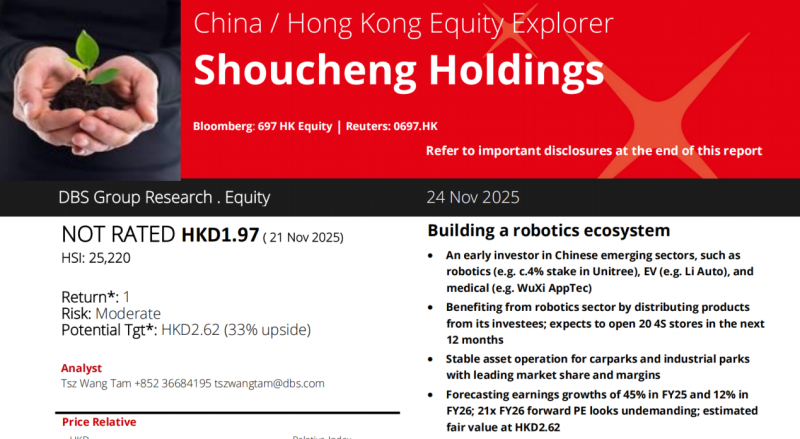
2025年,中国机器人产业正在进入"商业化加速元年"。从人形机器人、四足机器人,到具身智能模型、 核心零部件,资本与产业正在以罕见的速度汇聚,并在产业集群内形成"技术突破→产品迭代→商业化 放量"的加速链条。 而在这条高速推进的产业链路上,首程控股正在形成一个鲜明的标签:它不是单纯的财务投资者,而是 能以产业视角提前卡位、以场景能力推动落地、以生态建设实现协同的"中国机器人产业最佳投资人之 一"。 最近发布的星展银行(DBS)研报与多家内资券商的三季报研判,再叠加松延动力等被投企业频繁获得大 额融资,构成了市场重新认识首程投资实力的关键窗口。 一、外资视角:能投早期、能投核心、能投未来——首程具备顶级产业资本的"先手能力" 星展银行在11月24日发布的深度研报中,用一句极具含金量的判断,将首程的投资实力推至市场中 央:"Shouchengisbuildingaroboticsecosystem."(首程正在构建一个机器人生态系统。)——DBS研报 在外资机构的分析框架中,首程最具差异化的能力在于:其能在中国机器人产业最早期、最核心、最关 键的节点提前下注,并持续形成矩阵化布局。 星展在研报中列出的首程机器人投 ...

金融科技出海潮起 银行多维联动筑生态抢机遇
Zhong Guo Jing Ying Bao· 2025-11-25 09:16
Core Insights - The trend of Chinese fintech companies expanding overseas is accelerating, driven by advancements in cloud computing and artificial intelligence, making it a significant industry trend [1] - The Chinese fintech sector has established a solid foundation for international expansion, with proven technical capabilities and rich experience in promoting financial innovation [1] - Banks are actively collaborating with government departments and third-party institutions to create a comprehensive service ecosystem to support companies going abroad [1] Group 1: Expansion and Market Dynamics - Chinese fintech is entering a new phase of large-scale development, with various market players diversifying their overseas strategies [2] - WeBank plans to establish its Hong Kong headquarters as a global sales and innovation center, having already engaged with over 20 partner institutions across markets like Indonesia, Malaysia, and Thailand, with cooperation intentions exceeding hundreds of millions of dollars [2] - Financial One's "AI in ALL" initiative highlights China's leading position in AI development, particularly in sectors like healthcare and robotics, which is expected to drive further technological innovation [2] Group 2: Software and Service Trends - The global market for financial software is expanding due to the increasing demand for cross-border payment and settlement solutions, particularly in Southeast Asia, which is seen as a promising market for fintech [3] - The focus of tech companies going abroad is shifting from merely selling products to providing comprehensive solutions, which enhances the export of intermediate goods and components [3] - Key characteristics of tech companies' overseas expansion include technology-driven solutions, deepening collaboration between technology, capital, and localized operations, and the enhancement of brand influence [3] Group 3: Banking and Ecosystem Development - Banks are seizing opportunities in the fintech export market by collaborating with various stakeholders to create a full-chain service ecosystem that addresses the challenges faced by companies going abroad [4] - The establishment of the "Innovation and Technology Alliance" aims to provide a one-stop empowerment platform to tackle core challenges such as market access and compliance for Chinese tech companies [5] - Recommendations for banks include developing diverse financing support schemes and enhancing cross-border financial services to lower costs and improve efficiency for companies expanding internationally [5][6] Group 4: Risk Management and Policy Support - Banks are advised to strengthen risk hedging and consulting services to manage common risks like exchange rate fluctuations and compliance issues [6] - Government policies play a crucial role in supporting banks' services, with suggestions for tax incentives and simplified approval processes to reduce costs for companies [6] - The establishment of international talent training and risk warning systems is essential for providing robust support for companies venturing into overseas markets [6]
湾区金融大咖会:从2.0迈向3.0,业界盼理财通再扩容
2 1 Shi Ji Jing Ji Bao Dao· 2025-11-21 09:27
Group 1 - The 2025 Bay Area Wealth Conference was held in Shenzhen, focusing on the rising demand for cross-border wealth management in the Bay Area [1] - Hong Kong is increasingly recognized as a "super connector" for global asset allocation, facilitating new outbound investment paths for mainland investors through mechanisms like the ETF Connect [2] - The current inclusion of 40% non-Hong Kong assets in the Southbound ETF Connect provides mainland investors with an effective way to allocate overseas assets without consuming QDII quotas [2] Group 2 - Future Asset, a Korean asset management firm, aims to leverage Hong Kong's hub status to serve both mainland investors looking to invest overseas and foreign investors, including those from Korea, seeking opportunities in China [3] - The essence of wealth management is viewed as achieving stable wealth growth based on investor needs, with the Bay Area presenting a strong and diverse demand for wealth management services [3] - The upgrade of the "Cross-Border Wealth Management Connect" to version 2.0 has significantly boosted the market, with the number of participating individual investors increasing by over 120% to approximately 162,000 by mid-year [4] Group 3 - The Southbound investors' holdings have doubled, exceeding 16 billion yuan, reflecting the strong market response to the upgraded Cross-Border Wealth Management Connect [4] - The core changes in version 2.0 include a substantial increase in the entry amount and a more diverse product selection, which has led to a significant rise in market activity [4] - There is an expectation for further upgrades to version 3.0 to better meet the diverse cross-border asset allocation needs of high-net-worth clients [5] Group 4 - There is a notable difference in risk perception and asset attributes between domestic and foreign markets, highlighting the need for improved investor education and risk management [6] - Collaboration among market participants is essential to enhance investor suitability management and risk control [6]
【环球财经】星展银行:亚洲信用债利差逼近历史低位 警惕估值偏高风险
Xin Hua Cai Jing· 2025-11-20 16:59
Core Insights - The report from DBS indicates that the Asian dollar credit spreads, covering major markets like China, South Korea, India, and Indonesia, are narrowing to the lowest levels since the pandemic [1][2] - The DBS Asia (ex-Japan) Composite Credit Spread Index (DACS) has dropped to approximately 110 basis points, marking a historical low [1] - A significant factor contributing to the narrowing spreads is the limited market supply, despite an expected increase in Asian corporate dollar bond issuance in 2025, which is projected to reach the highest level since 2021 [1] Market Dynamics - The report highlights that the Asian market has shown resilience against changing global trade patterns and tariff barriers [2] - However, there are concerns regarding the high valuations of Asian credit bonds, which are perceived as "slightly elevated" and lack sufficient safety buffer [2]