大成基金

Search documents
又火了!200只“固收+”,创新高!
券商中国· 2025-04-20 23:22
Core Viewpoint - The bond market has experienced significant adjustments this year, while the stock market has seen an increase led by technology stocks, followed by fluctuations due to "reciprocal tariffs" [1] Group 1: Performance of "Fixed Income +" Products - Over 60% of "Fixed Income +" funds have shown positive year-to-date net asset value growth as of April 18 [2][4] - Nearly 200 funds reached new highs in net asset value in April, indicating strong performance in a volatile market [4] Group 2: Future Outlook for "Fixed Income +" Strategies - Fund managers believe that "Fixed Income +" strategies are likely to continue generating returns, with expectations for further product expansion [3][5] - The current capital market activity is driven by various factors, including economic stabilization, technological innovation, and geopolitical resilience, which support the value discovery of domestic assets [5] Group 3: Asset Allocation Insights - The allocation to equity and convertible bond assets has yielded good returns for funds, with some funds reporting over 6% net asset value growth in the first quarter [8] - Convertible bonds are seen as having strong configuration value due to their performance in the current interest rate environment [8][9] Group 4: Management Strategies for "Fixed Income +" Funds - There is a trend of incorporating active equity fund managers into the management of "Fixed Income +" products to leverage their stock-picking abilities [10][11] - The ability to manage across multiple asset classes and maintain a balance between equity and fixed income stability is crucial for success in this space [11] Group 5: Market Conditions and Sector Focus - The A-share market is expected to focus on domestic factors, with a gradual stabilization and subsequent rise anticipated [12] - In terms of sector allocation, there is an emphasis on consumer services and industrial sectors, while maintaining a focus on credit quality and yield in fixed income investments [12]


这边卖不动,那边“小爆款”!基金发行“跷跷板”,什么信号?
券商中国· 2025-04-20 14:25
Core Viewpoint - The article highlights a significant shift in the fundraising landscape for index funds and FOF products, indicating a broader trend rather than isolated incidents, driven by changing market conditions and investor preferences [2][6][8]. Fundraising Trends - On April 18, at least six index funds announced extensions to their fundraising periods, originally set to end on the same day, indicating a trend of delayed fundraising in the index fund sector [4][5]. - The extended fundraising periods include popular index funds related to semiconductor and technology sectors, with some funds extending their deadlines to April 30 and April 25 [4][5]. - Conversely, FOF products experienced a surge in popularity, with one product raising approximately 2.26 billion yuan and setting a record for the largest fundraising in the past three years for similar products [5][8]. Market Environment and Investor Behavior - The article notes a shift in investor preferences towards more stable assets like FOFs amid market volatility, suggesting that the current market environment is influencing how funds are allocated [6][8]. - The overall fundraising situation reflects a broader trend where index funds are facing challenges due to high market volatility and investor sentiment, leading to lower subscription enthusiasm [8][9]. Future Outlook - The article suggests that if market conditions improve, the fundraising for index funds may rebound, as the current environment has led to a more cautious approach from investors [8][9]. - The investment landscape is characterized by a need for diversified asset allocation strategies, with a focus on balancing risk and potential returns in a fluctuating market [10][11].

4只深证100指数ETF成交额环比增超100%
Zheng Quan Shi Bao Wang· 2025-04-16 10:46
Core Viewpoint - The trading volume of the Shenzhen 100 Index ETFs increased significantly today, with a total trading amount of 191 million yuan, marking a 34.18% increase compared to the previous trading day [1] Trading Volume Summary - The trading volume for E Fund Shenzhen 100 ETF (159901) reached 84.26 million yuan, up by 39.29 million yuan, representing an increase of 87.39% [1] - The Southern Shenzhen 100 ETF (159212) had a trading volume of 37.59 million yuan, an increase of 5.14 million yuan, with a growth rate of 15.85% [1] - The Founder Fubon Shenzhen 100 ETF (159961) saw a trading volume of 5.93 million yuan, up by 4.47 million yuan, reflecting a substantial increase of 305.49% [1] - Other notable increases in trading volume include the China Merchants Shenzhen 100 ETF (159975) with a 137.21% increase and the Guangfa Shenzhen 100 ETF (159576) with a 26.32% increase [1] Market Performance Summary - As of market close, the Shenzhen 100 Index (399330) declined by 0.63%, while the average decline for related ETFs was 0.62% [1] - The ETFs with the largest declines included the Industrial Bank Shenzhen 100 ETF (159970) and the Southern Shenzhen 100 ETF (159212), which fell by 0.94% and 0.89%, respectively [1]
基金双周报:ETF市场跟踪报告-20250414
Ping An Securities· 2025-04-14 06:41
1. Report Industry Investment Rating No relevant content provided. 2. Core Viewpoints of the Report - In the past two weeks, most ETF products have performed poorly, with only a few exceptions. The capital flow trends of different types of ETFs vary, and the scale of most ETFs has changed to some extent compared to the end of 2024 [2]. 3. Summary by Relevant Catalogs 3.1 ETF Market Review 3.1.1 Main Type ETF Fund Flows Overview - In the past two weeks, most broad - based ETFs had net capital inflows, with the CSI 300 ETF having the largest net inflow. Among them, the products tracking the STAR 50 had the smallest decline among broad - based ETFs, and the military industry ETF had the smallest decline among industry and theme products [9][11]. 3.1.2 Main Type ETF Cumulative Fund Flows - **Broad - based ETFs**: Since 2025, broad - based ETFs have generally seen capital outflows, but recently, due to large - scale capital inflows into the CSI 300 ETF and others, most broad - based ETFs have achieved net capital inflows. In April, except for A - series ETFs, all types of broad - based ETFs have changed from net outflows to net inflows, with significant inflows into the CSI 300, CSI 1000, and CSI 2000 ETFs [12]. - **Industry and Theme ETFs**: Technology ETFs have seen capital inflows since March, and the inflow speed has accelerated in the past two weeks. Pharmaceutical ETFs have changed from outflows to inflows, while financial real - estate ETFs have changed from inflows to outflows. Dividend ETFs have seen continuous small - scale capital inflows this year, and the net inflow speed has slightly increased in the past two weeks [20]. - **Bond ETFs**: Since 2025, credit - bond and treasury - bond ETFs have had net capital inflows, while convertible - bond ETFs have had net outflows. Affected by the bond - market rebound, treasury - bond ETFs have seen accelerated capital inflows since March, but in the past two weeks, treasury - bond and convertible - bond ETFs have changed from net inflows to net outflows, while short - term financing ETFs have had net inflows [20]. 3.1.3 ETF Product Structure Distribution - **Newly - issued Products**: As of April 11, 12 new ETFs were established in the past two weeks, with a total issuance share of 4.439 billion, including 11 stock ETFs and 1 QDII ETF [25]. - **Product Scale**: Compared with the end of 2024, except for broad - based ETFs, the scales of various types of ETFs have increased. The scales of commodity ETFs, bond ETFs, industry + dividend ETFs, and QDII - ETFs have increased by 71.48%, 32.76%, 12.22%, and 2.48% respectively, while the scale of broad - based ETFs has decreased by 1.42% [25]. 3.1.4 Manager Scale Distribution - As of April 11, China Asset Management has the largest on - exchange ETF scale, reaching 67.3518 billion yuan. E Fund's ETF management scale has expanded by more than 25.449 billion yuan compared to a year ago [26]. 3.2 Classification of ETF Tracking 3.2.1 Technology Theme ETF - **Performance**: Products tracking semiconductor - related indexes such as the CSI Semiconductor have performed well in the past two weeks, and overseas technology ETFs have performed worse than domestic ones [32]. - **Fund Flows**: Products tracking Hong Kong technology indexes such as the Hang Seng Tech have had the largest net capital inflows in the past two weeks, while products tracking the CSI All - Share Semiconductor have had net outflows [32]. 3.2.2 Dividend Theme ETF - **Performance**: The ETF product tracking the MSCI China A - Share International Low Volatility (USD) has had the smallest decline in yield in the past two weeks [33]. - **Fund Flows**: Products tracking the Dividend Low Volatility index have had the largest net capital inflows in the past two weeks, while products tracking the Guoxin Hong Kong - Stock Connect Central - SOE Dividend index have had significant net outflows [33]. 3.2.3 Consumption Theme ETF - **Performance**: Products tracking agricultural indexes such as the China Securities Grain Index have performed well in the past two weeks. The S&P 500 Consumer Discretionary Select Index ETF has a high premium [36]. - **Fund Flows**: The ETF tracking the 800 Consumption Index has had the largest net capital inflows in the past two weeks, while products tracking the CSI Wine Index have had net outflows [36]. 3.2.4 Pharmaceutical Theme ETF - **Performance**: Products tracking the STAR Biotech Index have performed well in the past two weeks [39]. - **Fund Flows**: ETFs tracking the Hong Kong Innovative Drug (CNY) and Hong Kong - Stock Connect Innovative Drug indexes have had the largest net capital inflows in the past two weeks, while products tracking the Hang Seng Healthcare Index have had net outflows [39]. 3.2.5 Large - scale Manufacturing Theme ETF - **Performance**: Products tracking utility - related indexes such as the Green Power Index have performed well in the past two weeks [42]. - **Fund Flows**: Products tracking the CSI Military Industry Index have had the largest net capital inflows in the past two weeks, while products tracking new - energy indexes such as the New - Energy Battery Index have had net outflows [42]. 3.2.6 QDII ETF - **Performance**: Products tracking the S&P 500 Consumer Discretionary Select Index have performed well in the past two weeks, and the QDII - ETF tracking this index has a high premium [44]. - **Fund Flows**: Products tracking the Hang Seng Tech Index have had the largest net capital inflows in the past two weeks, while ETF products tracking the Hang Seng Healthcare Index have had net outflows [44]. 3.3 Hot - Topic ETF Tracking 3.3.1 AI Theme ETF - **Performance**: AI - themed products have performed poorly in the past two weeks, with an average yield of - 9.12%. The product tracking the CS Artificial Intelligence index has the highest yield [52]. - **Fund Flows**: Since February 2024, there has been a large - scale net capital inflow. After a significant outflow from September to October 2024, the overall trend has been a rapid inflow. In the past two weeks, the capital inflow speed has slowed down, with a net inflow of 516 million yuan [52]. 3.3.2 Robot Theme ETF - **Performance**: Robot - themed products have performed poorly in the past two weeks, with an average yield of - 9.38%. The product tracking the Automobile Index has the highest yield [56]. - **Fund Flows**: After December 2024, the overall capital flow has shown a rapid inflow trend. In the past two weeks, the capital inflow speed has accelerated, with a net inflow of 1.625 billion yuan [56]. 3.3.3 "National Team" Holding ETF - As of the end of 2024, the "National Team" (only counting Huijin, Guoxin, and Chengtong) held a total of 320.396 billion shares of ETFs. In the past two weeks, there has been a large - scale net capital inflow of 186.118 billion yuan, with a net inflow of 106.611 billion yuan on April 8 alone [2].
关键时刻!重磅研判
Sou Hu Cai Jing· 2025-04-13 12:36
Core Viewpoint - The establishment of the "Chinese version of the stabilization fund" signifies a strategic response to external tariff pressures, showcasing China's commitment to maintaining market stability and investor confidence [1][11][20]. Group 1: Strategic Significance of the "Chinese Version of the Stabilization Fund" - The mechanism serves to isolate internal and external risks, effectively countering the impact of external tariffs on the capital market through coordinated actions by central financial institutions [4][11]. - It aims to reshape market pricing logic and investment ecology by guiding funds towards long-term value investments through the continuous purchase of strategic ETFs [11][12]. - The initiative promotes alignment between capital markets and national strategies, accelerating the valuation reconstruction of core assets in emerging industries [12][13]. Group 2: Policy Coordination and Market Response - Multi-departmental collaboration in response to tariff challenges reflects a strong policy determination and confidence, with potential future actions including support for export enterprises and increased consumer spending [19][20]. - The coordinated response sends multiple positive signals, including a commitment to safeguarding national interests and stabilizing market expectations [19][20]. - The combination of monetary, fiscal, and industrial policy tools demonstrates a comprehensive approach to managing market sentiment and reducing irrational decision-making risks [20]. Group 3: Long-term Investment Value in Capital Markets - The current economic resilience and low valuation levels provide a solid foundation for long-term investment in Chinese assets, with expectations of GDP growth exceeding 5% in the first quarter [22][24]. - The shift towards institutional investors and the emphasis on value investment principles are expected to enhance market stability and attract more patient capital [17][22]. - The ongoing structural transformation of the economy, moving from real estate-driven growth to innovation-led development, is anticipated to further enhance the investment value of the capital market [24][33]. Group 4: Global Economic Positioning - China's competitive advantages in the global economy include a vast domestic market, comprehensive industrial capabilities, and a strong emphasis on innovation in key sectors [27][28][30]. - The government's proactive policies and the robust performance of emerging industries are expected to sustain economic growth and attract foreign investment [29][30]. - The focus on high-quality development and the transition to new productive forces will play a crucial role in shaping the future landscape of the capital market [24][33].

基金市场一周观察(20250407-20250411):股市回调、债市上涨,消费、TMT基金相对较优
CMS· 2025-04-12 13:32
Report Industry Investment Rating No relevant content provided. Core Viewpoints of the Report - This week, the equity market declined overall, with the BeiZheng 50 slightly rising and the Hong Kong stock market experiencing a significant correction. The bond market rose, while the convertible bond market fell. Among funds, consumer and TMT funds performed relatively well [1][2]. - The average return of active equity funds in the whole market was -3.85%. Short - term bond funds had an average return of 0.10%, and medium - and long - term bond funds had an average return of 0.17%. Both equity - containing bond funds and convertible bond funds had negative average returns [1][2]. - There were 3 new stocks listed this week, with no break - even on the first day of listing. The average return of sample new - stock subscription funds this week was -0.86%, and the new - stock subscription yield for an 800 - million - yuan account was 0.030% [2]. - As of April 9, 2025, the average returns of low, medium, and high - risk FOF funds in the sample in the past week were -1.28%, -4.09%, and -6.64% respectively. During the statistical period, equity - oriented, index - type, alternative, and bond - type QDII funds declined by 7.81%, 8.37%, 5.94%, and 0.94% on average, and REITs declined by 0.57% on average [2]. Summary by Directory Market Review - Equity Market: The equity market declined overall, with the BeiZheng 50 slightly rising and the Hong Kong stock market correcting significantly. As of the close this week, the CSI 300 Index closed at 3,751 points, down 2.87%; the Shanghai Composite Index closed at 3,238 points, down 3.11%; the Shenzhen Component Index closed at 9,834 points, down 5.13%; the ChiNext Index closed at 1,926 points, down 6.73%. The Hang Seng Index in Hong Kong fell 8.47%, and the Hang Seng Tech Index fell 7.77% [6]. - Industry Performance: Agriculture, forestry, animal husbandry, and fishery led, with a gain of over 3%. Commerce and retail, national defense and military industry, and consumer services also performed well. Power equipment and new energy, communication, and media declined significantly, with a drop of over 6.5% [8]. - Number of Rising Stocks: As of April 11, 2025, there were 5,409 stocks in the A - share market, of which 796 rose this week. The number of rising stocks in the BeiZheng, ChiNext, Science and Technology Innovation Board, and Main Board was 117, 134, 97, and 448 respectively. Industries such as basic chemicals, machinery, agriculture, forestry, animal husbandry, and fishery, and electronics had a relatively large number of rising stocks, while the banking, coal, and steel industries had no rising stocks [11][15]. Key Fund Tracking Active Equity - Fund Performance: There were 3,949 active equity funds in the sample. The average return of the whole - market funds in the sample this week was -3.85%. Funds with better performance were mostly heavily invested in industries such as electronics, machinery, and medicine. Among industry funds, consumer funds had relatively better average returns, and top - performing funds in the TMT sector were leading [17][19]. - Position Estimation: The positions of ordinary stock - type and partial - stock hybrid funds increased this week. Compared with the previous week, the position of ordinary stock - type funds increased by 0.53 percentage points, and that of partial - stock hybrid funds increased by 0.26 percentage points. Actively managed partial - stock funds increased their allocation to stable and growth sectors and reduced their allocation to consumption, cyclical, and financial sectors. In terms of sub - industries, the allocation to industries such as computers, power equipment, and household appliances increased, while the allocation to industries such as banking, electronics, and non - banking finance decreased [22]. Bond - Type Funds - Bond Market Performance: The bond market rose overall this week. The ChinaBond Total Wealth Index closed at 245.84, up 0.38% from last week; the ChinaBond Treasury Bond Index closed at 246.84, up 0.5%; the ChinaBond Credit Bond Index closed at 222.13, up 0.16%. The CSI Non - Pure Bond Fund Index closed at 2,170.4 on Thursday, down 0.33% from last Thursday. The CSI Convertible Bond Index closed at 420.91, with a weekly decline of 1.7%, and the trading volume was 465.5 billion yuan, a change of 224.248 billion yuan from last week [30][32]. - Fund Performance Overview: The average return of short - term bond funds this week was 0.10%, and the median was 0.09%. The average return of medium - and long - term bond funds was 0.17%, and the median was 0.15%. The average return of first - tier bond funds was -0.03%, and the median was 0.07%. The average return of second - tier bond funds was -0.52%, and the median was -0.42%. The average return of partial - bond hybrid funds was -0.74%, and the median was -0.62%. The average return of low - position flexible allocation funds was -0.54%, and the median was -0.35%. The average return of convertible bond funds was -1.98%, and the median was -2.01% [34][36][37][39]. New - Stock Subscription Funds - New - Stock Overview: Three new stocks were listed this week, all with inquiry and offline placement details, raising a total of 1.81 billion yuan. There was no break - even on the first day of listing, and the total expected income from successful subscription was 241,100 yuan [40]. - New - Stock Subscription Income Calculation: Assuming weekly participation in offline new - stock subscriptions and successful subscription, based on the successful subscription rate of Class A investors, the number of allocated shares was calculated. Using the closing price on the first day of listing or the opening - board day as the selling price, the weekly new - stock subscription yield sequence for an 800 - million - yuan account was calculated. The weekly new - stock subscription yield for an 800 - million - yuan account this week was 0.030%. The optimal weekly and annual new - stock subscription scales were 200 million yuan and 400 million yuan respectively [41][43]. - Fund Company New - Stock Subscription Overview: Eight fund companies with two or more new - stock subscription funds were selected. All of them had a 100% successful subscription rate for the three new stocks this week, except for Southern Fund, which had a 50% successful subscription rate [44]. - New - Stock Subscription Fund Performance: There were 36 new - stock subscription funds in the sample. The average return of new - stock subscription funds in the sample this week was -0.86% [45]. FOF Funds - FOF funds were divided into low - risk, medium - risk, and high - risk categories. The average returns of low - risk, medium - risk, and high - risk FOF funds in the sample in the past week were -1.28%, -4.09%, and -6.64% respectively [46]. QDII Funds - During the statistical period, the average decline of equity - oriented and index - type QDII funds was 7.81% and 8.37% respectively, and the average decline of alternative and bond - type QDII funds was 5.94% and 0.94% respectively [47][48]. REITs Funds - The average decline of REITs this week was 0.57%. The Huaxia Beijing Affordable Housing REIT had a relatively high increase, rising 3.67% in the past week. The Huaxia China Communications Construction Expressway REIT had the strongest liquidity, with a trading volume of 200.4172 million yuan in the past week [49][50].
解析中证全指自由现金流指数及现金流因子构建
Shenwan Hongyuan Securities· 2025-04-11 10:12
Quantitative Models and Construction Methods - **Model Name**: CSI All Share Free Cash Flow Index **Model Construction Idea**: The model aims to select stocks with strong cash flow performance and further refine the selection based on valuation metrics such as free cash flow yield [5][6] **Model Construction Process**: 1. Define the stock universe by excluding ST/*ST stocks, financial and real estate sectors, and stocks with abnormal price movements or financial irregularities [6] 2. Filter stocks with positive free cash flow and enterprise value, where: $ \text{Free Cash Flow} = \text{Net Cash Flow from Operating Activities} - \text{Cash Paid for Fixed Assets, Intangible Assets, and Other Long-term Assets} $ $ \text{Enterprise Value} = \text{Market Capitalization} + \text{Total Liabilities} - \text{Cash and Cash Equivalents} $ [6][19] 3. Select stocks with positive operating cash flow for the past five years and rank them by profitability quality, defined as: $ \text{Profitability Quality} = \frac{\text{Net Cash Flow from Operating Activities} - \text{Operating Profit}}{\text{Total Assets}} $ Retain the top 80% based on this ranking [6][19] 4. Rank the remaining stocks by free cash flow yield: $ \text{Free Cash Flow Yield} = \frac{\text{Free Cash Flow}}{\text{Enterprise Value}} $ Select the top 100 stocks [6][19] 5. Weight the selected stocks by their free cash flow over the past year, with a cap of 10% on individual stock weights. Adjust the portfolio quarterly [6][19] **Model Evaluation**: The model effectively captures companies with strong cash flow performance and aligns with the investment theme of free cash flow [6][19] - **Model Name**: Simulated Free Cash Flow Portfolio **Model Construction Idea**: This model replicates the CSI Free Cash Flow Index methodology to construct a portfolio for backtesting purposes [19] **Model Construction Process**: 1. Follow the same stock selection criteria as the CSI Free Cash Flow Index [19] 2. Adjust the portfolio three times a year (April, August, October) [19] **Model Evaluation**: The simulated portfolio closely mirrors the performance of the CSI Free Cash Flow Index, demonstrating its robustness [23] Model Backtesting Results - **CSI Free Cash Flow Index**: - Annualized Return: 18.75% - Annualized Volatility: 22.79% - Sharpe Ratio: 0.82 [15][16] - **Simulated Free Cash Flow Portfolio**: - Annualized Return: 18.75% - Annualized Volatility: 23.40% - Sharpe Ratio: 0.80 [21][23] Quantitative Factors and Construction Methods - **Factor Name**: Revenue-to-Free Cash Flow Ratio **Factor Construction Idea**: This factor measures the proportion of revenue that translates into free cash flow, highlighting companies with strong revenue generation but weak cash flow performance [40] **Factor Construction Process**: $ \text{Revenue-to-Free Cash Flow Ratio} = \frac{\text{Revenue} - \text{Free Cash Flow}}{\text{Revenue}} $ [40] **Factor Evaluation**: The factor shows low correlation with common factors, indicating its uniqueness [44] - **Factor Name**: Quadrant Analysis Factor **Factor Construction Idea**: Classifies stocks into four quadrants based on the marginal changes in revenue and free cash flow [51] **Factor Construction Process**: 1. Divide stocks into four groups: - Revenue growth and free cash flow growth - Revenue growth and free cash flow decline - Revenue decline and free cash flow growth - Revenue decline and free cash flow decline [51] 2. Construct equal-weighted portfolios for each quadrant [54] **Factor Evaluation**: The "double growth" quadrant (revenue and free cash flow growth) delivers the highest annualized return, while the "double decline" quadrant performs the worst [58] Factor Backtesting Results - **Revenue-to-Free Cash Flow Ratio**: - RankIC Mean: -2.28% (CSI All Share), -4.17% (CSI 300), -3.09% (CSI 500), -1.63% (CSI 1000) - RankIC IR: -0.51 (CSI All Share), -0.43 (CSI 300), -0.46 (CSI 500), -0.25 (CSI 1000) [46] - **Quadrant Analysis Factor**: - "Double Growth" Portfolio: Annualized Return: 13.20% - "Double Decline" Portfolio: Annualized Return: 7.89% [58]
ETF市场日报 | 美股跨境ETF掀起涨停潮 港股板块ETF再受资金关注
Xin Lang Cai Jing· 2025-04-10 08:48
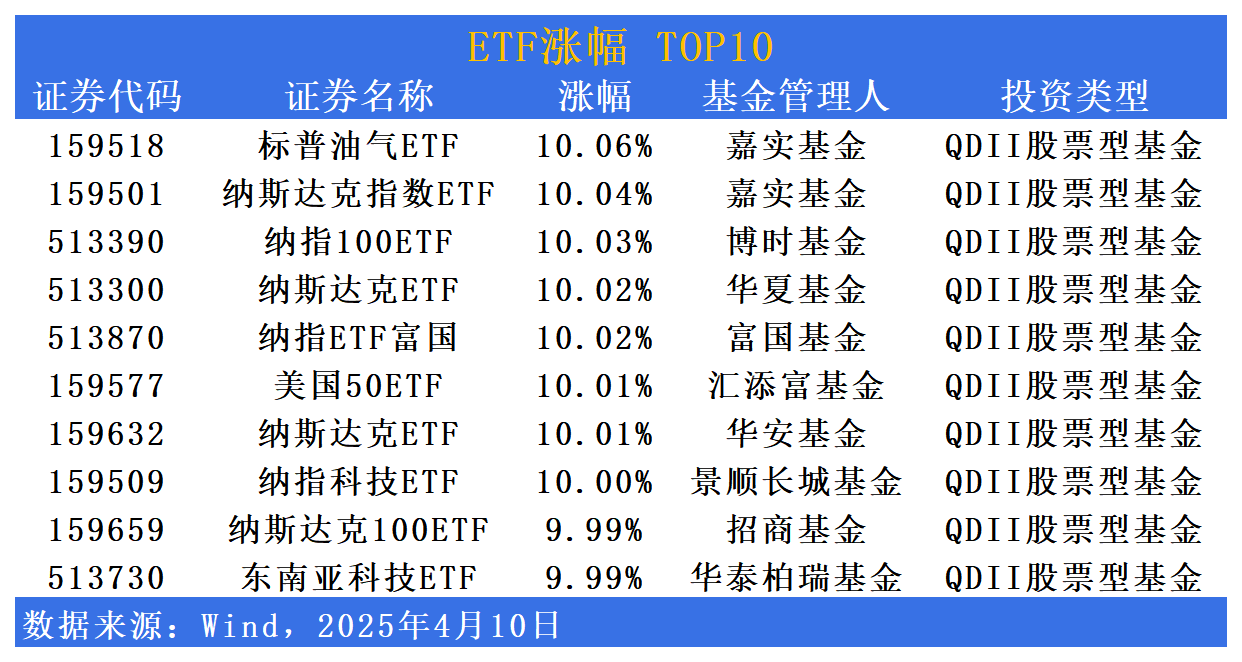
Market Performance - A-shares experienced a collective rebound with the Shanghai Composite Index rising by 1.16%, the Shenzhen Component Index increasing by 2.25%, and the ChiNext Index up by 2.27% on April 10, 2025 [1] - The total trading volume in the Shanghai and Shenzhen markets reached 1.61 trillion yuan, a decrease of 901 billion yuan compared to the previous day [1] ETF Performance - Several US stock ETFs saw significant gains, with the S&P Oil & Gas ETF rising by 10.06%, the Nasdaq Index ETF increasing by 10.04%, and the Nasdaq 100 ETF up by 10.03% [1] - The US stock market indices experienced substantial increases, with the Dow Jones Industrial Average up by 2,962.86 points (7.87%), the S&P 500 up by 474.13 points (9.52%), and the Nasdaq Composite up by 1,857.06 points (12.16%) [2] ETF Trading Volume - The top ETFs by trading volume included the Yinhua Daily ETF with 14.6 billion yuan, the Hang Seng Technology ETF with 13.93 billion yuan, and the Hang Seng Technology Index ETF with 13.70 billion yuan [5] - The top ETFs by turnover rate were led by the Benchmark Treasury ETF at 314.35%, followed by the New Economy ETF at 216.55% and the S&P Consumer ETF at 205.95% [6] New ETF Launch - The Dachen Shenzhen 100 ETF (code: 159216) is set to launch on April 11, 2025, closely tracking the Shenzhen 100 Index, which reflects the performance of core quality listed companies in the Shenzhen market [7] - The Shenzhen 100 Index is characterized by a significant weight in large-cap stocks, with 44.61% of its components having a market capitalization exceeding 200 billion yuan [7] Sector Focus - The Shenzhen 100 Index components are concentrated in TMT (Technology, Media, and Telecommunications), high-end manufacturing, and consumer sectors, indicating long-term growth potential aligned with China's economic transformation and high-quality development [8]
“关税风暴”来袭,年内已有超七成QDII基金收益率下跌!
Bei Jing Shang Bao· 2025-04-09 13:34
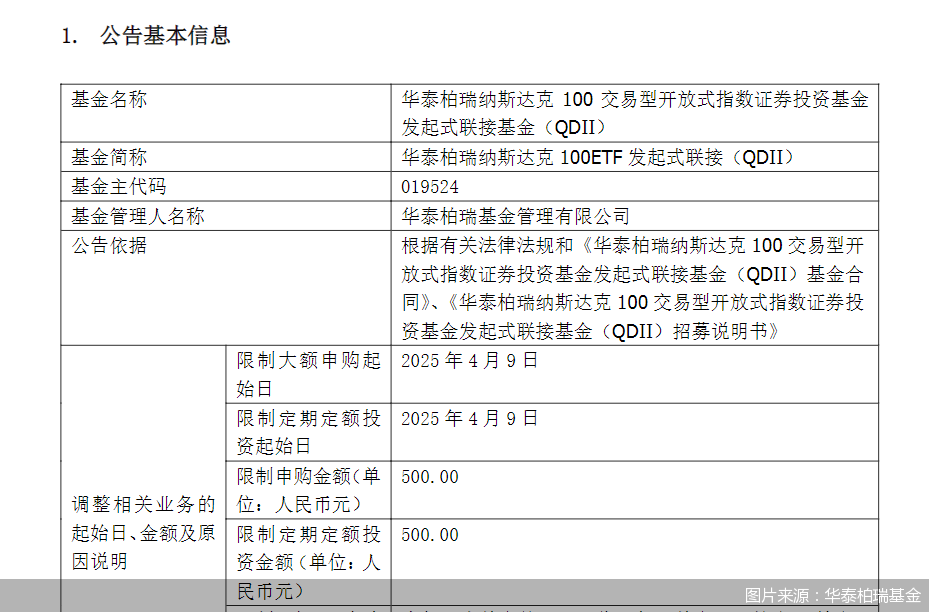
"关税风暴"冲击下,多只QDII基金业绩被波及。近日,多家公募下调旗下QDII基金申购额度上限。收益率方面,受"对等关税"影 响,全球股市普遍承压,年内收益率下跌的QDII基金已增至七成,4月以来更有超九成QDII基金告负。有业内人士表示,"对等关 税"背景下,若美股继续下跌,或会给投资美国市场的QDII基金带来更大亏损。此次震荡对于降低投资者海外布局风险偏好的效应在 短期内可能比较显著,"关税风暴"后续不确定性较大,建议投资者短期内采取防御性策略。 若从最新披露的QDII基金收益表现看,Wind数据显示,截至4月7日,全市场数据可取得的661只QDII基金中(份额分开计算,下 同),共计469只产品年初以来收益率告负,占比超七成。其中,260只产品跌超10%。 具体到产品看,多只投资全球科技、美股主题基金跌幅明显。其中,华夏全球科技先锋混合的美元现汇、美元现钞、人民币份额跌 幅居前,跌幅超过25.22%。含上述产品在内,建信新兴市场优选混合A/C(QDII)、华宝纳斯达克精选股票发起式A/C(QDII)、 华宝致远混合A/C(QDII)等共计33只QDII基金跌超20%。 值得一提的是,4月以来多只基金的年 ...
A股,大反攻!见证历史:两天买入超1780亿!
券商中国· 2025-04-09 04:50
Core Viewpoint - The A-share market is experiencing a significant influx of capital, primarily driven by substantial net inflows into ETFs, which are providing crucial support for market stabilization [2][4][5]. Group 1: Market Performance - On April 8, the A-share market rebounded, with the Shanghai Composite Index turning positive and the North China 50 Index surging by 6.88% [2]. - The semiconductor sector saw notable gains, with stocks like National Technology and Unisplendour hitting the daily limit [2]. - The total trading volume in the Shanghai and Shenzhen markets reached 1.12 trillion yuan, indicating a significant increase compared to the previous trading day [2]. Group 2: ETF Inflows - On April 8, ETFs recorded a net inflow of 1117.8 billion yuan, setting a new historical high, surpassing the previous record of 1093.94 billion yuan on October 8 of the previous year [4]. - Within this, stock ETFs accounted for 1062.75 billion yuan of the inflow, a substantial increase from 689.96 billion yuan on April 7 [4]. - Six major broad-based ETFs attracted over 100 billion yuan each in net inflows, contributing significantly to the overall increase in stock ETF investments [4]. Group 3: Institutional Support - Central enterprises, including Huijin Investment and China Chengtong, have announced increased purchases of ETFs to stabilize the capital market, signaling a commitment to long-term investment [5]. - The People's Bank of China is providing sufficient funding support to Huijin Investment through relending, creating a closed loop of policy tools, funding channels, and market operations [5]. - As of the end of 2024, institutional investors hold 66.9% of stock ETFs, with state-owned institutions like Huijin Investment being major holders [6]. Group 4: Public Fund Actions - Public funds are actively purchasing their own equity funds to support market stability, with several funds announcing significant self-purchases [8][9]. - Notable fund companies, including Bosera and Pengyang, have committed to investing millions in their equity funds to bolster market confidence [8][9]. - A total of 14 new technology-focused ETFs have raised over 170 billion yuan, indicating a strong pipeline of capital entering the market [11]. Group 5: Policy Impact - Recent policy measures have injected confidence into the market, with the introduction of a "Chinese version of the stabilization fund" aimed at mitigating market risks [13]. - The combination of government policies and institutional support is expected to enhance market stability and foster a recovery phase [12][13].