
陕西煤业

Search documents
焦炭落实第六轮提涨,下游钢厂补库需求尚存
Huachuang Securities· 2025-08-18 05:17
Group 1: Oil Market Insights - Global oil and gas capital expenditure has declined significantly since the Paris Agreement in 2015, with a 122% reduction from 2014 highs to $351 billion in 2021, leading to cautious investment from major oil companies [8][30][31] - Geopolitical tensions, particularly the Russia-Ukraine conflict, have heightened concerns over global energy supply, with the EU aiming to reduce oil imports from Russia by 90% by the end of 2022 [9][31] - Current oil prices are under pressure, with Brent crude at $67.89 per barrel and WTI at $63.31 per barrel, reflecting a decrease of 2.01% and 2.17% respectively [10][32][50] Group 2: Coal Market Dynamics - The price of thermal coal has shown resilience, with the average market price at Qinhuangdao port reaching 692 yuan per ton, up 2.61% week-on-week, supported by increased demand from power plants [11][12] - The supply side is gradually improving as coal mines resume production, but demand remains strong due to high temperatures increasing electricity consumption [11][12] - The focus on domestic coal production and the impact of international energy dynamics, particularly from the EU's renewed coal demand, are expected to enhance the profitability of domestic coal companies [12] Group 3: Coke and Coking Coal - The price of coke remains stable at 1280 yuan per ton, with downstream steel mills showing a need for replenishment despite high raw material costs [13][14] - Coking coal prices are also stable at 1610 yuan per ton, with market sentiment cautious as procurement slows down after previous stockpiling [13][14] - Steel production remains robust, with an average daily output of 240.73 million tons, indicating ongoing demand for coke [13] Group 4: Natural Gas Trends - The International Energy Agency (IEA) forecasts a slowdown in global natural gas demand growth from 2.8% in 2024 to 1.3% in 2025, with expectations of accelerated growth in 2026 [15][16] - Natural gas prices have decreased, with NYMEX natural gas averaging $2.86 per million British thermal units, down 5.6% week-on-week [15][16] - The EU's agreement on a natural gas price cap may exacerbate liquidity issues in the market, potentially leading to supply shortages [16][17] Group 5: Oilfield Services Sector - The oilfield services industry is experiencing a recovery in activity levels, supported by government policies aimed at increasing oil and gas production [18][19] - Global active rig counts have increased to 1621, with a slight rise in the Asia-Pacific region, indicating a positive trend in exploration and production activities [19] - The overall capital expenditure in the oil sector is expected to continue growing, driven by high oil prices and geopolitical factors [18]
中证全指自由现金流指数,投资价值如何?|第399期精品课程
银行螺丝钉· 2025-08-18 04:01
Core Viewpoint - The article discusses the concept of the Free Cash Flow Index, its characteristics, and how it differs from dividend and value indices, emphasizing its relevance in investment strategies [1][10][64]. Group 1: Free Cash Flow Index Overview - The Free Cash Flow Index is a strategy index closely related to the investment philosophies of Warren Buffett and Benjamin Graham, focusing on selecting stocks with the highest free cash flow rates [10][19]. - Free cash flow is defined as the cash available after necessary operational expenses and capital expenditures, which can be freely allocated by the company [14][19]. - The Free Cash Flow Rate is calculated as free cash flow divided by enterprise value, where enterprise value is the total market capitalization plus total liabilities minus cash and cash equivalents [17][19]. Group 2: Comparison with Other Indices - The Free Cash Flow Index differs from dividend and value indices in that it includes companies with high free cash flow that may not necessarily pay dividends or have low valuation metrics [22][23]. - Dividend and value indices tend to focus on traditional industries, while the Free Cash Flow Index can include emerging industry leaders with strong cash flows but low dividend payouts [23][25]. - The Free Cash Flow Index is more selective, excluding companies with high leverage that may show high dividend yields but low free cash flow [24][25]. Group 3: Index Characteristics and Performance - The China Securities Index for Free Cash Flow was launched in December 2024, and it selects the top 100 stocks with the highest cash flow rates from the broader market, excluding financial and real estate sectors [31][32][64]. - The index has shown a historical annualized return of 14.12% from December 31, 2013, to August 6, 2025, with a total return of 18.88% when including dividends, significantly outperforming the broader market index [40][41][64]. - The index's composition is heavily weighted towards industries such as industrials, materials, and consumer staples, with a concentration of over 50% in the top ten holdings [34][37][64]. Group 4: Future Outlook and Strategy - The Free Cash Flow Index is considered a valuable addition to investment strategies, particularly for investors looking to diversify away from financial-heavy indices [61][64]. - The index's methodology and focus on cash flow make it suitable for pairing with traditional dividend and value indices, providing a balanced approach to investment [61][64].


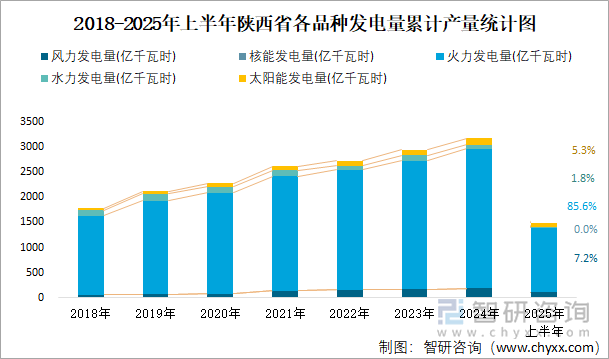
2025年上半年陕西省能源生产情况:陕西省发电量787.3亿千瓦时,同比下滑5.1%
Chan Ye Xin Xi Wang· 2025-08-18 03:10
统计范围: 报告中的产量数据统计口径均为规模以上工业,其统计范围为年主营业务收入2000万元及以上的工业企 业。 上市企业:陕天然气(002267)、通源石油(300164)、宝光股份(600379)、隆基绿能(601012)、 中国西电(601179)、陕西煤业(601225)、陕鼓动力(601369)、美能能源(001299)、陕西能源 (001286)、爱科赛博(688719) 相关报告:智研咨询发布的《2025-2031年中国能源行业市场研究分析及投资前景评估报告》 2025年6月,陕西省发电264.8亿千瓦时,同比增长1.6%。2025年上半年,陕西省发电787.3亿千瓦时, 同比下滑5.1%。分品种看,2025年上半年,陕西省火力发电量1279.2亿千瓦时,占总发电量的85.6%, 同比下滑3.7%;陕西省水力发电量27.2亿千瓦时,占总发电量的1.8%,同比下滑11.4%;陕西省风力发 电量108.1亿千瓦时,占总发电量的7.2%,同比增长9.7%;陕西省太阳能发电量79.68亿千瓦时占总发电 量的5.3%,同比增长3.6%。 附注 由于规模以上工业企业范围每年发生变化,为保证本年数据与上年可比 ...
能源ETF(159930)开盘涨0.59%,重仓股中国神华涨10.01%,中国石油跌0.12%
Xin Lang Cai Jing· 2025-08-18 01:39
Group 1 - The Energy ETF (159930) opened with a gain of 0.59%, priced at 1.369 yuan [1] - Major holdings in the Energy ETF include China Shenhua, which rose by 10.01%, while China Petroleum fell by 0.12% [1] - The ETF's performance benchmark is the CSI Energy Index, managed by Huatai-PineBridge Fund Management Co., Ltd., with a return of 36.12% since its inception on August 23, 2013, and a return of 4.40% over the past month [1] Group 2 - Other notable stock movements include China Petrochemical rising by 0.18%, Shaanxi Coal and Chemical Industry increasing by 1.07%, and Yanzhou Coal Mining up by 1.00% [1] - The ETF also saw gains from Jereh Oilfield Services (0.96%), China Coal Energy (1.15%), Shanxi Coking Coal (0.14%), and Meijin Energy (1.31%) [1]



沪指升破3700,周期机会详解?
2025-08-18 01:00
Summary of Key Points from Conference Call Records Industry Overview - **Express Delivery Industry**: Significant progress in anti-involution, with Guangdong leading price increases, followed by other provinces. Companies to watch include Shentong, YTO, Yunda, Zhongtong, and Jitu Express for their potential in emerging markets [3][3][3]. - **Aviation Industry**: Stocks showed unusual activity due to industry self-discipline notifications. Current market conditions are at a bottom, suggesting potential for recovery. Recommended stocks include major Hong Kong airlines and Huaxia Airlines in A-shares, along with Spring Airlines and Juneyao Airlines [4][4][4]. - **Coking Coal Market**: Prices are expected to rise significantly, benefiting companies like Jiayou International. Recovery in the African market, particularly with Zijin Mining's Kamoa mine, will support its operations [5][5][5]. - **Chemical Industry**: The chemical product price index (CCPI) is at 4,034 points, with a slight decline recently. However, a recovery is anticipated in Q4 2023 to Q1 2024. Key companies include Wanhua Chemical and Satellite Chemical, with the latter showing a low valuation despite a solid performance [6][6][6]. - **Refrigerant Market**: Prices are on the rise due to limited supply, enhancing manufacturers' pricing power. Companies like Juhua and Sanmei are expected to see significant growth potential [8][8][8]. - **Palm Oil Market**: Prices have increased, benefiting Zanyu Technology's operations in Indonesia, with production expected to double in the second half of the year [9][9][9]. - **Agricultural Chemicals**: Strong demand is noted, particularly for glyphosate, with prices rising significantly. Companies like Sinochem and Xingfa Group are highlighted for their growth potential [11][11][11]. - **Copper Industry**: Current valuations suggest significant upside potential for Jiangxi Copper and China Nonferrous Mining, with both companies positioned for recovery [14][14][14]. Company-Specific Insights - **China Shenhua**: Plans to acquire high-quality assets from the State Energy Group, expected to enhance asset scale and profitability. The acquisition includes multiple core assets and is projected to significantly boost net assets and profits [16][16][16]. - **Wanhua Chemical**: Reported a net profit of 3.04 billion yuan in Q2, exceeding expectations, with improvements in TDI gross margins and overall business performance [6][6][6]. - **Jiayou International**: Anticipated profit growth in coking coal trade due to rising market prices and recovery in African operations [5][5][5]. - **Zanyu Technology**: Expected profit increase from its Indonesian base, with production capacity projected to double [10][10][10]. Additional Considerations - **Market Sentiment**: The Shanghai Composite Index has surpassed 3,700 points, indicating a potential slow bull market, particularly in cyclical stocks like express delivery, aviation, and coking coal [2][2][2]. - **Policy Impact**: Anti-involution policies and other regulatory measures are expected to support price recovery in various sectors, particularly in chemicals and coal [12][12][12]. - **Investment Recommendations**: Focus on high-dividend coal companies and turnaround potential in coking companies under current market conditions [19][19][19]. This summary encapsulates the key insights and recommendations from the conference call, providing a comprehensive overview of the current market landscape and potential investment opportunities.


年底煤价或以最高点收官
GOLDEN SUN SECURITIES· 2025-08-17 13:49
Investment Rating - The report maintains an "Overweight" rating for the coal mining industry [6]. Core Views - The report suggests that coal prices are likely to end the year at their highest point due to increased regulatory checks on production, resilient demand, and potential capacity increases disrupting market expectations [4][11]. Summary by Sections Market Review - The CITIC Coal Index was at 3,523.37 points, down 0.77%, underperforming the CSI 300 Index by 3.14 percentage points, ranking 27th among CITIC sectors [3][83]. Production and Supply - In July, the average daily output of raw coal in China hit a new low since July 2023, marking the first year-on-year decline since May 2024 [2]. - The report highlights that the National Energy Administration's recent measures to check overproduction are crucial for stabilizing coal prices, indicating long-term supply risks [2][3]. Price Trends - Coal prices saw a significant rebound after hitting a low of 618 CNY/ton in mid-June, driven by seasonal demand and regulatory news [3]. - As of August 15, the price of thermal coal at North Port was reported at 696 CNY/ton, reflecting a week-on-week increase of 15 CNY/ton [9][39]. Demand Dynamics - The report notes that while downstream demand remains stable, the enthusiasm for purchasing coal has diminished due to rising prices, leading to a cautious approach from coal mines [9][40]. - The report emphasizes that the overall demand from downstream industries, including metallurgy and chemicals, remains stable despite fluctuations in coal prices [18]. Strategic Recommendations - The report recommends focusing on companies with strong earnings potential, such as China Shenhua, Shaanxi Coal and Chemical Industry, and others, highlighting their resilience in the current market [12]. - It also suggests monitoring the impact of regulatory measures on production and the potential for increased imports of coal [11][12]. Inventory and Stock Levels - The report indicates that coal inventories at ports have been declining, with a total of 2,364 million tons reported as of August 15, down 102 million tons week-on-week [22]. - The report also notes that the overall inventory levels in the coal market remain low, which supports price stability [47].




7月统计局数据点评:原煤产量同比转负,旺季火电增幅扩大
Changjiang Securities· 2025-08-17 13:45
Investment Rating - The industry investment rating is "Positive" and maintained [9]. Core Viewpoints - The report highlights that the domestic raw coal production has turned negative year-on-year, with a significant increase in thermal power generation during the peak season. The report anticipates that the demand for thermal coal will remain resilient due to high temperatures and the upcoming "golden September and silver October" non-electric peak season, which may support continued price increases for thermal coal. The report also emphasizes the defensive allocation value of coal stocks due to their high dividend yield and low allocation in the current coal sector [2][12][25]. Supply Summary - Domestic raw coal production in July was 38.099 million tons, down 3.8% year-on-year and down 9.5% month-on-month. From January to July, the total production was 2.779 billion tons, up 3.8% year-on-year [6][15]. - The import of coal and lignite in July was 35.61 million tons, down 22.94% year-on-year but up 7.8% month-on-month. The cumulative import from January to July was 25.731 million tons, down 13.0% year-on-year [12][17]. Demand Summary - In July, thermal power generation increased by 4.3% year-on-year and 21.9% month-on-month, with total domestic power generation reaching 926.7 billion kWh, up 3.1% year-on-year and 16.4% month-on-month. The report notes that the demand for thermal coal is supported by high electricity consumption due to summer heat [25][26]. - The report indicates that the demand for non-electric coal, particularly in cement production, has decreased, with July cement output at 14.557 million tons, down 5.6% year-on-year [30][34]. Future Outlook - For thermal coal, the report expects continued upward price momentum due to sustained electricity demand driven by high temperatures and the upcoming non-electric peak season. Key factors to monitor include production checks and the sustainability of terminal demand [2][12]. - For coking coal, the report notes that supply is tight due to production controls and safety regulations, with short-term price stability expected. The report suggests that there may be opportunities for strategic allocation in coking coal following policy catalysts and the release of negative mid-term reports [2][12][35].


煤炭开采行业周报:查超产影响下供给恢复偏慢,煤炭基本面旺季强势依旧-20250817
Guohai Securities· 2025-08-17 12:34
Investment Rating - The report maintains a "Recommended" rating for the coal mining industry [1] Core Viewpoints - The coal mining industry is experiencing a slow recovery in supply due to the impact of overproduction checks, with strong fundamentals in the coal market continuing [1][8] - The report highlights that the port coal prices have increased by 16 CNY/ton week-on-week, with prices in Shanxi and Inner Mongolia also rising [4][14] - The overall production recovery is cautious due to policies and maintenance issues, leading to tight supply conditions [4][14] Summary by Sections 1. Thermal Coal - Supply recovery remains limited, with port inventories decreasing and prices rising [14] - As of August 15, the Qinhuangdao port price for thermal coal reached 698 CNY/ton, up 16 CNY/ton week-on-week [15] - The production capacity utilization in the Sanxi region slightly increased by 0.13 percentage points [20] 2. Coking Coal - The production capacity utilization for coking coal decreased by 0.62 percentage points due to safety and overproduction checks [39] - The average customs clearance at Ganqimaodu port was 1,081 trucks, down 69 trucks week-on-week [43] - Coking coal prices at the port remained stable at 1,610 CNY/ton as of August 15 [40] 3. Coke - The demand for coke remains strong, with inventory levels at a yearly low [49] - The average profit per ton of coke increased to approximately 20 CNY/ton, up 36 CNY/ton week-on-week [53] - The production rate of independent coking plants was 74.15%, with a slight increase [56] 4. Anthracite - Anthracite prices remained stable, with the price for small blocks at 900 CNY/ton as of August 15 [69] - The demand from downstream power plants is stable, providing support for the market [69] 5. Key Companies and Investment Logic - The report emphasizes the investment value of leading coal companies, highlighting their strong cash flow and profitability [8] - Recommended stocks include China Shenhua, Shaanxi Coal, and Yanzhou Coal, among others [9]

险资大力加仓股票:上半年净买入6400亿元,环比增长78%
Feng Huang Wang· 2025-08-17 12:06
Group 1 - The current valuation of A-shares and Hong Kong stocks is relatively low, while dividend yields are high, suggesting that long-term capital allocation to equities may yield substantial returns [1] - Insurance funds have significantly increased their stock allocations, with the proportion reaching a recent high, driven by low interest rates and asset scarcity [1][3] - As of the end of Q2, the balance of insurance funds allocated to stocks was 3.07 trillion yuan, an increase of 8.9% from the previous quarter, representing a net purchase of approximately 640 billion yuan in the first half of the year [3][4] Group 2 - The shift in insurance funds' investment strategy is moving from "controlling positions" to "selecting sectors," reflecting the need to adapt to market volatility and structural changes [2][5] - Insurance companies have made 28 equity stakes in 23 listed companies this year, marking the highest number of actions in nearly four years [5] - The overall investment style of insurance funds favors large-cap, high-dividend, and low-volatility assets, with a preference for stable companies in sectors like banking, public utilities, and transportation [6] Group 3 - The total balance of insurance funds reached 36.23 trillion yuan by the end of Q2, with a 3.73% increase from the previous quarter [3] - The proportion of insurance funds allocated to long-term equity investments rose to 7.6%, while the allocation to securities investment funds was 4.6% [4] - The recent approval of several private fund management companies indicates progress in the long-term investment reform pilot for insurance funds [8]
煤炭开采行业周报:新版《煤矿安全规程》发布,安监形势仍然趋严-20250817
EBSCN· 2025-08-17 11:53
Investment Rating - The report maintains an "Accumulate" rating for the coal mining industry [6]. Core Views - The release of the new "Coal Mine Safety Regulations" indicates a tightening of safety supervision in the coal mining sector, with significant revisions made to the previous regulations [1]. - Recent trends show an increase in coal prices at ports, while international oil and gas prices have decreased [2]. - The operating rates of coking coal mines remain low, but the average daily pig iron output is at a high level compared to the same period last year [3]. - Coal inventories at Qinhuangdao Port and the Bohai Rim ports are at high levels compared to the same period last year [4]. - The report suggests that recent news regarding "anti-involution" and "checking overproduction" has positively impacted the medium to long-term expectations for coal prices, indicating significant upside potential for coal stocks [4]. Summary by Sections Safety Regulations - The new "Coal Mine Safety Regulations" consist of 34 chapters and 777 articles, with 56 new articles added and 353 articles substantially revised, marking the most comprehensive revision to date [1]. Price Trends - Qinhuangdao Port's average price for thermal coal (5500 kcal) is 692 RMB/ton, up by 18 RMB/ton (+2.61%) week-on-week [2]. - The average price for thermal mixed coal in Yulin, Shaanxi (5800 kcal) is 547 RMB/ton, up by 4 RMB/ton (+0.74%) [2]. - Newcastle Port's thermal coal FOB price (5500 kcal) is 69 USD/ton, up by 2.05% [2]. Production and Utilization Rates - The capacity utilization rate for 462 thermal coal mines is 93.9%, up by 0.54 percentage points week-on-week but down by 1.57 percentage points year-on-year [3]. - The operating rate for 523 coking coal mines is 83.7%, down by 0.19 percentage points week-on-week and down by 7.14 percentage points year-on-year [3]. Inventory Levels - As of August 15, coal inventory at Qinhuangdao Port is 5.67 million tons, up by 3.66% week-on-week and up by 5.78% year-on-year [4]. - Bohai Rim ports have a total coal inventory of 23.635 million tons, down by 4.15% week-on-week and down by 4.64% year-on-year [4]. Investment Recommendations - The report recommends accumulating shares of China Shenhua, China Coal Energy, and Shaanxi Coal and Chemical Industry, with a focus on coking coal stocks such as Lu'an Environmental Energy and Shanxi Coking Coal [4].