小米汽车

Search documents
何小鹏再变策略:用增程赌现在,用AI搏未来
Xin Lang Cai Jing· 2026-01-12 04:12
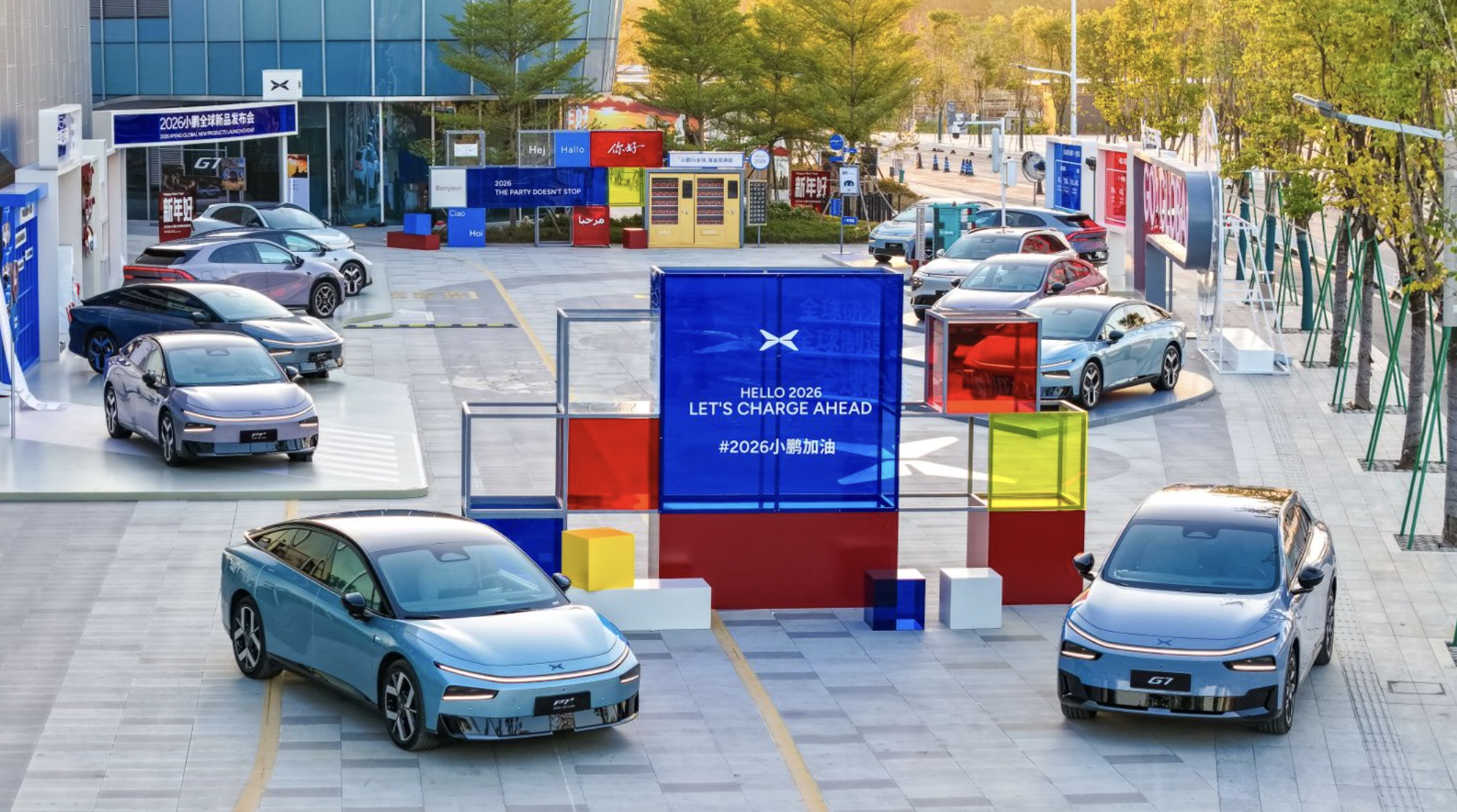
Core Viewpoint - Xiaopeng Motors' CEO He Xiaopeng believes that 2026 will mark the true beginning of fully autonomous driving in both China and the U.S., positioning the company to transition from an automotive manufacturer to a physical AI enterprise [1] Group 1: Company Strategy and Performance - Xiaopeng Motors has undergone a three-year internal restructuring, focusing on cost reduction and efficiency, with a return to core automotive manufacturing principles [1] - In 2022, Xiaopeng Motors delivered 429,000 vehicles globally, a 126% year-on-year increase, surpassing competitors like Li Auto and Xiaomi, making it the second-largest among new car manufacturers [1] - The company plans to launch seven range-extended models this year, including the P7+ and G7 range-extended versions, which maintain pricing below 200,000 yuan [13] Group 2: Technological Advancements - He Xiaopeng emphasizes the rapid evolution of AI technology, predicting that software capabilities will increase from 10% to 50% of vehicle value over the next decade, significantly altering transportation methods [5] - The second-generation VLA (Vision-Language-Action) model, which eliminates the "language translation" step, is expected to enhance the vehicle's ability to respond to real-world interactions, improving decision-making in unfamiliar scenarios [6] - Xiaopeng Motors' self-developed Turing chip has begun mass production, with the new models featuring varying configurations of this chip to support advanced AI functionalities [10] Group 3: Market Challenges and Consumer Behavior - Despite advancements, the market perception of AI in vehicles has not yet aligned with the technological vision, as consumers remain focused on practical factors like range and cost-effectiveness [11] - The dual sales strategy of range-extended and pure electric vehicles may complicate the company's manufacturing and supply chain processes, potentially leading to brand confusion among consumers [14] - The market for range-extended vehicles is projected to decline, with a 1.1% drop in wholesale sales expected by 2025, indicating a shift in consumer preference towards pure electric vehicles [13]


理想汽车失销冠交付量仅完成目标63% 单季归母净利亏6.2亿
Chang Jiang Shang Bao· 2026-01-12 02:47
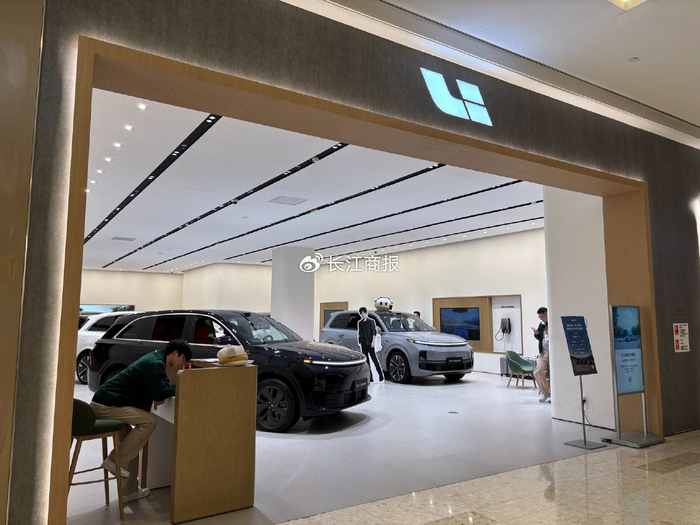
Core Viewpoint - Li Auto has experienced a significant decline in sales and profitability, leading to a restructuring of its product lines and management approach to regain market competitiveness [2][5][8]. Sales Performance - In 2025, Li Auto delivered a total of 406,300 vehicles, representing an 18.81% year-on-year decline, and only achieved approximately 63% of its revised sales target of 640,000 vehicles [7]. - The company has fallen from the top position in the new energy vehicle sector to fifth place, trailing behind competitors such as Leap Motor, Hongmeng Zhixing, Xiaomi Auto, and XPeng [7]. Financial Performance - In Q3 2025, Li Auto reported a net loss of 624 million yuan, ending a streak of 11 consecutive profitable quarters [8]. - The company's revenue for Q3 2025 was 27.365 billion yuan, a 36.2% decrease compared to the same period last year [8]. Organizational Restructuring - Li Auto is restructuring its product lines into two main categories: the first line, led by Tang Jing, will cover models MEGA, L9, L8, and L7; the second line, led by Li Xinyang, will focus on the i series and L6 [3]. - The restructuring is a response to declining sales and aims to return to a startup management model to enhance value creation and better meet user needs [4][6]. Market Challenges - The company has faced challenges including a recall of 11,411 vehicles due to safety concerns related to cooling system failures, which has negatively impacted consumer confidence [10]. - A recent fire incident involving a Li Auto MEGA vehicle has further raised concerns among consumers and the media [10]. Future Outlook - Despite current challenges, the CEO remains optimistic, highlighting milestones such as surpassing 1.5 million cumulative deliveries and expanding into new international markets [11].

理想汽车失销冠交付量仅完成目标63% 单季归母净利亏6.2亿李想急调管理模式
Chang Jiang Shang Bao· 2026-01-11 23:31
Core Viewpoint - Li Auto has experienced a significant decline in sales and profitability, leading to a restructuring of its product lines and management approach to regain market competitiveness [1][4][6]. Sales Performance - In 2025, Li Auto delivered a total of 406,300 vehicles, representing an 18.81% year-on-year decline, and only achieved approximately 63% of its revised sales target of 640,000 vehicles [6][7]. - The company has fallen from the top position in the new energy vehicle sector to fifth place, trailing behind competitors such as Leap Motor, Hongmeng Zhixing, Xiaomi Auto, and XPeng [7]. Financial Performance - In Q3 2025, Li Auto reported a net loss of 624 million yuan, ending a streak of 11 consecutive profitable quarters [8]. - The company's revenue for 2023 was 123.85 billion yuan, a 173.5% increase year-on-year, but revenue growth slowed to 16.64% in 2024, with a net profit decline of 31.37% [8]. Organizational Restructuring - Li Auto is restructuring its product lines into two main categories: the first line, led by Tang Jing, will cover models MEGA, L9, L8, and L7; the second line, led by Li Xinyang, will focus on the i series and L6 [2]. - The restructuring is a response to declining sales and aims to return to a startup management model to enhance value creation and better meet user needs [2][5]. Market Challenges - The company has faced challenges including a recall of 11,411 vehicles due to safety concerns related to cooling system failures, which may impact consumer confidence [9][10]. - A recent fire incident involving the Li Auto MEGA has raised concerns among consumers and the media, further complicating the company's recovery efforts [10]. Future Outlook - Despite current challenges, the CEO remains optimistic about achieving significant milestones, including surpassing 1.5 million cumulative deliveries and expanding into new international markets [10].

贾可吴伯凡吴声张晓亮,4万字2025-2026跨年对谈全文(上)
汽车商业评论· 2026-01-10 23:05
Core Viewpoint - The article discusses the evolution and current state of the Chinese automotive industry, highlighting the significance of achieving global sales leadership for domestic brands and the need for industry maturity and strategic resource consolidation [5][31][44]. Group 1: Achievements in the Automotive Industry - In 2025, Chinese domestic brands achieved global sales leadership, with total sales expected to reach 27 million units, surpassing Japanese brands by approximately 2 million units [13][20]. - The domestic market is projected to exceed 34 million units, marking a growth of about 3 million units from the previous year [13][20]. - The automotive industry contributes over 10% to China's GDP, emphasizing its critical role in the national economy [18][25]. Group 2: Industry Challenges and Maturity - The industry faces challenges such as declining profit margins, with the average profit rate rising slightly from 4.3% to 4.4% [35][25]. - There is a need for the industry to transition from aggressive competition to value-based competition, as highlighted by government interventions aimed at curbing price wars and promoting sustainable practices [31][36]. - The government has implemented measures to address industry chaos, including guidelines to prevent arbitrary price reductions and improve supply chain management [34][31]. Group 3: Resource Consolidation and Strategic Adjustments - Traditional automakers are increasingly consolidating resources and streamlining operations to enhance efficiency and competitiveness [45][47]. - Companies like Geely and Dongfeng are integrating their brands to strengthen their market position and improve operational effectiveness [45][47]. - The article emphasizes the importance of strategic focus and resource allocation in navigating the evolving automotive landscape, with companies needing to adapt to new market realities [51][53].

2025车企目标达成率透视:巨头稳健、新势力分化,新能源与出口双引擎驱动
Ju Chao Zi Xun· 2026-01-09 10:11
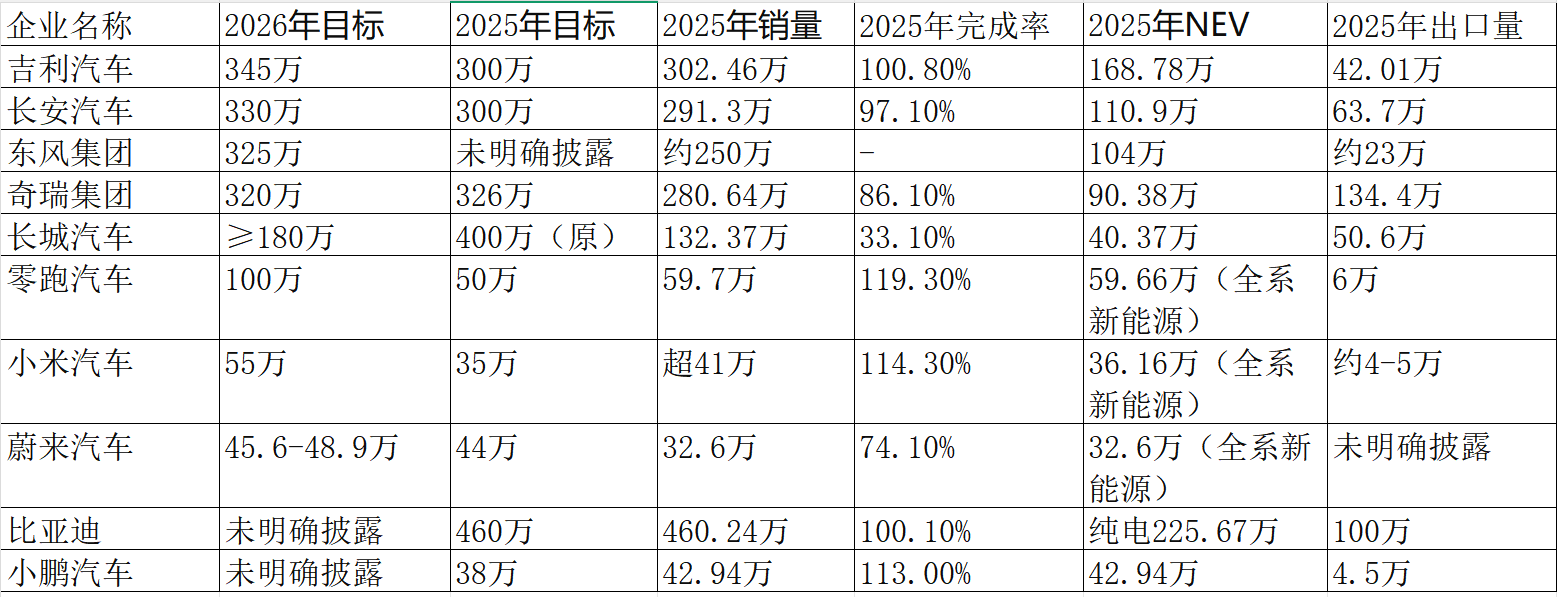
Core Insights - The Chinese automotive market has undergone significant changes in 2025, moving away from broad high growth to a more structured competitive landscape, with increasing penetration of new energy vehicles (NEVs) and a shift in the importance of overseas markets from a strategic option to a core pillar for survival and development [2] Group 1: Annual Goals and Performance - BYD demonstrated strong resilience, achieving a sales target of 460.24 million units, which is a 100.05% target achievement rate after a pragmatic adjustment from an initial goal of 550 million units [3] - Other traditional automakers like Geely (302.46 million units), SAIC Motor (450.75 million units), and Chery (280.64 million units) also met or closely approached their annual targets, indicating stability during their transformation [3] - In contrast, Li Auto's sales of 40.63 million units fell significantly short of its adjusted target of 64 million units, achieving only about 58% of its goal, highlighting challenges in product iteration and market expansion [5] Group 2: Growth Dynamics - The growth drivers for the automotive industry are clearly identified as internal growth in the NEV sector and expansion into overseas markets [9] - BYD maintained its leading position in the NEV market with sales of 460.24 million units, while new entrants like Leap Motor and Xpeng Motors achieved impressive growth rates of 103.13% and 125.88%, respectively [10] - Traditional automakers like Chery and Geely have made positive strides in transitioning to NEVs, but companies like Dongfeng and GAC face significant growth pressures due to slower transitions [12] Group 3: Export Performance - Exports have become a critical variable in determining industry rankings, with BYD's exports skyrocketing from 416,000 units in 2024 to 1,046,000 units in 2025, a growth of over 150% [12] - Chery led exports with 1,344,000 units, while SAIC Motor also surpassed 1,070,000 units in overseas sales, contributing to a total export of 4,386,800 units among the top five Chinese automakers [12] - Tesla's export growth in China was weak, with only 222,700 units exported from January to November 2025, indicating increasing competition from local brands in the international market [13] Group 4: Future Outlook - The market performance in 2025 indicates a shift from relying solely on domestic market growth to a comprehensive capability competition among automakers [15] - Strategic resilience and operational rationality are crucial, with companies like BYD successfully adjusting targets based on market feedback, while others like Xiaomi and Leap Motor are breaking through by precisely targeting niche markets [15] - The competition has evolved from mere sales volume expansion to a comprehensive comparison of technological depth, product ecosystem breadth, user operation precision, and sustainable profitability [16]

乘联分会:2025年12月新能源车在国内总体乘用车的零售渗透率59.1%
Zheng Quan Shi Bao Wang· 2026-01-09 08:25
Core Insights - The penetration rate of new energy vehicles (NEVs) in China's overall passenger car retail market is projected to reach 59.1% by December 2025, an increase of 9.6 percentage points year-on-year [1] Group 1: Market Performance - In December, the penetration rate of NEVs among domestic self-owned brands reached 80.9% [1] - The penetration rate of NEVs in the luxury car segment was 39.1% [1] - The penetration rate of NEVs among mainstream joint venture brands was only 8.2% [1] Group 2: Retail Market Share - In December, the retail market share of self-owned brand NEVs was 64.4%, a year-on-year decrease of 6.7 percentage points [1] - The retail market share of NEVs among mainstream joint venture brands was 3.7%, showing a year-on-year increase of 0.9 percentage points [1] - The new force brands, including XPeng Motors, Leap Motor, and Xiaomi Auto, contributed to a year-on-year growth of 4.9 percentage points in their market share, reaching 23.5% [1] - Tesla's market share was 7.0%, with a year-on-year increase of 0.6 percentage points [1]
2026仅1家目标销量翻倍,车企不再“放卫星”
Feng Huang Wang Cai Jing· 2026-01-08 08:26
Core Viewpoint - The Chinese automotive market, particularly in the new energy vehicle (NEV) sector, is transitioning from rapid growth to a more cautious approach, with manufacturers setting more conservative sales targets for 2026 compared to previous years [1] Group 1: Sales Targets and Growth Rates - Geely has set the highest sales target for 2026 at 3.45 million units, representing a 14% increase from 2025, with a goal of 2.22 million units in NEV sales, a 32% year-on-year growth [3] - Dongfeng aims for a total sales target of 3.25 million units in 2026, with an estimated growth rate exceeding 30% based on projected 2025 sales of approximately 2.5 million units [3] - Chery has announced a target of 3.2 million units for 2026, reflecting a 14.03% increase from 2025 [3] - Leap Motor is the only manufacturer aiming for a doubling of sales, targeting 1 million units in 2026, up from 500,000 units in 2025 [1][2] Group 2: Performance and Adjustments - Longhua's 2025 cumulative sales were 1.32 million units, with a significant adjustment in their 2026 target from at least 2.49 million units down to 1.8 million units, indicating a 36% growth from the previous year [4] - NIO has set a sales target for 2026 between 456,000 and 489,000 units, aiming for a growth rate of 40-50% from the previous year [6] - Xiaomi has also set a target for 2026 that exceeds a 30% increase from its previous year's sales, with plans to launch a new generation of vehicles [6] Group 3: Market Dynamics - The implementation of a 50% reduction in NEV purchase tax and adjustments to subsidy policies are creating new variables in the domestic automotive market [1] - Traditional automakers are adopting more cautious growth targets, while new entrants remain optimistic but have tempered their previous aggressive growth statements [1]

2025年我国召回乘用车超680万辆合资车成召回“主力” 新能源车召回数量下降
Zhong Guo Zhi Liang Xin Wen Wang· 2026-01-08 07:38
Core Insights - In 2025, China implemented 105 recalls for passenger vehicles, affecting approximately 6.825 million vehicles, with a notable decline in recalls for German brands and an increase for Japanese brands [1][2] Group 1: Recall Statistics - Japanese brands led in recall numbers with a total of 2.207 million vehicles recalled, marking a 27.3% increase year-on-year, accounting for over 30% of total recalls [1] - German brands had 1.28 million vehicles recalled, a significant decrease, while American brands recalled 1.399 million vehicles, experiencing a 60.5% drop [1] - Domestic brands recalled 566,000 vehicles, a 26.7% increase from 2024, with their market share surpassing 70% for the first time [1] Group 2: Major Recalls - Three recalls exceeded 500,000 vehicles: Dongfeng Honda and GAC Honda recalled approximately 1.367 million vehicles due to steering issues, Tesla recalled over 1.2 million vehicles for rearview camera and steering system failures, and Jaguar Land Rover recalled over 630,000 vehicles for engine and software issues [2] - The overall recall numbers for new energy vehicles decreased significantly, with over 2.1 million recalls in 2025, indicating improved quality control in the industry [2] Group 3: Quality Control and Investigations - In 2025, passive recalls reached 21 instances, with 12 involving domestic brands, highlighting the need for improved quality management systems among some manufacturers [4] - More than half of the battery-related recalls were initiated by the market regulatory authority, indicating a proactive approach to safety [4] - Japanese brands conducted all their recalls voluntarily, reflecting a mature corporate responsibility and transparency that can help rebuild consumer trust [4]

造车新势力10年沉浮:既分高下,也决生死
Jing Ji Guan Cha Wang· 2026-01-08 07:36
Core Insights - The article highlights the contrasting fates of new energy vehicle manufacturers in China, with Leap Motor achieving significant sales success while Neta Auto faces bankruptcy [2] - The landscape of new car manufacturers has drastically changed since 2015, with only a few remaining competitive players in the market [2] Group 1: Leap Motor's Success - Leap Motor is projected to sell nearly 600,000 vehicles in 2025, marking a 103% year-on-year increase and securing the title of sales champion among new car manufacturers [3] - The company shifted its strategy to target the mainstream market, launching models like the T03 and C11, which contributed to its sales growth [3] - Leap Motor has formed strategic partnerships with Stellantis and FAW, enhancing its brand credibility and accelerating its international expansion [3] Group 2: Hongmeng Zhixing's Rise - Hongmeng Zhixing, formerly Huawei Smart Selection, has seen rapid growth, with total deliveries reaching 589,000 units in 2025, a 32% increase from the previous year [4][5] - The AITO Wenjie brand, particularly the Wenjie M7, has been a significant contributor to this growth, with 420,000 units delivered in 2025, accounting for 71% of total sales [5] Group 3: Xiaomi's Entry - Xiaomi, entering the automotive sector later than its competitors, achieved sales of 412,000 vehicles in 2025, surpassing its target and ranking fifth among new energy vehicle manufacturers [5] - Despite its success, Xiaomi has faced challenges, including negative publicity related to safety incidents and design issues [5] Group 4: The Decline of "Wei Xiao Li" - The trio of "Wei Xiao Li" (NIO, Li Auto, and Xpeng) has experienced a divergence in performance, with NIO's sales declining to 326,000 units in 2025, despite a 47% year-on-year increase [6][7] - Xpeng led the trio with sales of 429,000 units, a 126% increase, while Li Auto's sales fell by 19.6% to 405,900 units, marking a significant drop from its previous leadership position [7][8] Group 5: Industry Challenges and Failures - The article discusses the decline of many new energy vehicle manufacturers, categorizing them into three groups: those that failed before mass production, those that made strategic errors, and those that faced funding issues [9][10] - Notable failures include companies like LeEco and Byton, which struggled with financial sustainability and market competition [10] Group 6: Future Outlook - The article suggests that the next decade will be more challenging for remaining players, emphasizing the need for operational efficiency and cost control to survive in a competitive environment [10][11] - New entrants continue to emerge, indicating ongoing interest in the automotive sector despite the challenges faced by existing manufacturers [11]

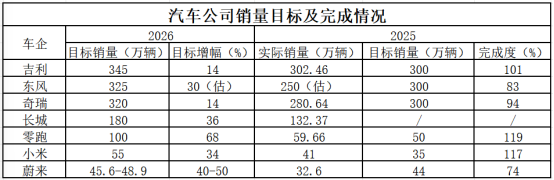
盘点2026年部分车企销量目标
Zhong Guo Qi Che Bao Wang· 2026-01-08 07:15
Core Viewpoint - Several automotive companies have announced their sales targets for 2026, and an analysis of their 2025 performance reveals the potential challenges they may face in achieving these goals [3]. Group 1: Company Performance and Targets - Geely Automobile aims for a target of 3.45 million units in 2026, having achieved 3.0246 million units in 2025, exceeding its target of 3 million units with a completion rate of 100.8% [3] - BYD's actual sales in 2025 reached 4.6024 million units, surpassing its adjusted target of 4.6 million units, with a significant pure electric sales figure of 2.2567 million units, ranking first globally [5] - Leap Motor set a target of 1 million units for 2026, achieving 597,000 units in 2025, exceeding its target of 500,000 units with a completion rate of 119.3% [8] - Changan Automobile has a target of 3.3 million units for 2026, with 2025 sales of 2.913 million units, achieving a completion rate of 97.1% [12] - Chery Group aims for 3.2 million units in 2026, having sold 2.8064 million units in 2025, with a completion rate of 86.1% [15] - NIO targets between 456,000 and 489,000 units for 2026, with 2025 sales of 326,000 units, achieving a completion rate of 74.1% [20] Group 2: Challenges Faced by Companies - Geely faces challenges such as EU anti-subsidy investigations and changes in Brazil's tax policies affecting exports [3][4] - BYD needs to improve sales in the high-end market, particularly for its luxury models, and address rising overseas transportation costs, which increased by 47% [6][7] - Leap Motor must compete in the 100,000-150,000 yuan market against Geely and Changan, while its gross margin is only 12%, below the industry average of 15% [10] - Changan's challenges include competition in the new energy market with BYD and Tesla, and reliance on Middle Eastern and Southeast Asian markets for exports, which are subject to geopolitical risks [14] - Chery's domestic market faces low new energy penetration at 32%, necessitating a faster transition, while its exports are vulnerable to currency fluctuations and trade barriers [15] - Great Wall Motors has significantly reduced its target from 4 million to 1.8 million units, indicating a strategic contraction, and faces delays in its new energy transition [18][19] - NIO's sales target increase of 40-50% requires monthly sales of 38,000-41,000 units, while its average monthly sales in 2025 were only 27,000 units, alongside ongoing financial losses [22] Group 3: Industry Trends and Insights - The competition in the automotive market is intensifying, with many companies having gross margins below the industry average of 15%, limiting their operational flexibility [23] - The price volatility of lithium carbonate, a key component for batteries, is expected to negatively impact cost reduction efforts for automotive companies in 2026 [23] - The automotive industry is entering a phase of "technology-driven + globalization" competition, requiring companies to balance scale, profit, and technology to achieve their 2026 targets [25]