燕京啤酒

Search documents
燕京啤酒涨2.04%,成交额6559.44万元,主力资金净流入822.35万元
Xin Lang Cai Jing· 2026-01-19 02:52
Core Viewpoint - Yanjing Beer has shown a stable stock performance with a slight increase in share price and positive financial growth indicators, indicating potential investment opportunities in the beverage sector [1][2]. Group 1: Stock Performance - On January 19, Yanjing Beer’s stock price increased by 2.04%, reaching 12.02 CNY per share, with a trading volume of 65.59 million CNY and a turnover rate of 0.22%, resulting in a total market capitalization of 33.879 billion CNY [1]. - Year-to-date, Yanjing Beer’s stock has risen by 7.03%, with a slight decline of 0.41% over the last five trading days, no change over the last 20 days, and a 2.47% increase over the last 60 days [1]. Group 2: Financial Performance - For the period from January to September 2025, Yanjing Beer reported a revenue of 13.433 billion CNY, reflecting a year-on-year growth of 4.57%, and a net profit attributable to shareholders of 1.770 billion CNY, which is a significant increase of 37.45% year-on-year [2]. - The company has distributed a total of 4.791 billion CNY in dividends since its A-share listing, with 1.325 billion CNY distributed over the past three years [3]. Group 3: Shareholder Structure - As of January 9, 2025, Yanjing Beer had 45,800 shareholders, a decrease of 16.65% from the previous period, with an average of 54,834 circulating shares per shareholder, which is an increase of 19.97% [2]. - The second-largest circulating shareholder is Hong Kong Central Clearing Limited, holding 74.5763 million shares, a decrease of 21.0157 million shares from the previous period [3].

食品饮料月月谈-如何展望春节旺季备货
2026-01-19 02:29
Summary of Key Points from Conference Call Records Industry Overview - **Industry**: Baijiu (Chinese liquor) and Soft Drinks - **Key Insights**: The Baijiu industry is nearing a bottom in terms of valuation, expectations, and holdings, with a potential turning point expected in Q3 2026. The soft drink market is showing strong performance from leading companies, with expectations for revenue growth above the industry average in 2026 [1][9]. Baijiu Industry Insights - **Market Dynamics**: The overall sentiment for Baijiu sales during the Spring Festival is cautious, with expectations of a year-on-year decline potentially reaching double digits. However, Moutai's significant price reduction may stimulate sales during low-frequency consumption scenarios [2][8]. - **Company Strategies**: - **Moutai**: Plans to stabilize overall product supply while adjusting the product mix to increase the availability of premium Moutai and 500ml Flying Moutai. This strategic shift is expected to have a profound impact on pricing and growth logic [4]. - **Luzhou Laojiao**: Focuses on maintaining stable apparent prices and ensuring stability in pricing, channels, and organizational structure to provide growth momentum during the recovery phase [5]. - **Investment Recommendations**: Companies such as Moutai, Fenjiu, and local brands like Gujing Gongjiu are recommended for their market share logic, while Wuliangye and Luzhou Laojiao are noted for their dividend security [1][8]. Soft Drink Market Insights - **Market Performance**: Leading companies in the soft drink sector are expected to maintain revenue growth above the industry average in 2026. Notable performers include Nongfu Spring and Dongpeng Special Drink, while Master Kong and Uni-President are seen as stable defensive investments [9][10]. - **Current Trends**: The market is experiencing significant competition, but leading companies are expected to leverage their channel and product advantages to maintain robust performance [9]. Tea Beverage Market - **Key Players**: Companies like Guming and Shanghai Auntie are rapidly expanding, with Guming planning to promote breakfast scenarios and Shanghai Auntie introducing coffee and health products. Both companies express confidence in same-store sales for 2026 [11]. Dairy Industry Insights - **Market Condition**: The dairy sector is currently experiencing weak demand but is expected to see a recovery in 2026. Companies like Yili, Mengniu, and New Dairy are recommended due to their stable fundamentals and growth potential [3][12][13]. Frozen Food Industry Insights - **Market Outlook**: The frozen food sector is showing positive prospects for 2026, with strong winter stocking and improved confidence among distributors. Companies like Anjijia, Qianwei Yangchun, and Sanquan Foods are optimistic about their outlook [14][15]. Seasonality and Consumer Behavior - **Consumer Trends**: The upcoming Spring Festival is expected to influence consumer behavior significantly, with increased stocking efforts noted across various sectors, including snacks and frozen foods. Companies are adjusting their strategies to meet this seasonal demand [17][18]. Recommendations for Investment - **Baijiu**: Focus on companies with strong market share logic and dividend security, such as Moutai and Luzhou Laojiao [8]. - **Soft Drinks**: Invest in leading brands like Nongfu Spring and Dongpeng, which are expected to outperform the market [9][10]. - **Dairy and Frozen Foods**: Look for opportunities in Yili, Mengniu, and Anjijia, which are positioned for growth in the recovering market [12][14]. Conclusion - The Baijiu industry is at a critical juncture, with potential for recovery in 2026, while the soft drink and dairy sectors are showing resilience and growth potential. Investors are advised to focus on companies with strong fundamentals and strategic positioning to capitalize on upcoming market opportunities [6][9][12].





AI赋能下的消费品投资机遇
2026-01-19 02:29
Summary of Key Points from Conference Call Records Industry and Company Overview - The conference call discusses investment opportunities in the consumer goods sector, particularly focusing on AI applications, AR technology, smart glasses, and AI education [1][2] - Companies mentioned include Yiyuan Yichuang, Quark, Tianli International Holdings, Huatu Shanding, Fenbi, Kevin Education, Focus Technology, Xiaogoods City, and Qingmu Technology [1][2][3][4] Core Insights and Arguments AI and AR Applications - The development of AR technology is expected to significantly impact traffic distribution and marketing channels, with companies like Yiyuan Yichuang already making strides in this area [2] - Smart glasses are becoming more affordable, priced around 1,000 yuan, and are anticipated to replace traditional glasses, with domestic companies like Quark showing strong performance [2] - AI education is addressing challenges in personalized learning and scalability, with companies like Tianli International Holdings and Huatu Shanding rapidly expanding their offerings [2] E-commerce Transformation - AI tools are transforming the e-commerce landscape through functionalities like image and video generation and cross-border translation, with companies like Focus Technology excelling in B2B platforms [3] Food and Beverage Sector - The food and beverage industry is showing signs of recovery, with companies like Anji Food, Baoli Food, and Qianhe Flavor Industry seeing stock price increases. A rising CPI is expected to further strengthen this trend [4] - The liquor sector is projected to accelerate its recovery starting Q3 2025, with companies like Moutai benefiting from price elasticity [4] Market Competition Changes - The public servant exam training and gold jewelry sectors are experiencing improved competitive dynamics, with online and offline integration reshaping the public exam training ecosystem [5] - The tourism industry is also expected to see increased demand, supported by favorable policies and anti-monopoly investigations benefiting upstream resources [5] Additional Important Insights Investment Recommendations - Investors are advised to focus on undervalued companies, particularly those significantly below their fair value, such as Action Education and Jiangsu Guotai [6] - The cultural tourism and retail sectors are anticipated to undergo significant transformations, presenting investment opportunities [6] Cotton Industry Trends - The cotton industry is witnessing a stabilization in prices, with Brazil expected to reduce production in 2025-2026, alleviating inventory pressures. Companies like Bailong Dongfang, with significant overseas capacity, are recommended for investment [7] Agricultural Sector Developments - AI technology is being applied in pig farming to reduce costs, with a slight increase in pork prices noted [8][9] Light Industry and Home Appliances - The light industry is seeing advancements in AI applications, particularly in smart glasses and toys, with companies like Mingyue Lens and Konnate expected to perform well [10][11] - The home appliance sector is closely tied to AI, with companies like Midea making significant progress in robotics, although competition is intense [14][15] Small Appliance Sector Strategies - Small appliance companies are encouraged to innovate their marketing strategies to adapt to the current market environment, with firms like Xiaoxiong and Xinbao actively expanding their operations [16]
【转|太平洋食饮-26年度策略】底部向阳,寻找结构性亮点
远峰电子· 2026-01-18 11:38
Overall Sector Review - The food and beverage sector significantly underperformed the market, with a year-to-date decline of -0.62%, lagging behind the Shanghai Composite Index by 15.0 percentage points [2] - The sector experienced a deep correction after an initial rebound driven by expectations of consumption recovery and supportive policies, but the actual recovery rate was lower than anticipated, leading to a consensus on weak domestic demand [2] Subsector Performance - The snack sector outperformed with a year-to-date increase of 28.88%, driven by channel expansion and a revenue growth rate of 30.97% in the first three quarters [4] - Soft drinks also showed resilience with a 10.11% stock price increase, benefiting from strong travel demand and low-cost, high-frequency consumption [4] - The restaurant chain sector saw a rebound with gains of approximately 10.34% and 10.29% for pre-processed and baked goods, respectively [4] - The liquor sector, particularly high-end liquor, faced challenges with weaker sales and declining prices, while beer performance was supported but affected by high-end market constraints [4] Investment Insights - The sector is under pressure from deflationary trends and a weak recovery, with consumer confidence remaining low, indicating a shift to a "new normal" of low growth [8] - High-end consumption has shown slight recovery due to stock market wealth effects, but sustainability remains a concern [9] - The food and beverage sector's valuation is at historical lows, with a current PE (TTM) of 21.9X, indicating potential investment opportunities in undervalued segments [12] Fund Holdings - As of Q3 2025, the food and beverage sector's fund holdings decreased to 6.38%, nearing levels seen in 2016, with the liquor segment comprising 5.52% of this [14] - Fund holdings in the liquor sector increased for certain subsectors, including white liquor and seasoning products, while others saw declines [16] Long-term Trends - The liquor industry is undergoing its longest adjustment period since 2003, with significant price corrections and a potential bottoming out of valuations [21] - The white liquor sector has underperformed the market with a year-to-date return of -4.87%, reflecting weak demand and a divergence from broader market trends [24] - The third quarter of 2025 saw a significant decline in revenue and net profit for the white liquor sector, indicating a deep adjustment phase [27] Pricing Dynamics - The white liquor market is experiencing a general decline in prices, particularly in high-end segments, while lower price segments show resilience [29] - The average price of high-end products like Moutai has dropped significantly, while mid-range and lower-range products have maintained stability or slight increases [31] Investment Recommendations - The white liquor sector is advised to focus on inventory reduction and demand recovery, with a preference for leading brands that can maintain pricing power and product stability [32]




食品饮料行业:春节走访:河南、上海市场跟踪
GF SECURITIES· 2026-01-18 10:06
Core Insights - The report maintains a "Buy" rating for the food and beverage industry, consistent with previous ratings, indicating a positive outlook for the sector [4] - The report highlights the cautious inventory management in the liquor market, particularly in Henan, with the upcoming Spring Festival sales performance still uncertain [17][19] - The demand for frozen food in Henan is showing signs of improvement as preparations for the Spring Festival begin, with increased confidence among distributors [22] - In Shanghai, the "锅圈" (Guoquan) stores are undergoing significant renovations, leading to a notable increase in daily sales post-renovation [25][27] Weekly Focus: Henan & Shanghai Market Tracking - **Henan Liquor Market**: Inventory levels are low, and major brands like Moutai are seeing stable pricing, with the Spring Festival sales performance yet to be observed [17][19] - **Henan Food Supply Market**: Distributors are beginning to stock up for the Spring Festival, with a slight uptick in demand noted [22] - **Shanghai Guoquan Store Renovations**: The store renovations have led to a significant increase in daily sales, with new product categories contributing to revenue growth [25][27] Food and Beverage Sector Overview - The food and beverage sector experienced a decline of 2.1% in the week of January 12-16, underperforming compared to the CSI 300 index [29] - The valuation of the food and beverage sector stands at a PE-TTM of 21.2X, with the white liquor sector at 18.3X, indicating a relative valuation compared to the broader market [43][46] Recent Key Announcements & News - The report includes updates on major companies like Qianwei Culinary and Sanquan Foods, highlighting their strategic adjustments and product innovations aimed at enhancing competitiveness [23][24] - The report notes that the industry is moving away from price wars towards a focus on product innovation and quality assurance [24] Investment Recommendations - The report recommends key liquor brands such as Luzhou Laojiao, Shanxi Fenjiu, and Moutai, as well as consumer goods companies like Anjuke Foods and Tianwei Foods, indicating potential investment opportunities [8][12]

茅台价格重塑,全面推进市场化转型
Xiangcai Securities· 2026-01-18 08:55
Investment Rating - The industry investment rating is maintained as "Buy" [1] Core Views - The report highlights that the food and beverage industry is currently experiencing a market downturn, with a 2.10% decline from January 12 to January 16, 2026, underperforming the CSI 300 index by 1.53 percentage points [3][7] - Moutai has broken its rigid ex-factory price, transitioning to a market-oriented pricing mechanism, which includes a multi-channel sales strategy and a dynamic pricing adjustment system based on market demand [4] - The report suggests that despite current market data indicating a cold consumer sentiment, the valuation of the food and beverage sector is at historical lows, presenting potential investment opportunities as the market begins to recover [5] Summary by Sections Industry Performance - From January 12 to January 16, 2026, the food and beverage sector fell by 2.10%, ranking 25th out of 31 sectors, with all sub-sectors declining, including other alcoholic beverages down by 0.22%, health products down by 0.72%, and meat products down by 1.35% [3][7] Moutai's Market Strategy - Moutai has approved a market-oriented operational plan that focuses on consumer needs and market demand, restructuring its product system to better meet diverse consumer preferences and transitioning to a multi-channel sales model [4] Investment Recommendations - The report emphasizes that the food and beverage industry's valuation is at a historical low, suggesting that investors should focus on three main lines: stable demand leaders, companies innovating in products and channels, and segments with reasonable valuations post-adjustment [5] - Specific companies to watch include Anjuke Food, Guizhou Moutai, Miaokelando, Andeli, Shanxi Fenjiu, Yanjing Beer, and Salted Fish [5]
80后最爱喝的啤酒 , 要破产了?
3 6 Ke· 2026-01-18 06:06
Core Viewpoint - Shandong Taishan Brewery Co., Ltd. has entered bankruptcy reorganization, highlighting the financial struggles faced by many regional traditional breweries amid industry adjustments and shifts in consumer preferences towards higher quality products [1][2][10]. Financial Situation - As of October 31, 2025, Taishan Brewery's total assets are approximately 622 million yuan, with total liabilities around 663 million yuan, resulting in a debt-to-asset ratio of 106.63% [2]. - The court determined that Taishan Brewery cannot repay its due debts and lacks sufficient assets to cover all liabilities, thus qualifying for bankruptcy reorganization [2]. Management Perspective - The management emphasizes that the company's challenges stem from historical debt rather than product or market issues, and the reorganization will allow a renewed focus on production and consumer service [2][8]. Historical Context - Founded in 1952, Taishan Brewery has evolved from a local brewery to a national player in the fresh beer segment, successfully adapting to consumer trends and market demands [5][6]. - The introduction of the "7-day short shelf life" fresh beer in 2013 marked a significant innovation, allowing the company to capture a niche market and establish a strong brand presence [6][7]. Market Dynamics - The brewery's struggles reflect broader challenges in the beer industry, where traditional brands must innovate and restructure to remain competitive against premium and craft beer segments [10][11]. - The shift from low-margin, high-volume sales to high-value, quality-focused products is essential for survival in the current market landscape [10][11]. Reorganization Strategy - The reorganization process will provide a legal framework for debt resolution and business restructuring, allowing the company to avoid asset seizures and maintain operations during this critical period [3][4]. - The strategy includes potential debt reduction, capital infusion, and operational reforms, aiming for a comprehensive recovery [3][4][12]. Future Outlook - The next six months to a year will be crucial for Taishan Brewery's transformation and potential rebirth, leveraging its established brand and market trust [4][13]. - The company may explore new product offerings and partnerships to enhance its market position and consumer engagement [13].
80后最爱喝的啤酒,要破产了?
Xin Lang Cai Jing· 2026-01-18 02:46
Core Viewpoint - Shandong Taishan Brewery Co., Ltd. has entered bankruptcy reorganization to address its significant historical debt burden, which is hindering its operational capabilities and market competitiveness [2][3][19]. Financial Situation - As of October 31, 2025, Taishan Brewery's total assets are approximately 622 million yuan, while its total liabilities amount to about 663 million yuan, resulting in an asset-liability ratio of 106.63% [3][18]. - The court has determined that Taishan Brewery cannot repay its due debts and lacks sufficient assets to cover all liabilities, thus justifying the acceptance of its reorganization application [3][20]. Reorganization Process - The reorganization will provide a "protection period" during which the company can avoid asset seizures and maintain basic operations, allowing it to focus on production and consumer service [20]. - The reorganization process will enable the company to develop debt repayment and business restructuring plans under court supervision, potentially involving strategic investors or debt-to-equity swaps [20][27]. Industry Context - The challenges faced by Taishan Brewery reflect broader issues within the regional traditional beer industry, particularly as consumer preferences shift from quantity to quality, necessitating product innovation and channel restructuring [2][11]. - The brewery's situation is indicative of many regional beer brands that are struggling to adapt to a market characterized by saturation and changing consumer demands [11][25]. Historical Background - Founded in 1952, Taishan Brewery has evolved from a local state-owned brewery to a significant player in the fresh beer segment, particularly with its Taishan Fresh Beer brand launched in 2013 [21][22]. - The company has successfully captured market share by focusing on high-quality, fresh beer products, leveraging local culture and consumer preferences [24][10]. Strategic Insights - The reorganization is seen as a strategic choice to clear accumulated financial risks and facilitate a comprehensive transformation of the brand and its operations [6][25]. - The brewery's future growth may involve expanding its product offerings and exploring new market opportunities, such as seasonal products and partnerships with high-end restaurants [28].
「港股IPO观察」净利率从3%飙至27%!金星啤酒IPO亮出“暴利底牌”:中式精酿高定价能否抵御巨头围剿
Hua Xia Shi Bao· 2026-01-16 11:49
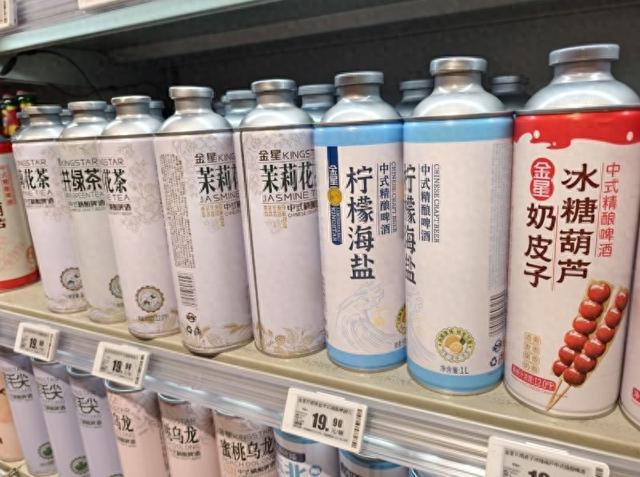
Core Viewpoint - Henan Jinxing Beer Co., Ltd. is embarking on an IPO journey in Hong Kong, aiming to enhance corporate governance, transparency, and secure capital for long-term product development and channel expansion [2][5]. Company Overview - Founded in 1982, Jinxing Beer has evolved from traditional beer to a focus on "Chinese craft beer," launching its first craft beer, Jinxing Maojian, in August 2024, which significantly boosted its performance [3][4]. - In 2023, the company reported revenues of 356 million yuan and a net profit of 12.2 million yuan, but by 2024, revenues surged to 730 million yuan, a 104.9% increase, with net profit reaching 125 million yuan, a 928% increase [3][4]. Financial Performance - For the first three quarters of 2025, Jinxing Beer achieved revenues of 1.11 billion yuan, a 191.2% increase year-on-year, and a net profit of 305 million yuan, a 1095.8% increase [3][4]. - The company has become the eighth largest in China's beer industry and the fifth largest domestic beer company, with a retail sales compound annual growth rate (CAGR) of 23.7% from 2022 to 2024 [4]. Product Pricing and Profitability - Jinxing Beer’s craft beer is priced significantly higher than traditional beers, with craft beer retail prices around 20 yuan per can (1L), compared to traditional beers priced between 2.5 yuan per can (330ml) and 6 yuan per bottle (500ml) [4]. - The gross margin has improved, with figures of 27.3%, 37.8%, and 47% for 2023, 2024, and the first three quarters of 2025, respectively, while net margins reached 3.4%, 17.2%, and 27.5% [4]. Market Position and Competition - Jinxing Beer faces increasing competition from major players like China Resources Beer and Yanjing Beer, which are expanding their craft beer offerings [6][9]. - The company relies heavily on distributors for sales, with 94.8% of its revenue coming from this channel, and has a network covering 29 provinces in China [7]. Strategic Outlook - The IPO is seen as a strategic move to strengthen Jinxing Beer’s market position amid intensifying competition, allowing for enhanced funding for innovation and brand development [5][9]. - The company aims to maintain its focus on Chinese craft beer while navigating the challenges posed by larger competitors and evolving market dynamics [8][9].
10家品牌荣膺“2025年度北京商业匠心智造品牌”
Bei Jing Shang Bao· 2026-01-16 08:57
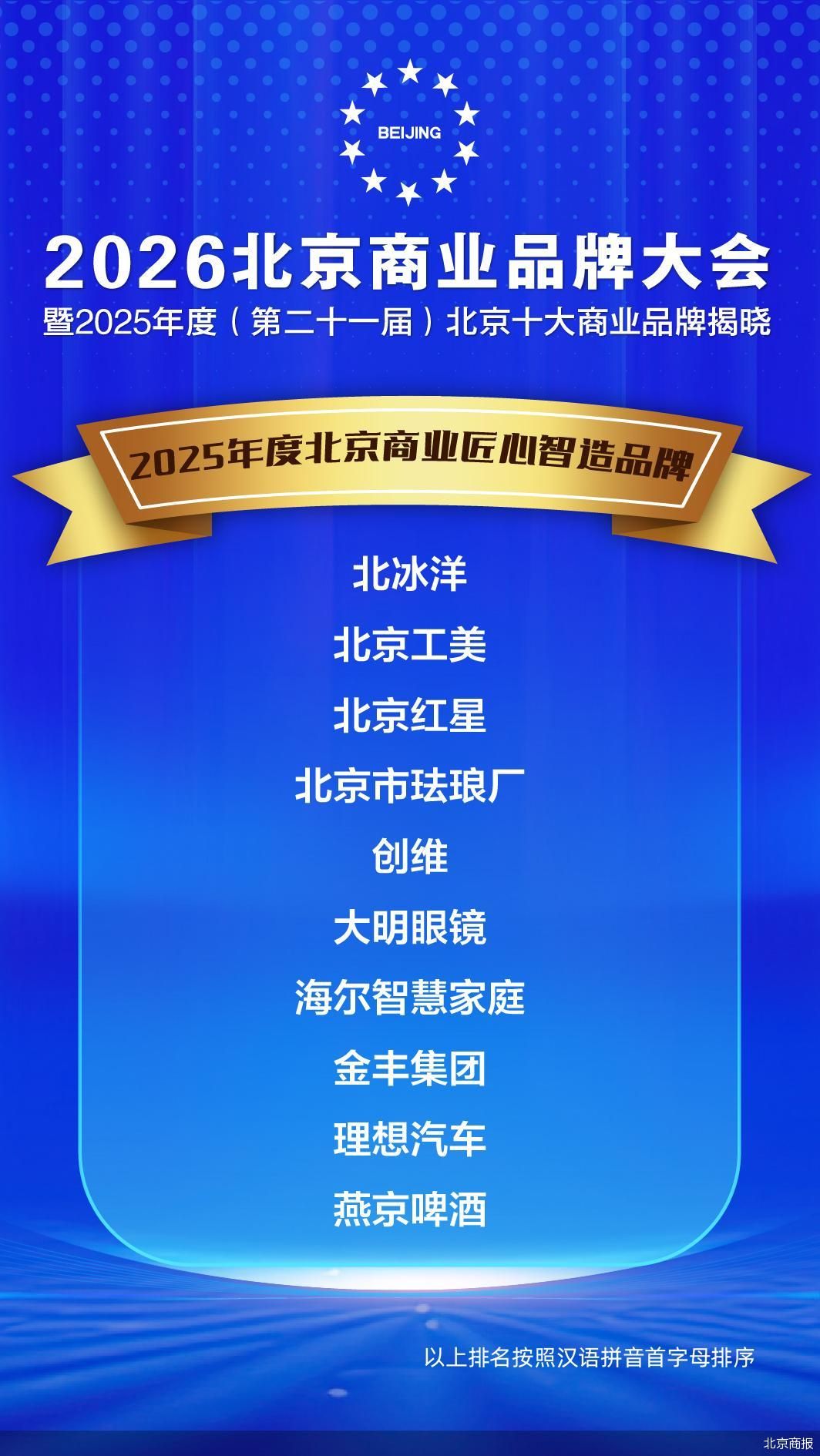
Core Insights - The 2026 Beijing Commercial Brand Conference and the announcement of the 2025 Top Ten Commercial Brands took place on January 16, guided by the Beijing Municipal Bureau of Commerce and organized by the Beijing Daily Media Group and the Beijing Commercial Association [1][4] - The theme of the event was "New Demand, New Supply," with government leaders, commercial experts, and corporate representatives gathering to witness the recognition of outstanding brands in Beijing [1] Group 1: Main Awards - The "2025 Top Ten Commercial Brands" represents brands with significant market influence and leadership in industry development [4] - The ten brands awarded as "2025 Beijing Commercial Craftsmanship Brands" include Beibingyang, Beijing Gongmei, Beijing Hongxing, Beijing Enamel Factory, Skyworth, Daming Glasses, Haier Smart Home, Jinfeng Group, Li Auto, and Yanjing Beer [1] Group 2: Subcategories and Special Awards - Four permanent subcategories were introduced: "Beijing Commercial Quality Service Brand," "Beijing Commercial Model Innovation Brand," "Beijing Commercial Craftsmanship Brand," and "Beijing Commercial New Star Brand" [4] - Three new special award categories were introduced for the first time: "2025 Financial Product Innovation Empowering Consumption Excellent Cases," "Beijing Cultural, Commercial, Tourism, and Sports Integration Excellent Cases," and "Beijing Fashion Consumption Power Leading Brand" [4]