
泰山玻纤

Search documents
2025年涨价主线全景扫描
Shang Hai Zheng Quan Bao· 2025-12-31 08:24
Group 1 - The core theme for 2025 is the price increase narrative driven by structural price hikes in various industries due to supply-demand reconfiguration, industrial upgrades, and policy guidance [1] - The lithium battery industry is experiencing a significant price surge, with lithium hexafluorophosphate prices skyrocketing from under 50,000 yuan/ton to 170,000 yuan/ton within a few months, indicating a strong demand driven by energy storage needs [2] - The storage chip market is entering a super cycle, with DRAM prices rising sharply due to tight supply and increased demand from AI applications, leading to a projected revenue peak of 216.3 billion USD in Q3 2025 [3] Group 2 - The non-ferrous metals sector is witnessing a remarkable performance, with the sector index rising over 85% year-to-date, driven by strong demand across various metal categories, including precious and industrial metals [4] - The outlook for 2026 suggests that most metal varieties will maintain a tight supply-demand balance, with prices expected to continue rising, particularly for copper and aluminum due to robust downstream demand [5] - Multiple industries are adopting "anti-involution" strategies to reshape market dynamics, with firms engaging in price stabilization efforts through coordinated production cuts and price adjustments [6] Group 3 - The refrigerant industry is experiencing a positive trend, with companies raising prices due to seasonal demand recovery and low inventory levels, indicating a bullish outlook for Q1 2026 [7] - The coal and building materials sectors are also following the "anti-involution" theme, with coal prices rebounding due to production restrictions and increased demand from extreme weather conditions [8] - The consensus among various institutions is that the price increase chain driven by supply-demand improvements will continue, presenting structural investment opportunities across multiple sectors [8]


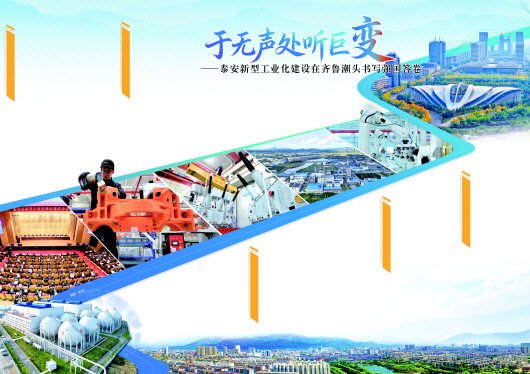
策划:泰安市委宣传部 泰安市新型工业化强市建设推进委员会办公室执行:齐鲁晚报·齐鲁壹点泰安融媒中心
Qi Lu Wan Bao· 2025-12-25 16:23
Core Insights - The article discusses the strategic implementation of a new industrialization initiative in Tai'an, focusing on enhancing industrial strength and innovation to address existing development bottlenecks [2][9]. Group 1: Industrial Strategy and Framework - Tai'an's new industrialization strategy is built on a "1+N" framework, which aims to create a robust organizational structure for industrial development, involving key leaders and specialized teams [2]. - The city has established a comprehensive planning system targeting four pillar industries: high-end equipment manufacturing, new materials, modern food, and high-end chemicals, along with several advantageous industries [3][4]. Group 2: Policy Support and Economic Impact - Tai'an has developed over 330 core policies to support industrial growth, including financial incentives and streamlined processes for businesses, resulting in significant tax refunds and funding for enterprises [4][12]. - The industrial value-added tax refunds reached 4.03 billion yuan, and the "Strong Industry Loan" program provided 69.527 billion yuan to 9,509 enterprises, fostering a substantial increase in the number of industrial enterprises [4][12]. Group 3: Pillar Industries Development - The four pillar industries have shown significant growth, with Tai'an's high-end equipment and new materials sectors achieving national competitiveness, including a 60% market share in certain steel products [3][5]. - The modern food industry has expanded from 119 to 204 regulated enterprises, with notable companies achieving over 1 billion yuan in revenue [7]. Group 4: Technological and Green Transformation - Tai'an is focusing on technological innovation and green transformation, with a reported 95.1% coverage of digital transformation among regulated industrial enterprises [10][11]. - The city has implemented numerous projects aimed at reducing energy consumption and increasing renewable energy capacity, with a 19.8% annual growth in installed renewable energy [10]. Group 5: Future Outlook and Goals - The city aims to further enhance its industrialization efforts during the "15th Five-Year Plan" period, focusing on smart, green, and integrated development to build a modern industrial system [14][15]. - Tai'an's industrial value added is projected to increase its share of GDP from 24.6% to 27.4% by 2024, indicating a strong commitment to industrial growth [14].
中金2026年展望 | 基础材料:供给优化持续,结构升级为王
中金点睛· 2025-12-22 23:38
Core Viewpoint - The article forecasts the industry landscape and corporate competition strategies for 2026, emphasizing demand as the starting point for analysis, with recommendations for sectors including fiberglass, consumer building materials, glass, and cement [2] Group 1: Fiberglass - The fiberglass sector is expected to maintain a favorable supply-demand balance, with a projected net increase in production of 400,000 to 500,000 tons by 2026, driven by high-end products like wind power yarn [6][10] - The high-end special fabric market is anticipated to continue its growth, with significant price increases expected for wind power yarn and potential price adjustments for ordinary yarn and electronic fabrics [5][7] - The industry is likely to see rational expansion with limited new capacity, as new entrants face challenges in achieving excess returns due to high initial costs [6][10] Group 2: Consumer Building Materials - The consumer building materials sector is under pressure, with new construction expected to decline by 16% year-on-year in 2026, and completions down by 7% [3][12] - Positive signals are emerging, including price increases for waterproofing materials and gypsum boards, alongside a reduction in cost rates and easing of impairment risks [3][11] - The market is witnessing a consolidation phase where leading companies are expected to recover profitability, benefiting from improved demand and supply optimization [11][15] Group 3: Glass and Cement - The glass sector is undergoing a "de-involution" process, with supply reductions anticipated as companies respond to ongoing losses, particularly in the float glass segment [3][24] - Cement demand is projected to decline by 7% in 2026, with supply-side policies aimed at curbing overproduction expected to play a crucial role in market dynamics [27][28] - The industry is expected to see a gradual recovery in pricing as supply and demand begin to balance, aided by a decrease in coal prices which may alleviate profit pressures [28][25]
中国风电纤维织物行业发展深度研究与投资前景分析报告(2025-2032年)
Sou Hu Cai Jing· 2025-12-10 05:13
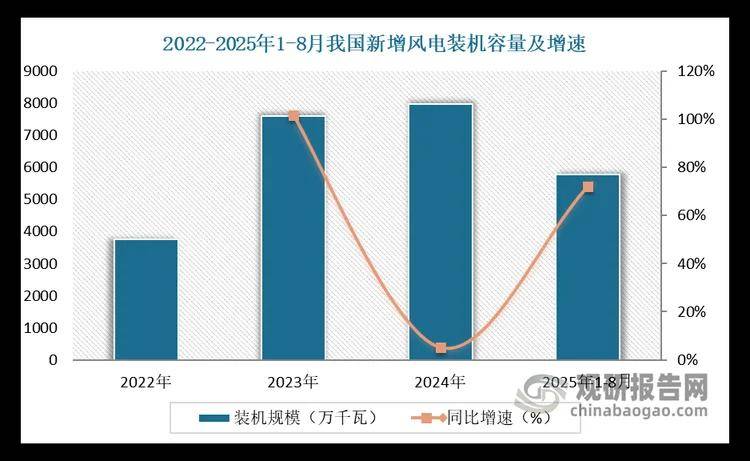
Group 1 - The wind power market is experiencing rapid growth, leading to increased demand for wind power fiber fabrics, which are essential materials in the manufacturing of wind turbine blades [1][5] - As of August 2025, China's installed wind power capacity reached 579 million kilowatts, a year-on-year increase of 22.1%, with new installations in the first eight months of 2025 growing by 72.1% [1] - The "Beijing Wind Energy Declaration 2.0" sets ambitious targets for wind power capacity, aiming for an annual increase of no less than 120 million kilowatts from 2025 onwards, with a cumulative target of 1.3 billion kilowatts by 2030 [5] Group 2 - The offshore wind power market is gaining momentum, creating new demand for wind power fiber fabrics due to its unique operational conditions [6][10] - Offshore wind power has significant advantages, including an equivalent full-load hour of over 4,000 hours and resource reserves three times that of onshore, which positions it as a core growth area for the wind power industry [6] - By 2024, China's offshore wind power capacity is expected to reach 43.31 million kilowatts, with new installations projected to be 5.4 GW in 2024 and 15 GW by 2027 [6][10] Group 3 - The trend of larger wind turbines is driving the demand for high-end wind power fiber fabrics, as larger blades require materials with superior strength and fatigue resistance [11][13] - The diameter of mainstream onshore wind turbine rotors in China has reached 193 meters, while offshore turbine blades have exceeded 153 meters in length [11] - Carbon fiber fabrics are increasingly preferred over traditional glass fiber due to their lower density (30%-35% lighter) and higher tensile modulus (3-8 times greater), which allows for a weight reduction of over 20% in blade manufacturing [13][15] Group 4 - The wind power fiber fabric market is characterized by high concentration, with leading companies like Zhenhua Co., Taishan Glass Fiber, and Hongfa New Materials dominating the market [18][19] - Zhenhua Co. holds over 35% of the global market share in wind power fiber fabrics as of 2024, maintaining its position as the largest supplier for three consecutive years [18] - The company has established production bases globally and serves major clients, including top ten wind turbine manufacturers, enhancing its competitive advantage [19]

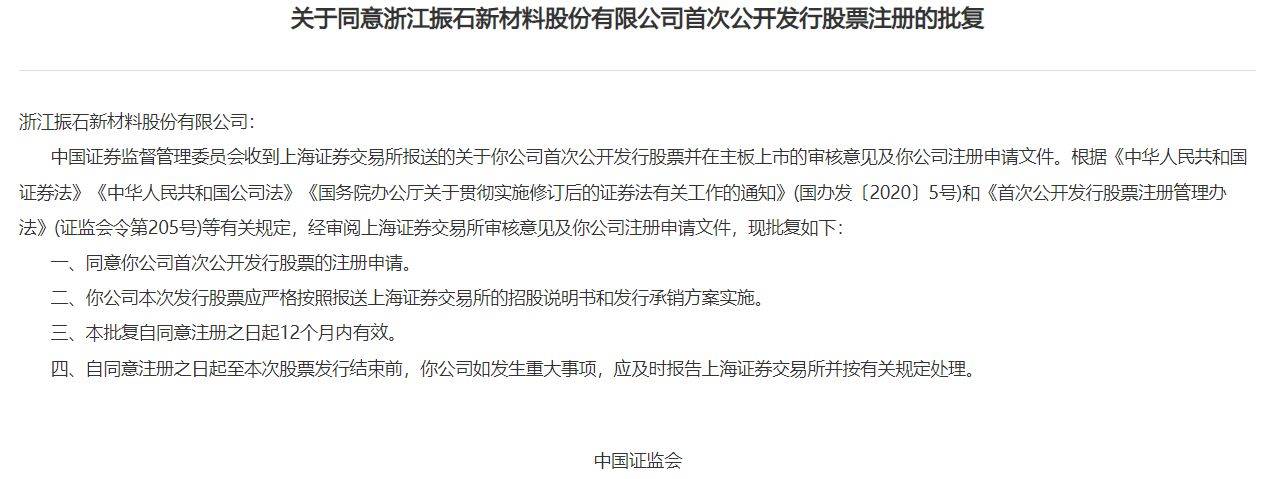
沪市主板企业振石股份IPO获注册
Sou Hu Cai Jing· 2025-12-09 14:07
Core Viewpoint - The China wind power fiber fabric industry is at a critical juncture, transitioning from a "large" to a "strong" phase, necessitating leading companies to focus on technological advancements and global strategies to maintain their competitive edge [7] Company Overview - Zhejiang Zhenstone New Materials Co., Ltd. is a national high-tech enterprise primarily engaged in the research, production, and sales of fiber-reinforced materials in the clean energy sector, with over 70% of its revenue derived from wind power fiber fabrics [4][5] - The company has become a global leader in wind blade material manufacturing, holding over 35% of the global market share for wind power glass fiber fabrics in 2024, and is recognized for its innovative solutions across various clean energy applications [4][5] Market Dynamics - The global wind power installation capacity is continuously increasing, with a clear trend towards larger blades, which can weigh nearly 20 tons and require about 60% glass fiber, driving demand for wind power fabrics [5] - The Chinese market demand for wind power fabrics is projected to reach 810,000 tons by 2025, indicating a robust market environment despite seasonal fluctuations [5] Industry Challenges - The industry faces significant challenges, including ongoing technological upgrade pressures and the risk of material substitution, particularly from carbon fiber, which is gaining market share in wind blade applications [6] - The international trade environment poses additional challenges, with anti-dumping and countervailing duties affecting the competitiveness of Chinese glass fiber products in overseas markets [6] - There is a potential risk of structural oversupply in low-end segments, as new entrants target high-performance fiber markets, necessitating strategic foresight from leading companies to avoid price wars and market saturation [6] Future Directions - Leading companies must not only maintain their current market positions but also strive for advancements in high-modulus and ultra-high-modulus products, while exploring new materials like carbon fiber [7] - A strategic shift towards localized production overseas is essential to mitigate trade risks and transition from merely exporting products to establishing technology standards and brand recognition globally [7]
2025年中国低介电电子布行业发展现状、竞争格局及趋势预测
Sou Hu Cai Jing· 2025-12-04 06:41
Core Insights - The low dielectric electronic fabric is a high-performance textile material with a dielectric constant (εr) lower than traditional electronic fabrics, primarily used in the electronics information field for applications like printed circuit boards (PCBs) and integrated circuit packaging, which helps reduce signal transmission delays and crosstalk, meeting the demands for high integration and high transmission rates in electronic devices [1][6][12]. Industry Overview - The global low dielectric electronic fabric market is experiencing significant growth, with the market size projected to increase from 59 million USD in 2020 to 181 million USD by 2025, reflecting a compound annual growth rate (CAGR) of 24.9%. Further forecasts suggest the market will reach 528 million USD by 2031, with a CAGR of 18.7% from 2025 to 2031, indicating strong development potential and market demand in the coming years [1][16]. Market Dynamics - The PCB industry is witnessing unprecedented growth opportunities driven by the global AI wave, with China's PCB market expected to reach approximately 412.11 billion CNY in 2024, further propelling the low dielectric electronic fabric sector [12][16]. Competitive Landscape - The production of low dielectric electronic fabric is characterized by high technical barriers, resulting in a limited number of manufacturers. Key global players include Nitto Denko (55% market share), Asahi Kasei (31%), and Taiwan Glass Group (11%) as of 2024 [2][19]. Research Methodology - The research team employs a combination of desktop research, quantitative surveys, and qualitative analyses, utilizing various models such as SCP, SWOT, PEST, regression analysis, and SPACE matrix to comprehensively analyze the market environment, industry policies, competitive landscape, technological innovations, and other relevant factors affecting the low dielectric electronic fabric industry [2][29]. Industry Chain Analysis - The upstream of the low dielectric electronic fabric industry includes raw materials and equipment such as high-purity quartz sand, silane coupling agents, and high-end jet looms, while the downstream encompasses applications in copper-clad laminates, PCB manufacturing, and AI servers [9][10].

中信证券:玻纤旺季复价有序推进 龙头量利齐升弹性高
Zheng Quan Shi Bao Wang· 2025-10-31 00:33
Group 1 - The core viewpoint of the article highlights that leading fiberglass companies in China, such as China Jushi, Taishan Fiberglass, International Composites, and Changhai Co., are implementing price adjustments for their main products, with higher adjustments expected for high-end products [1] - Since the peak season in September, the industry has shown signs of improved supply and demand, with sustained high demand for high-end product structures [1] - The increase in production costs and operational pressures from overseas tariffs have led fiberglass companies to enhance collaborative efforts to improve pricing, resulting in a consistent demand for improved profitability [1] Group 2 - The current price adjustments for roving and electronic yarns are progressing in an orderly manner, with expectations for effective downward transmission and sustainability [1] - Leading companies with advantages in high-end product structures, production costs, and market positioning are expected to see both volume and profit increase, making annual performance improvements more promising [1]



水泥供给侧改革稳步推进,美联储9月降息预期升温
Huafu Securities· 2025-09-15 04:00
Investment Rating - The industry rating is "Outperform the Market" [8][68]. Core Insights - The cement supply-side reform is progressing steadily, and expectations for a rate cut by the Federal Reserve in September are rising [3]. - The report highlights that the real estate market is showing signs of stabilization, with various policies being implemented to support housing transactions and mortgage rates [3]. - The construction materials sector is expected to benefit from supply-side reforms and a potential recovery in housing demand, leading to improved market fundamentals [6]. Summary by Sections Investment Highlights - The report notes significant policy changes aimed at improving real estate registration and facilitating housing transactions, with over 2,200 counties adopting the "house delivery equals certificate delivery" measure [3]. - The report emphasizes the potential for monetary and fiscal policy space to expand, particularly in light of the easing monetary policies in Europe and the U.S. [3]. - It mentions that the real estate market is entering a bottoming phase after a decline in sales area for over three years, increasing sensitivity to policy easing [3]. Recent High-Frequency Data - As of September 12, 2025, the average price of bulk P.O 42.5 cement is 341.7 CNY/ton, showing a 0.3% decrease from the previous week and a 9.6% decrease year-on-year [4][14]. - The average price of glass (5.00mm) is 1164.3 CNY/ton, reflecting a 0.7% increase from the previous week but a 6.5% decrease year-on-year [20][23]. Sector Review - The construction materials index increased by 2.45%, outperforming the broader market indices, with sub-sectors like refractory materials and fiberglass manufacturing showing notable gains [5][55]. - The report identifies key stocks to watch, including high-quality companies benefiting from inventory upgrades and those with strong fundamentals expected to recover [6]. Investment Recommendations - The report suggests focusing on three main investment themes: high-quality companies benefiting from inventory upgrades, undervalued stocks with long-term growth potential, and leading cyclical construction material companies [6].
当前时点如何看待AI电子布及玻纤反内卷?
2025-09-07 16:19
Summary of Conference Call Records Industry Overview - The conference call discusses the **AI electronic fabric and fiberglass industry**, highlighting significant trends and projections for the coming years. Key Points on AI Electronic Fabric - **High-performance interconnect board demand** is surging, with 2026 expected to be the year of mass application for Ma Jiu interconnect boards, primarily used in devices like Nvidia's B cards and Amazon's chips [1][3] - **Q fabric** is not the only material choice, but its application is being accelerated due to strategic decisions by downstream companies, particularly in the orthogonal backplane sector, with an estimated demand of **2 million meters** by 2026 [1][3] - The **switching field** is driving the application of Ma Jiu materials and Q fabric, with projected demand of **3 million meters** in 2026, increasing to **10 million meters** in 2027 [1][3] - The **supply gap for second-generation fabric** is expected to widen, leading to price increases and enhancing the advantages of repair fabric applications. Demand for LDK electronic fabric is projected to reach **200-300 million meters** by 2027-2028, with Low CTE electronic fabric demand at **30-40 million meters**, resulting in a combined market size of approximately **30 billion RMB** [1][4] Key Points on Fiberglass Industry - The **fiberglass industry** is experiencing a response to internal competition, with small enterprises uniting to propose price increases to improve profitability. The sustainability of these price hikes will depend on market acceptance and competitor reactions [5][26] - **Low CTE electronic fabric** demand has exceeded expectations, driven by increased orders from servers, Apple's M5 chip packaging, and TSMC's push for COS processes in automotive chips [6][7] - The **global mobile phone market** is expected to see significant growth in LCT demand, with projections for **20 million meters** in 2026 and over **30 million meters** in 2027, primarily due to increased sales from major manufacturers like Apple and Huawei [2][8] Additional Insights - **Nitto Denko** is investing **300 million JPY** in capacity expansion, which will increase its annual capacity to **10 million meters** by 2027, indicating strong market demand for LCT [9] - **China National Materials Technology** is optimistic about LCD supply in 2026, expecting a monthly supply of **600,000-700,000 meters** and an overall industry supply gap of around **30%** [10][11] - The **competitive landscape** in the electronic fabric industry is characterized by established players like China National Materials and Fiberglass, which have differentiated themselves in performance, cost, and yield [14] - **China Jushi** is making significant strides in the electronic fabric sector, with plans to achieve a **15% net profit margin**, potentially increasing its market value by **20 billion RMB** [13] - The **supply-side reform** has led to increased competition in the fiberglass industry, with new entrants facing challenges due to price declines and stricter project approvals [25][26] Conclusion - The conference call highlights a robust outlook for both the AI electronic fabric and fiberglass industries, driven by technological advancements and increasing demand from key sectors. The dynamics of supply and demand, along with strategic actions from industry players, will shape the market landscape in the coming years.

中材科技20250827
2025-08-27 15:19
Summary of Zhongcai Technology Conference Call Company Overview - **Company**: Zhongcai Technology - **Industry**: Specialty Electronic Fabrics Key Points Industry and Market Dynamics - The demand for first-generation DJD electronic fabric is expected to reach 150 million meters by 2026, with second-generation demand at 26 million meters, and third-generation demand also showing growth despite higher costs, indicating a clear cost-performance advantage [2][3][4] - The first-generation electronic fabric market is highly competitive, with Zhongcai Technology and Linzhou Guangyuan rapidly expanding production. Supply-demand tightness is anticipated in 2025, with potential easing in 2026 [2][4] - The second-generation fabric faces production difficulties and low yield rates (approximately 80%), leading to tight supply and potential price increases [5][4] - The third-generation fabric market has a favorable competitive landscape with high barriers to entry due to strict requirements for quartz fiber uniformity and fuzz control [5][6] Company Performance and Projections - Zhongcai Technology's first-generation electronic fabric sales are projected to reach 36 million meters in 2026, with second-generation sales at 7 million meters and third-generation sales at 10 million meters. Total profit from specialty electronic fabrics could reach 1.8 billion yuan if production and sales are maximized and prices remain stable [2][9] - The company’s traditional fiberglass business reported revenue of 4.35 billion yuan in the first half of the year, a 13% year-on-year increase, with a significant profit increase of 260% to 560 million yuan [10] - The wind power blade business generated approximately 5.2 billion yuan in revenue, an 84% increase year-on-year, with net profit rising to 370 million yuan, also a 260% increase [11] Competitive Advantages - Zhongcai Technology has a comprehensive product layout in the specialty electronic fabric sector, with leading product quality, particularly in TDN electronic fabric, which is expected to contribute significantly to revenue growth [2][7][16] - The company has demonstrated flexibility in resource allocation to adapt to market changes, maintaining a strong competitive position [7][17] Future Outlook - The specialty electronic fabric sector is expected to see significant profit growth, with projections indicating a total profit of 1.8 billion yuan for 2026. If all production capacity is fully utilized and prices remain stable, this could translate to a market capitalization increase of 55 billion yuan based on a 30x PE ratio [15] - The overall market sentiment remains positive, with the company positioned to benefit from ongoing demand and supply constraints in the specialty electronic fabric industry [15][17] Additional Insights - The electronic fabric industry has high technical requirements, particularly for third-generation fabrics, where contamination can severely impact performance [8] - The LCD electronic fabric market is rapidly expanding, particularly in consumer electronics, with major suppliers like Nitto Denko holding over 90% market share [8] This summary encapsulates the critical insights from the conference call, highlighting Zhongcai Technology's strategic positioning, market dynamics, and future growth potential in the specialty electronic fabric industry.