
小米

Search documents
科创人工智能ETF为何接连大涨?关注六个投资逻辑!
Xin Lang Ji Jin· 2025-08-21 02:45
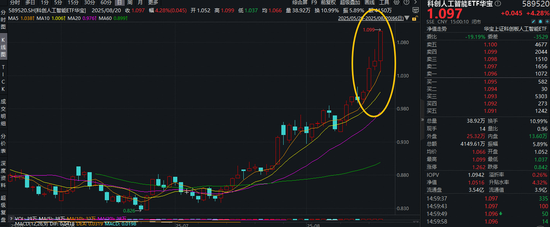
Core Viewpoint - The domestic AI industry chain is experiencing an independent rally despite the decline of major US tech stocks, with significant gains in stocks like Cambricon and Corechip [1][3]. Group 1: Market Performance - Cambricon's stock price surpassed 1,000 yuan, making it the second "thousand-yuan stock" in A-shares, with a net inflow of 2.234 billion yuan from main funds [1]. - The Sci-Tech Innovation Artificial Intelligence ETF (589520) reached a maximum price increase of 4.47%, closing up 4.28%, marking four consecutive days of gains and setting a new high since its listing [1]. - The index of the Sci-Tech Innovation Artificial Intelligence ETF has risen 43.45% since its low point on April 8, significantly outperforming other indices like the Sci-Tech 50 (24.24%) and the Sci-Tech Composite Index (41.38%) [3][4]. Group 2: Investment Logic - Market leaders often initiate a second wave of growth after completing an adjustment phase, and AI has met the conditions for a renewed mainline focus due to low crowding and ongoing long-term logic [5]. - The integration of AI with various industries is emphasized at the national level, indicating that AI is a crucial driver for economic transformation, with expectations for a rebound in the Sci-Tech board [6]. - Concerns over security vulnerabilities are leading domestic clients to reconsider purchasing NVIDIA chips, suggesting a potential shift towards domestic chip manufacturers like Huawei and Cambricon [7]. - The evolution of edge AI from auxiliary tools to autonomous intelligent entities is anticipated to create a trillion-dollar market, with significant developments expected in 2025 [8]. - The AI industry is projected to grow significantly, with the core industry size in China expected to increase from 18 billion yuan in 2017 to 600 billion yuan by 2024, and potentially surpassing 1 trillion yuan by 2030 [9]. - The semiconductor industry is in an upward cycle, driven by strong AI demand and the acceleration of domestic chip manufacturing, with expectations for significant benefits for Chinese semiconductor firms [10].

毛利率超特斯拉,小鹏学会了赚钱|钛度车库
Tai Mei Ti A P P· 2025-08-21 02:45
Core Insights - In the first half of 2025, the company reported a revenue of 34.08 billion yuan, doubling year-on-year, with a gross margin of 17.3%, surpassing Tesla in the second quarter [2][5] - The delivery volume reached 197,000 units, exceeding the total for the previous year, while net losses narrowed to 1.14 billion yuan, indicating a potential path to profitability [2][6] - The chairman expressed confidence that the fourth quarter will mark a new phase of self-sustaining profitability [2] Revenue and Delivery Performance - The surge in delivery volume was primarily driven by two high-volume models, MONA M03 and P7+, with P7+ accounting for over 20% of sales in the first half of 2025 [3] - The average selling price per vehicle dropped to 153,000 yuan in Q1 but rebounded to 164,000 yuan in Q2 due to the introduction of higher-margin models [3][5] Gross Margin and Cost Management - The overall gross margin of 17.3% represents an increase for eight consecutive quarters, slightly ahead of Tesla [5] - The company invested 4.19 billion yuan in R&D, a 48.6% increase year-on-year, focusing on core technologies such as AI and autonomous driving [5][6] Financial Health and Future Outlook - Cash reserves increased to 47.57 billion yuan, providing strategic flexibility amid industry pressures [6] - The company expects to deliver between 113,000 and 118,000 units in Q3, with a monthly delivery rate exceeding 40,000 units starting in September [6] Market Position and Competitive Landscape - Despite the positive financial indicators, challenges remain, including a low sales proportion of SUV models and slow overseas market penetration, with only 18,000 units delivered globally in the first half of 2025 [7] - The competitive landscape is intensifying, with rivals like Xiaomi and Zeekr also aiming for profitability, necessitating a focus on operational efficiency and cost control [7] Strategic Transformation - The company has shifted from a "technology romanticism" approach to a more pragmatic focus on operational capabilities, supply chain management, and sales channels [7] - The first half of 2025 marks a significant transformation for the company, transitioning from a technology-centric narrative to one of efficient manufacturing and cost control [7]

百度集团绩后跌超2%,机构称AI搜索改造加速,建议关注自动驾驶进展
Mei Ri Jing Ji Xin Wen· 2025-08-21 02:27
Group 1 - The core viewpoint of the articles highlights the mixed performance of the Hong Kong stock market, with the Hang Seng Index opening up by 0.2% while the Hang Seng Tech Index slightly declined by 0.03% [1] - Baidu Group reported its Q2 2025 earnings, showing total revenue of 32.7 billion yuan and a net profit of 7.3 billion yuan, reflecting a year-on-year increase of 33% [1] - The adjusted net profit for Baidu was 4.8 billion yuan, which represents a year-on-year decrease of 35% [1] Group 2 - The AI new business revenue for Baidu exceeded 10 billion yuan for the first time, with a year-on-year growth of 34% [1] - Huatai Securities noted that Baidu's total revenue of 32.7 billion yuan in Q2 2025 was better than the consensus estimate of -4.8%, primarily due to rapid growth in AI cloud revenue [1] - The Hang Seng Tech Index ETF (513180) includes 30 leading tech stocks in Hong Kong, focusing on the AI industry chain, with companies like Alibaba, Tencent, Xiaomi, Meituan, SMIC, and BYD being potential "seven giants" of Chinese tech [2]

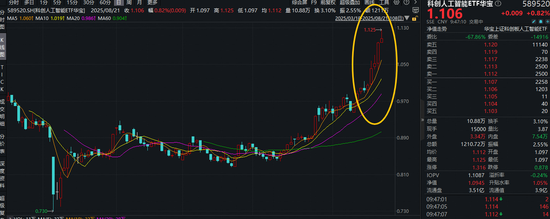
科创板迎来补涨行情?科创人工智能ETF(589520)强势拉升2.5%,冲击日线5连阳,继续刷新上市新高!
Xin Lang Ji Jin· 2025-08-21 02:16
Core Viewpoint - The domestic AI industry chain is experiencing significant growth, with the Sci-Tech Innovation Board Artificial Intelligence ETF (589520) leading the market, reflecting strong investor interest and potential for further gains [1][3]. Group 1: Market Performance - The Sci-Tech Innovation Board Artificial Intelligence ETF (589520) has seen a cumulative increase of 43.45% since its low point on April 8, significantly outperforming other indices such as the Sci-Tech 50 (24.24%) and the Sci-Tech Composite Index (41.38%) [3][4]. - Key constituent stocks of the ETF, including Chipone Technology and Cambricon Technologies, have shown substantial gains, with Chipone rising over 5% and others like Qihoo 360 and Yuntian Lifei increasing by over 4% [1]. Group 2: Investment Logic - Market leaders suggest that AI is set to remain a core investment theme in the second half of 2025, driven by ongoing advancements in large model technologies and the practical application of AI in various sectors [5]. - The government is emphasizing the integration of AI with industries such as manufacturing, finance, and healthcare, positioning AI as a crucial element for economic transformation [6]. - There is a growing trend towards domestic alternatives in AI chip production, with companies like Huawei and Cambrian Technology gaining attention amid concerns over foreign chip security [7][8]. Group 3: Technological Advancements - The emergence of edge AI applications is transforming AI from a mere tool to a productive force, with significant market potential in sectors like humanoid robotics and smart driving expected to materialize by 2025 [9]. - The AI industry in China is projected to grow from 180 billion yuan to 600 billion yuan between 2017 and 2024, with expectations to exceed 1 trillion yuan by 2030 [10]. Group 4: Semiconductor Industry Outlook - The semiconductor industry is entering an upward cycle, driven by AI demand and domestic chip production, with expectations for significant growth in the sector [11]. - The focus on domestic chip manufacturing is seen as a strategic move to enhance self-sufficiency and capitalize on the evolving AI landscape [12].
Counterpoint Research:上半年印度智能手机出口量达4000万部 同比增长30%
智通财经网· 2025-08-21 01:32
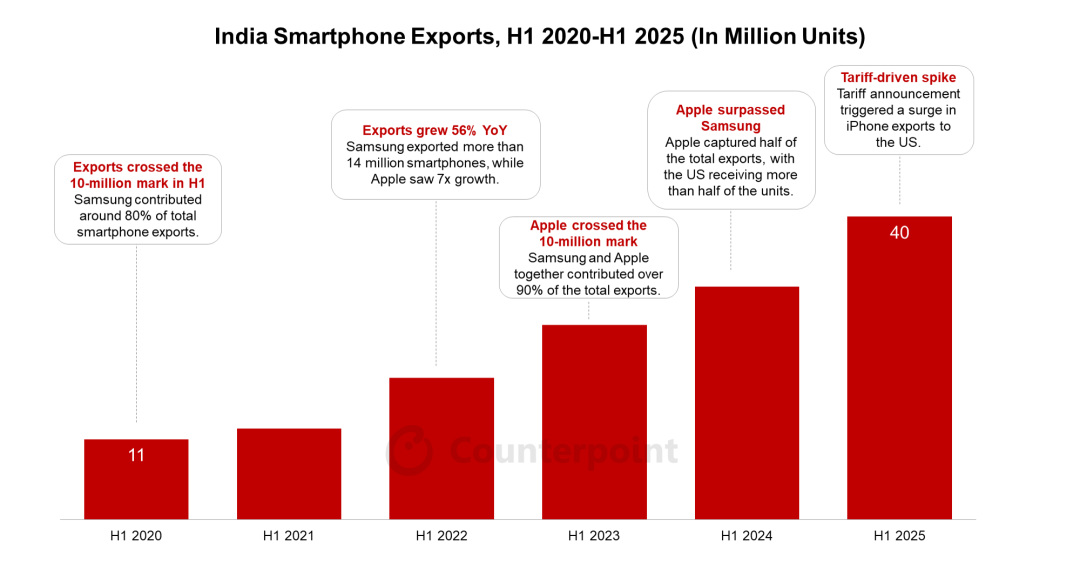
Core Insights - India's smartphone exports are projected to grow by 30% year-on-year in the first half of 2025, reaching 40 million units, highlighting the ongoing development of India's electronic manufacturing ecosystem and its strategic importance in the global supply chain [1] - Nearly 99% of smartphones sold in India are locally produced, reflecting the country's efforts to build a robust domestic manufacturing base supported by government initiatives like the Production-Linked Incentive (PLI) scheme [1] Export Destinations - The United States remains the primary destination for Indian smartphone exports, accounting for 54% of total shipments in the first half of 2025, up from 30% in the same period of 2024, with Apple exports making up over 75% of this volume [4] - Exports to Europe have decreased by 25%, with its share dropping from 47% in the first half of 2024 to 27% in 2025, primarily due to Apple shifting significant shipments to the U.S. to build inventory [4] Brand Performance - Apple's export volume increased by 53%, surpassing 20 million units for the first time in the first half of 2025, driven by enhanced manufacturing capabilities in India and supportive government policies [4] - Samsung's smartphone exports saw a slight increase of 1%, with over 60% directed to Western European markets, while exports to the U.S. surged by 268% [5] - Motorola experienced the fastest growth among brands, with a sevenfold increase in exports, primarily to the U.S., capturing market opportunities due to competitors' lack of new product iterations [5] Future Outlook - The smartphone export sector in India is expected to continue growing, bolstered by the expansion of major brands and government support through initiatives like the PLI scheme [6] - Recent U.S. tariff announcements on Indian goods, with rates potentially reaching 50%, introduce uncertainty into future supply chain dynamics, necessitating flexibility from manufacturers to adapt to changing trade policies [6]

字节辟谣与芯原股份联手设计AI芯片;OpenAI考虑上市;宇树科技预告新款人形机器人
Guan Cha Zhe Wang· 2025-08-21 00:57
Group 1 - ByteDance denies collaboration with Chip Original on AI chip development [1] - Google announces the launch of Pixel 10 series with AI-driven features, starting at $799 [1] - OpenAI's revenue surpasses $1 billion for the first time, considering an IPO in the future [3] Group 2 - Intel's market value increases by $24 billion, reaching the highest valuation since the dot-com bubble [4] - Yushutech announces a new humanoid robot with 31 degrees of freedom [4] - Baidu's fund invests in Jianzhixin Robot Technology, increasing registered capital [5] Group 3 - Xiaomi's Hanting Venture invests in Weitai Robot, increasing registered capital [6][7] - Huawei unveils its first MateTV, featuring HarmonyOS 5 and advanced touch technology [8] - Geely responds to complaints regarding changes to lifetime free data rights for vehicle owners [9] Group 4 - Sony raises the price of all PlayStation 5 models in the U.S. by $50 due to economic challenges and import tariffs [10]



四大证券报精华摘要:8月21日
Zhong Guo Jin Rong Xin Xi Wang· 2025-08-20 23:48
Group 1: Financial Regulations and Market Trends - The Financial Regulatory Bureau proposed to increase the upper limit of merger loan ratios and extend loan terms to better meet corporate financing needs, with controlled merger loans not exceeding 70% of transaction value and equity funds not less than 30% [1] - As of August 18, 17 large private equity firms held 33 stocks with a total market value of 22.55 billion yuan, with over 42% of these stocks in the electronic, computer, and pharmaceutical sectors, indicating a focus on growth and recovery [1] Group 2: Apple Supply Chain and Market Impact - Institutions have been intensively researching over 30 companies in the Apple supply chain, anticipating benefits as the iPhone 17 enters mass production [2] Group 3: A-Share Market Performance - The A-share market has shown strong momentum, with the Shanghai Composite Index reaching a ten-year high, driven by core assets and a focus on high-quality growth stocks [3] - The Social Security Fund has emerged as a major shareholder in 116 listed companies, with 25 new entries in the top ten circulating shareholders, primarily in high-end manufacturing and pharmaceutical sectors [3] Group 4: Heng Rui Pharmaceutical Performance - Heng Rui Pharmaceutical reported a revenue of 15.76 billion yuan and a net profit of 4.45 billion yuan for the first half of 2025, marking a year-on-year increase of 15.88% and 29.67% respectively, driven by innovative drug sales [4] Group 5: Automotive Industry Trends - Domestic car manufacturers are accelerating new car launches, with an average of 3.2 new models introduced daily, reflecting a trend towards "fast consumerization" in the automotive sector [5] Group 6: ETF Market Activity - Following the Shanghai Composite Index surpassing 3700 points, there has been a notable increase in ETF inflows, with 644 out of approximately 1100 ETFs seeing growth in scale, totaling nearly 33.6 billion yuan [6] Group 7: Tungsten Market Dynamics - Tungsten concentrate prices have surged, with a 51.75% increase since the beginning of the year, driven by tightening supply and emerging demand [7] Group 8: Dividend Asset Appeal - The appeal of dividend assets has risen, with 87.5% of 256 dividend indices showing gains this year, and significant inflows into dividend-related ETFs, indicating strong market interest [8] Group 9: Property Management Sector Recovery - Property management companies are showing improved profitability and diversified value-added services, indicating a shift towards independent development [9] - The solid-state battery industry is gaining attention as companies enter the pilot testing phase, which is crucial for accelerating industrialization [9]

财信证券晨会纪要-20250821
Caixin Securities· 2025-08-20 23:31
Market Overview - The Shanghai Composite Index closed at 3766.21, up 1.04%, while the Shenzhen Component Index rose by 0.89% to 11926.74 [1] - The ChiNext Index increased by 0.23% to 2607.65, and the STAR 50 Index saw a significant rise of 3.23% to 1148.15 [1] - The overall market showed a recovery trend with the total trading volume reaching 24,484.14 billion, a decrease of 1,922.65 billion from the previous trading day [7] Economic Insights - The LPR remained stable in August, with the 1-year rate at 3.0% and the 5-year rate at 3.5% [15][16] - The central bank conducted a 7-day reverse repurchase operation of 616 billion, injecting liquidity into the market [17][18] - China's imports and exports to other member countries of the Shanghai Cooperation Organization increased by 3% year-on-year in the first seven months, reaching 2.11 trillion [22][23] Industry Dynamics - Xiaomi's subsidiary, Hanxing Chuangtou, invested in Weitai Robotics, indicating a growing interest in the robotics sector [26] - Beijing aims to become a global benchmark city for robot applications, with the humanoid robot industry accounting for about one-third of the national market [28] - The railway procurement platform announced the second batch of tenders for the Fuxing high-speed trains for 2025, including 108 sets of standard trains and 30 sets of cold-resistant trains [30] - A meeting on the photovoltaic industry emphasized the need for market regulation and the elimination of low-price competition, as production in several segments saw significant declines [32] Company Updates - Huadong Medicine reported a net profit of 1.815 billion for H1 2025, a year-on-year increase of 7.01%, with total revenue reaching 21.675 billion [35][36] - Kolyuan achieved a net profit of 51 million in H1 2025, a remarkable increase of 187.23% year-on-year, driven by growth in HEV battery and energy storage sectors [44][45] - Yanghe Co. experienced a decline in revenue and net profit for H1 2025, with figures of 14.796 billion and 4.344 billion respectively, reflecting a decrease of 35.32% and 45.34% year-on-year [39][40]
手机承压、空调激战、汽车交付爬坡!小米Q2财报上演攻坚战,创新业务盈利尚需时间
Hua Xia Shi Bao· 2025-08-20 14:28
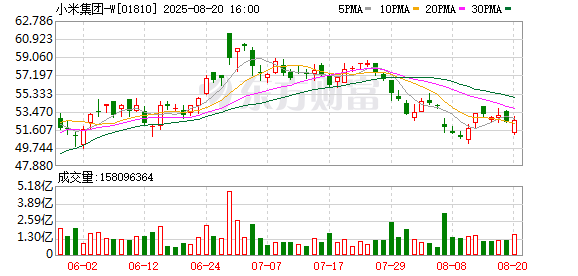
Core Insights - Xiaomi's Q2 financial report shows a revenue of 116 billion yuan, a year-on-year increase of 30.5%, and an adjusted net profit of 10.8 billion yuan, up 75.4% year-on-year [2] - Despite strong revenue growth, Xiaomi faces intense competition across its smartphone, home appliance, and automotive sectors [2] Smartphone Business - In Q2, smartphone revenue was 45.5 billion yuan, accounting for nearly 40% of total revenue, down from 52.3% in the same period last year [4] - Global smartphone shipments reached 42.4 million units, a slight increase of 0.6% year-on-year, but revenue decreased by 2.1% compared to the previous year [4] - The average selling price (ASP) of Xiaomi smartphones fell to 1,073.2 yuan, down 2.7% year-on-year and 11.3% quarter-on-quarter, primarily due to the launch of the REDMI A5 series [4][5] Home Appliances - Xiaomi's smart home appliance revenue grew by 66.2% year-on-year in Q2, with air conditioner shipments exceeding 5.4 million units [7] - The company aims to rank among the top three in the air conditioning market by 2030, despite facing fierce competition [7][8] - The average selling price of home appliances increased by approximately 10% in Q2, indicating resilience amid a price war in the industry [8] Automotive Sector - Revenue from Xiaomi's electric vehicle and AI innovation segment reached 21.3 billion yuan in Q2, with a gross margin of 26.4% [9] - The company launched its first SUV, the Xiaomi YU7 series, which received over 240,000 orders within 18 hours of its release [9] - Delivery times for the YU7 series are lengthy, with customers facing waits of up to 58 weeks, highlighting a significant challenge in the automotive sector [9][10] Financial Performance - The new energy vehicle segment recorded an operating loss of 300 million yuan in Q2, an improvement from a loss of 500 million yuan in Q1 [10] - Cumulatively, Xiaomi has invested over 30 billion yuan in new business initiatives since 2022, with significant losses expected to continue in the near term [11]
未验车先交几十万 小米被曝催收尾款:否则取消订单定金作废 车主炸锅:又不是买白菜
2 1 Shi Ji Jing Ji Bao Dao· 2025-08-20 13:33
Core Viewpoint - Xiaomi is facing backlash from car owners due to aggressive demands for payment of remaining balances before vehicle delivery, leading to a decline in customer trust and potential reputational damage [3][17][24]. Group 1: Customer Experience and Reactions - Multiple car owners reported being pressured to pay the remaining balance within seven days, despite the vehicles not being delivered yet, causing frustration and anger among customers [3][21]. - Affected customers expressed feelings of betrayal, stating that they were treated like "scalpers" despite being loyal fans of the brand [23][24]. - The situation has led to a significant decline in customer trust, with some long-time fans expressing disappointment and considering leaving the brand [24][28]. Group 2: Company Policies and Justifications - Xiaomi has implemented a policy requiring early payment in two specific scenarios: when a customer wishes to delay delivery or when there is a perceived high likelihood of the customer not picking up the vehicle [7][10]. - The company claims that these measures are necessary to prevent order cancellations and to manage production schedules effectively [7][10][25]. - Legal experts suggest that while Xiaomi's policies may be legally defensible, they could still face challenges regarding customer rights and obligations under consumer protection laws [9][24]. Group 3: Market Position and Competition - Despite the controversies, Xiaomi's vehicle delivery numbers have been impressive, with 311,700 units delivered within 15 months, significantly faster than competitors like NIO [3][25]. - However, the company is now facing increased competition from other brands, which may capitalize on Xiaomi's current challenges and customer dissatisfaction [25][28]. - The need for expanded production capacity is urgent, as delays in delivery could lead to further customer attrition and loss of market share [25][27].