
华锡有色

Search documents
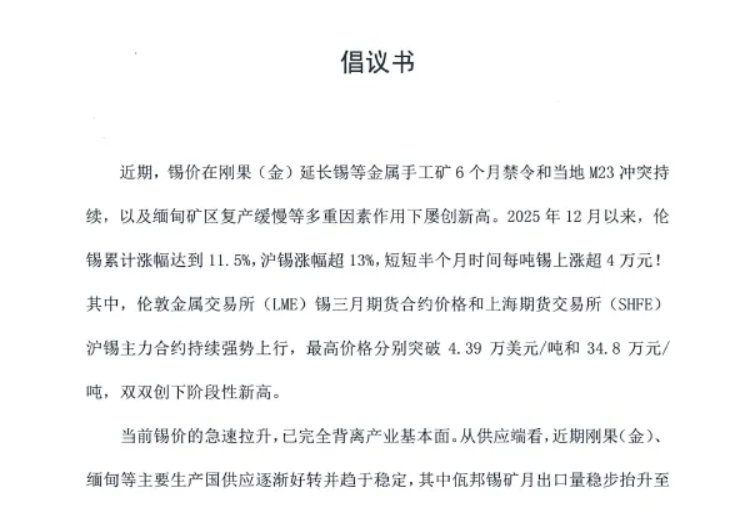
“算力金属”伦锡月涨超过11% 行业协会发文倡议理性谨慎
2 1 Shi Ji Jing Ji Bao Dao· 2025-12-24 23:10
Core Viewpoint - The recent surge in tin prices is driven by multiple factors, including supply disruptions in major producing countries and increased demand from emerging sectors, leading to significant pressure on downstream industries [1][4]. Group 1: Price Movements - Since December 2025, tin prices have increased significantly, with LME tin rising by 11.5% and SHFE tin by over 13%, translating to an increase of more than 40,000 yuan per ton in just half a month [2]. - LME three-month tin futures and SHFE main contracts have reached record highs, surpassing $43,900 per ton and 348,000 yuan per ton, respectively [3][4]. - The price increase has been more pronounced in tin compared to other industrial metals, with the best-performing copper only rising by less than 7% during the same period [2]. Group 2: Supply and Demand Dynamics - Supply from major producing countries like the Democratic Republic of Congo and Myanmar is stabilizing, with domestic tin smelting capacity fully released, resulting in a production of 189,000 tons from January to November, a 6.2% year-on-year increase [4]. - Despite growth in demand from sectors like photovoltaics and automotive electronics, traditional sectors show stable demand, with global tin consumption expected to grow by nearly 3% in 2025, lagging behind production growth [4]. - The global tin market is currently experiencing a supply surplus of approximately 10,000 tons, attributed to a slowdown in overseas demand [4]. Group 3: Industry Challenges - The rapid price increase has created significant pressure on downstream industries, particularly for small and medium-sized enterprises in sectors like solder, tinplate, and chemicals, leading to difficulties in fulfilling long-term contracts and maintaining product quality [2][8]. - The electronic manufacturing sector, a major consumer of tin-based solder, faces acute cost pressures due to soaring tin prices, impacting profit margins in PCB manufacturing and semiconductor packaging [8]. - The Tin Industry Association has called for a rational and cautious approach from all market participants to avoid speculative behavior and to guide prices back to a reasonable range [8].


PCB上游材料+设备观点汇报
2025-12-24 12:57
Summary of Key Points from the Conference Call Industry Overview - The conference call focuses on the PCB upstream materials and equipment industry, highlighting significant developments and market dynamics in this sector [1][2]. Core Insights and Arguments - **Interconnect Solutions**: The interconnect solution for the epoxy backplane has been confirmed, with no actual impact from the previously pessimistic expectations regarding the PTFE solution, which is unlikely to be implemented in the short term [1][2]. - **Testing Cycles**: The testing cycle for important backplanes is two months, with new sample results expected in January to February 2026. The 78-layer Ma Jiu Jia Q fabric solution is anticipated to be finalized [2][3]. - **Material Testing**: Companies like Switch Tree and MetaPlan are testing various material solutions, including Ma Ba Ma Jiu Jia second-generation fabric and Q fabric, with results expected in early 2026 [3][4]. - **Market Sentiment**: The PCB upstream materials market has shown signs of recovery, with previous negative expectations being replaced by positive information, particularly regarding the epoxy backplane [2]. Competitive Landscape - **Copper Foil and Resin**: The industry is primarily focused on copper foil and resin segments. All Ruby series boards will adopt HVLP4 copper foil in 2026, with APEC offering both third and fourth-generation copper options [5][6]. - **Domestic vs. Foreign Suppliers**: While foreign manufacturers currently dominate the fiberglass cloth and resin markets, domestic companies like Dongcai are rapidly emerging, achieving significant market share and establishing supply chains with major clients [5][6]. - **Market Opportunities**: There is substantial market space for domestic manufacturers to increase their share in resin, fiberglass cloth, and copper foil sectors, especially as foreign companies face challenges due to high costs and low production efficiency [6]. Company-Specific Developments - **Capacity Expansion**: The company is positioned to become one of the largest suppliers globally following the full implementation of its projects, with a relatively low valuation and significant growth potential [7]. - **Future Prospects of Feidu Hua**: Feidu Hua is expected to make significant progress in 2026, with a mature integrated production system and potential to become a global leader in the market [8]. - **Ma Jiu Jia Q Fabric Impact**: The upgrade trend in the Ma Jiu Jia industry is confirmed, with 2026 marking a pivotal year for increased production, benefiting companies like Ding Tai and Zhong Wu due to increased drill needle consumption [9][10]. - **Light Optoelectronics' Positioning**: Light Optoelectronics has recently recruited key members from a Japanese team and is building technical resources related to Q fabric, indicating potential future advancements [11]. Additional Important Insights - **AI Industry Opportunities**: Companies such as Dongcai, Feidu Hua, and Ding Tai are expected to leverage opportunities in the AI industry to accelerate their growth and become significant players in the PCB upstream materials or consumables sector [11].
“算力金属”伦锡月涨超过11%,行业协会发文倡议保持理性谨慎
2 1 Shi Ji Jing Ji Bao Dao· 2025-12-23 11:12
Core Viewpoint - The recent surge in tin prices, driven by supply constraints and geopolitical factors, has raised concerns within the industry, particularly affecting downstream companies that rely on tin for production [1][7]. Group 1: Price Trends and Market Dynamics - Tin prices have reached new highs, with LME tin increasing by 11.5% and SHFE tin by over 13% since December 2025, with a rise of over 40,000 yuan per ton in just half a month [3][5]. - The price of LME three-month tin futures and SHFE main contracts have both surpassed significant thresholds, reaching 43,900 USD per ton and 348,000 yuan per ton, respectively [5]. - The tin industry is experiencing a supply surplus of approximately 10,000 tons, with the recent price increase attributed more to market sentiment and capital flows rather than fundamental supply-demand dynamics [7]. Group 2: Supply and Demand Factors - Supply from major producing countries like the Democratic Republic of Congo and Myanmar is stabilizing, with domestic tin smelting capacity also being fully utilized, resulting in a production increase of 6.2% year-on-year [6]. - Despite growth in emerging sectors such as photovoltaics and automotive electronics, traditional demand remains stable, with global tin consumption expected to grow by nearly 3% in 2025, slightly below production growth [6]. Group 3: Impact on Industry Players - The rapid price increase has created significant pressure on downstream tin-consuming industries, such as solder, tinplate, and chemicals, leading to challenges in fulfilling long-term contracts and maintaining product quality [4][21]. - Companies like Yunnan Tin Company (000960), Huaxi Nonferrous Metals (600301), and Xingye Silver Tin (000426) are positioned differently within the market, with varying degrees of exposure to price fluctuations and potential earnings volatility [13]. - As of December 23, 2025, the stock prices of these companies have reflected the anticipated earnings growth due to rising tin prices, with annual increases of 103%, 127%, and 218% respectively [19]. Group 4: Industry Recommendations - The tin industry association has called for a rational and cautious approach from all market participants to avoid speculative behavior and to guide prices back to a reasonable range, emphasizing the need for a stable market mechanism [21].

华锡有色股价跌5.13%,汇添富基金旗下1只基金重仓,持有13.94万股浮亏损失28.86万元
Xin Lang Cai Jing· 2025-12-23 05:40
Group 1 - The core point of the news is that Guangxi Huaxi Nonferrous Metals Co., Ltd. experienced a decline in stock price by 5.13%, trading at 38.31 yuan per share, with a total market capitalization of 24.234 billion yuan [1] - The company was established on June 15, 1998, and listed on July 12, 2000, primarily engaged in the exploration, mining, and processing of nonferrous metals such as tin, zinc, lead, and antimony [1] - The main revenue composition of the company includes 91.82% from nonferrous metal products, 4.61% from deep processing of nonferrous metals, 2.43% from engineering supervision and other services, 0.89% from other supplementary services, and 0.25% from surveying, design, and consulting services [1] Group 2 - From the perspective of fund holdings, Huaxi Nonferrous is a significant investment for the Huatai-PineBridge Fund, with the Huatai-PineBridge Multi-Asset Income Fund holding 139,400 shares, representing 1.88% of the fund's net value [2] - The fund has incurred an estimated floating loss of approximately 288,600 yuan due to the decline in Huaxi Nonferrous's stock price [2] - The Huatai-PineBridge Multi-Asset Income Fund was established on June 16, 2023, with a current scale of 90.6592 million yuan, and has achieved a year-to-date return of 5.01% [2]
锡价狂飙引爆三年半新高!多重利好共振推升,短期强势中藏隐忧?
Xin Lang Cai Jing· 2025-12-22 04:58
Group 1: Price Trends - As of December 22, 2025, the spot price of tin in the Changjiang market is 341,000 yuan/ton, an increase of 3,500 yuan/ton from the previous day, continuing a recent rebound trend [1] - The current tin price is at a historically high level, with strong upward momentum expected to persist in the short term [1] Group 2: Factors Driving Price Increase - The recent price increase is attributed to a combination of supply constraints, macroeconomic shifts, and emerging demand [1] - Supply-side factors include a persistent tightness in raw materials, with significant disruptions in key production areas like Myanmar and Indonesia, leading to a sharp decline in tin ore imports to China [1] - Global visible inventories are at historically low levels, with LME tin stocks hovering near a ten-year low, providing solid support for spot prices [1] Group 3: Macroeconomic Environment - Global liquidity expectations are easing, with major central banks, including the Federal Reserve, entering a rate-cutting phase, which enhances the attractiveness of metals for investment [1] - Geopolitical risks, particularly conflicts in the Democratic Republic of Congo and Southeast Asia, are injecting additional supply risk premiums into the tin market [1] Group 4: Demand Dynamics - Despite a lackluster performance in traditional consumer electronics, emerging sectors such as AI, data centers, and high-end computing are experiencing explosive growth, driving demand for high-end solder [2] - The green industries, including photovoltaic solder strips and electric vehicle electronics, are also showing robust demand, becoming new growth drivers for tin consumption [2] Group 5: Industry Impact - The current high price environment is significantly altering the profit distribution within the industry, with upstream resource holders benefiting the most from price surges [2] - Midstream smelting companies are facing a divided situation, with smaller firms struggling due to intense competition for raw materials and low processing fees [2] Group 6: Short-term Price Outlook - In the short term (1-2 weeks), tin prices are expected to maintain a strong upward trend, with a core operating range projected between 340,000 and 349,000 yuan/ton, and a key resistance level at 350,000 yuan/ton [3] - Upward risks are primarily from unexpected supply disruptions or stronger-than-expected macroeconomic easing, while downward risks include demand suppression due to high prices and potential recovery of Myanmar's supply in early 2026 [3]

华锡有色涨2.05%,成交额1.94亿元,主力资金净流出596.90万元
Xin Lang Cai Jing· 2025-12-22 04:01
Group 1 - The core viewpoint of the news is that Guangxi Huaxi Nonferrous Metals Co., Ltd. has shown significant stock price growth and trading activity, with a year-to-date increase of 145.50% and a recent trading volume of 1.94 billion yuan [1][2] - As of December 22, the stock price reached 41.76 yuan per share, with a market capitalization of 26.416 billion yuan [1] - The company has experienced a net outflow of main funds amounting to 5.969 million yuan, while large orders showed mixed buying and selling activity [1] Group 2 - Guangxi Huaxi Nonferrous Metals Co., Ltd. was established on June 15, 1998, and listed on July 12, 2000, with its main business involving the exploration, mining, and processing of nonferrous metals such as tin, zinc, lead, and antimony [2] - The revenue composition of the company includes 91.82% from nonferrous metal products, 4.61% from deep processing of nonferrous metals, and 2.43% from engineering supervision and other services [2] - As of September 30, the company reported a revenue of 4.138 billion yuan for the first nine months of 2025, reflecting a year-on-year growth of 21.16%, while the net profit attributable to shareholders decreased by 8.54% to 494 million yuan [2] Group 3 - The company has distributed a total of 350 million yuan in dividends since its A-share listing, with no dividends paid in the last three years [3] - As of September 30, 2025, the top ten circulating shareholders include new entrants such as Yongying Ruixin Mixed A and Yongying Steady Enhanced Bond A, indicating changes in institutional holdings [3] - Hong Kong Central Clearing Limited increased its holdings by 2.489 million shares, while some funds exited the top ten circulating shareholders list [3]
宏观风险逐步落地,看好后续金属行情 | 投研报告
Zhong Guo Neng Yuan Wang· 2025-12-22 02:03
Group 1: Market Overview - The price of praseodymium and neodymium oxide decreased by 0.88% this week, with expectations of a 20-25% reduction in monthly output due to stricter environmental inspections in December [5] - LME copper price increased by 2.75% to $11,870.5 per ton, while domestic copper price decreased by 0.96% to ¥93,200 per ton [2] - LME aluminum price rose by 2.80% to $2,955.50 per ton, and domestic aluminum price increased slightly by 0.07% to ¥22,200 per ton [3] - COMEX gold price increased by 0.79% to $4,368.7 per ounce, influenced by geopolitical risks [4] Group 2: Supply and Demand Dynamics - Domestic copper inventory saw a slight increase of 0.79% week-on-week, with expectations of reduced imports and stable domestic supply [2] - Domestic aluminum production capacity remains high, with an operating rate of 79.85%, but inventory pressures are evident as production continues to accumulate [3] - The supply of antimony is expected to decline due to reduced overseas production, while demand remains stable, indicating a potential upward trend in global antimony prices [5] - Lithium carbonate price increased by 3.66% to ¥96,700 per ton, while hydroxide lithium price decreased by 0.25% to ¥87,000 per ton [6] Group 3: Export and Future Outlook - China's magnetic material exports in October increased by 16% year-on-year but decreased by 5% month-on-month, with a more optimistic outlook for future demand due to expected easing in export restrictions [5] - The overall sentiment in the aluminum processing sector remains weak, with a decrease in operating rates among major processing enterprises [3] - The market for tin is expected to remain strong due to low inventory levels and supply disruptions in key overseas mining regions [5]
工业金属的三连击
2025-12-22 01:45
Summary of Key Points from Conference Call Records Industry Overview - **Metals Sector Performance**: The metals sector has shown strong performance recently, both in commodities and stocks, supported by lower-than-expected inflation data and expectations of interest rate cuts by the Federal Reserve in 2026 [2][21]. - **Liquidity Expectations**: Enhanced liquidity expectations due to central bank gold purchases and rising ETF holdings are supporting gold prices, with a favorable outlook for precious metals like silver, platinum, and palladium [1][4]. Precious Metals - **Silver Price Surge**: Silver prices have surpassed $66 due to inventory disruptions, positively impacting gold, platinum, and palladium prices [3][10]. - **Market Dynamics**: The European Central Bank's decision to maintain interest rates and Japan's recent rate hike have contributed to price increases in tungsten, which is crucial for military and aerospace applications [3][13]. Industrial Metals - **Copper and Tin Outlook**: Copper prices are expected to remain strong due to macroeconomic factors and seasonal influences, with a tightening supply situation anticipated in the long term. Tin prices are also projected to rise despite current pressures from high prices and increased inventories [12][16]. - **Steel Industry Positioning**: Leading companies in the steel sector are well-positioned for a potential upward trend, with high potential for stock investments as the industry enters a strategic layout phase [6][20]. Energy Metals - **Lithium Market Dynamics**: Lithium prices are influenced by supply disruptions, particularly from key mines in Jiangxi. If production resumes quickly, prices may decline; otherwise, they could remain elevated due to inventory pressures [5][11]. - **Nickel and Cobalt Trends**: Nickel prices are under pressure from anticipated policy changes in Indonesia, while cobalt prices remain strong due to robust downstream demand and supply disruptions [8][9]. Rare Earths - **Price Trends**: The rare earth market is experiencing a decline in prices, particularly in medium and heavy rare earths, due to seasonal demand drops. However, long-term demand from emerging industries like electric vehicles is expected to support price increases [16][18]. - **Supply Constraints**: Domestic quotas for rare earth mining and separation are expected to grow at a slower pace, indicating tighter supply in the future [17]. Recommendations - **Investment Opportunities**: Recommended stocks include Zijin Mining, Jiangxi Copper, and leading steel companies like Baosteel and CITIC Special Steel, which are expected to perform well in the current market environment [12][22]. - **Focus on Strategic Resources**: Emphasis on investing in companies involved in tungsten and rare earths due to their strategic importance and expected demand growth in high-tech applications [13][18]. Conclusion - **Positive Outlook for Metals Sector**: The overall outlook for the metals sector remains optimistic, driven by improving liquidity, demand recovery, and strategic investments in industrial metals, precious metals, and energy metals [21].
南华期货2026年聚酯年度展望:TA仰望星空,EG脚踏实地
Nan Hua Qi Huo· 2025-12-21 12:13
1. Report Industry Investment Rating No relevant content provided. 2. Core Views of the Report - In 2026, the polyester production growth rate is expected to gradually slow down, but the demand growth rate is still estimated to reach around 4.5%, maintaining resilience. The terminal weaving orders have declined comprehensively, and the demand negative feedback will gradually spread upstream. The polyester load is expected to decline from late December, with the monthly average polyester load in January - March estimated at 89%, 84%, and 89.5% respectively. In the off - season, the demand side is difficult to drive prices upward [1]. - For MEG in 2026, the main trend will return to a pattern of oscillating and bottom - grinding. With the successive launch of new production capacities, high - level operation and high valuation are difficult to maintain. After the inventory accumulation expectation, the valuation has been rapidly compressed. Although the static supply - demand balance has improved, the cost side may bring additional negative factors. The over - supply expectation will continue to suppress the valuation to clear marginal production capacities, and the "reversal" may depend on macro - narrative drivers [1][19]. - PTA's production cut since the fourth quarter of 2025 has exceeded market expectations, alleviating the PX - TA structural contradiction. In 2026, there are plans to launch two PX production facilities with a total capacity of 5 million tons, expected to be put into operation after the third quarter, while PTA is not expected to have new capacity launches. In the first half of 2026, PTA's supply is expected to be tight against downstream demand, but the final inventory reduction depends on PTA's production cut intensity. PX's supply - demand pattern is favorable, and it is expected to be prone to rising and difficult to fall. However, before the upward driver appears, there may be a phased correction [2][26]. 3. Summary According to Relevant Catalogs 3.1 Chapter 2: Market Review 3.1.1 MEG Market Review - In Q1 2025, MEG prices dropped significantly due to cost collapse and weakening supply - demand patterns. In January, prices oscillated at a high level; in February, they rebounded slightly and then fell; in March, they were in low - level consolidation [3]. - In Q2 2025, macro and geopolitical factors dominated. The price once hit a low of 3956 yuan/ton and then rebounded. The geopolitical events in June led to price fluctuations [4]. - In Q3 2025, the "anti - involution" sentiment affected prices. The price reached a high of 4580 yuan/ton and then oscillated [4]. - In Q4 2025, MEG's valuation was continuously compressed with inventory accumulation and weak cost, and the price showed an oscillating downward trend [4][5]. 3.1.2 PTA Market Review - In Q1 2025, PTA prices mainly fluctuated with the cost, oscillating between 4700 - 5350 yuan/ton [8]. - In Q2 2025, macro and geopolitical factors dominated. The price once dropped to 4016 yuan/ton and then rebounded [9]. - In Q3 2025, PTA prices oscillated widely between 4500 - 5000 yuan/ton under the influence of cost and macro factors [10]. - In Q4 2025, PTA prices lacked a core driver after a rebound, oscillating narrowly between 4550 - 4800 yuan/ton [11]. 3.2 Chapter 3: Core Focus Points 3.2.1 MEG - In 2026, MEG will be in an oscillating and bottom - grinding pattern. The short - term weak pattern will continue, with port inventory expected to reach over 1.1 million tons in Q1 2026. The demand negative feedback will spread upstream, and the cost side remains weak [19][20]. - The "anti - involution" as a macro - mainline trading focus may repeatedly dominate the commodity market. The risk points for upward rebound mainly include unexpected reduction in large - scale production facilities, macro - policy benefits, and significant cost increase [23]. 3.2.2 PTA - PTA's production cut since Q4 2025 has alleviated the PX - TA structural contradiction. In 2026, PX has new capacity launch plans, while PTA has none. In H1 2026, PTA supply is tight against downstream demand, and PX is expected to be in a favorable supply - demand pattern, prone to rising and difficult to fall [2][26]. - In the near - term, the negative feedback from the terminal will spread upstream, and PX's valuation may correct. In the long - term, PX is expected to maintain an upward - prone pattern, and PTA's processing fee may be further repaired, but the supply - benefit dynamic balance will be the long - term main logic [28][29]. 3.3 Chapter 4: MEG Industry Analysis 3.3.1 MEG Industry Pattern Analysis - China's MEG production capacity has increased rapidly in recent years, changing from supply shortage to over - supply. In 2025, new capacity launches led to inventory accumulation expectations and a decline in valuation [33]. - Currently, the total MEG production capacity in the Chinese mainland is 30.275 million tons, with ethylene - based capacity accounting for 63% and coal - based capacity accounting for 37%. The production efficiency of coal - based MEG has improved, but it is expected to face pressure in 2026 [33][34]. 3.3.2 MEG Supply Analysis - In 2025, China's MEG production increased mainly due to the increase in operating rates. However, after the launch of new capacity in September, the valuation was under pressure, and the production profit of coal - based MEG was compressed in Q4 [36]. - In terms of product switching, some enterprises switched production between EO and EG based on production efficiency. In 2026, under the background of loose supply - demand, the MEG load is expected to decrease year - on - year [37]. - In 2025, the MEG import volume increased year - on - year, and the import source concentration increased. If India's anti - dumping policy is implemented, the global MEG logistics pattern may be reconstructed [48][49]. 3.3.3 MEG Balance Sheet Analysis - In Q1 2026, MEG is expected to have a slight over - supply, with an estimated cumulative over - supply of about 350,000 tons. In Q2, if the maintenance plans are implemented as scheduled and the polyester demand is in the peak season, there may be a supply - demand gap of about 300,000 tons. The annual demand growth rate is estimated at around 4.5% [57]. 3.4 Chapter 5: PTA Valuation Feedback and Supply - Demand Outlook 3.4.1 PX - PTA Industry Pattern Analysis - China's PX production capacity expansion has paused since 2024, while PTA has maintained a high - speed growth trend. The PX supply - demand pattern is relatively tight, while PTA has an over - supply problem, and the clearing of backward production capacities and the increase in exports are the main focuses for improving the supply - demand structure [59]. 3.4.2 PTA Supply Analysis and Valuation Feedback - In 2025, PTA's processing fee showed significant fluctuations. In Q4, due to production cuts, the processing fee was repaired, but in the long - term, it is expected to remain under pressure. In 2026, the supply - benefit dynamic balance is expected to be maintained, and the processing fee's upward space is limited [63][64]. 3.4.3 PTA Export Demand Analysis - In 2025, PTA exports decreased year - on - year, mainly due to the new production capacity in Turkey. The export reduction was partially transferred to other countries [67]. 3.4.4 PTA Balance Sheet Analysis - In 2026, the polyester load is expected to decline seasonally. In Q1, PTA is expected to have a slight over - supply of 100,000 - 150,000 tons, and in Q2, there will be a large supply - demand gap. The actual inventory reduction depends on the restart plans of PTA production facilities [74][75]. 3.5 Chapter 6: Polyester Demand Analysis 3.5.1 Start - up Performance - In 2025, polyester production increased by 7.4% year - on - year, and the production capacity growth rate slowed down. Currently, the terminal orders have declined, and the polyester demand load is expected to decline from late December. In Q1 2026, the polyester load is estimated at 89%, 84%, and 89.5% in January - March respectively [77]. 3.5.2 Macro - demand - In 2025, China's social consumer goods retail sales increased by 4% year - on - year, while textile and clothing consumption maintained a low - speed growth. The export demand was affected by international situations, with the growth rate decreasing in the second half of the year [98][103].
有色金属行业研究:有色金属周报:宏观风险逐步落地,看好后续金属行情-20251221
SINOLINK SECURITIES· 2025-12-21 11:29
Investment Ratings - The report maintains a positive outlook on copper, aluminum, and precious metals, indicating a sustained high level of market activity and potential for price increases [11][30][55]. Core Insights - Copper prices have increased by 2.75% to $11,870.5 per ton on the LME, while domestic prices have slightly decreased. Supply constraints and weak demand are expected to lead to a slight reduction in inventory levels [12]. - Aluminum prices rose by 2.80% to $2,955.50 per ton on the LME, with domestic production remaining stable despite high inventory levels. The market is experiencing a seasonal downturn, but there are signs of recovery [13]. - Gold prices increased by 0.79% to $4,368.7 per ounce, driven by geopolitical risks and market volatility. The SPDR gold holdings have also increased, indicating a positive sentiment towards gold as a safe-haven asset [14]. - The rare earth sector is expected to see upward price movements due to supply constraints and favorable export conditions. Companies like China Rare Earth and Northern Rare Earth are highlighted as potential investment opportunities [31]. - Antimony prices have decreased by 2.37%, but the long-term outlook remains positive due to expected recovery in exports and stable demand [32]. - Tin prices have increased by 1.86%, supported by low inventory levels and strong demand from sectors like semiconductors and photovoltaics [33]. - Lithium prices have risen by 3.66% to 96,700 CNY per ton, with production levels stable and demand from the energy sector remaining strong [56]. - Cobalt prices have shown mixed trends, with a slight increase in some products, but overall market activity is subdued due to seasonal factors [59]. Summary by Sections Copper - LME copper price increased by 2.75% to $11,870.5 per ton, while domestic prices decreased slightly. Supply constraints and weak demand are expected to lead to a slight reduction in inventory levels [12]. - The smelting sector is experiencing a decrease in operational rates, with a forecasted decline in production due to year-end inventory control [12]. Aluminum - LME aluminum price rose by 2.80% to $2,955.50 per ton, with domestic production remaining stable despite high inventory levels. The market is experiencing a seasonal downturn, but there are signs of recovery [13]. - The operating rate of downstream processing enterprises has decreased, indicating a continuation of weak demand [13]. Precious Metals - Gold prices increased by 0.79% to $4,368.7 per ounce, driven by geopolitical risks and market volatility. The SPDR gold holdings have also increased, indicating a positive sentiment towards gold as a safe-haven asset [14]. Rare Earths - The rare earth sector is expected to see upward price movements due to supply constraints and favorable export conditions. Companies like China Rare Earth and Northern Rare Earth are highlighted as potential investment opportunities [31]. Antimony - Antimony prices have decreased by 2.37%, but the long-term outlook remains positive due to expected recovery in exports and stable demand [32]. Tin - Tin prices have increased by 1.86%, supported by low inventory levels and strong demand from sectors like semiconductors and photovoltaics [33]. Lithium - Lithium prices have risen by 3.66% to 96,700 CNY per ton, with production levels stable and demand from the energy sector remaining strong [56]. Cobalt - Cobalt prices have shown mixed trends, with a slight increase in some products, but overall market activity is subdued due to seasonal factors [59].