
鸿海

Search documents
关税“大棒”如何影响市场?从宏观到个股,最全大行解读来了!(附行业&标的)
Sou Hu Cai Jing· 2025-04-04 00:42
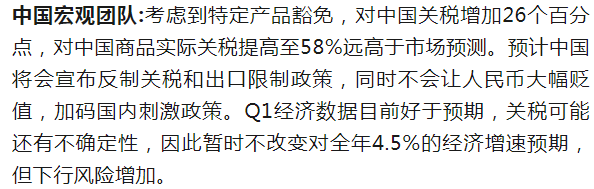
Global Macro - Goldman Sachs reports that the announced tariff rate has a weighted average of 18.3%, with an actual increase of 12.6 percentage points after specific exemptions are deducted, indicating that the overall tariff increase may exceed the previously expected 15 percentage points due to subsequent countermeasures [1] Focus on China - Morgan Stanley highlights that China is one of the countries most impacted by the tariff increases, with effective tariffs rising to 65% following a 34% increase in U.S. tariffs [3][5] - The impact of tariffs on China's economy is expected to be greater than in 2018-2019, with the difficulty of reaching an agreement to lower tariffs being significant [4][5] - The U.S. comprehensive tariffs will also negatively affect global trade, indirectly impacting China [4][5] Industry Impact - JPMorgan assesses that the direct impact of tariffs on Asian companies is relatively small, but certain industries may face indirect effects due to economic slowdown and currency fluctuations [8] - Approximately 14.4% of the Asian region is considered directly affected by U.S. tariffs, primarily driven by the industrial sector, especially export-oriented companies from Taiwan and South Korea [8] - The financial sector, which constitutes 39% of the investment-grade emerging market bond index in Asia, is expected to be less affected by tariffs, providing a buffer for the region [9] Individual Stock Impact - UBS indicates that the recent 34% tariffs on China will likely pressure stock prices until clear stimulus policies are announced, estimating a 3% revenue reduction for MSCI China constituents and a potential 1-2% profit decrease due to tariffs [11][15] - The sectors most at risk from potential profit impacts include machinery, petrochemicals, sportswear OEM, biotech, and tech hardware [15] - A list of companies with significant U.S. revenue exposure has been compiled, with many facing earnings impacts due to the tariffs [12][13]

国海证券晨会纪要-2025-03-31
Guohai Securities· 2025-03-31 01:39
Group 1: Key Insights from Reports - The report highlights that overseas growth remains strong, driven by both IP and product categories, with Pop Mart achieving a revenue of 13.04 billion RMB in 2024, a year-on-year increase of 106.9% [4][5] - The adjusted net profit for Pop Mart reached 3.4 billion RMB in 2024, reflecting a year-on-year growth of 185.9% [5][6] - The company plans to distribute a final dividend of 0.8146 RMB per share, totaling 1.094 billion RMB, which represents 35% of the net profit [6] Group 2: Company Performance and Growth - Xingtong Co. reported a revenue of 1.515 billion RMB in 2024, up 22% year-on-year, with a net profit of 350 million RMB, marking a 39% increase [12][13] - China Foreign Transport achieved a revenue of 105.621 billion RMB in 2024, a 3.9% increase, although net profit decreased by 7.2% to 3.918 billion RMB [16][17] - The company’s logistics and agency business volumes grew steadily, with contract logistics volume increasing by 4% and sea freight agency volume by 13% [17][18] Group 3: Industry Trends and Developments - The distributed energy storage demand is accelerating, with a focus on sodium battery solutions and new product iterations [21][24] - The report indicates that the global industrial storage market is entering a new growth phase, driven by economic viability and increasing backup power demands [24] - The wind power sector is experiencing a surge in component production, with significant increases in offshore wind projects expected in 2025 [25][26] Group 4: Investment Outlook - The report maintains a "buy" rating for Pop Mart, projecting revenues of 21.749 billion RMB, 30.671 billion RMB, and 38.205 billion RMB for 2025-2027, with adjusted net profits of 5.516 billion RMB, 8.026 billion RMB, and 9.974 billion RMB respectively [11] - Xingtong Co. is also rated as a "buy," with projected revenues of 1.943 billion RMB, 2.495 billion RMB, and 2.991 billion RMB for 2025-2027, alongside net profits of 417 million RMB, 494 million RMB, and 576 million RMB [15] - China Foreign Transport is expected to see revenues of 113.848 billion RMB, 118.386 billion RMB, and 122.636 billion RMB for 2025-2027, with net profits of 4.154 billion RMB, 4.300 billion RMB, and 4.429 billion RMB [20]




高盛大幅调低全球AI训练服务器出货量,全线下调相应供应链股价预期
硬AI· 2025-03-25 12:41
Core Viewpoint - Goldman Sachs has downgraded its forecast for rack-level AI server shipments, projecting a decline in expected volumes for 2025 and 2026 due to product transition impacts and supply-demand uncertainties [2][4]. Group 1: AI Server Market Outlook - Goldman Sachs expects AI training servers to remain the main growth driver in the market, but the growth rate is anticipated to be lower than previously expected due to factors such as product transition, production complexity challenges, demand variability, and tariff risks [7]. - The forecast for rack-level AI server shipments has been revised down to 19,000 units in 2025 and 57,000 units in 2026, with market sizes adjusted to $54 billion and $156 billion respectively [8]. Group 2: Impact on Supply Chain Companies - Goldman Sachs has lowered the target prices for several Taiwanese AI server supply chain companies, including Quanta, with reductions ranging from 7% to 21% [3][11]. - The downgrade reflects a shift from rapid growth to more rational expansion in the AI server industry, indicating that while growth is slowing, AI infrastructure investment remains a key growth driver in the tech sector [11]. Group 3: Performance of Different Server Types - High-performance AI servers are not expected to be completely replaced by rack-level solutions, as some customers prefer motherboard solutions for design flexibility [5]. - AI inference servers are projected to see sales growth of 41% and 39% in 2025 and 2026, respectively, driven by expanding application areas [12].


高盛大幅调低全球AI服务器出货量,全线下调相应供应链股价预期
华尔街见闻· 2025-03-25 10:59
Core Viewpoint - Goldman Sachs has downgraded its forecast for rack-level AI server shipments, indicating a slowdown in industry growth due to product transition impacts and supply-demand uncertainties [1][3][8]. Group 1: Shipment Forecast Adjustments - The forecast for rack-level AI server shipments in 2025 and 2026 has been revised down from 31,000 and 66,000 units to 19,000 and 57,000 units, respectively [1]. - The revenue forecast for AI training servers has also been adjusted, with expected growth of 30% in 2025 to reach $160 billion and 63% in 2026 to reach $260 billion, down from previous estimates of $179 billion and $248 billion [3][5]. Group 2: Factors Influencing Adjustments - The slowdown in shipments is attributed to several factors, including the transition period for GPU platforms, production complexity challenges, demand variability due to new AI models, and tariff risks affecting ODM manufacturers [4][5]. - The production complexity of full rack systems adds uncertainty to capacity ramp-up, while the release of more efficient AI models raises questions about market demand for intensive computing capabilities [4]. Group 3: Impact on Supply Chain Companies - Goldman Sachs has lowered target prices for several Taiwanese ODM and cooling supply chain companies, including Quanta, Foxconn, FII, Wistron, AVC, and Auras, with reductions ranging from 7% to 21% [1][7]. - Quanta's rating has been downgraded from "Buy" to "Neutral" due to limited upside potential in the current market environment [7]. Group 4: Market Dynamics - The market is transitioning from a phase of rapid growth to more rational expansion, reflecting a shift in the AI server industry [8]. - Despite the slowdown, investment in AI infrastructure remains a key growth driver for the technology sector, although growth will be more moderate than previously expected due to various limiting factors [8].

三大利空,突袭!
券商中国· 2025-03-25 08:36
Core Viewpoint - The recent significant decline in stocks related to computing power and artificial intelligence is attributed to concerns over potential market bubbles and lowered sales forecasts for AI servers [1][4][6]. Group 1: Market Performance - Small-cap stocks are underperforming, with significant drops in computing power and AI-related stocks, including a more than 7% decline in Cambrian [1]. - In the Hong Kong market, stocks like Hua Hong Semiconductor and Kingsoft Cloud saw declines of over 6%, while SenseTime dropped over 2% [1]. - The Hang Seng Tech Index fell by 4%, with major stocks like BYD Electronics and Sunny Optical Technology dropping over 11% [3]. Group 2: Analyst Insights - Analysts link the stock declines to two main factors: Alibaba's chairman noted signs of a bubble in AI data center investments, and Goldman Sachs downgraded its sales forecasts for rack-level AI servers for 2025 and 2026 [1][4][6]. - Goldman Sachs revised its forecast for AI server shipments down to 19,000 units and 57,000 units for 2025 and 2026, respectively, from previous estimates of 31,000 and 66,000 units [5]. Group 3: Specific Company Developments - On March 25, Xiaomi announced plans to place 800 million shares to raise approximately HKD 42.5 billion, which may negatively impact its stock price due to dilution concerns [7]. - Alibaba's chairman expressed concerns about overlapping investments in AI, indicating a potential risk of market saturation [6]. - Despite the current downturn, some analysts remain optimistic about the domestic computing power supply chain's growth, driven by increased capital expenditure and advancements in domestic chip technology [7][8].

每日投资策略-2025-03-17
Zhao Yin Guo Ji· 2025-03-17 03:26
Macro and Company Insights - The Chinese stock market saw a significant rise, driven by the consumer and financial sectors, with healthcare and consumer goods leading in Hong Kong stocks [3] - The Chinese government has introduced measures to boost consumption, including promoting income growth and enhancing service supply for the elderly and children [3] - The European stock market also rose, particularly in Germany, where a fiscal reform agreement was reached, allowing for increased defense spending and infrastructure investment [3] - The US stock market rebounded strongly, led by technology, energy, and financial sectors, despite concerns over consumer confidence and inflation expectations [3] Industry Insights - The technology sector is optimistic about AI server prospects, with Hon Hai's revenue guidance indicating over 15% growth in 2025, particularly in cloud/network and components [4] - The upcoming NVIDIA GTC 2025 event is expected to influence the technology supply chain positively, with a focus on new product roadmaps and updates in AI and autonomous driving [4] - The Chinese engineering machinery sector showed mixed results in February, with strong sales in earth-moving machinery but declines in non-earth-moving machinery related to real estate [5] Company Insights - Li Auto reported a net profit increase of 25% in Q4 2024, driven by cost control and AI capabilities, although gross margins were slightly below expectations [6] - China Hongqiao is projected to see a 95% increase in net profit for 2024, with a high dividend payout ratio of 63%, indicating strong returns for investors [8] - Shenzhen Sunway Circuit's revenue is expected to grow by 32.4% in FY2024, benefiting from increased demand in the semiconductor industry and automotive PCB revenue [10]
陆家嘴财经早餐2025年3月15日星期六
Wind万得· 2025-03-14 23:01
Key Points - The core viewpoint of the article highlights significant financial data from China, the merger of two major securities firms, upcoming public fund reforms, and the recent surge in gold prices [2][10][18]. Financial Data - In the first two months of the year, RMB loans increased by 6.14 trillion yuan, and the total social financing scale increased by 9.29 trillion yuan, which is 1.32 trillion yuan more than the same period last year [2]. - As of the end of February, M2 grew by 7% year-on-year, while M1 grew by 0.1%. The total social financing stock increased by 8.2% year-on-year [2]. Company Mergers - Guotai Junan and Haitong Securities have merged to form a new company named "Guotai Haitong Securities," with key leadership positions confirmed [2]. Public Fund Reforms - The details of the public fund reform plan are set to be released soon, focusing on encouraging long-term investments and improving compliance and risk management [2]. Commodity Prices - Gold prices have recently surpassed $3,000 per ounce, marking a new historical high, although they have since retreated. This surge is attributed to U.S. tariff policies and rising expectations for Federal Reserve interest rate cuts [2]. Stock Market Performance - Major U.S. stock indices closed higher, with the Dow Jones up 1.65%, the S&P 500 up 2.13%, and the Nasdaq up 2.61%. Notably, Nvidia and American Express led the gains [4]. - European stock indices also saw gains, with Germany's DAX up 1.86% and France's CAC40 up 1.13% [4]. Asian Market Trends - In Asia, the Nikkei 225 index rose by 0.72%, while the South Korean composite index fell by 0.28% [5]. Commodity Futures - International oil prices increased, with WTI crude oil up 0.96% to $67.19 per barrel, and Brent crude oil up 1% to $70.58 per barrel [5]. Debt Market Developments - The Chinese central bank is focusing on enhancing financing accessibility for key sectors, including the elderly care industry and consumer finance [10].


爱建证券电子行业周报:开源RISC-V芯片有望获得政策推广-2025-03-11
Shanghai Aijian Securities· 2025-03-11 09:39
Investment Rating - The report rates the electronic industry as "Outperform the Market" [1][3]. Core Insights - The report highlights the potential for RISC-V open-source chips to gain policy support for nationwide promotion in China, emphasizing their advantages in flexibility, modularity, and low power consumption [3][6][11]. - The electronic industry experienced a weekly increase of 2.7%, ranking 9th out of 31 sectors, with notable performances in semiconductor equipment and analog/digital chip design [3][27]. - The launch of new AI models and products, such as Manus and QwQ-32B, indicates a growing competitive landscape in AI technology, with significant implications for market demand in AI servers and related applications [18][23][24]. Summary by Sections 1. RISC-V and Domestic Chip Development - RISC-V is positioned to support the entry of domestic chips into the open-source era, with the Chinese government planning to issue guidelines for its promotion [6][15]. - The advantages of RISC-V include its open-source nature, modular design, and applicability across various fields such as IoT and automotive electronics [11][13]. 2. Global Industry Dynamics - The report discusses the release of the AI product Manus, which has achieved state-of-the-art performance, and compares it to existing models [18]. - Meta Quest 3S has become the best-selling VR device globally, indicating strong market demand in the VR sector [19]. - The QwQ-32B large language model from Alibaba demonstrates competitive performance with significantly fewer parameters than its counterparts [23]. 3. Market Review - The report provides a weekly overview of industry performance, noting that the electronic sector's increase of 2.7% is supported by strong performances in specific sub-sectors [27][30]. - The top-performing stocks in the electronic industry include Xinhuike and Green达, while the worst performers include Zhichun Technology and Aojie Technology [32].
2025年中国经济目标稳中求进
citic securities· 2025-03-08 15:46
Investment Rating - The report indicates a positive sentiment towards the Chinese market, with a focus on sectors such as robotics and engineering machinery, which have shown significant gains [3][12]. Core Insights - The Chinese government's GDP growth target of around 5% aligns with expectations, reflecting a focus on stabilizing prices and supporting economic growth through various fiscal and monetary policies [7][20]. - The report highlights the importance of infrastructure investment and consumer spending as key drivers for economic recovery, with an emphasis on supporting emerging industries like artificial intelligence and low-altitude economy [7][20]. - The report notes a rebound in the A-share market, driven by positive sentiment from the National People's Congress and government support for future industries [17][22]. Summary by Sections Global Market Dynamics - The report discusses the overall positive market sentiment in global markets, with U.S. stocks rebounding due to eased tariff concerns and strong performance in European markets driven by increased defense spending [3][10]. - The U.S. dollar index has fallen to a four-month low, supporting gold prices, while oil prices have declined due to higher-than-expected U.S. crude inventories [4][26]. Fixed Income - U.S. Treasury yields have shown volatility, with the 10-year yield at 4.28%, reflecting market reactions to economic data and tariff policy changes [27][29]. - Chinese investment-grade bonds initially performed well but saw widening spreads by the end of the trading session [27][29]. Sector Insights - The report identifies opportunities in the Chinese construction materials sector, particularly in cement, as domestic demand remains weak, prompting companies to explore overseas markets [20]. - The semiconductor industry in Taiwan is highlighted, with expectations of stable demand despite rumors of capacity adjustments by major players like NVIDIA [24]. Stock Market Performance - The report notes significant gains in the Hong Kong market, particularly in technology and industrial sectors, driven by government support for innovation and future industries [12][22]. - A-share indices showed mixed performance, with engineering machinery and robotics sectors leading the gains, while real estate and healthcare sectors lagged [17][18].
高盛交易台:英伟达继续下跌哪些受损
Goldman Sachs· 2025-03-05 04:33
Investment Rating - The report indicates a significant vulnerability in Asian companies correlated with Nvidia, particularly in the technology and financial sectors, suggesting a cautious investment stance [3][10][14]. Core Insights - Nvidia experienced an 8.7% decline, marking its second drop of over 8% in three days, driven by tariff fears and potential export controls to China [3]. - A notable correlation exists between Nvidia and Bitcoin at 91.5%, indicating that liquidity plays a crucial role in price movements [4][5]. - The weakening price momentum of Nvidia suggests that equities must continue to rise to justify their positions in investment portfolios, especially in a high-yield bond environment [7]. - Asian companies with high correlations to Nvidia include TSMC (98%), Mediatek, Hon Hai, ASE, Softbank, and Hynix, indicating a concentrated risk in the tech sector [10][11]. - Financial institutions in Australia and China also show significant correlations with Nvidia, highlighting unexpected vulnerabilities in the financial sector [14][20]. Summary by Sections Correlation Analysis - The report highlights that over 35% of India's Nifty index has a correlation greater than 90% with Nvidia, affecting companies like ICICI Bank and State Bank of India [20]. - TSMC's correlation with Nvidia is particularly high at 98.2%, making it and the Taiwan Stock Exchange vulnerable to Nvidia's performance [11][25]. Market Positioning - Current positioning suggests that Nvidia bulls are facing a critical test, with potential declines leading to significant impacts on correlated stocks and indices [23][24]. - A drop in Nvidia's stock price to $100 could lead TSMC to fall towards $850, affecting the TWSE and indicating Taiwan's unique vulnerability [25][26].

