
吉利

Search documents
星宇股份(601799):2025年Q2盈利能力环比改善 高端化+全球化驱动未来高成长
Xin Lang Cai Jing· 2025-08-29 06:33
Core Viewpoint - The company reported a strong financial performance for the first half of 2025, with revenue and net profit showing significant year-on-year growth, indicating a robust business outlook and potential for continued high growth in the future [1][2]. Revenue Growth - In Q2 2025, the company achieved revenue of 36.63 billion yuan, representing a year-on-year increase of 10.85% and a quarter-on-quarter increase of 18.36% [2] - The growth was primarily driven by strong sales from key clients such as Chery and Wuling, which sold 598,700 and 106,800 vehicles respectively in Q2 2025, reflecting year-on-year growth of 3.22% and 8.09% [2] - The company expects to maintain high revenue growth in H2 2025 due to the continued sales increase from core clients and the ramp-up of new projects from other clients [2] Profitability Improvement - The company reported a comprehensive gross margin of 19.64% in Q2 2025, showing a year-on-year decrease of 0.73% but a quarter-on-quarter increase of 0.81% [3] - The period expense ratio was 8.62%, with a year-on-year increase of 0.37 percentage points and a quarter-on-quarter decrease of 0.11 percentage points [3] - The net profit attributable to shareholders was 3.84 billion yuan in Q2 2025, reflecting a year-on-year increase of 9.35% and a quarter-on-quarter increase of 19.31% [3] Future Growth Drivers - The company identifies three main factors driving future growth: 1. Client autonomy through deepening partnerships with traditional automakers and expanding to new clients [4] 2. Product high-endization with a focus on new models that enhance average selling price (ASP) [4] 3. Global business expansion with new factories in Serbia, Mexico, and the U.S. contributing to growth [4] Investment Recommendation - The company maintains a "Buy-A" rating, projecting net profits of 17.0 billion, 21.1 billion, and 25.7 billion yuan for 2025 to 2027, with corresponding price-to-earnings ratios of 20.8, 16.7, and 13.7 times [4] - A target price of 148.75 yuan per share is set based on a 25 times PE for 2025 [4]

黑芝麻智能中报:收入同比增四成,全球化突破打开估值空间
Jing Ji Guan Cha Bao· 2025-08-29 05:30
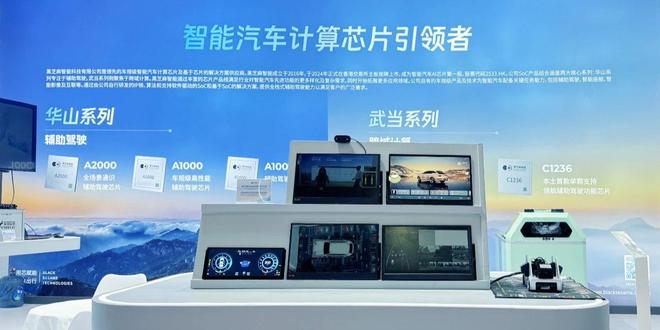
Group 1 - The core viewpoint of the article highlights that Hezhima Intelligent (2533.HK) achieved significant revenue growth of 40.4% year-on-year, reaching 253 million RMB in the first half of 2025, indicating ongoing expansion and acceleration in commercialization [2] - The company maintains close cooperation with leading clients such as Geely, BYD, Dongfeng, and FAW, with the A1000 series chip solutions already in mass production for several vehicle models [2] - The C1200 series, featuring urban NOA functionality, has completed testing in multiple locations and is set for deployment with several new energy vehicle companies [2] Group 2 - Hezhima Intelligent has made notable breakthroughs in overseas markets, achieving a record high in new overseas vehicle model designations in the first half of 2025, with deliveries expected to commence in the second half of the year [2] - The company has established partnerships with leading domestic robotics firms for humanoid and service robots, and has continued to ship L4 autonomous vehicle systems for closed environments [3] - Cash and cash equivalents reached 1.97 billion RMB, an increase of 520 million RMB from the end of the previous year, while the debt-to-asset ratio decreased to 37.5%, enhancing the company's financial strength [3] Group 3 - Hezhima Intelligent plans to accelerate acquisitions of high-performance, cost-effective AI chip companies to enrich its edge AI strategy and aims to establish a leading position in the full-scenario AI inference chip sector [3] - The company is not only maintaining high revenue growth but also achieving key breakthroughs in overseas expansion and multi-scenario applications, with future potential in intelligent driving and smart ecosystems continuously opening up [3]


中国神秘矿主,掌握2000亿王国,只有传闻,没有新闻
首席商业评论· 2025-08-29 04:11
Core Viewpoint - The article discusses the strategic moves of a Chinese entrepreneur, Yu Yong, who transformed a struggling mining company, Luoyang Molybdenum Co., into a global mining giant through timely investments and strategic partnerships, particularly in the copper and cobalt sectors, which are crucial for the electric vehicle industry [6][19]. Group 1: Entry into the Market - In 2003, Luoyang Molybdenum faced operational challenges due to falling molybdenum prices, leading to a government push for privatization [8]. - Yu Yong's company, Hongshang Industrial Holdings, acquired a 49% stake in Luoyang Molybdenum for 178 million yuan, which included compensation for laid-off workers [8][10]. - The investment proved lucrative, with profits soaring to 2.8 billion yuan in the second year and 17.14 billion yuan by 2006 [10]. Group 2: Strategic Acquisitions - From 2012 to 2018, during a global commodities downturn, Luoyang Molybdenum made significant acquisitions, including an 80% stake in Australia's NPM copper-gold mine for $820 million [12]. - In 2016, the company acquired a niobium-phosphate mine in Brazil for $1.5 billion, becoming the second-largest niobium producer globally [12]. - The acquisition of a 56% stake in the TFM copper-cobalt mine in the Democratic Republic of Congo for $2.65 billion positioned Luoyang Molybdenum as a key player in the copper and cobalt markets [12][15]. Group 3: Industry Positioning - By 2020, Luoyang Molybdenum had become the world's largest cobalt producer and a significant copper producer, with TFM becoming the fifth-largest copper mine globally [20]. - The company holds nearly one-third of the world's cobalt resources and is a major player in tungsten and molybdenum production [19]. Group 4: Downstream Integration - In 2019, Luoyang Molybdenum acquired IXM, the third-largest base metals trader, enhancing its influence in global metal trading [21]. - Strategic partnerships with companies like CATL and Geely have solidified its position in the electric vehicle supply chain, providing stable raw material sources [22]. Group 5: Financial Performance - Luoyang Molybdenum's revenue and market capitalization have surpassed 200 billion yuan, with a net profit of 8.671 billion yuan in the first half of 2025, reflecting a 60.07% year-on-year increase [25]. - The International Energy Agency (IEA) predicts a 30% shortfall in global primary copper supply by 2035, indicating strong future demand for copper [24].

C位“易主”,从成都车展透视车市三大变化
Zhong Guo Jin Rong Xin Xi Wang· 2025-08-29 02:19
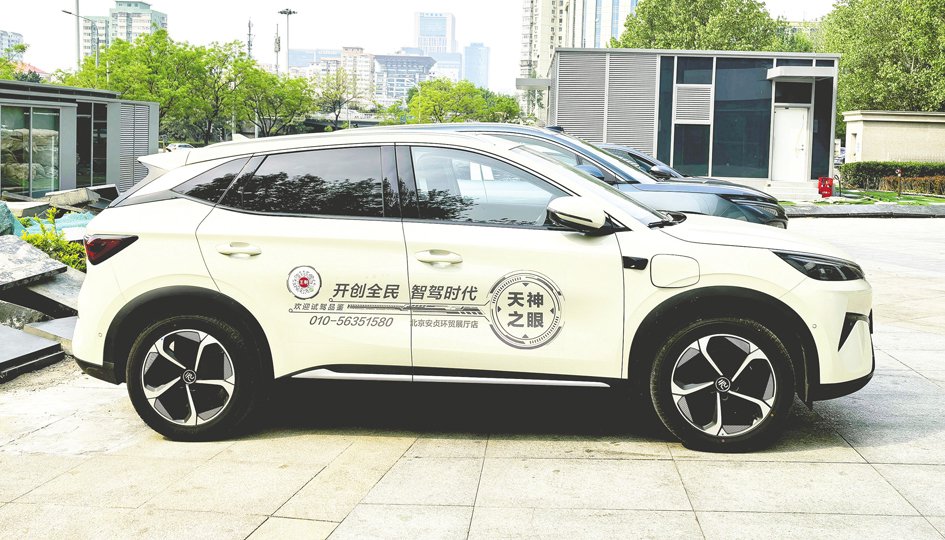
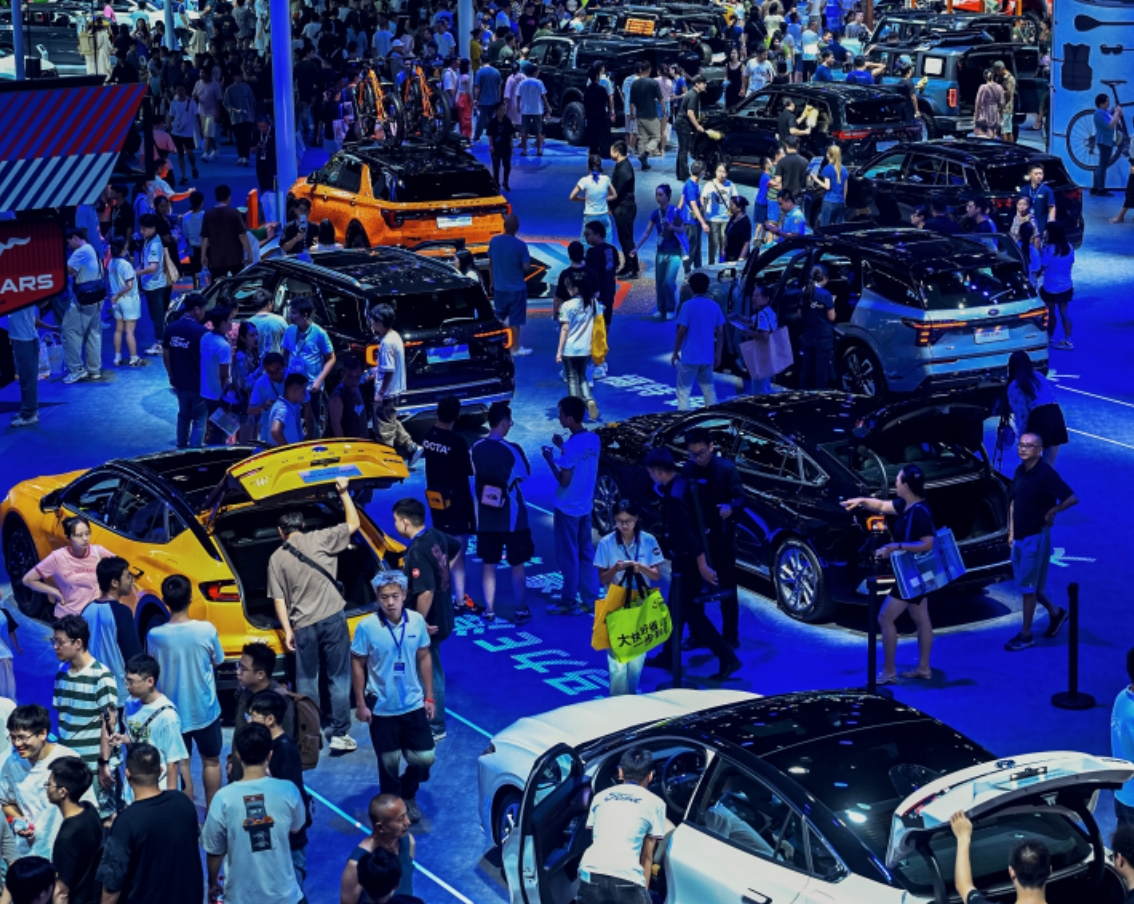
Core Insights - The 28th Chengdu International Auto Show has commenced, featuring nearly 120 automotive brands and over 1,600 vehicles on display, indicating a significant event in the automotive industry [1] - A notable trend is the collective absence of traditional luxury brands, reflecting a shift in the automotive market dynamics in China [2][3] - In contrast, domestic brands have significantly expanded their presence at the show, showcasing their growing strength and market influence [4][5] Luxury Brands Absence - The absence of luxury brands such as Porsche, Bentley, and Lamborghini at this year's show marks a significant change compared to previous years, driven by cost control measures [2][3] - Only six luxury brands, including Mercedes-Benz, BMW, and Audi, continue to participate, highlighting a decline in luxury brand representation [2] - The luxury car market is experiencing a downturn, with Porsche's global deliveries down 6% year-on-year, and a staggering 28% decline in the Chinese market [3] Domestic Brands Expansion - Domestic brands like BYD, Changan, and Chery have established dedicated exhibition spaces, showcasing their growing importance in the automotive sector [4][5] - BYD's pavilion features advanced technologies such as "God's Eye" intelligent driving demonstrations, indicating a focus on innovation [4] - The trend of domestic brands adopting "pavilion" formats at auto shows is becoming more common, enhancing brand visibility and communication [4] Rise of Regional Auto Shows - Regional auto shows are gaining prominence, with events like the Guangdong-Hong Kong-Macao Greater Bay Area Auto Show surpassing the Chengdu Auto Show in size and influence [6] - The Chongqing Auto Show is also expanding, with increased participation and audience numbers, indicating a growing interest in regional events [6][7] - These regional shows are evolving beyond mere sales platforms, integrating local economic and industrial ecosystems, thus becoming vital for brand promotion and investment attraction [7] Industry Evolution - The automotive industry in China is undergoing a transformation, moving from traditional luxury brands to a focus on domestic brands and technological advancements [7] - The competition landscape is shifting, with a clear trend towards high-quality development centered on technology, ecology, and user experience [7]
恒帅股份2025年上半年深耕车用核心部件 机器人技术突破、电子水泵定点与充电小门订单多点开花
Zheng Quan Shi Bao Wang· 2025-08-29 01:56
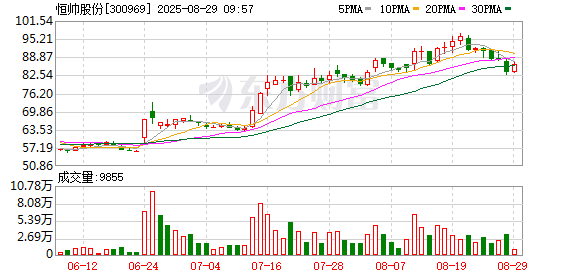
Core Business Progress - The company has made significant breakthroughs in robot technology research and development, focusing on harmonic magnetic field motor technology, which has advantages such as high power density, compact size, cost savings, low electromagnetic interference, and long lifespan [1] - The harmonic magnetic field motor technology has already achieved mass production in collaboration with Lenze on drum motors and is entering a ramp-up phase [1] - The company is customizing solutions for humanoid robots, including linear joint motors, rotary joint motors, and dexterous hand motors, aiming to create new growth areas in industrial automation and humanoid robots [1] Fluid Technology and Electric Pump Business - The electronic water pump business has become a core growth point, securing key customer contracts due to its efficient heat management and low power consumption [2] - The company is gradually configuring a production capacity of 1.5 million electronic water pumps to meet mass production demands [2] - The company is also expanding into integrated solutions in the thermal management field, enhancing product value and market competitiveness [2] Financial Performance - In the first half of 2025, the company achieved a revenue of 428 million yuan and a net profit of 84.65 million yuan, with a non-recurring net profit of 75.47 million yuan [4] - The company’s cleaning products generated a revenue of 201 million yuan, while motor products generated 192 million yuan during the same period [3] Research and Development - The company invested 15.49 million yuan in R&D in the first half of 2025, a year-on-year increase of 4.23%, focusing on harmonic magnetic field motors, new magnetic materials, electronic pump optimization, and intelligent cleaning systems [3] - The company holds a total of 64 patents, including 18 invention patents, showcasing its strong technical capabilities and product quality control [5] Future Outlook - The company plans to continue focusing on core automotive components, increase the industrialization of robot technology, and expand the market for electronic pumps and charging door assemblies [5] - The company aims to leverage global capacity layout and technological innovation to achieve performance recovery amid the trends of automotive electrification and intelligence [5]

国产替代浪潮中的隐形冠军② | 豪威集团:视觉芯片的“车载之王”
Bei Jing Shang Bao· 2025-08-28 16:06
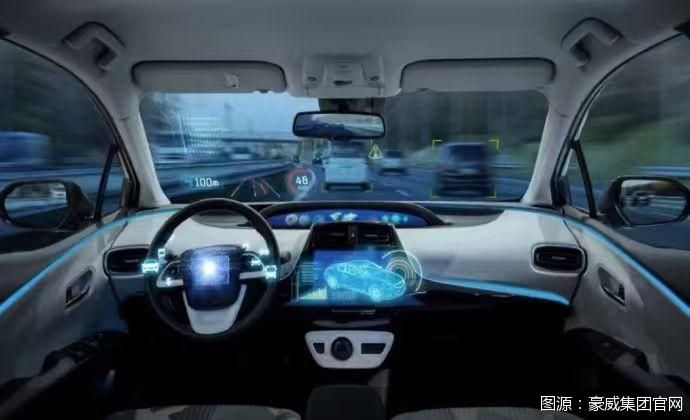
Core Viewpoint - The article discusses the transformation of Weir Shares into Haowei Group, highlighting its strategic shift from consumer electronics to automotive visual chips, driven by the growth of the intelligent automotive market and the company's successful acquisitions [3][4][6][8]. Company Transformation - Haowei Group, formerly Weir Shares, underwent a significant transformation after acquiring Beijing Haowei, which was a key player in the global CMOS image sensor market, leading to a substantial increase in net profit and a shift in business focus [4][6][12]. - The company has successfully transitioned from being heavily reliant on the consumer electronics sector to becoming a leader in the automotive visual chip market, capitalizing on the growing demand for intelligent driving technologies [6][8][10]. Financial Performance - In 2024, Haowei Group reported automotive market revenue of 5.905 billion yuan, a year-on-year increase of 29.85%, contributing over 30% to the total revenue of its image sensor solutions [8][10]. - The company’s revenue is projected to grow by 13.49% to 15.97% in 2025, with net profit expected to increase by 39.43% to 49.67%, indicating strong growth potential in the automotive sector [10][16]. Market Position and Strategy - Haowei Group holds a market share of nearly 30% in the domestic automotive CIS sector, benefiting from its advanced technology and competitive product offerings [9][10]. - The company has strategically positioned itself to take advantage of the shift towards intelligent vehicles, with major automotive manufacturers increasing their adoption of advanced camera systems [9][10]. Challenges and Risks - Despite its growth, Haowei Group faces challenges such as high share pledges by its controlling shareholder, which may impact its control stability and investor confidence [14][15][16]. - The company’s R&D expenditure has shown volatility, with a declining R&D expense ratio, raising concerns about its ability to maintain competitive advantages in a rapidly evolving market [16][17][18].

智驾下沉至主流价格区间 中西部市场潜力待释放
Mei Ri Jing Ji Xin Wen· 2025-08-28 12:41
Group 1 - The Chengdu International Auto Show is considered a "barometer" for the automotive market, showcasing significant models from various manufacturers for the second half of the year [1] - A major highlight of this year's show is the emphasis on "intelligent driving" systems, with many manufacturers presenting their newly launched systems from the first half of the year [1][4] - The mid-range market (priced between 150,000 to 200,000 yuan) is seeing a notable increase in the adoption of advanced intelligent driving technologies, which is expected to drive consumer demand in the central and western regions of China [3][4] Group 2 - The Chengdu region is identified as one of the most active areas for automotive consumption in China, with a projected growth of 9.5% in the automotive manufacturing industry in Sichuan for 2024 [3] - The report from the China Electric Vehicle Hundred People Association indicates that the penetration rate of advanced intelligent driving features in passenger vehicles is expected to reach 20% by the end of 2025, nearly doubling from the first half of 2024 [4] - Various models in the 150,000 to 200,000 yuan price range are being highlighted for their intelligent features, such as the HUAWEI ADS4 system in the SAIC-Huawei collaboration model [4][5] Group 3 - The unique geographical and climatic challenges of the central and western regions, such as winding mountain roads and frequent fog, necessitate advanced adaptations in intelligent driving systems [7][8] - Manufacturers are focusing on localizing their intelligent driving systems to ensure compatibility with regional road conditions, utilizing a combination of different sensor technologies for improved reliability [7][8] - The Chengdu Auto Show serves as a platform for showcasing cutting-edge technologies and facilitating collaboration between academia and industry to enhance the development of intelligent driving and new energy technologies [9]

前7个月我国汽车产销量均超1800万辆
Mei Ri Jing Ji Xin Wen· 2025-08-28 12:29
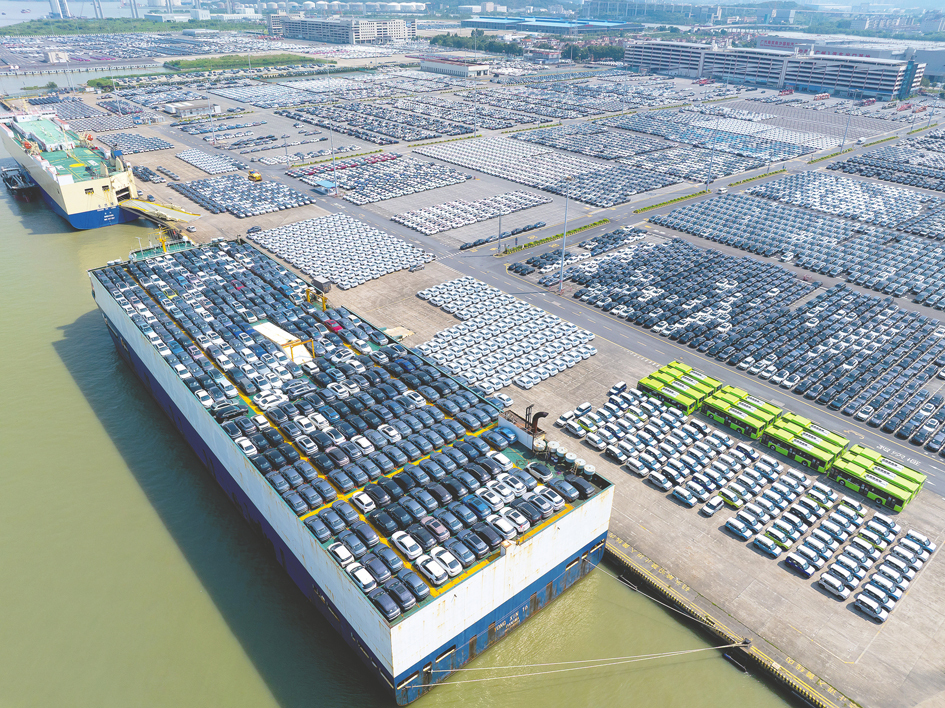
Core Viewpoint - The Chinese automotive market has shown significant growth in the first seven months of 2023, with production and sales increasing by 12% and 12.7% year-on-year, respectively, despite a seasonal decline in July [1][3]. Production and Sales Data - From January to July, the total automotive production reached 18.235 million units, while sales reached 18.269 million units, marking a year-on-year increase of 12.7% and 12% [1]. - In July alone, production and sales were 2.591 million and 2.593 million units, respectively, reflecting a month-on-month decline of 7.3% and 10.7%, but a year-on-year increase of 13.3% and 14.7% [1][3]. Market Dynamics - The decline in July's production and sales is attributed to the traditional off-season and scheduled equipment maintenance by manufacturers, leading to a seasonal slowdown [3]. - The "old-for-new" vehicle policy continues to show positive effects, and the introduction of new models by companies has contributed to stable market operations [3]. Passenger Vehicle Market - In July, the production and sales of passenger vehicles reached 2.293 million and 2.287 million units, with year-on-year growth of 13% and 14.7% [4]. - Chinese brand passenger vehicles accounted for 70.1% of total passenger vehicle sales in July, with a year-on-year increase of 3.8 percentage points [4]. - From January to July, the sales of Chinese brand passenger vehicles reached 10.873 million units, a year-on-year increase of 24.4%, with a market share of 68.6% [5]. Commercial Vehicle Market - In July, commercial vehicle production and sales were 298,000 and 306,000 units, respectively, showing a month-on-month decline but maintaining double-digit year-on-year growth [6]. - From January to July, commercial vehicle production and sales totaled 2.397 million and 2.428 million units, with year-on-year increases of 6% and 3.9% [6]. New Energy Vehicles (NEVs) - NEVs continued to show rapid growth, with July production and sales reaching 1.243 million and 1.262 million units, respectively, marking year-on-year increases of 26.3% and 27.4% [7]. - NEVs accounted for 48.7% of total new vehicle sales in July, with domestic sales surpassing 50% for the first time since December [7]. - From January to July, NEV production and sales reached 8.232 million and 8.22 million units, with year-on-year growth of 39.2% and 38.5% [7]. Export Performance - NEVs have become a major driver of export growth, with total automotive exports reaching 3.68 million units from January to July, a year-on-year increase of 12.8% [8]. - Traditional fuel vehicle exports decreased by 7%, while NEV exports surged by 84.6% [8]. - BYD's export growth was particularly notable, with a 130% increase, reaching 553,000 units [8].
“中国新能源第三极”崛起:车企共谋“西进方略”,开发“西南”适配车型与技术 | 车展观察①
Mei Ri Jing Ji Xin Wen· 2025-08-28 07:14
Core Insights - The rapid development of the new energy vehicle (NEV) market in Chengdu is highlighted, with the city achieving a NEV ownership of 1.08 million by June 2023, leading non-restricted cities in China [1][2] - The Chengdu Auto Show serves as a significant platform for showcasing new vehicles and technologies, reflecting the market's vitality and consumer confidence [1][2][9] NEV Market Growth - Chengdu's NEV penetration rate is nearing 50%, with 309,000 NEVs sold in 2024, marking a 9% year-on-year increase in overall vehicle sales [2] - The NEV production in Sichuan province reached 144,000 units in the first half of the year, accounting for 27.6% of the province's total vehicle production, a 16.2 percentage point increase from the previous year [2] Regional Expansion - The NEV market in the southwestern region, including Chongqing, Yunnan, and Guizhou, is experiencing significant growth, with Chongqing's NEV sales increasing by 34% and Yunnan's by 42% in 2024 [3] - The southwestern region is projected to produce over 3 million NEVs by 2025, capturing more than 20% of the national market share [6] Policy Support - Government policies, such as vehicle replacement subsidies, are driving NEV sales, with Sichuan offering up to 15,000 yuan for new energy vehicle purchases [5] - Chengdu's government is also implementing a "purchase subsidy" policy during the auto show, allowing for up to 20,000 yuan in subsidies for trade-in vehicles [5] Infrastructure Challenges - The rapid increase in NEVs has led to a shortage of charging infrastructure, particularly in rural areas, with only 40% coverage in townships [7] - Plans are in place for Sichuan to establish 2.93 million charging stations by 2030, while Yunnan aims for over 60,000 public charging facilities by the end of 2025 [7] Technological Advancements - The Chengdu Auto Show features new charging technologies, such as BYD's "Megawatt Flash Charge" and CATL's sodium-ion battery, aimed at addressing charging difficulties and enhancing vehicle range [8] - Several new range-extended models are being introduced to cater to the unique climatic conditions of the southwestern region [8]

中国汽车品牌向价值链高端迈进 “豪华车”的定义更丰富了
Ren Min Ri Bao Hai Wai Ban· 2025-08-28 00:35
Group 1 - The definition of "luxury cars" is evolving in China, with consumers increasingly valuing technology and user experience over traditional metrics like price and brand prestige [1][3][11] - Chinese automotive brands are advancing into the luxury car segment, offering high-end features that were once exclusive to imported luxury vehicles, such as air suspension and advanced infotainment systems [2][4][5] Group 2 - The introduction of air suspension technology in domestic vehicles has significantly reduced costs, with entry-level models now starting around 200,000 yuan, down from 500,000 yuan [4] - The market share of Chinese brands in the 300,000 yuan and above segment is increasing, with companies like NIO and Li Auto successfully targeting high-end consumers [5][6] Group 3 - Chinese brands are gaining recognition in the high-end market, with a reported 68.5% share of total passenger vehicle sales in the first half of the year, a 6.6 percentage point increase year-on-year [6][7] - The perception of "Chinese cars" is shifting, as brands like BYD and Lantu penetrate the premium market, challenging the stereotype of low-cost, economy vehicles [7][8] Group 4 - Traditional luxury brands are facing challenges in the Chinese market, with significant declines in sales for BMW, Mercedes-Benz, and Audi, particularly in the first half of the year [9][10] - In response, these brands are accelerating their electric vehicle strategies and collaborating with local suppliers to meet the diverse demands of Chinese consumers [10][11]