
腾讯

Search documents
国产AI大模型企业密集上市:资本狂欢下的技术博弈与产业未来
Sou Hu Cai Jing· 2026-01-22 09:54
Group 1 - The year 2024 is recognized as the "Year of Commercialization for China's AI Large Models," with a significant wave of domestic AI companies expected to go public in 2025 [2] - Over ten Chinese tech companies focused on large language models (LLMs) have submitted IPO applications since Q1 2024, raising over 30 billion RMB in the first half of 2025 [2] - Major cities like Beijing, Shanghai, and Shenzhen are becoming hubs for AI large model companies, supported by local government policies [5] Group 2 - DeepSeek, known for its open-source large model, has a valuation exceeding 12 billion USD and plans to invest 4.2 billion RMB in R&D for 2024 [3] - Zhipu AI, backed by Tsinghua University, is pursuing a listing on the Sci-Tech Innovation Board, with its GLM-4 Turbo model outperforming international counterparts in various tasks [3] - Moonshot AI has gained attention for its "Long Context Window" technology, securing 800 million USD in funding and achieving a post-investment valuation of 6.5 billion USD [4] Group 3 - In 2024, total investment in China's AI sector reached 215 billion RMB, with over 60% allocated to large models and related applications, marking a 75% increase from 2023 [6] - The average investment amount in Pre-IPO rounds rose from 520 million RMB in 2023 to 870 million RMB in 2024, indicating a shift towards more mature AI companies [6] - The adoption rate of AI technology among enterprises surged from 22% in 2022 to 47% in 2024, with significant growth expected in sectors like finance, manufacturing, education, and healthcare [7] Group 4 - Domestic large model companies have made significant advancements, with eight out of the top ten positions in the CLUE benchmark held by Chinese models [7] - The Chinese government has introduced supportive policies for AI companies, including measures to facilitate domestic and international financing [7] - The geopolitical landscape, particularly U.S. restrictions on high-end GPU exports, has accelerated the demand for domestic AI solutions [8] Group 5 - Companies are exploring various monetization strategies, including API service fees, enterprise solutions, and open-source models with commercial licenses [14] - The training and inference costs for large models remain a significant challenge, with estimates indicating that training a trillion-parameter model could exceed 120 million RMB [16] - Only 15% of AI large model companies that have submitted IPO applications reported profitability in the last fiscal year, with average losses reaching 1.8 times their revenue [17] Group 6 - Traditional valuation methods are being challenged, leading to the development of new frameworks that emphasize technical barriers and ecosystem value [18] - The stock performance of AI-related companies has shown a polarized trend, with major players like Baidu and Alibaba seeing significant stock price increases [19] - The AI large model sector is expected to undergo a commercial validation phase from 2025 to 2026, with a focus on actual revenue growth and sustainable business models [26]


港股收盘 | 恒指收涨0.17% 商业航天概念走强 泡泡玛特午后升近6%
Zhi Tong Cai Jing· 2026-01-22 09:05
Market Overview - The Hong Kong stock market showed mixed performance, with the Hang Seng Index rising by 0.17% to close at 26,629.96 points, while the Hang Seng China Enterprises Index fell by 0.09% to 9,114.3 points, and the Hang Seng Tech Index increased by 0.28% to 5,762.44 points. The total trading volume was HKD 234.86 billion [1] Blue Chip Performance - Pop Mart (09992) led the blue-chip stocks, rising by 5.97% to HKD 206, contributing 13.8 points to the Hang Seng Index. The company has been in the spotlight due to its new product launch and share buybacks totaling nearly HKD 350 million [2] - Other notable blue-chip performers included Wharf Real Estate (01997) up 4.81%, Li Auto-W (02015) up 4.13%, while China Life (02628) fell by 3.82%, dragging the index down by 15.13 points [2] Sector Highlights - Large tech stocks had mixed results, with Baidu rising over 4% and Alibaba nearly 1%, while Tencent fell by 0.83%. The construction and cement sectors performed well, with China Liansu up over 8% and China National Building Material up nearly 7% [3] - Oil and gas stocks were active, with Shanghai Petrochemical (00338) up 3.45% and Sinopec (00386) up 3.41%. The International Energy Agency (IEA) raised its global oil demand growth forecast for 2026 to 930,000 barrels per day, up from a previous estimate of 860,000 barrels per day [3][4] Commercial Aerospace - The commercial aerospace sector saw renewed interest, with JunDa Co. (02865) rising nearly 16% and other related companies also showing significant gains. Reports indicate that Elon Musk is pushing for a SpaceX IPO, which could further stimulate the sector [4] Real Estate Sector - Hong Kong real estate stocks showed positive performance, with Wharf Real Estate (01997) and Sun Hung Kai Properties (00016) both rising significantly. Analysts predict a continued upward trend in property prices, although the growth rate may moderate due to resilient mortgage rates [5][6] Gold Stocks - Gold stocks experienced a decline, with Lingbao Gold (03330) down 3.16% and Zijin Mining (02899) down 2.3%. This drop is attributed to easing risk aversion, leading to a decrease in gold prices from historical highs [6] Notable Stock Movements - Minth Group (00425) saw a significant increase of 13.94% following a positive report from Citigroup, which initiated a 90-day upward catalyst observation [7] - ASMPT (00522) continued its upward trend, rising 6.29% as it evaluates options for its surface mount technology business [8] - Baidu (09888) was active, rising 4.1% after the release of its new AI model, which supports various forms of information processing [9] - Longqi Technology (09611) debuted with a 3.55% increase, raising approximately HKD 1.52 billion from its IPO [10] - Nanshan Aluminum (02610) faced a decline of 6.89% after announcing a share placement at a discount to its previous closing price [11]

2026年最热的板块由蚂蚁阿福和王小川引领
新财富· 2026-01-22 08:47
Core Viewpoint - Major tech companies are accelerating their investments in AI healthcare, leveraging advancements in AI capabilities to enhance medical service supply and transform the healthcare market [2][3][19]. Group 1: AI Healthcare Developments - OpenAI launched ChatGPT Health, which connects electronic medical records and health applications to provide personalized responses based on user health information [5]. - Anthropic introduced Claude for Healthcare, aimed at general users, enhancing data connectivity and allowing secure access to personal medical records [6]. - Baichuan Intelligence released Baichuan-M3, a next-generation medical language model that outperformed previous models in testing [7]. Group 2: Evolution of Internet Healthcare - Prior to the mobile internet era, users relied on Baidu for health information, facing challenges like misleading advertisements and difficulty in assessing medical institutions [10][11]. - The internet healthcare sector transitioned to a platform-based model post-2016, with services like online consultations becoming standard [12][13]. - Despite improvements, the healthcare system still relies heavily on individual doctors, limiting service supply and efficiency [14][15]. Group 3: AI's Role in Healthcare - AI is increasingly used for non-urgent health inquiries, with users often consulting AI before visiting a doctor, although AI's advice is typically a preliminary step rather than a replacement for professional medical advice [16][17]. - The healthcare market is vast, with over 5% of ChatGPT's queries related to health, indicating significant user engagement with AI for health-related questions [17]. Group 4: Company Strategies - Ant Group's Aifu aims to be the largest platform in healthcare, integrating AI into existing medical pathways rather than replacing traditional diagnosis [20][21]. - Aifu's rapid user growth to 30 million monthly active users is attributed to its integration with existing healthcare services and resources [23]. - Baichuan's strategy focuses on developing advanced AI models for healthcare, emphasizing the importance of understanding life sciences as a pinnacle of AI capability [32][33].

2025最强AI产品一文看尽丨量子位智库年度AI 100
量子位· 2026-01-22 07:37
Core Viewpoint - The article highlights the transformation of China's AI product ecosystem in 2025, marking it as the "Year of AI Applications," where the focus shifts from mere functionality to system reconstruction driven by advancements in underlying models, user demand, and business model evolution [5][6]. Group 1: AI Product Landscape - The 2025 AI market in China is characterized by the launch of major AI companies like Zhipu and MiniMax, indicating a maturing market [3]. - The "AI 100" product list released by Quantum Bit Think Tank categorizes AI products into three main segments: "Flagship AI 100," "Innovative AI 100," and the top products from ten popular sectors [7][29]. - The "Flagship AI 100" focuses on the strongest AI products of 2025, showcasing those that have achieved significant technological breakthroughs and practical application value [8][29]. Group 2: User Engagement and Market Trends - The top five AI products on the web account for over 62% of monthly active users (MAU), while the top five on mobile apps represent over 65% of daily active users (DAU) [12]. - AI general assistants and AI office platforms remain the most popular sectors, significantly outpacing other categories in user scale [12]. - The "Innovative AI 100" aims to identify products with potential for explosive growth in 2026, highlighting emerging trends in various AI sectors [13][16]. Group 3: Sector-Specific Insights - The article identifies ten key AI application sectors, including AI browsers, AI agents, AI smart assistants, and AI education, each featuring top three products that exemplify innovation and engineering excellence [19][23]. - The evaluation of these sectors serves as a retrospective on the AI application market in 2025, emphasizing the competitive landscape and user engagement [24]. Group 4: Evaluation Methodology - The "AI 100" list employs a dual assessment system combining quantitative and qualitative metrics, focusing on user data, growth, and long-term development potential [26]. - Quantitative metrics include user scale, growth, and engagement, while qualitative assessments consider technology, market space, and user experience [26].

港股异动丨邵氏兄弟控股大跌超17%,发新股向大股东CMC收购内地文娱资产
Ge Long Hui· 2026-01-22 04:00
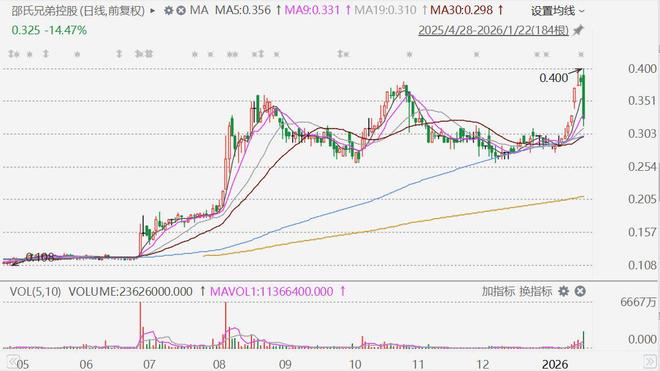
邵氏兄弟控股(0953.HK)大跌超17%报0.315港元。消息面上,黎瑞刚旗下华人文化CMC拟将一系列业务 注入邵氏兄弟,包括影视制作发行及内地影院营运。邵氏兄弟公告指,将向华人文化CMC 一方以股份 方式支付代价45.77亿元(约50.98亿港元),每股配发价0.32港元,较周三收市价0.38港元折让15.8%。 邵氏兄弟指,将发行159.3亿股支付收购,而交易构成非常重大交易及关连交易,公司会召开及举行临 时股东大会供独立股东审议。配股方面,其中CMC及其一致行动人士获99.4亿股,其他指定股份接收方 包括联属人士ODE、阿里巴巴、腾讯、苏州禾民投资合伙等合共接收余下近59.9亿股。完成后,CMC 于公司持股将由29.94%增至59.74%,成为控股股东。 ...
每日投资策略-20260122
Zhao Yin Guo Ji· 2026-01-22 02:33
Group 1: Market Overview - Global markets showed mixed performance, with the Hang Seng Index closing at 26,585, up 0.37% for the day and 3.72% year-to-date [1] - The US markets also experienced gains, with the Dow Jones up 1.21% and the S&P 500 up 1.16% [1] - In contrast, the German DAX and Japanese Nikkei 225 saw declines of 0.58% and 0.41% respectively [1] Group 2: Sector Performance - In the Hong Kong market, the Hang Seng Financial sector fell by 0.44%, while the Hang Seng Utilities sector rose by 1.15% [2] - The real estate sector underperformed, with a decline of 0.77% year-to-date [2] - The industrial sector showed resilience, gaining 0.86% for the day [2] Group 3: Company Insights - iQIYI is projected to see a revenue recovery in Q4 2025, with expected total revenue of RMB 6.77 billion, reflecting a 2% year-on-year growth [4] - The company is anticipated to achieve a non-GAAP net profit of RMB 93 million, a turnaround from previous losses [4] - iQIYI's innovative business segments, including overseas operations and IP derivatives, are showing positive progress [4]
台积电2025Q4营收同比增长,DRAM价格持续上涨
Zhong Guo Neng Yuan Wang· 2026-01-22 01:38
Core Viewpoint - The data center sector is driving significant growth in the power equipment industry, with capital expenditures showing a high growth trend, particularly among major overseas players, while domestic giants like Alibaba and Tencent are experiencing a slowdown in their capital spending [1][3]. Demand Side - Overseas capital expenditures in Q3 2025 reached $99.617 billion, marking an 80.39% year-on-year increase and a 9.54% quarter-on-quarter rise [3]. - Alibaba's capital expenditure for Q3 2025 was 31.5 billion yuan, reflecting an 80.10% year-on-year increase but a decline of 18.55% quarter-on-quarter. The company reiterated its three-year investment framework of 380 billion yuan, indicating potential for further investment [3]. - Tencent's capital expenditure was 13 billion yuan in Q3 2025, down 24.05% year-on-year and 32.05% quarter-on-quarter, with a downward revision of its annual guidance, indicating spending below initial expectations [3]. Supply Chain - NVIDIA reported total revenue of $57.006 billion in Q3 2025, with data center product revenue reaching $51.215 billion, a historical peak, showing a 24.62% quarter-on-quarter increase and a 66.44% year-on-year increase, accounting for over 89% of total revenue [4]. - TSMC's revenue for December 2025 was 335 billion new Taiwan dollars, a 20.4% year-on-year increase but a 2.5% quarter-on-quarter decline, achieving a record high for the same period [4]. - The CPU price index in November 2025 was 99.04, slightly up from 98.20 in October, while DRAM spot prices surged from $27.14 on November 17, 2025, to $66.50 by January 16, 2026, reflecting a more than 145% increase over two months, indicating strong server demand [4]. Application Side - The number of models in use is steadily increasing, with application deployments becoming more frequent. Token usage from January 5 to January 12, 2026, reached 7.65 trillion, an 18.97% increase from the previous period [4]. - In Q3 2025, the release of models such as Grok4Fast, GPT-5nano, and gpt-oss-20B led to a decline of over 50% in the price of tokens for models scoring above 40 on the ArtificialAnalysis intelligence index [4]. Investment Recommendations - The construction of AI data centers is expected to drive demand for HVDC and SST technologies. The global data center installation capacity is projected to increase by approximately 14 GW in 2024, with major cloud providers maintaining high capital expenditures. TSMC's capital expenditure for 2026 is expected to reach $52-56 billion, a year-on-year increase of about 30% [5]. - The increasing power density of data center cabinets is likely to enhance the penetration of HVDC and SST technologies, with smart busbars expected to see widespread adoption [5]. - Recommended stocks include Zhongheng Electric (002364), Oulu Tong (300870), Weiteng Electric (688226), and Sunshine Power (300274). Stocks to watch include Kehua Data (002335), Keda (002518), Kelu Electronics (002121), Magmi Tech (688676), and Sifang Co. (601126) [5].

OpenAI的理想主义,终于向广告低头了
3 6 Ke· 2026-01-21 12:57
Group 1 - OpenAI is shifting from technological idealism to a monetization logic based on internet traffic, starting to add advertisements next to answers for U.S. users, with revenue from ads expected to exceed $10 billion by 2027 and reach $110 billion by 2030 from non-paying users [1][4] - The company anticipates revenue of $13 billion by 2025 with 800 million weekly active users, but faces increasing cost pressures, predicting cash consumption to rise to approximately $17 billion by 2026 [4][5] - OpenAI's market share in the enterprise sector has dropped from an estimated 50% in 2023 to 27% this year due to intensified competition from companies like Anthropic and Google [4] Group 2 - Sam Altman's attitude towards advertising has evolved from rejection to acceptance, recognizing the necessity of a business model that allows AI to be accessible to everyone, even if it involves advertising [5][6][7] - Initial advertising efforts by OpenAI will be cautious, with clear labeling and separation from original answers, and a commitment not to sell user data to advertisers [9][13] - The conversational interface of AI allows for interactive advertisements, where users may soon be able to ask questions directly related to ads, enhancing the purchasing decision process [11][13] Group 3 - Domestic AI companies are generally not rushing to announce advertising plans, preferring to transition AI into transaction and service gateways instead of relying on advertising revenue [14][16] - Baidu is leading the way in reimagining advertising through AI, integrating AI-driven content into its search results to create a more interactive user experience [15] - Other AI platforms like Doubao and Kimi Qianwen are focusing on becoming transaction gateways rather than selling ads, with features that allow users to make purchases directly through AI interactions [16][19] Group 4 - The commercialization of AI may ultimately lead to a focus on transactions rather than advertising, with OpenAI already implementing instant checkout features for users [19] - As AI becomes more involved in consumer decision-making, users are transitioning from seeking information to accepting decisions made by AI, which raises concerns about trust and transparency [20][21] - The integration of advertising into AI responses could undermine user trust, as distinguishing between organic recommendations and paid promotions becomes increasingly difficult [21]

“AI入口大战”--字节已成“倒逼之势”,阿里腾讯“输不起”
华尔街见闻· 2026-01-21 10:37
Core Viewpoint - ByteDance is aggressively expanding in both AI cloud infrastructure and consumer applications, creating significant pressure on Alibaba and Tencent to increase investments by 2026 to defend their core markets [1][2]. Group 1: AI Cloud Market Dynamics - ByteDance's Volcano Engine has rapidly become the second-largest AI infrastructure provider in China, achieving a market share of 13% in AI cloud services by mid-2025, trailing only Alibaba's 23% [1][3]. - ByteDance is leveraging its first-mover advantage in AI to disrupt the long-standing dominance of Alibaba, Tencent, and Huawei in the cloud market [2][3]. - The company's strategy includes expanding its sales team and utilizing aggressive pricing to weaken competitors, focusing on selling AI products based on its extensive database and computing infrastructure [3][4]. Group 2: Consumer Application Impact - The shift in user behavior towards AI as a primary interface poses a risk of marginalizing traditional apps, as users may prefer to interact with AI first rather than using search engines [2][5]. - ByteDance's control over user engagement time is a critical advantage, as it can influence user actions during idle moments, positioning its AI applications favorably [6][7]. Group 3: Strategic Implications for Competitors - Goldman Sachs identifies 2026 as a pivotal year for Chinese internet giants, emphasizing the need for Alibaba and Tencent to significantly increase their capital and operational expenditures in AI to maintain their market positions [2][8]. - The competition is not merely about technology but also about who can establish a "default entry point" for users, which will redefine traffic distribution and advertising budgets [8][9]. Group 4: Investment Logic Transformation - The investment landscape is expected to shift from valuing "visions" to focusing on profitability growth and new narratives by 2026, with an emphasis on "alpha" returns rather than mere valuation expansion [9][10]. - Investors are advised to prioritize metrics related to "entry success rates" and the progress of transaction closures over emotional responses to models [10][11]. Group 5: The Nature of the AI Super Entry Battle - The AI super entry battle does not require all players to succeed; it only needs one dominant entry point, with others potentially becoming secondary features [12].


Hugging Face回看“DeepSeek时刻”:过去一年,中国AI如何改变全球开源格局?
硬AI· 2026-01-21 09:19
Core Viewpoint - The article emphasizes that the release of DeepSeek R-1 marks a pivotal moment in the AI landscape, breaking down barriers in technology, application, and psychology, thus leading to a significant shift towards open-source AI in China and globally [3][12]. Group 1: DeepSeek Moment and Barrier Breakdown - The release of DeepSeek R-1 on January 20, 2025, is identified as a watershed moment that transformed the AI development landscape, lowering the barriers to technology and application [3][12]. - Prior to R-1, China's AI industry was predominantly focused on closed-source models, but R-1 changed this dynamic, making open-source a strategic choice for Chinese tech companies [6][12]. - R-1's significance lies not in being the strongest model but in its ability to reduce three critical barriers: 1. **Technical Barrier**: R-1 made advanced reasoning capabilities downloadable and adjustable, treating reasoning as a reusable module [8]. 2. **Adoption Barrier**: The MIT license allowed for rapid deployment in production environments, shifting discussions from model performance to deployment strategies [9]. 3. **Psychological Barrier**: The mindset shifted from "Can we do this?" to "How do we do this well?", leading to significant changes in decision-making among companies [10]. Group 2: Major Players and Strategic Restructuring - The article notes a substantial increase in open-source contributions from major players like Baidu, Alibaba, and Tencent, with Baidu's release volume on Hugging Face rising from zero to over 100 in 2025, and ByteDance and Tencent's contributions increasing by eight to nine times [15][13]. - The focus of competition has shifted from individual model performance to ecosystem development, with companies like Zhipu AI and Alibaba not only releasing model weights but also building engineering systems and ecosystem interfaces [13][14]. - The article highlights that the collective rise of Chinese AI players is driven by shared technological, economic, and regulatory pressures, leading to a competitive alignment among companies [17]. Group 3: Market Impact and Global Response - The article reveals that in the category of newly built models (less than one year old), Chinese models have surpassed those from any other country, including the U.S., in download volume [18]. - The global market's response to China's AI rise includes efforts from the U.S. and France to accelerate the release of open-source models to maintain competitiveness, although many startups and researchers globally are increasingly relying on Chinese-developed models [21][22]. - The article concludes that the world is reacting to this shift, sparking a new wave of open-source enthusiasm, with expectations for significant releases from both China and the U.S. in 2026, focusing on architectural trends and hardware choices [22].
