吉利

Search documents
看完雷军发布会,高盛上调小米、宁德时代目标价,预言“当下的AI眼镜就是2017年的TWS耳机”
硬AI· 2025-06-28 13:24
Group 1: Core Insights - Goldman Sachs indicates that the pre-sale of the YU7 has significantly exceeded market expectations, solidifying Xiaomi's leadership position in the high-end automotive market [1][4] - The AI glasses launched by Xiaomi are expected to open new avenues in the ecosystem, potentially replicating the explosive growth trajectory of TWS headphones [1][6] Group 2: YU7 Performance - The YU7 electric SUV, launched on June 26, achieved a record order volume of 289,000 units within the first hour, far surpassing the initial target of 150,000 orders within 24 hours [8][9] - The pricing of the YU7 models is competitive, with the standard, Pro, and Max versions priced at 253,500 RMB, 279,900 RMB, and 329,900 RMB respectively, aligning closely with market expectations [9][10] - The YU7 features a 96.3 kWh battery with a CLTC range of 835 km, making it the longest-range model among pure electric SUVs with battery packs under 100 kWh [9][10] - Goldman Sachs has adjusted the projected delivery volumes for Xiaomi's electric vehicles for 2025-2027 upwards by 1-6%, anticipating deliveries of 411,000, 800,000, and 1,174,000 units respectively [10] Group 3: AI Glasses Market Potential - Xiaomi's AI glasses are expected to capture 10% of the Chinese smart glasses market, projected to reach 2.9 million units by 2025 [6][12] - The AI glasses are positioned as next-generation portable AI terminals, with a competitive price starting at 1,999 RMB and features including a 12MP camera and real-time translation capabilities [12][13] - The Chinese AI/AR glasses market is forecasted to grow at a compound annual growth rate (CAGR) of 56%, from 479,000 units in 2024 to 6.962 million units by 2030 [13] Group 4: Benefits to CATL - The success of the YU7 is expected to directly benefit CATL, as it becomes a major supplier of high-end batteries for Xiaomi [6][14] - CATL's penetration rate for its high-margin Kirin battery is anticipated to rebound in the second half of 2025, following the launch of models like the YU7 [15][16] - CATL's unit profit is projected to increase from 152 RMB/kWh in 2025 to 169 RMB/kWh by 2030, driven by improved product structure [17]


美银证券:汽车供应链首选激光雷达、自动驾驶芯片、线控底盘 看好地平线(09660)等
智通财经网· 2025-06-28 11:05
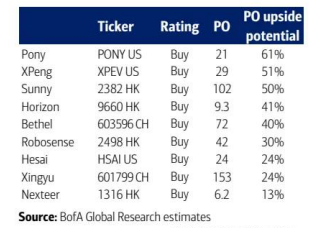
Core Insights - The report from Bank of America Securities highlights the rapid transformation in China's smart automotive industry driven by intense competition and the accelerated application of autonomous driving technologies by companies like BYD [1][2] Industry Overview - The penetration rate of L2+/L3 autonomous driving in China is projected to rise from 27% in 2025 to 80% by 2030, with sales of vehicles equipped with these features expected to grow from 6.1 million units in 2025 to 18.4 million units by 2030, reflecting a CAGR of 25% [2] - The Robotaxi market is anticipated to see explosive growth, with sales expected to increase from 2,500 units in 2025 to 400,000 units by 2030, representing a CAGR of 176% [3] Key Companies and Technologies - Companies such as Hesai (HSAI.US), Horizon (09660), and NIO (01316) are identified as key players in the smart automotive supply chain, particularly in laser radar, autonomous driving chips, and drive-by-wire chassis [1][4] - The report emphasizes that the integration of sensing, processing, and control systems is crucial for autonomous driving capabilities, while smart cockpit systems include components like cockpit domain controllers and heads-up displays [3] Component Market Insights - The estimated value of smart automotive components is $2,400 for entry-level vehicles and $6,000 for high-end models [4] - The penetration rate of laser radar in Chinese passenger vehicles is expected to increase from 6% in 2024 to 40% by 2030, driven by safety considerations and decreasing costs [4] - The market for autonomous driving and advanced driver-assistance system chips is projected to grow at a CAGR of 25% from 2024 to 2030 [4] Ratings and Price Targets - Bank of America Securities has provided ratings and price targets for several companies, indicating strong upside potential for stocks like PONY US, XPEV US, and HSAI US, with potential increases ranging from 24% to 61% [5][6]
杭州人,正在闷声发大财
投资界· 2025-06-28 07:38
Core Viewpoint - Hangzhou is emerging as a new financial hub, attracting talent and investment, making money a natural instinct for its residents [3][5][19]. Group 1: Population and Talent Attraction - By 2024, Hangzhou's resident population is projected to exceed 12.62 million, marking a continuous double-digit growth for ten years [5]. - In 2022, over 25% of the talent influx to Hangzhou was from the digital economy sector, including IT, internet, and gaming [6]. - The proportion of high-end job seekers applying in first-tier cities has decreased from 45% in 2017 to 36% in 2021, while new first-tier cities like Hangzhou have seen an increase from 31% to 35% [7]. Group 2: Quality of Life and Income - Hangzhou boasts a per capita disposable income of 73,797 yuan in 2023, approximately 1.9 times the national average, ranking sixth among mainland cities [8]. - The city offers a high quality of life with significant green spaces and cultural activities, making it an attractive place for work and leisure [8][19]. Group 3: Economic Structure and Opportunities - Hangzhou's GDP reached 2.18 trillion yuan, with the private economy contributing 61.5% of this figure [10]. - The city is home to major companies like Alibaba and NetEase, which have established a robust digital economy and service sector [10][11]. - The median annual salary for computer programmers in Hangzhou is 250,000 yuan, with 10% earning over 520,000 yuan [10]. Group 4: Entrepreneurial Environment - Hangzhou has a vibrant entrepreneurial ecosystem supported by substantial government funding and investment, with over 1.7 trillion yuan invested in nearly 40,000 enterprises in 2023 [15]. - New graduates can receive up to 200,000 yuan in project funding and three years of rent subsidies, while successful projects can receive up to 5 million yuan in rewards [15][16]. - The city has streamlined its application processes for subsidies, allowing for efficient access to financial support [17][18].



今天银行股为何大跌?
表舅是养基大户· 2025-06-27 13:14
Group 1: Xiaomi's Performance - Xiaomi's Yu7 model achieved impressive sales, with 200,000 units pre-ordered within 3 minutes and over 240,000 units locked in total, indicating strong market demand [1] - In comparison, Li Auto's expected second-quarter delivery was around 110,000 units, highlighting Xiaomi's significant market share gain [1] - The strong sales of Yu7 are expected to impact other SUV manufacturers negatively, leading to declines in their stock prices, with BYD down 7%, Xpeng down 5.5%, and others down around 3-3.5% [1] Group 2: Market Reactions and Fund Movements - Despite the positive sales news, Xiaomi's stock performance was below expectations, with a closing increase of only 3.6% after an initial 8% rise [2] - There was a significant net sell-off of Xiaomi shares, with southbound funds selling 3.2 billion, indicating a strong profit-taking sentiment among investors [3] - The sell-off is seen as a healthy market correction, preventing potential bubbles from forming [5] Group 3: Banking Sector Analysis - The banking sector experienced a decline of nearly 3%, attributed to specific institutional needs for balance sheet adjustments at the end of the quarter [7] - The Shenwan Banking Index fell by 2.86%, contributing approximately -1.45% to the overall decline of the low-volatility dividend index, indicating that the issue was primarily within the banking sector [8] - Institutional selling was driven by a combination of profit-taking and seasonal adjustments, with significant sell-offs occurring as banks reached historical highs [9][10] Group 4: Divergence in Banking Stocks - A divergence was noted between A-share and Hong Kong banking stocks, with A-shares declining while Hong Kong stocks began to rebound, suggesting continued buying interest from insurance funds [14] - The China Construction Bank in Hong Kong saw net purchases exceeding 1.3 billion, indicating strong demand despite the overall market downturn [17] Group 5: Commodity Market Insights - The metals sector, particularly copper, saw significant gains, with a rise of over 2% driven by tight global supply and increased demand [23] - The surge in copper prices is linked to supply shortages and geopolitical factors, with expectations of continued high performance in the metals sector [28]

36氪出海·关注|出口只是上半场,车企们的巴西战事刚开始
3 6 Ke· 2025-06-27 10:16
Core Insights - BYD's electric vehicle exports to Brazil are increasing significantly, with the company leading the market in both pure electric and plug-in hybrid segments [2][4][8] - Brazil is becoming a key export market for Chinese electric vehicles, with a projected 90% growth in electric vehicle sales in 2024 [2][5] - The Brazilian government is reinstating import tariffs on electric vehicles, which will rise to 35% by July 2026, impacting the export strategies of Chinese automakers [4][5] Group 1: Market Performance - BYD sold 76,713 vehicles in Brazil in 2024, representing a year-on-year growth of over 300% [2] - In May 2024, BYD accounted for over 80% of Brazil's pure electric vehicle sales, with 5,596 units sold out of a total of 6,969 [2] - In the first half of 2024, Brazil imported over 62,000 electric vehicles from China, making up 91.4% of total electric vehicle imports [5] Group 2: Tariff Changes - Brazil's import tax for pure electric vehicles will increase from 10% in January 2024 to 35% by July 2026 [5] - The tax rates for hybrid and plug-in hybrid vehicles will also rise, with mixed models facing a 30% tax by 2026 [5] - The upcoming tariff increases are prompting Chinese automakers to expedite their exports to Brazil [4][5] Group 3: Local Production Initiatives - The Brazilian government is launching a National Green Mobility and Innovation Program to encourage local production by global automakers [8] - Several Chinese automakers, including GAC and Great Wall Motors, are planning significant investments in local production facilities in Brazil [8] - BYD is set to establish a large production complex in Brazil, although there have been delays due to labor disputes [8][9] Group 4: Competitive Landscape - Chinese automakers will face competition from established players like Toyota and Renault, as well as local government and labor factors [9] - The year 2026 is anticipated to be a pivotal moment for Chinese electric vehicle manufacturers in Brazil, as they deepen their integration into the local economy [9]


汽车芯片:有人辞官归故里,有人星夜赶科场
Hu Xiu· 2025-06-26 00:23AI Processing
本文来自微信公众号:电子工程世界 (ID:EEworldbbs),作者:付斌 在汽车芯片领域,一场前所未有的"冰火两重天"大戏正在上演。 曾经被视为"兵家必争之地"的汽车芯片市场,此刻有人黯然离场,又有人踌躇满志。可谓是"甲之蜜 糖,乙之砒霜"。 巨头纷纷退场 就在近期,国际上就发生了五起备受关注的巨头退出事件。 第一,英特尔即将关闭汽车业务,并裁减该部门大部分员工。6月25日消息称,该公司在给员工的一份 通知中表示:"英特尔计划逐步停止英特尔架构汽车业务。"该公司还提到,会继续履行对现有客户的承 诺,但会裁减英特尔汽车部门的"大多数"员工。 汽车并非英特尔核心业务,陈立武上任CEO后一直也在强调英特尔要回归核心业务,不过有数据显示目 前有5000万辆汽车使用英特尔的处理器。值得注意的是,目前英特尔还掌握Mobileye多数股权,不过此 项决定似乎不会影响该公司运营;2024年初英特尔收购了电动汽车能源管理SoC公司Silicon Mobility。 第二,安霸(Ambarella)有意出售。6月25日消息称,安霸正在与银行家合作,并已接洽潜在买家。消息 传出后,该公司股价上涨21%,市值达到约26亿美元。该 ...





欧洲车企转身警示:中国别丢了燃油车底子
Sou Hu Cai Jing· 2025-06-25 15:06
Core Viewpoint - Audi's decision to retract its plan to stop developing and selling internal combustion engine vehicles by 2033 reflects a broader trend among traditional automakers like Mercedes and Volvo, who are also reassessing their electric vehicle strategies due to lower-than-expected market acceptance of electric vehicles [1][2]. Group 1: Market Dynamics - The acceptance of electric vehicles in Europe is slower than anticipated, with pure electric passenger car registrations projected at 1.9931 million units in 2024, representing a market share of 15.4%, and only 13.6% within the EU [2]. - Traditional automakers face challenges in the electrification process, including high costs of electric vehicle development and production, profitability issues, and insufficient charging infrastructure [2]. - Audi's Brussels factory halted production of the Q8 e-tron due to poor sales, symbolizing the company's shift away from "full electrification" [2]. Group 2: Regional Considerations - Toyota's CEO highlighted that developing pure electric vehicles in Japan could lead to higher carbon emissions compared to hybrid vehicles, due to Japan's reliance on thermal power generation [2]. - The environmental impact of electric vehicles varies by region, influenced by energy production and consumption methods, as well as the resource consumption and pollution associated with battery production [2]. Group 3: China's Strategy - China's new energy vehicles (NEVs) have achieved significant market penetration, with a 50% market share in July 2024, and maintaining over 50% for five consecutive months [5]. - Government subsidies and policy support have been crucial in the early development of China's NEV industry, but there is a need to recalibrate these supports to avoid market distortions and encourage long-term healthy development [8]. - The concept of "equal rights for oil and electricity" is proposed to allow both fuel and electric vehicles to compete under the same market rules, promoting fair competition and reducing reliance on subsidies [8]. Group 4: Technological Development - Chinese automakers must not neglect the development of internal combustion engine technologies, as traditional vehicles will continue to hold a significant market share globally for the foreseeable future [9]. - Maintaining strong fuel vehicle technology can provide flexibility and options for Chinese automakers in varying market demands and policy environments, supporting sustainable development [10]. - Companies like Geely and Chery are continuing to invest in fuel vehicle technology while pursuing multiple technological pathways [9][10]. Group 5: Future Outlook - Audi's retraction of its ban on fuel vehicles presents an opportunity for Chinese automakers to reassess their development paths, emphasizing the need for a balanced approach between NEV advancements and traditional vehicle technology upgrades [11]. - The Chinese automotive industry is at a critical transition point, requiring a rational and comprehensive strategy to maintain competitiveness in the global market while avoiding isolation in electric vehicle development [11].
曹操出行登陆港股,网约车平台打响Robotaxi抢滩战
Hua Xia Shi Bao· 2025-06-25 11:20
Core Viewpoint - Cao Cao Mobility, the second-largest ride-hailing platform in China, has officially listed on the Hong Kong Stock Exchange, becoming the largest mobility platform in the market [1] Group 1: Listing Details - Cao Cao Mobility's stock began trading on June 25, with a closing price of HKD 35.3 [1] - The company issued 44.1786 million H-shares, with 30% allocated for public offering in Hong Kong and 70% for international investors, raising approximately HKD 1.718 billion [2] - The public offering was oversubscribed by 21.14 times, while the international offering was oversubscribed by 2.78 times [2] - Six cornerstone investors, including Mercedes-Benz and other firms, committed to purchasing shares worth approximately HKD 952 million, accounting for over half of the total fundraising [2] Group 2: Market Context - The ride-hailing market is experiencing intense competition, with Didi holding a 70% market share, while Cao Cao Mobility ranks second with a 5.4% share [5] - In 2023, Cao Cao Mobility reported a revenue of nearly HKD 14.7 billion, a 37% year-on-year increase, with a gross margin of 8.1%, the highest in three years [5] - The company has expanded its operations to 146 cities, planning to enter 85 new cities in 2024, focusing on second-tier and lower-tier cities [6] Group 3: Future Prospects - The development of Robotaxi services is a key competitive focus for ride-hailing platforms, with Cao Cao Mobility planning to launch its autonomous driving platform in February 2025 [7] - The company aims to introduce a custom L4-level Robotaxi model by the end of 2026, indicating a strategic shift towards technology-driven solutions [7] - Industry experts suggest that scaling user base and operational capacity will be crucial for competitive advantage in the ride-hailing market [6]
珠海冠宇获多家车企定点!
起点锂电· 2025-06-24 10:12
Core Viewpoint - The article highlights the growing significance of low-voltage lithium batteries in the automotive industry, particularly focusing on the advancements and market positioning of Zhuhai Guanyu, which has secured multiple contracts with major automotive manufacturers for low-voltage battery supply [2][3]. Group 1: Low-Voltage Lithium Battery Overview - Low-voltage lithium batteries are defined as those with a voltage below 3.0V, offering advantages such as safety, lightweight, and cost-effectiveness compared to standard 3.7V batteries [5]. - These batteries are increasingly used in electric vehicles (EVs) to replace lead-acid batteries, particularly for functions like start-stop systems, lighting, and electronic control units [5][7]. Group 2: Zhuhai Guanyu's Market Position - Zhuhai Guanyu has established itself as a leading supplier in the low-voltage lithium battery sector, having received orders from numerous automotive companies including General Motors, Jaguar Land Rover, and NIO [3][7]. - The company reported an auxiliary battery installation of nearly 900,000 sets in 2024, positioning it within the top tier of the industry [7]. Group 3: Technological Advancements - Zhuhai Guanyu's low-voltage lithium batteries feature three key advantages: wide temperature range (-40°C to 85°C), compact design with over 60% reduction in size and weight, and a dual supply chain system for efficient delivery [7][8]. - The company is the first to commercialize 48V low-voltage lithium batteries, which significantly reduce fuel consumption and enhance energy recovery efficiency [7][8]. Group 4: Project Developments - The company is expanding its production capacity, with a significant project in Malaysia involving an investment of approximately 2 billion RMB, aimed at enhancing global customer response and delivery capabilities [10]. - Zhuhai Guanyu is also advancing in solid-state battery technology, having established a new experimental line for all-solid-state lithium batteries [10][11]. - The company plans to complete its Doumen project by November this year, which will introduce multiple fully automated production lines [10].

4815亿登顶!42岁张一鸣首次问鼎中国首富,梁文锋杀进前十!
YOUNG财经 漾财经· 2025-06-24 08:23
Group 1 - Zhang Yiming, at 42 years old, tops the list of China's richest with a holding value of 481.57 billion yuan, marking a 42% increase from the previous year [7][8] - The total market value of the 500 entrepreneurs listed in the "New Wealth" report is 13.7 trillion yuan, a 12% increase year-on-year, with an average holding value of 273.8 million yuan [1] - The rise of AI has significantly influenced the wealth rankings, with seven of the top ten entrepreneurs benefiting from this trend [6][10] Group 2 - The TMT sector leads the wealth creation, with 110 entrepreneurs listed, contributing a total wealth of 334.08 billion yuan, which is 24.4% of the total wealth on the list [23][25] - The chip industry is a major contributor to wealth, with 36 entrepreneurs from this sector, marking a significant increase in exports, surpassing 1 trillion yuan [25][28] - AI's emergence has revitalized the consumer electronics sector, with notable recoveries in stock values for companies like Luxshare Precision and Lens Technology [32] Group 3 - The geographical distribution of wealth has shifted, with Zhejiang province producing four of the top ten richest individuals, reflecting a transition from real estate to technology and AI [19][54] - The report highlights a significant increase in the number of entrepreneurs from the western regions of China, indicating a broader distribution of wealth creation [55] - The consumer sector is thriving, with new entrants in the beverage and coffee markets, showcasing a shift in consumer preferences and spending [36][37] Group 4 - The report indicates that at least six of the top industry leaders are directly or indirectly linked to the rise of the new energy vehicle sector, showcasing its impact on wealth creation [44][49] - The financial services sector has also seen significant contributions from investments in companies like BYD, reflecting the interconnectedness of various industries [46] - The report emphasizes the importance of innovation and openness in driving wealth creation, with a focus on AI, chips, and new consumer trends [59][60]