
腾讯

Search documents
港股收盘 | 恒指收跌1.05% 三大航逆市走强 医药、AI应用方向承压
Zhi Tong Cai Jing· 2026-01-19 08:43
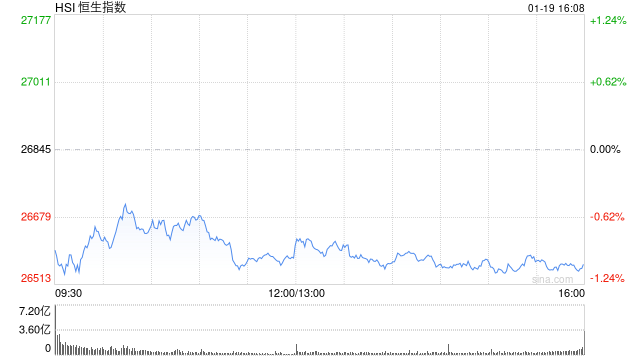
Market Overview - The Hong Kong stock market experienced a decline, with all three major indices dropping over 1%. The Hang Seng Index closed down 1.05% at 26,563.9 points, with a total trading volume of HKD 2,256.89 million [1] - The Hang Seng China Enterprises Index fell 0.94% to 9,134.45 points, while the Hang Seng Tech Index decreased by 1.24% to 5,749.98 points [1] Blue-Chip Stocks Performance - Li Ning (02331) reached a new high, closing up 2.94% at HKD 21, contributing 2.21 points to the Hang Seng Index. Morgan Stanley forecasts moderate revenue growth for Li Ning by 2025, with net profit margins stabilizing at high single digits [2] - Other blue-chip stocks included Sinopec (00386) up 3.34% at HKD 4.95, and Mengniu Dairy (02319) up 2.78% at HKD 15.89. China Biologic Products (01177) fell 6.19% to HKD 6.52, negatively impacting the index [2] Sector Highlights - The aviation sector showed strong performance, with China Eastern Airlines (00670) rising 9.2% to HKD 5.7, and China Southern Airlines (01055) increasing 6.29% to HKD 5.91 [3] - Electric power equipment stocks also gained, with Dongfang Electric (01072) up 6.38% at HKD 27.66 [4] - Gold stocks were active due to rising market risk aversion, with Zhaojin Mining (01818) increasing 3.62% to HKD 37.82 [5] Earnings Forecasts - Companies with positive earnings forecasts included Qutoutiao (00917), which surged 38.78% to HKD 35, and TCL Electronics (01070), which rose 13.4% to HKD 11.17. TCL expects a net profit growth of 45% to 60% for 2025 [6] - China Taiping (00966) anticipates a profit increase of 215% to 225% for the fiscal year ending December 31, 2025 [6] Notable Stock Movements - New World Development (00017) surged 16.28% to HKD 11.07, reaching a two-year high, driven by positive market sentiment [7] - UBTECH (09880) rose 8.63% to HKD 144.7 after signing a service agreement with Airbus for humanoid robots [8] - China International Marine Containers (01138) climbed 7.39% to HKD 12.94, supported by changes in global oil trade dynamics [9] - China Duty Free Group (01880) increased 6.65% to HKD 87.4, benefiting from strong growth in duty-free shopping in Hainan [10] - Cambridge Technology (06166) fell 12.2% to HKD 82.05, as its Q4 net profit forecast was below market expectations [11]
收评:港股恒指跌1.05% 科指跌1.24% 科网股走弱 风电股逆势上涨 阿里巴巴跌超3%
Xin Lang Cai Jing· 2026-01-19 08:11
Market Overview - The Hong Kong stock market indices collectively declined, with the Hang Seng Index falling by 1.05% to 26,563.90 points, the Hang Seng Tech Index down 1.24%, and the State-Owned Enterprises Index decreasing by 0.94% [1][5]. Sector Performance - Technology stocks experienced a mixed performance, with Bilibili dropping over 6%, Alibaba down more than 3%, Kuaishou falling over 2%, and other major players like Xiaomi, Meituan, Tencent, and JD.com declining over 1%. However, Baidu saw an increase of over 1% [1][5]. - Airline stocks led the gains, with China Eastern Airlines rising over 9%. The Spring Festival travel rush is expected to see 95 million passengers transported over 40 days, averaging 2.375 million daily, representing a year-on-year growth of 5.3% [2][6]. - Wind power stocks also performed well, with Dongfang Electric increasing over 6%. The State Grid Corporation of China anticipates a fixed asset investment of 4 trillion yuan during the 14th Five-Year Plan, a 40% increase compared to the previous plan, aimed at enhancing the new power system's supply chain [3][7]. - The biopharmaceutical sector saw a general decline, with WuXi Biologics dropping over 4%. Reports from the JPM conference indicated positive developments in the innovative drug sector, with multinational pharmaceutical companies and biotech firms announcing new pipeline strategies and significant transactions [3][7]. - Cryptocurrency-related stocks faced significant losses, with OKLink falling over 5%. The market experienced a collective drop due to renewed tariff threats from Europe and the U.S., leading to over 240,000 liquidations and a total liquidation amount of $864 million [3][7].


大摩闭门会-互联网调研纪要与中国AI发展更新
2026-01-19 02:29
Summary of Key Points from Conference Call Records Industry and Company Overview - **Companies Involved**: Alibaba, Baidu, Yunmanman, Tencent, Huya, Bilibili, Tencent Music, GDS, OTA Industry - **Industry Focus**: E-commerce, Cloud Computing, AI Technology, Data Centers, Live Streaming, Online Travel Agencies (OTA) Core Insights and Arguments Alibaba - **E-commerce Performance**: Alibaba's CMR (Customer Management Revenue) is expected to show low single-digit growth in the December quarter, down from previous expectations of mid-single-digit growth. NBS (Net Merchandise Sales) decreased by 5% in October and November, reflecting competitive pressures and high base effects. CMR is projected to decline in the March quarter but may stabilize in Q2 and recover in the second half of the year [1][2] - **Financial Outlook**: The company anticipates a full-year loss of approximately 60 billion RMB for FY2027, with cloud revenue expected to exceed 380 billion RMB, maintaining growth expectations despite supply chain considerations [1][3] - **Flash Sales Business**: Positive performance noted, but March quarter losses are not expected to decrease significantly [1] Baidu - **Kunlun Chip Development**: Baidu plans to complete the IPO of its Kunlun chip within four to five months, with an internal valuation of 40-50 billion USD, exceeding market expectations. The company will retain over 50% ownership post-IPO [4] - **Client Base**: Major clients include Tencent and China Mobile, with no supply chain disruptions reported [4] Yunmanman - **Order Growth**: The fourth-quarter order growth is at the lower end of guidance due to seasonal factors and the cleaning of low-quality orders, but this will not impact revenue or profit. The company plans to invest in autonomous driving and overseas expansion in 2026, which may negatively affect profits [5] - **Revenue Confidence**: The company is confident in achieving a 30% or higher growth in commission-based revenue [5] Tencent - **Stock Sale Impact**: Tencent's sale of Hong Kong stocks aimed to meet liquidity requirements, leading to a market overreaction and stock price decline. Current valuation is considered undervalued at a 2026 P/E ratio of 16 [6] Data Center Industry - **Growth Expectations**: GDS anticipates an increase in annual new bookings from 250-300 MW to 500 MW, reflecting ambitious growth plans. However, new large data centers face strict regulatory approvals, with only a 10% success rate for project applications [7] OTA Industry - **Regulatory Challenges**: The OTA industry faces short-term uncertainties due to regulatory scrutiny, reminiscent of Alibaba's past experiences with antitrust issues, leading to cautious investor sentiment [8] Bilibili and Tencent Music - **Bilibili's Advertising Growth**: Strong performance in advertising with over 20% growth attributed to increased traffic, despite challenges in the gaming sector [9] - **Tencent Music's Market Sentiment**: No significant changes in operations, but market disappointment over K-POP performance restrictions in China has negatively impacted stock prices [9] Huya - **Live Streaming Business**: Huya's revenue is primarily global, with compliance risks at historical lows. The company expects stable or slight revenue growth through refined operations [10][11] - **Investor Returns**: Huya commits to a 200 million USD dividend and a 100 million USD stock buyback over the next three years [12] Concert Ticketing and IP Business - **Ticketing Market Saturation**: The concert ticketing business is currently saturated, limiting revenue growth despite strong demand. The company plans to focus on content investment for overseas expansion [13][14] - **Impact of Sino-Japanese Relations**: No significant impact on sales observed post-relations events, though some projects have been delayed [15] Additional Important Insights - **AI Technology Platform**: Huya's AI platform is among the top 30 global aggregators, expected to achieve over 5% annual growth in third-party advertising revenue for 2026 and 2027 [11] - **Market Reactions**: Overall market reactions to stock sales and regulatory news have led to volatility, but some companies are viewed as having strong fundamentals and potential for recovery [6][9] This summary encapsulates the key points from the conference call records, highlighting the performance and outlook of various companies and industries involved.


通信|未来三年景气确立-算力方向重点布局
2026-01-19 02:29
Summary of Conference Call Records Industry Overview - The telecommunications industry is expected to experience strong growth over the next three years, with leading companies like Zhongji Xuchuang and Xinyi Sheng showing impressive performance, indicating a positive outlook for 2025 [1][3] - The demand for the telecommunications sector is optimistic for 2026 and beyond, driven by overseas wafer factory expansions, GPU upgrades, VR glasses, and public demand [1][5] - The domestic computing power industry chain is set to initiate procurement and bidding for 2026 starting in the second half of 2025, with significant growth expected in the IDC sector [1][6] Key Insights and Arguments - The current GPU power consumption is high, with approximately 1.5GW for one million cards, leading to a total demand of around 5GW when including other devices [1][7] - Internet capital expenditure is expected to continue growing, which will drive demand in the IDC market, potentially leading to a supply-demand imbalance [1][8] - The SDN network is a significant growth area in the network equipment sector, with major internet companies like ByteDance, Alibaba, and Tencent launching their SKAP network frameworks [1][9] Investment Opportunities - Companies with strong performance, such as Xuchuang, Xinyi Sheng, Yuanjie, and Bochuang, are highlighted as key investment opportunities in the optical module sector [1][5] - The optical fiber industry is experiencing price increases, with G657A2 optical fibers in short supply, prompting operators to adjust bidding strategies [1][14] - New technology directions in optics, such as onboard optics, CPO, and NPO, present significant growth potential, with companies like Robertco and Zhichuang Technology being noteworthy [1][15] Market Dynamics - The IDC market is expected to see a significant increase in bidding activity, with a large-scale bidding market anticipated in early 2026 [1][6] - The optical communication sector is projected to be a critical allocation direction due to clear demand forecasts for 2026 and 2027 [1][13] - Second-tier module manufacturers may have opportunities to capture overflow orders, with the 800G and 1.6T market expected to reach 70-80 million units this year [1][17][18] Future Outlook - TSMC's capital expenditure plans for the next three years are significantly higher than expected, indicating a clear industry outlook [1][12] - The upcoming earnings forecasts are expected to alleviate concerns regarding fourth-quarter performance fluctuations and material impacts, leading to a focus on the first quarter and 2027 [1][19]





中科宇航上市辅导状态已变更为辅导验收,5家商业航天公司全部启动IPO;马斯克脑机第一人首曝!不开颅在线升级——《投资早参》
Mei Ri Jing Ji Xin Wen· 2026-01-19 01:29
Group 1: Important Market News - The People's Bank of China and the National Financial Regulatory Administration announced that the minimum down payment ratio for commercial housing loans is adjusted to no less than 30% [1] Group 2: Industry Insights - Domestic commercial aerospace companies are advancing their IPO processes, with China Aerospace Science and Technology Corporation's subsidiary, Zhongke Yuhang, changing its listing guidance status to acceptance. The company aims to become the first commercial aerospace stock in China [2] - The satellite communication industry is projected to reach a market size of 200 to 400 billion yuan by 2030, with an annual compound growth rate of 10% to 28%. This sector is transitioning from "concept validation" to "scale application," driven by technological maturity and cost reduction [2] - Major internet companies in China, including Alibaba, ByteDance, and Tencent, are intensifying competition in AI application products. Alibaba's newly launched Qianwen APP aims to serve as a personal AI assistant, integrating various services within its ecosystem [3][4] - Alibaba's Qianwen APP achieved over 10 million downloads within seven days of its launch, making it the fastest-growing AI application, directly competing with ByteDance's Doubao [4] - The brain-computer interface sector is gaining traction, with significant investments and advancements. A startup, Merge Labs, raised $252 million in seed funding, indicating strong interest in this technology [5][6] - The global market for brain-computer interface medical applications is expected to reach $40 billion by 2030 and $145 billion by 2040, highlighting its potential in treating neurological disorders [6] Group 3: Company Updates - Rongbai Technology is under investigation by the China Securities Regulatory Commission for misleading statements regarding a major contract [7] - San Da Membrane announced a plan to reduce its shareholding by up to 996,040 shares, representing no more than 3% of its total share capital [7] - He Shi Eye Hospital's shareholder plans to reduce its stake by up to 310,610 shares, accounting for 1.97% of the total share capital [7] - Jinke Environment reported a planned reduction of up to 102,520 shares by a significant shareholder, representing 0.83% of the total share capital [7] - Wei Si Medical announced a plan to reduce its shareholding by up to 287,310 shares, which is 3% of its total share capital [8] - Sifangda's controlling shareholder plans to reduce its stake by up to 483,150 shares, while other executives also plan to sell portions of their shares [8] - Chuhuan Technology reported a planned reduction of up to 239,560 shares by its significant shareholders [8]


国信证券晨会纪要-20260119
Guoxin Securities· 2026-01-19 00:55
Group 1: Outdoor Apparel Industry - The outdoor footwear and apparel industry has maintained rapid growth since 2021, with a CAGR of 25.3% for outdoor apparel and 18.4% for outdoor footwear, projected to grow by 24.5% and 16.3% respectively in 2025 [24][26] - Online sales of outdoor footwear are growing at over 40%, while growth in outdoor apparel has slowed to low single digits since Q2 2025; specific categories like down jackets and quick-dry clothing are experiencing strong growth, with some quarterly YoY growth nearing 100% [24][26] - The industry is seeing increased competition among brands, with top brands like Kailas and Berghaus maintaining high growth through specialized product lines, while others like The North Face are underperforming; pricing trends are weakening overall, but some high-demand brands are still able to increase prices [24][26] Group 2: AI Application in Computing Industry - Major international companies are focusing on AI application in vertical scenarios, with OpenAI launching ChatGPT Health and Amazon optimizing cross-border e-commerce operations through AI [28] - Domestic companies are also advancing in AI applications, with Alibaba upgrading health services and ByteDance's Volcano Engine becoming a key AI cloud partner for major events [28] - The market for AI applications is expected to see significant growth, with predictions indicating that the GEO market will reach $24 billion globally by 2026, driven by high consumer trust in AI applications in China [30][32] Group 3: Public Utilities Industry - The public utilities sector, including electricity, gas, and water, is characterized by its "essential" nature, with stable long-term growth prospects; the transition to low-carbon energy sources is expected to increase the share of clean energy consumption to 28.6% by 2024 [32][33] - The global electricity shortage is becoming more pronounced, leading to increased electricity prices and making the sector an attractive investment area, particularly as AI development accelerates [33]
2026AI入口争夺战打响第一枪 互联网大厂火拼两大核心维度
Zheng Quan Shi Bao· 2026-01-18 21:38
Core Insights - Alibaba's latest Qianwen APP integrates AI functionalities for food delivery, flight booking, and hotel reservations, marking the beginning of the competition for AI entry points in 2026 [1][2] - The competition among major players like Alibaba, ByteDance, and Tencent is intensifying, focusing on the integration of AI into consumer-facing applications [2][5] - The shift from traditional internet entry points to AI-driven interfaces signifies a fundamental change in the logic of traffic distribution and business ecosystems [5][6] Group 1: AI Application Developments - Alibaba's Qianwen APP has achieved over 10 million downloads within seven days of its launch, surpassing records set by ChatGPT and DeepSeek, making it the fastest-growing AI application [2] - ByteDance's Doubao has reached over 100 million daily active users, becoming a leading AI application in China, and has integrated shopping functionalities within Douyin [3] - Tencent's Yuanbao, launched in May 2024, has seen significant user growth due to its integration with DeepSeek and substantial marketing investments [3] Group 2: Competitive Landscape - The competition for AI entry points is characterized by a focus on "traffic control rights" and "data and ecosystem construction rights," with the ultimate goal of establishing a sustainable business model [5][6] - The AI entry point battle is not just about user acquisition but also about creating a habitual reliance on AI for consumer needs [6][7] - The positioning of AI applications varies among companies: Alibaba aims for an "AI shopping assistant," ByteDance focuses on "video entertainment," and Tencent explores "social AI" [7] Group 3: Emerging Trends - The emergence of Generative Engine Optimization (GEO) indicates a shift from traditional search engine optimization to AI-driven content adaptation, emphasizing the importance of AI in user interaction [8][9] - The AI application sector has seen a significant increase in stock prices, with some companies experiencing over 100% growth, driven by the GEO concept [9] - Despite the competitive landscape, the commercialization of AI applications remains uncertain, with companies primarily focused on user experience rather than immediate monetization [9]
港股观澜系列(三):静待港股重振旗鼓的契机
Ping An Securities· 2026-01-18 14:53
Group 1 - The report highlights that since Q4 2025, the Hong Kong stock market has underperformed compared to the A-share market, with significant phase rotation characteristics observed [2][5] - The underperformance is attributed to liquidity pressure and a lack of strong industry momentum in the Hong Kong market, particularly in sectors that are thriving in the A-share market such as defense, non-ferrous metals, and telecommunications [8][21] - The report notes that the Hong Kong market is heavily concentrated in financial, software, internet, and pharmaceutical sectors, lacking representation in high-end manufacturing and defense industries, which are performing well in the A-share market [19][21] Group 2 - The report anticipates that the Hong Kong market could see a recovery in H1 2026 driven by three main factors: a potential dovish signal from the new Federal Reserve chairman, an expected recovery in profit growth for Hong Kong stocks, and accelerated commercialization of AI applications [30][31] - It is projected that the profit growth rate for Hong Kong stocks will enter a recovery phase in H1 2026, with expectations of a rebound in earnings for internet platforms and sustained high growth in sectors like information technology and healthcare [33][34] - The report emphasizes that the valuation of the Hong Kong technology sector is attractive compared to A-shares, with leading companies in Hong Kong nearing similar valuations to their US counterparts, while benefiting from a larger domestic market for AI applications [37]
AI应用爆发前夜,大模型等待黎明
Tai Mei Ti A P P· 2026-01-18 12:01
Core Insights - The AI industry continues to gain momentum in 2026, with significant stock performance in the A-share market, particularly in AI application sectors [1] - Minimax has successfully launched on the Hong Kong stock market, achieving a market capitalization exceeding 100 billion [2] - Major tech companies are preparing for an AI application battle, with Alibaba, ByteDance, and Tencent all investing heavily in AI applications [4] Industry Trends - The rapid iteration of large models is evident, with 29 versions released by 11 tech companies in just 206 days, averaging a new version every 7.1 days [7][8] - User demand for AI applications is surging, with Doubao's monthly active users surpassing 200 million and Qianwen APP reaching 30 million in just 23 days [9] - The AI market in China is projected to grow to 993 billion by 2030, with a compound annual growth rate of 35.5% from 2024 to 2030 [10] Investment and Financials - Major companies are significantly increasing their capital expenditures on AI, with Baidu planning 30 to 50 billion, Tencent 70 to 100 billion, and Alibaba potentially increasing its 380 billion investment due to high demand [11] - AI companies are accelerating their IPOs, with multiple firms, including Zhiyuan AI and Minimax, recently listing on the Hong Kong Stock Exchange [12][14] - AI talent is in high demand, with salaries reaching up to one million and companies offering competitive packages to attract top talent [15] Challenges and Market Dynamics - Despite the growth, profitability remains a challenge, with Zhiyuan AI reporting losses exceeding 6.2 billion from 2022 to mid-2025, and Minimax over 8.7 billion from 2023 to Q3 2025 [18] - The competitive landscape remains unchanged as all major internet platforms integrate AI, leading to a potential homogenization of services [19][22] - The cost of using large models is decreasing rapidly, with significant price reductions observed in 2024, which is essential for the explosion of AI applications [27] Future Outlook - The AI industry is expected to experience an application explosion, with companies believing that revenue growth will eventually cover model costs [36] - The survival of companies in the AI sector will determine who defines the future, emphasizing the importance of endurance in the current challenging environment [37]
智谱1000亿 , 清华赚翻了
3 6 Ke· 2026-01-18 09:22
Group 1 - The core point of the article highlights the remarkable market performance of Zhipu, which has seen its market value increase by over 500 billion HKD within a week of its listing on the Hong Kong Stock Exchange, reaching a total market value of 1.1 trillion HKD [1][2] - Zhipu was established in 2019, leveraging the technological foundation laid by Tsinghua University's KEG laboratory, which developed the AMiner product in 2006, focusing on AI-driven research insights [2][3] - The initial shareholding structure of Zhipu included significant stakeholders such as Huakong Technology, which held 11.99% of shares at the time of establishment, and has since seen its stake value rise to approximately 38.83 billion HKD [2][3] Group 2 - The company has completed at least 8 rounds of financing, raising over 8.3 billion CNY, and has attracted more than 50 institutional investors, indicating strong backing from the investment community [4][5] - Following its IPO, Zhipu's stock price surged by over 126% within the first seven trading days, driven by strategic partnerships and technological advancements, including a collaboration with Didi and the launch of a new image generation model with Huawei [5][6] - The success of Zhipu is part of a broader trend in China where university-led technology transfer initiatives are yielding significant financial returns, with Tsinghua University leading in technology commercialization efforts [7][9]