
零跑汽车

Search documents
专家预计:未来三年中国电动车出口欧盟年均增速约20%
Di Yi Cai Jing· 2026-01-12 14:15
Core Insights - The EU has become a significant growth engine for China's automotive exports, particularly in the electric vehicle (EV) sector [1] - A recent agreement between China and the EU provides general guidance on price commitments for Chinese exporters of pure electric vehicles, which is expected to strengthen the market position of Chinese brands in Europe [1] - Chinese brands are experiencing rapid growth in the EU, with a projected annual export growth rate of around 20% for Chinese electric vehicles to the EU from 2026 to 2028 [1] Group 1: Export Data - In 2025, China exported 2.07 million pure electric vehicles, with 580,000 units (28%) going to the EU [2] - For plug-in hybrid models, 940,000 units were exported from China, with 250,000 units (nearly 27%) to the EU [2] - Ordinary hybrid models saw exports of 440,000 units, with 170,000 units (approximately 39%) to the EU [2] Group 2: Market Dynamics - Major Chinese automakers such as SAIC, BYD, Chery, Leap Motor, and Xpeng are intensifying their efforts in the European market [3] - The price commitment mechanism established through negotiations is seen as a pragmatic breakthrough that replaces high tariffs, ensuring stable market access for Chinese electric vehicles in the EU [3] - Long-term collaboration between China and the EU is expected to shift from trade competition to deeper industrial cooperation, particularly in areas like battery recycling and carbon footprint management [3]
“翘尾效应”失灵! 去年12月乘用车零售量同比下降14%
Mei Ri Jing Ji Xin Wen· 2026-01-12 13:10
Group 1 - The domestic passenger car market experienced a retail volume of approximately 2.261 million units in December 2025, marking a 14% year-on-year decline, the first drop in December sales in four years [1] - The decline in December 2025 sales is attributed to policy adjustments regarding vehicle replacement and trade-in subsidies, leading to increased consumer hesitation [1] - The penetration rate of new energy vehicles (NEVs) reached 59.1% in December 2025, an increase of 9.6 percentage points compared to December 2024, indicating a significant growth trend [1][2] Group 2 - In December 2025, the penetration rates for NEVs were 80.9% for domestic brands, 39.1% for luxury brands, and 8.2% for mainstream joint venture brands, showing substantial growth of around 20 percentage points for both domestic and luxury brands compared to January 2025 [2] - The total retail sales of NEVs in 2025 reached 12.809 million units, a year-on-year increase of 17.6%, with an overall penetration rate of 53.3% [2] - NEV exports approached half of total passenger car exports, with 273,000 NEVs exported in December 2025, representing a 119.8% year-on-year increase [2][3] Group 3 - The overall domestic passenger car market for 2025 recorded a cumulative retail volume of approximately 23.744 million units, reflecting a 3.8% year-on-year growth, the lowest growth rate in the past three years [4] - The decline in sales during the fourth quarter of 2025 is attributed to the temporary delay in consumer purchases due to the phased reduction of trade-in and scrappage policies [4] - The 2026 market is expected to stabilize with early implementation of trade-in policies, potentially leading to a strong start in January 2026 [4][5] Group 4 - The 2026 market is anticipated to show a "U-shaped" trend with overall sales expected to remain flat compared to 2025, while exports are projected to maintain a growth rate of over 10% [5] - The market for high-end NEVs and fuel vehicles, particularly those priced above 200,000 yuan, is expected to perform well in 2026 [5] - Price competition will remain a critical factor in the automotive market in 2026, with cautious expectations for the growth of pure electric vehicle exports [5]
崔东树:锂电池出口退税对供需影响不大
Zhi Tong Cai Jing· 2026-01-12 12:17
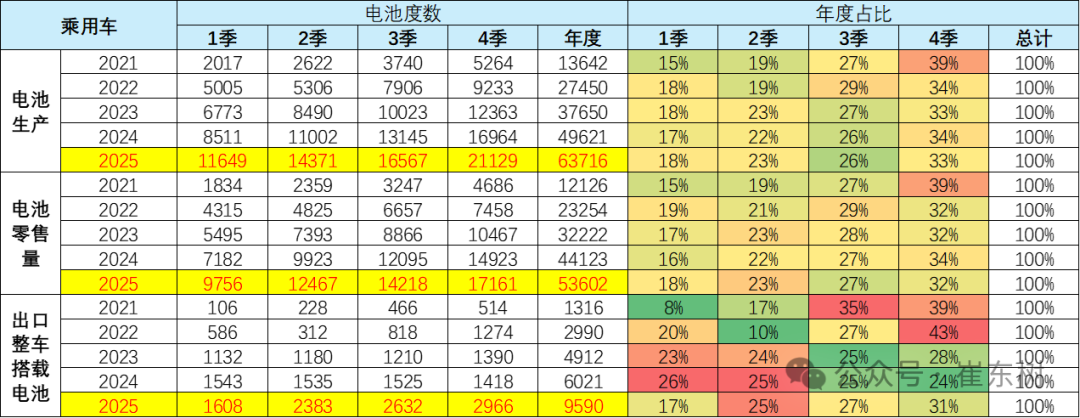
Core Viewpoint - The Ministry of Finance and the State Taxation Administration announced the cancellation of VAT export rebates for photovoltaic products, including lithium batteries, effective January 8, 2026. This move aims to align export prices with market supply and demand, reduce the phenomenon of "subsidizing overseas consumers," and address international concerns to ease trade frictions [1]. Group 1: Lithium Battery Demand Analysis - The overall demand for lithium batteries in passenger vehicles is projected to continue growing, although the expected explosive growth is not as pronounced. December saw a month-on-month decline of 5% in production, indicating lower-than-expected demand for lithium batteries [5][6]. - In December, the production of lithium batteries for new energy passenger vehicles reached 6,916 million degrees, a year-on-year increase of 20%, but a month-on-month decrease of 5%. The total for the year was 63,608 million degrees, reflecting a 29% increase [6]. - Retail demand for lithium batteries in new energy passenger vehicles showed significant weakness in December, with only 6,059 million degrees sold, indicating a slowdown in demand growth [9][10]. Group 2: Export Trends - The export of lithium batteries for new energy passenger vehicles has shown strong growth, primarily driven by BYD's contributions. However, the demand for batteries from independent suppliers remains limited [3][14]. - The export of lithium batteries is expected to face challenges, with a significant decline in exports to the U.S. projected for 2025, down 9.5 percentage points compared to 2024. The EU remains the primary market, accounting for about 40% of exports [20]. - In 2024, the export of lithium batteries is anticipated to be impacted by EU sanctions and tariffs, leading to a reduction in demand [14][20]. Group 3: Market Dynamics - The adjustment in export tax rebates is seen as a strategic move to stabilize the market and reduce speculation in lithium carbonate prices, particularly as the first quarter typically sees lower domestic demand for lithium batteries [1]. - The overall structure of lithium battery exports is shifting, with a notable decrease in exports to the U.S. and an increase in exports to the EU and Southeast Asia [20]. - The domestic demand for lithium batteries is expected to remain weak in the first quarter of 2026, with production adjustments likely necessary to align with fluctuating demand [3][18].


跳出手机屏幕,千问正在改变物理世界
经济观察报· 2026-01-12 11:48
Core Viewpoint - The article emphasizes the emergence of "Physical AI," which signifies the integration of AI into various hardware products, moving beyond traditional mobile applications to interact with the physical world [1][4][22]. Group 1: AI Hardware Development - The CES (Consumer Electronics Show) is highlighted as a global technology trendsetter, where the focus is shifting from conceptual displays to practical, mass-produced AI hardware products [2][6]. - The AI hardware showcased at the Aliyun Tongyi Intelligent Hardware Exhibition includes over 1,500 diverse products, indicating a significant shift towards practical applications of AI in everyday devices [1][2]. - Companies are now focusing on integrating AI capabilities into their products to enhance user experience, rather than just showcasing hardware specifications [2][6]. Group 2: Innovations in AI Applications - New AI hardware products, such as AI translators and health monitoring devices, are being developed to provide real-time insights and recommendations based on user data [7][9]. - The article mentions the introduction of AI hardware that can operate independently without the need for mobile applications, showcasing a trend towards more user-friendly designs [9][10]. - The integration of AI into various sectors, including automotive and health, is transforming how users interact with technology, making it more intuitive and responsive [16][17]. Group 3: Market Dynamics and Competitive Landscape - The article discusses how the Chinese hardware industry is leveraging its supply chain advantages to rapidly innovate and bring AI products to market [6][19]. - The shift from traditional business models to a more open-source approach with the Tongyi Qianwen model is enabling smaller companies and individual developers to participate in the AI hardware ecosystem [15][19]. - The competitive landscape is evolving, with companies focusing on practical applications of AI that address specific user needs, rather than just competing on technical specifications [13][21]. Group 4: Future of AI in Physical World - The article posits that the future of AI lies in its ability to seamlessly integrate into everyday objects, enhancing their functionality and user interaction [22][23]. - The concept of "AI as the new electricity" is introduced, suggesting that AI will become a fundamental part of various industries, similar to how electricity transformed society [19][22]. - The ongoing development of AI hardware is expected to lead to a significant transformation in productivity and user experience across multiple sectors [17][22].


合资车企的生死500天
3 6 Ke· 2026-01-12 11:25
Core Viewpoint - The automotive landscape in China has dramatically changed, with joint venture car manufacturers facing significant challenges and competition from domestic brands and new energy vehicles [2][3][4]. Group 1: Challenges Faced by Joint Venture Car Manufacturers - 2023 and 2024 are considered the most difficult years for joint venture car manufacturers in China, with several brands like Changan Suzuki and Dongfeng Renault exiting the market [3]. - Joint venture brands that once thrived in China are now losing market share to domestic brands and Tesla, with their product competitiveness being heavily criticized [4]. - The perception of joint venture brands has shifted, with consumers questioning their value compared to domestic electric vehicle brands [4]. Group 2: Signs of Recovery - In 2023, some joint venture brands began to show signs of recovery, such as GAC Toyota's Platinum 3X, which received 10,000 orders within an hour of its launch [5]. - Dongfeng Nissan's N7 model also performed well, achieving over 40,000 deliveries in six months despite later production issues [6]. - The emergence of new models from joint ventures indicates a potential turnaround, with some industry observers suggesting a "comeback" for these brands [7][8]. Group 3: The 2023 Shanghai Auto Show - The 2023 Shanghai Auto Show marked a turning point, showcasing the strength of domestic brands and the challenges faced by joint ventures [9][17]. - Executives from major global automotive companies were reportedly shocked by the advancements of domestic brands, which now offer competitive products [12][13]. - The event highlighted a shift in market dynamics, with domestic brands beginning to lead industry trends while joint ventures are seen as followers [18]. Group 4: Internal Changes and Strategy Shifts - Joint venture manufacturers are now allowing their Chinese teams more autonomy in product development, moving away from a global model to a more localized approach [31][32]. - This shift includes empowering local teams to design and develop products tailored to the Chinese market, as seen with Nissan's N7 and GAC Toyota's Platinum 3X [34][39]. - The focus on local development is part of a broader strategy to enhance competitiveness in the rapidly evolving automotive landscape [44][50]. Group 5: The Concept of Reverse Joint Ventures - The trend of "reverse joint ventures" is emerging, where foreign companies collaborate with Chinese brands to leverage local technology and market knowledge [54][57]. - This shift indicates a significant change in the dynamics of the automotive industry, with Chinese companies now taking the lead in technology and product development [62][63]. - The evolving landscape suggests that foreign manufacturers are increasingly reliant on Chinese innovation to remain competitive in the global market [64][68].



汽车行业周报:如何展望2025Q4业绩?-20260112
Changjiang Securities· 2026-01-12 11:22
Investment Rating - The investment rating for the automotive industry is "Positive" and maintained [9] Core Insights - The wholesale sales of passenger vehicles in Q4 2025 are expected to be approximately 8.76 million units, a year-on-year decrease of 1% but a quarter-on-quarter increase of 14%. The profitability in Q4 may show differentiation compared to the same period last year, with expectations for a quarter-on-quarter improvement [2][5] - The revenue from automotive parts is anticipated to grow steadily quarter-on-quarter, but profitability may face pressure due to factors such as raw material costs and exchange rates [2][5] - The wholesale sales of heavy trucks are projected to be 314,000 units in Q4 2025, representing a year-on-year increase of 43.6% and a quarter-on-quarter increase of 11.5% [2][5] - The overall sales of buses are expected to see a significant quarter-on-quarter increase during the peak season, with sales of large and medium buses reaching 44,000 units, a year-on-year increase of 8.8% and a quarter-on-quarter increase of 42.2% [2][5] - The total sales of motorcycles are estimated to be around 4.73 million units in Q4 2025, reflecting a year-on-year increase of 11.0% but a quarter-on-quarter decrease of 6.2% [2][6] Summary by Sections Passenger Vehicles - Q4 2025 wholesale sales are expected to be about 8.76 million units, down 1% year-on-year but up 14% quarter-on-quarter. New energy vehicle sales are projected at 4.84 million units, up 13% year-on-year and 21% quarter-on-quarter [5] Automotive Parts - Revenue is expected to grow steadily quarter-on-quarter, but profitability may be pressured by raw material and exchange rate factors [5] Heavy Trucks - Q4 2025 wholesale sales are projected at 314,000 units, with a year-on-year increase of 43.6% and a quarter-on-quarter increase of 11.5% [5] Buses - Large and medium bus sales are expected to reach 44,000 units in Q4 2025, with a year-on-year increase of 8.8% and a quarter-on-quarter increase of 42.2% [5] Motorcycles - Total motorcycle sales are estimated at 4.73 million units in Q4 2025, reflecting an 11.0% year-on-year increase but a 6.2% quarter-on-quarter decrease [6]


联检科技:汽车检测资质持续拓展,积极提升经营业绩
2 1 Shi Ji Jing Ji Bao Dao· 2026-01-12 11:19
Core Viewpoint - The company, Lianjian Technology, has significantly expanded its third-party testing qualifications for major automotive manufacturers, enhancing its market penetration and operational performance in the automotive testing business [1] Group 1: Company Developments - The subsidiary, Guanbiao Testing, has obtained third-party testing qualifications from major automotive companies including Jianghuai Automobile, Geely Automobile, Leap Motor, and Chery Automobile [1] - The company has also expanded its recognition capabilities to include traditional and new energy vehicle manufacturers such as General Motors, Volkswagen, NIO, and Li Auto [1] Group 2: Market Impact - The newly acquired qualifications are expected to strengthen order conversion and market penetration for the company's automotive testing services [1] - The company aims to accelerate the release of qualification effectiveness to improve its operational performance in the automotive testing sector [1]
年终盘点2025汽车市场的“龙门一跃”:油退电进,全球登顶
3 6 Ke· 2026-01-12 10:37
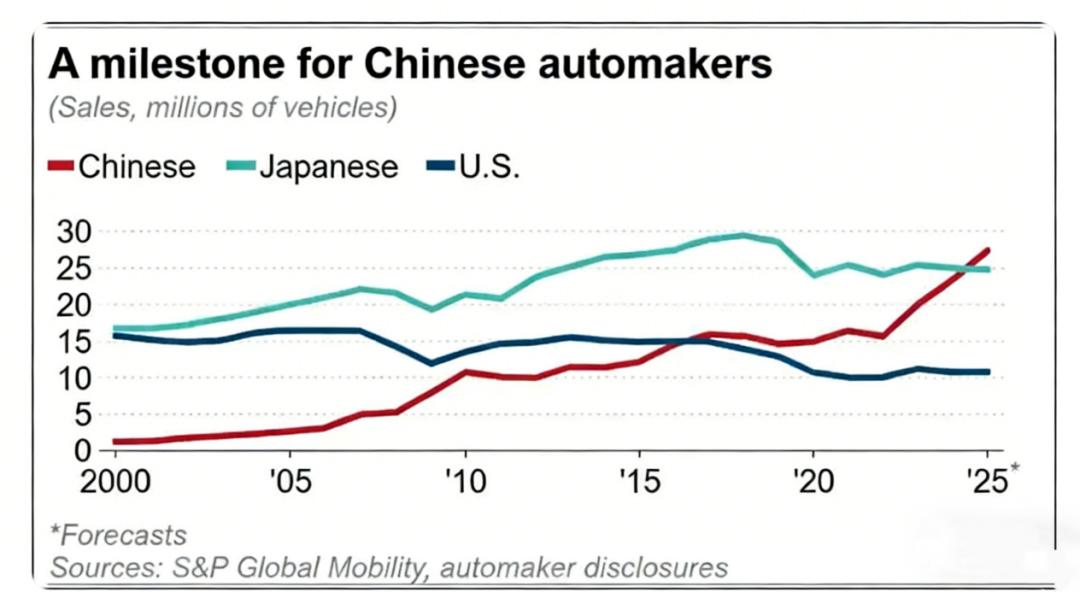
Core Insights - The penetration rate of new energy vehicles (NEVs) in China has surpassed 50%, marking a significant shift in the automotive market dynamics, transitioning from a "policy-driven" to a "product-driven" model [1][10] - The year 2025 is seen as a pivotal moment for the Chinese automotive industry, with the market experiencing a fundamental transformation akin to a "Nokia moment" [1] - The competition is evolving from price wars to value wars, emphasizing technology and product quality over mere volume [11] Industry Overview - In 2025, China's automotive manufacturers are projected to achieve global sales of 27 million vehicles, securing the top position in the global new car sales rankings for the first time [2] - China has overtaken Japan to become the world's largest automobile exporter, with NEVs accounting for a significant portion of this growth [4] - The domestic market's NEV sales are nearing 60%, reflecting a structural change in consumer preferences [4] Sales and Market Penetration - By November 2025, the retail penetration rate of NEVs reached 53.6%, with projections for the full year estimating a rate of 54.0% [6] - The rapid increase in NEV penetration is attributed to a combination of policy support, technological advancements, infrastructure development, and market demand [7] Policy and Technological Developments - The exit of purchase subsidies in 2023 has been offset by continued tax exemptions and various local incentives, which have helped maintain consumer interest in NEVs [7] - 2025 is expected to be a year of technological breakthroughs in NEVs, with advancements in high-voltage platforms, solid-state batteries, and smart driving technologies [8] Infrastructure and Consumer Experience - The expansion of charging infrastructure is crucial for alleviating consumer concerns about range anxiety, with projections of 20 million charging stations by the end of 2025 [9] - The cost advantages of NEVs are becoming increasingly apparent, with electric vehicles offering significantly lower operating costs compared to traditional fuel vehicles [9] Competitive Landscape - The shift from price competition to value competition is reshaping the industry, with companies focusing on technological innovation and profitability [11] - Some companies, like Leap Motor, have emerged as strong competitors, achieving significant sales growth and profitability [13] Global Expansion - In 2025, China's automotive exports are expected to exceed 7 million units, with NEV exports alone projected to reach 2.315 million units, marking a 102.9% increase [21] - Chinese automakers are transitioning to a "global + local" model, emphasizing localized production and R&D to better penetrate international markets [22] Challenges and Future Outlook - Despite rapid growth, challenges such as trade protectionism and compliance costs remain significant hurdles for Chinese automakers in global markets [24] - The automotive industry is expected to continue evolving, with a focus on sustainable growth and value creation as it navigates the transition from a subsidy-driven to a market-driven environment [25]

跳出手机屏幕,千问正在改变物理世界
Jing Ji Guan Cha Wang· 2026-01-12 10:19
Core Insights - The CES 2026 highlighted the arrival of the "Physical AI" era, with a shift from AI generating text and images to interacting with the real world [1] - The Alibaba Cloud Tongyi Intelligent Hardware Exhibition showcased over 1,500 AI-integrated hardware products, emphasizing practical applications rather than theoretical concepts [1][3] - The focus of hardware manufacturers is on embedding AI capabilities into everyday products, transforming how people live and work [3][6] Group 1: AI Hardware Development - The exhibition featured 76 categories and over 200 brands, including major players like Honor and OPPO, as well as innovative startups [1] - AI hardware is moving beyond traditional smartphone applications, with products capable of tasks such as driving, assisting the visually impaired, and adjusting lighting [1][3] - Companies are leveraging the Qianwen model to enhance their products, enabling functionalities like health monitoring and automatic report generation [3][4] Group 2: Market Trends and Innovations - The focus is on practical AI applications that address specific needs, such as the YoooTek AI ONE device that captures voice notes and organizes information [4][6] - The shift towards AI hardware is supported by a new multi-modal interaction development kit, allowing even non-coders to integrate AI into their devices [6] - The competitive landscape is evolving, with a focus on reducing costs and improving efficiency in AI hardware development [6][7] Group 3: Industry Dynamics - The integration of AI into hardware is seen as a way to enhance productivity and redefine interactions in various sectors, including automotive and healthcare [10][11] - The Chinese manufacturing ecosystem is characterized by low trial costs and a willingness to innovate, positioning it as a leader in AI hardware development [11][12] - The Qianwen model's open-source strategy is enabling a broader range of developers to create AI hardware, democratizing innovation [8][12]
钢材&铁矿石日报:商品情绪偏暖,钢矿震荡走高-20260112
Bao Cheng Qi Huo· 2026-01-12 10:03
Report Industry Investment Rating No relevant content provided. Core Views - The main contract price of rebar oscillated higher with a daily increase of 0.60%, showing a pattern of decreasing volume and increasing open interest. With supply increasing and demand weak, the fundamental contradiction has accumulated. Although the positive factor is the warm commodity sentiment, the rebar price is expected to continue the oscillatory and stable operation. Attention should be paid to the production situation of steel mills [5]. - The main contract price of hot-rolled coil also oscillated higher with a daily increase of 0.55%, with decreasing volume and increasing open interest. In the current situation of increasing supply and weak demand, the fundamentals of hot-rolled coil are weak, and the price continues to be under pressure. The relatively positive factor is the warm commodity sentiment, and its trend is expected to maintain an oscillatory and stable operation. Attention should be paid to the demand performance [5]. - The main contract price of iron ore oscillated higher with a daily increase of 0.92%, and both volume and open interest expanded. Currently, the supply of iron ore is high while the demand improvement is limited, so the fundamentals of iron ore are weak, and the ore price continues to be under pressure. The relatively positive factors are the warm commodity sentiment and pre - holiday restocking support. Under the game of multiple and short factors, the ore price maintains a high - level operation. Attention should be paid to the restocking situation of steel mills [5]. Summary by Directory 1. Industry Dynamics - In December 2025, 482 projects started across the country with a total investment of about 534.092 billion yuan. The total investment in 2025 was about 27.52 trillion yuan. The top three provinces in terms of start - up investment in December were Guangxi, Jiangxi, and Anhui, with total investments of 121.238 billion yuan, 59.41 billion yuan, and 49.103 billion yuan respectively [7]. - As of January 12, 2026, 21 car companies announced their 2025 production and sales data. These 21 car companies sold a total of 25.0233 million vehicles in 2025. BYD led the domestic market with sales of 4.6024 million vehicles. SAIC Group ranked first in production with 4.602 million vehicles in 2025, followed by BYD with 4.5374 million vehicles. 18 car companies saw their sales increase in 2025. XPeng Motors had the highest growth rate of 125.94%, followed by Leapmotor with 103.10%, and BAIC BluePark with 84.06% [8]. - Since January 12, 2026, Handan has launched a level - II emergency response for heavy pollution weather, which is expected to be lifted around January 17 due to poor atmospheric diffusion conditions [9]. 2. Spot Market - Rebar: The spot price in Shanghai was 3,280 yuan, in Tianjin was 3,200 yuan, and the national average was 3,341 yuan. The price changes were 20 yuan, 0 yuan, and 4 yuan respectively [10]. - Hot - rolled coil: The spot price in Shanghai was 3,290 yuan, in Tianjin was 3,190 yuan, and the national average was 3,311 yuan. The price changes were 20 yuan, 0 yuan, and 5 yuan respectively [10]. - Tangshan billet: The price was 2,970 yuan with a change of - 10 yuan [10]. - Zhangjiagang heavy scrap: The price was 2,090 yuan with no change [10]. - PB powder (Shandong port): The price was 825 yuan with a change of 7 yuan [10]. - Tangshan iron concentrate powder (wet - basis): The price was 777 yuan with no change [10]. - Freight rates: Australian freight was 7.84 yuan with a change of - 0.08 yuan, and Brazilian freight was 21.13 yuan with a change of - 0.46 yuan [10]. - SGX swap (current month): The price was 108.34 yuan with a change of 0.49 yuan [10]. - Platts Index (CFR): The price was 108.50 yuan with a change of 0.30 yuan [10]. 3. Futures Market - Rebar: The closing price of the active contract was 3,165 yuan, with a daily increase of 0.60%. The highest price was 3,174 yuan, the lowest was 3,141 yuan, the trading volume was 957,432 lots (a decrease of 212,075 lots), and the open interest was 1,726,703 lots (an increase of 11,840 lots) [13]. - Hot - rolled coil: The closing price of the active contract was 3,311 yuan, with a daily increase of 0.55%. The highest price was 3,320 yuan, the lowest was 3,289 yuan, the trading volume was 408,729 lots (a decrease of 106,874 lots), and the open interest was 1,427,498 lots (an increase of 10,408 lots) [13]. - Iron ore: The closing price of the active contract was 822.5 yuan, with a daily increase of 0.92%. The highest price was 826.0 yuan, the lowest was 817.0 yuan, the trading volume was 272,044 lots (an increase of 1,717 lots), and the open interest was 654,834 lots (an increase of 14,950 lots) [13]. 4. Related Charts - Steel inventory: Charts show the weekly changes and total inventory (steel mill + social inventory) of rebar and hot - rolled coil from 2022 - 2026 [15][21][25]. - Iron ore inventory: Charts show the inventory of 45 ports in China, including inventory changes, seasonal inventory, inventory of 247 steel mills, and inventory of domestic mine iron concentrate powder [23][24][26]. - Steel mill production: Charts show the blast furnace operating rate and capacity utilization rate of 247 sample steel mills, the profitability ratio of 247 steel mills, the operating rate of 87 independent electric furnaces, and the profit and loss situation of 75 building material independent electric arc furnace steel mills [30][33][35]. 5. Future Outlook - Rebar: The supply - demand pattern has weakened. The weekly output increased by 2.82 tons, and the demand decreased by 25.48 tons. With the accumulation of fundamental contradictions, the rebar price is under pressure in the off - season. Although there is positive commodity sentiment and cost support, it is expected to continue the oscillatory and stable operation. Attention should be paid to the production of steel mills [40]. - Hot - rolled coil: The supply - demand pattern has changed little. The weekly output increased by 1.00 tons, and the demand decreased by 2.43 tons. With high inventory and weakening demand, the price is under pressure. Although the positive factor is the warm commodity sentiment, it is expected to maintain an oscillatory and stable operation. Attention should be paid to the demand performance [40]. - Iron ore: The supply - demand pattern is weak. The inventory is rising, and the demand improvement is limited due to the poor profitability of steel mills and the off - season steel market. The supply is at a relatively high level. Although there is warm commodity sentiment and pre - holiday restocking support, the ore price is expected to maintain a high - level operation. Attention should be paid to the restocking of steel mills [41].